







Abstract
Background
Paresthesia can be defined as an unpleasant, painless, weird and prolonged sensation, without total loss of sensation, which is similar to the sensation of local anesthetic. 1 In dentistry, it manifests mostly through the mental, lingual and inferior alveolar nerves and is due to local and systemic factors.
The most frequent complaints of patients related to paresthesia are loss of sensitivity of the lips and cheeks, difficulty in feeding, talking and smiling, inability to control saliva, and constant irritability. 2
Case report
A 28-year-old woman presented with bilateral facial paresthesia after undergoing orthognathic surgery. She described a lack of touch sensitivity in the region of the nose, nasal folds (bilaterally), lower lip, and chin region. The patient was referred to the Laser Therapy Clinic of UNICHRISTUS Clinical Dental School for treatment and recovery of intraoral and extraoral sensitivity with laser acupuncture (LA).
Laser acupuncture
Low-power laser therapy involves the release of energy from photons absorbed through photochemical effects, photophysical and/or photobiological effects on cells and tissues, and does not generate heat. 3 LA has been applied clinically since the 1970s. Friedrich Plog was the first researcher to use laser to stimulate the sites of traditional acupuncture points. 4 Tissue stimulation with low-power laser is not only painless but also has the advantage of being non-invasive, non-traumatic and easily performed by a qualified professional. 5 Other advantages include reduced treatment time and low risk of infection. LA may be ideal for patients with aversion to needles.
Methods
Evaluation
Methods of initial and periodic evaluation were identical and aimed to map the deficiency condition before, during and after the proposed treatment, helping achieve an objective measure of treatment outcome for both the therapist and the patient. A Microbrush® applicator was used to apply light touch in the regions of the nose, lips, external face, chin and left and right cheek mucosa, and the gingival, lingual and buccal areas. The borders at which the patient reported not feeling touch was marked in toothpaste using another Microbrush® to demarcate the area affected by paresthesia (Figure 1). The objective of this analysis was to determine the presence or absence of sensitivity to touch (pain or shock-like sensation).
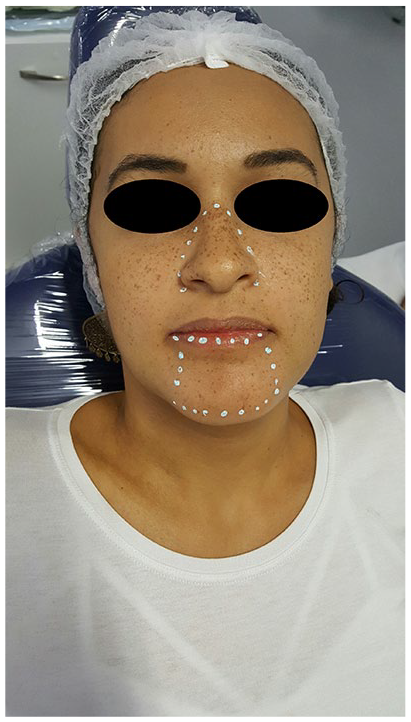
Photograph—pre-treatment—showing demarcated area presenting paresthesia.
Treatment
The patient received LA irradiation once a week at the sites of traditional acupuncture points, both local and distal, selected according to the symptoms of paresthesia. ST5, ST6, CV24, GV26, LI4, LU7, ST36 and ST45 were used in the patient’s treatment plan according to the principles of traditional Chinese medicine (TCM). We chose to irradiate locations on the head first (ST5, ST6, CV24 and GV26) then those in the upper limbs (LI4 and LU7) and finally the points of the lower limbs (ST36 and ST45). InGaAlP (indium–gallium–aluminum–phosphate) laser irradiation was applied, emitted in the infrared range (35 J/cm², continuous, wavelength 808 ± 10 nm, power 100 mW ± 20%; DMC Laser Therapy Model XT, Sao Carlos, SP, Brazil). The patient’s skin was cleaned with a 70% alcohol swab before irradiation of the facial region, to avoid interference by chemicals products and sweat in the absorption of laser radiation. The laser pointer was kept as close as possible to the skin, using only soft touch, so as to avoid acupressure-like effects. Irradiation duration was kept constant (60 s per site) across all sessions. Usual safety standards were followed in terms of protective glasses for operator and patient, as well as the protection of laser tips with contact barriers.
Results
After 6 weeks of treatment, there was a considerable reduction in the area without sensitivity. The region that still bothered the patient was the chin and lower lip; however, she already felt a sense of touch and tingling, suggesting that neural activity in this region was already beginning to return to normal (Figure 2). The treatment protocol once a week appeared to contribute to the periodic recovery of the patient. It is clinically feasible for professionals and avoids missed visits. It is compatible with the treatment protocol that usually takes place in acupuncture practice.
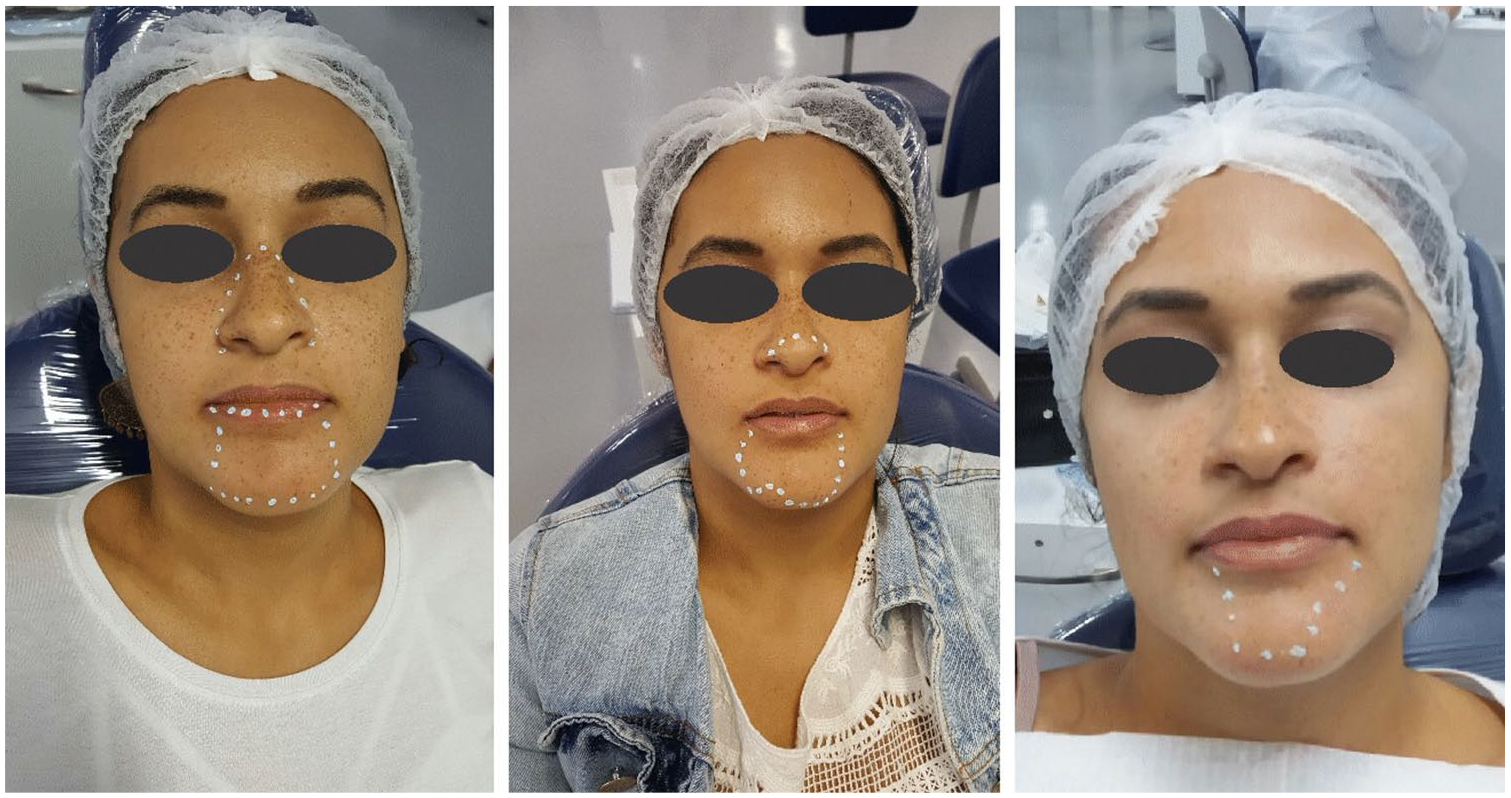
Serial photographs—pre-treatment (left image) and post-treatment (middle and right images)—demonstrating reduction in demarcated area presenting paresthesia.
Discussion
LA appeared effective in the case presented and could be a viable alternative or complementary method for the treatment of facial paresthesia that could help reduce the intake of medication and accelerate patient recovery.
Neurosensory alteration after orthognathic surgery is a cause of concern for the dental surgeon. Although expected in some circumstances, and usually an isolated and transient episode, it is sometimes complex and unpleasant, and can also cause disorders such as functional loss, psychological disorders and change in routine activities.
Although positive results using this energy source have been observed in patients with nerve injury, other studies including control groups are needed to verify the effectiveness of LA for this indication.
There are already a few studies evaluating the use of LA in post-oral surgery sensor neural deficiencies. Some protocols have been developed to verify the benefits of this new technology in improving paresthesia caused by dental surgical procedures. However, to date, no longitudinal studies have evaluated the effects of treatment with LA on neural changes resulting from orthognathic surgery, justifying further investigation in this clinical scenario.
Footnotes
Acknowledgements
The authors are grateful to Dr Clarissa Pessoa Fernandes and Dr Diego Peres Magalhães for their assistance as scientific advisors to this research and also the institution UNICHRISTUS, Fortaleza, Brazil, for providing the materials and place for this work and Dr Renata Mota Rodrigues Bitu Sousa (Coordinator of School of Dentistry UNICHRISTUS) for her constant encouragement of the dental academics of this institution.
Declaration of conflicting interests
The authors declared no potential conflicts of interest with respect to the research, authorship, and/or publication of this article.
Funding
The authors received no financial support for the research, authorship, and/or publication of this article.
Ethical approval
This study was approved on 14 November 2018 by the CEP (Comitê de Ética em Pesquisa) of Centro Universitário Christus, Fortaleza, Ceará, Brazil with approval number 3.021.708.
Patient consent
Written informed consent was obtained from a legally authorized representative(s) for anonymized patient information to be published in this article.
