







Abstract
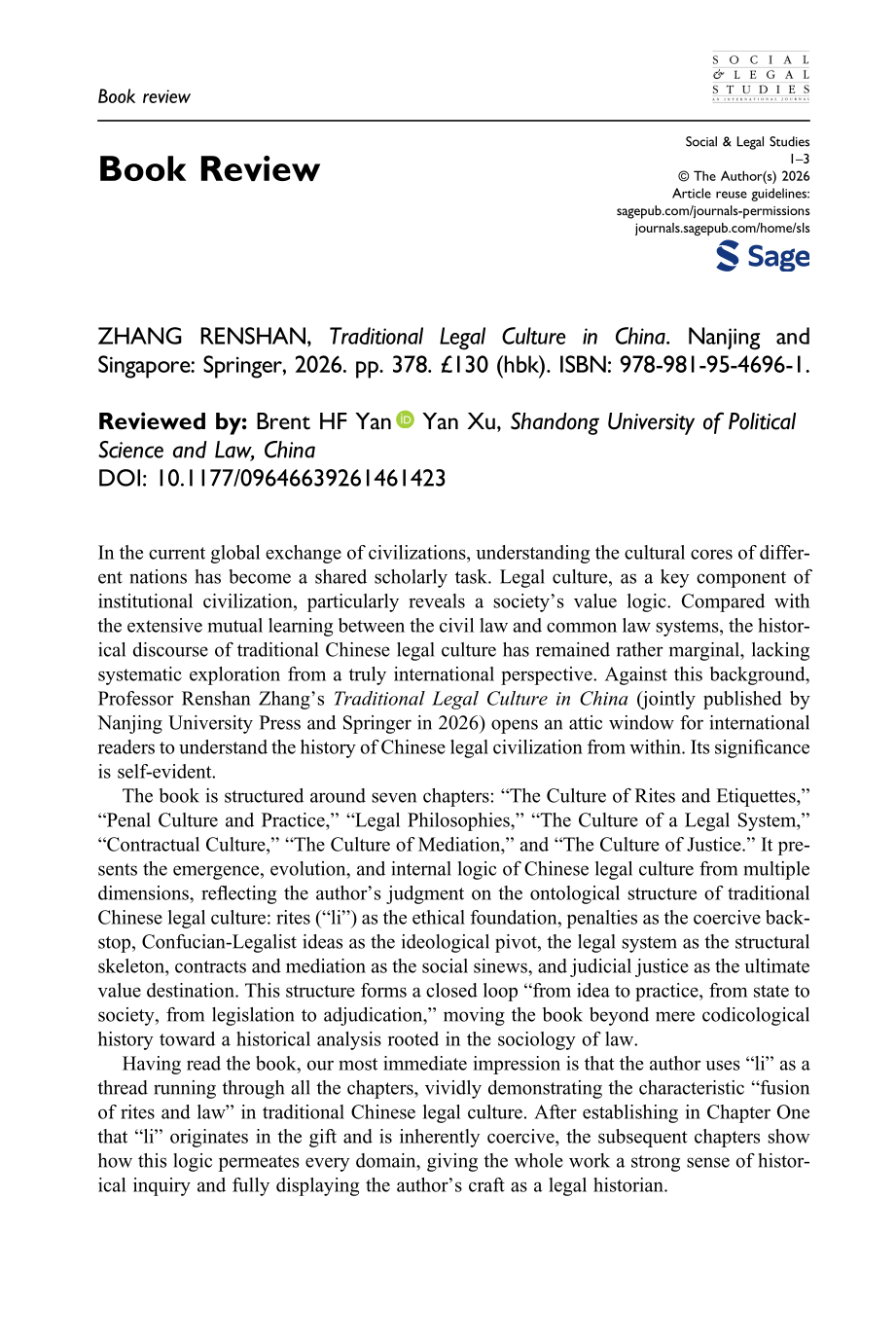
In the current global exchange of civilizations, understanding the cultural cores of different nations has become a shared scholarly task. Legal culture, as a key component of institutional civilization, particularly reveals a society's value logic. Compared with the extensive mutual learning between the civil law and common law systems, the historical discourse of traditional Chinese legal culture has remained rather marginal, lacking systematic exploration from a truly international perspective. Against this background, Professor Renshan Zhang's Traditional Legal Culture in China (jointly published by Nanjing University Press and Springer in 2026) opens an attic window for international readers to understand the history of Chinese legal civilization from within. Its significance is self-evident.
The book is structured around seven chapters: “The Culture of Rites and Etiquettes,” “Penal Culture and Practice,” “Legal Philosophies,” “The Culture of a Legal System,” “Contractual Culture,” “The Culture of Mediation,” and “The Culture of Justice.” It presents the emergence, evolution, and internal logic of Chinese legal culture from multiple dimensions, reflecting the author's judgment on the ontological structure of traditional Chinese legal culture: rites (“li”) as the ethical foundation, penalties as the coercive backstop, Confucian-Legalist ideas as the ideological pivot, the legal system as the structural skeleton, contracts and mediation as the social sinews, and judicial justice as the ultimate value destination. This structure forms a closed loop “from idea to practice, from state to society, from legislation to adjudication,” moving the book beyond mere codicological history toward a historical analysis rooted in the sociology of law.
Having read the book, our most immediate impression is that the author uses “li” as a thread running through all the chapters, vividly demonstrating the characteristic “fusion of rites and law” in traditional Chinese legal culture. After establishing in Chapter One that “li” originates in the gift and is inherently coercive, the subsequent chapters show how this logic permeates every domain, giving the whole work a strong sense of historical inquiry and fully displaying the author's craft as a legal historian.
Penal culture (Chapter Two) is simply the other side of the coin—the binary opposition of “rites first, penalties second.” Zhang traces punishment to the violence of war against external ethnic groups, but the crucial point is that once the state was consolidated, the same coercive power turned inward to maintain the order of “li.” Yet alongside harsh punishments there existed, from the Western Zhou onward, a tradition of “caution in penalization” and “leniency.” This apparent paradox—cruelty coexisting with humanity—can only be understood through “li”: punishment aims not at revenge but at correction, that is, restoring the order of “li.” Leniency toward those who repent shows that “li” values moral cultivation over brute force. Why did Chinese law exhibit this unique fusion of rites and penalties? Chapter Three provides an intellectual–historical answer: from the pre-Qin Confucian-Legalist debates, to the Confucianization of law under the Han, and finally to the “Tang Code with Commentaries” enshrining the principle that “morality and ethics serves as the foundation of governance while penalty is the tool of governance” (p. 34). The driving force throughout was the legal elites—scholar-officials who internalized “li” as both philosophy and professional practice. Mauss spoke of the spirit of the gift that compels reciprocation; Zhang's counterpart is the scholar-official's conviction that “li” is cosmic and social order itself, which no positive law could replace.
The subsequent chapters extend the narrative from state codes to grassroots life. “The Culture of a Legal System” (Chapter Four) traces the imperial Chinese legal system from its “first appear[ance] in pre-Qin days” to its “further develop[ment] during Qin and Han Dynasties,” then “enter[ing] into a formative phase during Sui and Tang Dynasties before reaching perfection in Ming and Qing Dynasties” (p. 151), culminating in the late Qing transformation. With macro-historical vision and micro-attention to legal practice, the author shows how folk norms—village regulations, clan rules, trade customs—compensated for the absence of private law. And these folk norms are precisely the localized embodiments of “li.” The chapter on contractual culture (Chapter Five) tells us that contracts in ancient China operated through moral–legal forces such as trust, face, and ritual propriety—again a historical projection of the gift-logic of “li.” The culture of mediation (Chapter Six) is the most direct practical expression of “li”: aversion to litigation was not merely strategic but a virtue, because going to court signaled the failure of harmonious order based on “li.” This value of harmony, which stood as the highest political ideal in traditional Chinese thought, persisted into the late Qing and crystallized into relatively stable institutional procedures. Finally, the culture of justice (Chapter Seven) integrates “human emotions, heavenly principles, and national laws”—a holistic, “li”-oriented rationality. Zhang honestly points out the risk of “rule by man” inherent in this tradition, yet also reveals its distinctive pursuit of substantive and relational justice.
As we can see, under Zhang's “‘li’ perspective,” the distinctive features of traditional Chinese legal culture emerge clearly. Yet in the narratives of comparative law between China and the West, “li” has often been reduced to mere etiquette or moral custom—which has then been taken as evidence of the absence of “real law” in China. Zhang's detailed argumentation in this book decisively overturns that assumption. He reveals that “li” was not a benign code of conduct but a normative order possessed of legal force, social bindingness, and coercive enforcement. The book engages quietly but powerfully with Marcel Mauss's classic theory of the gift—both inheriting and transforming it to explain the deep structure of Chinese legal civilization.
In The Gift, Mauss argued that archaic societies operate under a system of “total prestation”: seemingly voluntary gifts are in fact obligatory, interested, and embedded in the entire social fabric (economic, legal, moral, religious). Zhang explicitly acknowledges this intellectual debt (p. 3). His account of “li” begins precisely with the practice of giving and repaying in primitive societies: whether between friends or rivals, “Seemingly, gifts and repayments are offered voluntarily, but in fact, they are compulsory in strict terms” (p. 3). This echoes Mauss's famous insight—to give is to create obligation.
In sum, Traditional Legal Culture in China is not a descriptive compendium but a theoretically ambitious integration and reconstruction of a “history of rites-and-law” and a “theory of rites-and-law.” The author absorbs the insight of Western anthropology concerning the obligatory gift, demonstrates how a civilization could construct its legal order on that foundation, and goes further by adding the state's punitive apparatus, the metaphysical hierarchy of Confucian philosophy, and two thousand years of institutional evolution—achieving an indigenized development of Western theory. For readers in law, sociology, anthropology, and history, the book raises some urgent questions: Can modern legal systems develop a “total” conception of law without sliding into moralism or coercion? What lessons might the “li” model or a harmony-centered worldview offer for contemporary restorative justice or alternative dispute resolution? Can or will Western legal theory—constrained by the opposition between status and contract—draw wisdom from a tradition that never fully accepted that binary?
