







Abstract
Photographers have become common targets of security practice in the public spaces of US and UK cities. The securitization of photography – where photographers are commonly stopped, questioned, told to surrender film or delete photos, and in some cases arrested – rests upon the invocation of a post-9/11 context and the preemptive security logics that characterize the ‘war on terror’. Here, the spatio-temporality of the photograph and the photo-taking subject are in tension with preemptive security stances in which everyday, ordinary actions – such as photography – are rendered suspicious and worthy of potential intervention. Using examples of specific encounters between photographers and security personnel, this article interrogates the conduct of these interventions and the preemptive security stance that scopes ordinary actions and everyday urban spaces through flexible and dispersed acts. Finally, the article considers how this uncoordinated and dispersed practice travels across a wide variety of actors without clear, causal linkages. The practice is a mobile, circuitous one, and through its analysis the article argues for more attention to be paid to everyday, embodied, and dispersed practices of preemption.
Introduction
What the Photograph reproduces to infinity has occurred only once: the Photograph mechanically repeats what could never be repeated existentially.... [I]t is the absolute Particular, the sovereign Contingency, matte and somehow stupid, the This ... the Occasion, the Encounter, the Real in its indefatigable expression. (Barthes, 1981: 4) The ordinary is a circuit that’s always tuned in to some little something somewhere. A mode of attending to the possible and the threatening, it amasses the resonance in things. It flows through clichés of the self, agency, home, a life. It pops up as a dream. Or it shows up in the middle of a derailing. Or in a simple pause. It can take off in flights of fancy or go limp, tired, done for now. It can pool up in little worlds of identity and desire. It can draw danger. Or it can dissipate, leaving you standing. (Stewart, 2007: 12)
In 2008, a local news crew interviewed an Amtrak official in Washington DC’s Union Station in order to clarify Amtrak’s official policy on photography in its train stations. The segment was inspired by a number of cases where security personnel told people they were not allowed to take photographs in the station. During the interview, as the Amtrak official was clarifying that photography is indeed allowed in Amtrak stations, he and the reporter were approached by a security guard who told them to put down the camera as they were not allowed to be filming in Union Station. The absurdity of this particular example is echoed in a proliferating number of other cases where photographers have been stopped, questioned, told to delete photos, required to hand over film or other equipment, detained, and, in some cases, arrested for taking photographs or filming while in public spaces in the USA and the UK. Even though there are very few actual legal restrictions on taking photographs or filming in public spaces, there is no shortage of evidence that these sorts of encounters between photographers and security personnel are commonplace in both US and UK cities (see, for example, Cohen, 2005; Dresser, 2011; Dunlap, 2004; Dwyer, 2010; Leach, 2005; Lewis, 2009a,b; Lyon, 2004; McGee, 2004; Moore, 2009; Rose, 2005, 2011; Shin, 2010; Watson, 2009; see also Manning, 2010). 1 In these encounters, photographers were told that their photo-taking was a security problem because of concerns for terrorism. This article analyzes the resonances between photography and the preemptive security climate of the ‘war on terror’, asking what is it about the spatio-temporal imaginaries of the photograph and the photographer that have led to their securitization, and what these encounters between photographers and security personnel can tell us about embodied, dispersed security acts in a preemptive stance.
In the Amtrak example, and in most examples of the security–photography encounter, there is a clear disjuncture between actual legal restrictions on photography in public space and the actions of security personnel. Generally, photographing in public spaces or private spaces open to the public is not restricted, although people have the right to a reasonable expectation of privacy – meaning, for example, that you may not use a telescoping lens to photograph inside an apartment from a public street (see Krages, 2006). 2 Taking a photograph while in private spaces generally open to the public (e.g. shopping malls, stadiums) is generally allowed unless signs indicate otherwise. Property owners may prohibit photography taken on private premises even without signage, though they may not restrict photography of privately owned property if carried out from a public space. There are some legal restrictions on taking photographs in public spaces, though these are locally variable. In the USA, for example, there can be restrictions on photographing or otherwise imaging US military installations deemed matters of national security (and usually not areas openly visible to the public) by military officials under Section 793 of Title 18 of the US Code. The US Department of Energy may prohibit the photographing of certain areas of nuclear facilities, but this generally does not include areas that are publicly visible. 3 There are also some restrictions on the photographing of crime or accident scenes that might impede investigation and/or care. In the UK, it is illegal to take photographs in the courts and there are restrictions on commercial photography in Trafalgar Square and Parliament Square. In short, there are some restrictions on the taking of photographs in public spaces in the USA and the UK, but these are quite specific and narrow. None of the encounters analyzed for this article nor any of those in the publications cited above took place in any of these restricted contexts.
The most common legal issues surrounding photography concern the right to privacy and relations between police and photographers. The right to privacy is frequently invoked in relation to aggressive photojournalism and harassment. The example of the death of Diana, Princess of Wales and her boyfriend and driver as they fled from paparazzi is often given as an example of the tangled implications of legality, privacy, and photography (Harvard Law Review, 1998). These questions resound in cases of the suppression of the press by police and military who object to the recording of their activities (Burton, 1998). The suppression of photographing police continues to be of great importance, particularly in the context of the preemptive ‘war on terror’. In the UK, Section 58a of the Terrorism Act 2000 can be used to restrict the photographing of police if an officer has reasonable suspicion that the record ‘is of a kind likely to be useful to a person committing or preparing an act of terrorism’. This line of thought is found again in Sections 44 and 47a of the same Act, which give uniformed police broad powers to ‘stop and search’ people if a police officer feels the stop and search is ‘expedient for the prevention of acts of terrorism’. These sweeping measures have been used liberally and critiqued heavily for their vague and ambiguous nature and the racialized and discriminatory ways in which they are often practised (see Prasad, 2011). Specific measures such as these, broad and vague as they are, have not been used in photography stops in the USA, where security personnel have given vague and false justifications such as ‘the 9/11 law’ and ‘homeland security’. Discriminatory practice resonates here, too, as in the case of Reza Farhoodi, a university student who ‘appears to be of Middle Eastern descent’ who was removed from his seat at a Washington Redskins game at FedEx Field, was questioned by security, and had his camera confiscated because he was taking photos of friends and the game. Farhoodi later joked: ‘I’ll make sure to shave before I go to the next game’ (Fisher, 2007; see also Puar, 2007).
Photography restrictions are evolving, as they are now entangled with elusive appeals to security and terrorism. In the security–photographer encounters considered for this article, photographers were not stopped for taking photographs of sensitive or classified military installations or inside nuclear facilities, nor for impeding police investigations and emergency workers, nor were they aggressively pursuing photographs that would violate reasonable expectations of privacy in public. The stops were justified by appeals to ‘terrorism’ (or, more accurately, a suspicion of a future occurrence of terrorism), ‘homeland security’, ‘9/11’ or ‘7/7’, or ‘the war on terror’. It is this phenomenon that is of concern here.
This article takes the disjuncture between the lack of legal cause for stopping photographers in these encounters and the commonality of the practice as a site for interrogating how security ‘works’ through encounters and why the photograph and the practice of photographing are acted upon in a preemptive security context. That these encounters emerge in a staggering array of locations and jurisdictions – the examples cited above occurred on airplanes and in sports arenas, in transportation hubs, and on public streets in cities across the USA and in diverse areas of London – evidences that this is not a systematic practice. This standard irregularity is used to interrogate how contemporary threat imaginaries reverberate through ordinary security conduct. While the discretionary power and ‘situational exigencies’ of street-level policing (Mastrofski, 2004: 102; citing Bittner, 1970) have been extensively reported in criminology literature, this article is, rather, situated with a concern for security governance and security assemblages that place the photographer on the street into a relationship with transnationally conceived ideas about terrorism and security. These encounters, while fragmented and contingent, resonate with a preemptive security climate.
The analysis seeks to contribute to conversations about the relationship between visuality and post-9/11 security (see Campbell and Shapiro, 2007; Feldman, 2005), particularly those that analyze the relationship between ways of seeing and preemptive security stances (Amoore, 2007). Further, the article analyzes how preemption plays out in the everyday flows of urban spaces in the USA and the UK, particularly as urban life, an unpredictable field of emergence, is governed through contingency (Dillon, 2006, 2007). These encounters act to momentarily stabilize the contingent flux of urban spaces and subjects (see Martin, 2010). By dwelling upon these encounters, the analysis emphasizes the everyday and banal conduct of security work (Katz, 2006; Amoore and De Goede, 2008) in order to contribute to the project of ‘conceiving of security as embodied-performative practice played out in and through space’ and drawing out the ‘intuitive, relational, and spatial dimensions of ... “everyday security”’ (Higate and Henry, 2010: 33–4). Intuitive and relational, everyday security is not easily reducible to clear commands or authorizations. The peculiarity and diversity of the actual ways in which these encounters occur evidences the difficulty in drawing clear lines of causality from macro-security discourses of preemption to the micro-conduct of security personnel. The governance of uncertainty and contingency is not uniformly dictated and enacted. Rather, ordinary preemption is flexible and dispersed, as interventions are made on the basis of suspicions about how present actions in countless sites might play out in the future.
I begin by analyzing preemptive security and its relation to the spatio-temporality of the photograph and anticipatory visuality. The next section relates this anticipatory visuality to the subjects of preemptive security and preemptive efforts to momentarily stabilize subjects and spaces in ways that render them accessible to security personnel. It is then argued that the non-alignment of actual photography restrictions with the actual conduct of these encounters illustrates the ways in which preemption works through flexibility, modulation, and dispersion. The article ends by interrogating how these disparate security encounters resonate with a preemptive stance and the implications for challenging these encounters.
Preemption, anticipation, and photography
Photography–security encounters are taking place in a context of preemptive security. Many scholars have detailed the ascendance of preemption in contemporary security modes, particularly in the context of the ‘war on terror’ (Amoore and De Goede, 2008; Anderson, 2010a,b; Aradau and Van Munster, 2007; De Goede, 2008b; Massumi, 2007). Preemptive security diverges from security governance based on risk in that future threats that are incalculable and indeterminate are acted upon. A preemptive mode is one in which possible future threats are imagined (Salter, 2008) and ‘anticipatory action’ is enabled to work upon these imaginations of the future (Anderson, 2010a). Further, preemption is oriented toward a ‘politics of zero risk’ (Aradau and Van Munster, 2007: 103; Aradau et al., 2008), where even the smallest chance of threat is unacceptable and must be acted upon at the limits of knowledge. Preemptive security, then, involves an imaginative orientation toward the future that enables ways of acting upon indeterminate threats in the present.
This ‘presence of the future’ (Anderson, 2010a: 7) is the vital feature that links preemptive security to security–photography encounters. The future is brought into the present in the spirit of pervasive doubt, foreboding, and suspicion, and this permeated suspicion intensifies elastic security practices that stretch and reach with imaginative attempts to presently address ‘what has not happened and may never happen’ (Massumi, 2007). Preemptive security stretches across space and through time as it holds possible futures in tension with the present (see Ericson, 2008: 70). Here we find creative attempts, flexible and vague tactics, to meet the unfolding of an unreadable future where threats may emerge. Vague future possibilities are folded into suspicious readings of, say, financial transactions, unattended luggage, the expression of radical ideas, or taking a photograph. Preemption is the idea that ‘security’ can be stretched across, or can become immanent to, all of these moments and what they might result in or become in the future.
This preemptive, permeated suspicion implies someone who takes up the preemptive stance. Throughout this article, the phrase ‘security personnel’ is used to highlight that photography encounters are instigated by a variety of actors: private security guards, Police Community Support Officers, neighborhood watch groups, community policing groups, and citizens ‘watchful’ for terrorist activity (see Amoore, 2007; Bhandar, 2006). Diverse actors take up the preemptive stance, and it is quite difficult to locate where exactly this practice emanates from. In a preemptive security context, Jef Huysmans writes that the location of decisions is obscured. He asks us to ‘rethink what “acts” can be in diffuse securitizing processes where little security nothings rather than decisive acts with exceptionalizing power do the immense work of making and circulating insecurities’ (Huysmans, 2011: 380; emphasis added). The preemptive stance as elaborated in this article is composed of ‘little security nothings’, acts that are dispersed and continuous but not regular and that modulate on the basis of where, by whom, to whom, and how they unfold. These encounters evidence a performative register where dispersed and diverse individuals create, reiterate, and refashion notions of preemption in everyday, embodied practice (see Bialasiewicz et al., 2007).
Even as little security nothings are dispersed, they resonate with preemption in a way that still holds the narrative together. William Connolly’s (2005: 870) notion of ‘resonance’ is a helpful way of understanding political fields that are not-quite-causal yet still assembled together: ‘heretofore unconnected or loosely associated elements fold, bend, blend, emulsify, and dissolve into each other, forging a qualitative assemblage resistant to classical models of explanation’. The security–photographer encounter resonates with preemptive security themes of anticipating and acting in advance of unknowable, disastrous futures, but preemptive practices are not uniformly or consistently performed. The encounter between security personnel and photographer is a site in which imagined futures are brought into the present in little security acts that bend and flex depending on circumstance and whim. In this way, preemption is deeply and irregularly embedded within the everyday unfolding of urban space, as modulating acts that flex and dissolve have become immanent to such mundane acts as taking photographs (see Amoore and De Goede, 2008).
How is it, then, that security–photography encounters emerge in a preemptive security context? The semi-official line on the security concern for photographers in public spaces is that capturing a space in a photo can be a strategy for attack planning. It is imagined that photos will be used to plot an attack. However, the multiplying possibilities for capturing and imaging spaces exceed the capabilities that would be required to police or eradicate them. One of the examples in this article focuses on an encounter I had because I was taking photographs while standing on a street in Boston near a US federal building. Both the street and the building can be viewed online with Google Maps’ ‘street view’ function and on Google Earth. Anyone with Internet access can find a 360-degree street-level view, with zooming capabilities, of the building in question, as is the case for locations across the globe through this technology. And what about cameras in other handheld devices like mobile phones? And the zooming capabilities of even the most basic point-and-shoot cameras that allow us to photograph inconspicuously and at a distance? Another photography–security encounter elaborated below takes place in a Boston metro station: the same station is viewable online in detailed illustrations of the city’s underground stations. These are all but blueprints, depicting elevators, stairs, structural beams, areas of ingress and egress, tracks, and train trajectories. With the multitude of ways in which people can capture images, not to mention the fact that there are very few pertinent restrictions on taking photographs in public space, this semi-official line is not sufficient. What animates this disparate yet commonplace practice that cites the image, the photo – so utterly takeable – as a security risk?
In one of her essays on photography, Susan Sontag (1977: 163) writes: ‘One can’t possess reality, one can possess (and be possessed by) images – as, according to Proust ... one can’t possess the present but one can possess the past’. This idea of possessing the past in images, and thus of having a fixed, stable point from which to make decisions about the future, is the dreamworld of security practice. In this way, the photo is thought to hold in suspension the contingency and flux of spaces and subjects constantly in formation: ‘In the real word, something is happening and no one knows what is going to happen. In the image-world, it has happened, and it will forever happen in that way’ (Sontag, 1977: 168; emphasis in original). Barthes (1981: 4) likens photographs to the ‘tireless repetition of contingency’ or to ‘the Occasion, the Encounter, the Real in its indefatigable expression’, which is not to say that photos actually possess reality or truth or essence, but, rather, the dream that they could or might. In the security–photographer encounter, this idea of the photo as a fixed point, a possession of the past or the Real becomes entangled with the ‘anticipatory gaze’ (Amoore, 2007: 216) of preemption that scans for ways in which the present could become dangerous. Preemptive visuality entwines imagined, threatened futures with the unfolding of the present and, here, potential future uses of photos are folded into the present taking of photographs. Similar to the ways in which anticipatory visuality is ‘predicated on the assumption that the image can fix, verify and authenticate identity’ (Amoore, 2007: 218), the security–photographer encounter is not really about the photos themselves but rather about the desire to ‘fix, verify, and authenticate’ photographers.
Stabilizing suspicious subjects and spaces
The anticipatory gaze of the security–photography encounter is trained upon the subjects of preemptive security. Lauren Martin writes: ‘the subject of security is contingent, continually changing, and possibly becoming dangerous’ (Martin, 2010: 19; see also Amoore, 2007: 217–8). Beyond whatever the future may hold for the photograph or the space it frames, the encounter between security and photographer is one opportunity to scope and authenticate the contingent, shifting person who has snatched it – and his or her future intentions. In a security–photographer encounter, the act of seeing is tripled: there is the scene through the lens, the seeing and authenticating of the subject, and a seeing of the future (held in the photo and the taker’s intentions). Through the encounter, security personnel attempt to know the photographer as a security subject, to map and fix what futures might result from his or her actions in the present. Of course, there is no centered, autonomous subject with clearly readable or knowable intentions (Isin, 2004), even as this is precisely what is sought in preemptive security practice. Accordingly, Martin (2010: 20) asks: ‘how might efforts to momentarily stabilize the subject be reconfigured and re-embedded at specific sites’? This applies as well to the reiterative and creative performativity of security personnel. The subject who ‘secures’ is also a contingent subject, continually in flux, making momentary decisions on risk and norm, worth intervention or not. The preemptive encounter is a momentary stabilization of mobile, contingent subjects in specific sites as present unfoldings are halted and scrutinized for future intentions.
In August 2007, I was questioned by a Homeland Security worker and a Boston police officer for taking photographs near the John F. Kennedy Federal Building, which houses the city’s Homeland Security headquarters. I was photographing a string of bollards that line the entire length of the Sudbury Street side of Boston’s City Hall Plaza. As I approached the end of the block, photographing the waist-high blocks that culminate the series, a man in a Homeland Security shirt approached me with a ‘Ma’am’ as he gestured a nearby Boston police officer (denoted here as BPD) to join us. The ensuing conversation went something like this:
Ma’am, ma’am. Could you please stop? What are you taking pictures of?
Bollards.
Bollards?
Yes.
Why?
I’m conducting research on urban security practices.... Is it a problem that I’m taking pictures?
We want to know why people are taking pictures of a federal building.
We just want to know what you’re doing.
Can we see your camera?
Why?
Photo surveillance is a confirmed component of pre-attack planning.
Well, I guess you can look at my camera if you don’t erase anything, particularly the pictures of my cat at the beginning.
[The police officer and I engage in somewhat friendly, inconsequential banter. He seems embarrassed by the whole affair.]
What’s the research for?
A PhD. Do you work here? What do you do?
I’m an agent.
For DHS?
Yes. [Awkward silence]
Alright.... Well, I guess I’ll move along.
The encounter ended awkwardly as they walked away from my question. They did not take my name, and the agent did not erase any photos. And, while I’m sure my face was captured in a host of surveillance cameras, I left bewildered but unscathed. My free movement through the city was momentarily suspended in this encounter, but was quickly restored through the security personnel’s snap decision regarding suspicion and harmlessness. It did not escape me that my position as a woman unmarked by particular racial constructs of suspicion hurried along the encounter and perhaps accounted for the police officer’s embarrassment, his attempts to appease me with banter, and the ease with which I made a sarcastic comment. The particular confluence of circumstances at that moment all played a role in producing the encounter in the first place and the outcome of a determination of harmlessness: the time of day (‘agent’ happened to be leaving the office), my role and demeanor (bewildered academic, knows the word ‘bollard’), my gender and race (free of red flags?), my activity (photography – red flag), the space in which it occurred (US federal building, important enough to be potentially harmed) – all of which are filtered through me and the security personnel who stopped me.
Afterwards, I was struck by the degree to which this cannot be about the photo. I walked around the building (now at a greater distance) and looked at all the different entrances and structural fortifications around it. This site, the stark but oft-used City Hall Plaza located in the heart of downtown Boston, is composed of so much contingency and movement that the idea that the various components that make up its flows could be known, held, and constantly scrutinized seems almost quaint. In just this 20-minute stretch of reflection, teenagers moved in packs, office workers on mobile phones hurried to lunch, tourists snapped photos with seemingly no knowledge of whether the buildings in the background were federal buildings or hotels. My readings and judgments of individuals’ intentions and roles from their appearances and actions were no different from those of the security personnel who scope the urban scene with their own categories, stereotypes, and assumptions filtering their gaze. Stopping and evaluating me was not about the photographs. By taking the photo (now, suspicious), I provided a fixed point of stopping and evaluating, one point in those never knowable flows of urban space.
This tension between the reality of complexity and the desire for stasis is everywhere present in urban security practice. The material reality of the city is characterized by surprise, which means that security practices cannot rely upon static vision; rather, they need creative and anticipatory imaginations. Suspicion must be dealt with as it arises. Threats and city spaces are similar in that they ‘give no advance notice of what [they] will become’, to borrow a phrase from Hayden Lorimer’s (2005: 84) discussion of ‘ordinary actions’. Phil Hubbard’s (2006: 95) account of urban life applies to those who try to regulate it as well: ‘Everyday life in cities is, after all, something that cannot be adequately prepared for: no matter how carefully scripted, urban life has a tendency to surprise, and we are constantly forced to improvise and adapt to events as they unfold around us.’ The encounter is a stabilizing point, much like the idealized photograph itself, from which security personnel attempt to halt and grasp what is always just beyond fully comprehending – those flows of things and persons moving from point to point, full of ideas, intentions, and potential. The fixed point of the encounter is just as illusory as the essence assumed in the photograph – neither can fully contain nor communicate all that compose it.
Dispersed and flexible preemption
In a preemptive security context, interventions are supposed to be made before threats can actualize – indeed, before they are even known – which casts a host of ordinary actions as suspicious. A poster put out in 2008 by four UK policing bodies evidences this (see Figure 1). The poster states: ‘Thousands of people take photos everyday. What if one of them seems odd?’ Below a field of cameras, where one is being singled out as being perhaps odd, is written: ‘TERRORISM. IF YOU SUSPECT IT, REPORT IT.’ Photography has been placed in a relationship of equivalence with terrorism. However, at the same time that this poster is displayed and promoted by policing bodies, UK officials have had to publicly ‘remind’ security personnel that there are no general prohibitions on photography in public space because of the outcry over increasing numbers of security–photographer encounters in London (Lewis, 2009c). This tangle of messages swirls around the practice of securitizing photography in unclear ways and with entirely unclear implications for those who are stopped. In a radio interview, Inspector Robert Tucker, head of the Philadelphia Police Department’s Domestic Preparedness Division, echoes this point with his thoughts on encounters between photographers and security officials:
Would we like them not to photograph sensitive infrastructures? I would, it would make our job a lot easier, but you know what, there’s some beautiful photographs and we understand that. But with that understanding know that if we should get a 911 call – that an officer will respond and ask reasonable questions and, you know what, if you have reasonable answers there’ll be a very positive interaction. (Rose, 2005)
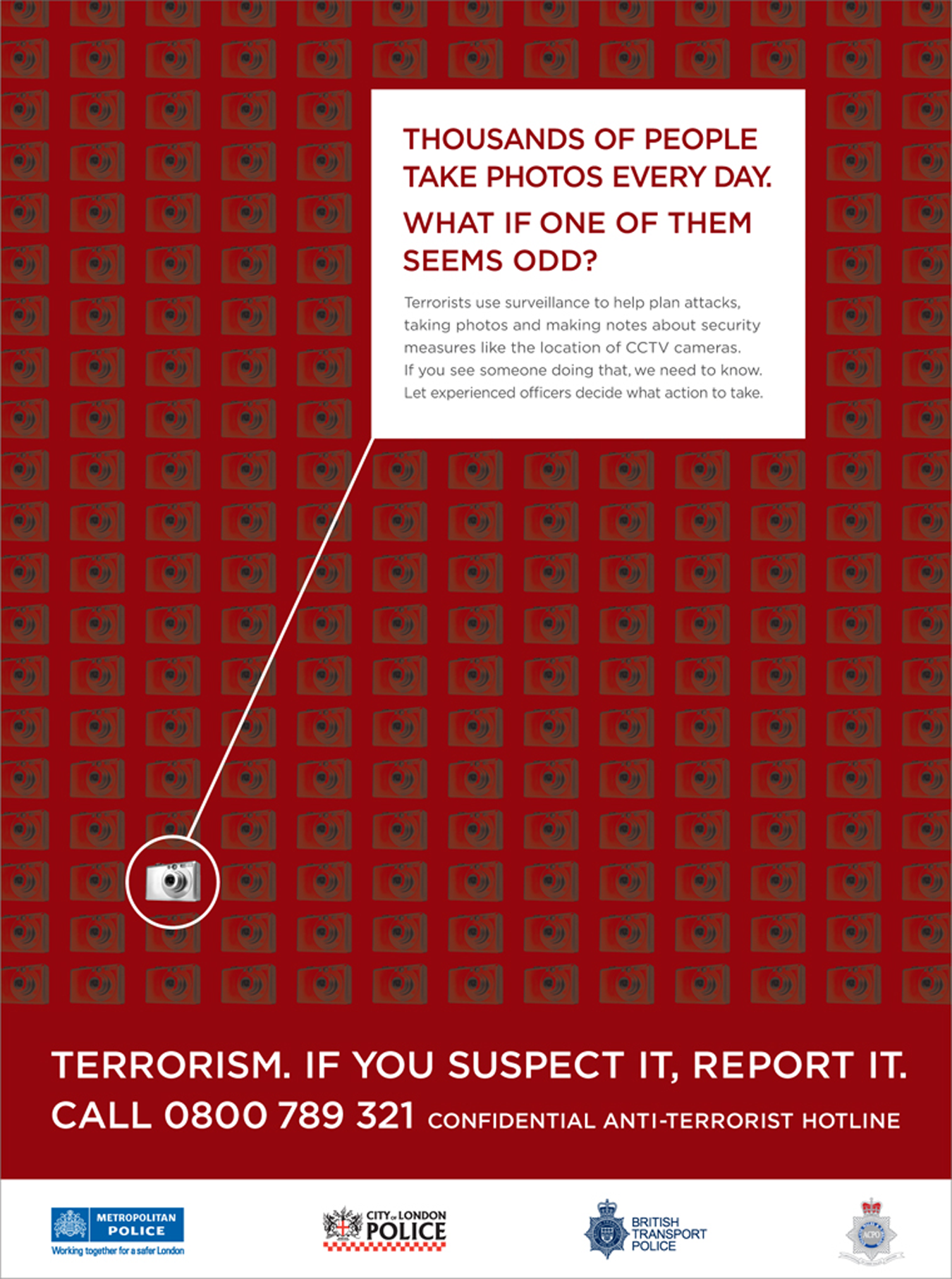
This poster is part of the UK’s Metropolitan Police counter-terrorism publicity campaign that directs the public to a ‘confidential anti-terrorist hotline’
Compare these comments to the Metropolitan Police statement on the application of a UK policy that prohibits the recording of police and military personnel on the basis of suspicions of future terrorist acts:
It would ordinarily be unlawful to use Section 58A to arrest people photographing police officers in the course of normal policing activities, including protests.... An arrest would only be lawful if an arresting officer had a reasonable suspicion that the photographs were being taken in order to provide practical assistance to a person committing or preparing an act of terrorism.
4
Placing the act of photographing in a relationship of resonance with terrorism – whether it occurs near ‘sensitive infrastructures’ or not – remaps the boundaries of the ‘reasonable’ and suspicious or ‘odd’. In the logic of Tucker and the Metropolitan Police, security is produced through the ‘positive interaction’ with police, as encounters with policing bodies are the moments in which reasonable and suspicious are defined. The poster’s composition illustrates the anticipatory gaze that is brought to the task of discerning the reasonable from the suspicious. If we can single out one of these photographers represented in the field of cameras, if we can just isolate them from the field of benign intentions and acts, we can preempt future harm that may be embedded within present actions.
Returning to Boston, many of the ‘positive interactions’ between photographers and security personnel have taken place in spaces under the jurisdiction of the Massachusetts Bay Transit Authority (MBTA). The MBTA has jurisdiction over Greater Boston’s public transportation systems, including the subway (the ‘T’), buses, the commuter rail, and commuter boats. The MBTA has its own dedicated police force, the transit police, who have full police powers. The MBTA does have a written policy on photography within the spaces that fall under its charge. However, this policy is hard to find, leaves many situations open for interpretation, and, according to interviews and media accounts, is inconsistently applied. The policy states:
No permit is required for non-commercial/personal use pictures taken in public areas. However, any person taking pictures on, in, or of MBTA property, vehicles, or employees must provide proper identification [‘photo identification that includes, at a minimum, name, address, and date of birth’] upon request of an MBTA Transit Police Officer or other MBTA Official. The MBTA Transit Police Officer or other MBTA Official may allow the person to take pictures at the specific location under the following conditions: the person provides proper identification; the circumstances indicate that the subject(s) of the picture(s) does/do not pose a security or safety threat or in any way cause disruption of services or operations of the MBTA; and the picture(s) is/are for personal or educational use only (e.g., tourist, railroad buff, student, artist, etc.). (MBTA, 2007: 2)
In the event that a photographer does not obey this policy, the responding official is left to determine the suspiciousness, the purpose, and the predilections (‘railroad buff’?) of the photographer. Those not in compliance with the policy ‘will be directed to stop taking pictures and will be subject to additional law enforcement action as appropriate’ (MBTA, 2007: 1).
The potential ambiguities of a photographer–MBTA security official encounter have become all too clear to Jason, a professional photographer who estimates that he has had at least 13 encounters with MBTA officials while photographing in a metro station (the ‘T’) between 2001 and 2007. He states: ‘It’s fairly routine and kind of baffling that the MBTA police do not know their own policy.’ 5 The most drastic exchange resulted in Jason’s arrest by MBTA officers after he was asked to stop photographing in the Downtown Crossing T station and refused. Jason noticed commotion on the opposite platform where police and other first-responders were crowded together. He deduced from overheard conversation that a woman had been stabbed. From where he stood, approximately 60 feet away on the opposite platform, he could see the crowd of emergency personnel but not the victim. Because he has connections to a local, daily newspaper distributed at T stations, Jason thought this crime scene was news and that his photographs would not show the victim but the backs of the emergency personnel across two sets of train tracks and the median of columns that separate them (see Figure 2). 6 Within 30 seconds of photographing the scene, Jason says an officer facing him on the opposite platform motioned to him to stop taking pictures. After he refused, an officer appeared at his side and told him to stop. He replied, ‘I’m sorry, but no.’ Jason volunteered identification to the officer two or three times, as he had familiarized himself with the MBTA photo policy following his previous encounters with officials in the T. He says of the encounter:
The officer said that if I didn’t stop taking pictures I would be removed from the station. I replied that I would not cease my photography and that photography, was, in fact, a civil right and an activity explicitly allowed on their own MBTA Transit Police website and requested for a supervisor to be called. The officer then took me by the arm, lifted it sharply and walked me back toward the entrance.
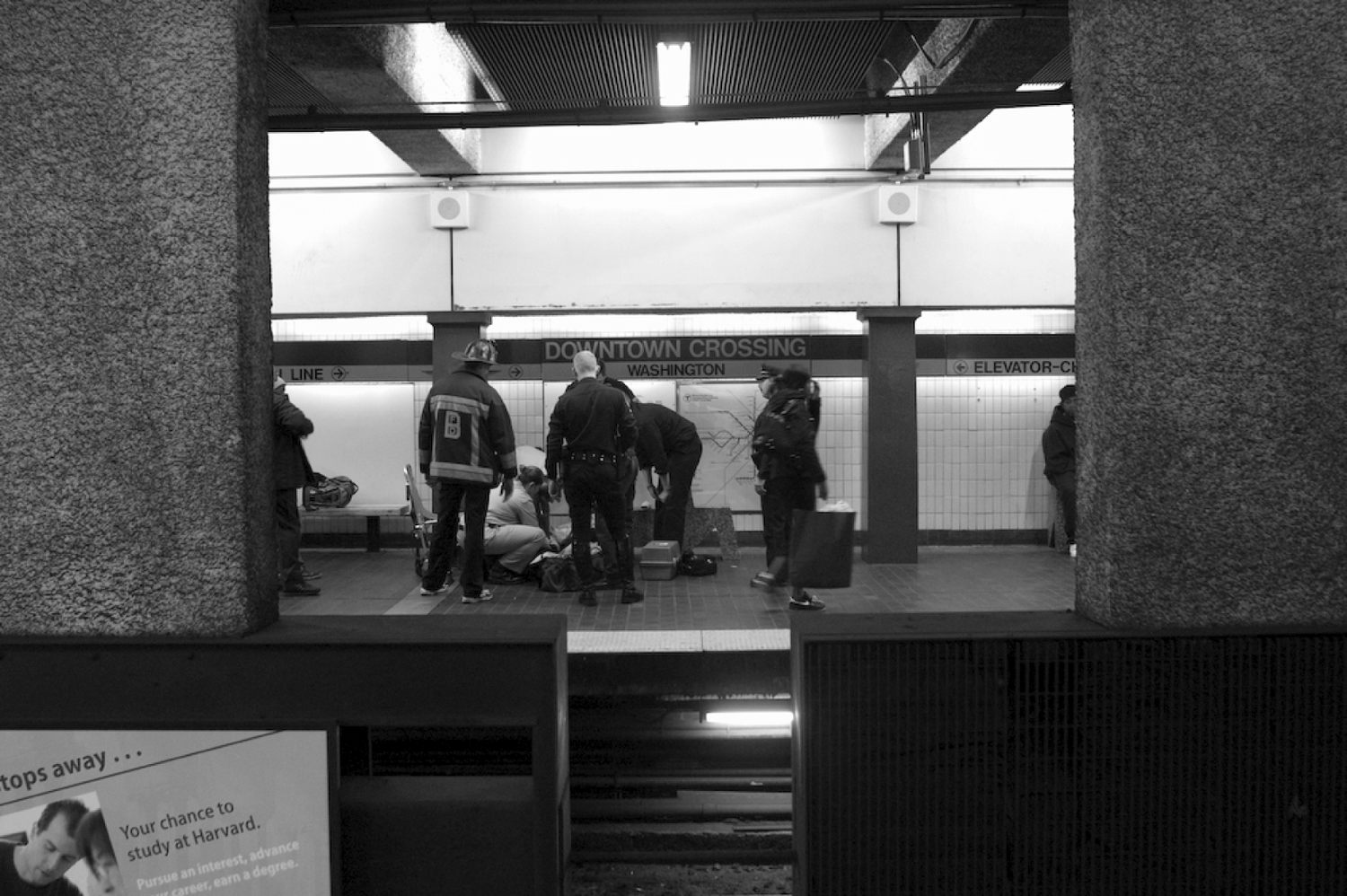
Jason took this photograph before he was arrested
After refusing to leave the station, he was placed in handcuffs and two officers flipped through the photographs on his camera. Jason says he would conservatively estimate that he requested a supervisor be called to the scene between two and three dozen times. At one point he says he was told, ‘You’re under arrest, you don’t get to make any requests.’ Jason wanted a supervisor to be present because he knew he was acting in accordance with the MBTA photography policy, and the officers had demonstrated no familiarity with or concern for the conduct that is called for in this policy. When Jason asked why he was being arrested, an officer replied ‘trespassing’, even as Jason pointed out that he had paid his fare and was waiting for a train. Following Jason’s arrest, the case went to court. The prosecution was unable to produce evidence of a law that Jason had broken, and the judge dismissed the charges and Jason was asked to pay court fees. After looking at the photographs, the judge became ‘outright annoyed’ and lowered the court fees from $400 to $150. The written policies and guidelines for practice were either not known or ignored by the officials. Jason, as a self-aware suspicious subject, was acting in accordance with photography regulations. These, however, were irrelevant, as the encounter actually had more to do with the performative interaction and the anticipatory gaze of security personnel.
The maddening non-alignment of the actions of security personnel with actual policy evidences the ways in which a preemptive stance is stretched across space in elastic and vague acts. The flexibility and ambiguity of security–photographer encounters leave open the possibility for intervening upon, scoping, and evaluating the photographer and his or her future intentions without ever actually having to criminalize or formalize restrictions on the act of photographing. In effect, however, photographers – particularly professionals like Jason who encounter this problem often – have become furtive and suspicious subjects. There is, of course, not always a one-to-one mapping between official procedures and the actual conduct of police or security work (see Herbert, 1997). But, in the case of the many preemptive security–photography encounters, this consistent non-alignment of policy/law and ordinary conduct is glaring.
The conduct of these encounters echoes Aradau and Van Munster’s analysis that precaution fabricates ‘urgent decisions at the limits of knowledge’ by ‘managers of unease’ (Aradau and Van Munster, 2007: 107; see also Butler, 2004; Amoore, 2007: 221). Acting in advance of, in lieu of, and at the limits of knowledge, these encounters evidence an explosion of performative sites of preemption. Preemptive suspicion need not be linked to any specific knowledge or proof of wrongdoing or intent; rather, decisions on suspicion emerge quickly from judgments about the unfolding of banal acts themselves – such as taking a photo, making a wire transfer, or paying cash for an airline ticket. That is, ordinary preemption is processual, emergent, and expansive, and for all of these reasons increasingly difficult to decisively locate and challenge. Jason’s case was ultimately dismissed in court, but this does not mean anything to the actual conduct of these encounters. Many of these incidents never make it to a court. Many end with the quick deletion of photos, the confiscating of equipment, and/or the removal of the photographer from the site in question. In effect, the incidents of encounter multiply, but they appear and disappear quickly, slipping in and out of ordinary actions.
In precisely this context, Huysmans (2011: 377–8) questions the traditional appeal to accountability or answerability for critiquing exceptional security speech acts or decisions because securitizing is actually taking place through dispersion:
through continuously associating, reassociating, tweaking and experimenting with materials, procedures, regulations, etc. The scene of securitizing is then not one of expressing or disrupting a given order but of creating things, meanings and subjects in habitual, everyday innovation.... Power is then to be understood as infinitesimal mediations, as little nothings, dispersed in a continuously developing security bricolage.
This is further complicated by the fact that this dispersion is itself irregular. It is not simply that dispersed and immanent security practices are transparently mandated or applied. Dispersion is wedded to vague and elusive ambiguity. The stretch of preemption is linked to its modulation. These preemptive encounters are shape-shifting processes that create as they come to be in the world not as they were ordained before the fact.
I have deliberately pivoted between UK and US contexts to emphasize that security–photographer encounters are taking place in disparate locations, undertaken by a wide variety of actors that are not connected in any significant causal way. Rather than cast this practice as too neat and clean, flowing distinctly from one point to another (police supervisors tell officers to stop all photographers, they stop photographers, follow protocol, etc.), I seek to show that the reality is more complex and has significant implications for attempts to challenge the practice. However, even as these acts are not easily reducible, it also must be said that security–photography encounters are consistent with a zeitgeist of preemption. The security contexts in the USA and the UK resonate with each another, and they share a close relationship and disposition towards the two countries’ respective and collective ‘wars on terror’. These security climates are complex and sprawling and revolve around ‘resonating fictions’ (De Goede, 2008a: 162; Connolly, 2005) of preemptive security. The private security guard, the police on the street, the Homeland Security worker, and the enrolled citizen are operating upon an imagined presence of future disaster. The bizarre and inconsistent examples of security-photography encounters evidence how this mode of preemptive operation plays out in ordinary acts.
This is perhaps most stark in the USA, where many encounters are justified by statements from security personnel that are quite simply untrue. Photographers have been questioned, asked to stop photographing, had their photographs erased, film confiscated, or were arrested through the citation of laws that do not exist. In a National Public Radio interview, one photographer who was questioned stated that he had been told it was ‘illegal to take pictures of an oil refinery’, while another had been told that it was ‘illegal to take pictures of a federal building’ (Rose, 2005). Interviewees had been told it was ‘against the law to photograph trains’, that a ‘special law was just passed prohibiting photography of LNG [liquefied natural gas] tankers for security purposes’, and that ‘it is against the law to take photographs in MBTA sites’.
In each encounter, security personnel cited 9/11, terrorism, or homeland security regulations as justification. One man interviewed asked a fare-collector why photography was ‘not allowed’ on MBTA property. She replied, ‘Hellooooo ... 9/11!’ He said, ‘When I tried to reason with her, pointing out it’s a public place, she threatened to call the police to arrest me.’ Another was told to stop photographing an incoming T train from above, outside a station, by a security guard from an adjoining university. The guard stated he must stop ‘because of a Homeland Security law that prohibited photographing of trains’. The photographer told the guard he did not think that was correct, because he was taking the pictures for an Amtrak photography contest. After questioning the guard further, he was told: ‘I could be arrested for loitering, and that they had caught terrorists in the train tunnels planning attacks.’ These fabricated citations of the ‘Hellooooo ... 9/11’ context resonate with a vague sense of permeated suspicion, where imagined terrorist futures are brought into the present and render ordinary behaviors suspicious and open to intervention.
Security–photographer encounters in the UK have taken advantage of a slightly more structured, but no less vague, justification: photographers have been cited Section 44 of the Terrorism Act 2000 as grounds for their stop. Under the ‘stop and search’ powers set out therein, a law enforcement officer of a certain rank or above can stop and search anyone if he or she ‘considers it expedient for the prevention of acts of terrorism’. The powers were meant to apply only in specified places and specified times. However, ‘the reality was that the police had a continuous monthly rolling authorisation throughout Greater London. The public were not entitled to know where or when a Section 44 authorisation was in place’ (Quinton, 2011: 21). Stop-and-search powers, and their blanketed application, received a blow in 2010 when the European Court of Human Rights ruled in the case of Gillan and Quinton v. the United Kingdom that the powers violated the right to a private life. This has not meant the end of their use, however. Section 44 has been modified slightly under Section 47a, which grants stop-and-search powers if a constable ‘reasonably suspects that an act of terrorism will take place’. There is no specific mention of photography in either of these powers, but security personnel in the UK commonly cite them to photographers. The practice is so common that a group called I’m a Photographer Not a Terrorist has swollen in size, with supporters and actions (like photographer flashmobs) across London.
In the UK case, security personnel tried to use an actual tool that resonates with a mandate for suspiciousness but that is also entirely ambiguous. These blanketing authorizations, extended over the entirety of London, are worded and applied in ways that clearly maintain their imprecision and flexibility. Using these technologies of suspicion, an officer need only pluck an imagined terroristic future from out of thin air and intervention becomes ‘reasonable’. This is not so different from the ‘Hellooooo ... 9/11’ judgment used by a range of security personnel in the USA. These kinds of encounters have become environmental expectations, not because they happen every time a photographer points to shoot, but because they could or might. They are the prevailing conditions of a preemptive security climate and illustrate the ways in which security acts have become routinized and ordinary, woven into the everyday possibilities of unexceptional spaces and actions.
Conclusions
In his call for the re-evaluation and reassertion of acts in security practice, Huysmans (2011: 379) emphasizes the difficulty of political challenges to security practices where ‘the distinction between ordinary and extra-ordinary, everyday and exceptional is folded and in which exceptional ruptures become processes of often little innovations, struggles become mundane controversies’. How does one challenge a preemptive context, an atmosphere, as things that ‘slip into daily life without much ado’ (Huysmans, 2011: 377)? Taking into account the diversity of actors enrolled, the shape-shifting modulation of flexible interventions, their ambiguous wellsprings and transitory, bizarre ‘decisions’, answers to this question become increasingly difficult. Challenging the implications for individual photographers often takes place at the moment of encounter, as we accept or contest vague justifications, or in police stations and courtrooms, as for Jason. But, can disparate encounters, actors, and places be drawn together in a more comprehensive picture? Groups like I’m a Photographer Not a Terrorist and their photographer flashmobs have brought attention to the absurdity of these practices by inserting a different act into urban space. Like the encounters the group critiques, the flashmob is a momentary appropriation, a transitory assertion of a different imaginative vision of the future: one in which pervasive suspicion that effectively constricts access to public space does not overtake the everyday unfolding of the present.
A radical change is required to undo the atmospheric acceptance of restricting ordinary actions in the present based on the imagination of surprising, disastrous futures. In her consideration of anticipatory visuality, Amoore (2007: 227) writes:
The technologies deployed to translate the unforeseen into the foreseeable, of course, fail everywhere and for much of the time. When they do, we see a glimpse of what they otherwise conceal: the absolute undecidability of all decision and the unforeseeability of most of what we think is seen.
Public space will always exceed its own securing, and preemptive subjects and their future intentions will never be rendered knowable. Recognizing that preemptive efforts ‘fail everywhere and for much of the time’ requires an acceptance of the open uncertainty of the future. This seemingly commonsense thought is rendered obsolete in a preemptive stance as the fundamental fact of the undetectable, surprising nature of everyday life is radically disregarded in favor of dispersing interventions into ever-finer scales of ordinary life.
Preemptive security acts are ways of attending to and affecting people, spaces, and behaviors. They stretch the field of suspicion and occupy the everyday with creative and emergent little security nothings. This article has attempted to draw these elements into relation, to understand how a blanketing preemptive security context operates and what kinds of spaces and experiences are intensified in its name. By no means a slight foe, atmospheric preemption stretches out in bizarre and inconsistent gestures that are not easily reducible to but resonant with the commonplace acceptance that traumatic futures are everywhere a part of the present. In effect, it is the present that is reconfigured as the imagination of catastrophic futures is interwoven into the everyday expectations and experiences of urban space.
Footnotes
Acknowledgements
The author would like to thank Claudia Aradau, Marieke de Goede, Rich Schein, Anna Secor, and three anonymous reviewers for very helpful comments on previous versions of this article.