







Abstract
The recent global climate change discourse is a prominent example of a securitization of environmental issues. While the problem is often framed in the language of existentialism, crisis or even apocalypse, climate discourses rarely result in exceptional or extraordinary measures, but rather put forth a governmental scheme of piecemeal and technocratic solutions often associated with risk management. This article argues that this seeming paradox is no accident but follows from a politics of apocalypse that combines two logics – those of security and risk – which in critical security studies are often treated as two different animals. Drawing on the hegemony theory of Ernesto Laclau and Chantal Mouffe, however, this article shows that the two are inherently connected. In the same way as the Christian pastorate could not do without apocalyptic imageries, today’s micro-politics of risk depends on a series of macro-securitizations that enable and legitimize the governmental machinery. This claim is backed up by an inquiry into current global discourses of global climate change regarding mitigation, adaptation and security implications. Although these discourses are often framed through the use of apocalyptic images, they rarely result in exceptional or extraordinary measures, but rather advance a governmental scheme of risk management. Tracing the relationship between security and risk in these discourses, we use the case of climate change to highlight the relevance of our theoretical argument.
Introduction
Climate change is often depicted as one of the major threats facing our entire planet and a profound security issue, and presented in the apocalyptic terminology of ‘living in the end times’ (Žižek, 2010). 1 A variety of different studies have analysed the recent trend of securitizing climate-related issues, whose beginning is generally located in 2007 with the publication of the most recent report of the Intergovernmental Panel on Climate Change (IPCC) and the UN Security Council debate on climate change, energy and security (see, for example, Detraz and Betsill, 2009). 2 There seems to be a strong consensus among these various studies: while there has been a remarkable securitization of climate change at the rhetorical or discursive level, the resulting notion of urgency has not been translated into exceptional political action, as securitization theory would suggest (Buzan et al., 1998; Buzan and Wæver, 2009). 3 Instead, climate change has been made governable through a rather piecemeal and technocratic approach to the management of carbon emissions (Methmann, 2011; Rothe, 2011). In the literature, this has been explained by reference to the existence of a variety of concepts of security that compete within the climate-change discourses, such as a more narrow national security discourse and broader concepts like human security (Brzoska, 2009; Trombetta, 2008).
This article suggests a different explanation for the absence of exceptional measures in climate policies. While we agree with observations that there are different conceptions of security within the climate discourse, this explanation misses the intimate relation between exceptional security discourses and routine risk-management practices in climate politics. In our view, such an approach mirrors the literature on critical security studies that treats these concepts as two very different animals: Those working on the logic of security focus on existentialist rhetoric and exceptional measures (most prominently, Buzan et al., 1998; Buzan and Wæver, 2009), while scholars inspired by Foucault highlight how the logic of risk works through everyday practices of calculation and management (see, for example, Dillon and Lobo-Guerrero, 2008; Aradau et al., 2008). While some of the latter have already pointed to the fact that risk and security are two sides of the same coin (Dillon, 2007; Bigo, 2001), this article takes the argument a step further by fleshing out the relationship between the two sides. Theoretically, we draw upon Ernesto Laclau and Chantal Mouffe’s theory of hegemony (see Laclau and Mouffe, 1985; Laclau, 1990, 2005). Against this backdrop, we argue that the relationship between risk and security is the result of an articulatory practice but cannot be determined in advance. The actual political practices that result from any given act of securitization will depend on the particular way in which antagonism and security are discursively constituted.
This claim is established in three steps, which will each be developed in turn in the three sections that follow. The next section briefly introduces risk and security as two paradigms within critical security studies, before evaluating how Laclau and Mouffe’s hegemony framework might possibly contribute to their amalgamation. Based on this theoretical rationale, the subsequent section argues that, in the case of climate change, security and risk do not accidentally coexist, but rather are intrinsically connected through an articulation that we propose labelling ‘the logic of apocalypse’. This logic is similar to, but goes beyond, existing approaches such as ‘macro-securitization’ or ‘catastrophe’, in that it constructs a universal threat on a planetary scale, invokes humanity as a collective victim, anticipates the end of time, and draws on religious fantasmatic images. The final section traces in three different cases how apocalyptic climate change is articulated as overstraining the capacity of political actors, and thus as ruling out exceptional measures and passing responsibility to the ‘political machine’ of risk dispositifs.
The three cases we analyse are the climate-change discourses on mitigation, adaption and climate–security linkages. 4 While the former two serve as ‘paradigmatic’ cases for international climate governance, the latter can be understood as a ‘critical case’ (Flyvbjerg, 2006). If the logic of security is translated into risk-management practices even in the traditional field of security politics, this strengthens the overall argument of the present article. In line with Foucault’s archaeology, we have sought to reveal the deep structure across these discourses by means of a metaphor and narrative analysis (see Milliken, 1999). Moreover, the framework of hegemony is obviously interested in revealing hegemonic discourses. Maarten Hajer (1995: 60) has suggested measuring discursive hegemony in terms of two dimensions: discourse institutionalization – in other words, the fact that certain storylines materialize in important societal and governmental institutions – and discourse structuration – that is, the fact that all discursive agents have to draw upon the hegemonic storylines if they are to make a relevant contribution to a given discourse. In order to account for the first dimension, our analysis has focused on the publications of paradigmatic international organizations and institutions in the three cases, because as multilateral organizations it is very unlikely that these would present extreme positions. The second dimension is covered by the fact that our analysis also includes NGOs (in mitigation and adaptation) and state actors (in the Security Council case), and so covers the most important types of actors in global politics. An overview of the different sources in the sample and examples for the salience of the claims advanced here are provided in the Appendix. 5
Risk or security? Yes, please!
As noted above, we can observe that a large part of the literature on critical security studies is characterized by a split between two camps that seldom speak to each other: one mainly focusing on the logic of security, the other more concerned with the logic of risk (Aradau and Van Munster, 2011: 19). This article will first trace back the conceptual roots of these two logics, before introducing the discourse theory of Laclau and Mouffe in an effort to show how this might help transcend the binary conceptualization just noted.
The logic of security has been most prominently theorized in the Copenhagen School’s account of securitization (Buzan et al., 1998), the basic idea of which is as follows: Security is a speech act following a conventionalized script. This script involves casting an external enemy or existential threat and identifying exceptional measures to deal with that enemy or threat. Constructions of danger that lie below the threshold of existentialism, such as the concept of risk, are excluded from the account. And this exclusion is a deliberate and explicit one, introduced in order to protect the intellectual and analytical coherence of the Copenhagen School’s security concept (Buzan et al., 1998: 4). More recently, the approach of the Copenhagen School has been updated with a rationale for ‘macro-securitizations’, as in the cases of terrorism or climate change (Buzan and Wæver, 2009), which however leaves the exceptional underlying security logic untouched. Since its initial formulation, the securitization approach has been criticized for mainly two reasons: First, for artificially narrowing the notion of security to a geopolitical understanding (Aradau and Van Munster, 2007; Dillon 2007). Second, for concentrating on linguistic practices and exceptional rhetoric and thus disregarding the various ways by which security is actually constructed through the everyday practices of security agents (Bigo, 2002).
This critique gave birth to an alternative version of critical security studies, which mainly draws upon the thoughts of Michel Foucault. It has been the merit of this second strand of literature that the logic of risk has become more prominent in critical security studies. Starting from Foucault’s (2007) concepts of ‘governmentality’ and ‘biopolitics’, this literature highlights the routine and micro-practices of risk management in contemporary security politics. The notion of ‘governmentality’ refers to a form of political power that seeks to govern ‘the conduct of conduct’ (Foucault, 1982) of individuals indirectly. Governmentality has its roots in the ‘pastoral power’ (Foucault, 2007: 123) of Christianity, the secularization of which gave birth to a comprehensive economy of power in the 17th century. In the course of the ‘governmentalization of the state’ (Foucault, 2007: 109), security in terms of risk became one of the major dispositifs or technologies that sought to govern the population for its own sake. The logic of risk is thus mainly associated with the field of social or internal security (e.g. in crime prevention and social control; see Rose, 2001; Rose et al., 2006). This, again, reinforces the binary division between the logics of security and risk (Aradau and Van Munster, 2011: 20). Against this passionate drive to keep things apart, we claim that it might be helpful to theorize the amalgamation of the two logics.
A helpful starting point for such an endeavour is the theory of hegemony as developed by Ernesto Laclau and Chantal Mouffe (1985). In a nutshell, these authors argue that society in general should be understood as a radically contingent discourse, whose closure depends on the existence of hegemonic articulations. This dense argument can be unfolded and related to the study of security in three steps. First, hegemony theory gives up the strict distinction between the discursive and the non-discursive. In line with Wittgenstein’s (1967) notion of the ‘language game’, both linguistic statements and non-linguistic practices or other forms of meaningful symbolic order (images, architecture, etc.) all merge into an encompassing notion of discourse. As an ontological category, discourse is not restricted to speech or writing, but affects ‘any complex of elements in which relations play the constitutive role’ (Laclau, 2005: 68–9). As relational systems, then, social and political orders can be studied as discourses. For a theorization of security and risk, on the one hand, this means there is no reason to locate constructions of security solely in linguistic practices, as members of the Copenhagen School have done. On the other hand, it also implies that practices (and artefacts) not only influence discourses by producing knowledge – which would be a Foucauldian take – but are themselves signifying practices, or language games. From a hegemony point of view, both security and risk are discursively constituted through a plurality of articulatory practices.
Second, following on from De Saussure’s linguistics, Laclau and Mouffe conceive of discourse as structured by two complementary logics: those of equivalence and difference (Laclau, 2005: 68). While difference treats discursive elements as discrete entities and stresses their dissimilarity, equivalence seeks to unite them under a common denominator – an ‘empty signifier’ (Laclau, 1996). The identity or meaning of any object ultimately rests upon its differential and equivalential position within discourse. As the logic of equivalence and the creation of empty signifiers are necessarily dependent on an antagonistic relationship, every social and political order is founded upon a radical antagonism (Laclau and Mouffe, 1985: 125). This implies that the identification of an enemy is not an exclusive feature of a security logic but actually the prerequisite of every political order. At the same time, it means that also risk as a technology of government requires antagonism to constitute the social order that it seeks to govern.
Third, as there is nothing like an essential core of discourses, these structures never become fully fixed or ‘sutured’ (Laclau and Mouffe, 1985: 111). This brings about a situation where discourses are subject to ‘dislocation’ (Laclau, 1990: 40) and a constant (re)negotiation of meaning through practices of ‘articulation’ (Laclau and Mouffe, 1985: 105). For the theory of security and risk, this implies that, on the one hand, security discourses are not constructed through a single articulation or speech act – they are the product of ongoing processes of articulation and rearticulation and thus contingent; while, on the other hand, the relationship between security and risk is a matter of discursive articulation.
Laclau and Mouffe provide two examples for the discursive structuring of society, and these are incisive for our own argument. On the one hand, they refer to millenarian movements that structure the social terrain according to two closed chains of equivalence, which entirely overlay any difference: ‘peasant culture representing the identity of the movement, and urban culture incarnating evil’; ‘a maximum separation has been reached’, so when ‘the millenarian rebellion takes place, the assault on the city is fierce, total and indiscriminate’ (Laclau and Mouffe, 1985: 129–30). This resembles the Schmittian extreme friend–enemy distinction that legitimizes the adoption of exceptional measures and is characteristic of the logic of security. And it can be found in many recent securitizations, from Nazi Germany’s ‘total war’ to Cold War macro-securitizations of two universal and utterly contradicting ideologies (see, for example, Buzan and Wæver, 2009: 260). On the other hand, Laclau and Mouffe cite Benjamin Disraeli’s politics in the 19th century as the other extreme: challenging the perception of ‘two nations’, ‘a clear cut division of society into two extremes of poverty and wealth’, through the notion of ‘one nation’ and breaking ‘the popular revolutionary subjectivity’ into different subject positions in order to displace ‘the frontier of antagonism to the periphery of the social’ (Laclau and Mouffe, 1985: 130). Such a conception of society as a pure space of differences would become the forerunner of the welfare state (Ewald, 1991) and lives on in many contemporary practices of risk management (Deleuze, 1992).
For the relationship between risk and security, these examples indicate that the form of politics that flows from the creation of an antagonism depends on the actual articulation of this antagonism. If, for example, such an antagonism is constructed as a fierce opposition between two political communities, it might result in a state of exception in the Schmittian sense. However, if the frontiers of antagonism coincide with the limits of society, the latter can be governed according to a logic of risk. In the light of this argument, it is instructive that even macro-securitizations such as the Cold War were intimately connected to technologies of risk (Aradau and Van Munster, 2011: 17–30). For example, the evolution of the dispositifs of liberal risk management characteristic for Western welfare states was accompanied by a securitization of communism, producing the inner social cohesion necessary for technologies of (social) insurance. 6
Climate change and the logic of apocalypse
As was shown in the previous section, the relationship between risk and security cannot be theoretically determined in advance but results from the empirical articulation of antagonism. In the remainder of this article, we highlight one particular form through which antagonism can be created: a form best captured by the term apocalypse. In the case of climate change, the logic of apocalypse constitutes antagonism in such a radical and existential way that, paradoxically, it does not result in exceptional measures, but rather in the micro- and routine practices of risk management. In accordance with the concept of discourse advocated by Laclau and Mouffe, we have focused not on authoritative speech acts, but on the constitution of antagonisms in discourses of climate change in general. The first step of our empirical analysis involves an investigation of how climate change is expressed metaphorically.
The bottom line of this analysis in all three of the cases we examine – mitigation, adaptation and the UN Security Council – is that climate change is featured as a kind of external enemy. One of the terms most commonly associated with ‘climate change’ throughout our sample, for example, is the word ‘dangerous’. The usage of this term may not be so surprising given that it is used in the text of the United Nations Framework Convention on Climate Change (UNFCCC) of 1992. In that particular context, the objective of policy is said to be the ‘stabilization of greenhouse gas concentrations in the atmosphere at a level that would prevent dangerous anthropogenic interference with the climate system’. 7 In subsequent discussions and documents, however, this formulation turned virtually ubiquitously into ‘dangerous climate change’ (see, for example, UNDP, 2007: 3; Steiner, 2009: 9; World Resources Institute, 2007: 7). Semantically, the UNFCCC formulation seeks to qualify the degree of human interaction with the climate system as dangerous, whereas the latter expression attaches this label to climate change itself. The nature of the initial activity that causes climate change – human interference – is accordingly concealed through use of the statement that climate change itself would be dangerous. Climate change mutates from a process rooted in human activity to a dangerous Other.
This externalization of climate change is particularly mirrored by two very salient metaphors. For example, it is evident within the anticipation of ‘climate shocks’ (see, for example, Up in Smoke Coalition, 2004: 29; UNDP, 2007: 88; World Bank, 2010: 14). Shocks are generally external to those they affect; they are caused by sudden changes from the outside. Similar reasoning applies in the case of the very common depiction of climate change as a ‘threat’ or as ‘threatening’ something (see, for example, World Resources Institute, 2008: 40; UNEP, 2009a: 7; World Trade Organization and UNEP, 2009: v). Climate change is understood as an external and independent thing. Very obviously, this discursive articulation, which is dominant in all three cases, represents the exceptional rhetoric of the logic of security; or, in terms of hegemony theory, it articulates an antagonism.
In line with our theoretical argument, however, the nature of this antagonism needs to be further specified. Important in this regard is the notion of catastrophe. A striking example is the perception that climate change poses an imminent risk of ‘catastrophic events’/‘catastrophic outcomes’ (see, for example, Up in Smoke Coalition, 2004: 8; UNDP, 2007: 7; Global Humanitarian Forum, 2009: ii). These include the possibility of ‘unpredictable and non-linear events that could open the door to ecological catastrophes’ (UNDP, 2007: 2). What does the notion of catastrophe tell us about the nature of antagonism? A very useful approach to the political implications of this term is offered by Aradau and Van Munster (2011), whose ‘genealogy of the unknown’ traces different forms of knowledge and practices for dealing with an unknown future in Cold War security policy. They distinguish between dispositifs of security centring on crisis, on disaster, and on catastrophe, while showing how these subsequently strengthened each other. The dispositif of catastrophe deals with low-probability, high-impact risks. These are characterized by their disruptive and transformative impact and involve a ‘tipping point’ – the point of no return between a relatively linear and steady development and a radically contingent and potentially chaotic future. The crucial point for the argument of this article is that catastrophe merges the logic of security with that of risk. We argue that the securitization of climate change draws on the central characteristics of catastrophe but advances it towards a new stage in this series of dispositifs of security: the logic of apocalypse. 8
First, while catastrophic risks often affect a particular delimited political community (such as the West threatened by terrorism), a logic of apocalypse inherently invokes an encompassing and universal threat. Climate change, for example, is very often articulated as a global ‘war’ (Sorcar, in UN Security Council, 2007b: 10) or even as comparable to ‘the two world wars’ (UNDP, 2007: 2). This war metaphor definitely implies an agglomeration of various catastrophes. In line with this, climate is defined as a ‘threat multiplier’, so that ‘climate change threatens markets, economies and development gains. It can deplete food and water supplies, provoke conflict and migration, destabilize fragile societies and even topple governments’ (Ban Ki-moon, 2009: 6). In this sense, it takes the form of a master-threat that is not simply a catastrophe: ‘climate change is a security issue, but it is not a matter of narrow national security. It has a new dimension. It is about our collective security in a fragile and increasingly interdependent world’ (Becket in UN Security Council, 2007a: 19). In line with the approach of Buzan and Wæver (2009), the discursive strategy at play here could be called a ‘macro-securitization’ at the global level. As Figure 2 illustrates for the case of the Security Council, it creates a chain of equivalence combining a broad range of phenomena that are increased or induced by climate change into the master-threat of dangerous climate change.
On the other hand, however, it simultaneously invokes humanity as the one collective victim and opponent of dangerous climate change. Hence Kofi Annan’s statement at the beginning of the 15th Convention of the Parties to the UNFCCC: ‘Climate change threatens the entire human family. Yet it also provides an opportunity to come together and forge a collective response to a global problem’ (Annan, 2006). Hence ‘the battle against dangerous climate change is part of the fight for humanity’ (UNDP, 2007: 6); and hence, ‘there are no sides in the fight for climate justice’ (Global Humanitarian Forum, 2009: iv). The hegemonic discourse of climate change eradicates differences across the globe and presents humanity as a universal sufferer (Swyngedouw, 2010). In this sense, across the three cases, the climate-change discourse articulates global warming as an external antagonism that coincides with the limits of humanity and so constitutes the latter as a homogeneous social space that can be governed according to the logic of risk – a point to which we will return below.
Second, the temporality displayed by the logic of apocalypse differs from that of the catastrophe. While the catastrophe represents the interruption of a linear development by an unknowable event, the apocalypse represents the (sometimes even teleological) endpoint of an accelerating development. Thus, time is not interrupted by but directed at a certain event. For example, in the Security Council debate in 2007, this is expressed in the paradigmatic statement that ‘everyone’s future is at stake now’ (Aboud in UN Security Council, 2007a: 35). The World Bank (2010: 100) equally indicates a radical break in time, because ‘in a changing climate the past is no longer prologue’. For security politics in general, Dillon (2011: 782) has diagnosed a ‘political eschatology’ that is ‘concerned with the end of things’ and gives rise to a modern politics of security that ‘derives from the positive exigencies of government and rule that arise in restricting that end’. This is mirrored in the securitization of climate change. What is at stake is the very end of time itself, which has to be deferred through political interventions: ‘We are confronted with a chemical war of immense proportions. It is not a struggle against anyone; rather it is a fight against time and for the benefit of humanity’ (Weisleder in UN Security Council, 2007b: 32, emphasis added). Climate change not only is external to ‘humanity’ as a spatial category (each and every inhabitant of the planet), but also constitutes a sort of a temporal limit to society – radicalizing the antagonism even further.
The last quotation also points to the third apocalyptic characteristic of the securitization of climate change: it is organized around biblical/religious master-signifiers and metaphors. On the one hand, many of the consequences of climate change that are invoked throughout the discourse bear close resemblance to the four horsemen of the apocalypse: war, death, disease and famine (see Appendix) – for example, the ‘consequences of flooding, disease and famine – and, from that, migration on an unprecedented scale’ (Beckett in UN Security Council, 2007a: 18). This migration is cast as an ‘exodus of entire populations’ (Craxi in UN Security Council, 2007a: 4, emphasis added). On the other hand, the solution of the climate crisis is often thought of as a sort of universal salvation: ‘The silver – indeed gilt-edged – lining to the climate change cloud is that many solutions already exist or are in the pipeline. … These are not some whimsical Nirvana but real opportunities to deliver a Green Economy’ (UNEP, 2008: 3). Climate change marks the crossroads between apocalyptic doom and universal salvation. This religious dimension exaggerates the antagonism at the limits of humanity even further, to such an extent that climate change becomes the radical opposite of humanity as such (UNDP, 2007: 1).
The religious dimension expressed in these apocalyptic metaphors is all the more important in that it presents a first bridge to the logic of risk – which is based on ‘pastoral power’ (Foucault, 2007: 123–4; on Foucault’s analysis of Christianity, see Macmillan, 2011). Foucault disregarded, or at least downplayed, the fact that Christianity and/or its oriental ancestors not only gave birth to the pastorate but also were the first apocalyptic religions (for the notion of apocalypse, see Swyngedouw, 2010: 218–9). We could thus say that the ideological background of pastoral power is a narrative that takes the twofold form of a promise and a warning. On the one hand it foretells the end of the world; on the other it promises an absolute fullness-to-come if the subjects behave properly in the eyes of God. The subject’s fear and its perceived lack of identity can be regarded as the primary governmental resource behind the pastoral power. Judgment Day could be tomorrow. The pastoral power is only effective because the Last Judgment must be feared at any moment. The confession thus not only deploys ongoing micro-practices of self-optimization and spiritual guidance, but at the same time serves the function of recalling the millenarian context of human life. In this sense, the Christian ‘conduct of conduct’ draws inherently on the idea of living in the end times. In sum, we argue that the pastoral power – in its modern form of government – is still grounded upon and legitimized through similar narratives. In these modern forms of pastoral power, God has disappeared and been replaced by different concepts – such as a nature out of control or the poor that have become dangerous. Macro-securitizations like dangerous climate change, then, spread a pastoral responsibility at the international level – for example, by constructing humanity as a political subject confronted with an external antagonism like dangerous climate change, which is to be governed by a logic of risk following from pastoral power.
Lastly, the logic of apocalypse is marked by a certain anti-epistemology – the impossibility of knowing. While the dispositif of catastrophe in general is characterized by eager attempts to make the future present, the apocalypse is marked by systematic ignorance. In the field of climate change, this might be a surprising argument given the fact that climate policy – maybe like no other policy – is characterized by the will to know the future (see, for example, Anderson, 2010). We absolutely agree with that, yet still we would argue that there are large parts of the global climate polity that are governed through technologies that creatively exploit the impossibility of knowing. In our sample, climate-change threats are depicted as ‘unprecedented’, ‘unpredictable’, ‘uncontrollable’ or even ‘unthinkable’ (see Figure 2). Yet, and this is decisive, it is also not necessary that these threats can be known by the subject. For example, Eric Swyngedouw (2010) has argued that it is the vagueness of dangerous climate change that enables it to function as an empty signifier to be shared by everyone. And, below, we will argue that it is the systematic lack of knowledge in the face of the apocalypse that enables particular dispositifs of risk.
As a first conclusion, we argue that the antagonism constitutive of climate discourses takes the form of an apocalypse, a form that even exaggerates the notion of ‘macro-securitization’ or ‘catastrophe’ by invoking climate change as a total threat to the entire planet, radically undermining the temporal organization of existing societies, drawing on religious metaphors and a specific anti-epistemology. The remainder of this article seeks to flesh out how exactly apocalypse articulates the logic of security with different dispositifs of risk and accordingly does not result in exceptional measures but instead invokes micro-practices of governmental management.
Apocalypse and risk
Previous literature on climate politics and risk has shown that climate change is governed through practices that can be broadly grouped into three categories: precaution, preemption and preparedness. Precaution identifies a certain tipping-point for an ongoing trend that must be mitigated at any cost; preemption instead works in absence of any indication of a threat and thus means to proactively modulate or bring about a desired future; lastly, preparedness does not try to avoid dangerous events but instead increases subjects’ ability to cope with them. The UNFCCC is the most prominent example of an institutionalization of the precautionary principle (Anderson, 2010); preparedness features most prominently in the politics of adaptation, and centres on vulnerability and resilience (Oels, 2012); while a logic of preemption stands behind current international debates that discuss geo- engineering as a large-scale anticipation of possible risks (Cooper, 2006). The remainder of this article will examine how the logic of apocalypse is translated into these technologies of risk. It argues that mitigation is characterized by a precautionary rationality, while adaptation is dominated by a preparedness perspective. Both also feature prominently in the Security Council debate – whereas technologies of preemption, which most closely resemble exceptional measures, are surprisingly salient neither here nor in the other two cases.
Mitigation: The human tragedy and technology as deus ex machina
Drawing on the idea of apocalyptic climate change, the mitigation sample articulates the logic of security and risk in a particular way: it presents the climate-change conundrum as a ‘tragedy’ and presents the technocratic arrangements of precautionary risk management as a ‘deus ex machina’. To start with, the mitigation discourse shares the dominant storyline of dangerous climate change as that was presented earlier. It also mirrors the tension between apocalypse and universal salvation, as it assumes that climate change is in principle a resolvable problem, whose solution will also positively affect many other issue areas. In this sense, climate change – technically and economically speaking – is presented as a resolvable problem, as is also the case, for example, in recent IPCC reports (e.g. IPCC, 2007) and the Stern Review (Stern, 2007). This assumption that the issue is resolvable, however, is contrasted with a severe distrust in the ability of political leadership to actually avoid the ‘avoidable catastrophe’ (UNDP, 2007: 2). For example, UNDP is concerned that ‘we can avoid 21st Century reversals in human development and catastrophic risks for future generations, but only by choosing to act with a sense of urgency. That sense of urgency is currently missing’ (UNDP, 2007: 15; see also Greenpeace and European Renewable Energy Council, 2008: 6; Global Humanitarian Forum, 2009: ii). This distrust in the problem-solving capacity of politicians reveals a general distrust in human agency, since ‘although an increasing number of people know about climate change and believe action is needed, too few make it a priority, and too many fail to act when they have the opportunity’ (World Bank, 2010: xxi). Here, the human being is depicted as an irrational and short-sighted individual, who knowingly steers towards catastrophe.
This general distrust in human agency – particularly that of ‘political leaders’ – is the reason why the logic of apocalypse does not result in exceptional measures. The subtle pessimism is present throughout the whole sample in the mitigation case. To put the matter bluntly, it seems that the radical nature of the antagonism constituted by climate change, its apocalyptic character, overburdens the capacity of human beings, and in particular that of political actors. Human fallibility in the face of the avoidable catastrophe – it is not difficult to discern the plot of the ancient tragedy here.
As in every good tragedy, there is also a deus ex machina that bears the brunt of resolving the crisis. In the climate-change discourse, the metaphor used for this device is ‘technology’ – understood in terms of two complementary variants. On the one hand, technology encompasses technical devices. This is paradigmatically expressed in Figure 1, which is taken from a UNDP handbook on climate-change mitigation. As the figure shows, the whole problem of climate change is boiled down to a question of the right ‘low carbon technology’. While the upper lines represent the tragic course of events that lead towards the catastrophic ending, it is neither policy nor action on the part of political leaders but rather technology that shifts the development to a safe path, expressed by the lower green line. Technology becomes indispensable here. This is a theme that is time and again cited throughout the whole sample. Technology is either referred to in general terms as ‘clean’ or ‘green technology’, or it is listed in more detailed fashion as clean-energy technology, carbon sequestration, biofuels or nuclear energy. Whatever it takes to avoid climate change, it is ‘technology’ that will do the job. A case in point concerns the IPCC. In its latest report, the Panel deploys technological innovation as a placeholder for technologies that have not yet been invented (Keary, 2010). It simply assumes that technological innovation will advance progressively and increase.
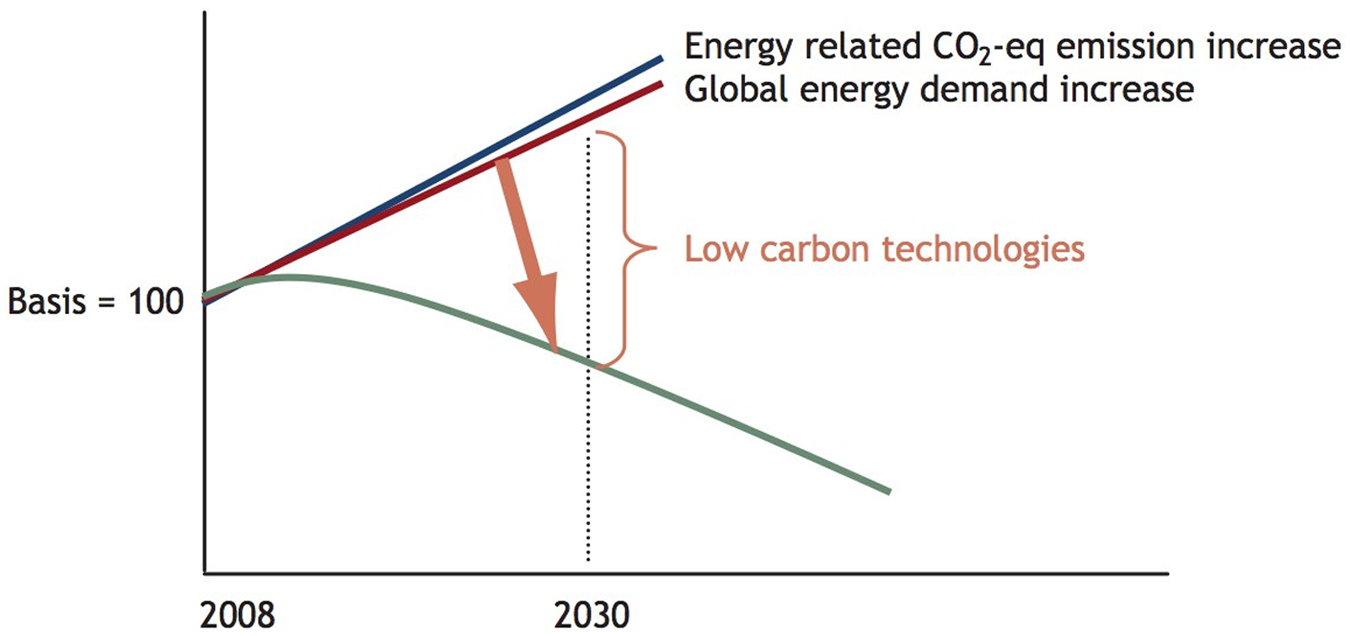
Technology as the deus ex machina
On the other hand, though, technology has to be understood in a broad and all-encompassing sense. It includes not only technical devices, but also highly technocratic politics and policies in the form of technological arrangements. In this sense, technology becomes sort of a ‘political machine’, one that ‘offers a set of skills, techniques, practices and objects with which it is possible to evade and circumscribe politics’ (Barry, 2001: 7). It is striking that the whole sample of climate-mainstreaming discourses is overly concerned with the implementation of political ‘mechanisms’, ‘policy instruments’, ‘arrangements’ and the like. The use of such metaphors indicates the highly technical understanding of climate governance that predominates. Eventually, governance is supposed to be designed in a way that mirrors the precision and determinacy of mechanical devices – hence, the ubiquitous obsession with carbon markets. This stance is perfectly embodied in the expectations for the Copenhagen Summit. For example, the World Bank constructs a metaphorical opposite between ‘inertia’ and ‘flow’ – the former being caused by human inability, the latter being promoted by a technopolitical deus ex machina of ‘efficient solutions’, ‘finance’ and ‘new technologies’ (see Appendix).
This equals a precautionary risk management that is embodied in the UN Framework Convention. As noted earlier, the dispositif of security underpinning the logic of risk is concerned with the organization of circulation. This is exactly what is mirrored within the global mitigation discourse. The rationale of the 1992 Framework Convention is that ‘good circulation [economic growth] is to be maximized while bad circulation [carbon emissions] is to be reduced to a “tolerable” level (but not completely eliminated)’ (Oels, 2012). And it is the idea of technology that permits the making of such a distinction in the first place. The mitigation of climate change is about governing such an invisible, almost virtual, entity as carbon emission, and this obviously cannot be done without technical measurements, calculations and transformations (Lövbrand and Stripple, 2011). The broader understanding of technology, on the other hand, enters the climate discourse through the ‘flexible mechanisms’ of carbon trading established by the 1997 Kyoto Protocol. Kyoto actually represented a renunciation of the ‘command and control’ approaches that had previously informed environmental politics. Through the adoption of the protocol, attempts to control and manage the circulation of greenhouse gases were replaced by an economic machine that would automatize and optimize this process. The political machine of ‘technology’ thus fulfils a crucial function of the logic of risk within the mitigation discourse: identifying and managing those parts of the economy that are harmful for its overall persistence. In this sense, the logic of risk seeks to manage global circulation in optimal ways so that it does not cross the apocalyptic threshold (which has been institutionalized in the Copenhagen Accord in terms of ensuring that average global temperatures do not increase by more than 2° Celsius).
In sum, the first case of mitigation discourses demonstrates how the logic of apocalypse prompts technologies of risk management instead of exceptional measures. Climate change represents an ‘avoidable catastrophe’, but its sheer immensity causes distrust in political action, and hence prevents it from resulting in exceptional measures. Instead, authority is transferred to the political machine of technology, which fulfils the core task of risk management: distinguishing good from bad circulation.
Adaptation: Making people fit for survival in the apocalypse
A change occurs, however, in those documents that are mainly concerned with the adaptation to climate change. Here, apocalyptic climate change enters a scene of traditional risk management and pushes it towards technologies of preparedness. Again, the apocalyptic nature of climate change results in a particular rationality of risk. To start with, it is quite striking that the discourse imagines the world before the advent of climate change as a world of traditional and functioning dispositifs of risk, of which the climate had been a distinct subset (UNDP, 2007: 78–83). In other words, humanity’s path to prosperity and welfare is studded with hidden rusty nails, but these risks can be managed and have traditionally been managed by ‘the individual’, ‘the community’ or ‘the nation’ (Up in Smoke Coalition, 2005: 16). In this world, there seems to be a natural balance between climate risks and risk management.
‘Dangerous climate change’, however, is presented as a game-changer. It undermines traditional techniques of risk management. Global warming causes, for example, ‘more volatile weather conditions’ or ‘surprising changes in climate-linked disease patterns’, and governments are thus confronted with ‘a riskier and more complex environment’ and ‘imperfect knowledge’ about it (World Bank, 2010: 88). While traditional means of anticipating the impact of extreme weather events were based on solid socioeconomic and physical data, ‘in a changing climate the past is no longer prologue’, so that ‘uncertainty about the future climate’ becomes the dominant concern of risk assessment (World Bank, 2010: 100). A case in point for the inability of traditional risk-management techniques to deal with climate change is the fact that insurance is an inappropriate preparation and can even become counterproductive, because it results in ‘maladaptation’ (World Bank, 2010: 102). In sum, the unpredictability, the unintelligibility, the radical otherness of apocalyptic global warming disrupts the traditional forms of risk calculation and risk management.
And this, finally, gives rise to a rationality of preparedness. Given the fact that precaution is no longer possible within the politics of adaptation, a ‘culture of preparedness’ (Collier and Lakoff, 2008) is necessary. As the worst-case scenario cannot be ruled out, we have to be able to deal with it at any moment. It is therefore necessary to invest in the preparedness of people, governance mechanisms and critical infrastructures so that these will be able to cope with extreme social, economic or environmental shocks. The concept of ‘resilience’, in particular, has become a prominent theme among security professionals – as illustrated, for example, by the US National Homeland Security Strategy of 2007 (US Department of Homeland Security, 2007) – and has spread way beyond the security sector (Walker and Cooper, 2011: 154; Lentzos and Rose, 2009). It denotes the ability of social systems to survive extreme stress without necessarily having to return to a previous state of equilibrium. Such resilience, as Dillon argues, is achieved if governmental power adopts ‘lifelike properties’ and puts forth open, transformative and informationally driven systems that are capable of ‘adaptive learning’ and ‘emergence’. The contingency of threats leaves no other option than to rely on the ‘contingency of life’ – that is, on its ability to deal with external stress in an adaptive and creative process. Instead of trying to govern contingency, power now has to ‘govern through contingency’ (Dillon, 2007: 16).
The apocalyptic nature of climate change makes it necessary to invest in such a dispositif of preparedness. Resilience is a buzzword within the sample of analysed documents on adaptation (see Appendix). The World Wildlife Fund (2009: 10), for example, calls for strengthening ‘the socio-ecological resilience of coastal ecosystems’ and so summarizes this attitude perfectly. The core of resilience is to empower the poor to deal with the consequences of climate change. Resilience, thus, first of all seeks to empower (local) social systems to cope and deal with climate change themselves. Responsibility for disaster prevention is conferred upon local communities and households (World Bank, 2010: 100). The prime task of government is thus to transfer decisionmaking autonomy to these local actors – for these have the potential for self-management. Strengthening the local level is thus cited as a key response to climate change throughout the sample of analysed documents (Up in Smoke Coalition, 2005: 4; Greenpeace and European Renewable Energy Council, 2008: 3).
Governing through resilience and community perfectly exemplifies the latter two characteristics of the logic of apocalypse outlined above. On the one hand, the global climate polity constructs a pastoral responsibility on the part of the international community to protect the most vulnerable against dangerous climate change. This requires giving the latter fair warning of the dawning catastrophe and making them fit for survival. At the same time, the logic is characterized by an anti-epistemology – the sheer impossibility of knowing and controlling apocalyptic climate change from a global centre. The global pan-optic management of climate risks is an illusion. While Spaceship Earth is on autopilot, the international climate regime limits itself to organizing the free flow of information. Radical contingency replaces planning as the logic of government.
Security: The war of all against nothing
The third case study involves the UN Security Council debate on climate change in 2007. This represents an extreme case, since here securitization is most likely to result in exceptional measures. At first sight, the discourse here follows the script of securitization in the Copenhagen School’s sense, articulating climate change as a source of conflict among states. However, our analysis, as illustrated in Figure 2, reveals a much more fine-grained picture. To be precise, it actually presents two different versions of securitization, drawing on two different antagonisms. On the one hand, there is an antagonism constructed between first-order threats – that is, the direct impacts of a changing climate – and all vulnerable regions, countries or communities. The security framing here is one of human security, as climate change threatens the livelihoods, food supplies, water security, etc. of the vulnerable. On the other hand, these hot spots or zones of crisis can become a source of danger themselves. The human insecurity in vulnerable regions, then, is articulated with what could be called a neo-Malthusian ‘climate-conflict discourse’ (Trombetta, 2008; Detraz and Betsill, 2009). This states, on the one hand, that vulnerable regions suffering from the impacts of climate change will be conflict-prone, as ‘they lack the knowledge, capacity and resources to deal with it’ (Heller in UN Security Council, 2007b: 19). Environmental degradation and the resulting scarcity of resources are understood as an additional and novel driver for conflicts (see Appendix). Taken together, these ideas constitute a security discourse in which ‘the vulnerable are becoming dangerous’ (Oels, 2012) – that is, a threat for national security in the Western world or even for international security. The vulnerable thus become the dangerous enemies in the sense of the logic of security. And this clearly implies the adoption of a preemptive logic and the exceptional measures of interstate conflict and military intervention.
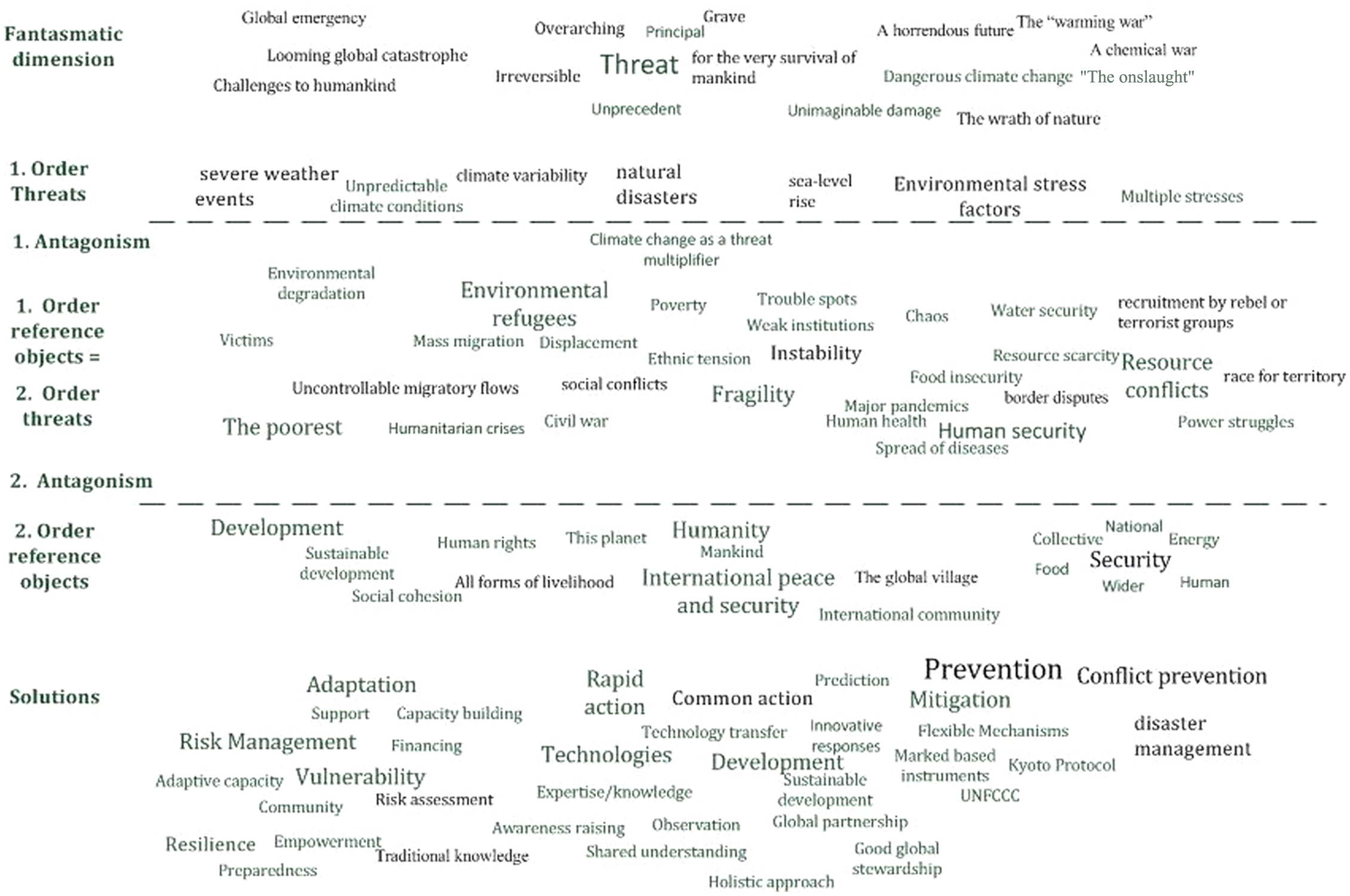
The discursive structure of the Security Council debate
Yet, even in the security field, preemptive or other security measures, which can be found for example in disaster management (see Figure 2), only play a minor role. The reason for this is that the two articulations of climate change and security are heavily permeated by a different storyline, one that follows the logic of apocalypse (the fantasmatic dimension presented in Figure 2). Also in this case most articulations stress the universality of the threat, resulting in an antagonistic frontier between humanity and dangerous climate change that is characteristic for the apocalypse (see above). And this explains why an exceptional rhetoric in the case of climate change is not linked with the adoption of exceptional measures. While the climate/humanity antagonism is still most dominantly couched in metaphors of war (see Appendix), the unification of humanity implies that this particular war is fought against an entirely spectral enemy: ‘this is not a struggle against anyone’ (Weisleder in UN Security Council, 2007b: 32). And this war of all against nothing is the crucial point for the logic of apocalypse that connects security and risk in this particular case and thus excludes exceptional measures – because ‘our conflict is not being fought with guns and missiles but with weapons from everyday life – chimney stacks and exhaust pipes’ (Pita in UN Security Council, 2007b: 8).
The antagonism created by a logic of apocalypse does not just replace or transform the other security articulations: it also links them in crucial ways. As Figure 2 shows, the most prominent demand articulated in the discourse is prevention. And as second-order threats like ‘uncontrollable migratory flows’ (see Figure 2) mainly evolve under conditions of an apocalyptic climate change, mitigation becomes the best measure of conflict prevention. Again, there is a dichotomization between a linear development (e.g. normal migratory patterns) and a state of chaos. Therefore, also the climate-security discourse heavily promotes the political machinery of the UN Framework Convention and its Kyoto Protocol (Churkin in UN Security Council, 2007b: 17) – just as ‘appropriate incentives, public–private partnerships, low-carbon emitting technologies and innovative solutions’ (Kryzhanivskyi in UN Security Council, 2007b: 4).
At the same time, also adaptation becomes a form of conflict prevention, as it lessens the direct impacts of climate change on the vulnerable. The discourse thus articulates a risk-management approach similar to that in the field of adaptation, which revolves around the concepts of vulnerability, resilience and community (see, for example, Hill in UN Security Council, 2007b: 6; (Koenders in UN Security Council, 2007a: 22). The hegemonic discourse here takes up the calls for supporting the vulnerable with adaptation and constructs a responsibility on the part of the West (see Appendix and Figure 2). This responsibility is transformed into a pastoral relation, taking the form of government at a distance through empowerment, stakeholder participation and self-responsibilization of local communities. Also in the field of global security governance we can see the impacts of the ‘banality of the apocalypse’ (De Goede and Randalls, 2009: 872). Even though climate change is commonly seen as one of the major threats to international peace and security, this does not result in the adoption of exceptional measures – not in preemptive geo-engineering, not in a global climate response force, not in military pre-warning systems, etc. Rather, the (political) machine of mitigation governance and the preparedness of the vulnerable become the cornerstones of a broadened security agenda.
Conclusion
The starting point of this article was the paradoxical simultaneity of the logic of risk and the logic of security in global discourses of climate change. Drawing on Laclau and Mouffe’s theory of hegemony, we have argued that risk and security have been articulated in a way that may be termed the logic of apocalypse: creating a universal threat for the entire planet, radically undermining the possibility of a future as such, mobilizing religious apocalyptic imageries and emphasizing an anti-epistemology. Our empirical analysis in three cases – those of mitigation, adaptation and the security sector – reveals that this logic is deeply ingrained in global discourses of climate change. Yet, apocalypse is the hegemonic way of articulating climate change as a security problem. And, following our theoretical argument, this logic of apocalypse results coherently in practices of risk management: mitigation as precautionary risk management, adaptation as investing in preparedness, and security not as preemption but as a combination of the former two. In the face of the apocalypse, politicians seem to be too small and ‘human’ to resolve the dawning crisis – hence, responsibility is handed over to the arcane and obscure practices and rationalities of risk management.
To conclude, we suggest that our study be read as outlining a contribution to critical security studies that might be termed the security paradox. It may indeed be a recurrent pattern that securitization, as the Copenhagen School holds, results in exceptional measures. However, there are definitely some cases in which securitization is so overwhelming that it prompts a counterintuitive result: the greater and more apocalyptic the perceived threat, the greater the resulting distrust in political actors and exceptional measures, and thus the smaller and technocratic the political measures; here, securitization is so exaggerated that it prompts the opposite: routine and micro- practices of risk management. By contrast, for those working in the Foucauldian tradition, this piece could draw attention to the fact that even the most mundane practices of risk management are politically supported and discursively sustained by images of an overwhelming apocalyptic threat. In other words, our work supports the emerging insight that risk and security are two sides of the same coin – rather than two very different animals.
Footnotes
Appendix
Results of discourse analysis in three cases (examples)
| Mitigation | Adaptation | Security | |
|---|---|---|---|
| Sample |
Greenpeace OECD UNEP UNDP World Bank World Trade Organization (WTO) World Economic Forum |
Global Humanitarian Forum (GHF) UNDP Up in Smoke Coalition World Bank World Resources Institute (WRI) |
Security Council Debate on Climate Change 2007 (with 72 speeches from country delegates) |
| Universal Threat |
‘[Climate change] may well overwhelm the coping capacities of national and global institutions, forcing societies to scramble to deal with events that are already unfolding and challenging the very foundations upon which modern civilization depends’ (Steiner, 2009: 5). ‘Never before has humanity been forced to grapple with such an immense environmental crisis’ (Greenpeace and EREC, 2008: 15). ‘Climate change threatens the entire human family. Yet it also provides an opportunity to come together and forge a collective response to a global problem’ (Annan, 2006). The ‘single biggest challenge to civilisation, no form of unilateral action can solve the climate change’ (WTO, 2009). |
‘Climate change is different from other problems facing humanity – and it challenges us to think differently at many levels. Above all, it challenges us to think about what it means to live as part of an ecologically interdependent human community’ (UNDP, 2007: 2). ‘After a decade of UN conferences designed to end poverty and save the global environment, disasters – driven or exacerbated by global warming – could spell out the end of human development for the poor majority, and perilous political and economic insecurity for the rest of the world’ (Up in Smoke Coalition, 2004: 20). ‘We live in a global village and we each have a responsibility to protect our planet’ (GHF, 2009: ii). |
‘All existing and potential threats from environmental damage come together in the overarching threat posed by climate change’ (Wenaweser in UN Security Council, 2007a: 28–9). ‘Certainly, this will not be the first time in the history of humankind that men and women will have to fight for land, water, food and living space; but, this time, it will be on a greater scale and with disastrous effects that will dwarf the invasions and raids of ancient times’ (Ikoube in UN Security Council, 2007a: 8). ‘Climate change is a security issue, but it is not a matter of narrow national security. It has a new dimension. It is about our collective security in a fragile and increasingly interdependent world’ (Beckett in UN Security Council, 2007a: 19). ‘The world has moved from a global threat called the cold war to what should now be considered the “warming war”. Our conflict is not being fought with guns and missiles but with weapons from everyday life – chimney stacks and exhaust pipes’ (Pita in UN Security Council, 2007a: 8). |
| End of Time |
‘Climate change is not a problem that can afford to wait. It is a threat to future development, peace and prosperity that must be tackled with the greatest sense of urgency by the entire community of nations’ (WTO and UNEP, 2009: v). ‘We are running out of time. We cannot afford to delay action on climate change. The costs and consequences are simply too high for our economies, our people and our environment’ (OECD, 2010). ‘What we know well from successful case studies, and what this volume again argues is that any success in overcoming poverty takes time and persistence; efforts to address rural poverty are linked to natural systems and must abide by natural cycles. Yet time is a growing constraint as the early impacts of climate change emerge and their long-term effects become clearer’ (WRI, 2008: 10). ‘The world is currently facing the greatest challenge of all time. Rapid climate change is transforming the conditions under which life has persisted for millions of years’ (WWF, 2009: 3). |
‘With climate change, every year of delay in reaching an agreement to cut emissions adds to greenhouse gas stocks, locking the future into a higher temperature. In the seven years since the Doha Round started, to continue the analogy, stocks of greenhouse gases have increased by around 12 ppm of CO2 and those stocks will still be there when the trade rounds of the 22nd Century get underway’ (UNDP, 2007: 4). ‘Climate change is the defining human development issue of our generation. … It calls into question the Enlightenment principle that human progress will make the future look better than the past’ (UNDP, 2007: 1). ‘From the level of the individual, to the community, and to the nation, people have had to cope with climate variability and climate change for centuries’ (Up in Smoke Coalition, 2005: 16). |
‘We are confronted with a chemical war of immense proportions. It is not a struggle against anyone; rather it is a fight against time and for the benefit of humanity’ (Weisleder in UN Security Council, 2007b: 32). ‘Everyone’s future is at stake now’ (Aboud in UN Security Council, 2007a: 35). ‘We are all passengers on the same flight. Those from rich countries, poor countries or island States should not wait until the last minute to catch the flight’ (Aboud in UN Security Council, 2007a: 36). ‘With a view to escaping that trap, I strongly believe that we should explore common solutions based on enlightened national interests’ (Choi Young in UN Security Council, 2007a: 23). ‘The time for action is now’ (McKnee in UN Security Council, 2007a: 33). ‘The mere possibility of such an unthinkable event is sufficient reason to seriously look for ways to prevent a future that none of us will be able to handle’ (Sorcar in UN Security Council, 2007a: 10). |
| Religious Metaphor |
‘In view of the gathering environmental crisis, and especially the specter of climate change, there is an urgent need to make economies far more sustainable’ (UNEP, 2008: 28). ‘The ice is melting. The seas are rising. The weather is behaving everywhere in new and ominous ways’ (WEF, 2010: 7). ‘The silver – indeed gilt-edged – lining to the climate change cloud is that many solutions already exist or are in the pipeline. . . . These are not some whimsical Nirvana but real opportunities to deliver a Green Economy’ (UNEP et al., 2008: 3). |
‘Climate disasters have been a recurrent theme in human history. Plato’s Atlantis myth captures the destructive power of floods. The collapse of the Mayan civilization was triggered by a succession of droughts. The 21st Century has already provided some potent reminders of the frailty of people in the face of extreme climate’ (UNDP, 2007: 75). ‘Apocalyptic events in the full glare of world media attention’ (UNDP, 2007: 1). ‘For some of the world’s poorest people, the consequences could be apocalyptic’ (UNDP, 2007: v). |
‘This is a struggle of sacrifices’ (Menon in UN Security Council, 2007b: 28). ‘If we continue to delay action, we will be judged harshly [by future generations]’ (Hackett in UN Security Council, 2007b: 2). ‘The first chapter of a complex chain of events’ (Capelle in UN Security Council, 2007b: 16). ‘Consequences of flooding, disease and famine – and, from that, migration on an unprecedented scale’ (Becket in UN Security Council, 2007a: 18). ‘An exodus of entire populations’ (Craxi in UN Security Council, 2007a: 4). ‘Finally, addressing climate change is also a matter of good global stewardship’ (McKnee in UN Security Council, 2007b: 33). |
| Risk Dispositif |
‘It is essential that climate mitigation policy is guided by the best available science concerning ecosystem carbon, and decisions should be informed by the overall costs and benefits of carbon management’ (UNEP, 2009c: 6). ‘Collecting and disseminating shining examples of smart market mechanisms and creative financial instruments is one of the central goals of the UNEP’ (UNEP, 2009b: 3). ‘Explore how to build up a global carbon market’ (OECD, 2010). ‘Climate change represents a dramatic increase in uncertainty and new decision-making methods will be required to cope with it’ (UNDP, 2009: 14). ‘While some uncertainties remain – applying a risk management perspective to the available information – we conclude that a reasonable approach is for all leaders of business and government to take action now’ (WEF, 2008: 6). |
‘Addressing the climate challenge will also require changes in the way governments operate. … For both mitigation and adaptation, many needed actions require a long-term perspective that goes well beyond those of any elected administration’ (World Bank, 2010: 20). ‘It is the insight that ecosystems are valuable assets that can be owned and managed for sustained benefits that builds the foundation of ecological resilience’ (WRI, 2008: 17). ‘All these factors call for a new model of development in which strategies to increase human resilience in the face of climate change and the stability of ecosystems are central’ (Up in Smoke Coalition, 2005: 4). ‘Engaging communities in preparedness and emergency communication protects their livelihoods. For example, in Mozambique communities along the Búzi River use radios to warn communities downstream of flooding’ (World Bank, 2010b: 100). ‘Lacking access to formal insurance, [the poor] develop self-insurance mechanisms. . . . Diversification of production and income sources is another form of self-insurance’ (UNDP, 2007: 83). |
‘Risk assessments to see which communities are vulnerable, and taking steps to address those risks, are essential’ (Aisi in UN Security Council, 2007a: 27–8). ‘For that reason, improving resilience to climate-related and other natural disasters must form an integral part of national development strategies’ (Hill in UN Security Council, 2007b: 6). ‘We also need to ensure that our communities are well briefed on those impacts and that they are empowered with the capacity to plan for mitigation and adaptation’ (Aisi in UN Security Council, 2007a: 27). ‘We are in need of a global framework of risk management to address the challenge of climate change’ (Wieczorek-Zeul in UN Security Council, 2007a: 20). ‘Climate change requires us to reassess security risks, so that we can take adequate preventive and corrective measures’ (Maurer in UN Security Council, 2007a: 22). ‘The United Nations should, furthermore, intensify its early warning efforts as well as its efforts to prevent and manage crises caused by climate change in the most vulnerable areas. It could assist countries concerned to elaborate risk reduction strategies’ (Verbeke in UN Security Council, 2007a: 6). |

Notes
Chris Methmann is a Researcher at the Institute of Political Science at the University of Hamburg. He works on global climate discourses, the relationship between environmental change, conflict and migration, and the political economy of climate politics. Together with Delf Rothe and Benjamin Stephan, he is co-author of (De-)Constructing the Greenhouse: Interpretive Approaches to Global Climate Governance (Routledge, 2012).
Delf Rothe is currently finishing his PhD at the University of Hamburg. He is working on critical security studies, international climate governance and post-structuralist discourse theory. He has recently published on risk-management approaches in climate governance in International Relations, and on the securitization of climate change and its implications for international climate politics in Hans-Günter Brauch et al., eds, Climate Change, Human Security and Violent Conflict: Challenges for Societal Stability (Springer Verlag, 2012).