







Abstract
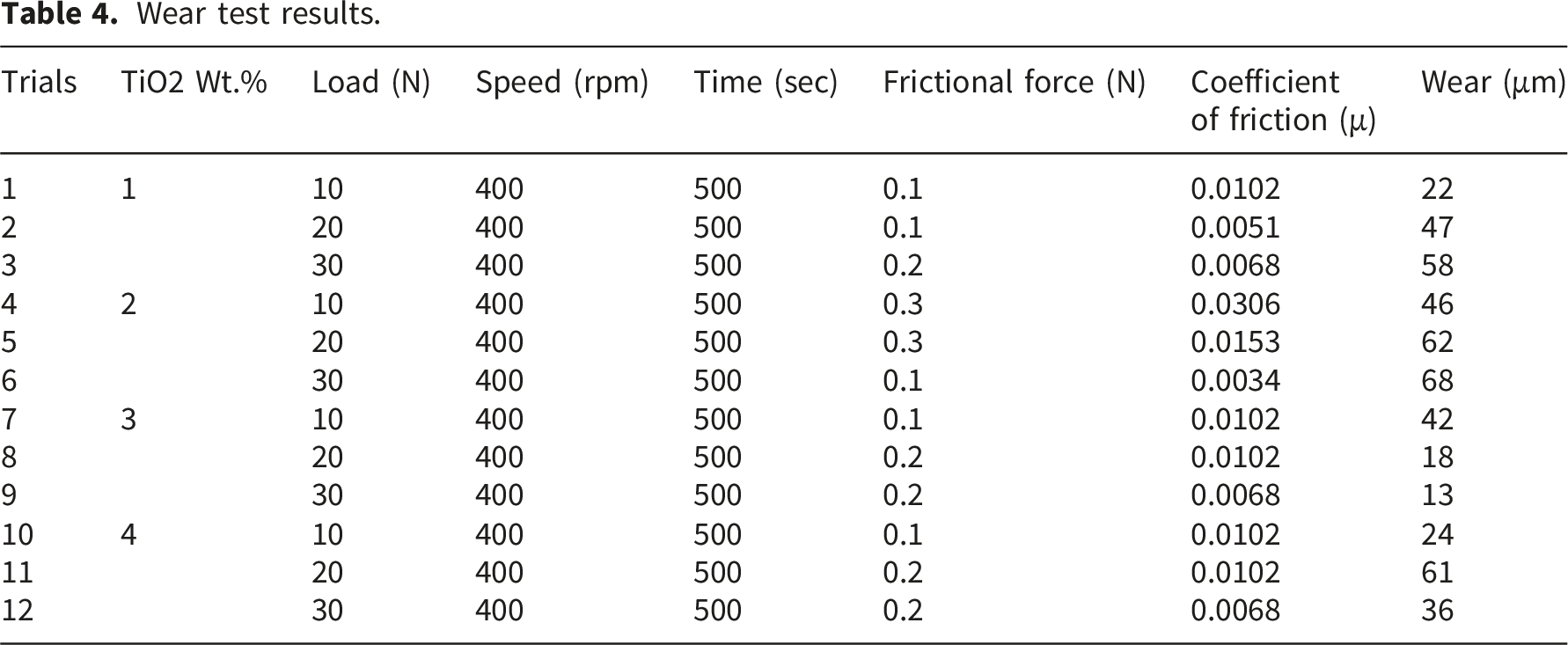
Particle reinforcement is one of the methods used in natural hybrid composite manufacturing to enhance mechanical characteristics. In this work, four distinct hybrid laminates were prepared using natural fibers and four different weight percentages (Wt.%) of titanium oxide nano filler by the compression molding procedure. Epoxy served as the matrix, and sisal and banana fibers were utilized as natural reinforcements. With the addition of the hybrid fiber reinforcement and TiO2 filler, the mechanical properties of flexural, impact, and tensile characteristics improved greatly (impact energy of 13.452 J, flexural strength of 94.86 MPa, and tensile strength of 18.6 MPa). Mechanical performance was enhanced in polymer-based composites by the addition of 3 Wt. % TiO2 filler. The features are improved by the filler substitutes, which fill the space between the fiber and matrix phases. When 3 weight percent TiO2 (T3) was added, the minimum wear of 13 μm with the Coefficient of Friction 0.0068 was observed for the T3 at a 20 N load, with a frictional force of 0.2 N.
Introduction
Researchers are interested in using natural fibers (NF), which are renewable and sustainable resources, as reinforcement in polymers to replace synthetic fibers. Hydrophobic characteristics are typically found in polymers, whereas hydrophilic characteristics are seen in NF. Due to the advantages of these materials, the automotive industry and others have become increasingly interested in them. NF composites present numerous benefits compared to synthetic fiber composites, including affordability, biodegradability, reduced density, satisfactory specific properties, insulation, improved thermal characteristics, and lower energy usage in processing, among others. 1 Banana is a lignocellulosic fiber sourced from the stem of the plant, known for its superior mechanical characteristics. Additionally, among the 130 nations that grow bananas, India stands as the top producer, accounting for 27% of global production. Karnataka is one of the leading states in India for banana cultivation. Bananas are also grown in several states of South India, such as Tamil Nadu (TN), Maharashtra (MH), Kerala (KL), and Andhra Pradesh (AP). Similarly, they are also grown in Northeast India, including Assam (AS) and Gujarat (GJ). Banana fibers (BF) are a byproduct of their cultivation; therefore, the source can be accessed for industrial uses without any investment. Numerous studies have examined natural fibers for various purposes due to their suitable stiffness, excellent disposability, and renewability. Additionally, they can be recycled and are capable of biodegradation. Plant fibers are naturally hydrophilic, containing approximately 8–13% moisture and featuring cellulose within their cell structure. Besides cellulose, plant fibers are composed of various natural components, including lignin, hemicellulose, pectin, and waxy substances. The amount of lignin in plant fiber affects its structure, characteristics, and form. 2 Banana fibers demonstrate significant tensile strength and minimal elongation before breaking. Consequently, utilizing these fibers to prepare hybrid composites as a reinforcement in resin-based composites may offer new opportunities in various fields such as automobile, Civil, and engineering applications. Banana cultivation is highly favored in India; the ability to reuse these pseudo stems could greatly benefit the economy. 3 The sisal plant belongs to the Agavaceae family, which produces stiff fibers typically used in the production of twine and rope. These fibers are entirely biodegradable, a renewable energy source, remarkably robust, and easy to maintain, exhibiting minimal wear and tear resistance. Sisal fiber (SF) serves as an excellent raw material for manufacturing natural fiber composites (NFCs). Many NFCs are densely packed with natural fibers to reduce product costs, resulting in a poor interfacial relationship between the fibers and the soft matrix. To properly construct an enhanced performance in NFC, the primary issue that must be addressed is interfacial compatibility. SF is a type of perennial tropical natural fiber distinguished by a high aspect ratio, better stiffness, and robust texture with greater tensile strength and resistance to friction. Generally, products such as carpets, ropes, burlap bags, textiles, and paper. The usage of SF in these items is modest and provides little extra benefit. SF can be used to make NFCs, which is one of the most valuable uses expanding quickly recently. 4 Among the various natural fibers, sisal and banana exhibit excellent mechanical characteristics. 5 Epoxy resin is widely utilized as the matrix substance in creating NFC for various structural and industrial uses due to its improved dimensional stability, excellent adhesion, and high resistance to chemicals and heat. 6 Since using this epoxy as a matrix, which is used to improve the mechanical, thermal, and electrical qualities of the NFC. The introduction of nano fillers promotes the interfacial adhesion and load transfer among composite components, resulting in exceptional mechanical properties. 7
The hybridization of NF was employed to address limitations such as reduced tensile, flexural, and impact strengths. In recent years, nano-reinforcements have been added to conventional ablative composite materials to achieve property improvements.8–10 According to recent studies, the mechanical features and abrasive qualities of the NFCs are greatly improved by nano fillers. With nano TiO2 filler, the mechanical properties of the carbon epoxy composite (CEC) were enhanced because the filler is more rigid than the matrix. The higher the filler supply %, the more difficult the CEC becomes. At all abrading distances, regardless of load intensity, the inclusion of nano TiO2 decreased the wear loss of the CEC.TiO2 nano filler, which displays less wear loss than unfilled CE composites, also shows a similar pattern as abrading distance and load increase. When filler is added, the CE composite’s wear rate lowers at both loads because the hard filler particles reinforce the bond between the fiber and the filler-filled matrix and prevent carbon fracture. Incorporating nano TiO2 filler increases the tensile strength and hardness of CE composites while decreasing wear loss. The mechanical and vibrational characteristics of pineapple, banana, and sisal fibers were enhanced by the application of chemically produced titanium oxide (TiO2) nanopowder. 11 The filler content is the most important factor determining the wear rate, followed by the sliding velocity, according to research on the sliding wear behavior of waste glass dust-filled hemp-epoxy composites and the application of prediction models for the wear study. 12 The tensile, impact, and flexural strengths of hybrid pineapple/sisal, sisal/banana, and banana/pineapple combinations were enhanced by up to 3% TiO2 replacement. At 4%, uneven nano-filler dispersion reduces the mechanical stability of bio-composites. Because of the enhanced surface contact with the resin/hybrid natural fibers and the filler/resin interface, which results in improved composite stiffness and natural frequency, hybrid combinations of pineapple and sisal with 3% TiO2 filler had the greatest natural frequency. Natural frequency and damping characteristics improved by incorporating nano-fillers. Wear and deformation behavior is shown to depend strongly on loading conditions, material structure, and composition, with cyclic stresses causing progressive viscoplastic strain accumulation in HDPE-glass fiber composites, particularly in matrix regions between closely spaced fibers. Granular materials exhibit shape-dependent contact orientations, influencing frictional resistance and wear pathways, while higher-order fabric tensors improve the prediction of these anisotropic behaviors.13–17 The aspects like friction characteristics and energy loss at the peak strain zone in the filler enhance the damping behavior of natural composites. 18 The impact of titanium dioxide (TiO2) particles as a filler material on the dry slide wear performance of natural Ficus Benghalensis (FB) fiber-reinforced hybrid polymer composites has been studied. The sliding distance and normal load had very little effect on the sliding wear rate, whereas the fiber content had the biggest impact, followed by the sliding velocity. The possibility of using TiO2 as a filler to enhance the mechanical and wear characteristics of Ficus Benghalensis/epoxy matrix composites. 19 When Sisal/Pineapple fiber reinforcement (1:1 ratio) and TiO2 filler were added, the mechanical properties of flexural, impact, and tensile characteristics significantly improved. The mechanical performance of the 40 Wt. % Sisal pineapple and 5 Wt.% TiO2 mixture was enhanced. The addition of a high TiO2 filler (5 weight percent) to the polymer-based composites resulted in a lower Specific Wear Rate (SWR), according to the Taguchi optimization results. By filling in the gaps between the fiber and matrix phases, the filler substitutes enhance the characteristics. 20 The graphene acts as a nano-filler to improve the mechanical properties of hybrid polymer matrix composites reinforced with cotton/viscose fabric. The NFC with banana/jute fiber using a compression moulding technique with rice husk filler percentages of 1-3 Wt.%. The mechanical properties of the hybrid composite were enhanced through the addition of rice husk as a filler. The inclusion of 3 Wt. % of rice husks yields the highest tensile strength and tensile modulus. 21 This study aims to evaluate the impact of the TiO2 nano filler on the mechanical and wear properties of banana/sisal hybrid composites fabricated via compression molding with epoxy as the matrix. By incorporating varying weight percentages of TiO2, the research seeks to enhance interfacial bonding, improving tensile, flexural, and impact strengths, as well as wear resistance and frictional behavior. The work also investigates the TiO2 loading to maximize performance while analyzing fracture surfaces to understand failure mechanisms. Ultimately, this study demonstrates that TiO2 nano filler significantly improves the durability and mechanical characteristics of natural fiber composites, promoting their sustainable use in industrial applications.
Preparing TiO2 filler hybrid composite
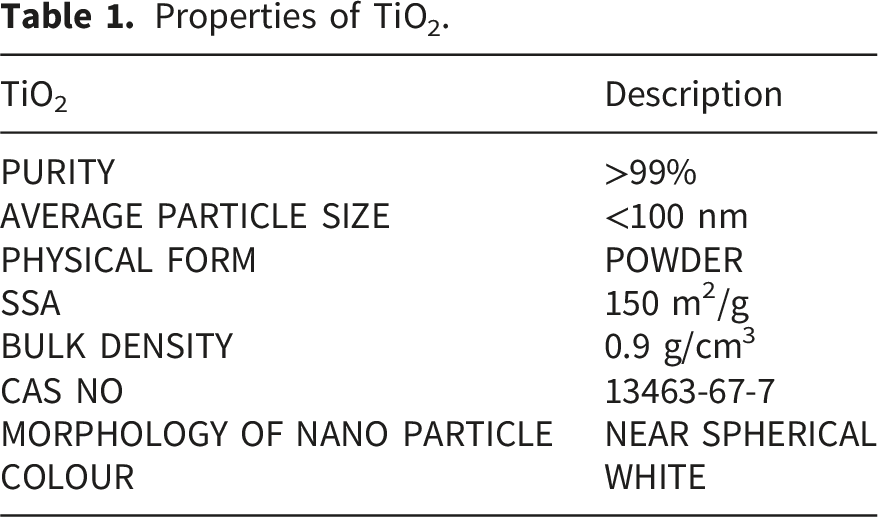
Properties of TiO2.
Testing of composites
A Charpy Impact Tester was used to determine the impact strength of hybrid natural composites, while a Universal Testing Machine (UTM) was used for tensile and flexural tests. ASTM D 638, ASTM D 790, and ASTM D 256 standards were used for tensile, flexural, and impact tests. A dumbbell specimen with a gauge length of 50 mm and a crosshead speed of 2 mm/min was used for a tensile test. Flexural and impact tests were performed using a rectangular workpiece with dimensions of 125 × 13 × 3 mm. The wear and friction properties of the produced hybrid NFC were investigated using a pin-on-disc machine with a disc diameter of 150 mm and a track diameter of 100 mm. The ASTM G99 standard was followed in conducting the test, and silicon carbide abrasive paper of grade 1200 was used to polish the testing specimen’s counter face (65 × 13 × 3 mm).
23
Each combination was examined three times.
To identify the structure and existence of TiO2 nano-powder, SEM testing was performed using the QUANTA 200 MODEL machine from ICON ANALYTICAL.
Results and discussion
Mechanical properties of TiO2 hybrid composite.


Tensile and Flexural properties of TiO2 hybrid composites.
The tensile strength is increased by adding TiO2 as secondary reinforcement, as the TiO2 nanoparticles are hard. 11 A decrease in tensile strength was noticed for the 4 Wt.% TiO2 (T4) of 16.06 MPa. A decrease in wettability, leading to a sticking characteristic known as agglomeration, above 3% filler, exhibited a decline in the tensile properties of NFC. 24 The combination of 3 Wt.% TiO2 showed tensile strength. The inclusion of nano fillers decreases the void space between the natural fiber and the epoxy matrix, thereby enhancing the tensile properties of the composite. 24 The mechanical characteristics of the banana/sisal fiber-reinforced hybrid composite were improved by using TiO2. The incorporation of TiO2 boosts the surface area of the matrix material, resulting in an interfacial bond between the fiber and the matrix. 21 The smaller particle size of the filler leads to better adhesion and interfacial stiffness, which improves stress transfer and elastic deformation in NFC, thereby enhancing their tensile properties. 25 The addition of sugarcane bagasse ash nano fillers up to 5 Wt.% results in a uniform distribution of filler within the sisal, flax, banana, and kenaf natural fiber/epoxy matrix blend. 24 The addition of filler also improves flexural properties. The composites experienced enhanced stress transfer due to robust bonding between the fibers and matrix, enabling elastic deformation. The maximum flexural strength is observed at 3 Wt.% of TiO2 addition of 94.86 MPa. Agglomeration leads to a decrease in flexural properties when nano addition exceeds 3 Wt.%. 24 Strong hydrogen bonds were formed because of the epoxy matrix’s higher polarity, which enhanced the hybrid natural composites’ flexural qualities. Viscosity increases with higher filler replacement at higher weight percentages, activating internal component porosities and reducing flexural characteristics. 26
Void validation.

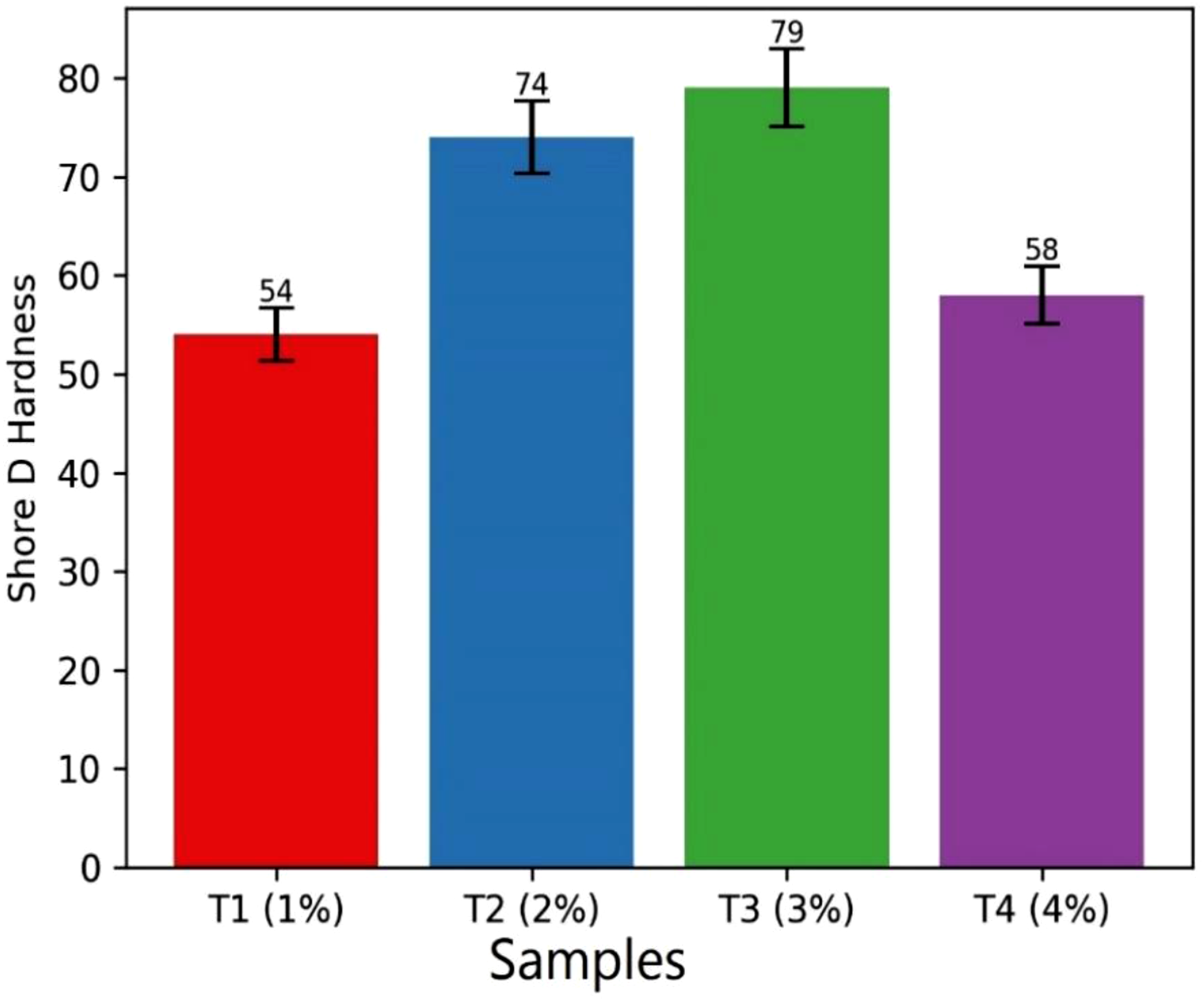
The greatest improvement in impact strength characteristics (Figure 2) was noted at T3, 13.45 J, and the same combination also produced the highest hardness of 79 (Figure 3). This demonstrated the importance of incorporating TIO2 filler in improving the mechanical properties of epoxy-based polymer composites. Impact results for different Wt% of Tio2. Hardness results.
The fiber pullout was observed in Figure 4 of T1. The T3 combinations achieve a result with enhanced bonding between fiber and matrix, with less fiber pullout, resulting in improved properties. The SEM results demonstrated improvements in morphological features due to the nano-filler incorporation. The SEM results demonstrated improvements in morphological features resulting from the incorporation of nano-fillers. The addition of filler decreases the pores between the reinforcement and matrix phases, thereby improving the compatibility of the polymer-based composite.
18
SEM analysis after tensile test of T1, T2, T3, and T4.
The inclusion of filler improves the bonding strength between reinforcements and epoxy-based composites. The mix of fiber reinforcements provided sufficient adhesion to the epoxy matrix, enhancing the wear resistance of NFC. 2 27 The incorporation of nanoparticles markedly demonstrated beneficial properties for biobased fibers, improving their usability. 28
Wear test results.
Statistical analysis of wear and coefficient of friction.

Practical implications
The observed enhancement in tensile, flexural, impact, and hardness characteristics at 2–3 Wt. % TiO2 suggests that the developed banana/sisal hybrid composites can be considered for lightweight and semi-structural applications. The combination of reduced wear rate and improved hardness supports potential use in tribological components, such as low-load bearings, sliding pads, domestic appliance parts, and automotive interior elements, where a balance between strength, durability, and sustainability is required. The use of naturally derived fibers also aligns with the current industrial trend toward low-density, renewable, and biodegradable composite materials.
Future work
Fiber surface modification to further enhance fiber–matrix bonding
Long-term durability studies, including moisture conditioning, UV exposure, and thermo-oxidative aging.
Fatigue and creep testing to evaluate performance under repeated or sustained loading conditions.
Hybrid reinforcement strategies, combining TiO2 nanoparticles with other nano/micro fillers to optimize multi-functional performance.
Wear surface morphology to enhance the depth of tribological evaluation.
Conclusion
The hybrid composite of banana and sisal fibers with different TiO2 fillers has been prepared, and the following mechanical and wear properties have been evaluated. • The particle reinforcement of TiO2 filler in the hybrid banana/sisal composition resulted in a significant improvement in tensile, flexural, and impact properties. • The 3 wt.% TiO2 addition (T3) resulted in maximum mechanical parameters, including tensile strength of 18.6 MPa, flexural strength of 94.86 MPa, and impact strength of 13.452 • The agglomeration effect harms the properties of the hybrid composites at the higher level of particle reinforcement (T4). • The minimum wear of 13 μm with the Coefficient of Friction 0.0068 was observed for T3 at a 20 N load, with a frictional force of 0.2 N.
Footnotes

Funding
The authors received no financial support for the research, authorship, and/or publication of this article.
Declaration of conflicting interests
The authors declared no potential conflicts of interest with respect to the research, authorship, and/or publication of this article.
Data Availability Statement
The datasets used and analyzed during the current study are available from the corresponding author on request.