







Abstract
Juan Antonio Vallejo-Nágera, psychiatrist, painter and writer, wrote a widely adopted textbook of psychiatry in Spanish- and Portuguese-speaking countries, particularly during the 1970s, the famous Introducción a la psiquiatría. There, he advanced the concept of soteric neurosis, a condition regarded as a ‘mirror image’ of phobias and similar to the diagnostic entity described in DSM-5 under the heading of hoarding disorder. Indeed, much earlier than the recent nosological discussions on hoarding, Vallejo-Nágera already reported soteric neurosis to be distinct from obsessive-compulsive disorder and to be associated with excessive attachment to objects and positive affect (pleasure), leading to accumulation, decreased treatment seeking, increasing interference in daily activities and blurred boundaries with normality. Vallejo-Nágera also made several predictions, including the propensity soteric neurosis patients may have towards the development of separation anxiety, obesity and other ‘masked’ symptoms. In the light of his original and insightful contributions to the concept of hoarding disorder, it would be interesting to assess his hypotheses in future studies.
Keywords
Introduction
Juan Antonio Vallejo-Nágera was born in Oviedo, Spain. 1 He studied medicine at the University of Madrid and obtained his doctorate in 1951. He specialized in neuropsychiatry and obtained several distinctions throughout his career. His father, Dr Antonio Vallejo-Nágera (1889–1960), was a controversial Professor of Psychiatry at the University of Madrid who has been criticized for his radical ideas and connections to ultranationalism and eugenics. 2 When he retired in 1959, the Chair of Psychiatry in Madrid was left vacant and Dr JA Vallejo-Nágera became the acting Chair for the next two years. Professor Juan José López Ibor, who later was elected as Chair, invited Dr JA Vallejo-Nágera to continue as a Professor within the same Department where he continued to work for the next 25 years until the retirement of Dr. Lopez Ibór. 1 In 1974, he left academic life and, in 1982, stopped seeing patients. A religious citizen, Dr JA Vallejo-Nágera spent the last days of his life studying the catechism. He died of pancreatic cancer in 1990. 1
Dr JA Vallejo-Nágera has been described as a ‘humanist’. 1 However, he declared himself as a ‘right-wing bourgeois that hated the demagogy that impregnates democracy’. 3 He was not sympathetic to politics either since, according to him, it requires ‘manipulating men and leaving loyalties in the lurch’. 3 As a medical writer, however, Dr JA Vallejo-Nágera published at least two famous books, namely Psiquiatría Clínica 4 and Introducción a la psiquiatría. 5 He also succeeded in other areas including painting, bookbinding and writing, and he won an important Spanish literature prize (Prêmio Planeta). 6
According to a recent book edited by the World Psychiatric Association, ‘if there was ever a book on psychiatry which has influence in the training of Spanish doctors during the transition [namely the years preceding and following the advent of DSM-III], it was that penned by JA Vallejo-Nágera [son]’. 7 Not only was his Introducción a la psiquiatría 5 used by the vast majority of Spanish medical students, 7 it was also heavily influential in other Spanish- and Portuguese-speaking countries across the world, including Brazil. Perhaps one of the most original contributions of JA Vallejo-Nágera in his textbook was the then new description of the condition named ‘soteric neurosis’.
Soteric neurosis
To JA Vallejo-Nágera, soteria (the Greek divinity who personified safety or recovery 8 ) was the opposite of phobia (‘el síntoma opuesto en espejo a la fobia’). 5 More specifically, he described it as ‘a reaction to certain stimuli, which gives an absurd and unjustified sense of safety and protection’. Similar to phobias, soteria was ‘a psychological mechanism that one observes in otherwise normal people’. JA Vallejo-Nágera regarded talismans, amulets, pets and horseshoes as soteric objects. 5 According to him, the individual with soteric neurosis typically knew there is no cause and effect relationship between the soteric object (or act) and its derived protection or fortune. Nonetheless, affected individuals reported feeling less anxious by possessing such objects or engaging in such activities. JA Vallejo-Nágera suggested that the ‘exaggeration of the soteric mechanisms, to the point of interfering with the subject’s normal activities’, formed ‘a type of neurosis’. 5
According to JA Vallejo-Nágera, the clinical picture of soteric neurosis was less prominent and stressful to the patient than the phobias. Generally, patients sought treatment at later stages or did not show up to treatment at all, since the objects were considered ‘sources of pleasure’. 5 This would differ markedly from phobias where ‘objects’ were invariably associated with the experience of increased anxiety. Critically, JA Vallejo-Nágera believed that manifestations of soteric neurosis were limited to the accumulation of soteric objects. 5 However, in some instances the patient could not separate himself from a person or situation, with ensuing limitations for his or her life. To JA Vallejo-Nágera the symptom could sometimes be masked, thus resulting in difficulties in identifying its soteric qualities, ‘as in the forms of obesity due to overeating’.
JA Vallejo-Nágera proposed a psychodynamic model for soteric neurosis. 5 He argued that this condition was similar to a phobia where the object (in this case soteric) would symbolize the primary source of safety and comfort, i.e. the mother figure. Specifically, he was not referring to the mother as she really was but to an idealized character that one usually experiences in first infancy, i.e. a protecting being that avoids all evils and satisfies all children’s needs. JA Vallejo-Nágera argued that psychotherapy was the treatment of choice for soteric neurosis and that this approach should aim at unravelling the defence mechanisms of projection, transference and displacement of the maternal object that seem to play a key role in its pathogenesis. 5
Discussion
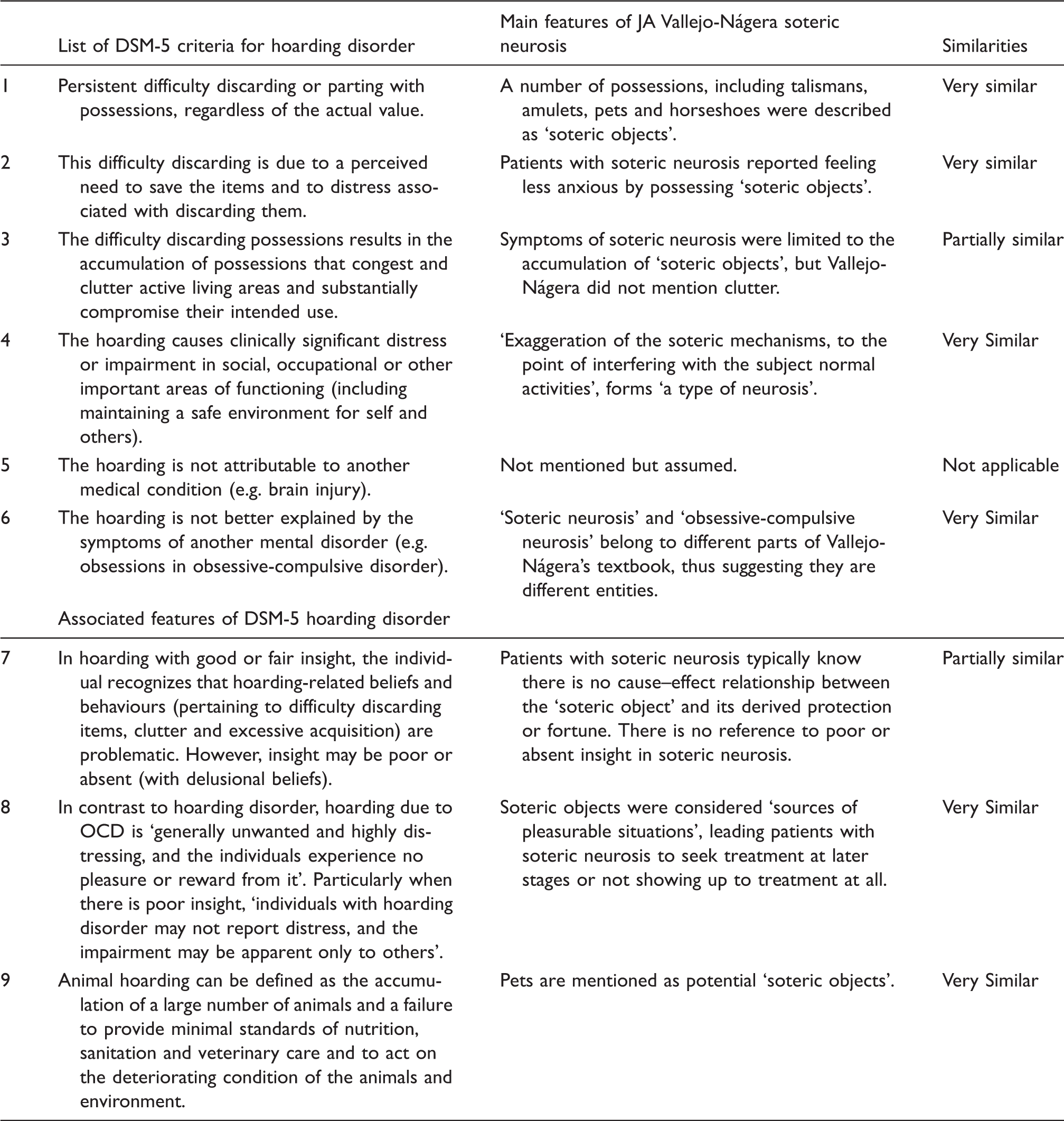
While JA Vallejo-Nágera provided general guidelines to differentiate soteric neurosis from phobias, as described above, he did not clearly address the shared versus distinct features between soteric neurosis and other obsessive-compulsive spectrum disorders. Apparently, JA Vallejo-Nágera considered obsessional and soteric neurosis as different entities since each was discussed in distinctive sections of his textbook. One could argue speculatively that, in contrast to obsessive-compulsive disorder (OCD), JA Vallejo-Nágera’s descriptions of soteric neurosis lacked typical obsessions and compulsions. Instead, its critical symptoms would be a superstitious over-attachment to objects. On the other hand, greater difficulties may arise when attempting to differentiate soteric neurosis from hoarding disorder, a newly approved diagnostic category in DSM-5. 9
Although the interest in hoarding as a symptom of OCD and obsessive-compulsive personality disorder (‘anal traits’) emerged earlier than the publication of JA Vallejo-Nágera’s book,10,11 he reported in the 1960s many of the features associated with hoarding as a sui generis nosological entity. Similar to soteric neurosis, which has been classified separately from OCD, hoarding disorder has been differentiated from OCD on many different levels including clinical, cognitive and biological. 12 In spite of this, hoarding disorder remains in the DSM-5 chapter of OCD and related disorders, based on the traditional link between hoarding and OCD spectrum (i.e. that hoarders are usually seen in OCD clinics). 12
Excessive attachment to objects is a critical component of hoarding disorder. In this condition, items are generally hoarded because of their emotional significance (e.g. association with a significant event, person, place or time), their instrumental characteristics (e.g. usefulness) and their intrinsic values (e.g. aesthetic qualities). 13 Although not specifically cited in this list, the sense of safety and protection mentioned by JA Vallejo-Nágera in regard to soteric neurosis could well fit with any of these reasons. For instance, soteric objects, talismans or amulets, may be hoarded for the emotional memories the owner associates with them, for warding off unforeseen ‘evil eyes’ and as decorative pieces with unique aesthetic qualities. Although JA Vallejo-Nágera did not mention recurrent and persistent thoughts, urges and images (obsessions) in his description, soteric neurosis symptoms could also be interpreted as mere superstitions in which case its associated hoarding symptoms could be better described as secondary to OCD. In fact, the diagnostic boundaries between hoarding disorder and hoarding due to superstitious thoughts can be blurred and deserve further investigation. 14
Finally accumulation, a key hoarding disorder symptom, was also described by JA Vallejo-Nágera, albeit superficially, in his portrayal of soteric neurosis. He believed that manifestations of soteric neurosis were limited to the collection of soteric objects. 5 Nevertheless, he did not refer to clutter. In DSM-5, the diagnosis of hoarding disorder requires that difficulty in discarding possessions results in the accumulation of objects that congest and clutter active living areas and substantially compromises their intended use. This might be considered a key point of difference between the concept of hoarding disorder and soteric neurosis. To this end, soteric neurosis could be a broader entity which seems to encapsulate the edges of normality by including individuals who do not have cluttered homes but clearly have excessive attachment to objects or acts.
Comparison between DSM-5 hoarding disorder and JA Vallejo-Nágera’s soteric neurosis.
By mentioning ‘masked forms’ of soteric neurosis, JA Vallejo-Nágera expanded his concept to several DSM-5 disruptive, impulse control and conduct disorders (e.g. kleptomania), substance-related and addictive disorders (e.g. gambling disorder) and paraphilic disorders (e.g. fetishistic disorder). For instance stolen objects (in kleptomania), sexual paraphernalia (in paraphilias) and drugs and alcohol (in addiction) could all represent soteric objects for being associated with attempts to modulate states of emotional discomfort. It is also not uncommon for patients with pathological gambling to be excessively attached to ‘lucky’ numbers or amulets that sometimes can contribute to perpetuate symptoms. While JA Vallejo-Nágera’s hypothesis is interesting, apparently he underestimated the fact that, in psychiatry, expansion of concepts generally leads to less clinical utility. In support of his view, however, emerging neuroscientific evidence suggests that discrete DSM-5 entities are related to a common pathophysiological mechanism involving reward-processing deficits mediated by the dopamine mesocorticolimbic system. 17 In fact, by broadening the concept of soteric neurosis to many other conditions, JA Vallejo-Nágera apparently led to an earlier version of the so-called impulsive-compulsive spectrum. 18
Conclusions
The concept of soteric neurosis is similar to what has been recently termed hoarding disorder in DSM-5. It includes its distinctiveness from OCD, excessive attachment to objects, associated positive affect, resulting accumulation, decreased treatment seeking, increasing interference and blurred boundaries with normality. Nosologists from other parts of the globe sometimes overlook the history of Iberian descriptive psychopathology. Spanish- and Portuguese-speaking authors have provided important contributions to pre-DSM-III psychiatry including the conceptual basis for multiaxial diagnosis (by Professor José Luis Leme Lopes in Brazil), 19 the description of the so-called ‘anxious thymopathy’ as an endogenous condition (by Professor Lopez-Ibór in Spain) 20 and the loss of ‘intentionality’ of consciousness (i.e. atelesis) as the basic cognitive deficits in schizophrenia (by Professor Honório Delgado in Peru). 21 Heavily influenced by the traditional descriptive psychopathology, several Iberian and Latin American authors should not be forgotten. When read carefully, they still have a lot to teach us, given that all modern knowledge starts in the history classroom.