







Abstract

Corrected concordance between woodcuts in Katakura’s Sanka Hatsumō (edition Edo, 1799) and engravings in Van Deventer’s Nieuw Ligt (edition Amsterdam, 1765) and Smellie’s Anatomical Tables (edition Amsterdam, 1765).
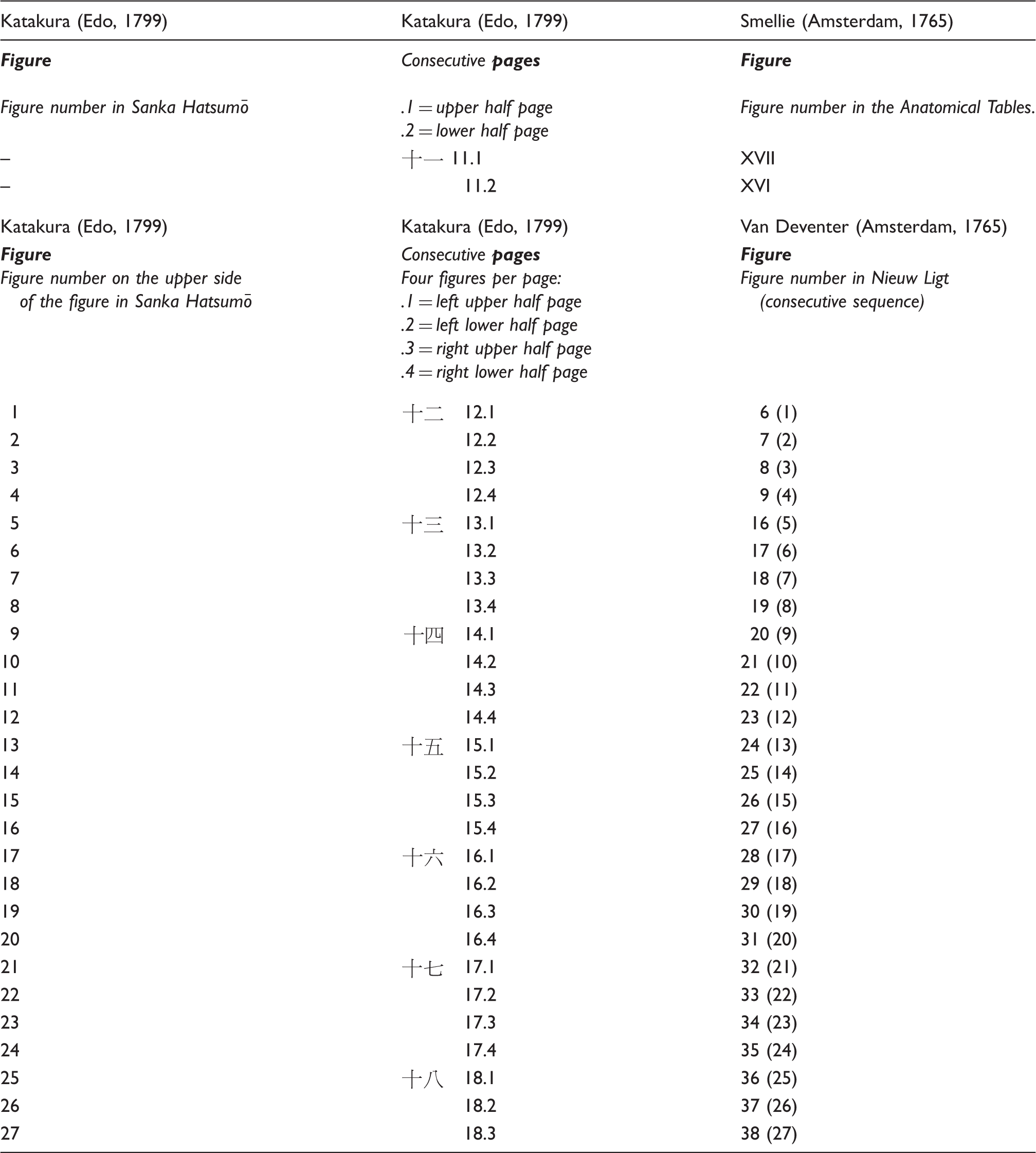
Recently, Professor Mori, head of the library of Nagasaki University, brought to notice that the Japanese woodcut depicted in Figure 1a of this paper 1 bears the number 19 on the upper side of the plate in the original Japanese text, and not the number 8 or 30 as might be expected from Table 1. The writings by Katakura, Van Deventer and Smellie were studied again together with professor Mori and this led to the following conclusions: the page numbers in Katakura’s Sanka Hatsumō refer to both the left page and the following right page in a backward order (old Japanese writings, up to the Meiji era (1868–1912), were read backwards). In each Japanese paper in those days, the page number was placed in the centre of one piece of paper and once folded the numbers appear on the left side of the left pages. The pages are in fact double leaves with a blank side both on the backside of the left and the right paper. These bifolia were bound together. Katakura xylographically printed four figures of Van Deventer on one piece of paper. Treatment of the paper in the manner mentioned above resulted in pages with two figures and a page number on the left pages. The last Van Deventer figure (number 38) was printed on the upper half of a right page (Katakura figure number 27 on page number 18). On the lower half of this page, a black rectangle is printed with the same size as the obstetrical prints.
Incorporation of these data in a corrected version of Table 1 leads to the conclusion that the concordance between the two series of obstetrical illustrations is not random at all but complete.