







Abstract
Professor Juan Negrín López was Prime Minister of the democratically elected left-wing government of Spain for the latter two-and-a-half years of the three-year Civil War which ravaged the country between 1936 and 1939. The side loyal to the government lost, partly because of the generous aid received by their opponents from Germany and Italy, partly because of the Anglo-French agreement, observed by most countries but ignored by Germany and Italy, to outlaw arms supplies to either side, partly because of internal dissent, and partly because of the greater military capability of the enemy. Negrín led the country with tenacity and wisdom, but is remembered with ambivalence in Spain, and hardly at all elsewhere, although he spent the years of his post-war exile in the UK and France. This paper draws attention to a member of the medical profession who achieved both academic and political distinction, but whose career ended in a disaster which he was powerless to prevent. Among his admirable qualities, he should be remembered for his courage. Like most wars, the Spanish Civil War had its share of psychopaths and villains – but also its share of heroes, and Juan Negrín belongs among their number.
Keywords
Introduction
Few doctors have held high offices of state, least of all at a critical time in their nation's history. Juan Negrín was a medical scientist who abandoned the laboratory to devote himself to a more worldly, if ultimately hopeless cause. He played a resolute and prominent role on the world stage during the years leading up to the Second World War (WW2), but history has been unkind to him in his own country, where he became an object of widespread vilification, and he has been largely ignored elsewhere. An extraordinary and admirable man, he showed himself in the end to be a true friend of the western democracies, even though he had every reason to feel that he and his compatriots had been betrayed by them. It is the purpose of this paper to draw attention to his intellectual achievements, his remarkable courage, his phenomenal energy, his personal integrity, and his indefatigable defence of the cause of freedom (Figure 1).
Juan Negrín López: medical scientist and prime minister of the Spanish Republic 1937–1939.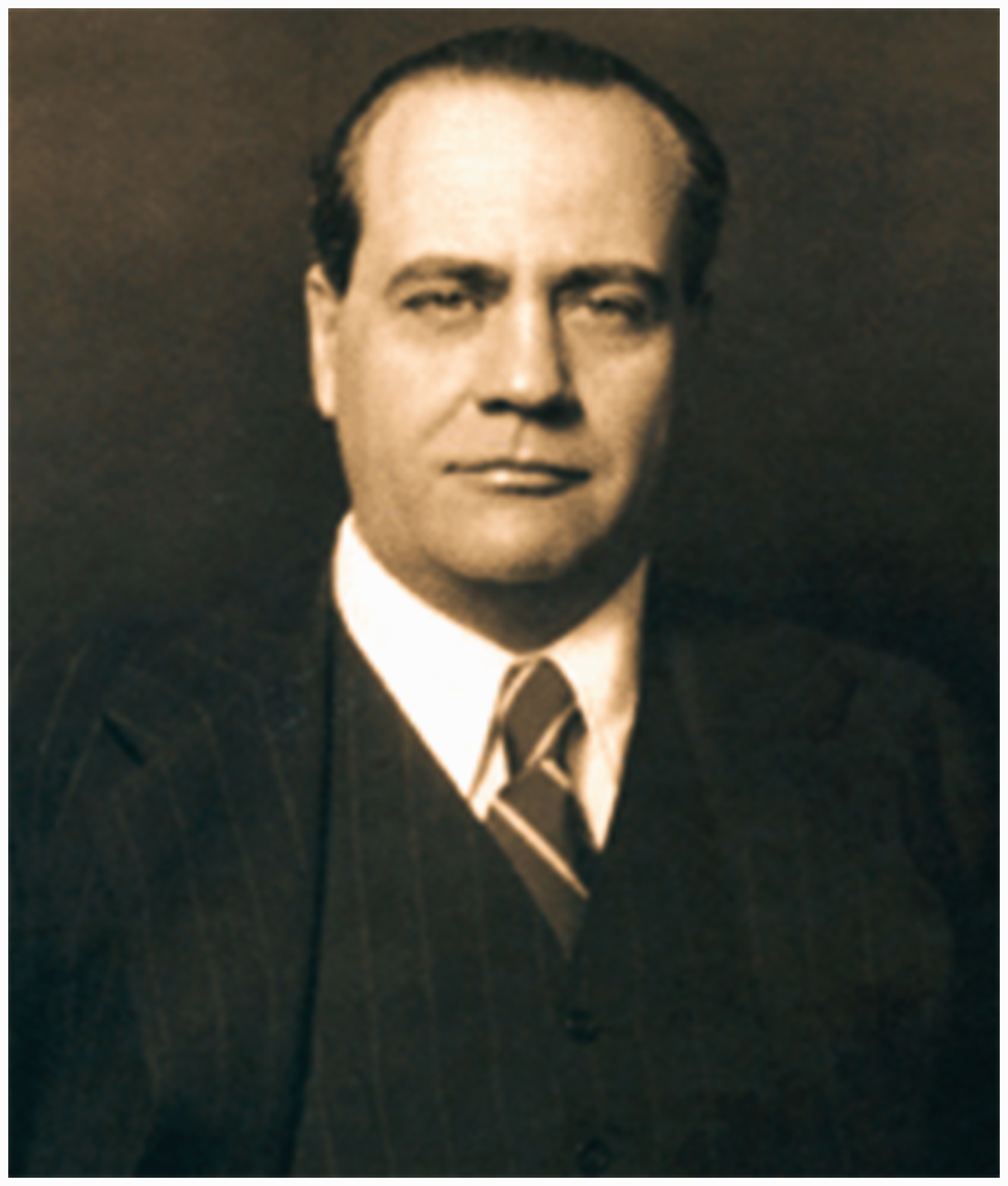
There is an extensive literature surrounding Negrín; the facts of his life have been recorded in several biographies, including an excellent one in English, 1 and several in Spanish of which one in particular discusses his scientific work. 2 The momentous events in which he played such a key role, have been the subject of extensive studies by historians, the most relevant of which is a recent work by Preston. 3 This paper will draw heavily on these accounts in an attempt to review the principal aspects of its subject's life with due attention to the contributions to medicine which he made before, and, in particular, one made after his political career. His work is unfamiliar to physicians and medical scientists in the English-speaking world, even though he found refuge in the UK during WW2.
Education and early life
Juan was born in Las Palmas, in the island of Gran Canaria on 3 February 1892, the eldest of the three children of an extremely prosperous businessman. He went to school in Tenerife where he was an outstanding student, passing the Baccalaureate at the age of 14. For his further education, he went to Germany, a country whose pre-eminence in the sciences had established it as a Mecca for scholars throughout the continent of Europe, and where Spanish medical academics enjoyed a particular affinity with their colleagues. 4 Here, he initially devoted himself to learning German, but having a flair for languages, he also learned English, French, and Italian and picked up a little Russian (subsequently becoming fluent in the first three and embarking on the study of economics in addition) before attending medical school in Kiel for two years and then entering the extremely prestigious Faculty of Medicine at Leipzig University at the age of 16. There, he embraced Socialism, which was becoming a highly influential movement throughout the land. In 1912, he obtained a doctorate in medicine and physiology, and joined the research team of Professor Theodor von Brücke with whom he co-authored five papers over the next four years. In 1914, many of the academic staff departed to join the military, and Negrín became a lecturer in physiology at Leipzig, but in 1915 wartime events necessitated his departure from Germany so abruptly that he was unable to pack a single reprint of any of his publications. 5
In February 1914, he married Maria, an accomplished pianist and daughter of a Ukrainian Jewish businessman who had settled in Germany. Juan was agnostic, but Maria was a Catholic, and their first son was born the same year, and four more children, during the following 10 years. The two girls subsequently died, and the three boys would settle in the United States (US) after the Spanish Civil War, where the eldest, also called Juan, would become a neurosurgeon.
Return to Spain
His precipitate departure from Germany found him once again in Las Palmas, seeking funds to enable him to pursue his research at the Rockefeller Institute or at Harvard. These ambitions were overtaken in 1916 by an offer, keenly supported by Ramón y Cajal, of his appointment as director of the new university physiology laboratory in Madrid. This was an offer he was unable to refuse, but his German degrees, which included a medical qualification, had to be validated in Spain and after attending various courses and submitting a thesis, he passed the necessary examinations with distinction. This enabled him to undertake some medical practice in order to supplement his academic salary and to finance his large family and expensive life-style. His two other income-generating ventures were a private laboratory for clinical analysis, and a publishing company which he established with Julio Álvarez del Vayo (who would remain an enduringly true and loyal friend and served under him as his war-time Minister of State).
In 1922, he was entrusted with the Chair of the Department of Physiology within the reorganised Faculty of Medicine, and the department thrived under his leadership and became the School, or Institute, of Physiology. The laboratory of physiological chemistry came under his wing, and it undertook urine, blood and stool investigations on behalf of the clinics, and this fitted well with his interest in biochemistry. When he became Chairman of the Faculty of Medicine, a position he held until 1934, he initiated a reorganisation of the curriculum to favour physiology at the expense of its traditional competitor, anatomy. During the 20 years which led up to the outbreak of the Civil War, he was very active in the development of the Medical School and played a major role in planning the University City, eventually becoming Secretary of its Construction Committee. 6 He was thus in an unassailable position to establish the direction which research in biomedical science would follow, and the structure and organization of teaching in medicine.
Because he was appointed to a position of such responsibility so young, his greatest achievements seem to have been administrative, and he was very good at attracting, selecting and nurturing talented students whose later publications would resound throughout the world of physiology, and at building a prestigious research and teaching department. 7 In any event, he surrounded himself with a team of gifted graduate students who made valuable contributions to various aspects of biomedical science both when working under him, and subsequently. The best known of these was Severo Ochoa de Albornoz who worked in physiology and biochemistry, but wisely left Spain on the outbreak of the Civil War. He settled in New York, where his work on the synthesis of RNA earned him a Nobel prize in 1959.
In 1925, Negrín's marriage started to unravel, but sufficiently amicably that he and his wife continued to live in the same house. During the same year, he met the young woman with whom he was to spend the next 30 years, called Feliciana López de Dom Pablo or ‘Féli’, a schoolmate of the daughter of his close friend the leading socialist Indalecio Prieto, a friendship which spectacularly failed to survive the gruelling years ahead.
Scientific achievements
The thesis which he submitted in Madrid was a continuation of the work he had begun in Leipzig, in collaboration with von Brücke, on the chromaffin cells of the adrenal medulla and on the role of the autonomic nervous system in the regulation of vascular tone. Using anaesthetised dogs and rabbits, he had developed the techniques of dividing the splanchnic nerves just below their emergence from the diaphragm, and of stimulating the left one which, unlike the right, sends branches to both suprarenal glands. Unlike earlier authors, he found the fall in blood pressure following section of the nerves to be inconstant and transient and possibly simply due to shock related to the surgical procedure and manipulation of the viscera. To minimise this confounding factor, he divided the vagus nerves and he used a lumbar approach to gain access to the sympathetic nervous system. Stimulation caused a fall in blood pressure followed by a secondary elevation, which he attributed to the secretion of adrenalin, concluding that the adrenal medulla played an important role in the regulation of vascular tone. The rate of secretion of the hormone, he considered, varied according to the demands of the moment. He turned his attention also to the phenomenon which Claude Bernard had described and labelled ‘piqûre’ diabetes 70 years previously when he noted transient hyperglycaemia after puncturing the floor of the fourth ventricle, and Negrín used a technique for estimating blood sugar levels which he had himself developed. 2
His biochemical interests extended to studies into the control of calcium levels in the plasma, and on comparative concentrations of vitamin A in the livers of cod and of tuna. 8 He and his co-workers also developed a number of instruments and techniques, 9 although his own publications while professor of physiology were comparatively sparse, and he scorned the professorial custom of including his own name in the authorship of papers generated entirely by junior members of his team. Tragically, this centre of excellence so painstakingly assembled would, like many others, 10 be destroyed by the Civil War.
Change of direction: politics in a Spain awash with blood
Juan Negrín joined the Socialist Party in 1929, and was a member of the socialist minority in all three of the coalitions which governed the Second Republic during the five years of relative peace which followed its inception in 1931, and then throughout the three years of brutal Civil War which were the result of the military rebellion in July 1936. This calamitous event took the government, but few other people, by surprise.
The two opposing sides resolved themselves into the insurgent Nationalists led by General Franco, and the disparate and sometimes violently clashing factions loyal to the legitimate, moderately left-wing ‘Popular Front’ government collectively termed Republicans. The front line between them divided Republican (‘red’) Spain from the rebel (‘white’) zone, and it quickly became established through the Guadarrama mountains to the north of Madrid. Negrín soon started to pay regular visits there to learn something of the craft of soldiering and to help in the construction of defences, as well as bringing such supplies as he was able, in his car. Throughout the war and afterwards, barbarities were systematically inflicted on their compatriots by the rebels. During the early months, they were also inflicted on their perceived enemies by squads of militias claiming to represent unions or political parties who would take their victims on one-way trips or paseos with their inevitable conclusion in extra-judicial executions. Negrín would join his colleague and friend Indalecio Prieto, at considerable personal risk, in nightly patrols to clear the streets of these bloodthirsty gangs, and he sometimes slept in a local prison to restrain the guards from assaulting suspected Nationalist sympathisers. He also helped a number of his students from conservative or well-to-do families to hide, or to escape from the capital to the Nationalist zone.
The Civil War changed the direction of innumerable lives in Spain and in a number of other countries. Juan Negrín was, until it broke out, an academic also engaged in politics, but who, according to a highly respected correspondent, only made one or two speeches when, as chairman of the Finance Committee (a role for which his only qualifications were that he had launched the two successful small businesses mentioned earlier), he had to answer questions; he was later to inform Parliament ‘Thank God I am not a politician, and that I have no intention of ever becoming one’. 11 The war took complete control of his destiny, which was henceforth inextricably bound to that of the Republic which he would serve with indomitable resilience and fortitude, and the newly appointed socialist Prime Minister, Largo Caballero, nominated him as his Finance Minister at the beginning of September 1936. Loyal to his erstwhile colleagues, he appointed as his confidential secretary Rafael Méndez, who, many years later, was to become head of the Mexican Institute of Cardiology. As negotiator for the purchase of foreign arms, an enterprise critical to the survival of the Republic, he appointed an obstetrician called Alejandro Otero. Almost immediately, the Ministry of Finance was thrust centre stage by Stalin's decision to come to the aid of the Republic, and Negrín made a significant and controversial decision. October saw the first landings of Russian arms at Cartagena and Alicante. To pay for these supplies, and as a deposit against further supplies in the future, Largo Caballero and the cabinet acceded to the new finance minister's suggestion that Spain should ship over half of her 700 tons of gold reserves from their place of safe-keeping in the caves of the Cartagena naval base to Moscow. A little over 400 tons of bullion, worth half-a-billion dollars, were loaded in 8000 boxes onto four ships, and arrived in Odessa on 25 October. 12 This is one of the decisions which would lead to the calumny which was heaped on Negrín's head in later years, and he has been widely accused of enjoying far too cosy a relationship with Stalin's regime. It is difficult, in retrospect, to see any alternative means of acquiring the arms, oil, and food that were essential to the continued conduct of the war, since the Nationalists were being most generously provided for by Mussolini and Hitler. Negrín himself robustly countered that the Anglo-French-inspired policy of Non-Intervention, systematically ignored by the Fascist Axis, had rendered the Republic totally dependent on Soviet arms.
These criticisms were reinforced in the wake of the events in Barcelona in May 1937, familiar to anglophone readers through their description by George Orwell. 13 The outcome of that war-within-a-war was that the POUM (Workers’ Party of Marxist Unification, the ‘Trotskyist’ communist party whose militia Orwell had joined) was outlawed and its leader tortured and slaughtered, and other members imprisoned, and its supporters among the anarchist groups were treated with corresponding savagery. The influence of the Stalinist communists, and the Russian ‘advisers’ who helped to organise the armed forces and the intelligence services, became predominant, and this enabled the Republic to develop armed forces based on normal military discipline and to disband the collectives which were in control of industry and agriculture in Aragon, Catalonia and Andalucia. The widespread demand for ‘revolution’ throughout these regions was put on hold, and it was now possible to adopt policies more relevant to a beleaguered state fighting for its survival—but also, security measures which were harsh in the extreme. Largo Caballero, always out of sympathy with the communist political commissars prevalent throughout the army, resigned, and Negrín was offered the poisoned chalice by President Azaña in his stead and would remain in office from 17 May 1937 virtually until the defeat of the Second Republic nearly 2 years later.
Personality
Negrín seems to have had a personality that inspired loyalty in his undergraduate and graduate students, and was sociable, humorous, good-natured, and possessed of an optimistic outlook on life which would stand him in good stead in the grim years to come. He was a good communicator, although, curiously in a politician, he is said to have lacked a gift for oratory and used to leave most of the undergraduate lecturing duties to his juniors. His personal life typified what has become known as ‘champagne socialism’ and he lived like the wealthy man that he was, dwelling in a very desirable area of Madrid, being invariably smartly dressed, and delighting in excellent meals and wines, luxurious cars, restaurants and theatres.
In a country torn by conflicting political and religious passions, Negrín brought to his office a much-needed voice of reason. For example, although agnostic, he was keen to end anticlerical violence and to restore religious freedom. He was, however, most irregular in his personal habits, and rejected a fixed timetable for meals or sleep; he was an irritating boss, since he was reluctant to attend to paperwork and was followed around by secretaries with cases of documents needing his attention, whom he treated with unfailing courtesy. It is not surprising that he has left exceedingly little in the way of personal archives or diaries, let alone memoirs. There are also surprisingly few photographs of him, as he was a most reluctant subject for the camera. 14 Impatient with protocol and often authoritarian, he would run cabinet meetings without any formal agenda, and often started late or cancelled them at the last minute. Among the many paradoxes of his nature, however, he nevertheless established a reputation as an efficient administrator at the Ministry of Finance.
Two characteristics are indisputable; he had prodigious energy, and enormous physical courage. Numerous examples of the latter quality are mentioned in this paper. Of his energy, the greatly admired correspondent of the Daily Telegraph commented ‘He might say good-bye to his friends at four o’clock in the morning, but at 8.30 sharp he would drive up to his office at the University City in his car’. The same writer observed that his ‘chief impression of him was of his strong pity for human suffering’. 15 Martha Gelhorn described him in extremely warm terms after nearly three punishing years of war. ‘Negrín is a really great man, I believe… and it's so strange and moving to think of that man who surely never wanted to be prime minister of anything being pushed by events and history into a position which he has heroically filled… he used to be a brilliant gay lazy man with strong beliefs and perhaps too much sense of humour. He was it seems never afraid and loved his friends and his ideas about Spain and drinking and eating and just being alive. Now… he has a 20-hour working day’. 16
War leader
There are plenty of Prime Ministers who have inherited a weak set of cards, but the hand that Juan Negrín found himself holding would have deterred a less determined man. The cards were heavily stacked in favour of the insurgents, who had a fine army raised and trained in Spanish North Africa as well as over one-third of the army in the Peninsula including a majority of the officers, and they received generous support from Hitler and Mussolini in terms of arms and men, in spite of the Non-Intervention agreement which was strangling the Republic. Negrín felt that he held two strong cards, however; the first was the good relationship he enjoyed, and continued to cultivate, with the Kremlin, partly through his friend Marcelino Pascua, eminent physician and ambassador to Moscow. It may be noted in parenthesis that the medical profession was well represented in the higher echelons of government in the Spanish Republic, almost constituting a ‘medicocracy’, but not at all in the rebel government which would replace it. The other card in which he placed his trust was his belief that, provided that the Republic could hold out for long enough, the UK and France would eventually come to its aid, as soon as the widely predicted WW2 broke out; otherwise, he reasoned, Franco would enter the war on the side of the Axis and Gibraltar would be lost to the Allies, and with it, control of the Straits. He retained, in addition to his premiership, the portfolio of finance, and control of the 50,000 strong Carabineros, the border guards who provided the PM's personal protection and which his elder son Juan joined as a medical officer (his future career in the USA has already been noted; his other son, Rómulo, was a fighter pilot in the Republican Air Force and was shot down, but was lucky enough to parachute into Republican territory).
In spite of the confidence which he continued to profess, and the resolve which he urged on his constituents, military defeat looked increasingly inevitable over the ensuing 18 months, and the progressively dwindling zone which he governed ran short of essential supplies of all kinds. The starving nation was ultimately sustained by a diet whose staple ingredient was lentils, which became known as ‘Doctor Negrín's little resistance pills’. 17 He assumed the Ministry of Defence in April 1938, having dismissed his old friend, the defeatist Indalecio Prieto whose bitter enmity he had to endure thereafter. His relationship with President Azaña was also deteriorating, for similar reasons, but he enjoyed the loyal support of a number of staunch colleagues.
By the autumn of 1937, and after less than six months in office, Negrín had gone a long way towards restoring law and order and something approaching normality to civilian life, and towards the creation of an effective army, despite desperate shortages of weapons. In December that year, the army launched an initially successful offensive to capture Teruel. He was an assiduous supporter of the army, and invited his old friend JBS Haldane (‘JBS’), the ebullient communist professor of physiology and genetics at University College London, to visit the ice-bound Teruel front on Christmas Eve 1937. JBS was an ardent supporter of the Republic, and his stepson Ronnie had become, at just 17, the youngest recruit to the British Battalion of the International Brigades until his repatriation after being shot through the arm at the Battle of Jarama. 18 JBS paid three visits to war-torn Spain during the conflict, to learn about the effects of air-raids and to give lectures to the International Brigades about the effects of gas (which, in the event, was scarcely used) 19 – and was inclined to embark on somewhat foolhardy forays to the front lines. He was undoubtedly ‘the most famous foreign scientific figure to identify himself directly with the cause of the Spanish Republic’. 20 On this occasion, he brought with him his friend the vocalist Paul Robeson, who sang Negro spirituals for the English-speaking Brigaders. Negrín had moved the government to Barcelona at the end of October, and JBS later wrote ‘in Barcelona, in December 1937, at a time when the city was being bombed several times weekly, Dr. Negrín and his cabinet held their meetings on the ground floor of an ordinary house – not even a steel frame building if I remember correctly – near the centre of the city and some distance from any of the really bomb-proof shelters. Dr. Negrín… was also aware of the importance of an example of courage. And the Spanish people realize that if he is their ruler and leader, he is primarily their servant. Being an heroic people, they will only give their allegiance to an heroic man’. 21
Despite the early success of the campaign to take Teruel, it was recaptured by the Nationalists early in 1938 and they then advanced rapidly through Aragon to reach the coast in April, dividing ‘Red’ Spain in two. Franco then advanced south towards Valencia, until the Republicans launched a massive and daring offensive across the River Ebro in the south of Catalonia, which took the enemy completely by surprise; Negrín was once again a frequent visitor to the trenches there. Inevitably, this advance was eventually repulsed, and by the end of the year Franco's troops were storming north through Catalonia and nothing, now, could disguise the fact that they were steadily increasing their control of the country in terms of territory, population, and the strength of their armed forces. By the autumn of that year, Negrín had been engaged in a round of visits to ministers in the UK, France and the USSR to try to enlist their support in the defence of the Republic, and when his efforts went unrewarded, he managed to maintain his habitual optimism that resistance could be continued until the outbreak of the clearly imminent WW2. He felt certain that when the inevitable happened, the liberal democracies would be forced to enter the Spanish conflict in opposition to the Rome-Berlin Axis. By sustaining a demonstrable capability of waging war, he also hoped that Franco might be persuaded to negotiate a settlement whereby whole-scale executions would be averted, and he became increasingly preoccupied with potential arrangements for the evacuation of those liable to be most at risk. He was, however, undermined in all these concerns by President Azaña and by his ministers, most of whom had been convinced of the hopelessness of the Republic's chances since the beginning of the year, and had been engaged in individual attempts at diplomacy. Indeed, many of the Republic's ministers had regarded the war as lost from early 1938 onwards, and Negrín himself had been interested in the possibility of a negotiated peace since the middle of the year, but had been sustained in his lonely policy of continued resistance by repeated votes of confidence in his leadership.
Barcelona fell at the end of January and the cabinet installed itself in Figueras Castle, where the Prime Minister presided over its last meeting on Spanish soil held in the freezing stables of the castle on 1 February. One week later, the Prime Minister met with representatives of the British and French governments, who had urged him to lay down his arms. Negrín refused, unless Franco was willing to accept his three conditions of an independent Spain, in which the people were free to choose their own form of government, with a guarantee of no reprisals. He requested that the diplomats convey his offer of himself as a sacrificial victim, if General Franco would execute him in exchange for the lives of the mass of innocent civilians. Franco ignored the proposal, being determined to eliminate all left-wing organizations together with their leaders, and having no intention of allowing the government of the country to be chosen by democratic process.
On 5 February Juan Negrín joined the mass exodus over the Pyrenees and into exile. After a cabinet meeting in Perpignan, he proceeded to Toulouse, flew to Alicante and thence travelled to Madrid. He was accompanied by several of his ministers, but not, to his dismay, by the President of the Republic who had preceded him across the French frontier and was happily ensconced in Paris, adamantly resisting his Prime Minister's urgent and repeated suggestions, conveyed by Álvarez del Vayo, that he should return to Spain, and formally resigning soon afterwards. Negrín, on the other hand, later declared that had he, himself, not returned, he would have died of shame.
The end of the war
During the last months of the war, Negrín undertook a number of flights from Barcelona to Paris, flown by his personal pilot who on one occasion managed to run out of fuel so that they had to make a forced landing near Orleans, when both men were fortunate enough to escape injury. The nature of these clandestine errands was to squirrel away quantities of gold plate and other forms of treasure belonging to the Spanish state. These were eventually loaded in 120 suitcases onto the Vita, an ocean-going yacht, formerly the property of King Alfonso XIII, at her secret mooring near Le Havre, and were destined for Mexico.
As the situation continued to deteriorate, he had increasing recourse to a ‘kitchen cabinet’ comprising some of his previous medical students and research assistants, a few members of the socialist party, several of them medical, and a few journalists. None of these close associates ever saw him betray the slightest uncertainty regarding eventual victory for the Republic until the very final days. Loyalty was, however, becoming an increasingly scarce commodity. Dissatisfaction had increased in the Cortés (the Spanish legislative assembly) as the war became irretrievably lost, and there was a hostile faction which blamed the Prime Minister and accused him of allowing the communists to control much of the government of the country. He was even accused of prolonging the war pointlessly as part of a plot to rule the country as a dictatorship. Popular sentiment in a nation suffering immense hardship from shortages, malnutrition, and continual bombardment and facing imminent defeat was increasingly out of tune with his rhetoric of resistance. This inevitable dissatisfaction became personified in the form of a colonel by the name of Segismundo Casado, a loyal (to the Republic) career officer who had served with some distinction but whose judgement was clouded by his loathing of communism and improbable alliance with a number of anarchists. It was further clouded by his delusion that lifelong friendships among the upper echelons of Franco's army would enable him to negotiate humanitarian terms for a conclusion of hostilities, and he would thus emerge as the saviour of the nation.
During the first two months of 1939, the strain on Negrín of the implacable ferocity of the insurgents, widespread disloyalty from his own side, and a growing inclination from the community of nations to recognise the Franco regime as the legitimate government of Spain, took its toll, and he began to betray evidence of the intolerable stress he was under. His ‘demeanour in those days was not the same as he had maintained throughout the war and which had won the love and respect of the genuine fighters and millions of Spaniards… Perhaps the coup by Casado and his gang served to release him from the battlefield and bestowed on him the dignity of a man unjustly attacked and a victim of treachery’ 22 ; and it was noted that his attacks of angina were increasing in frequency, and that he always carried his glyceryl trinitrate tablets with him, and took medication for insomnia. 23 Towards the end of February, he and his entourage took up residence in El Poblet, a farmhouse now situated in the eastern suburbs of the town of Elda, 41 km by road inland from Alicante.
A shattering blow was delivered to the Republic on the 5th March by the commander of the fleet, who, following fighting in the port and then bombardment by the Nationalists in Cartagena, with threats of more to come, ordered it to put to sea, contrary to the instructions of the Prime Minister, taking with it the last hopes of escape to relative safety by those loyal to the government. (It sought shelter in a French port in Tunisia, where the crews were interned.) The following day, one of Casado's henchmen announced the seizure of power by a ‘National Council of Defence’ in a radio broadcast, and this military junta ruled for the final three weeks before Franco marched into Madrid and troops throughout the remains of Republican Spain laid down their arms. The war thus ended, ironically, as it had begun – with an uprising by a disaffected minority of the military against an elected government, in order to protect the nation from communist domination. Negrín appears to have been in a state of denial regarding the coup, which took few of his ministers by surprise, but it immediately became clear that the population was heartily sick of the war, and that the army was not disposed to remain loyal to his government, so he started to pack in preparation for departure before the telephone discussions between el Poblet and the junta were completed. According to the army Director of Medical Services, ‘he looked like an invalid without hope’, but the dignity and humanity of his behaviour was superhuman 24 and he composed a message offering to negotiate with the rebels. Learning that Casado's only response was to advance his troops towards Elda with the object of taking him prisoner, Negrín left for Monóvar airfield, where two DC2 aircraft were waiting to transport him and his entourage to France and what would be, for him, permanent exile. They left behind them yet another civil-war-within-a-civil-war, waged by Casado against the communists at the cost of yet a further few hundred lives. As has been clearly demonstrated by Preston, Casado's coup served only to accelerate the collapse of the Republic and fuel the savage reprisals committed by the Franco regime; Negrín later observed that thanks to Casado, the end of the Republic (on 1 April 1939) was mired in ‘catastrophe and shame’. 25
Exile: Paris and London
Negrín's determination to secure the safety of those in the dwindling Republican zone at greatest risk of execution by the victorious Nationalists was thwarted by the efforts of both insurgent regimes (Franco's and now Casado's) to prevent their escape, by the departure of the fleet from Cartagena, and by the reluctance of France to admit a sudden influx of immigrants. Once installed in Paris, however, he strove tirelessly to improve the lot of his fellow exiles through the Service for the Evacuation of Spanish Refugees (SERE), which he established and funded from the treasure which he had shipped to Mexico on the yacht Vita. This organization arranged passage to South America (mainly Mexico) for at least 10,000 refugees, and also some support on their arrival there. Even in this venture he was betrayed, this time by his former friend Indalecio Prieto with whom he had been on extremely hostile terms for many months, but who was now installed in Mexico and seized the treasure, now stored there, to set up a rival body which was able to thrive at the expense of SERE.
A number of other leading figures in the Spanish government were also in Paris at the time, although others had reached Mexico. They tended to fall into two camps, one loyal to Negrín while the other supported Prieto, but the former continued to regard himself as the legitimate leader of a democratic Spanish government in exile for the next five years. He would have preferred to remain in Paris throughout this period, but as the Nazis were approaching the city, he was able to secure passage from Bordeaux in a Greek freighter and disembarked in Wales on 25 June 1940. He invited Azaña and Largo Caballero to accompany him, but both declined. Once in London, he rented an office in Grosvenor Square and gave a number of speeches and attended discussions with leaders of the British Labour Party. Attlee and other prominent socialists favoured official recognition of his ‘government’, but Churchill withheld such recognition, being exceedingly wary of any move which might offend Franco and result in Spain's entry into the World War on the side of the Axis powers. (By 1945 the Mexican rival ‘Republican Government in Exile’ was recognised by many ‘Latin-American and other left-wing countries’.) His presence in London was indeed an embarrassment to the British government, for he pursued political activities in Chile, France, and Mexico although his continued presence here was supposed to be conditional on his abstinence from any such participation, in order to mollify the Spanish dictatorship. 26 His determination to send food parcels to 50 Spaniards in German concentration camps was probably viewed as a political act in some quarters, since the reason leading to their incarceration would have been opposition to the Franco regime. The British Ambassador to Madrid, Sir Samuel Hoare, a long-time apologist for the Generalísimo, tried to arrange his relocation to the USA or Mexico without success, and wrote to Churchill, accusing Negrín of escaping with the national treasure and leaving [his compatriots] to suffer imprisonment and death 27 ; the Franco government also claimed that his life-style in the UK (he had purchased a house outside London) was financed by funds stolen from the Spanish Treasury.
As can be imagined, Negrín's thoughts often dwelled on the civil war, and he had several meetings with Orwell and described to his friend Herbert Matthews, the correspondent of the New York Times, the regrets which he had expressed to the novelist. He unjustly included himself among ‘the irresponsible leaders who, having been unable to prevent a war that was not inevitable, contemptibly surrendered when it could still be fought and won’. 28
Back to science
Although he had long resigned himself to be a politician rather than a scientist, he equipped a laboratory in his home, but made little use of it. He did, however, rekindle a friendship probably born at pre-war scientific conferences, and then nurtured in the frenzy of the Battle for Madrid (October and November 1936; the fighting had, ironically, reached its destructive climax in the University City which Negrín had done so much to create) and then at Teruel – and contacted Professor Haldane. JBS had now been commissioned by the Royal Navy to undertake studies into the effects of high pressure on humans so that techniques could be developed for helping crews to escape from stricken submarines, and like Negrín, he was physically fearless; it was entirely in keeping with the principles of both men that they should volunteer themselves as subjects for an unpleasant and dangerous investigation which would help to save lives in a war in which, in Negrín's case, his own country was only peripherally involved.
When a submarine is damaged or sustains mechanical failure and is unable to rise to the surface, further danger awaits the survivors; they cannot just open the door, step out, and make for the surface. The water is immediately at a far higher pressure than the air in the hull, depending on the depth, so even opening the door ceases to be an option. It had therefore become normal to incorporate an air chamber in the submarine where the crew could become adjusted to the prevailing pressure over a matter of a few minutes and inhale air at this pressure, prior to using the chamber's escape hatch. The pressure itself, however, and the individual constituent gases in air exert harmful effects at these depths, as can the very low temperatures encountered, and, on the way up, as the external pressure decreases, they would become exposed to other hazards, particularly decompression sickness (‘the bends’), and it was known that ascent had to be very gradual to minimise this risk.
Haldane therefore recruited 17 volunteers whose occupations varied from tailor to prime minister, the last mentioned being Juan Negrín, at 48 the oldest, the group also including the intrepid professor himself – and exposed them to air, or various combinations of gases, at ten atmospheres pressure in a cylindrical steel hyperbaric chamber measuring eight feet long by four feet diameter (100 ft
3
or 2.83 m3 capacity) which could hold two, or, ‘at a pinch, three people in a sitting position’
29
(Figure 2). One subject suffered a pneumothorax, and several, including Haldane, experienced seizures due to oxygen toxicity, although it is not recorded whether Negrín was among them. Neither was he specifically included among the ‘many [of our subjects who] behaved in an irresponsible manner’ due to nitrogen narcosis, although Haldane was able to reassure him in a letter dated 14 November 1940, that he ‘certainly [had] nothing to be ashamed of in the way that [he] behaved under pressure’
30
; the writer was clearly referring to pressure in the most literal sense. Negrín had preserved ‘complete outward calm and his score in a dexterity test rose slightly’!
31
The Lords Commissioners of the Admiralty had already expressed their appreciation of the services their distinguished volunteer had rendered, at risk to himself, in taking part in these ‘experimental researches’.
32
Haldane's pressure chamber arrives at the University of Cambridge Veterinary School in August 1978 for use in the study of decompression sickness (courtesy of Drs Anthony Palmer and Ian Calder).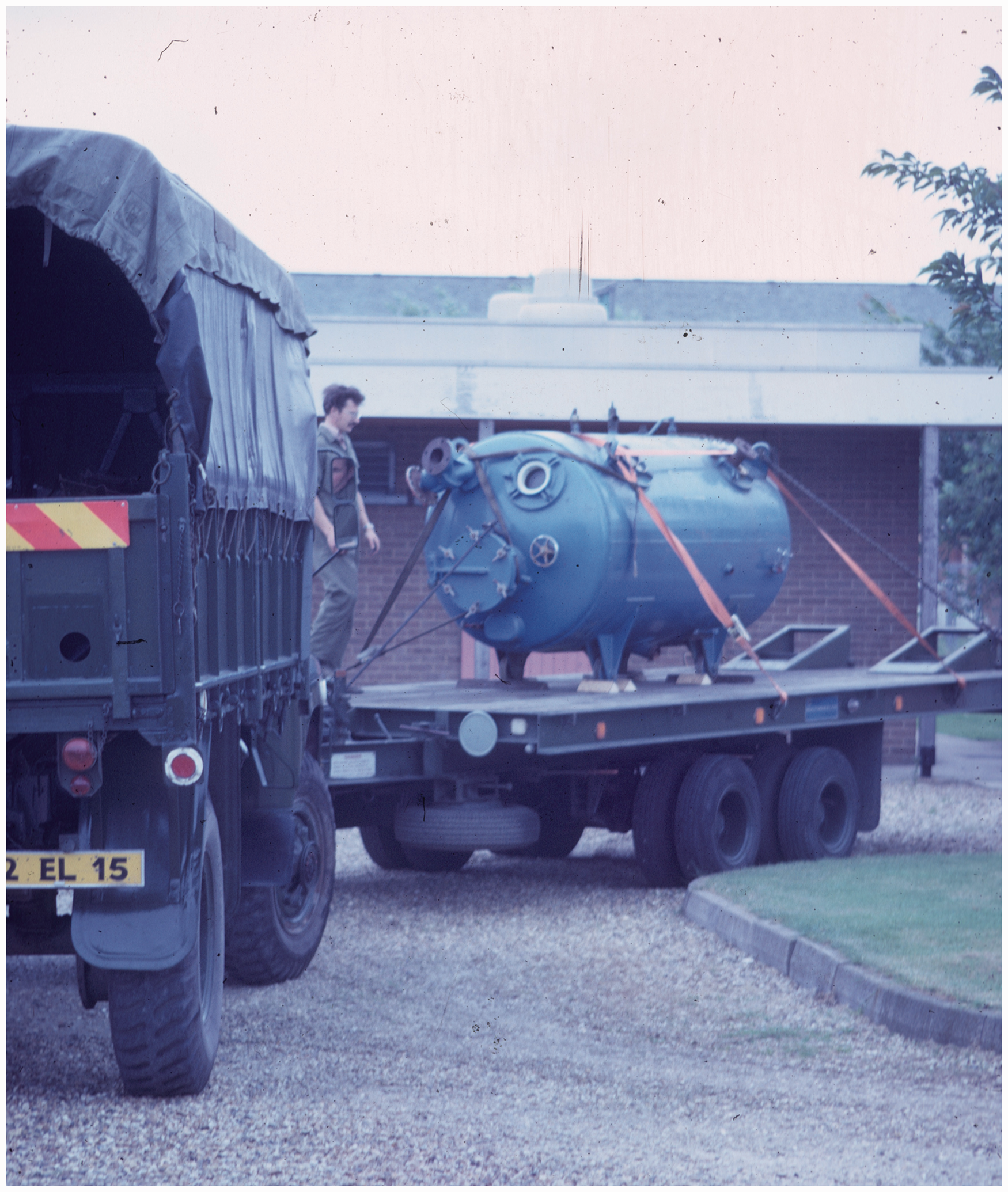
The final years
The 1 August 1945 found him in Mexico at a meeting of the Cortés, defending his presence in London, the bastion of the defence of democracy and the location of several governments-in-exile, as the legal presence of the Spanish Republic. A Republican, Martínez Barrio, who had been prime minister for a single day on the fateful 18 July 1936, was elected interim President, accepted the resignation of the Negrín government and invited the former Professor of Chemistry José Giral, who had succeeded him and lasted some six weeks, to form the next ‘government’. Negrín was not invited to be a member of the ‘cabinet’.
After the end of the war, he and Feli spent more time in Paris than in England, while keeping their house in the latter country; his wife and three sons were installed near New York, where they were frequent visitors. During the early 1950s, his angina was complicated by arrhythmia, and he was prescribed quinidine. His ischaemic heart disease progressed, and in 1956 he invited his three American sons and their families to visit him in his home in Chiddingfold. His final cardiac episode occurred there on 12 November, and his coffin was flown to Paris where he was buried in the Père Lachaise Cemetery.
Conclusion: the judgement of posterity
As one of the dominant figures in such a major conflagration, much has been written about Juan Negrín, and he has had many detractors; their claims are lacking in substance.
He has been blamed for the defeat of the Republic. The facts are that the extremely effective mercenary troops of the Army of Africa, the massive aid received by the insurgents from the fascist powers, and the starvation of the government-led armed forces of materiél by the policy of non-intervention, proved overwhelming for the Republic. Others have echoed Hoare's claim that he enriched himself at the expense of the nation. Of this, there is no evidence whatever, and he was fortunate that thanks to his background, the pursuit of riches never became a distraction from the conduct of the war or the running of the state. It is said that he was a ruthless communist who allowed the Party to dominate the conduct of both the war and the maintenance of law and order in the rearguard, and who was thus complicit in the brutality of their methods. Herbert Matthews wrote that ‘Don Juan Negrín was no more communist than you or I’,
33
and del Vayo agreed that ‘rarely has there been a politician less disposed to be anybody's puppet’.
34
Negrín was far too authority-averse to be a Party member although the divisions within his government necessitated some fairly authoritarian behaviour on his own part. He was perfectly willing to admit that the non-intervention agreement effectively propelled him into the arms of the USSR, which did provide some essential supplies and which also emphasised the imperative of well organised and disciplined armed forces in time of war.
In his epic trilogy of the SCW, the former professor of history in Madrid and acknowledged authority on the war, Ángel Viñas, makes it clear that Negrín presided over a government with very few available options, that he, unlike most of his colleagues, divined the nature of his opponent and his insatiable thirst for vengeance, and pursued the only course potentially capable of saving significant numbers of lives. Viñas presents abundant evidence of the honour of its principal protagonist and a robust defence of his policies. He concludes ‘The part he played was first class. Not in vain did he, as Chancellor of the Exchequer, president of the government, and Minister of Defence, represent the spirit of resistance… pragmatic and accustomed to taking difficult decisions, and moving always through a hornets’ nest with the balance of a tight-rope walker… Negrín continued to play each and every one of the few cards left to him… He knew perfectly well, like Azaña and Prieto, that it was impossible to win the war. And they knew that he knew. But, unlike them, he never gave up…’ 35
Juan Negrín's memory is preserved in Las Palmas, where his grand-daughter Carmen is Honorary President of the Fundación Juan Negrín, and the rebuilt University City in Madrid is enduring testimony to his vision.
Footnotes
Declaration of conflicting interests
The author(s) declared no potential conflicts of interest with respect to the research, authorship, and/or publication of this article.
Funding
The author(s) received no financial support for the research, authorship, and/or publication of this article.