







Abstract
In June 1962 at the age of 87 years, Sir Winston Churchill (1874–1965) fell over in his hotel room at the Hotel de Paris in Monte Carlo and sustained a fracture to the neck of his left femur. He was flown back to London and the fracture operated on at The Middlesex Hospital by two eminent orthopaedic surgeons, Mr Phillip Newman (1911–1994), Consultant to the The Middlesex Hospital and The Royal National Orthopaedic Hospital, Stanmore, and The Institute of Orthopaedics, London, and Professor Herbert Seddon (1903–1977), Consultant to the The Royal National Orthopaedic Hospital, Stanmore, and Director of The Institute of Orthopaedics under whom Churchill was admitted as a private patient. Churchill’s recovery was complicated by the development of deep vein thrombosis. During his convalescence, Churchill befriended Seddon who recorded his time with him in his private papers. On 21 August, Churchill was discharged to his home at 28 Hyde Park Gate which had been modified during his admission and made a return to public life in November 1962 at a dinner at the dining club he had originally founded, The Other Club.
Churchill and The French Riviera
The French Riviera was one of Churchill’s very favourite places. After his disastrous performance in the 1922 general election (having been taken ill with appendicitis during the electoral campaign and coming fourth) 1 he decided to take some time off with his wife Clementine and their three-month-old baby daughter Mary (later Lady Soames) by renting a villa in Cannes for that Christmas and New Year. 2 This long-to-be-married couple were destined to return to the South of France in September 1958 to celebrate their golden wedding anniversary.
Winston Churchill in his later years was the much sought-after house guest of the international jet set, his celebrity such that he was the beneficiary of much hospitality from three particular individuals namely Max Aiken Lord Beaverbrook (1879–1964) the newspaper magnate, 3 Emery Reves (1904–1981), Churchill’s literary agent and his partner Wendy Russell (1916–2007) 4 and Aristotle Onassis (1906–1975), the Greek shipping magnate and his wife Tina (1929–1974). 5
Both Reves and Beaverbrook owned impressive Riviera properties, La Pausa 6 (the former home of Coco Chanel bought by Reves in 1953) at Roquebrune near Monte Carlo and La Capponcina 7 at Cap d’Ail respectively which were put at Churchill’s disposal as was an eighth floor penthouse suite of rooms at the Hotel de Paris in Monte Carlo then owned by Onassis who in 1953 had acquired a controlling financial stake in the company Société de Bains de Mer (SBM) in Monte Carlo which included the Hotel de Paris in its portfolio of properties. 8
Additional luxury accommodation was provided in the form of Onassis’s super yacht, Christina in which the elite company would socialise while cruising the Mediterranean, Adriatic or Caribbean (Churchill was the personal guest of Onassis no less than eight times on board this vessel between 1958 and 1963). 9 Churchill was usually accompanied on these sojourns by his Private Secretary Anthony Montague Browne (1923–2013), his nurse and valet, Roy Howells (1928–), his body guard Sergeant Edmund Murray (1917–1996) and sometimes other members of his family although these arrangements were not always to the liking of Churchill’s wife, Lady Clementine (who according to their daughter Mary found some Riviera company ‘shallow, vulgar and boring’ and felt ‘imprisoned in these luxurious cages with little to do’). 10 When not socialising, Churchill would spend his time painting or visiting the Casino in Monte Carlo.
Fall and fracture
In June 1962, Churchill decided to spend some time on The French Riviera in the company of his granddaughter Celia Sandys (1943–) a teenager at the time. On 28 June, just two days into an intended two-week stay, Churchill tried to make his way to the bathroom in his suite at The Hotel de Paris, Monte Carlo, when he tripped and fell, at about six o’clock in the morning. A New Zealand nurse Robin Powell who had been reading on duty outside Churchill’s room heard the fall and entered to find him on the floor. She immediately summoned Howells 11 whose room was on the third floor and the British expatriate doctor, Dr David Myrddin Roberts (1906–1977) 12 who lived nearby in Cap d’Ail and who acted as one of Churchill’s general practitioners on The Riviera. Howells called Montague Browne. 13
Howells describes the scene in his book, Simply Churchill. Churchill was lying on the floor apparently not in much pain saying that he thought he had broken his leg. 14 However, Montague Browne describes in his memoirs Long Sunset that he considered the situation to be far more serious than it appeared and describes how, in a surreal moment, seeing the great man prostrate on the floor called to mind the image of a fallen stag, 15 whereas Howells suddenly realised the truth of Churchill’s earlier comment that ‘all babies look like me’. 16
Dr Roberts arranged for an X-ray of the hip using portable equipment which was brought into the hotel from The Princess Grace Clinic nearby. The Clinic’s chief radiologist Dr Andre Fissore confirmed that there was a fracture to the upper third of the left femur. 17
Churchill was then taken to The Princess Grace Hospital where a full-length Hip Spica was applied, covering the left leg, abdomen and lower chest, by a team of French doctors lead by Professor Charles Louis Chatelin, Head of Surgery, under general anaesthesia administered by Dr Marcel Gramaglia. 18
However, Churchill was incensed on waking up to discover what had been done and roared ‘You monsters! You Monsters! Leave me alone. Get out of here – all of you!’. Howells was moved to state that ‘It was obvious that he had declared open war on the doctors’. 19 Churchill told Montague Browne that he wanted to die in England indicating that perhaps he too appreciated the true gravity of the situation. The French doctors in attendance remonstrated with Montague Browne, adamant that repatriating Churchill for surgery could kill him. However, their advice and concerns were overridden and Churchill prevailed. Montague Browne immediately telephoned Number 10 Downing Street. The Prime Minister, Harold Macmillan (1894–1986) then made ready an RAF Comet aero-medical aircraft from 216 Squadron Transport Command to fly Churchill and his entourage from Nice to Heathrow Airport. 20 Seddon under whom Churchill was to be admitted to The Middlesex Hospital requested that Lord Moran (1882–1977), Sir Charles Wilson, 21 Churchill’s personal physician since 1940 inform Montague Browne that he would prefer Churchill to be repatriated without the Hip Spica in place. 22 The aircraft left RAF Lyneham, Wiltshire, at 7:00 p.m. the same day scheduled to leave Nice Airport for Heathrow at 11:00 a.m. the following morning with its precious cargo. Lord Moran was in London but was kept informed by bulletins from Monte Carlo.
Repatriation
On the morning of 29 June Churchill left the hospital in France to begin the journey home.
Howells relates ‘that nurses, patients, doctors, domestic staff, men in overalls and boiler suits and people from nearby houses, all turned out to wave goodbye’. Dr Roberts and Howells accompanied Churchill in the ambulance which was escorted by French police motorcyclists at the head of a motorcade. Behind the motorcyclists was a French television truck which was immediately in front of the ambulance followed by a car full of detectives. Behind the entourage were other cars carrying members of Churchill’s staff. 23
Howells describes in detail the flight back to Britain. The Comet left Nice airport at 11:00 a.m. Churchill sipped weak whisky and soda en route and read newspaper reports of his misfortune while chatting to his granddaughter Celia Sandys and Montague Browne. 24 Seddon notes in his papers however that Churchill had been given 100 mg pethidine by intramuscular injection during the flight approximately 50 minutes before landing. 25 Churchill’s stretcher was located just behind the cockpit cabin. Squadron Leader F Yetman the captain of the aircraft flew across Europe at 28,000 ft, 10,000 ft lower than usual to maintain oxygen levels for their patient. The weather was fine and there had been less than 10 seconds of turbulence during the flight. 26
The aircraft landed at 1:30 p.m. Churchill was somewhat unceremoniously lifted off the aircraft by a fork lift truck. He was met on arrival by Lady Clementine Churchill, Lord Moran and one of Seddon’s team, Philip Yeoman (1923–1997), Senior Registrar.27,28 Churchill was transported by road to the private Woolavington Wing of The Middlesex Hospital. Seddon noted that his patient arrived at the hospital at 2:30 p.m. in a cheerful mood, not distressed and having had no food. 29
Howells gives a detailed account of Churchill’s first floor hospital room relating that the bed had been specially angled so that Churchill would be able to see the secluded garden and ornamental fish pond below. The room had been filled with flowers including Howells says, ‘a special show of yellow irises, blue delphiniums, carnations and stocks sent by family and well-wishers. 30
Pre-operative assessment
Churchill was prepared for surgery. He was examined by one of the senior Middlesex Hospital consultant anaesthetists, Dr Oswald P Dinnick (1923–1995) 31 who discovered rales in the left side of the chest, blood pressure 140/80 mmHg and a full pulse with occasional ectopic beats. 32 The electrocardiogram revealed first degree heart block with a very prolonged P–R interval and some flattening of the T waves in the lateral leads. 33 Some 20 years earlier Churchill’s ECG, reviewed by the cardiologist Sir John Parkinson (1885–1976)34,35 did not show this but did reveal some extra systoles with left axis deviation and inversion in lead T3 which Parkinson considered to be normal. There was no evidence of ischaemic heart disease. 36
The X-ray of the left femur which accompanied him from France showed a basal fracture of the neck of the femur with slight valgus displacement of the upper fragment. Seddon noted that ‘there was a long zone of translucency in the shaft of the femur which came up to a point about 3 and a half inches below the lower rim of the greater trochanter’. Serum proteins were noted to be normal and no Bence Jones proteins to suggest myeloma. 37
The surgeons
Philip Newman was a consultant surgeon at both The Middlesex Hospital and the Royal National Orthopaedic Hospital (RNOH), a decorated hero of Dunkirk and an international authority on spinal surgery. 38 Seddon 39 was initially appointed Resident Surgeon at the RNOH Stanmore in 1931 and then went on to hold the chair of orthopaedics at Oxford University in 1940. Seddon was an international authority on peripheral nerve injuries and was appointed part time Director of Studies at the Institute of Orthopaedics and Clinical Director to the RNOH in 1948. 40
On arrival at The Middlesex Hospital, Montague Browne expected Seddon as Professor to perform the operation. However, to his surprise Seddon told him ‘… Newman will do it twice as well as I can’ – a self-effacing and modest admission that Newman had greater experience and skill at trauma surgery than he, acquired and honed during his time as a surgeon at Dunkirk. 41 In his operation notes, Seddon lists Newman’s name first as the primary surgeon and his own second as assistant. 42 Churchill’s entourage however clearly considered that title connoted superiority and thus preferment. Seddon was subsequently knighted in 1964 and in 1976 Newman was made Commander of the Most Excellent Order of the British Empire (CBE).
The operation
Despite Seddon’s request that the hip spica that had been applied in France be removed before repatriation, this had not been done and on arrival at The Middlesex Hospital, the front part of the spica was removed by Seddon and Newman. 43
The operation began at 6:00 p.m. Seddon’s operation note reveals that Newman performed the procedure and Seddon assisted. A general anaesthetic had been administered by two anaesthetists, Drs Dinnick and DH Cope (1922–2015). 44 Seddon records that the fracture was easily reduced with slight internal rotation. During insertion of the nail, a part of the outer cortex of the greater trochanter separated but there was no disturbance to the fracture site. A four-hole plate was connected with the nail and attached to the femoral shaft with screws. The wound was closed with suction bottle drainage after instillation of 1 gram of chloromycetin (chloramphenicol). An Elastoplast dressing was applied and Seddon notes that Churchill ‘returned to bed at 8.00pm in good condition, having had one pint of blood’. 45
Lady Clementine was Churchill’s first visitor.
At 9:05 p.m., Brigadier GP Hardy Roberts (1907–1997), the Superintendent of the hospital, put out a bulletin stating that ‘The fixation of the fracture of the neck of the femur was carried out this evening successfully, and Sir Winston’s condition after the operation is at present satisfactory’.
Two days later Churchill was able to sit out without pain. Howells records in his memoirs that at this time Churchill developed bronchitis and subsequently congestion of the lungs and that he was smoking a cigar as Lord Moran tried to examine him and was extremely reluctant to part with it, gripping it firmly between his teeth. 46 However, Seddon does not mention this but that on the sixth postoperative day he was seen by the cardiologist Dr Evan Bedford (1898–1978) 47 who discovered extra systoles but no atrial fibrillation. However, Seddon noted that there was an ‘obvious femoral venous thrombosis’ with swelling and tenderness of the thigh and leg. Dindivan (phenindione) anticoagulation was immediately commenced. He became jaundiced probably as a side effect of the phenindione which was thus gradually withdrawn to good effect. The swelling of the thigh and leg had resolved by 16 August. 48
Fifteen days after the operation the stitches were removed and the wound was seen to have healed well. Two days later, Churchill took his first steps and mobilised with assistance every subsequent day. 49 One of his nurses noted his dislike for physiotherapy. 50
Howells relates how Churchill’s appetite and penchant for the finer things in life were little affected by his surgery. He continued to smoke cigars. His diet included Petite Marmite Savoy soup (sent in to The Middlesex Hospital from the Savoy Hotel kitchens during his stay), caviar, fricassee of chicken, omelettes, strawberry ice cream, cheese and biscuits plus champagne and brandy. 51
Churchill’s hospitalisation drew a great deal of national and international attention. Howells relates that there was a core of pressmen camped outside the hospital and that the hospital superintendent set aside the hospital board room for them and even supplied them with refreshments. 52 He had already received a telegram from Queen Elizabeth before arriving back in Britain. 53 Amongst his visitors were his son Randolph, Generals Eisenhower (1890–1969) and Montgomery of El-Alemein (1887–1976) and the Prime Minister Harold Macmillan (who at the time was conducting negotiations for Britain’s entry into the European Economic Community of which Churchill did not approve). 54
Lord Moran decided that whilst Churchill was hospitalised under the care of others he himself would take the opportunity to have a short break in the Alps between 9 and 16 July having given his telephone number to Montague Browne and reassuring him that he could be back in London within eight hours if he was needed. 55 In October 1961, some nine months before Churchill’s accident, Moran’s wife Dorothy suffered an intracranial haemorrhage (subarachnoid) and had remained in a coma since. Moran devotedly visited her every day, taking a bus to St Thomas’s Hospital. Happily, Dorothy was eventually to make a full recovery. This poignant episode reminds us that doctors whilst caring for others may well have their own personal crosses to bear. 56
During his convalescence at The Middlesex, Churchill befriended Seddon. Churchill told him that he found the evenings ‘burdensome’ and requested that he come in at times to keep him company. Seddon explained that he was very busy but would attend when he could and that he would have his dinner beforehand ‘at one of the little restaurants in Soho’ and would arrive for coffee. Seddon kept notes on his relationship with Churchill during this time. Churchill always poured the coffee himself and always asked if Seddon preferred white or brown sugar. Brandy followed next and Seddon noted that he had never met anyone who could make a modest dose of cognac last so long, perhaps this was the way Churchill preferred to take his brandy. 57 Howells reports that ‘always there was the small bottle of champagne on his meal tray and the bottle of old brandy at his bedside’. 58
The main event of the evening however was the choosing of cigars. Four boxes of these were placed on his bed tray. Seddon observed that: each was opened and he pawed through the cigars to find one that was exactly right; he sniffed them, he rolled them between his fingers and listened to them – what good that did defeated me because he was deafer than me.
Churchill sometimes reminisced with Seddon, talking favourably of Marrakech and painting there. Some evenings Churchill would watch a film sent by the Rank Organisation. Seddon remembers watching Sink the Bismarck with him. Seddon observed the great man watching the film noting that ‘he never took his eyes off it, and they lit up. He sat upright and his usually pale face flushed. His cigar went out – he just held it, his mouth open in rapt attention’. 59
Discharge from hospital
Churchill was discharged home to his London residence, 28 Hyde Park Gate on the morning of Tuesday 21 August 1962 after spending 54 days in hospital. Moran had already thought about Churchill’s convalescence well before his discharge and had been discussing the immediate arrangements for this with Lady Churchill along with Montague Browne, Seddon and Newman. It was apparent that Churchill’s London home would have to be modified prior to his return and Churchill’s bedroom was moved to the ground floor, into the room which had until then been Montague Browne’s office. A new bathroom was also built and a lift installed so that Churchill could access the lower ground floor dining room and garden. 60
Unsurprisingly, Churchill left hospital in grand style. Howells describes Churchill’s attire for the journey home – a grey homburg, his initials on the silk lining, gold cufflinks engraved with the family crest on one side and his monogram on the other, a cream poplin collar-attached shirt and a medium grey Prince of Wales check suit, a blue polka dot tie and a heavy gold watch chain. 61
He was carried to an ambulance by four attendants. Howells recorded that ‘hundreds of people jammed the street to cheer him on his way’ (Figure 1). The hospital windows and those of nearby offices were crammed and there were even people on the hospital roof’. He was puffing on a cigar held in his right hand and smiling and as he was put into the ambulance he gave his famous ‘V’ sign to the delighted crowd.
62
Churchill leaving The Middlesex Hospital, 21 August 1962. Far left rear, Mr Clark (security officer), next left Mr Beech (Woolavington Wing porter), far right Miss Wannop (Matron of the Woolavington Wing). Reproduced with permission from uclh arts and heritage, UCLH NHS Foundation Trust.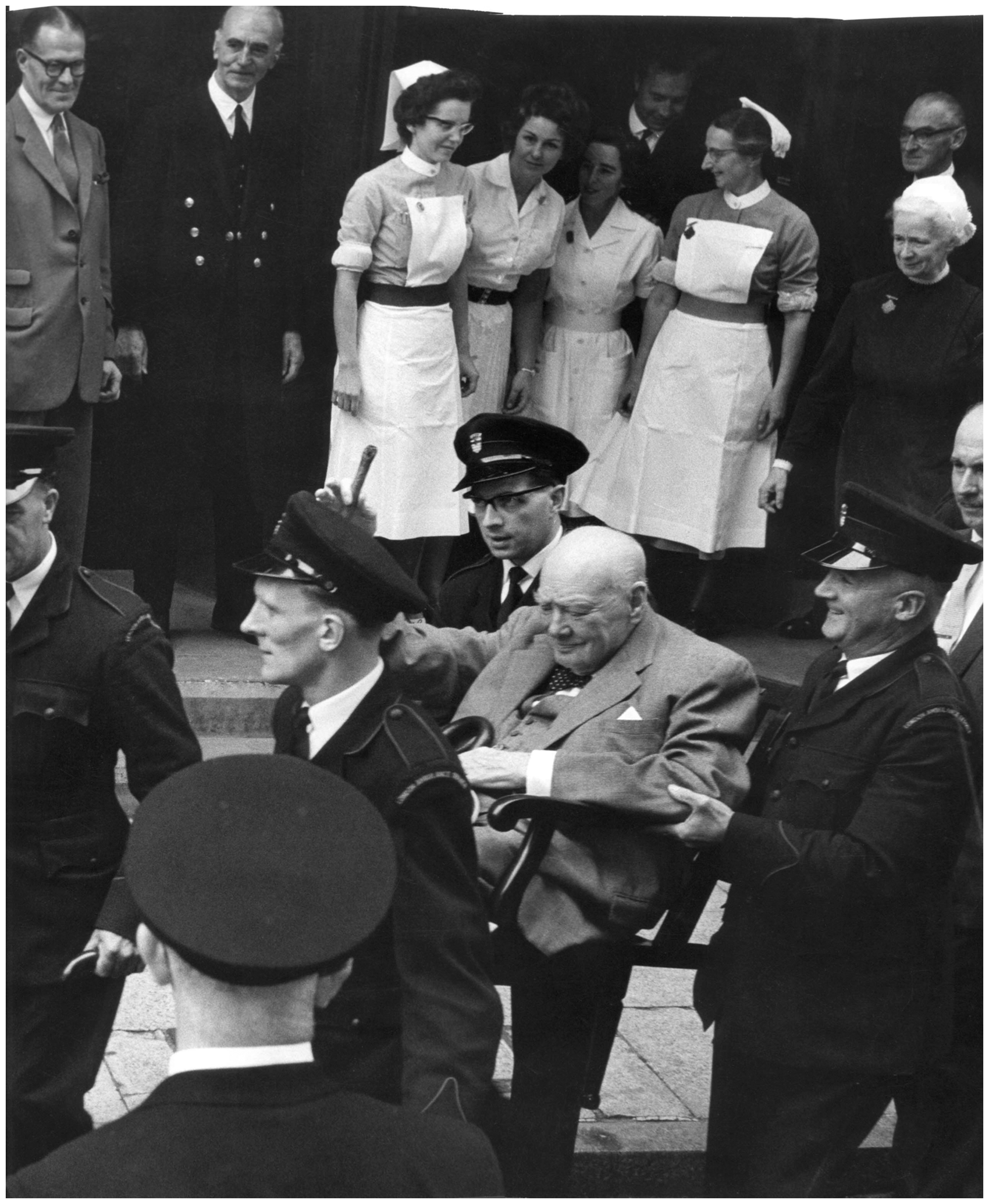
A further throng of well-wishers gathered outside his home to welcome him on his return. The event was captured by Pathe News. 63 Later, after returning home, Churchill called all his staff into his bedroom for a glass of champagne. 64
Just over a month following his discharge from hospital, on 17 September 1962 Churchill wrote to Newman from 28, Hyde Park Gate expressing his gratitude and referring to some mementoes of his hospitalisation.
The mementoes to which Churchill referred were generous indeed. Seddon and Newman each received an engraved modern silver salver especially commissioned from Asprey’s, the Royal silversmiths and a box of cigars plus a signed photograph. 65
Newman replied the same day from 107 Harley Street, London W1:
66
Dear Sir Winston, Your photograph and silver salver have arrived here today and have quite overwhelmed me. They will be very proud souvenirs, both for myself and for my family. Thank you so much for your kind thought. It has been a great honour, not only for myself, but also the Middlesex Hospital, to be able to help you recover from your recent accident. I sincerely hope that you will be able to do more and more as time goes on and be present at the opening of the House of Commons. Yours sincerely, Philip Newman Dear Sir Winston, I have just returned from East Africa. You thank me most generously … … What a delight it is to possess such a superb piece of silver, with an inscription perfect in its simplicity. This is not for me alone, it is for my family … . In thanking you for these mementos may I also say how grateful I am to Lady Churchill for her patience and understanding, and to you Sir Winston, for your kindness to Philip Newman and me – your faithful servants-, which made our anxiety easier to bear.
Churchill subsequently insisted that all the doctors who had treated him since his fall should submit their accounts for payment. Seddon, Newman and Bedford politely declined to invoice Churchill for their services. The doctors who had initially treated him in France, however, Prof Chatelin, Fissore and Gramaglia together with Dr Roberts all billed Churchill and received payment directly from Churchill’s personal Lloyd’s bank account. Prof Chatelin received 1500 NF the others 500 NF each. 69
Churchill’s recovery continued at home and his return to public life was confirmed by his attendance at a meeting of the dining club he had founded many years before, The Other Club 70 at The Savoy Hotel in November 1962 where, after feasting on Petite Marmite Savoy soup, fried fillet of sole wrapped in smoked salmon garnished with scampi followed by fillet of roast deer stuffed with pate de foie gras served with truffle sauce he apparently gave an entertaining impromptu speech seemingly little the worse for his recent illness and in April 1963 he returned to the Riviera to finish the holiday his fall had interrupted. 71
The management of Churchill’s neck of femur fracture bears favourable comparison with today’s standards as indicated by The National Hip Fracture Database 2017 Report. 72 He was operated on approximately 36 hours after sustaining the fracture (as were 71% of cases in the Report) and by expert surgeons, two factors which favourably affect outcome. Although his length of hospital stay at 54 days was more than twice the average for England today (21.6 days for 2016), his recovery was complicated by a leg thrombosis requiring anticoagulant therapy. Churchill returned to his original residence as did 67% of 65,000 cases within four months in 2016. Furthermore, Howells reports that Churchill was medically fit for discharge home well before his actual discharge date. In fact, at approximately three weeks, he stated that ‘At this stage Sir Winston could have gone home at any time but the alterations to Hyde Park Gate were taking longer than had been planned’. 73 On return home, Churchill was able to walk from his bedroom to the drawing room with the aid of a stick and a newly installed hand-rail. 74 Churchill was of course given a degree of special treatment which would not have been available to less eminent patients. However, the personal challenge to rehabilitate after this injury was no less for him than for anyone else.
Nevertheless, Mary Soames 75 wrote of this episode that, ‘although he made a remarkable recovery from this accident … it marked a definite further stage in his slow decline’.
Churchill died in January 1965 some two and half years after sustaining his fracture.
Footnotes
Acknowledgements
I am grateful to Lord Nicholas Soames for permission to discuss Churchill’s medical history. The late Sir Anthony Montague Browne also kindly gave written permission to use any of his material in the preparation of this manuscript. I am very grateful to the late Sir Martin Gilbert with whom I discussed some aspects of the subject matter and to archive staff at both The Royal College of Surgeons of England and The Churchill Archive Centre, Cambridge for their help with permissions and advice for the Seddon Papers and Churchill references respectively. I am also grateful to members of Philip Harker Newman’s family namely his two sons Anthony and the late Richard Newman as well as his grandson for access to relevant family memorabilia. I am also grateful to my friend and colleague Mr Mark Loeffler, orthopaedic surgeon, for introducing me to the Newman family.
Declaration of Conflicting Interests
The author(s) declared no potential conflicts of interest with respect to the research, authorship, and/or publication of this article.
Funding
The author(s) received no financial support for the research, authorship, and/or publication of this article.