







Abstract
Arriving to the United States in 1921, Dr. Vladimir Fortunato (1885–1938) was a respected and celebrated figure responsible for creating striking medical models and anatomical sculptures. Although Dr. Fortunato was well connected and worked for some of the United States’ most prestigious medical institutions, his legacy, achievements, and creations have all but vanished from the annals of American medical history. In an effort to establish a more defined profile of this obscure man’s life and lifework, this article draws on scant information provided by a range of sources, including academic journal articles, obituaries, and physician autobiography. In the present-day era of digital imaging technologies, Dr. Fortunato’s lifelike sculptures represent a bygone age of medical visualization that embraced both utility and beauty.
Very little is known about the Russian-American physician and sculptor, Vladimir Fortunato (1885–1938), a man who crafted visually striking and lifelike medical models during the early twentieth century. Indeed, historians and other researchers will find evidence about Fortunato’s life and career unvaryingly fragmentary—cursory obituaries, passing mentions in the memoirs of prominent American physicians, and infrequent citations and commendations in medical publications and the popular press. Yet for all the dense obscurity that shrouds Fortunato, his sculptures—which include meticulously wrought anatomical and pathological moulages, models, and bas reliefs, as well as beautifully solemn death masks—are highly valued works that continue to be acquired by museum curators, historians of medicine, librarians, archivists, and private collectors alike. In rare medical and scientific instrument catalogs, Fortunato‘s pieces regularly fetch between $1000–$6000 (about £750–£4500), not uncostly purchases for museums and special collections. 1 Oddly, however, esteem for these medical sculptures has not provoked the expected corollary interest in limning the life of the gifted man responsible for their creation.
A model citizen
Born in the Crimea in 1885, Fortunato was a graduate of the University of Moscow and later worked as a medical model sculptor at the Moscow Medical Museum. 1 Whether the young Fortunato graduated with a medical degree and practiced as a physician is unknown; however, the assiduous anatomical precision of his models suggests an erudite comprehension of human anatomy and pathology. Moreover, even as his exact academic and professional credentials remain uncorroborated, he was addressed deferentially as “Dr. Fortunato” in American periodicals and medical publications. Fortunato’s early-career tenure at the museum ended in 1921, when he and his wife embarked to the United States. 1 Various American periodicals, such as the Decatur Review, clarify the Fortunato’s immigration as an “escape from Russia.” 2 The New York Times echoed this biographical detail, stating “Dr. Fortunato and his wife escaped from Central Russia … fleeing from the Communist regime. …” 3 Whatever the circumstances, Fortunato settled in Baltimore, Maryland, where he worked as a medical sculptor for the Johns Hopkins Hospital. 1 It is likely that Fortunato rendered modeling services for a range of academic departments of the medical school and the hospital, but it is certain that he produced sculptures for the Johns Hopkins Brady Urological Institute.
Far from being slapdash productions turned out for medical school classes and pedagogical exhibitions, Fortunato’s sculptures were regarded as fine examples of craftmanship to the extent that he received a prestigious national commendation. In 1927, the New York Times announced that he had received a Treasury Department gold medal for his “lifelike vaccination models showing types of reactions to smallpox vaccine.” 4 Lamentably, the whereabouts of these celebrated models remain a mystery. Fortunato’s colleagues retained his services with alacrity, with Dr. Hugh H. Young proving to be a regular commissioner of various urological models. Young recollects using the “urologic bus,” which he described as “a carriage sufficiently small to be taken along on teaching rounds.” 5 The “urologic bus” contained various “anatomic and pathologic models or specimens that have been previously selected in accordance with cases and diseases to be seen at ward rounds.” 5 During the rounds, Young explains, “we also make use of a series of drawings by Mr William P. Didusch, as well as models that have been prepared by Dr. Vladimir Fortunato.” 6 Evidently, teaching physicians valued the edifying utility of Fortunato’s models and added them to the peripatetic teaching trolly that moved through the hospital’s corridors.
It is unknown whether Fortunato received accolades for work other than his smallpox models, but he did create dozens, perhaps hundreds, of other high-quality medical sculptures that served as important mock pathological specimens and pedagogical tools for physicians and students. One arresting example of Fortunato’s lifelike work, dated 1934 and housed in the University at Buffalo’s Robert L. Brown History of Medicine Collection, models the face and infected oral cavity of a diphtheria patient [Figure 1, model image]. The patient’s face is bordered by a white cloth, the eyes are closed, and the mouth is open, revealing the accretion of a mucous membrane characteristic of the disease. In the example of this model, as in his other work, Fortunato is invested in capturing the reality of the patient’s sickly countenance and symptoms. On a deeper level, however, it is evident that Fortunato cared just as much, if not more, about depicting with lifelike accuracy the presence of the malady in question as he did the patient’s particular humanity. Viewing the sculpture in person, one observes and touches the delicately hirsute eyebrows, the eyelashes, and the untrimmed nostril hair; one sees the misaligned and aged dentition, chapped lips, and feels the soft-skinned visage. The awful presence of diphtheria is modeled for academic study but underlying the sculpture’s formal utility is Fortunato’s palpable reverence for the afflicted human body.
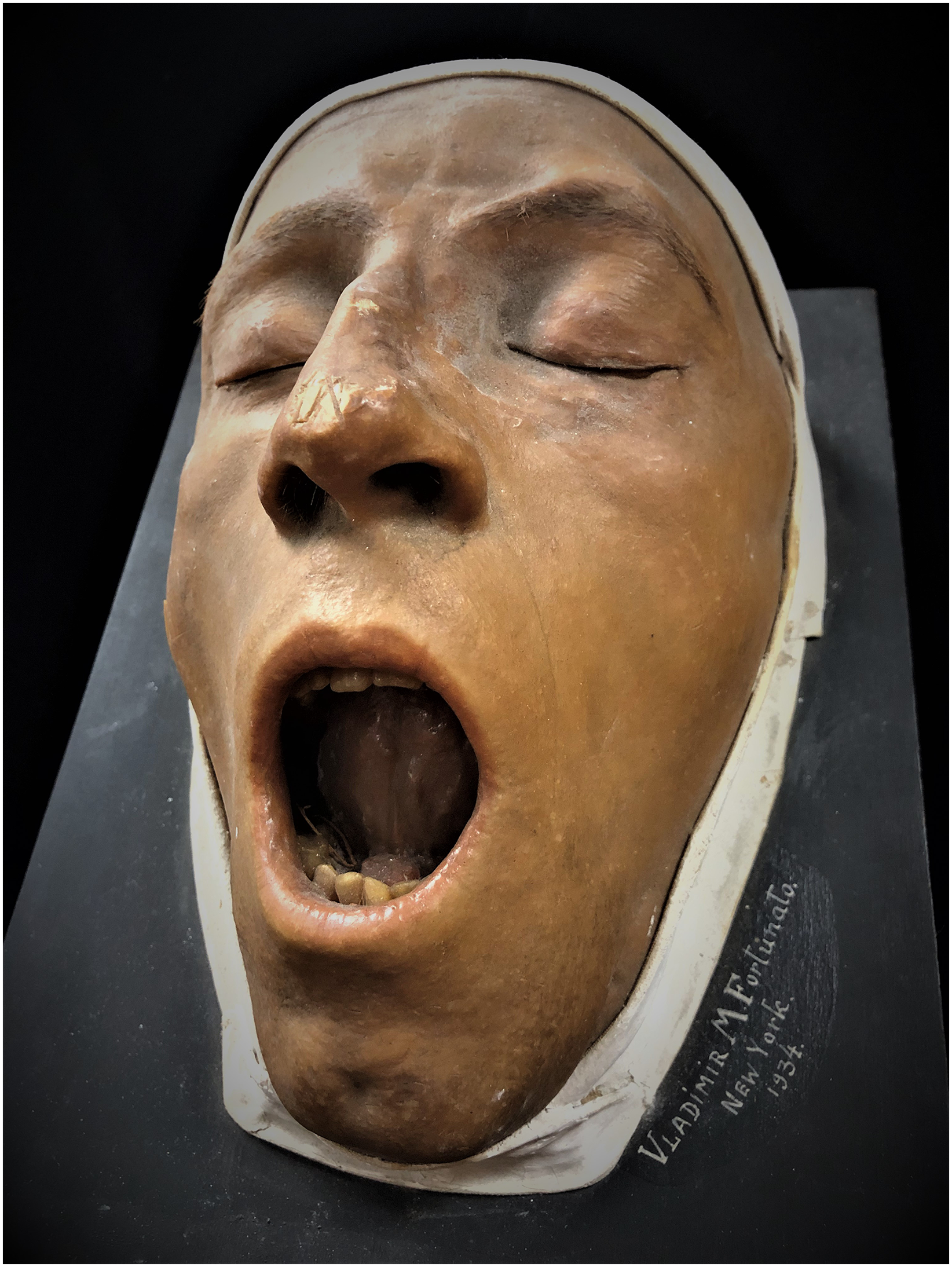
A 1934 medical model featuring a patient with diphtheria. Courtesy of the University at Buffalo’s Robert L. Brown History of Medicine Collection.
It might be supposed that to sculpt works such as this one would need a dour and dismal temper, informed by hours spent observing disease, suffering, and cadavers. While difficult to speculate reasonably about Fortunato’s disposition and character, an amusing anecdote from Young’s autobiography offers insight that Fortunato may have been a showman who pursued his work with peculiar humor. Young had commissioned Fortunato to produce sculptures for an American Medical Association meeting in Chicago, Illinois. Puzzled about how to transport the fragile works, Fortunato proposed an extraordinarily unusual method which required “using a coffin box, on the inner surfaces of which he was able to fasten his models and so avoid injury to them in transit. When the lid was screwed on four men were required to carry it by the coffin handles to the truck that transported it to the station.”
7
If the mere thought of four men hauling medical models in a coffin is not instantly outrageous, Young continues: At the station difficulties were encountered when the express company demanded a death certificate. At Chicago, as a truck carrying the coffin was pulled down the platform Irish laborers on an adjacent track stopped their work, removed their hats, and stood reverently with bowed heads.
7
One can think of less spectacularly outlandish modes of transporting the models safely—carefully wrapped and packaged in boxes, for example—but the sculptor had his eccentric vision for how his work was to be mobilized to the American Medical Association meeting. It is thus tempting to view Fortunato’s logistics less as an example of sober pragmatism and more, perhaps, as a flash of the doctor‘s impishly morbid sense of humor.
Fortunato’s accomplished sculpturing gained recognition beyond medical models and the depiction of illness. In 1922, Fortunato was called upon to sculpt a bust of Dr. William Stewart Halsted (1852–1922), a celebrated American surgeon who was one of the four physicians who established the Johns Hopkins Hospital.
8
In 1925, three years following the completion of the Halsted bust, the Johns Hopkins Alumni Magazine noted that the work’s likeness was in demand: Dr. V. Fortunato, whose fine bust of the late Dr. Halsted has been so highly praised, has recently made some bronze plaques of the bust which may now be obtained from him at the Hospital. The plaques … are five by seven inches and cost $21.00. This work was begun as the result of a suggestion of several alumni that many of Dr. Halsted’s friends and pupils might desire a copy of the bust.
9
Like his medical models, Fortunato’s public-facing commemorative work was lauded by admiring colleagues. Furthermore, the New York Times reported on February 6, 1924, that Fortunato was retained by Mrs. Edith Wilson to cast a death mask for her late husband, the former president Woodrow Wilson who died just three days before.
3
Fortunato was recommended by two Johns Hopkins colleagues, Drs. Kelly and Young, both of whom obviously esteemed the sculptor’s work.
3
The Times quoted Fortunato describing his initial work on the project: The face looked as Woodrow Wilson must have looked fifteen or twenty years ago. It was very sympathetic. The value of the death mask, of course, is the fact that it preserves the measurements of a face. This, with photographs, will aid in making a life-like bust if it should be desired to make one. I shall finish the mask and take it to Mrs. Wilson. If she approves, a bust will be made.
3
Indeed, Mrs. Wilson approved the mask with gracious admiration [Figure 2, death mask image]. In a letter of thanks to Fortunato dated October 27, 1924, she wrote: I consider the bronze recumbent head which you have completed of Mr Wilson a wonderfully fine piece of work. When I look at it a line I read years ago, descriptive of the work of a great sculptor, comes vividly to my mind: “For art can grant what love denies / And fix the fugitive.” There is a subtle something of Mr. Wilson’s personality you have caught and fixed which unborn ages will see and that will help them to understand his strength and courage. I hope the success of your work will give you the gratification you deserve.
10
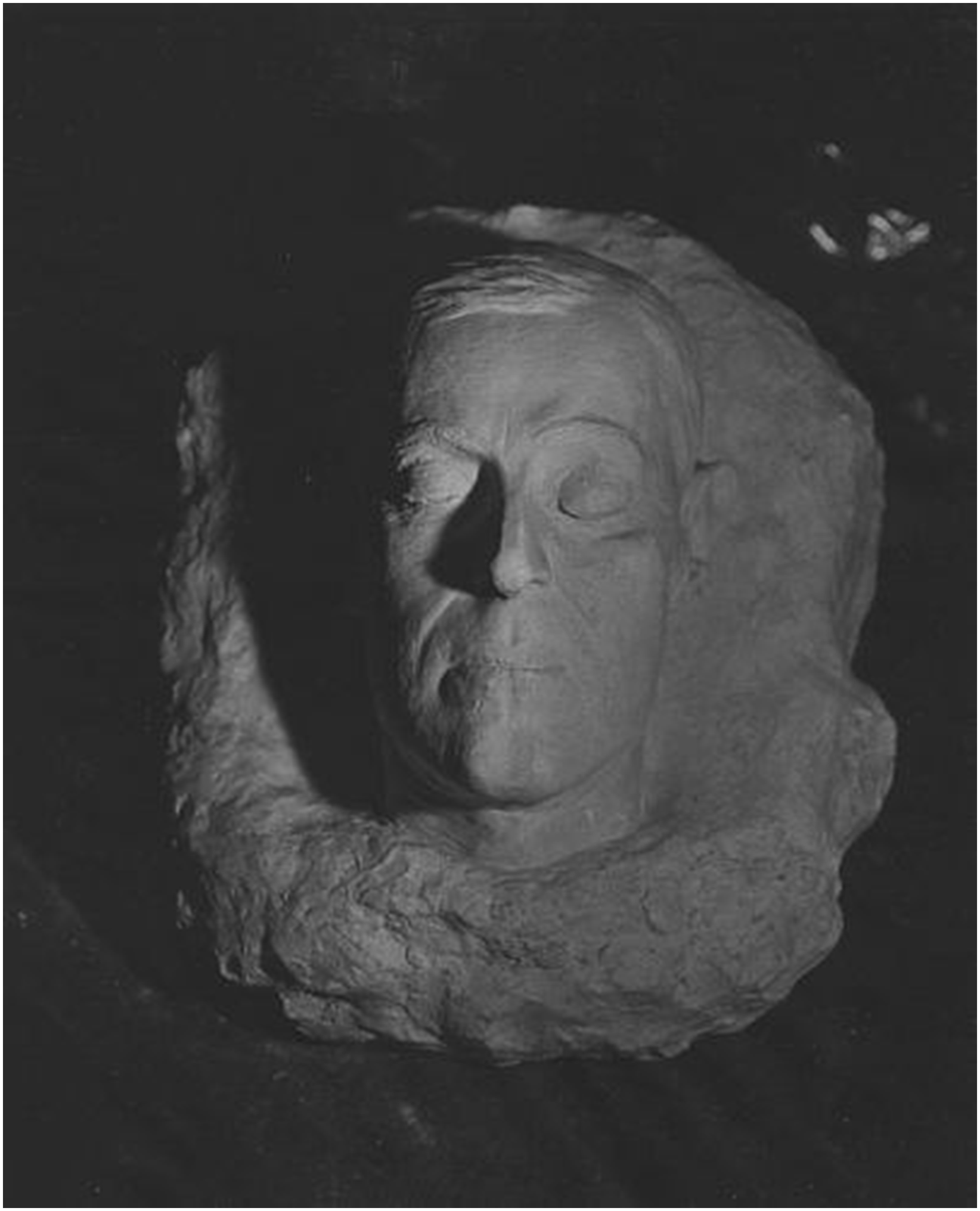
Thomas Woodrow Wilson death mask (1924), sculpted by Dr. Vladimir Fortunato. Image courtesy of the Division of Political and Military History, National Museum of American History, Smithsonian Institution. https://www.si.edu/object/thomas-woodrow-wilson%3Anpg_25187.
It is worth quoting the full length of Wilson’s missive because it documents a characteristic of Fortunato’s death mask also evident in his medical models—an ability to imbue his sculpted human forms, diseased patients and major political figures alike, with a kind of ineffable quality (“a subtle something”) that onlookers recognized as familiar and viscerally human.
New York, New focus
By the 1930s, Fortunato’s artistic oeuvre broadened to include plaster anatomical models depicting the male and female reproductive systems, the latter in both pregnant and nonpregnant states. 11 Fortunato left Baltimore for New York City sometime during this period, relocating to 609 West 158th St in Washington Heights, near the newly established (1928) Columbia-Presbyterian Medical Center. 12 While it is unclear exactly when and why Fortunato relocated, sources indicate that by 1937 he had affiliated himself with Dr. Robert Latou Dickinson, a prominent New York-based obstetrician, gynecologist, and surgeon. Lauded by Margaret Sanger for his staunch support of birth control, Dickinson was also praised by sexologists Alfred Kinsey and William Masters & Virginia Johnson for his impact on human sexuality research. 13 Like Fortunato, he was also an accomplished medical artist whose body of work denoted a profound interest in human reproduction and sexuality. Given Dickinson’s stature and Fortunato’s recent forays into reproductive modeling, one might surmise that it was in fact the very opportunity to work with Dickinson that lured Fortunato from the shores of Maryland.
In 1937, Dickinson occupied a studio space in the New York Academy of Medicine. At the Academy, during the fall of that year, Dickinson met with representatives of the Maternity Center Association (MCA) along with other interested physicians to discuss the MCA’s upcoming exhibit planned for the 1939–40 New York World’s Fair. 13 To be installed within the “Hall of Man,” in the Fair’s Medicine and Public Health Building, the MCA’s “First Year of Life” exhibit was to showcase idealized family dynamics conducive to parenthood, human development from conception to delivery, and proper infant care. 13 Dickinson was charged with depicting the female reproductive system and fetal development in sculptural form.
But Dickinson needed a team to actualize his vision. Fortunato joined, presumably to assist in the creation of these “Birth Series” sculptures (and perhaps to glean a bit of the international acclaim a World’s Fair promised). Also working with Dickinson during this time was Gershon Legman. Self-described as Dickinson’s “amanuensis,” or artistic assistant, Legman may be best remembered as a chronicler of folklore and crude sexual humor, as well as an author of erotic fiction. 14 Indeed, even during these early years, Legman’s voyeuristic eye was as keen as his pen. In his bawdy two-volume series, Rationale of the Dirty Joke: An Analysis of Sexual Humor (1968), Legman includes two separate anecdotes concerning Fortunato, whose focus at the Academy was seemingly anything but singular.
Fortunato is first directly referred to by name, as Legman credits him for the perfection of an anatomical model with a very specific purpose, namely the “vibrating milk-rubber dildo.” 15 “[P]roduced in 1937 by a famous anatomical model-maker, the late Dr. Vladimir Fortunato, in New York …” this creation was ably powered by a vibrating scalp-massage motor. 15 For the good of the curious reader, Legman provides more detail, noting: “Three sizes of replaceable phallic shafts (beautifully modeled in rubber) were available, specifically for women: Large, Medium, and Very Large. For my assistance in inspiring this invention, I was presented by Dr. Fortunato with the Medium size.” 15 Although no further exposition is provided regarding the nature of Legman’s “inspiration,” one can uncomfortably envision the locker-room miasma which must have permeated Dickinson’s studio.
Camaraderie, however, eventually gave way to competition. Although unnamed at this point, undoubtedly Fortunato was the “anatomical-model maker” evoked as a colleague of Dickinson’s when Legman’s musing eventually drifted to vasectomies.
16
Dickinson, it seems, was one of the first physicians to provide this modern method of birth control, and according to Legman, Fortunato was one of the earliest recipients of this surgery. Legman recalls: [Fortunato], who was middle-aged, powerfully built, and handsome, made a pest of himself among the women of the New York Academy of Medicine by announcing to them—as several of them confided to me—the news of his vasectomy, coupled with the assurance that he therefore could not impregnate them, and seemed amazed that they did not all therefore sink swooningly into his arms.”
16
Far from a champion for harassment-free workplace, Legman proceeds to launch himself into the fire sparked by Fortunato, stating: “[t]he idea … that there is nothing like the spice of danger, never occurred to this modern primitive.” 16 The inference being that the women of the Academy needed the thrilling threat of pregnancy to succumb to a man’s (unwanted) workplace advances.
Given vignettes like these, one wonders how anythingwas accomplished by Dickinson's Academy team. However, successes were noted, particularly related to the World's Fair Birth Series model-sculptures. By 1938, Dickinson had developed the earliest of works in this sculptural series. Bas-relief reproductions of the female reproductive system were set in plaster; these sculptures depicted life-size organs [See Figure 3].17,18 Using Dr. Dickinson's master catalogs, Mr. Joe Tait, MA, MLIS, Librarian and Archivist of the Cleveland Museum of Natural History (Cleveland, OH) in March 2022 confirmed via personal communication the contributions of Fortunato to these first Birth Series models. Additionally, Fortunato's efforts (along with Dr. Dickinson's) are credited in the lower left corner of the birth model referred to as Series 4. 19 In Series 4 and 5, the early period of development from 4 weeks to 3.5 months is represented in a tableau of five bas relief uteruses, ovaries, and embryos.19,20 Richly detailed,the 3.5 month example is particularly striking and features striated uterine walls, loosely coiled placenta, and ten curled fingers and toes nestled near a well-developed recumbent head [See Figure 4]. 21 A beautiful sculpture, and one of Fortunato's last.
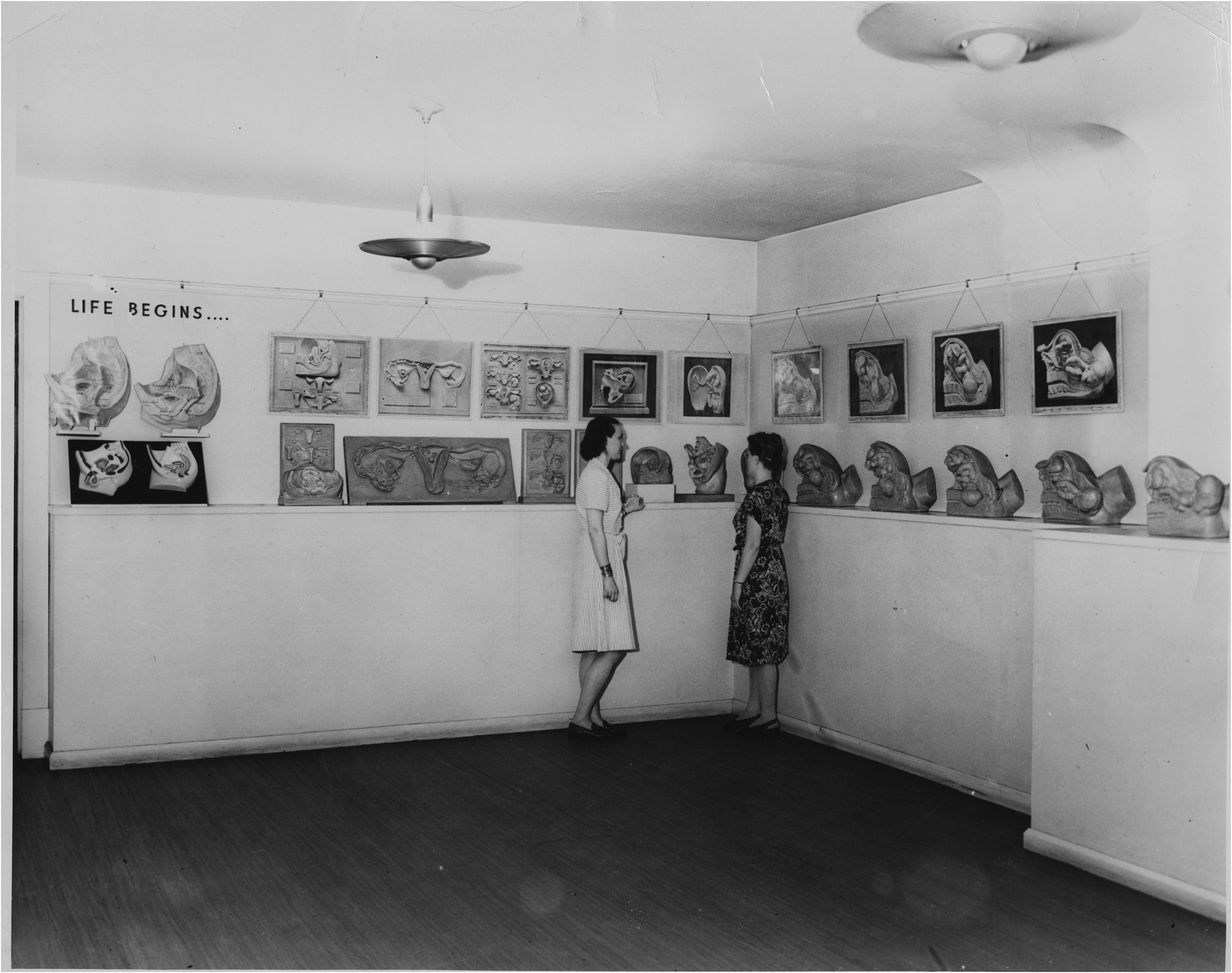
The Dickinson-Belskie Birth Sculptures, as exhibited in the Cleveland Health Museum (c.1945) after the closing of the 1939 New York World’s Fair. Note the bas-relief, Fortunato signed, ‘Series 4’ directly to the left of the woman in the white dress. Note also, above her head and to the left is a reproduction of ‘Series 4’ combined with ‘Series 5’, as reproduced in the MCA’s Birth Atlas. Image courtesy of the Cleveland Museum of Natural History held within the Maternity Center Association Records, Box 261, folder 18 of Columbia University Irving Medical Center’s Archives and Special Collections.
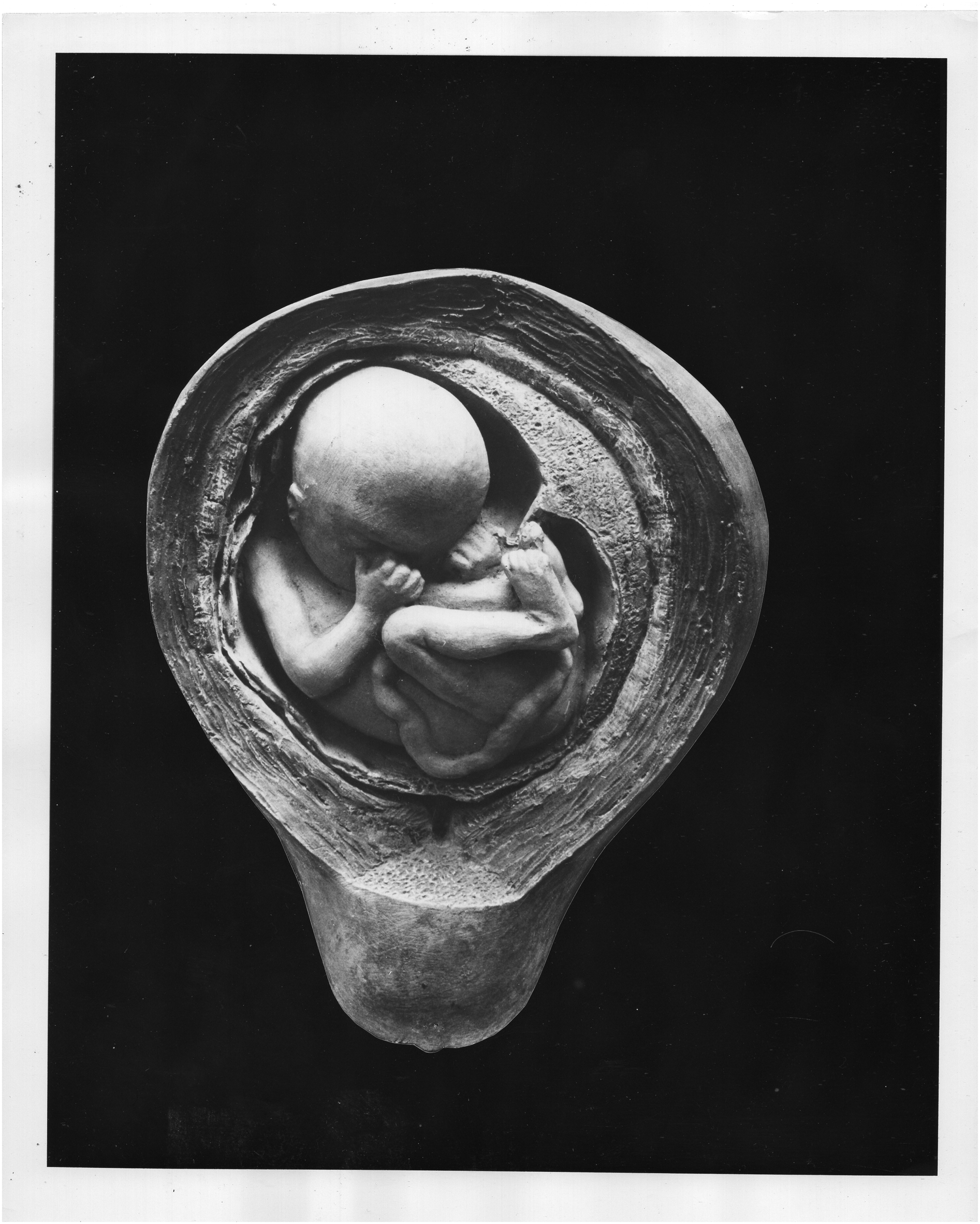
Detailed view of the Birth Series' 3 ½ month fetus. Image courtesy of the Cleveland Museum of Natural History.
On June 10, 1938, Fortunato suffered a heart attack, dying later that same day. He was 53 years old. His New York Times obituary notes: “at the time of his death, he was preparing models for the New York World’s Fair under the direction of committee on medicine and public health.” 22 Similar mournful nods towards Fortunato’s World’s Fair preparations were also relayed in the British Medical Journal. 23 Both outlets also discussed Fortunato’s earlier work with the Moscow Medical Museum and Johns Hopkins University. With obituaries published within one of the most influential United States newspapers, as well as within a preeminent international medical journal, Fortunato had clearly achieved national and international recognition, both from the public sphere and the medical profession. The fact that Dickinson’s name was not attached to either of these write-ups, even though Dickinson, and not Fortunato, was the main force behind the World’s Fair sculptures also hints at Fortunato’s outsized reputation. Why, then, has Fortunato’s name all but disappeared from modern memory? Perhaps the answer lies, in part, with the forthcoming lauded reception of Dickinson’s Birth Series.
A legacy deferred
New York’s 1939 World’s Fair opened on April 30, 1939. The MCA’s First Year of Life exhibit within the Hall of Man was heralded as a massive success. To complete his sculptures after Fortunato’s untimely death, Dickinson recruited a new set of hands, those of young Abram Belskie. 13 With Belskie’s skill, Dickinson completed his sculptural series in time for opening day. The resulting final models were stunning three-dimensional representations of pregnant torsos and full-term fetus in utero, each sculpture showing the progression from pre-labor to delivery. 18 Viewed by more than 700,000 people during its first year at the Fair, historian Rose Holz notes that “the installation attracted long lines every day from ten in the morning to ten at night. Neither rain nor shine stopped the crowds from coming; nor did the occasional stampede.” 13 These lines even prompted multiple complaints from nearby exhibitors who noted that fairgoers were unable to properly view other exhibits due to the sheer number of people waiting to glimpse the unborn. 13 After the Fair, the Dickinson-Belskie Birth Series, as they were now known, would continue to inspire and instruct. The Series in its totality was reproduced within the MCA’s well-received Birth Atlas (1940), published in six separate editions until the 1960s, and then again within the MCA’s subsequent publication, A Baby is Born (1966). 13 During this same time period, reproductions of the sculptures were traveling around the country, including Flint, MI, Madison, WI, Chicago, IL and Cleveland, OH, drawing crowds wherever they were displayed. 13 Somewhere among all this success, however, Fortunato’s imprint on the Series was lost, his work relegated to brief acknowledgement and a signature on Series 4.
But this may not be the only factor to induce Fortunato’s obscurity. Perhaps the specific medium of his work should also be considered. Many of Fortunato’s models were pedagogically oriented, providing tactile and visually lifelike replications of specific anatomical renderings; pathological studies, such as dermatological conditions; and various infectious diseases. As new medical education resources developed, such as the x-ray and photographic forms of clinical documentation, it is probable that Fortunato’s painstakingly detailed models were gradually regarded as passé, even obsolete. In fact, Fortunato’s Johns Hopkins colleague, the American gynecologist and surgeon Dr. Howard A. Kelly (1858–1943), expressed this exact sentiment in the preface to his stereoscopic image collection, the immensely popular Stereo Clinic published in installments from 1908 to 1915: “Surgeons have long been conscious of a want in the way of illustrating their operations not as yet perfectly met by flat illustrations however admirably done.” 24 Kelly also acknowledges anatomical models and sculptures but notes their limitations, as these “specimens are not available for all, and apart from their being stored in a laboratory, they are in the gross bulky as well as fragile.” 24 Newer technologies, like the stereoscope, offered practical and cheaper alternatives to cumbrous models. Just as medical sculptures began to recede with the advent of new visualization technologies perhaps institutional memory of Fortunato did, too.
Another factor is the possibility that Fortunato’s U.S.-based career was hindered by institutional funding issues. Historical accounts indicate that limited budgets harried the sculptor, which suggests, in part, that Fortunato‘s home institutions may have respected the medical modeling profession enough to fund a position but found it dispensable during particularly impecunious situations. Fortunato’s colleague, Dr. Young, remarked on this very trouble in his autobiography. Young reflects on his appreciation of Fortunato’s models and eager willingness to engage his services: “I had found his work very helpful in recording rare clinical and pathological conditions, so I cast about to find funds to keep him in Baltimore.” 25 In this case, Young managed to secure additional funding to keep Fortunato working at Johns Hopkins. While it is not certain whether pecuniary difficulties overshadowed the majority of Fortunato’s career, it is quite possible, based on Young’s recollections, that the unfortunate sporadic nature of funding may have relegated Fortunato and his work to the institution’s periphery.
Regardless how much or how little one speculates on the circumstances of Fortunato’s obscurity, it is ultimately the singularity and significance of his medical models that occasion this more detailed, if still imperfect, biographical account. In the present-day era of screen-based projections, digital data, virtual reality, and computerized medical imaging, Fortunato’s prodigious output represents a nearly forgotten era of medical visualization that was simultaneously optic and haptic—his lifelike models invited a level of human engagement that invited both sight and touch, a mode of sculpture at once pedagogical and artistic.
Footnotes
Acknowledgements
We gratefully acknowledge the contributions of Rosalba Varallo Recchia of Princeton University Library's Department of Special Collections, David Coffeen of Tesseract Early Scientific Instruments, Joe Tait of the Cleveland Museum of Natural History's Harold Terry Clark Library, Arlene Shaner of the New York Academy of Medicine, and Steve Novak and Cameron Mitchell of Columbia University Irving Medical Center's Archives and Special Collections. Through the provision of primary source material, as well as guidance and suggestions, each of these individuals added valuable insights into the life and works of Dr. Vladimir Fortunato.
Declaration of conflicting interests
The author(s) declared no potential conflicts of interest with respect to the research, authorship, and/or publication of this article.
Funding
The author(s) received no financial support for the research, authorship, and/or publication of this article.
