







Abstract
Mukhtar Ahmad Ansari was a doctor and remarkable political figure in the late 19th century and the first half of 20th century. After studying medicine in Edinburgh, he returned to his country and became interested in political issues. Not unlike other educated Indian Muslims, Ansari first expressed his concerns about the situation in the Ottoman empire and went to Istanbul as the head of the medical mission. Ansari, who became more interested in politics after his days in Istanbul, came to the forefront as one of the leading figures of the Indian independence movement. Along with Mahatma Gandhi (1869–1948), Ansari did not engage in violence but supported the unity of Muslims and Hindus and opposed communalism. Despite his active political life, Ansari continued his medical studies with great seriousness and played an active role in establishing the Delhi Medical Association in 1914. During this period, his most important aim was to graft animal testicles onto human beings.
Keywords
Introduction
The primary purpose of this article is to highlight the chronicle of struggles and achievements of an eminent man of India, Mukhtar Ahmad Ansari. His political role in the freedom struggle, in the Khilafat Movement, and in the Indian National Congress have been studied by historians. 1 For sure, his activities were not limited to India, and he went to Istanbul as a part of the Red Crescent Mission during the Balkan Wars. His Istanbul days in the Mission have also been treated in several works. 2 However, almost nothing has been written about his medical research and studies in India and abroad. Therefore this article aims to present his efforts and treaties in medicine while briefly touching on other aspects of his life.
His early life and education
Mukhtar Ahmad Ansari was born on 25 December 1880 in Yusufpur, Ghazipur district of the erstwhile North-Western Provinces and Oudh (now Uttar Pradesh). His family, the Ansaris, had great eminence in the Ghazipur district. They claimed to be a descendant of Abu Ayyub al-Ansari (d. 672), a close companion of the Prophet Muhammad and his host at Medina. 3 His father, Haji Abdul Rahman, was a judicial servant of the British East India Company in the Ballia district. His elder brothers Abdul Wahab (d. 1946) and Abdur Razzaq (1868–1930) were also renowned hakims, especially the eldest one, Abdul Wahab, who specialized in the Yunani system of medicine. 4
Mukhtar Ahmad Ansari began his education at Victoria High School. Then his father sent him and his younger brother Mohammad Raza (d. 1935) to Muir Central College at Allahabad (now Prayagraj). 5 In this college, he studied English, Mathematics, Deductive Logic, Trigonometry and Geometry and Conic Sections, Elementary Physics and Chemistry. However he had to leave the college in 1898 since his family moved to Hyderabad. Before leaving, Ansari had passed his intermediate examination at Muir Central College in 1896, and then he went to Nizam College, an institution founded by Hyderabad Nizam. While a student, he married one of his cousins Shamsunnisa Begum (d. 1938), in 1899. He graduated from the Madras Medical College in 1900, and before his graduation, he received a state scholarship to study medicine in Great Britain. 6
Ansari went to Great Britain at 21 and joined the Medical College in Edinburgh. At the end of his education, he graduated with a Doctor of Medicine and Master of Surgery degree in 1908. Then he moved to London to serve as Resident Medical Officer in the Charing Cross Hospital, House Surgeon at the Lock Hospital, and Clinical Assistant at St Peter's Hospital. 7 He was the first Indian doctor who achieved such a distinction. 8 Five years after his graduation, he earned a Master of Surgery from the University of Edinburgh for his thesis, Treatment of syphilis by arylarsonates with special reference to recent research. 9 During his stay in London, Ansari met some famous Indian intellectuals and British civil servants such as Mohammad Iqbal 10 (1876–1938) and Thomas Walker Arnold (1864–1930). 11
Ansari returned to India in 1910, and waited for about six months for an appointment in one of the medical institutions in Hyderabad. Indeed before he moved to Hyderabad, he was offered the principalship of the Lahore Medical College. Still, due to the terms of the scholarship, he could not accept this offer. He set up his practice in Calcutta, but he decided to settle, in his own words “cradle of Islamic civilization in India” in Delhi and opened a clinic. In these days, the distinguished English novelist Edward Morgan Forster 12 (1879–1970) stayed at Ansari's house Behist [paradise], and he described him as “a most charming Doctor.” Ansari set up his second clinic in 1928 and acted as a medical adviser to the princes of Alwar, Rampur, Joara, and Bhopal. 13
His early political interest in India and medical mission to Istanbul
When Ansari returned to India at 32, his homeland was relatively calm, and he became the nucleus of minor political activities, such as the Home Rule League. But the Italo-Turkish War (1911–1912) 14 and the Balkan Wars (1912–1913) 15 began to transform the political atmosphere in India. Indian Muslims were very worried about the condition of the Ottoman Empire. The Comrade, the Hamdard, the Zemindar, and the Al-Hilal newspapers published the news about the war. During this period, Indian Muslims were very active in supporting the empire, and they planned several projects to voice their concern and support the Ottoman Empire. Among these projects, Anjuman-i-Khuddami-i-Kaaba [Society of the Servants of the Kaaba] and The Red Crescent Mission to Turkey were the most critical attempts. Ansari was very active in the latter one. 16
The idea of the medical mission to Istanbul by Maulana Shaukat Ali (1873–1938)
17
first appeared in Comrade on 19 October 1912.
18
It indicated Ansari's name as the most suitable man for this mission: “Those who know Dr Ansari's greatest ability as physician and surgeon will hail the idea of a relief mission under his direction with delight.”
19
(Figure 1) Ansari had agreed to lead the mission, but Indian Muslims had to be raised subscriptions. Two weeks after publishing this news, Ansari wrote his views in the same newspaper: The Turk has been fighting ever since he established his empire on the shores of the Bosphorus and has so far survived the deadliest of struggles. Yet never before in the annals of the Ottoman Empire had he to face a situation so critical in nature, so challenging to handle, and so dangerous in consequences as he has now before him. It is perfectly obvious that the very existence of the Turkish nation depends upon the issue of this war. Firstly, the medical service in the Turkish Army has been very recently organized and as such will be unable to cope with the requirements of such a deadly war. Secondly, Turkey's foes are already receiving, on a very large scale, medical … help from all parts of Europe; and the poor Turk is left entirely to his own limited resources. What we can do to lighten his burden is to provide an efficient field-hospital where a fair number of the sick and wounded can be accommodated.
20
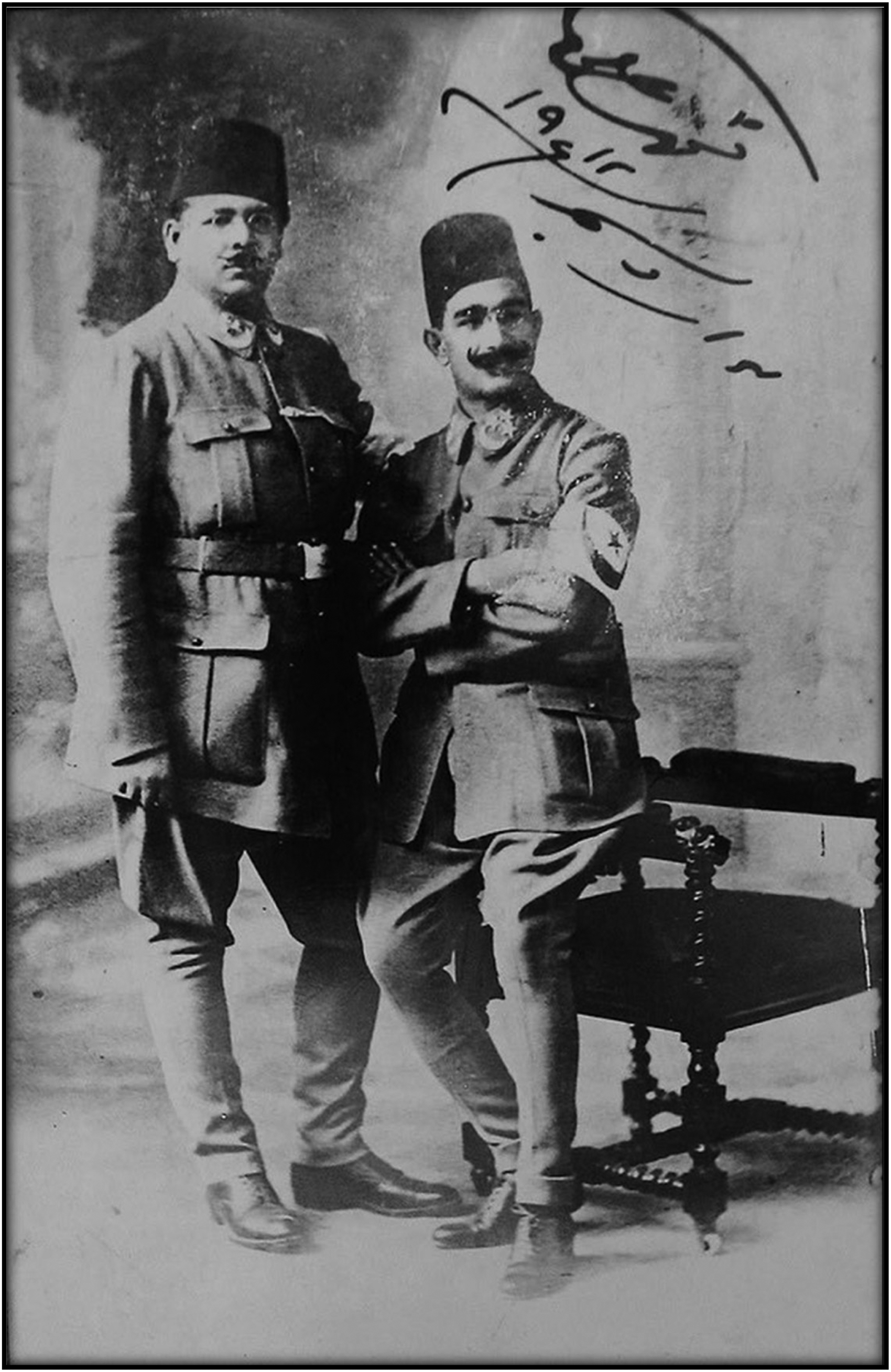
Muhktar Ahmad Ansari (right). Source: Internet.

Indian Medical Mission and Dr Ansari (Source: Kızılay Archive).
On 14 January 1913, Ansari and the Turkish officials went to Ömerli (Istanbul) to decide on the location of the first field hospital. 25 Before the establishment of Ömerli Field Hospital, (Figure 3) a mission introduced a delegation that included Talât Bey 26 (1874–1921) and Enver Pasha 27 (1881–1922) (Figure 4). Ansari and his Indian fellows were in Ömerli; two Indian Muslim doctors came from London; they recently graduated from medical school, Dr Abdur Rahman Bihari and Dr Raza Haider. 28 After Ömerli, some members of the Indian mission were sent to Çanakkale to establish another field hospital, but it was closed down after the cessation of active warfare in April 1913 as well. 29
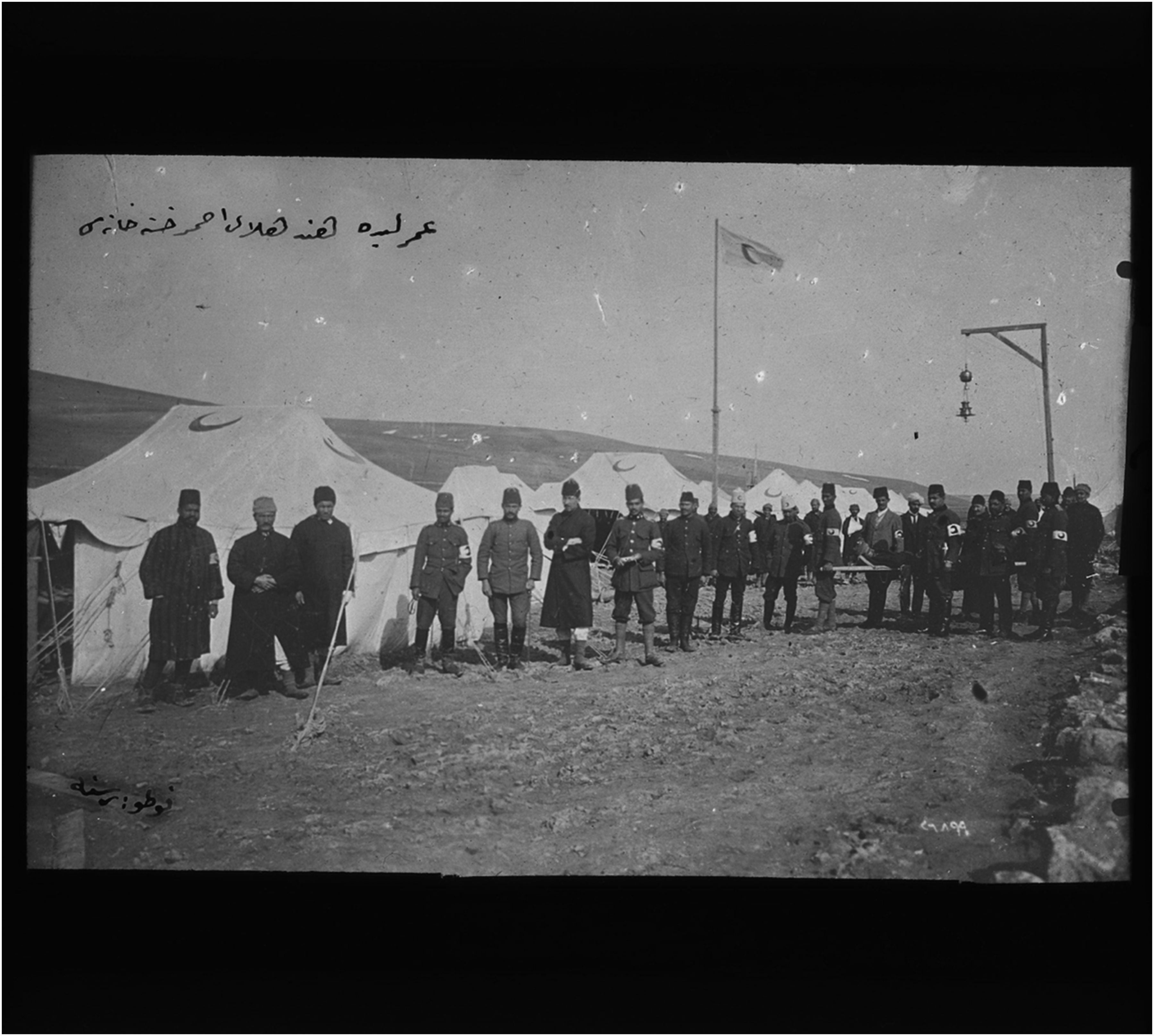
Ömerli Field Hospital (Source: Kızılay Archive).

Enver Pasha and Dr Ansari (Source: Kızılay Archive).
To Ansari, “the most important result of the mission was the formation of a bond between the Turkish nation and the Indians.” 30 During his stay in Turkey, Ansari established contacts with the Young Turk leaders and Egyptian nationalists, such as Shaikh Abdul Aziz Shawish (1876–1929). In his collaboration with Shawish and other notable names, Ansari proposed a scheme for a rehabilitation colony in Anatolia for Muslim refugees from the Balkans, a university in Medina, an Islamic Bank, and a cooperative society. 31 Ansari visited Ankara, Konya, and Adana to implement a rehabilitation colony and published his observations in Comrade. 32
His political life after istanbul
Ansari returned to India on 4 July 1913 with high confidence and was actively involved in political matters after the medical mission. He met ulama and western-educated Muslims for Indian independence and expressed himself simultaneously in the Indian National Congress 33 and the All-India Muslim League. 34 Ansari also played an essential role in the Lucknow Pact of 1916, and thanks to this Pact, Congress and the League agreed upon the idea of proportional representation. He was part of the Home Rule League and was elected President of the Home Rule League in 1917. In November 1919, the first session of the All-India Khilafat Conference opened in Delhi, and Ansari became the chairman of the Anti-Peace Celebrations Committee. In 1918 and 1920, he presided over the annual session of the Muslim League. He also held a high position in Congress; he was a member of its Working Committee and its General Secretary in 1920, 1922, 1926, 1931, and 1932. 35
During this long and turbulent period, Ansari continued to be interested in Ottoman politics and was very active during the Khilafat Movement from 1919 to 1922. The aim of the Central Khilafat Committee was to exercise pressure on the British Government to prevent the disintegration of Turkey and maintain the independence of the Holy Places, Mecca, and Medina. In this period, he worked closely with the leading figures in the Committee, but unlike his followers in Movement, he was moderate and had two crucial aims. The first one is to avoid violence like Mahatma Gandhi. Secondly, he hoped to gain the support of Hindus for the Khilafat Movement, which strengthened the alliance between the Hindus and Muslims. He suggested that Congress and Muslim League leaders jointly form the “Congress-League Party.” Still, his plan fell through when Gandhi decided to suspend civil disobedience in March 1922. So it was the end of hope for an alliance between the two communities. But it was not only a surprise for Ansari and Indian Muslims; after the suspension of civil disobedience, the Grand National Assembly at Ankara first decided to separate the Khilafat from the Sultanate in November 1922 and secondly decided to abolish the Khilafat in March 1924. 36 After these crucial developments, Ansari resigned from the membership of the Khilafat Committee. 37
Subsequently, Ansari devoted himself to finding a remedy to the Hindu–Muslim conflicts, and he worked with Lala Lajpat Rai (1865–1928) in preparing a National Pact for improving Hindu-Muslim relations. Nevertheless the publication of the Nehru Report in 1928 and Gandhi's decision to launch civil disobedience in 1930, some of the Indian Muslim leaders, like Mohammed Ali, attacked Gandhi and the Congress. Not long ago, Ansari founded the All-India Nationalist Muslim Party in July 1929. His support for Congress and his role in the Nationalist Muslim Part caused anger among his colleagues. The Ali Brothers condemned him and his friends in the party for “betraying the Muslim cause”. 38
During this zealous period, he was under the surveillance of the British Government since he struggled for the cause of Khilafat and the demand for independence. Because of his growing influence and prestige in the political scene, he became a very close friend of Mahatma Gandhi. However following these developments, he was highly disappointed with his party's efforts. Early in 1933, when he went to Europe, Ansari retired from politics. On his return, he tried reappearance in the political scene, but due to his health problems, he retired from active political life in April 1935. After this date, Ansari devoted his time to Jamia Millia, who was one of the founders, and at his death on 10 May 1936, he was the Chancellor. 39 Ansari was the co-founder and chancellor of the Jamia Millia Islamia [al-Jami’a al-Milliyya al-Islamiyya], founded in October 1920, and he served as the chancellor of the institution between 1928 and 1936. 40 Dr Ansari died of a heart attack on 10 May 1936 and was buried on the university campus.
Ansari's medical research
Besides his political activity, Ansari continued practising medicine and caring for his patients. He conducted hundreds of operations in India, and earnestly endeavoured to graft animal testicles from bulls, monkeys, and sheep onto human beings. As indicated by Ansari, “the desire for regenerative methods of treatment is wide-spread in India,” and “many tropical climate, unhygienic surroundings low standard of living due to poverty, poor general physique, adverse social conditions, segregation of the sexes, early marriages, high birth-rate, lack of medical and sanitary aid and a low average of life” were the leading causes of it. The great majority of patients who visited Ansari's consulting rooms frequently complained “their failing strength, vigor and to the thinning of the semen”. Therefore since the days of his early career, he had to deal with the patients who “suffering from real or imaginary decline in their mental, physical and sexual powers.” At the beginning for these patients, Ansari used to treat drugs. Yet, in 1915 he changed his mind. He began to give “fresh extract of raw testes” to them. Meanwhile, he continued to read about this issue, and an illuminating article in the Journal of Physiology for December 1919 impressed Ansari and his studies. 41
Ansari decided to improve his investigations into this particular field of medical research thanks to this article and visited Europe in 1921. When he was in London, the sudden death of Mr Wilson, who advertised a lecture at the Albert Hall on the subject, “How I Became Young,” caused a terrible impression about Eugen Steinach's (1861–1944) method of regeneration. 42
During his visit to London, he studied all the accessible literature in English, but it was minimal. Then he looked at some articles written in German and translated them into English. In the autumn of 1921, he visited Vienna and met Professor Eugene Steinach. After seeing Steinach's research in his biological laboratories, Ansari went to the clinic of Dr Robert Lichtenstern (1874–1955) and observed that “the application to man of Steinach's experimental researches had produced outstanding results in different conditions for which it was used.”. 43
After his return to India in November 1921, Ansari presented a paper before the Delhi Medical Association on the “Arrest of Senescence and Possibilities of Regeneration, with special reference to Steinach's experiments and Lichtenstern's application of these results to Man.” Before his second visit to Europe in the summer of 1925, Ansari was able to carry out a few operations of vaso-ligature and vasectomy, or grafting of sex glands, between 1922 and 1924, but his results were also not encouraging. He visited Paris, Lucerne, and Vienna. With his observation of Voronoff, Stocker, Lichtenstern, and Steinach's studies, Ansari wrote, “I gained much in practical and clinical knowledge in this tour and determined to pursue the work vigorously.” In the autumn of 1925, he presented his second article, “Recent Researches on the Regenerating Effects of Internal Secretion of the Sex-glands, with a report on five cases, two of Steinach's operation and three of testicular grafting” to the Delhi Medical Association. Between 1926 and 1934, as indicated in his book, Ansari operated on more than 600 patients and made a strenuous effort “to keep in touch with these patients directly or their physicians over three to four years.” Lastly, Ansari noted around 440 cases of grafting and pride in his success. He gifted a copy of his book, Regeneration in Man, to Mahatma Gandhi. 44
Conclusion
Turkish novelist and intellectual Halide Edip Adıvar 45 (1884–1964) visited India upon the invitation of Dr Ansari in 1935. In India, Adıvar promised his old friend to write a book about India. 46 She published Inside India after Ansari's death and dedicated it to his memory. As indicated by Adıvar, Dr Ansari was one of the most distinguished Muslim nationalists in India in the late 19th century and the first half of the 20th century. For years, his house, which she described in the first part of her book and where she stayed as a guest for a while, was the headquarter of the followers of the freedom struggle and local Congress Committee. In this house, the leaders from different parts of India met and made important decisions.
Adıvar and Ansari's paths crossed during a difficult time in Istanbul, and this friendship continued for many years. The days he spent in Istanbul had meanings beyond medical aid, and he strengthened Indo-Turkish relations.
After returning to his country, although he emerged as a prominent figure in the political arena, he did not neglect his patients. He conducted new research in order to improve their quality of life. For example, shortly after Istanbul, he played an active role in establishing the Delhi Medical Association (after DMA) in 1914. According to the information given by this institution, “DMA is older than Indian Medical Association” and “the first inaugural function was held on 20 August 1914 in the consulting room of Dr Ansari in Fatehpuri Mosque”. 47
Footnotes
Acknowledgments
We thank Kızılay Archive and its staff for enabling us to access Ansari's photographs.
Declaration of Conflicting Interests
The author(s) declared no potential conflicts of interest with respect to the research, authorship, and/or publication of this article.
Funding
The author(s) received no financial support for the research, authorship, and/or publication of this article.
1.
Mushirul Hasan (ed.), Muslims and the Congress: Select Correspondence of Dr. M. A. Ansari 1912–1935, New Delhi: Manohar Publications, 1960; A Nationalist Conscience: M. A. Ansari, the Congress, and the Raj, Manohar, New Delhi, 1987; M. A. Ansari, New Delhi, 1995; “Muhktar Ahmad Ansari (1880–1936)” EI3, 2007/3; Francis Robinson, Separatism Among Indian Muslims: The Politics of the United Provinces’ Muslims, 1860–1923, London: Cambridge University Press, 1974; P. G. Robb, “Muslim Identity and Separatism in India: The Significance of M.A. Ansari”, Bulletin of the School of Oriental and African Studies, 54/l (1991), pp. 104–125; M. Naeem Qureshi, Pan-Islam in British Indian Politics: A Study of the Khilafat Movement 1918–1924, Leiden: Brill, 1999.
2.
Azmi Özcan, Pan-Islamism: Indian Muslims, the Ottomans and Britain, 1877–1924, Leiden: Brill, 1997; Syed Tanvir Wasti, “The Indian Red Crescent Mission to the Balkan Wars”, Middle East Studies, 2009, 45/3, 393–406; Ahmet Zeki İzgöer and Ramazan Tuğ, Padişah’ın Himayesinde Osmanlı Kızılay Cemiyeti 1911–1913 Yıllığı, Ankara: Türk Kızılayı Yayınları, 2013; Burak Akçapar, People's Mission to the Ottoman Empire: M. A. Ansari and the Indian Medical Mission, 1912–1913, Oxford: Oxford University Press, 2014; Ahmet Zeki İzgöer, “1911–1913 (1329–1331) Tarihli Osmanlı Hilal-i Ahmer Sâlnâmesine Göre Balkan Savaşları Sırasında Hint Müslüman Halkının Osmanlı’ya Yardımları”, Journal of History and Future, 1/1 2015, pp. 99–171;
3.
Abu Ayyub al-Ansari was born in Yathrib [Madina] and close companion of Prophet Mohammed. Abu Ayyub was one of Ansar, helpers and patrons of Prophet and his followers from Mecca after the hijra. He joined the first Arab Siege of Istanbul at the age of ninety and died due to illness during the siege. He buried in Istanbul and after the conquest of the city by Ottomans Turks, a tomb was constructed above his grave and after that this area was named as Ayyub. When Dr. Ansari came to the city, he visited the tomb.
4.
Hasan, M. A. Ansari, p. 10; Mushirul Hasan, “Muhktar Ahmad Ansari (1880–1936)”, pp. 133–135; Halide Edip, Inside India, London, 1937, p. 30.
5.
Hasan, M. A. Ansari, p. 12. Muir Central School in North India was a college of higher education founded by Scottish Orientalist, and colonial administrator William Muir in 1872 and this college incorporated into Allahabad University.
6.
Hasan, M. A. Ansari, pp. 12–13.
7.
Hasan, Muslims and the Congress, Introduction.
8.
“Being a doctor in London hospital caused quite a furor in local press and an evening newspaper published a story ‘Grave Injustice to British Doctors’ with racist tones.” Hasan, M. A. Ansari, pp. 13–14.
9.
10.
Famous Indian Muslim thinker, politician, and poet. He was born in Punbab. Iqbal completed his B.A. and M.A. at the Government College Lahore. He completed his second B. A. at Trinity College and then received a Ph.D. in philosophy at the University of Munich. Iqbal returned to Lahore in 1908 and died in 1938.
11.
The question of when he became involved in political affairs is controversial. To one of his biographer Mushirul Hasan, “until 1911, Ansari gave no evidence of his interest in Indian politics”. See; Hasan, M. A. Ansari, pp. 14–17; Unlike Hasan, Muhammed Yusuf Abbasi claim that while Ansari was continuing his studies in London, he became interested in political issues. The young doctor who defended the independence of India, came into contact with Indian nationalists in London during this period. With the encouragement of Amir Ali (1849–1828), who carried out the activities of the Indian Muslim League in London, Ansari participated in the activities of the London Muslim League before its establishment and took part in its committees. See; Muhammed Yusuf Abbasi, London Muslim League (1908–1928): An Historical Study, Islamabad, National Institute of Historical and Cultural Research, 1988, p. 16, 21.
12.
English novelist and writer, best known for his novels, especially A Passage to India (1924).
13.
Hasan, Muslims and the Congress, Introduction; Hasan, M. A. Ansari, pp, 17-19; Choudhry Khaliquzzaman, Pathway to Pakistan, Pakistan: Longmans Green, 1961, p. 32.
14.
15.
“The Balkan Wars were two sharp conflicts that heralded the onset of World War I. In the First Balkan War a loose alliance of Balkan States eliminated the Ottoman Empire from most of Europe. In the Second Balkan War, the erstwhile allies fought among themselves for the Ottoman spoils.” See:  (accessed 9 December 2022).
16.
Hasan, M. A. Ansari, p. 35; Qureshi, Pan-Islam in British Indian Politics: A Study of the Khilafat Movement 1918–1924; pp. 58–60; Azmi Özcan, Panislamizm: Osmanlı Devleti, Hindistan Müslümanları ve İngiltere (1877–1924), Ankara: İSAM Yayınları, 1992; pp. 218–232. Anjuman-i-Khuddami-i-Kaaba [Society of the Servants of the Kaaba] was founded in the early days of 1913 by Qayyam-ud-din Mohamed Abdul Bari (1879–1926), Mushir Hosain Kidwai and Ali brothers.
17.
Maulana Shaukat Ali was the elder brother of Maulana Mohamed Ali. He was born in Rampur and graduated from Mohammadan Anglo-Oriental College’da (later Aligarh Muslim University). He worked as a civil servant and took an active part in the Khilafat Movement. See: Biographical Notes in Qureshi, Pan-Islam in British Indian Politics: A Study of the Khilafat Movement 1918–1924.
18.
Wasti, “The Indian Red Crescent Mission to the Balkan Wars”, p. 393, 406; 394.
19.
Hasan, M. A. Ansari, p. 35
20.
Hasan, M. A. Ansari, p. 35–36.
21.
For help of Indian Muslims to the Ottoman empire see; Özcan, Pan-Islamism: Indian Muslims, the Ottomans and Britain; İzgöer and Tuğ, Padişah’ın Himayesinde Osmanlı Kızılay Cemiyeti 1911–1913 Yıllığı; İzgöer, “1911-1913 (1329-1331) Tarihli Osmanlı Hilal-i Ahmer Sâlnâmesine Göre Balkan Savaşları Sırasında Hint Müslüman Halkının Osmanlı’ya Yardımları”, pp. 99-171; Y. Doğan Çetinkaya, “Hint Hilafet Hareketi’nin Para Yardımı ve ‘İngiliz İzni’”, Toplumsal Tarih, Mayıs 2022, pp. 44–50.
22.
Özcan, Pan-Islamism: Indian Muslims, the Ottomans and Britain; Wasti, “The Indian Red Crescent Mission to the Balkan Wars”, 394; Akçapar, People's Mission to the Ottoman Empire: M. A. Ansari and the Indian Medical Misssion, 1912–1913, p. 163; Ahmet Zeki İzgöer and Ramazan Tuğ, Padişah’ın Himayesinde Osmanlı Kızılay Cemiyeti 1911-1913 Yıllığı, Ankara: Türk Kızılayı Yayınları, 1913, pp. 134–135.
23.
Wasti, “The Indian Red Crescent Mission to the Balkan Wars”, p. 394.
24.
The Committee of Union and Progress (İttihat ve Terakki Cemiyeti) later the Union and Progress Party was a revolutionary organization and political party active between 1889 and 1926 in the Ottoman Empire and the Republic of Turkey. For the history of committee see: M. Şükrü Hanioğlu, The Young Turks in Opposition, New York, Oxford: Oxford University Press, 1995.
25.
26.
Mehmet Talât was born in Edirne. He worked in a school and post office. After the Young Turk Revolution of 1908, he became deputy for Edirne in the Ottoman Parliament and in 1909, he was appointed minister of the interior. He was the leader of main faction in the CUP. In 1912, he became minister of post and then the secretary general of the CUP. Talât Pasha became Grand Vezir in 1917 and after the defeat, escaped to Europe. He was assassinated in Berlin on 16 March 1921. For detail information about him and his role during this period see: Feroz Ahmad, The Young Turks: The Committee of Union and Progress in Turkish Politics 1908–1914, Oxford: At the Clarendon Press, 1969; M. Şükrü Hanioğlu, The Young Turks in Opposition.
27.
İsmail Enver was born 22 November 1881 in Istanbul. He graduated in 1902 from Harbiye and posted to the army. Joined the CUP and he became a hero of the Young Turk Revolution in 1908. He was a leading member of the Ottoman government from 1913 to 1918. When Ansari came to Istanbul, Enver Pasha was the chief of the general staff of the Ottoman army. He played a key role in the Ottoman entry into World War I. After the Ottoman defeat in 1918, he escaped abroad and attempted to organize the Turkic peoples against the Soviets. Enver Pasha was killed in Turkistan while fighting the Bolsheviks in 4 August 1922. For detail information about him and his role see: Ahmad, The Young Turks: The Committee of Union and Progress in Turkish Politics 1908–1914 and Hanioğlu, The Young Turks in Opposition.
28.
Other doctors joined the Mission; Aale Imran, and Hasan Abid Jafri from England; and Mirza Abdul Qayyum from India and an Egyptian physician, Dr Fouad. See; Wasti, “The Indian Red Crescent Mission to the Balkan Wars”, p. 397.
29.
Wasti, “The Indian Red Crescent Mission to the Balkan Wars”, p. 398.
30.
Qureshi, Pan-Islam in British Indian Politics: A Study of the Khilafat Movement 1918–1924, 59. During these days, Ansari made friendship with some leading persons and their friendship continued for many year. The most important of these include: Halide Edip Adıvar and Hüseyin Rauf Orbay. Rauf Orbay was the former Prime Minister of the Republic of Turkey and she visited India and met his old friend, Ansari. See: Fehim Kuruloğlu, “The Usual Suspect: Turkey's Former PM Hüseyin Rauf Orbay's Journey to India in 1933”, Yakın Dönem Türkiye Araştırmaları, 2022, 41, pp. 230–253.
31.
Qureshi, Pan-Islam in British Indian Politics: A Study of the Khilafat Movement 1918–1924, 59–60.
32.
Burak Akçapar, Halkın Fermanı: Balkan Savaşları’nda Hint Müslüman Tıp Heyeti, İstanbul: Koç Üniversitesi Yayınları, 2022, pp. 158–161. For Ansari's Letters see, Akçapar, Halkın Fermanı: Balkan Savaşları’nda Hint Müslüman Tıp Heyeti, pp. 187–261.
33.
The Indian National Congress, or Congress Party formed for independence from Great Britain in 1885.
34.
The All-India Muslim League was a political party established in Dhaka in 1906. The aim of the party was to secure Muslim interests on the Indian subcontinent.
35.
Hasan, Muslims and the Congress, Introduction.
36.
On 30 October 1918, The armistice of Mundros was signed and it was the end of WWI and unconditional surrender of the Ottoman Sultan. The seat of Caliphate, Istanbul, and Anatolia were occupied by the Allied forces. It caused the national resistance led by Mustafa Kemal Pasha (later Atatürk). While he was in Anatolia to organize the resistance, the elections were held in Istanbul and the deputies declared the Misak-ı Milli, the National Pact for the creation of independent Turkish state. Upon this crucial attempt, The British officials took action against the Turkish nationalist. On 23 April 1920, a new Parliament, the Grand National Assembly, was established in Ankara and after two years in August 1922, the Turkish army won decisive victory against the Greeks. On 14 October 1922, The Mudanya armistice was signed by the Turks, represented from Ankara Government, the Greeks and the British. After a short time, the British invited both the Ankara and Istanbul Government to the Lausanne Conference. To Ankara, it was unacceptable and Mustafa Kemal firstly separated sultanate and the caliphate and then abolished the office of the sultanate to end the problem of two governments in the country. For the decision and the reaction of Indian Muslim to it see: Azmi Özcan, Pan-Islamism: Indian Muslims, the Ottomans and Britain, 1877–1924, chapter six.
37.
Hasan, Muslims and the Congress, Introduction.
38.
Hasan, Muslims and the Congress, Introduction.
41.
42.
Eugen Steinach researched sex hormones and their effects on mammals in the late 19th and early 20th centuries in Europe. He experimented on rats by removing their testicles and implanting them elsewhere in their bodies, and he found that the testes interstitial cells produce male sex hormones. He developed the Steinach Rejuvenation Procedure.
43.
Ansari, Regeneration in Man XIII-XVII.
44.
Ansari, Regeneration in Man, XVII-XX.
45.
Turkish novelist and author Halide Edip was born in Istanbul. She and her husband joined the Turkish nationalists and played a crucial role in the Turkish War of Liberation in Anatolia. She visited India in 1935. She became a member of Parliament in 1950.
46.
Halide Edip, Inside India, p. 9; Halide Edip Adıvar and Dr. Ansari had met in Istanbul during the days of mission. For their friendship and Adıvar's visit see: Ali Fuat Bilkan, “Halide Edip Adıvar’ın Inside India Adlı Eseri ve Hindistan Ziyareti”, Bilig, 2005, 33, pp. 119–136. According to Bilkan, Adıvar and Ansari had met Istanbul on 4 and 7 January 1913. For Adıvar's conferences in India see Bilkan, “Halide Edip Adıvar’ın Hindistan’daki Konferansları”, Bilig, 2011, 56, pp. 33/44.