







Abstract
Sabuncuoğlu Şerefeddin was a pioneering Turkish surgeon and scholar who lived in Amasya during the fifteenth century. His illustrated surgical treatise, Cerrahiye-i Ilhaniye (Ilkhanid Surgery), is considered a landmark in medical history, providing detailed descriptions of surgical operations and instruments accompanied by coloured illustrations. In addition to this seminal work, Sabuncuoğlu made significant contributions to experimental pharmacology in Anatolia through his work Mücerrebname (The Book of Experiences), which documents his pharmacological experiments on animals and himself. This paper aims to provide a biographical account of Sabuncuoğlu's life and to highlight his enduring contributions to medical science.
Introduction
Sabuncuoğlu Şerefeddin, a renowned surgeon and medical scholar of the fifteenth century, made groundbreaking contributions to Anatolian and Ottoman medicine. His seminal work, Cerrahiye-i Ilhaniye, stands out as the first illustrated surgical atlas in Anatolia, featuring detailed miniatures that depict surgical techniques and instruments. In a time when surgery was undervalued, Sabuncuoğlu's dedication marked a bold departure from prevailing norms, cementing his legacy as a pioneer of surgical specialization in Anatolia. In addition to this seminal work, Sabuncuoğlu made significant contributions to experimental pharmacology in Anatolia through his work Mücerrebname (The Book of Experiences), which documents his pharmacological experiments on animals and himself. This paper aims to provide a biographical account of Sabuncuoğlu's life and to highlight his enduring contributions to medical science
Sabuncuoğlu Şerefeddin's biography
Our understanding of Sabuncuoğlu Şerefeddin's biography is limited and primarily derived from his surviving works. In his Mücerrebname (Book of Experiences), he noted that the book was completed in 1468 (873 AH) when he was 85 years old. Based on this information, it can be inferred that he was born in 1386 (788 AH). 1 It is reasonable to conclude that he was born in Amasya, given that he spent the majority of his life there and adopted the title El-Hekim bi Amasyati’l Mahruse (“The Physician from Amasya”). 2 His father's name was Ali, and his grandfather was Sabuncuzade Hacı İlyas. 3 This lineage suggests that he came from an esteemed family with a strong tradition of medical scholarship, as he referred to himself as Şerefeddin ibn-i Aliyyü’l-Mütetabbib (“Son of Supreme Physicians”). 4
Sabuncuoğlu practiced medicine for 14 years at the Bimaristan of Amasya, 5 which today functions as a medical history museum. His expertise and proficiency in the field earned him a promotion to the position of court physician, serving at the court of İsfendiyar Bey in Kastamonu. 6 The exact date of his death remains unknown; however, since his last work was completed at the age of 85 in 1468, it can be assumed that he passed away around this time.
Sabuncuoğlu Şerefeddin's works
Sabuncuoğlu Şerefeddin authored three significant medical works: Terceme-i Akrabadin, Cerrahiye-i Ilhaniye, and Mücerrebname. He wrote all these works in Turkish. Considering that Persian and Arabic were the predominant scientific languages of his time, Sabuncuoğlu's decision to write in Turkish reflects a highly innovative approach aimed at making his works accessible to those in Anatolia who did not understand Persian or Arabic.
In the epilogue of his work named Terceme-i Akrabadin (Translation of pharmacopoeia), he explained the reason for this: “In this period, Turkish is spoken in Anatolia. In addition, most of the surgeons of this time are illiterate; and even if they are literate, they all read books written in Turkish. In the way of writing this book in Turkish, more people can benefit from these. By this means, they learn the essence of the matter and through solving their problems, can save themselves from the mistakes and the troubles”. 4
Certainly, Sabuncuoğlu Şerefeddin, who was a learned physician, used to know Arabic and Persian languages. He translated the part Akrabadin of Zahire-i Harezmşahi, which was a Persian work, and the book at-Tasrif by Zahrawi, which was an Arabic work, into Turkish. However, the fact that Sabuncuoğlu wrote his works in Turkish, contributed to learning of Turkish medicine in Anatolia by more people and he contributed to the development of Turkish as a scientific language in Anatolia.
Terceme-i Akrabadin (Translation of Pharmacopoeia)
Sabuncuoğlu Şerefeddin's earliest work, in chronological order, was Terceme-i Akrabadin, a translation of the Akrabadin section from Zahire-i Harezmşahi, originally written in Persian by Jurjani. Akrabadin works can be considered the pharmacopoeias of the period. He completed this work in 1454 in response to a request from physicians in Amasya for a Turkish translation of an Akrabadin text. In fulfilling this request, Sabuncuoğlu reviewed the existing Akrabadin texts known at the time and selected this particular work for its superior formulations and precise measurement guidelines. 4
In his Turkish adaptation, Sabuncuoğlu expanded the original 31-chapter book by adding two additional chapters (Chapters 29 and 33), resulting in a 33-chapter publication. In Chapter 29, he provided crucial information about the duration of the therapeutic effects of drugs, a significant resource for physicians. To further aid Turkish readers in understanding the Akrabadin, he included a Persian-Arabic-Turkish dictionary in Chapter 33. This addition was specifically designed to facilitate comprehension and enhance accessibility for a wider audience.
Cerrahiye-i Ilhaniye (Ilkhanid Surgery)
Sabuncuoğlu Şerefeddin's second and most renowned treatise is Cerrahiye-i Ilhaniye, written in 1466 when he was 83 years old. 3 A distinguishing feature of this work, compared to other surgical writings of the time in Anatolia, is its coloured illustrations of patients and surgeons, which provide detailed depictions of surgical procedures. The book contains 138 drawings illustrating surgical operations alongside depictions of 168 surgical instruments, making it the first known colour-illustrated surgical atlas in Anatolia.
Sabuncuoğlu prepared this treatise with the intention of presenting it to Sultan Mehmed Fatih, seeking recognition and financial support during a period of personal financial hardship. 3 However, due to his advanced age, he was unable to present the work himself. The treatise reached the palace during the reign of Bayezid II, the son of Sultan Mehmed Fatih, and the most esteemed copy bears Bayezid II's seal. This valuable manuscript was removed from the palace at an unknown date and gifted to a French physician by Yasincizade Ilmi Efendi in 1860. By 1871, it had become part of the collection of the French National Library (Bibliotheque Nationale). 7 To date, only three extant hand-written copies of the treatise are known: one is housed in the Istanbul Millet Library, another in the Department of the History of Medicine and Ethics at Istanbul University's Faculty of Medicine, and the third in the National Bibliothéque (Bibliotheque Nationale) in Paris. 8 Prof. Dr Ilter Uzel, a medical historian, examined all three copies and prepared a text in Latin script. 9
Cerrahiye-i Ilhaniye comprises 3 chapters and 191 sections: the first chapter focuses on surgical cauterizations (57 sections), the second on surgical incisions and interventions (98 sections), and the third on fractures and dislocations (36 sections). While much of the content is translated from Zahrawi's at-Tasrif, the book also incorporates numerous original contributions by Sabuncuoğlu. These original contributions include his observations, experiments, and innovations, such as using acupuncture for toothaches, performing plastic surgery on a tracheotomy patient, removing objects lodged in the trachea, applying a “Reverse T incision” to treat hydrocephalus, implementing a “long post-operative drainage period” for the treatment of short frenulum, designing a “mibza-straighter scalpel” and a urinary catheter for narrow urinary meatus, defining hermaphroditism, and describing the gynecological examination position. These contributions distinguish Cerrahiye-i Ilhaniye as a pioneering work in its field. 8
The illustrations in Cerrahiye-i Ilhaniye offer valuable insights into the medical practices of the time. They indicate the presence of female surgeons (Figure 1) and physicians, illustrate the positions and methods used in surgical operations, and show the role of surgical assistants. Unfortunately, the tradition of illustrating surgical operations initiated by Sabuncuoğlu Şerefeddin was not continued in Anatolia, and no illustrated surgical books were written until the nineteenth century. Moreover, the fact that only three copies of this work exist indicates that it and similar studies did not attract much interest.
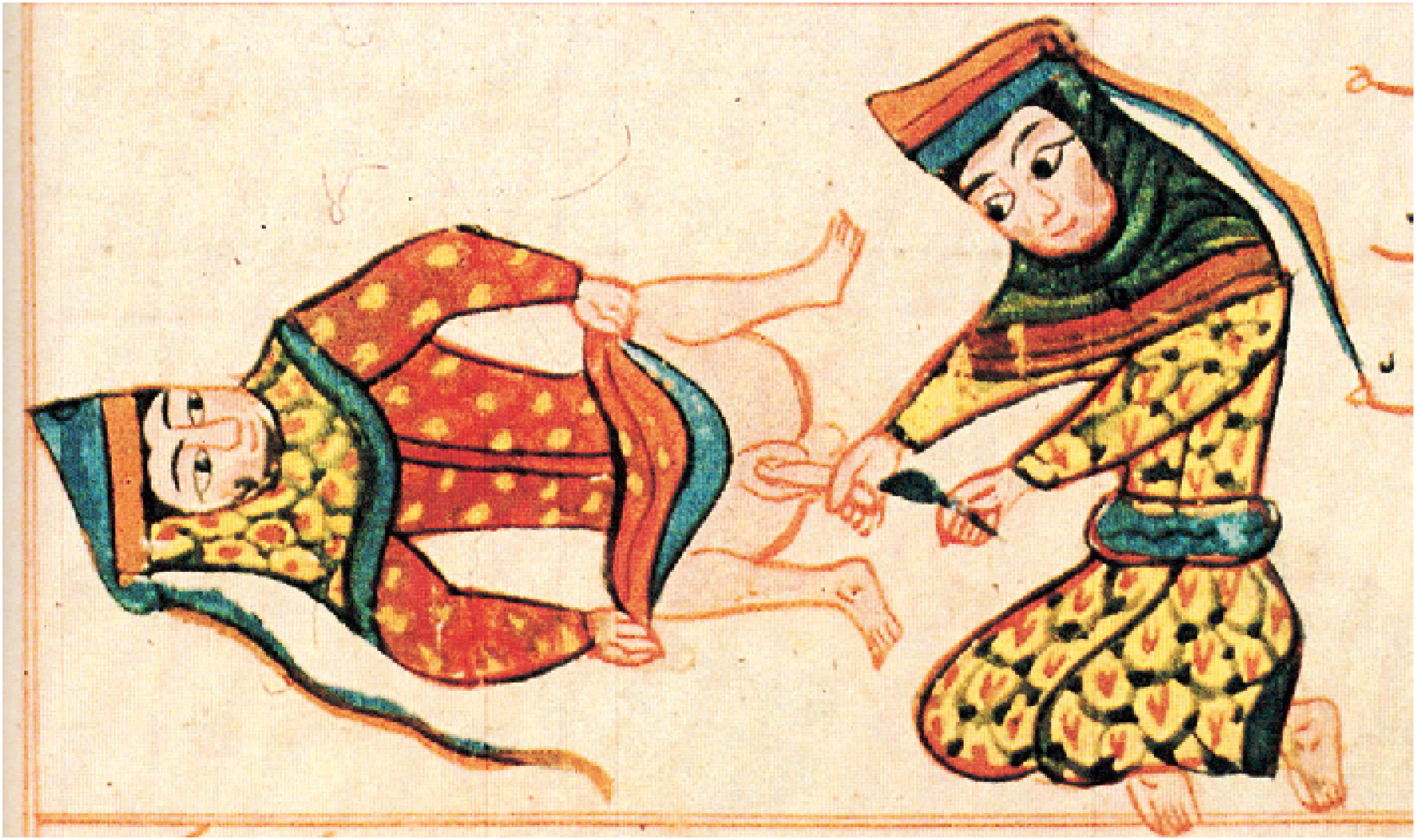
Female surgeon treating hermaphroditism in Cerrahiye-i Ilhaniye (Supplement Turc 693, NATIONAL LIBRARY of France, Folio 110b).
The earliest known drawings of surgical instruments in history were made by Zahrawi (936–1013) (Figure 2). The first anatomical drawings emerged from the twelfth century onward in Europe, coinciding with the resurgence of dissection studies. The tradition of anatomical drawings that emerged in Europe was followed in the Islamic world, with notable figures such as Ilyas bin Mansur, a renowned physician of the Timurid Empire, incorporating anatomical illustrations similar to those in Europe into his works (Figure 3). 10
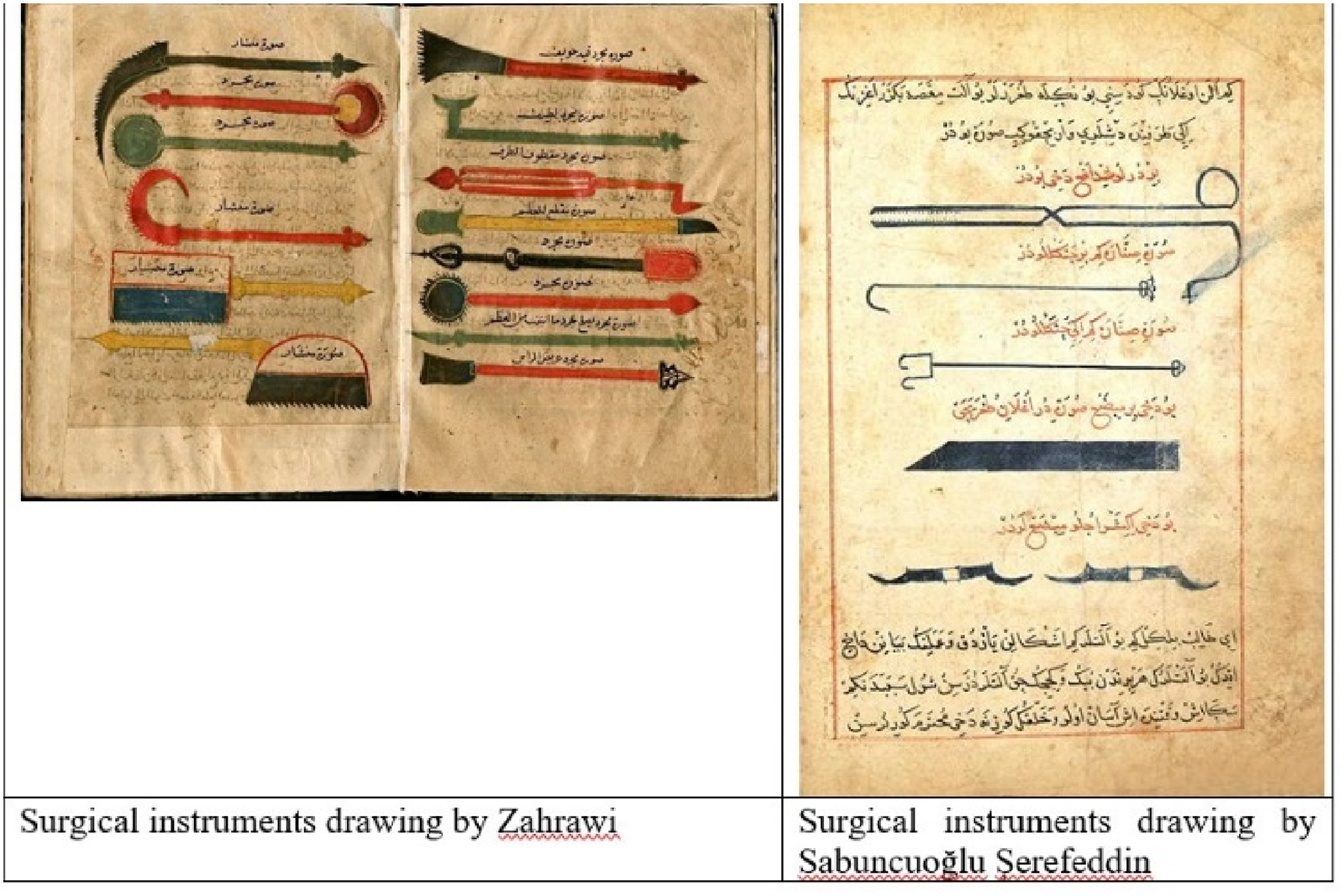
Surgical instruments.
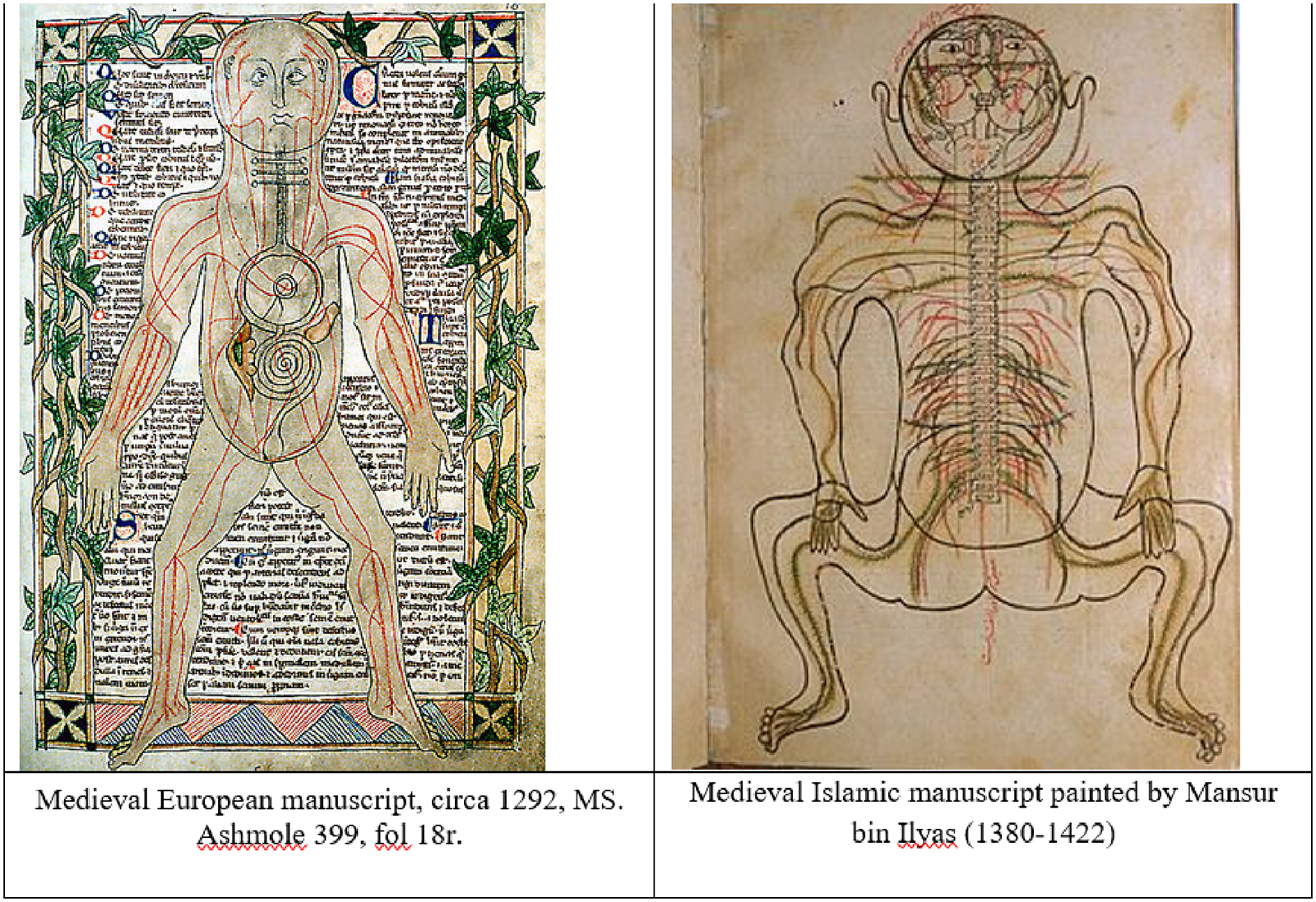
Anatomical illustrations in medieval world.
The earliest examples depicting scenes of surgical operations are also found in European works dating from the thirteenth and fourteenth centuries. The first example in the Islamic world of depicting surgical scenes in books is the Cerrahiye-i Ilhaniye, written in Anatolia by the Ottoman physician Sabuncuoğlu Şerefeddin. As in the early classical and medieval medical texts, the primitive and nonrealistic illustration of figure (https://www.gla.ac.uk/myglasgow/library/files/special/exhibns/month/may2006.html) was also adopted by Sabuncuoğlu. As Sabuncuoğlu himself noted, the primary reason for including these illustrations may have been that the majority of surgeons of the time were illiterate. The miniatures were created with an educational purpose rather than artistic value, and similar examples in Europe also developed with this characteristic until the Renaissance period. Comparative examples from various surgical scenes are presented below (Figure 4).
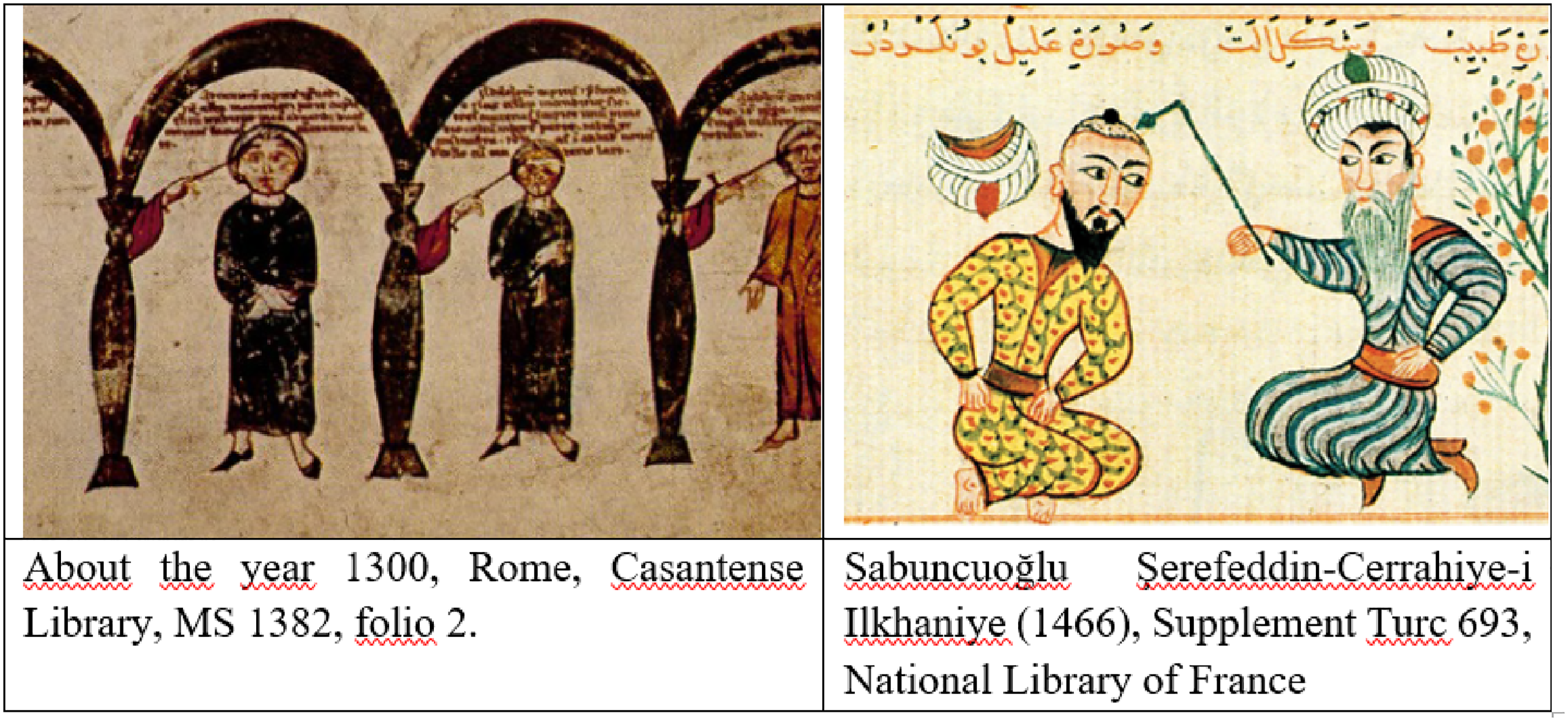
Illustrations showing cauterization.
Cerrahiye-i Ilhaniye encompasses a wide range of surgical disciplines and also provides insights into anaesthesia, which is critically important for enabling pain-free surgery. Sabuncuoğlu indicates that he utilized mandragora and almond oil as anaesthetics for surgical procedures.11,12 Additionally, he extensively addresses pain management, offering therapeutic approaches for a wide range of symptoms, including headaches, toothaches, throat pain, ocular pain, sinus-related pain, as well as lower back pain and sciatica. The text recommends the use of various topical preparations, such as creams, pomades, plasters, ointments, and lotions, for alleviating pain. 13
Cerrahiye-i Ilhaniye provides detailed discussions on general surgical procedures, such as the management of inguinal hernias, hemorrhoids, anal fistulas, and perianal abscesses. 14 A substantial portion of the treatise, approximately one-third, is dedicated to orthopedic surgery. In this section, Sabuncuoğlu provides comprehensive descriptions of treatment techniques for fractures and dislocations of the extremities.15,16 Pediatric surgery is another area extensively covered in Cerrahiye-i Ilhaniye. It includes procedures such as circumcision, management of meatal stenosis, imperforated anus, hypospadias, epispadias, perineal fistulas, and urethral atresia. 17
Similarly, urinary surgery is given significant emphasis, detailing surgical techniques for urinary retention, bladder irrigation, and urolithiasis. 18 Procedures related to the genital region, including varicocele, hydrocele, orchiectomy, and penectomy, are also comprehensively addressed. 19 Obstetrical procedures constitute another key focus area. Sabuncuoğlu discusses both normal and abnormal labor, including the management of abnormal presentations, delivery of dead fetuses and removal of retained placentas. 20
Neurosurgery occupies a prominent position in the treatise, with numerous subchapters addressing conditions like sciatica, spinal deformities, head trauma, epilepsy surgery, hemiplegia, low back pain, hydrocephalus, and kyphosis. Pediatric neurosurgical procedures, particularly those involving skull fractures, are also explored in depth. These sections, enriched with illustrations, are regarded as significant contributions to the historical development of neurosurgery in Turkey.21-28
The text also explores plastic surgery techniques, including procedures for gynecomastia, hermaphroditism, maxillofacial reconstruction, and eyelid surgery.29,30 In ophthalmology, Cerrahiye-i Ilhaniye stands out for its detailed illustrations and descriptions of surgical procedures and instruments. Conditions such as symblepharon, lymphangiectasia, pannus, proptosis, chalazion, and hypopyon are meticulously discussed, along with their corresponding surgical treatments. 31 In thoracic surgery, the treatise covers topics such as the management of sternal and rib fractures and the treatment of empyema using thoracic drainage techniques. 32
Endoscopic procedures are also addressed in Cerrahiye-i Ilhaniye, including uroendoscopy and the removal of foreign bodies from the upper pharynx and esophagus. 33 The treatise also includes unique insights into acupuncture, where Sabuncuoğlu suggests the application of cauterization at acupuncture points for four specific indications. 34 Finally, Cerrahiye-i Ilhaniye references additional medical subspecialties, 35 including psychiatry, 36 dermatology, 37 dentistry, 38 oncologic surgery, 39 pneumothorax, 40 vascular surgery, 41 war surgery, 42 and otolayrngology.43,44
Mücerrebname (Book of Experiences)
Sabuncuoğlu Şerefeddin is renowned not only for his illustrated surgical manuscript Cerrahiye-i Ilhaniye, but also for his significant contributions to experimental pharmacology in Anatolia. In 1468, at the age of 85, he authored Mücerrebname, a treatise on pharmacological experiments, at the request of physicians in Amasya. At the beginning of this work, he included a “Table of Medical Compounds,” which systematically categorized drugs according to their effects, areas of application, and frequency of use—from the most common to the least. This treatise documents medications whose effects were either serendipitously discovered or intentionally studied by Sabuncuoğlu, along with the results of his empirical investigations. For instance, he administered theriac to a rooster, allowed it to be bitten by a snake, and observed its survival. In a more daring experiment, he ingested theriac himself, permitted a snake to bite his finger, and noted the absence of pain or swelling. These experiments effectively demonstrated theriac's protective properties against venom.1,2,5,6
Sabuncuoğlu's willingness to conduct experiments not only on animals but also on himself reflects his profound commitment to scientific inquiry and his exceptional self-confidence. His reliance on empirical evidence is encapsulated in a statement from Mücerrebname, which compiles his trials: “Tecrübe delil-i sıdktır” (“Experiments provide the most accurate evidence”).45 Through his bold experimental approaches, Sabuncuoğlu advanced the experimentation of pharmaceutical practices of the Islamic medical tradition46-48 to a new level and emerged as a pioneering figure in the development of experimental pharmacology in Anatolia.
Conclusion
Sabuncuoğlu Şerefeddin stands out as a trailblazer in the history of medicine, particularly in Anatolia, where his groundbreaking contributions to surgery and pharmacology bridged the gap between practice and theory. His seminal works, Cerrahiye-i Ilhaniye and Mücerrebname, not only advanced surgical techniques and experimental pharmacology but also set a precedent for the use of Turkish as a scientific language, making medical knowledge accessible to a broader audience. By incorporating illustrations into his surgical treatises, Sabuncuoğlu innovatively addressed the educational challenges of his time, particularly for illiterate surgeons. His willingness to experiment both on animals and himself reflects his profound dedication to empirical science, a rarity in his era. Moreover, his ability to adapt and expand upon earlier works, such as those by Zahrawi, highlights his role as both a preserver and an innovator of medical knowledge. Despite his significant achievements, the limited distribution and subsequent neglect of his works until modern times underscore the challenges of disseminating scientific knowledge in his historical context. Nevertheless, Sabuncuoğlu's efforts laid the groundwork for the development of surgery and pharmacology in the Ottoman Empire and beyond. In examining Sabuncuoğlu's legacy, it is evident that he was not only a practitioner but also a visionary who sought to elevate the standards of medical practice through education and innovation. His contributions continue to resonate, offering valuable insights into the historical progression of medicine and its interplay with culture, language, and society.
Sabuncuoğlu Şerefeddin remains an enduring figure in the history of medicine, embodying the spirit of innovation and dedication. Through his illustrated surgical atlas and pharmacological experiments, he bridged the gap between practical medicine and academic inquiry. His works continue to provide invaluable insights into the medical practices of his era, affirming his status as both a surgeon and a scholar.
Footnotes

Ethical committee
Not applicable.
Contribution list
No contribution
Funding
The author received no financial support for the research, authorship, and/or publication of this article.
Declaration of conflicting interests
The author declared no potential conflicts of interest with respect to the research, authorship, and/or publication of this article.