







Abstract
In the literature on the emergence of the principles of war in British military thought there has been a failure to examine the reaction of the Royal Navy and the Royal Air Force to the appearance of the first list of principles in the army’s 1920 Field Service Regulations. By considering correspondence, articles, books, field manuals, and staff college lecture scripts, this article demonstrates that there was a debate on the principles of war between the world wars which involved all three armed services. The acceptance of the principles into the doctrine of each of the services represented a fundamental shift away from Jomini and the final acceptance of Clausewitzian approaches to the theory of war. The debate also contributed significantly to the emergence of a ‘common language’ between the services, thus laying the basis for a tri-service ‘strategic culture’ which was attuned to the challenges of joint operations.
Keywords
Scholarly interest in the principles of war has hitherto been limited to broad surveys of the subject covering several epochs. But whether the writer be academic or military, there are usually references to field manuals which list the principles, the writings of Carl von Clausewitz, Antoine-Henri de Jomini, and the part played in 1919/20 by the then Colonel J.F.C. Fuller, who provided a list which was integrated into British army doctrine in the opening section of the 1920 Field Service Regulations (FSR), volume II. 1 The only historian to date of the evolution of the ‘principles’ has noted the part played by Fuller and the way in which the idea took root among armies in the interwar period. Yet because he concentrates upon army doctrine, his analysis leaves a number of unanswered questions. 2 In particular: if the principles were ‘eternal’ and of universal application, as was claimed, did air forces and navies also embrace the idea? And, in the case of Britain, the country where the principles were first identified and enshrined in doctrine, was there a wider debate on the subject?
Among the causes of the failure to investigate fully the reaction to the principles of war in interwar Britain is, in the first instance, the fact that historians have often viewed military theory through the prism of the writings of prominent individuals, or a particular body of writing, such as articles in service journals. 3 So, while there has been some awareness of the role of doctrine in the history of the principles, there has been a tendency to consider the printed word detached from its historical context. In the second instance, historians have generally concentrated on one specific arm of service in histories of the era. The very few general studies of the military history of the interwar period have focused on military policy and interventions, or have examined attitudes towards new technology, largely within the parameters of the debate on ‘military innovation’; thus, military theory has been considered as a factor only where it can be related to particular weapons. 4
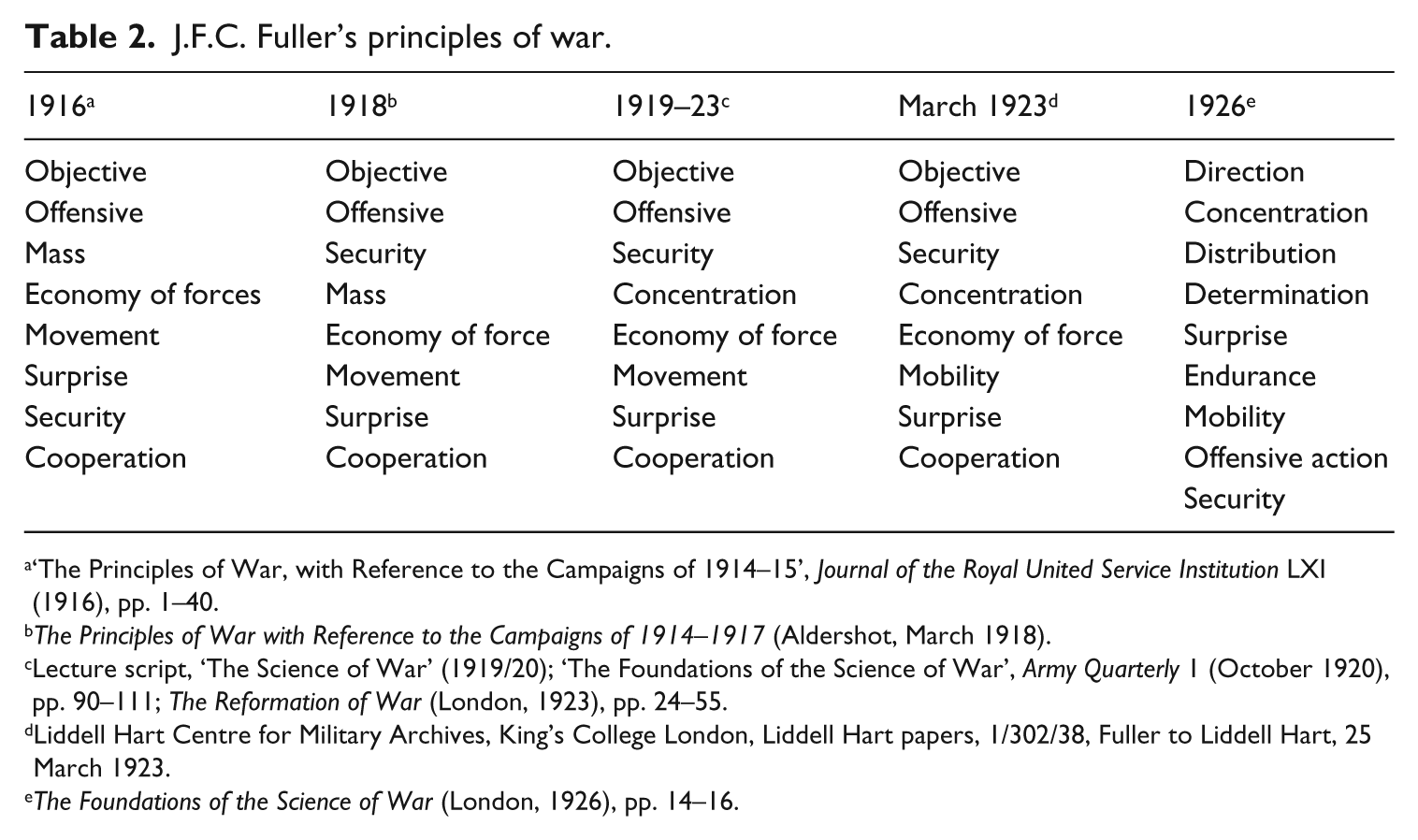
By employing correspondence, operations manuals, and staff college lecture scripts, this article will demonstrate that the debate on the principles of war in the interwar period was not restricted to the British army, but rather involved all three armed services. In examining the debate, four phases will be considered: first, the official adoption of J.F.C. Fuller’s list of eight principles of war by the British army in 1920; second, the doctrinal impact of the principles, 1920–5; third, the opening phase of the debate, 1926–30; and, finally, the second phase of the debate, 1931–9. In addition to outlining the way in which the armed forces reacted to the codification of the principles of war in official doctrine, the article will seek to ascertain if the principles were treated as a medium through which strategic ideas could be discussed. (The reader should refer to the appendix for separate lists of the principles of war which chart their evolution in army doctrine and J.F.C. Fuller’s writings.) Indeed, not only is this ‘case study’ relevant for the history of British military thought, it also provides an opportunity to investigate whether military theory made any contribution to ‘strategic culture’ in the interwar armed forces.
Although strategic culture has proved extremely difficult to define, it has been argued that national security elites create an ‘official language of discourse’ to cultivate a sense of in-group solidarity. 5 Hence, the question can be asked as to whether the history of inter-service dialogue over the principles provides any evidence of an emerging ‘strategic culture’ in Britain between the wars. This is particularly interesting in relation to the model proposed by Thomas Mahnken, who argues that strategic culture operates at three levels: the nation (national strategic culture), the armed services (military strategic culture), and the individual services (service strategic culture). 6 Given that the Royal Air Force was founded in 1918, the interwar period was, then, the first opportunity for all three armed services in Britain to cooperate and develop a new, tri-service, military strategic culture.
I. The Emergence of the Principles of War, 1909–1920
In essence, the origins of the ‘principles of war’ in the armed services in Britain can be traced back to Part I (Operations) of the army FSR of 1909, which noted: ‘The fundamental principles of war are neither very numerous nor in themselves very abstruse, but the application of them is difficult and cannot be made subject to rules. The correct application of principles to circumstances is the outcome of sound military knowledge built up by study and practice until it has become instinct.’ The manual referred throughout to general principles, but nowhere were any principles specifically identified. 7 Two years before, Colonel Lancelot Kiggell had used the phrase ‘principles of strategy’ in the preface to the sixth edition of Edward Bruce Hamley’s instructional work, first published in 1866, The Operations of War: Explained and Illustrated. 8 In many ways Hamley provided a link to Antoine-Henri de Jomini’s work The Summary of the Principles of the Art of War, in which it was stated that ‘Military science rests upon principles which can never be safely violated in the presence of an active and skillful enemy.’ 9 In the decade before the outbreak of the Great War, there were increasing references to the idea of principles of war in military scientific works. One book, published in 1914, carried the title The Principles of War Historically Illustrated, even if its author stopped short of providing a list of any principles which might have existed independently of individual arms of service. 10
It would be all too easy at this point to assert, as John Alger has done, that ‘Jomini, far more than Archduke Charles or Clausewitz, laid the foundations for the modern concept of the principles of war.’ Indeed, Alger goes so far as to claim that Jominian influence on military institutions in the nineteenth and early twentieth centuries was greater than that of Clausewitz because soldiers were trained in ‘Jominian terms’. 11 In the case of Britain, however, there are reasons to doubt this statement: in the decade and a half prior to the First World War, although Jomini continued to exercise influence, in part via Hamley and other instructional works, 12 there was a surge in interest in Clausewitz’s On War. Awareness of his theories was increased in particular by the writings of G.F.R. Henderson, Spenser Wilkinson, and Julian Corbett. 13 Hence, it should not be presumed that Jomini was the sole inspiration for those writing on the principles of war in Britain after the First World War. Clausewitz also had thoughts to offer on ‘principles’, such as his argument in On War that principles represented ‘a law for action’, but not formally, since their application required individual judgement. 14 But, like Jomini, he did not offer any ‘definitive list’ for the reader.
It took until 1916 before the principles of war were ‘identified’ by an obscure British officer. In an article published in the RUSI Journal, ‘The Principles of War, with Reference to the Campaigns of 1914–15’, Captain J.F.C. Fuller began by quoting from the FSR to highlight the reference to unspecified principles. Then, with perhaps a nod in the direction of Clausewitz, he argued that ‘to compile a grammar without mentioning the alphabet’ was a serious omission. What followed from Fuller was an energetic argument that the inclusion of the actual principles of war would have been of value not only to soldiers, but also to civilians and politicians. He then listed what he regarded as the eight fundamental principles: objective, offensive, mass, economy of forces, movement, surprise, security, and cooperation. The application of the principles was, however, governed by nine conditions: time, space, ground, weather, numbers, moral (forces), communication, supply, and armament. He analysed the eight principles on the basis of the course of the war up until that point, before considering tactics and tactical principles and the relationship between tactical and strategical principles. For someone of Fuller’s lowly rank, the article was a veritable tour de force. 15
Fuller returned to these ideas later in the war, delivering a lecture several times at the Senior Officers’ School, Aldershot, entitled ‘The Principles of War with Reference to the Campaigns of 1914–1917’, following a request in the summer of 1917 by the commandant. 16 This rather more compact assessment repeated the same principles of war, although in a slightly different order, and supplemented the original nine conditions which governed them with three new ones – obstacles, training, and observation. Following an exposition of his eight principles, he concluded by arguing that their application was a matter of common sense, and that ‘This war is no more an exceptional war than any war is exceptional to the one which preceded it.’ 17 The source for these ideas remains hard to document with any certainty, but it is obvious that in Book III of On War ‘economy of forces’ and ‘surprise’ can be found as individual chapters, while offensive, mass, and security can also be identified throughout that book. 18 The key point, however, is that Fuller’s principles were not maxims or axioms of the type which could be found in Jomini’s writings, 19 but rather key elements in the conduct of war which had been presented for study and reflection.
Fuller’s subsequent role in the codification of the principles was the result of his membership of a committee which had been revising the Staff College entrance examination. In late November 1919 he pointed again to the ‘offending’ passage in the regulations. The Chief of the Imperial General Staff, Sir Henry Wilson, then decided that the situation should be rectified.
20
Bernard Paget, an officer working at that time at the Staff College and involved in the redrafting of the FSR,
21
wrote to Fuller on 14 January 1920 in response to a lecture entitled ‘The Science of War’, which Fuller had sent him. He thought it to be ‘a model of clear and thorough thought expressed in logical sequence’. He continued: I should like to see the first chapter of the new F.S.R. built on it with the principles and conditions of war boldly stated, as you have done, & the Chapter concluded with the admirable paragraph on the Battle, which tells concisely & very clearly the secret of how to study military history, & apply it.
22
There could not have been a clearer endorsement of Fuller’s ideas; in fact, Paget’s approval may have been influenced by his earlier contact with Tank Corps HQ during 1918 while serving as GSO2 at Sir Douglas Haig’s General Headquarters. 23
On 4 March 1920 Paget wrote to Fuller again, communicating that the proofs of the new FSR were being revised at Camberley, that he was responsible for the sections on the principles of war, and that he was ‘making very full use of your lectures on the subject, & feel sure that you will have no objection. They are a very great help.’
24
He wrote again to Fuller from the Staff College a month later, reporting that ‘the syndicate to which I belong’ had finished its work on the first chapter of volume II of the FSR, ‘which begins with your principles of war’. Adding that Major John Dill would be sending Fuller a copy, he not only thanked Fuller profusely, but also acknowledged the importance of his thinking on the subject: what really matters is that they are in our bible, & for that the whole army should thank you … There is now no excuse for not knowing these principles & therefore there is far less excuse, if any, for breaking them with resultant failure.
25
At the beginning of May 1920 the new regulations were rumoured to be ‘almost ready for publication’; the author was Cecil Faber Aspinall, who had been made an honorary brigadier general on the 1st of that month. 26
Two sets of proofs for the FSR, dated 4 November 1919 and 13 January 1920, 27 make clear that Aspinall had his own ideas on the principles of war, even if he had opted for maxims rather than principles. Hence, his first maxim was ‘Victory can only be won as a result of offensive action,’ while his fifth was ‘Act with rapidity, thus inflicting surprise.’ Some of them – such as ‘The line of communications must be kept intact’ and ‘The aim pursued by a commander must be followed with all his might’ – do seem to derive from the Jominian tradition. Yet, there is an obvious overlap with some of Fuller’s principles, even if they were rather masked by the maxims Aspinall had laid out: offensive action, maintenance of the objective, concentration, and surprise can all be identified. Nonetheless, it is possible that Aspinall had been working from Fuller’s 1918 pamphlet as he had identified the ‘circumstances’ (Fuller had talked of conditions) which would affect the commander’s decision-making: from Fuller’s list of nine conditions affecting the principles of war, only supply was missing. 28
When the new provisional FSR was finally issued in October 1920, it included seven of Fuller’s principles of war – objective, offensive, surprise, concentration, economy of force, security, and cooperation. They were not reproduced verbatim in the regulations but were still very close to what had appeared in the manuscript Fuller had sent Paget. 29 While he had listed ‘surprise’ as his seventh principle, in the FSR it appeared as the third; his sixth principle of ‘movement’ had been renamed ‘mobility’, and became the seventh principle. While the original statement on the principles from the pre-war edition of the FSR remained unaltered – that, while the principles of war were ‘neither numerous or in themselves abstruse[,] the application of them is difficult’ – it was now noted that ‘each situation must be taken on its merits’. 30 What is also significant is the fact the regulations, which had been referred to as ‘almost ready’ in May 1920, took until October before they were accepted by the General Staff. This can be explained at least in part by Aspinall’s convoluted writing style, which had been considerably improved by the time the final version was published; the extensive reworking also indicates that there had been ample time to discuss the new principles.
According to John Alger, Fuller’s contribution to the development of the modern principles of war has been ‘often overstated’. He argues that the employment of principles was already widespread in a variety of front-line orders, manuals, and handbooks during 1914–18; the shift from references to fundamental principles to an actual listing ‘occurred quite independently of Fuller’s views’. 31 He is correct that soldiers had become more accepting of the need to establish specific principles and saw them as a means of codifying military experience. But the way in which Fuller’s list of principles had been promoted during the war, first through his article of 1916, then via lectures at Aldershot, and finally through their almost direct path into the army’s FSR, suggests that Alger’s interpretation is not entirely accurate. But the full significance of Fuller’s principles can only be grasped if their impact on the doctrine of all three armed services is considered.
II. The Doctrinal Impact of the ‘Principles of War’, 1920–1925
One of the reasons for the rapid impact of the principles on British military thought was that the subject had already come to wider attention through the publication of the English translation of Ferdinand Foch’s 1903 work Des principes de la guerre in 1918. The reviews were laudatory. The Army & Navy Gazette, even if its verdict was obviously influenced by the wartime role of the work’s author, described the book as a ‘military classic’ which could not be ‘too deeply studied by those who would understand why Foch won, and for this reason alone an English translation was badly needed’. 32 The Fortnightly Review thought that the book ‘cannot fail to take its place in our libraries as a military text-book of high worth and undisputed authority’. 33
As a result of reading Foch’s work, a young army captain, Basil Liddell Hart, published an article in April 1920 in which he considered the application of the principles of war to infantry tactics. Drawing from Foch’s work, he identified two central principles – security and economy of force. He argued that security was obtained by information and resistance, but also through the associated principles of freedom of action and fixing the enemy. Economy of force, which was the art of concentrating the maximum of one’s own forces for a knockout blow, contained other principles: surprise, mobility, speed of execution, husbanding of strength, teamwork, mental discipline, and exploitation. While Liddell Hart was interested primarily in minor infantry tactics on the battlefields of the Great War, he had, almost inadvertently, stumbled across the problem of deciding what were simply tactical methods and what could be considered general principles. 34
Even if interest in the principles had already been awakened before the publication of the 1920 FSR,
35
military concern was largely driven by their codification in doctrine. This was reinforced by an article published by Fuller in October 1920, in which he sketched out his ‘science of war’ and which included a lengthy discussion of his own eight principles.
36
Major A.H. Burne, writing in the Army Quarterly in 1922, noted that ‘writers have carefully refrained from coming to close quarters with them until in these last days the Principles have been tabulated in Field Service Regulations, Volume II’. Burne’s point of departure was to test whether or not the assertion that the principles of war were eternal was actually true, since ‘it is a drastic and sweeping statement’. He analysed the campaign in Syria conducted by Ramses II against the Hittites in 1288
What caused the principles to become the basis for an inter-service debate was, first of all, their inclusion in 1922, unaltered, in the first operations manual of the Royal Air Force. The wording in the section on the principles of war was identical to the army manual with the exception that ‘army’ was substituted with ‘Air Force’, and ‘platoon commanders’ became ‘junior leaders’. 39 While chapter IX, ‘Co-operation with the Army’, was submitted to the Army Council for approval, the considerations which lay behind the decision to include the relevant sections from the army’s FSR have not survived in the official records. What does emerge from the correspondence is that when it came to the chapter on cooperation with the army, the Army Council recommended it ‘should be issued as “provisional” only’. Moreover, it was noted that ‘there is considerable controversy, as between the views of the War Office and Air Ministry, in the fields of higher Air Policy and Strategy’. 40 Concern over the contents was hardly surprising, not least as 2,500 copies of the manual were ordered on 5 December 1921. 41
The process of producing the manual reflected the severe difficulty facing the RAF, namely its uncertain position institutionally, caught between the army and the navy. Both the other two services regarded the RAF as a threat, something which could be seen in the debate over whether a ministry of defence should be created. 42 Yet, one area where the extensive discussions over the content of the first RAF operations manual did not generate controversy was the principles of war, conceivably because there were other much more contentious points to be dealt with, but also because the principles were still seen at this stage as fixed and, therefore, inherently uncontroversial. This latter interpretation would appear to be confirmed by the fact that when the new army FSR finally made the transition from provisional to final in 1924, the section on the principles of war remained more or less identical to the original version of 1920. 43
By the mid-1920s the original army list of principles began to take on a life of its own. The publication in October 1925 of the second edition of the Naval War Manual saw their inclusion, virtually unchanged, together with several explanatory passages from the 1920 FSR, all with minimal rephrasing. 44 This was a most significant development, since naval opinion had been sceptical about the utility of principles. A paper written in 1922 by the director of the Royal Naval Staff College, Admiral Reginald Drax, presented a list of twenty principles, which included the eight from the army’s FSR, even if mobility was rendered as ‘mobility and flexibility’, and maintenance of the object was listed simply as ‘the object’. 45 In addition, it included defence, indoctrination, initiative, time, morale, preparation for war, leadership, hard fighting, justice, friction, risks, and ‘follow up victory’. Drax argued that the main principles of strategy often applied equally to tactics. The reason why the navy had decided to subscribe to the principles of war provided in the 1920 FSR is hinted at in his claim that any principle of ‘permanent utility … will apply generally to fighting on land, on sea or in the air, in any campaign and in any century’. Given that Drax was director of the Naval Staff College, it comes as less of a surprise that during the 1924–5 session at the college, despite warnings about the danger of ‘catch phrases and maxims’, the eight principles were presented as part of the syllabus. 46
That both the RAF and the Royal Navy were willing to accept into their doctrine the ‘principles of war’ as laid out in both the 1920 and 1924 army FSR seems to have been motivated by two factors. On the one hand, the battles surrounding the Air Ministry, and whether it should be subsumed within the Admiralty and the War Office, provided a need for at least some olive branches in areas where cooperation was possible. On the other, a general need was perceived at the time to draw up guidelines for cooperation between each of the services in wartime. This is confirmed by the issue in 1925 of the ‘Manual of Combined Naval, Military and Air Operations’, which was based on the need to ‘record principles which experience has shown govern the successful conduct and issue of combined operations’. While the manual was intended to acquaint commanders with the capabilities, limitations, requirements, and interdependence of each of the services, the existence of ‘principles of war’ common to all three promised a doctrinal basis for combined operations. 47
If codification in doctrine had not yet led to an open debate on the subject, there is evidence that the principles were already starting to be used as an educational tool. A number of lecture manuscripts, delivered by an officer to the Cambridge University Officer Training Corps (OTC) in the early 1920s, which testify to the awareness of the new principles have survived. In ‘Concentration and Economy of Force’ the lecturer began by noting: ‘Our latest Field Service Regulations lay down, for the first time, certain fixed and definite principles, neglect of which we are told cannot be otherwise than attended with grave risk in War.’ The lecture not only covered the question of the extent to which the principle of concentration had been observed during the Great War, but also considered the weight given to it by British governments in the past. 48
The principle of surprise in particular was elucidated in two separate lectures to the Cambridge University OTC. The first, commencing with a reference to the FSR, asserted: ‘To surprise amounts to crushing an opponent from a short distance by numbers in a limit of time. Otherwise the adversary, though overtaken by numbers retains the power to meet the attack, to bring up his Reserves, in which case the assailant loses the advantage of surprise.’ It was also pointed out that the outstanding lesson of the battle of Cambrai in 1917 was that surprise was still possible, even under the conditions of trench warfare. The second lecture devoted considerable attention to Sir Edmund Allenby’s great offensive in Palestine, and it was noted that ‘this offensive illustrates in a remarkable degree the truth of the eight great principles of war laid down for us in our Field Service Regulations, Volume II’. The lecture concluded with further examples of the way in which these eight principles had underpinned Allenby’s offensive in 1918. 49
By the mid-1920s, evidence can be found that the RAF was also starting to take the subject seriously. In a lecture delivered at the RAF Staff College, Andover, probably in 1925, Air Vice-Marshal Robert Brooke-Popham devoted considerable attention to the principles. He noted that they had first been formulated in an article in the RUSI Journal in February 1916 by Colonel Fuller, who had ‘earned the gratitude of the fighting services by formulating these principles, if only for the reason that it simplifies our methods of study’. He dismissed the argument that victories had been won for centuries without recourse to the principles, and thus they were not required, pointing out that only recently had the principles underlying the work of great master masons been identified. There was good cause to believe in their value, not least because as they were expressed ‘in similar, if not identical, wording’ in the Naval War Manual, Air Operations Manual, and FSR II. He then examined each of the eight principles, concluding with a plea for cooperation between all three services. 50
That not all military writers had thrown off the influence of Hamley can be seen in the work by W.D. Bird, The Direction of War, which first appeared in 1920, followed by a second edition in 1925. Interestingly, the preface began with a quotation from Foch to the effect that the principles of war were unalterable. According to Bird, the principles which governed war were constant, even if their application varied. 51 Yet despite this emphatic opening, nowhere does Bird refer to the principles as expounded in the 1920 FSR. The book was, in essence, an updating of Hamley through the inclusion of examples from the Great War, emphasizing operations, campaigns, communications, and interior lines. Although the preface did contain a quotation from Clausewitz, the works consulted included Hamley’s Operations of War and Jomini’s Précis de l’art de la guerre. Mobility was referred to as a factor in war, rather than a principle, while in the second chapter, on imperial defence, those principles which could be found in the FSR which were mentioned – objective, concentration (of effort), and surprise – were not actually referred to as principles. 52 What is significant here is the extent to which the book was out of step with the broad acceptance of the principles in each of the armed services by 1925. 53 In short, the way in which the principles of war had been codified in official doctrine represented nothing less than the supplanting of the Jominian tradition by the Clausewitzian approach: rather than ‘maxims’, eight key elements in the conduct of war had been accepted by all three armed services as an aid to study.
III. The Opening of the Debate, 1926–1930
The broad acceptance of the principles of war in the army appeared to be confirmed by their inclusion in works designed to assist officers in preparing for examinations. 54 But the real beginning of the debate came with the publication of Fuller’s The Foundations of the Science of War, in which he committed two infringements of military etiquette. The first of these occurred on the second page of the preface: Fuller revealed that he had identified the principles of war and had, on official request, contributed these to the writing team, and that ‘[they] were, in slightly modified form, included in the new edition of the Field Service Regulations’. Traditionally, official regulations were published with no indication of who had written, co-written or contributed to them. The second affront was that he had now revisited the principles and ‘revised’ them. He indicated he had replaced the first principle (maintenance of the objective) with ‘direction’, economy of force had been substituted with ‘distribution’, cooperation had been removed from the list, and he had added two new principles, endurance and determination. 55 This breach of convention was noted in an article by Lieutenant Colonel F.E. Whitton, who wrote that the principles had not existed until recently and no sooner had they been given official sanction than Colonel Fuller had scrapped one principle and added two new ones. He was particularly caustic because the eternal principles had been ‘brought into being quite arbitrarily … then pitchforked practically wholesale and apparently without any discussion into the military bible of the Army’. 56
Army officers were clearly uncomfortable about the influence which their troublesome colonel was exercising over the debate, not least because he continued to be invoked by RAF officers. Squadron Leader C.G. Burge, in a book-length treatment of the principles of war in 1927, quoted extensively from Fuller’s The Reformation of War, using it to support his argument that warfare ought to be treated as one subject. While he argued that there were separate laws for war at sea, on land, and in the air, ‘common to all three there are principles of war which change only in their application’, and he listed the original eight. What exercised him in particular was the eighth principle, that of cooperation, since this was the one on which the future of the air force would turn. While he did claim that the ability of air forces to take the war immediately to enemy territory was one of their outstanding features, he did not go so far as to claim that air forces could win wars single-handedly. In a plea for improved cooperation between the services, he argued that the principles of war were universal and applied to land, sea, and air. 57
Towards the end of the decade, the Royal Air Force still felt vulnerable to pressure from the other two services and their earlier calls for a ministry of defence. Perhaps because of this, it sought to pursue a policy of conciliation in doctrine. So the new 1928 edition of the RAF War Manual did not alter the eight principles of war which it had published in 1922. The principle of cooperation, over which Burge had fretted, was defined in a neutral fashion: ‘The actions of all parts of a force must be coordinated as to achieve the maximum combined effort from the whole. Personal good will throughout the ranks is essential to this end.’ The section entitled ‘The Aim in War’ noted that the air force would work together with the army and navy in breaking down the enemy’s resistance and would engage in direct cooperation with them. 58
In contrast to the RAF’s doctrine, changes were made to the army’s list of principles in a new edition of the FSR in August 1929. Some limited insight into the process of redrafting the principles can be gleaned from surviving correspondence. Colonel John Dill, who had worked on the 1920 FSR, was contacted by the War Office in April 1928, which sent a draft of the first chapter of the new FSR, volume II, noting that the director of staff duties did not want any further changes, unless suggested by Dill. The enclosed draft contained the same eight principles, in the same order, as in the 1924 FSR. 59 A few months later the War Office asked Admiral Sir Herbert Richmond – commandant of the Imperial Defence College, 60 and a noted writer on naval affairs and strategy – to comment on the draft of the completed regulations. 61 Richmond made a number of suggestions as regards the phrasing of some introductory paragraphs in the first chapter, and he suggested what he regarded as more precise definitions of the principles of ‘maintenance of the object’ and ‘security’. But nowhere was there any suggestion that the existing eight principles required any modification. 62
Whereas in both the provisional FSR of 1920 and the 1924 edition of the manual the principles of war had been included in the second section, when the 1929 FSR was published they appeared in the seventh section. The two earlier editions had noted that the application of the principles would vary in each situation, and that war was an art and not a science; in the 1929 edition the wording was now different. The principles of war could be defined, ‘but their relative importance and the method of their application are constantly varying’. This variation was due to the ‘human factor in war’, a phrase commonly employed by critics of the tank. In addition the 1929 FSR now contained a list of seven principles: the previous first principle, maintenance of the objective, had been removed, while the definitions of the remaining seven had been rewritten entirely. 63
That the revisiting of the principles of war by the General Staff might have reflected a desire to counteract Fuller’s influence on the debate can be seen in the publication of a book by Major General Sir Frederick Maurice, which was intended to coincide with the appearance of the new manual. 64 The author expressed his thanks to the General Staff for providing him with an advance copy of the new FSR. The book was based around the new seven principles of war, and it also contained an introduction by the Chief of the Imperial General Staff, Field Marshal Sir George Milne, who warned of the dangers of too much study of ‘continental strategists’. The ultimate official endorsement was given when Milne wrote that ‘this book, by elaborating the rather concise statements of an official text-book, will be found a very useful adjunct to the study of the forthcoming edition of the Field Service Regulations’. 65
Nowhere is Fuller mentioned in the book, but it took up many of the themes on which he had written and was clearly an attempt to provide an alternative, officially approved discussion of the principles of war. 66 It did not receive a universally friendly reception, however, with one reviewer taking the author to task for his failure to accept that the principles of war were ‘of universal application’. Maurice had argued there were specific aspects of the conduct of war which were peculiar to Britain, but the reviewer clearly thought otherwise, noting also that there was no real concept of grand strategy in the work. There were also a series of factual errors, which led to the conclusion that ‘the book needs revision before it can be accepted as a really first class text book on strategy’. 67 The reviewer had clearly understood the work to be a disguised attack on the theories of Fuller, an interpretation which the conclusion to the book bore out. Maurice argued that war was an art, and that science could only be one of its instruments, never its master – a clear jab in the direction of Fuller’s ‘science of war’. Maurice’s final message was that the mastering of any art was achieved by those who adapted new methods to established principles and that there was nothing new in this. 68
The suspicion that Maurice had been selected by the General Staff as a form of ‘court interpreter’ of the new principles of war is strengthened by the fact that he delivered a series of lectures to both Junior and Senior Divisions at the Staff College, Camberley, in January 1930, sticking closely to the new list of principles in the FSR. 69 In his opening lecture he explained that the principles were not a formula but a guide for action, they were there to guard against surprise, and their application depended upon the constantly varying factors of time and space. There was also another barb aimed at Fuller, when he stated that ‘fixed ideas about future war are futile and dangerous’, as was ‘prophecy about war’. His subsequent lectures on ‘the object in war’, ‘security’, and ‘economy of force’ followed a historical framework, emphasizing the lessons of the Great War. The lecture on the principle of mobility contained a familiar indirect attack on Fuller, with a comment that the development of a particular weapon, the tank for example, was incidental not fundamental to warfare. Moreover, while science altered the conditions under which the principles were applied, changing also their relative importance, it was ‘no substitute for them’. Finally, in his lecture on the principle of concentration, Maurice stated that concentration of power at the right time and place was ‘the ultimate goal of strategy – all other principles lead up to this principle’.
Meanwhile, although naval officers had remained tight-lipped on the subject in the 1920s, by the end of the decade they had started to become more open in their discussions, particularly in relation to the principle of cooperation. Admiral Sir Herbert Richmond had already for some time advocated the creation of a ‘doctrine of war’ for all three armed services. 70 In a lecture entitled ‘The Friction of War’, delivered in 1928 at the Royal Naval War College at Greenwich, Captain R.A. Hornell concluded his examination of the Clausewitzian concept by arguing that failure was not always due to friction. The real problem was often a lack of cooperation, ‘which is indeed one of the greatest principles of war’. 71 In an article on surprise in warfare in the Naval Review in 1930, Captain W.F. Wake-Walker noted its status as a principle of war in the FSR, where it was described as the most effective and powerful weapon in war. 72 And, in the 1930 summer session at the Naval War College, there were at least three lectures which were delivered on the issue, one an overview of the eight principles in the Naval War Manual, another on maintenance of the object, and a further one on mobility and surprise. 73
Moreover, and coinciding with the publication of the new 1929 FSR, a public debate flared up between naval officers in the pages of the RUSI Journal. In August 1929 Rear Admiral C.V. Usborne published a piece which presented an imaginary dialogue between a naval student of war and a philosopher. It was suggested that the existing eight principles of war (the article had been written before the publication of the revised army list of seven) were merely abstract ideas which required definite statements to bring them to life, the author obliging with a list of nine such theses; the application of the principles to naval warfare was discussed; and it was suggested that military strength was the product of weapon value, skill, morale, and numbers. 74 The article was one of the more intelligent contributions to the discourse on the principles of war thus far, but it provoked a critique by another naval officer.
Richmond sought to pick holes in the views expressed by Usborne by arguing that it was unclear as to whether the latter had described the principles upon which armed forces were organized and administered, or whether he was referring to the conduct of operations. He argued that it was generally accepted that the principles were understood to refer to the employment of armed forces – at least this was the sense in which Napoleon, Jomini, Foch, and G.F.R. Henderson had discussed them. In particular, he took issue with Usborne’s understanding of the principle of economy of force, which Richmond regarded as not only confined to numbers, but having to be seen in relation to space and time, as Clausewitz had argued. And he concluded with an attack on Usborne’s definition of the principle of mobility, which he thought had been understood solely in terms of surprise. Although Richmond’s critique was unfair in places, and distorted some of Usborne’s points, he set a debate in motion. 75 He was in some ways an unlikely critic of the principles of war, given his calls for a unified doctrine for all three services, but in correspondence with Liddell Hart he complained that what Usborne meant by ‘principles of war’ was in fact theory, that the navy was more interested in catchwords, and that junior officers tended to cling blindly to the naval manuals. 76
Usborne responded with another imaginary dialogue between his philosopher and student, clearly relishing the fact that Richmond had not attacked his central idea that principles had to be formulated into statements. He also rejected the argument that the ‘principles’ referred solely to the employment of armed forces, repeating his previous point that they governed war in all its facets. He quoted Foch, who writing in September 1918 had used the foreword to the English edition of The Principles of War to underline the point that war had undergone a revolution due to advances in armaments. Finally, he defended his own formulated principles by arguing, in the case of mobility, that superior mobility, both mental and physical, would help counter the unexpected. 77
In an article in February 1930 Lieutenant Colonel H. de Watteville argued in a discussion on national policy, grand strategy, and strategy that ‘If the “Principles of War” are to apply to the whole of the national activities brought into play in modern war … they must be defined in a far broader and more elastic form’. 78 In the following issue of the RUSI Journal he devoted a complete article to the subject, noting that there was ‘a considerable cleavage of opinion’ over the principles between the three services. He thought that men of action had an instinctive suspicion of abstract principles, arguing that the form of presentation and the style of language in which they were presented needed to vary depending upon the level for which they were intended; yet there was a need to create a doctrine from the principles common to all three services. He concluded by warning that the principles of war were an educational tool and should not become a substitute for intuition on the field of battle: the principles needed to inspire and not to govern leadership. 79
The debate rumbled on through 1930, with Whitton’s contribution being followed by a brief piece by Liddell Hart, 80 as well as two pieces by an anonymous author. Captain John Creswell, writing under the pseudonym of ‘Phormio’, argued in an article on the principle of ‘economy of forces’ that this phrase could be misconstrued, as the word ‘economy’ in the military sphere had become associated with economics and saving money. He made a plea for a return to what he thought was Foch’s conception of combining concentration, cooperation, and security, which taken together led to a meaning which conveyed gaining the maximum distribution of forces available. 81 The article showed that there was still much to be debated, as exemplified by a piece in the following issue of the journal which argued that the principle of mobility did not appear to contain the idea of ‘never losing time’: in naval warfare, ‘never losing time’ had a different quality because ships could retreat to protected harbours. Thus, it had to be accepted that the principles of war would differ between naval and land forces, so it was not possible to have principles which embraced all aspects of warfare. 82
IV. The Second Phase of the Debate, 1931–1939
The second phase of the debate was marked by the four characteristics which had accompanied its first phase: articles in service journals; reflections on the principles in books; the publication of new doctrine manuals; and lectures and discussions on the principles at the armed forces’ staff colleges. What is surprising is that, after the publication of the Foundations of the Science of War, the only new thoughts Fuller had to offer were in Lectures on F.S.R. II (1931), a form of commentary on the FSR. His most interesting idea was that, in relation to the maintenance of the object, there were ‘three controlling objects in every war’: first, the political object, the destruction of the civil will of the enemy; second, the strategic object, the destruction of the opponent’s plan; and, third, the tactical object, the destruction of the enemy’s army. On the question of the intensely debated principle of economy of force, he noted that ‘Surprise economises, concentration economises, security economises, and so also do successful offensive action and sustained mobility.’ When it came to the application of the principles, he added that, while all of them needed to be used, what was important was the relationship between them. 83
But it was in the pages of the Naval Review that the debate which had been instigated in the RUSI Journal was continued. 84 It began with two articles which expressed scepticism about the utility of the principles of war. First, Russell Grenfell pointed out that the acceptance by the Royal Navy of Fuller’s eight principles had been nothing other than a compromise between the authorities of the naval and military staff colleges, which did not amount to general acceptance. Grenfell referred to the views of Maurice, who he thought had taken a very loose approach to terminology, and went on to examine ‘the official principles of war in a critical spirit’. He questioned whether some of the eight principles were principles at all, while suggesting only three of his own: the object, concentration at the decisive point, and initiative. It is clear that his aim was to challenge official doctrine because he quoted directly from the Naval War Manual at the beginning of the article. 85 His argument clearly struck a chord, with two other authors voicing similar sentiments. The first, ‘Soldier’, suggested four principles which could not be ignored in war: the object, the will to win (morale), initiative, and security. 86
These articles led to another three contributions in the following issue. ‘Cam’, none other than Admiral Sir Herbert Richmond, thought that ‘Soldier’ had unnecessarily disqualified some of the principles, particularly that of security. He argued that the chief problem was one of definition, remarking that the eight principles had been a useful point of departure. He made a distinction between the principles of command (which also applied to statesmen) and the principles for the conduct of operations, and he concluded with a warning that the principles should not be ‘codified’ too precisely since this led to men learning them off by heart. The second author also chipped away at the arguments presented by ‘Soldier’, arguing that it should not be assumed that all the principles were of equal value. Too much ought not to be expected of them – they were simply an aid to effective planning. The third writer took issue with Grenfell’s article, arguing that his three principles in fact overlapped with the eight principles listed in the War Manual. 87
This debate was concluded the following year by a naval officer who sought to take stock of the views of all the contributors. He observed that the principles could be used both to make war and to study war. Clausewitz, Mahan, Corbett, and Richmond were all invoked to support the importance of using the principles to aid the study of history; the principles were also ‘desirable and necessary’ as signposts in the study of strategy. It was precisely because war was an art and not a science that some principles or other were required to enable the beginner to grasp the subject. Examining each of the principles which the previous writers had found questionable, the author presented a table setting out abstract principles, concrete principles, and factors which might be used to apply principles. Unlike the contributions of the previous year, this was an intelligent defence of the utility of the principles of war. 88 It was a fitting conclusion to a lively service debate – and one which was not restricted to the pages of the Naval Review alone. 89
It was not only in service journals that thoughts on the subject were aired. An assault on the thesis that the principles of war applied to all three services was provided by Brigadier General Percy Groves in his 1934 book, Beyond the Smoke Screen. According to this retired airman, there were four anti-air-power arguments employed by the army and the navy, the chief one being the claim that air power could not be decisive in war because it contravened ‘one of the basic and immutable principles of war, namely, “That victory in war can only be won by the defeat of the enemy’s armed forces”’. He questioned whether this principle of war was immutable. Referring to a passage in the most recent FSR – which stated that the aim of war was ultimately to bring pressure upon an enemy people so that they would force their own government to sue for peace – he argued that, if an air attack on an enemy population proved decisive, this would mean that the ‘old shibboleth’ that victory in war could only be achieved through defeat of the enemy’s armed forces was dead. 90
Groves’s insinuation that the ‘anti-air arguments’ propounded by naval and military officers were continually underpinned by the assertion that principles of war were immutable was, however, not entirely fair. Although the existence of the principles of war was still accepted by officers during the 1930s, there were obvious nuances in their statements. One army general, Henry Rowan-Robinson, in a 1935 survey of Britain’s military position, noted that ‘in essence’ the ‘age-old principles of strategy’ remained the same, mentioning the principles of concentration, mobility, security, cooperation, offensive, security, and surprise. But not only did he differentiate between their application in tactics and strategy, he also argued that these ‘age-old principles of strategy need a fresh examination before they can be safely applied to a warfare that has altered more in the last three decades than in any ten centuries of history’. Indeed, he went on to acknowledge that, for the air force, the idea that destruction of the enemy’s main force on the battlefield was the sole object was no longer valid – concentration of air forces could well be against objects of enemy infrastructure. 91
Needless to say, the old-style compendiums of historical data, designed to assist in revision for examinations, did not disappear, but such works were starting to include more cerebral introductory commentaries. 92 In what was described as ‘a high-grade “cram book”’, 93 Lieutenant Colonel R.A.E. Voysey commented that the principles of war applied to both strategy and tactics, going much further than previous instructional works in proposing that the principles could best be learned ‘from a careful study of strategy’, and added that strategy was not a subject for cramming. 94 In his background discussion of the principles, Voysey quoted Foch to argue war was like architecture – part art and part science. He discussed Foch’s four principles, pointing out that his concept of ‘economy of forces’ included both concentration and economy of force. And he noted that the 1924 principle of ‘the object’ had now been omitted from the 1929 FSR. This was significant because, while the destruction of the enemy’s armed forces still held true for operations on land, the ‘destruction of the hostile army is no longer the only, or even necessarily the principal, means of achieving the political object of the war’. 95 Clearly, the Royal Air Force’s efforts were bearing fruit.
What had emerged from the discussion over whether the principles of war applied to all levels of war, or were merely relevant for tactics and operations, was that a need for principles for the higher direction of war had now been identified. While these considerations never entirely achieved the level of doctrine, the Imperial Defence College became an institution at which such issues were considered. A leading RAF officer, Robert Brooke-Popham, who had served as commandant from 19 January 1931 to 18 January 1933, delivered a lecture there entitled ‘The Higher Direction of War’ in November 1934. 96 In his correspondence relating to the lecture there is a list of eight ‘Principles of Higher Direction of War’, which warrant quotation in full:
Ultimate responsibility for control of War must rest with those who are responsible for policy.
Peace organisation must be quickly transformable to organisation for higher direction of war.
War organisation must be flexible so as to meet any class of crisis.
Technical advisers must have direct access and must be responsible for execution of the advice they give.
Decision must be rapid, therefore body must be small and be able to meet daily.
The body charged with higher direction must have executive power.
The Dominions must have a voice in the shaping of general policy and higher direction.
Co-ordination of allied effort must be achieved. 97
Brooke-Popham’s thoughts, which pre-date the creation of the post of the minister for the coordination of defence in March 1936, 98 give an indication of the extent of the impact of the principles of war on senior officers’ thinking.
Ironically, it seems that for the army the degree of public debate was unwelcome: there was a clear de-emphasis of the principles of war in the 1935 edition of volume II of the FSR. The principles of war were now referred to as ‘some of the guiding principles for tactical success’. These were the principles of surprise, mobility, concentration, economy of force, security, cooperation, and offensive action. The list was the same as that in the 1929 manual, but the order had been changed. While the manual commented that these ‘commonsense precepts, or principles, are easy enough to learn and grasp’, it went on, ‘Their application to the situations and problems of the battlefield, which are never twice the same, needs constant practice and study.’ 99 Since the principles were buried under the heading ‘The elements of tactics’, one reviewer of the manual missed their presence completely, merely noting that the principles for the employment of armed forces in war and the tactical employment of larger formations were to be ‘relegated’ to a new, third volume of the FSR. 100
When the newly instituted third volume was signed off by the Army Council, yet another revised selection of principles could be found. It was pointed out this time ‘that the principles that guide action in war, whether strategical or tactical, are not laws, such as the laws of natural science … they simply indicate a course of action that has been successful in the past’. The principles listed deviated from the second volume of the 1929 FSR in that there were once again eight, but this time with a new principle added, ‘the identification of national will’, while the previous principles had again been placed in a different order: concentration of effort, cooperation, economy of force, security, offensive action, surprise, and mobility. But the first two principles – identification of national will and concentration of effort – were now classified as ‘strategical principles’. Also, an attempt was made throughout to communicate the way in which some principles could be applied at different levels of war. 101 There was brief acknowledgement of the new list in the Army Quarterly, but with the qualification that ‘It would have been better to say that success is sometime won by adhering to one or more principles at the price of violating others.’ 102
One prominent military writer, Henry Rowan-Robinson, devoted two chapters of his 1938 book on imperial defence to the revised list in the new third volume of the FSR. He argued that the principles of war concerned both strategy and tactics, explaining that they derived ‘from a study of the campaigns of the Great Captains of history’. Paraphrasing the regulations, he noted that they were in no way rules. He went on to consider strategy in three dimensions, covering in particular the impact of air power upon naval and land warfare, as well as making a range of policy suggestions concerning the central management of defence. Hence, even if he did not risk trying to apply the principles of war to grand strategy, he showed he was well aware of the need for the three services to coordinate their planning. 103 The book was an indication of the degree to which thinking in the army had come to embrace the application of the principles to the different levels of war and the need for cooperation between the services.
Although the air force did not have to contend with any adjustments to the principles in their operations manual, 104 the subject continued to be discussed at the RAF Staff College at Andover. As part of the fourteenth course held there, the commandant, Air Vice Marshal A.S. Barratt, delivered two lectures on the principles in February 1936. 105 His excursion highlighted the fact that the principles were fundamental and did not change, but, at the same time, failure in war was usually caused by ‘over-conservatism of thought’. Identifying the emergence of total war, he noted that war now required the entire resources of the nation. He made a plea for the objective study of history, using the principles, for which he acknowledged indebtedness to Fuller. Most interesting of all was his contention that the ‘acceptance of certain principles provides for unity of thought and a common doctrine’. He closed his second lecture by raising the question of whether propaganda ought to be accepted as a principle. The same two lectures were subsequently presented in a slightly amended form by Barratt at the seventeenth course at the RAF Staff College on 1 February 1939, following a detailed open discussion of the principles of war the previous day. 106
The continuing interest in early 1939 was not restricted to the air force, since one week later at Andover the deputy director of the Royal Naval Staff College at Greenwich, Captain F.H. Pegram, delivered a lecture on the subject in relation to naval warfare. The core of the lecture was a discussion of each of the eight principles from the Naval War Manual, although the objects of the navy were considered to be at the level of grand strategy (economic and military pressure), at the level of major strategy (control of trade routes and communications), and at the level of minor strategy (destruction of enemy forces). His treatment of the principle of cooperation emphasized that ‘Common doctrine taught at Staff Colleges has done much to help co-operation between the Services.’ The issue of cooperation between the armed services was stressed by the commandant of the RAF Staff College in his summing up of the discussion, noting the importance of making small sacrifices in the interests of the success of a combined plan. 107
The outbreak of war, and the first wartime course at the RAF Staff College, confirmed the importance of the principles of war as a means by which members of the three services could encourage cooperation and contribute to each other’s training. On 7 November 1939 Wing Commander A.B. Ellwood delivered a lecture on the eight principles in the RAF manual. However, he also mentioned the ninth principle in the American regulations, that of simplicity, and the Clausewitzian treatment of pursuit and public opinion. Surprise was considered from four perspectives: tactical, strategical, material, and organizational. He concluded with one of the original contentions – that namely, while obvious, ‘these principles have constantly been disregarded’. He had sought not only to illustrate their soundness but to emphasize that they would contribute to the successful prosecution of the war. 108 The following day the significance of the subject was reinforced by Lieutenant Colonel J. Stephenson, who presented a lecture on historical illustrations of the same eight principles which had been used in the lecture the previous day, making no reference to the army’s own separate list of principles. 109 Clearly, inter-service cooperation in wartime demanded a return to the original eight principles as the medium through which strategy could be discussed.
V. Conclusion
The various sources which have been examined here demonstrate conclusively that the interwar debate on the principles of war in Britain was a tri-service debate, a point so far missed completely by military historians. Although it was conducted against the background of a more heated controversy over J.F.C. Fuller’s calls for the establishment of a science of war, 110 it was one of the less fractious discussions of the period. Still, a number of conclusions can be drawn in relation to the content and evolution of the debate, its overall doctrinal significance, the creation of a common language for all three services, and the relevance of the debate for broader historical issues surrounding strategic culture and military innovation.
The intellectual content and contours of the debate were shaped and influenced by four military theorists: Carl von Clausewitz, Ferdinand Foch, J.F.C. Fuller, and Frederick Maurice. The vast majority of books, articles, and lectures from the period make reference to one or more of these writers. In the 1920s it was a combination of the appearance in English translation of Foch’s 1903 study Des principes de la guerre and the publication of the new British army Field Service Regulations, volume II, which motivated officers to consider the subject in print. The debate was driven by two major factors in its first phase: first, the adjustment by Fuller in a very public fashion of his original eight principles, which led to a semi-official refutation of his ideas by Frederick Maurice; and, second, the questioning of whether the army could state unequivocally that the goal of any war was the destruction of the enemy’s armed forces in the field. 111 The key questions which were raised – whether there were immutable principles of war, and whether these principles could be applied at all levels and to each of the three services – encouraged the cross-service dialogue which came to fruition in the 1930s with the general acceptance by the army and the ‘senior service’ of air power as central to the conduct of modern warfare.
In terms of official doctrine, the acceptance of the principles of war into the operations manuals of all three armed services was of far-reaching significance on two counts. First, it represented the culmination of a process which saw Clausewitzian concepts finally replace the Jominian outlook which had been maintained for so long in the army through Hamley’s Operations of War, the final edition of which was published in 1922. 112 This is not to say, of course, that references to Jomini dried up completely during the course of the debate, but they were far fewer than those made to Clausewitz. 113 Indeed, it was only really Herbert Richmond who brought Jomini into the public discourse, arguing that Jomini’s understanding of the principles of war was in a ‘restricted sense’ because it referred to the employment of armies in the field. 114 The acceptance of abstract principles was necessary because warfare could no longer be seen in Napoleonic categories; general principles were now required which could be applied to war in three dimensions; principles were required which could be used in the analysis of warfare at the four new levels of tactics, operations, strategy, and grand strategy.
Second, the intellectual and doctrinal drive behind the principles of war saw the army supplant the Royal Navy as the leader in the development of British service culture, the second level in Mahnken’s three-tier model of ‘strategic culture’. This was, in part, a result of the massive expansion of the army during the Great War, a process which caused it to take doctrine more seriously than it had done before. 115 That this was accepted by the Royal Navy was, however, because it had also embraced Clausewitz before 1914, at least in part through the publication of Julian Corbett’s 1911 study, Some Principles of Maritime Strategy. 116 But what contributed significantly to the creation of an inter-service debate was the appeal which Fuller’s writings held for officers in both the Royal Navy and the Royal Air Force: by linking the principles of war to his own ‘science of war’, Fuller succeeded in adding momentum to the idea of the need for a general theory of war appropriate for the new technological age.
Although more caution is required with regards to any conclusions on the creation of a language common to all three services, it can be seen that each of the three services made efforts to cooperate. While Admiral Sir Herbert Richmond complained bitterly to Liddell Hart in 1937 that the Admiralty had shown little interest in the Imperial Defence College, regarding it as a low priority, by this time at least Richmond had an axe to grind. 117 The fact that, while serving as the college’s first commandant, he was approached by the army in 1928 to comment on the drafts for the new FSR shows that the college did have a role to play in inter-service debate. Moreover, the willingness of the commandants of the army, navy, and air force staff colleges to invite officers from other services to lecture led to an awareness of differences in terminology and assumptions. 118 The creation of a ‘common language’, to which the debate on the principles contributed, provided the basis for an embryonic tri-service understanding, thus laying the foundations for a strategic culture attuned to warfare in three dimensions.
This unified military culture, however imperfect, provides new insights into the wider issues of strategic culture and military innovation. In terms of strategic culture, the debate shows that elements of national strategic culture and service culture combined to generate a new ‘second tier’, that of joint, inter-service military culture, for the first time involving army, navy, and air force. It represents a window on early British strategic culture, one which extended into the remainder of the twentieth century and beyond: it is here that the true origins of British military strategic culture can be sought. And, in terms of ‘military innovation’, it can be argued that this concept should be widened to include the development, doctrinal codification, and inter-service discussion of new military concepts. Indeed, it could even be suggested that the development of new military terminology, to which the debate on the principles of war represented an important contribution, was a crucial but unseen element in British interwar military innovation. 119
Footnotes
Appendix: The Evolution of the Principles of War,1916–1935
J.F.C. Fuller’s principles of war.
| 1916 a | 1918 b | 1919–23 c | March 1923 d | 1926 e |
|---|---|---|---|---|
| Objective | Objective | Objective | Objective | Direction |
| Offensive | Offensive | Offensive | Offensive | Concentration |
| Mass | Security | Security | Security | Distribution |
| Economy of forces | Mass | Concentration | Concentration | Determination |
| Movement | Economy of force | Economy of force | Economy of force | Surprise |
| Surprise | Movement | Movement | Mobility | Endurance |
| Security | Surprise | Surprise | Surprise | Mobility |
| Cooperation | Cooperation | Cooperation | Cooperation | Offensive action |
| Security |
‘The Principles of War, with Reference to the Campaigns of 1914–15’, Journal of the Royal United Service Institution LXI (1916), pp. 1–40.
The Principles of War with Reference to the Campaigns of 1914–1917 (Aldershot, March 1918).
Lecture script, ‘The Science of War’ (1919/20); ‘The Foundations of the Science of War’, Army Quarterly 1 (October 1920), pp. 90–111; The Reformation of War (London, 1923), pp. 24–55.
Liddell Hart Centre for Military Archives, King’s College London, Liddell Hart papers, 1/302/38, Fuller to Liddell Hart, 25 March 1923.
The Foundations of the Science of War (London, 1926), pp. 14–16.
Acknowledgements
The author would like to extend his thanks to Dr Joe Moretz and Dr Jim Beach for providing assistance with source material, as well as Prof. Sir Hew Strachan and two anonymous reviewers for some helpful comments on an earlier draft of this article. He would also like to thank the Trustees of the Liddell Hart Centre for Military Archives, King’s College London, for permission to quote from material for which they hold the copyright.
Funding
This research received no specific grant from any funding agency in the public, commercial, or not-for-profit sectors.
1
Zvi Lanir, ‘The “Principles of War” and Military Thinking’, Journal of Strategic Studies XVI (1993), pp. 1–17; Gertmann Sude, ‘Principles of War’, in Franklin D. Margiotta, ed., Brassey’s Encyclopedia of Military History and Biography (London, 2000), pp. 786–9; J. Widén and J. Ångström, Militärtheorins Grunder (Stockholm, 2005), pp. 119–44; Beatrice Heuser, Den Krieg denken: Die Entwicklung der Strategie seit der Antike (Paderborn, 2010), pp. 110–21; and Marshall L. Fallwell, ‘The Principles of War and the Solution of Military Problems’, Military Review XXXV (May 1955), pp. 48–62.
2
John I. Alger, The Quest for Victory: The History of the Principles of War (Westport, CT, 1982), pp. 120–48.
3
For instance: Jay Luvaas, The Education of an Army: British Military Thought, 1815–1940 (London, 1964); Robin Higham, The Military Intellectuals in Britain, 1918–1939 (New Brunswick, NJ, 1966); Heuser, Den Krieg denken; for journals, Timo Baumann, ‘Die Entgrenzung taktischer Szenarien: Der Krieg der Zukunft in britischen Zeitschriften’, in Stig Förster, ed., An der Schwelle zum Totalen Krieg (Paderborn, 2002), pp. 179–266.
4
Anthony Clayton, The British Empire as a Superpower, 1919–1939 (Basingstoke, 1986); Allan R. Millett, ‘Patterns of Military Innovation in the Interwar Period’, in A.R. Millett and W. Murray, eds, Military Innovation in the Interwar Period (Cambridge, 1996), pp. 329–68.
5
See in general: Alastair I. Johnston, ‘Thinking about Strategic Culture’, International Security XIX (1995), pp. 32–64; Colin S. Gray, Modern Strategy (Oxford, 1999), pp. 129–51; and Williamson Murray, ‘Does Military Culture Matter?’, Orbis XLIII (1999), pp. 27–42.
6
Thomas G. Mahnken, United States Strategic Culture (Defense Threat Reduction Agency, Advanced Systems and Concepts Office, Fort Belvoir, VA, 2006), pp. 5–18.
7
War Office, Field Service Regulations, Part I: Operations, 1909, reissued 29 July 1912 (HMSO: London, 1912), passim, quote from ch. 1, para. 2, pp. 13–14.
8
Edward Bruce Hamley, The Operations of War Explained and Illustrated: A New Edition Brought up to Latest Requirements by Col. C.E. Kiggell, 6th edn (Edinburgh and London, 1907), p. v.
9
Antoine-Henri de Jomini, The Art of War [reprint of 1862 trans.] (Westport, CT, n.d.), ch. 1, art. 2, p. 15.
10
Maj. Gen. E.H. Altham, The Principles of War Historically Illustrated (London, 1914), pp. v–viii.
11
Alger, Quest for Victory, p. 31.
12
One work, Jominian in conception, referred to ‘principles of strategy’. Lt Col. Walter H. James, Modern Strategy: An Outline of the Principles which Guide the Conduct of Campaigns (2nd edn, Edinburgh and London, 1904). In another, first published in 1887, four ‘fundamental principles of war which underlie all warlike operations, and which are … stated by Jomini’, were listed. Lt Col. [Hamilton] Tovey, The Elements of Strategy, new edn, rev. and ed. T. Miller Maguire (London, 1904), p. 8.
13
Christopher Bassford, Clausewitz in English: The Reception of Clausewitz in Britain and America, 1815–1945 (New York and Oxford, 1994), pp. 67–112.
14
Carl von Clausewitz, On War, ed. Michael Howard and Peter Paret (Princeton, NJ, 1984), book 2, ch. 4, pp. 151–5.
15
Anon. [J.F.C. Fuller], ‘The Principles of War, with Reference to the Campaigns of 1914–15’, Journal of the Royal United Service Institution (hereafter, JRUSI) LXI (1916), pp. 1–40.
16
J.F.C. Fuller, The Foundations of the Science of War (London, 1926), p. 14.
17
University Archives and Special Collections, Rutgers University, NJ (hereafter, UA&SC Rutgers), Major General J.F.C. Fuller papers, box 13, J.F.C. Fuller, The Principles of War with Reference to the Campaigns of 1914–1917 (Army Printing Office: Aldershot, n.d. [March 1918]).
18
Clausewitz, On War, Book III, chs 9, 15. In the view of one historian of military thought, in content Fuller’s principles ‘owe much to those of Clausewitz’. Antulio J. Echevarria II, ‘Principles of War or Principles of Battle?’, in Anthony D. McIvor, ed., Rethinking the Principles of War (Annapolis, MD, 2005), p. 62.
19
See here the ‘lists’ from Jomini’s work, in Alger, Quest for Victory, appendices 7–11, pp. 202–9.
20
A.J. Trythall, ‘Boney’ Fuller: The Intellectual General, 1878–1966 (London, 1977), pp. 108–9, which draws largely from J.F.C. Fuller, Memoirs of an Unconventional Soldier (London, 1936), pp. 388–9.
21
Paget had graduated from the Staff College in 1920, and he returned as an instructor in 1926; he was known there as ‘Form and System’ because of his meticulous approach to staff work. R. Owen, ‘Sir Bernard Charles Tover Paget (1887–1961)’, Oxford Dictionary of National Biography (hereafter, ODNB) (Oxford, 2004), XLII, pp. 339–41; Manuscripts Division, National Library of Scotland, Edinburgh (hereafter, NLS), Acc. 6119, Major General Douglas N. Wimberley papers, ‘Scottish Soldier: Autobiography’, vol. 1, unpublished TS, 1963, p. 224.
22
UA&SC Rutgers, Fuller papers, box 1, Paget to Fuller, 14 January 1920.
23
In addition to various GHQ conferences attended by Fuller, Paget visited Tank Corps HQ on 13 January and 3 March 1918, while Fuller visited GHQ on 8 February 1918. Tank Museum Archive & Research Library, Bovington Camp, Dorset, J.F.C. Fuller papers, 92.E1980.18, Fuller war diary, December 1917 – July 1918, fols 5, 7, 11.
24
UA&SC Rutgers, Fuller papers, box 1, Paget to Fuller, 4 March 1920.
25
UA&SC Rutgers, Fuller papers, box 1, Paget to Fuller, 6 April 1920.
26
Lieutenant Colonel Cuthbert Headlam had noted in his diary on 6 May 1920 after a visit to the War Office, ‘Young Gammell still reigns over the publications and I gather from him that the new FSR is almost ready for publication. Aspinall apparently is its father.’ Durham County Records Office, Cuthbert Headlam papers, diary, D/He/16, 6 May 1920. Aspinall’s authorship can also be confirmed by another source at the Liddell Hart Centre for Military Archives, King’s College London (hereafter, LHCMA), Basil Liddell Hart papers, LH 7/1920/35, B.H.L.H., ‘Memorandum on the Principles of War’, 1920 [date added later].
27
LHCMA, Liddell Hart papers, LH 7/1920/171, proofs of War Office, ‘Field Service Regulations. Vol. II: Operations, 1919’, 4 November 1919, and LH 7/1920/172, proofs of War Office, ‘Field Service Regulations. Vol. II: Operations, 1920’, 13 January 1920.
28
LHCMA, Liddell Hart papers, LH 7/1920/172, FSR, vol. II., proofs of 13 January 1920, pp. 5–6.
29
For what is almost certainly the text which Fuller sent Paget, see LHCMA, Liddell Hart papers, LH 1/302/673, J.F.C. Fuller, ‘The Science of War (A lecture delivered at the Royal Naval College, Greenwich)’, TS, 31 March 1920. While Paget started corresponding with Fuller in January 1920, it seems this was simply another version of the lecture Paget had used.
30
General Staff, War Office, Field Service Regulations, vol. II: Operations, 1920, Provisional, issued with Army Orders, October 1920 (HMSO: London, 1923), ch. 1, pp. 13–16.
31
Alger, Quest for Victory, p. 106.
32
‘New Books: The Principles of War by Marshal Foch’, Army & Navy Gazette LX (18 January 1919), p. 37. Translation: Ferdinand Foch, The Principles of War, trans. Hilaire Belloc (London, 1918).
33
A.M. Murray, ‘Marshal Foch’s “Principles of War”’, Fortnightly Review CV (March 1919), pp. 352–60; also T. Miller Maguire, ‘Marshal Foch’s Principles and Practice of War’, JRUSI LXIV (1919), pp. 68–73.
34
Capt. B.H. Liddell Hart, ‘The Essential Principles of War and Their Application to the Offensive Infantry Tactics of To-day’, United Service Magazine LXI (April 1920), pp. 30–44. For military correspondence relating to the article, LHCMA, Liddell Hart papers, LH 7/1920/8, J.A.H. Gammell (DSD, War Office) to Liddell Hart, 13 March 1920; Maj. D. Murray to Liddell Hart, 19 April 1920; and Maj. C.T. Tomer to Liddell Hart, 24 April 1920.
35
Lt Col. L.V. Bond, ‘Lecture Notes on the Principles of the Field Service Regulations’, Royal Engineers Journal XXXV (1922), pp. 141–50. The article had originally appeared in the Journal of the Royal United Service Institution of India in July 1921, and the author noted, on p. 141, that the notes had been compiled in September 1920 before receipt of the new FSR, vol. II, so that the article referred to the 1914 edition of the FSR.
36
J.F.C. Fuller, ‘The Foundations of the Science of War’, Army Quarterly I (October 1920), pp. 90–111.
37
Maj. A.H. Burne, ‘The Battle of Kadesh and the Principles of War’, Army Quarterly IV (October 1922), pp. 115–23.
38
Col. H. Rowan-Robinson, ‘Doctrine and the Principles of War in F.S.R.’, Journal of the Royal Artillery L (1923), pp. 309–20.
39
LHCMA, Air Chief Marshal Robert Brooke-Popham papers, 8/7, Air Ministry, Confidential, CD. 22. Operations Manual, Royal Air Force (Provisional) (HMSO: London, July 1922), pp. 1–3. For useful background on the writing of the manual, see Neville Parton, ‘The Development of the Early RAF Doctrine’, Journal of Military History LXXII (2008), pp. 1155–77.
40
The National Archives of the United Kingdom, Kew (hereafter, TNA), AIR 2/216, H.J. Creedy (War Office) to the Secretary, Air Ministry, 19 July 1921, enclosing ‘Remarks and Criticisms upon Chapter IX – “Co-operation with the Army” – of the R.A.F. Training Manual. Part I.’
41
TNA, AIR 5/299, Printing and Publication of RAF Operations Manual CD 22, minute 12, 5 December 1921.
42
See William Philpott, ‘The Campaign for a Ministry of Defence between the Wars’, in Paul Smith, ed., Government and the Armed Forces in Britain, 1856–1990 (London, 1996), pp. 109–54.
43
Army Council, War Office, Field Service Regulations, vol. II: Operations, 1924, issued with Army Orders, August 1924 (HMSO: London, 1924), ch. 1, pp. 1–4.
44
TNA, ADM 186/66, Admiralty, Naval Staff, Training and Staff Duties Division, C.B. 973: Naval War Manual, 1925 (London, October 1925), pp. 1–2.
45
Reproduced subsequently as [Rear Adm. Reginald Plunkett-Ernle-Erle-Drax], ‘The Principles of War’, Naval Review XX (1932), pp. 323–9.
46
Caird Library, National Maritime Museum, Greenwich (hereafter, NMM), Vice Admiral Thomas Hope Troubridge papers, TRO/401/21 (1), Syllabus, RN Staff College, Greenwich (session 1924–5), War I & II by Captain Rushton, n.d.
47
TNA, AIR 10/1206, ‘Manual of Combined Naval, Military and Air Operations (1925)’, p. 11.
48
NLS, Acc. 8681, Further Papers of Major General Douglas N. Wimberley, item 42, ‘Concentration and Economy of Force (1)’, TS, Thornton, Cambridge University OTC, n.d. [c.1924].
49
NLS, Acc. 8681, Further Papers, item 47, ‘Surprise in War (1)’, TS, and ‘Surprise in War (2)’, TS, both Thornton, Cambridge University OTC, n.d. [c.1924].
50
RAF Museum, London (hereafter, RAFM), AIR 69/20, Air Vice Marshal R. Brooke-Popham, ‘The Principles of War’, lecture script, RAF Staff College, Andover, n.d. [c.1925]. Brooke-Popham had been appointed as the first commandant of the college on 1 April 1922.
51
Maj. Gen. W.D. Bird, The Direction of War: A Study and Illustration of Strategy (2nd rev. edn, Cambridge, 1925), p. v.
52
Ibid., pp. v, x, 53–76, 309–14.
53
Vice Admiral Herbert Richmond was not impressed by The Direction of War, writing in his study notes that Bird had used object and objective as synonyms. NMM, Admiral Sir H.W. Richmond papers, RIC/2/2, Object, n.d., contained in ‘Commonplace Book: A Collection of Remarks of Various Authorities on Subjects of Interest to a Naval Officer. Vol. II. Compiled by Vice-Admiral Sir H.W. Richmond’.
54
Maj. H.G. Eady, Historical Illustrations to Field Service Regulations, Vol. II (London, 1926), pp. 8–49. See also A. Kearsey, Notes on Training for War. Staff College. With Schemes and Solutions, and Historical Illustrations of the Principles of War (London, 1927), with a consideration of the principles of war exclusively through historical examples, pp. 41–62, and idem, A Summary of the Strategy and Tactics of the Egypt and Palestine Campaigns with Details of the 1917–18 Operations illustrating the Principles of War (2nd rev. edn, Aldershot, n.d. [1928]).
55
Fuller, Foundations of the Science of War, pp. 14–16, 208–29. He had already provided an analysis of his own principles of war three years earlier, in Col. J.F.C. Fuller, The Reformation of War (London, 1923), pp. 24–55; however, just a month after publication, he came to accept mobility was a better term than movement in his list of principles. LHCMA, Liddell Hart papers, LH 1/302/37, Fuller to Liddell Hart, 25 March 1923.
56
Lt Col. F.E. Whitton, ‘The Mystery of Strategy’, Quarterly Review CCXLIX (October 1927), pp. 273–90.
57
Squadron Leader C.G. Burge, Basic Principles of Air Warfare (The Influence of Air Power on Sea and Land Strategy) (Aldershot, n.d. [1927]), pp. 55, 130–2.
58
TNA, AIR 10/1910, Air Publication 1300. Royal Air Force War Manual. Part I: Operations (London, July 1928), no pagination, ch. 1, paras 7–11.
59
NMM, Richmond papers, RIC/5/4, Capt. Kennedy (War Office) to Col. J.G. Dill, 27 April 1928.
60
The Imperial Defence College opened its doors in January 1927, with Richmond as its first commandant. For Richmond’s time at the IDC, see Barry D. Hunt, Sailor-Scholar: Admiral Sir Herbert Richmond, 1871–1946 (Waterloo, Ont., 1982), pp. 149–66. For more general background, see also T.I.G. Gray, The Imperial Defence College and the Royal College of Defence Studies, 1927–1977 (London, 1977).
61
NMM, Richmond papers, RIC/5/4, War Office to Commandant, Imperial Defence College, 16 August 1928.
62
NMM, Richmond papers, RIC/5/4, Richmond to Director of Staff Duties, War Office, 24 September 1928, enclosing ‘Remarks on Chapter I of the Draft Revise of Field Service Regulations, Vol. II’, n.d.
63
War Office, Army Council, Field Service Regulations, vol. II: Operations, 1929, issued 9 August 1929 (HMSO: London, 1929), pp. 6–9.
64
F. Maurice, British Strategy: A Study of the Application of the Principles of War (London, 1929). After he was retired by the Army Council in May 1918, Maurice remained close to the military establishment. He continued to publish military books, and was appointed professor of military studies at the University of London in 1927. Trevor Wilson and Robin Prior, ‘Sir Frederick Barton Maurice (1871–1951)’, ODNB XXXVII, pp. 452–55.
65
F. Maurice, preface, and G. Milne, introduction, to Maurice, British Strategy, pp. vii and xv–xvi.
66
Any evidence which might throw light on the motivation behind the War Office’s collaboration with Maurice, if it exists, cannot be found in his papers. He did communicate over official policy, however, with Cavan, Milne’s predecessor, and Milne did write to thank him for the book. LHCMA, Frederick B. Maurice papers, 3/5/148, Maurice to Cavan, n.d. [12 January 1924]; 3/5/149, Cavan to Maurice, 14 January 1924; 3/5/150, Cavan to Maurice, Confidential, 6 February 1924; 3/5/182, Milne to Maurice, 7 October 1929.
67
Anon. review of F. Maurice, British Strategy, JRUSI LXXIV (1929), pp. 889–90. There were critical comments in another review, specifically on the chapter on cooperation, which it was thought did not say enough about cooperation between the services. Anon. review, Fighting Forces VI (1930), pp. 647–8.
68
Maurice, British Strategy, p. 243.
69
NMM, Troubridge papers, TRO/401/21, (2) Maj. Gen. Sir Frederick Maurice, Junior and Senior Divisions 1930, ‘Principles of War I’, lecture précis, n.d.; idem, Junior and Senior Divisions 1930, ‘Principles of War II: The Object in War’, lecture précis, Staff College, Camberley, January 1930; (3) idem, ‘Principles of War III: The Principle of Security’, Staff College, Camberley, January 1930; (4) idem, ‘Principles of War IV: Principle of Economy of Force’, Staff College, Camberley, January 1930; (5) idem, Junior and Senior Divisions, ‘Principles of War V: Principle of Mobility’, n.d.; (6) idem, Junior and Senior Divisions, ‘Principles of War VI: The Principle of Concentration’, n.d.
70
See his lecture ‘Co-operation’, at the Royal United Service Institution, 20 February 1923, reproduced in Adm. H.W. Richmond, Naval Policy and Naval Strength and Other Essays (London, 1928), pp. 185–203.
71
Rear Adm. R.A. Hornell, ‘The Friction of War’, Naval Review XVIII (1930), pp. 630–7, quote from p. 363.
72
[Capt. W.F. Wake-Walker], ‘Surprise in War’, Naval Review XVIII (1930), pp. 117–28. The article also shows considerable familiarity with the writings of J.F.C. Fuller.
73
NMM, Admiral Sir Arthur M. Peters Papers, PET/6 (11), Admiral Rushton, ‘Précis of Lecture on Principles of War’, RN War College, Greenwich (summer session 1930), 18 March 1930; (14) ‘Précis of Lecture on Strategy: Maintenance of the Objective’, Royal Naval War College, Greenwich (summer session 1930), n.d.; (16) ‘Précis of Lecture on Mobility and Surprise’, Royal Naval War College, Greenwich (summer session 1930), n.d.
74
Rear Adm. C.V. Usborne, ‘The Principles of War: A Dialogue’, JRUSI LXXIV (1929), pp. 465–77.
75
Adm. Sir H.W. Richmond, ‘Principles of War: A Criticism’, JRUSI LXXIV (1929), pp. 714–20.
76
LHCMA, Liddell Hart papers, LH 1/598, Richmond to Liddell Hart, 14 July, 10 September, and 2 October 1930.
77
Rear Adm. C.V. Usborne, ‘The Principles of War: Another Dialogue’, JRUSI LXXV (1930), pp. 60–9.
78
Lt Col. H. de Watteville, ‘The Conduct of Modern War’, JRUSI LXXV (1930), pp. 70–81, quote from p. 81.
79
Lt Col. H. de Watteville, ‘The Principles of War’, JRUSI LXXV (1930), pp. 267–75.
80
Liddell Hart’s intervention amounted to little more than stating that practical guides were of more use than abstract principles. B.H. Liddell Hart, ‘The Essence of War’, JRUSI LXXV (1930), pp. 490–1.
81
Phormio, ‘“Economy of Forces”: A Plea for the Older Meaning’, JRUSI LXXV (1930), pp. 492–6. This contribution provoked a brief exchange over the meaning of ‘economy of forces’ between the author and Lt Col. F.E. Whitton in the correspondence section of the journal: Whitton to the Editor, August 1930, JRUSI LXXV (1930), pp. 834–5, and Phormio to the Editor, 9 December 1930, JRUSI LXXVI (1931), p. 178.
82
Phormio, ‘The Value of Time: A Principle of War?’, JRUSI LXXV (1930), pp. 701–7.
83
Maj. Gen. J.F.C. Fuller, Lectures on F.S.R. II (London, 1931), pp. 7–11, quote from p. 10.
84
The first contribution to a series of articles was ‘Principles of War: Ancient and Modern’, Naval Review XXI (1933), pp. 710–16, which consisted of [Adm. Sir Howard Kelly], ‘I: The Military Maxims of Sun Tzu’, pp. 710–13, and [Lt G.M. Bennett], ‘II: A Naval Officer’s Catechism’, pp. 714–16.
85
R.G. [Russell Grenfell], ‘The Principles of War’, Naval Review XXII (1934), pp. 227–33.
86
‘Principles of War’, consisting of ‘I’ by Soldier [Capt. G.R. Miles] and ‘II’ by Phormio [Commodore J. Creswell], Naval Review XXII (1934), pp. 451–3.
87
‘Principles of War’, consisting of ‘I’ by Cam [Adm. H.W. Richmond], ‘II’ by Pisces [Lt Cdr P.W. Brock], and ‘III’ by Valor [Cdr C.C. Hughes-Hallett], Naval Review XXII (1934), pp. 615–27.
88
Toddler [Capt. B.H. Smith], ‘Principles of War’, Naval Review XXIII (1935), pp. 1–10.
89
See Wing Cdr E.L. Howard Williams, ‘The Principles of War and the RAF’, Royal Air Force Quarterly IV (1934), pp. 373–9.
90
Brig. Gen. P.R.C. Groves, Beyond the Smoke Screen (London, 1934), pp. 140–7, quote from p. 141.
91
Maj. Gen. H. Rowan-Robinson, Security? A Study of Our Military Position (London, 1935), pp. 77–80, quote from p. 77.
92
See A. Kearsey, A Study of the Strategy and Tactics of the East Prussian Campaign, 1914, Illustrating the Principles of War (London, 1932), and idem, A Study of the Strategy and Tactics of the Mesopotamia Campaign, 1914–1917, up to and including the Capture and Consolidation of Baghdad, April 1917, Illustrating the Principles of War (Aldershot, n.d. [1935]), esp. pp. v–vii, for a discussion of how the principles of security and economy of force were later violated in the campaign through the expansion of policy and strategy.
93
Lt Gen. George MacMunn, ‘Foreword’, in Lt Col. R.A.E. Voysey, An Outline of the Principles of War (Norfolk, 1934), p. v.
94
Voysey, Outline of the Principles of War, p. vii.
95
Ibid., pp. 1–6.
96
LHCMA, Brooke-Popham papers, 9/7/2, ‘Higher Direction of War’, IDC Lecture, 16 November 1934.
97
LHCMA, Brooke-Popham papers, 9/8/6, ‘Principles of Higher Direction of War’, TS, n.d. [1934].
98
On this subject, Sean Greenwood, ‘Sir Thomas Inskip as Minister for the Co-ordination of Defence, 1936–39’, in Smith, Government and the Armed Forces, pp. 155–89.
99
Army Council, War Office, Field Service Regulations, vol. II: Operations: General, 1935, issued by Army Council, 30 November 1935 (HMSO: London, 1935), p. 24. The author may have been Archibald Wavell, as Liddell Hart’s copy carries the inscription, ‘By A.P. Wavell’. Manual at LHCMA, Liddell Hart papers, LH 15/8/91.
100
‘Tactical Doctrine Up-date: Field Service Regulations, Part II, 1935’, Army Quarterly XXXII (July 1936), p. 262.
101
Army Council, War Office, Field Service Regulations, vol. III: Operations: Higher Formations, 1935, issued by Army Council, 31 December 1935 (HMSO: London, 1936), pp. 5–8, quote from p. 6.
102
‘The Higher Leading: Field Service Regulations, Part III, 1935’, Army Quarterly XXXIII (October 1936), p. 135.
103
Maj. Gen. Henry Rowan-Robinson, Imperial Defence: A Problem in Four Dimensions (London, 1938), chs 2 and 3, pp. 11–60, quote from p. 11.
104
AP 1300: Royal Air Force War Manual. Part 1: Operations (Provisional) (Air Ministry [London], February 1940), ch. 4, para. 4, shows the principles remained unaltered in 1940.
105
RAFM, AIR 69/119, RAF Staff College, 14th Course, Air Vice Marshal A.S. Barratt, ‘Principles of War: Part I. The Nature of War’, lecture, 14 February 1936, and ‘Principles of War: Part II’, lecture précis, 19 February 1936.
106
RAFM, AIR 69/257, RAF Staff College, 17th Course, Secret, Air Vice-Marshal A.S. Barratt, ‘Principles of War Parts I & II’, 1 February 1939, and ‘Minutes of Discussion on Principles of War’ by Air Vice Marshal A.S. Barratt, 31 January 1939.
107
RAFM, AIR 69/258, RAF Staff College, 17th Course, Capt. P.H. Pegram, ‘Principles of War in Naval Warfare’, 7 February 1939, and ‘Minutes of the Discussion Following Lecture’, 7 February 1939.
108
RAFM, AIR 69/307, RAF Staff College (War), 1st Course, Wing Cmdr A.B. Ellwood, ‘The Principles of War’, 7 November 1939.
109
RAFM, AIR 69/308, RAF Staff College (War), 1st Course, Lt Col. J. Stephenson, ‘Historical Illustrations of the Principles of War’, 8 November 1939.
110
While the principles of war and the need for a ‘scientific approach’ were closely connected in Fuller’s works, the controversy over his claims that outdated tradition was opposed to scientific progress was associated more in the public debate with his theories on mechanization. For general background on the ‘science of war’, see Brian Holden Reid, ‘Colonel J.F.C. Fuller and the Revival of Classical Military Thinking in Britain, 1918–1926’, Military Affairs XLIX (1985), pp. 192–7, and John I. Alger, ‘Science of War’, in Margiotta, Brassey’s Encyclopedia, pp. 851–63.
111
It is important to note that it was not only the RAF which questioned this idea. When consulted on the new FSR in 1928, Herbert Richmond argued at length that the defeat of the armed forces would often compel a country to capitulate, but that the resistance of the entire people needed to be overcome. NMM, Richmond papers, RIC/5/4, ch. 1 (4), ‘The Object of the Armed Forces’, TS, n.d. [1928], p. 1.
112
On Hamley, see Luvaas, Education of an Army, ch. 5, ‘The Strategic Pedagogue’, pp. 130–71. Occasional references can still be found to Hamley in some works, such as in Maurice, British Strategy, pp. 53, 96, and Voysey, Outline of the Principles of War, p. xii.
113
It was suggested on several occasions, in fact, that a ninth principle of war, public opinion, needed to be considered because it had been identified by Clausewitz: Voysey, Outline of the Principles of War, pp. 2–3; RAFM, AIR 69/119, A.S. Barratt, ‘Principles of War: Part I’, lecture, 14 February 1936, p. 7; RAFM, AIR 69/307, A.B. Ellwood, ‘The Principles of War’, lecture, 7 November 1939, p. 32.
114
Cam [Richmond], ‘Principles of War’, p. 619. See also his discussion of Jomini’s principles of war, which he reduced to four maxims, at NMM, Richmond papers, RIC/5/4, ch. 1 (4), ‘Object of the Armed Forces’, TS, n.d. [1928], p. 27.
115
On this issue, see Jim Beach, ‘Issued by the General Staff: Doctrine Writing at British GHQ, 1917–1918’, War in History XIX (2012), pp. 445–63.
116
For Corbett’s contribution to military theory, see J.J. Widen, ‘Sir Julian Corbett and the Theoretical Study of War’, Journal of Strategic Studies XXX (2007), pp. 109–27.
117
LHCMA, Liddell Hart papers, LH 1/598, Richmond to Liddell Hart, 17 December 1937. For Richmond’s career, see Hunt, Sailor-Scholar, passim, and, for a concise overview, with a reference to ‘his unpopularity within the Admiralty’, H.G. Thursfield, ‘Sir Herbert William Richmond (1871–1946)’, ODNB XLVI, pp. 875–6.
118
Just one of several examples can be found at NMM, Troubridge papers, TRO/401/21 (20), Air Vice-Marshal E.R. Ludlow-Hewitt, ‘Air Policy and Strategy’, lecture at the Royal Naval War College, Greenwich, 28 March 1930. Fuller himself lectured at Greenwich and the Air Staff College, Andover, in the 1920s, and also contributed to both the RAF Quarterly and the Naval Review.
119
Williamson Murray has argued that success in innovation has been created by the identification of specific military problems which require solving and a military culture which learns from mistakes; failure has been the result of the misuse of history and mental and organizational rigidity. W. Murray, ‘Innovation: Past and Future’, in Millett and Murray, Military Innovation, pp. 300–28. In the light of this case study, there are grounds for a reconsideration of current views on innovation in the British armed forces in this period.