







Abstract
This article draws on three examples of the violent repression of pro-independence nationalist street demonstrations: Casablanca, 7–8 December 1952; Algiers, 10–13 December 1960; Paris, 17 October 1961. Changes in the urban landscape due to migration, urban planning and housing policy brought the threat perceptions of the colonial authorities to centre upon certain poor districts and their inhabitants, in the context of strengthening pro-independence nationalism. These developments help explain where and how this lethal repression took place, as well as its key objectives (containment, punishment, deterrence). The late colonial authorities experienced great difficulties in spatially containing pro-independence demonstrations and urban mobility more widely.
Introduction
The ‘showcase’ cities of empires represented a key focus for both the late colonial state and pro-independence groups whose strategies were deeply informed by spatial logics. In the post-1945 period, Casablanca, and even more so Algiers, became ‘welfare arenas’ for French governments hoping to stave off pro-independence nationalism through socio-economic reform. 1 Yet such cities also constituted a stage to contest public space, show nationalist support and appeal to potential overseas audiences simultaneously, notably where political movements seemed unlikely to defeat the French militarily, as was the case in both colonial Morocco and Algeria. 2 Unsurprisingly, moments of colonial ‘crisis’ emerged when such cities became a flashpoint: in order to maintain French prestige and the interests of powerful European settler societies, colonial authorities attempted to reimpose colonial control over mobile urban populations in at times highly violent fashion.
The problems that the late colonial authorities experienced in spatially containing pro-independence demonstrations and urban mobility more generally were emblematic of the wider difficulties that the late colonial state experienced in limiting the size, strength and forms of pro-independence sentiment and nationalist organization: literal (spatial) and figurative (political) containment were therefore closely linked. This comparative article examines this particular post-1945 configuration in relation to the two most prominent examples of lethal repression of pro-independence street demonstrations during decolonization in Morocco (Casablanca, 7–8 December 1952) and Algeria (Algiers, 10–13 December 1960), the latter event occurring during the war for independence (1954–62). The analysis triangulates these main two examples with the repression of Algerian demonstrations in Paris (17 October 1961) – by far the largest mobilization by and repression of Algerian nationalists in mainland France during the war of independence – to better understand in what ways Metropolitan France was similar but never identical to colonial North Africa in this respect. Such comparisons have to be empirically based: these three demonstrations provide the richest archival sources of all street protests during the Algerian war and the struggle for independence in Morocco respectively. Furthermore, they articulate highly local with much wider political dimensions, given the nationalist desire to promote its cause on the world stage.
Setting these events within an entirely new spatialized and comparative light, this article seeks to make two main points in relation to such demonstrations. First, that in order to better comprehend the production of the repressive violence that occurred during these events, we need to trace the various processes – often linked to forms of symbolic and structural violence – that had shaped the urban landscape and determined who lived where: rural-to-urban migration, urban colonial planning and welfare colonialism had, in different ways and to varying extents, remoulded these three cities to produce complex forms of socio-ethnic segregation that nationalist groups used to their advantage. Structural, symbolic and physical violence can therefore be usefully articulated within the same analytical frame: the urban landscape was not a ‘neutral’, blank slate or backdrop against which these events occurred – a common analytical presupposition in studies on North Africa especially. 3 On the contrary, this urban landscape was essential to the way in which the repression unfolded, whom it targeted, why and where, since French threat perceptions were overtly spatialized, often focusing on shanty towns.
Second, this essay shows that lethal repressive violence in colonial zones, and on 17 October 1961 in Metropolitan France, was often closely related to who had the right to move around the city, and for what purpose. Policing tactics often sought to physically contain protestors within specific urban areas which were delineated according to ethnic lines: infringing the implicit or explicit control of the colonial state and/or ‘threatening’ Europeans would bring a violent punitive response, designed to be exemplary, demonstrative and hence dissuasive. However, as our three examples will show, repression and its often punitive logics were not always linked or limited to spatial transgression and containment, and might be a response to strikes, more general pro-independence activism, and acts of physical and material violence by the colonized.
While these three events are usually dealt with separately, 4 a closer analysis in fact reveals a number of striking similarities. To be sure, each of these events occurred at a different ‘stage’ in the decolonization process: in Casablanca, the December 1952 protests and their repression radicalized the pro-independence movement that only took up arms in an extensive way after August 1953, when the French authorities exiled the Moroccan Sultan; the December 1952 events therefore contributed to political and ethnic polarization that subsequently deepened. In contrast, by December 1960 and October 1961 respectively, after years of violent conflict, the political stakes were arguably more about the timing and detail of how the Algerian war of independence would be ended and independence achieved, and the opposition that such a political process had generated amongst pro-French Algeria sympathizers. Similarly, there were key differences in the sociopolitical contexts: in Metropolitan France, 5 Algerians were both the demographic minority and the political minority, as opposed to being the demographic majority yet still the effective political minority in Algeria (as were Moroccans in Morocco). 6 However, while a clear distinction might, quite rightly, be assumed between colony and metropolis in further aspects, for example through the more frequent intervention of the military in the colony to maintain law and order, and where there existed fewer risks of a backlash to extreme violence, the October 1961 repression in Paris serves as an interesting case study in the weakening of some of these differences: from the late 1940s onwards, the French state’s fight against pro-independence nationalism, and especially that against the FLN (National Liberation Front) after 1954, borrowed extensively from colonial repertoires of policing. 7 For example, the swift use of lethal repression, the disproportionate nature of such violence, its often punitive and collective nature, are all suggestive of colonial forms of violence spanning the Mediterranean, consonant with the ways in which Algerians in Metropolitan France were treated differentially, as were the colonized in North Africa, whatever their theoretical legal status. Indeed, in all three cases, we see high levels of repressive state intervention involving lethal violence against banned protests by racialized groups supporting causes (independence) that are judged illegitimate and who were seeking to show their agency by moving around the city as they wished.
Turning to the first of these contexts, in Casablanca on 7–8 December 1952, security forces targeted particular poor Moroccan urban districts in the context of nationalist and trade union strikes following the assassination in Tunis of trade unionist Ferhat Hached. Hached had shown close solidarity with the struggle for independence in Morocco that was led by the main nationalist party, the Istiqlal (Independence), which wanted an end to the French Protectorate, and sought to appeal to international support. 8 Centring upon the largest shanty town in Casablanca, Carrières centrales, an area housing up to 45,000 people, repressive violence also occurred in two other districts on 8 December: near a trade union meeting house in the central city, and in an ethnically mixed neighbourhood on the road in from the suburbs. Violence took the form of police units firing at Moroccan demonstrators, and there were also instances of Moroccans being shot in their homes. There was also violence from protestors, who killed four civilian Europeans and three Moroccan police. The numbers of other Moroccans killed in Casablanca well exceeded the official figure of 50: there was an administrative cover-up. 9
Seldom subjected to close academic scrutiny notwithstanding the historiographical consensus regarding their political importance, 10 the December 1960 events in Algiers take us beyond the Casbah geographically and beyond the ‘Battle of Algiers’ (1956–7) sequentially. 11 In Algiers, like in other cities such as Oran, 12 Algerians initially mobilized against provocation and physical attacks by well-organized pro-French Algeria hardliners among the European population on 9–10 December 1960, expressing their opposition to President Charles de Gaulle during his official visit (on 4 November 1960, de Gaulle had invoked an ‘Algerian Republic’, and on 16 November then announced a referendum (for 8 January 1961) on possible Algerian self-determination). Opposing this, the Front for French Algeria (created June 1960), wanted de Gaulle’s departure by provoking civil unrest to ensure army intervention. 13 These Algerian mobilizations soon turned into mass demonstrations in support of Algerian independence across the central and suburban majority Algerian and ethnically mixed districts on 11 December and the following days. The FLN managed to move from counter-demonstration (10 December) to collective self-affirmation (11 December) and thereby influence its negotiations with the French state that had been interrupted in June 1960 through a display of nationalist support that resounded on the world media stage. Some Algerians attacked Europeans in response to violence exacted by European vigilantes, with Algerian demonstrators seeking to move into majority European areas, creating numerous flashpoints: there were at least 90 Algerian deaths. 14 These events brought de Gaulle to consider the Provisional Government of the Algerian Republic (GPRA, the FLN’s main executive organ) as representative of the Algerian people, thus hastening negotiations for independence (achieved July 1962). The impact of these protests was all the more startling since demonstrations had largely been removed from the Algerian nationalist repertoire as a preventive measure: FLN leaders remembered the mass repression of nationalist mobilizations at Sétif and Guelma (north-eastern Algeria) in May 1945. This violence had brought considerable political and ethnic polarization, and is often seen as the true start of the war of independence. 15 Consequently, nationalist tacticians in Algeria (as in Paris and Casablanca) often preferred strikes, as opposed to street demonstrations, as a means of mobilizing urban populations.
On 17 October 1961, many pro-FLN Algerian migrants were killed by the Paris security forces while demonstrating peacefully for independence, in the context of the war that had spread to the French capital, notably due to the crucial income that the French FLN Federation (FF-FLN) provided the armed struggle through raising taxes amongst Algerians. 16 This FF-FLN had attracted considerable repression, especially under Police Chief Maurice Papon (appointed March 1958). The FF-FLN duly responded to such repression: the demonstrations of 17 October 1961 might more accurately be termed a breaking of the curfew placed on Algerians by Papon on 5 October 1961. 17 Angered by FLN killings of security force personnel, many within the Paris police saw the FLN protests on 17 October 1961 as an opportunity to ‘punish’ Algerians indiscriminately: police attacked Algerians who were attempting to converge on certain strategic points of central Paris. Some Algerians were shot, others clubbed to death, others still thrown into the Seine and canals, with security force violence continuing for days in detention centres. An official French cover-up has made a precise death count impossible. 18 While some smaller-scale demonstrations continued in the days following 17 October 1961, the FF-FLN in France did not attempt to replicate the tactic in subsequent months for fear of further violence.
Massacres, as Joshua Cole has argued, intrigue historians since they provide a window onto multiple processes intrinsic to the societies in which they occur. 19 In a similar vein, street demonstrations, for Patrice Mann, constitute a ‘total social fact’: 20 the ‘exceptional’ event – here moments of ‘colonial crisis’ as defined by the colonial authorities – provides a means to examine the more routine, everyday power relations of the colonial situation and the opposition that such inequality attracted. 21 Indeed, examining demonstrations, by underlining the agency of the colonized, avoids reducing the latter to the status of victims.
Such ‘colonial crises’ also produced a wide range of sources. Albeit mainly based on French state archives, this article also incorporates sources from nationalist organizations, interviews with former demonstrators, and insights from contemporary anti-colonial counter-enquiries to provide multiple perspectives that include those of Moroccans and Algerians. This colonial situation nonetheless cannot be reduced to the confrontation between European or Metropolitan French security forces and (Muslim) Algerian or Moroccan protestors. First, because the European civilian population constituted a direct actor in Algiers and Casablanca, through vigilantism. Second, since many security forces in all three cities contained members of colonized society, as can be observed in other imperial contexts. 22
I. Migration and the Shifting Urban Landscape
In order to explain the events in Algiers and Casablanca, we first need to understand how migration profoundly transformed North African cities spatially, socially and politically from the 1920s onwards. Land seizure during colonization, new forms of local-level political control, famine and disease all brought difficulties to rural communities. Consequently, individuals, families and local societies considered migration to cities as a financial survival strategy: 23 this ‘uprooting’ from the countryside revealed the structural violence behind the long-term dislocating socio-economic impact of colonial rule. 24
Algiers and Casablanca were both regional and national hubs for such migration, although Casablanca, as Morocco’s new economic capital, had a more sizeable industrial and manufacturing base to attract newcomers: Algiers, on the other hand, was largely characterized by urbanization without industrialization. Both cities’ indigenous workforces witnessed high levels of unemployment, under-employment and underpayment, consonant with the place they occupied in the largely socio-ethnically segregated colonial economy. 25 The figures reveal migration of a speed and scale unheard of in North African history: in Casablanca, the (Muslim) Moroccan population increased from 52,134 in 1926 to 433,504 in 1950. 26 In greater Algiers, the (Muslim) Algerian population grew from 73,036 in 1926 to reach 293,465 by 1954. 27 The Europeans fears of being ‘overrun’ demographically-speaking by the colonized thus grew stronger. 28
With migration ongoing, and in the absence of any serious socio-economic policy for the colonized before the late 1940s, a housing crisis had emerged. Shanty towns exemplified this development, with informal settlements in both Algiers and Casablanca mostly developing in districts close to the main employment zones such as ports, industrial zones and markets, in so doing following the economic development of these cities away from the established historic centres of Casbah (Algiers) and Medina (Casablanca), which until the 1930s had also served as the established places of first residency for poor migrants, but which thereafter were hugely overcrowded. In Casablanca, the sizeable European population perceived shanty towns as a particular problem, no doubt initially because spontaneous housing compromised the policy of zoning separating Moroccan and European residential districts. 29 The authorities thus sought to reorder the urban environment and impose ‘re-segregation’. 30 Using the pretext of public health, the city council forcibly evacuated the inner-city shanty towns in 1937–8, with some 9500 shacks being relocated well out into the suburbs, further swelling the population of the two largest existing shanty towns, Carrières centrales and Ben M’sik respectively, each of which housed approximately 45,000 people by the late 1940s (Map 1). The first political decision to rehouse shanty-town residents came with Morocco’s chief urban planner Michel Ecochard (1946–52), who aimed to produce cheap accommodation. 31 Such welfare colonialism emerged more strongly after 1945, and was designed to remind the colonized of the potential material benefits of remaining under French control by exemplifying France’s benevolent ‘civilizing mission’, thereby reinforcing links between colony and metropolis. 32 Ultimately, considerable replacement housing for Moroccans was built, yet such measures were insufficient: the estimated number of shanty-town inhabitants in Casablanca rocketed from 50,000 in 1936 to 140,950 in 1953. 33
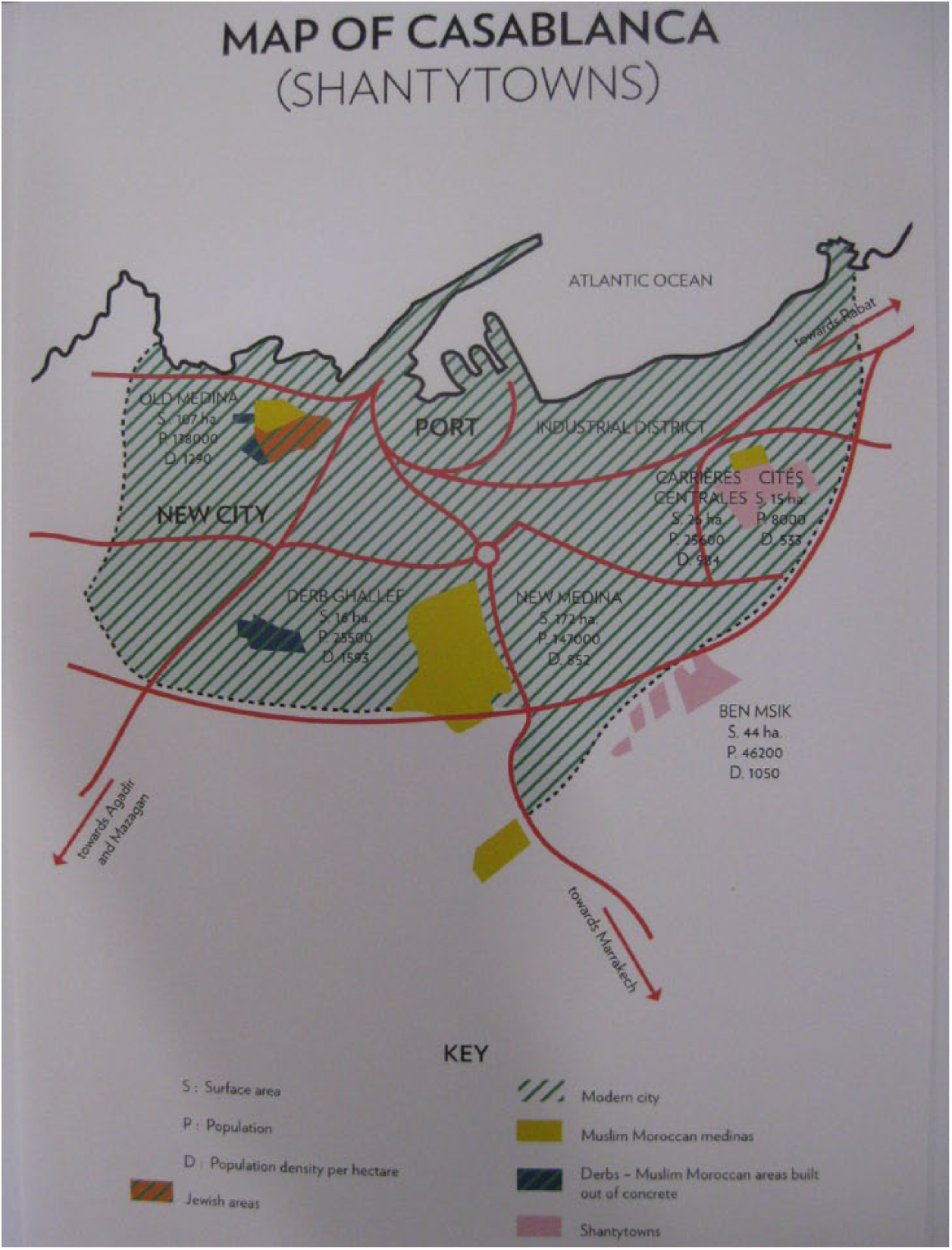
Map of Casablanca indicating the main Moroccan areas, taken from Robert Montagne, Naissance du prolétariat marocain (Paris, 1950), annex. Adapted by Laurent Eisler, reproduced with permission.
In Algiers, as in Casablanca, authorities responded to an increasingly embarrassing social and hence political problem, yet the council feared that rehousing might encourage prospective migrants. 34 Minimizing shanty-town growth was therefore the sole and unworkable response: in Algiers, there was no mass-scale relocation of shanty towns, and this initially limited shanty-town size (Map 2). The initiatives of mayor Jacques Chevallier (1953–8) constituted the first real efforts to build mass social housing for Algerians, and were therefore the first substantial policies of welfare colonialism in Algeria. While Chevallier was increasingly marginalized during the ‘Battle of Algiers’, his self-styled ‘housing battle’ aiming to win social peace was continued throughout the rest of the war, notably through de Gaulle’s ambitious Constantine Plan (1958–62) for socio-economic and educational improvement. 35 This continuation of the ‘social war’ 36 in Algeria can be explained by such measures’ place within counter-insurgency, designed to win ‘hearts and minds’ (see below). From the mid-1950s onwards, an urban patchwork existed of shanty towns, temporary rehousing and more permanent estates. However, as in Casablanca, financial stringencies in Algiers meant that social housing provision was insufficient. Furthermore, rehousing initiatives in both cities often simply displaced, rather than eroded socio-ethnic segregation: for example, since very few housing estates were ethnically mixed, many Algerian demonstrators in December 1960 who wanted to take the argument to Europeans had to leave their immediate district, explaining protestors’ attempts to head to other areas.
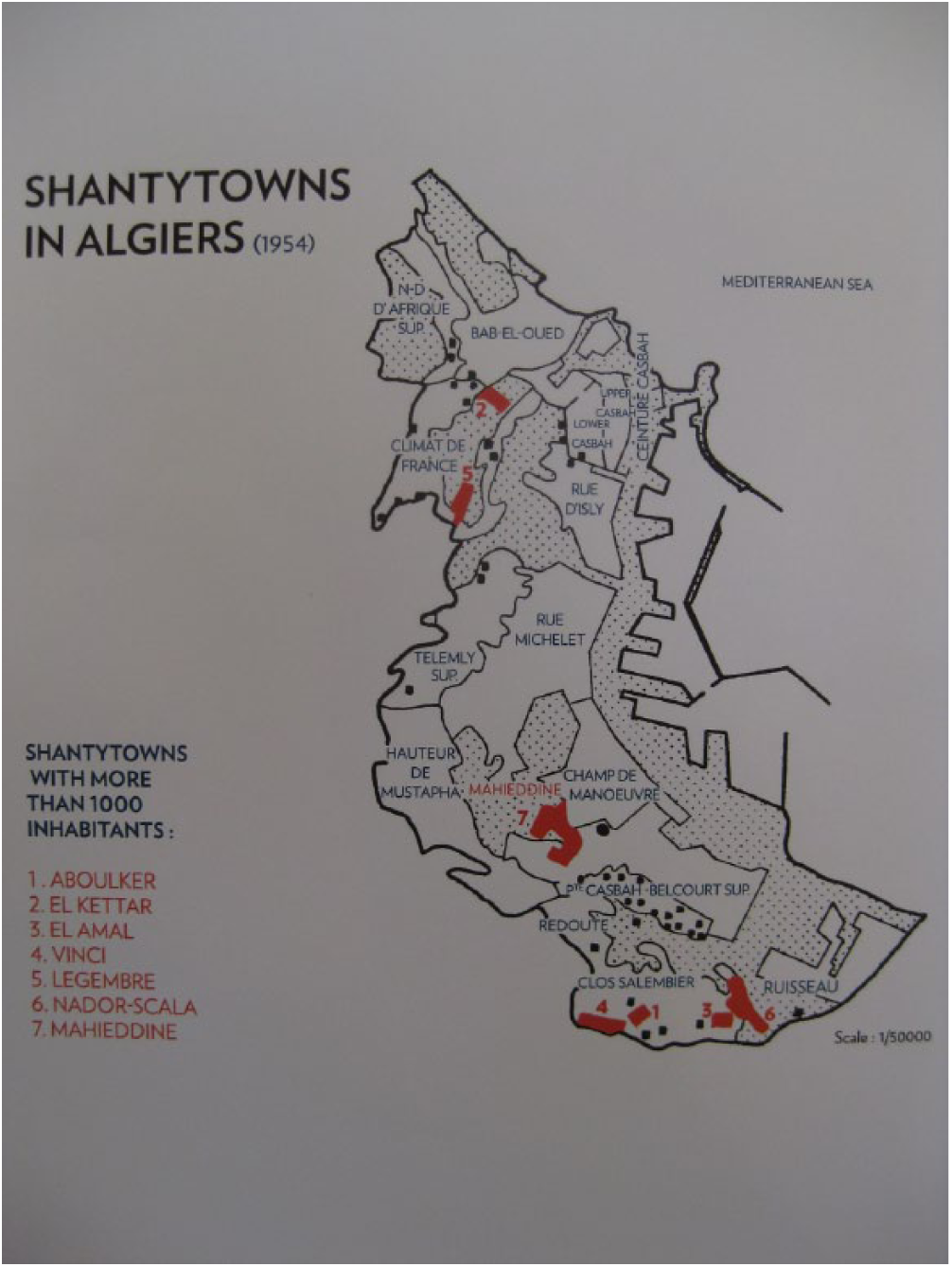
Map of shanty towns in central Algiers in 1954 with those of over 1000 residents indicated, taken from Descloîtres, Reverdy and Descloîtres, L’Algérie des bidonvilles, p.43. Adapted by Laurent Eisler, reproduced with permission.
II. Creating and Imagining the New Nationalist Cities
After 1945, majority Moroccan and Algerian urban areas in Casablanca and Algiers were increasingly considered not just as a possible health and social danger, but also as a political and security one: from the colonial authorities’ perspective, both cities had become an archipelago of ‘problem’ areas. In essence, pro-independence nationalism after 1945 managed to move well beyond its initial urban heartlands of Medina (Casablanca) and Casbah (Algiers) respectively. A remarkable number of similarities can be highlighted between the two cities, with nationalists using grass-roots political activism through both direct means (parties and cells) and more indirect borrowed or ‘imported’ forms such as sports clubs and scouts, as well as places of better-established everyday sociability (cafés, mosques, Islamic schools). 37 The colonial authorities were often ill-informed about many of these activities, which complicated urban ‘pacification’. By the early 1950s, the main nationalist organization, the Party of the Algerian People – Movement for the Triumph of Democratic Liberties in Algiers, already had two strong bases outside of the Casbah, situated in ethnically mixed Belcourt and Clos-Salembier, respectively (see Map 2).
Through garnering considerable support in Carrières centrales, Istiqlal had likewise partially shifted Casablanca’s existing nationalist geography. By the early 1950s, Carrières centrales was considered the Istiqlal’s heartland as the party attracted the urban poor via the General Confederation of Moroccan Trade Unions (UGSCM), 38 which was present in the adjacent industrial zone where many in Carrières centrales worked. The authorities saw Casablanca as the city in which a Moroccan working-class identity first emerged. 39 Consequently, however, French officials often exaggerated Communist influence both within and beyond the Istiqlal. The Istiqlal also used public events linked to royal ceremonies: the presence of thousands of Moroccans marking the annual commemoration of the start of the Sultan’s rule on 18 November 1952 had been considered a deliberate attempt by Istiqlal to challenge French control of urban space while circumventing bans on overtly political demonstrations. 40
Alongside activists’ undoubted success in reaching a mass audience, this process of nationalist urban extension arguably signalled the French authorities’ shortcomings when analysing the rapidly changing social and political identities of the urban poor. In both Casablanca and Algiers, the high numbers of newly-arrived migrants were considered to suffer from social anomie since they were no longer integrated into rural social structures, nor had they yet been absorbed into city life. 41 Yet such assumptions went well beyond the diffuse fear of the ‘floating population’. In the North African colonial context, those charged with maintaining law and order viewed such people as presenting a considerable potential political danger: the colonial authorities feared the urban poor might fall prey to pro-independence nationalism, seen as unrepresentative and violently imposing itself upon unwitting and politically immature ‘lost souls’. When viewed through the lens of Orientalism and its symbolic violence, the urban poor were politically naïve, ignorant and hence easily influenced. As Roger Maneville, in charge of the industrial district in which Carrières centrales was situated, stated in 1951, ‘All told, Casablanca’s Muslim proletariat remains a docile mass that can be easily led with enough effort.’ 42 French techniques of ‘urban pacification’ therefore sought to detain nationalist activists to remove them from positions of influence and then ‘work’ on the rest of the population viewed as inherently pro-French.
Repression and reform therefore went hand in hand, although the balance between these two linked elements shifted over time, and the repressive aspect often dominated and targeted the colonized collectively. If we concentrate here, for the moment, on the more reformist features of colonial policy, the first stage was to better ‘know’ this highly mobile urban population to ensure surveillance and thereby ‘reconnect’ with the local population. Agencies were thus created at moments when the potential political and security threat coming from urban areas was viewed as increasing. Combining military and civilian functions, the Delegation for Urban Affairs (DAU), headed by army officers, was founded in Casablanca in 1947. 43 Created in 1957 at the peak of the ‘Battle of Algiers’, the Urban Administrative Sections (SAU) were based on the army’s Specialized Administrative Sections (SAS) introduced in rural areas in 1955: the SAU, led by army officers, were tasked with overseeing majority Algerian districts and introducing reformist policy (housing, education, training) while, like the DAU in Casablanca, liaising with other security forces. The SAU’s implantation showed that, outside the Casbah, the shanty towns, but also the new housing estates of the Chevallier era, were all viewed as a potential security danger. The SAT-FMA agencies 44 in the main cities in France with a sizeable Algerian migrant population, and especially in the Paris suburbs such as Nanterre, were introduced because of the Algiers SAU’s perceived success during 1957–8. The SAT-FMA were headed up by military officers (most with prior experience in the DAU, SAU or SAS), with some police support. 45
DAU officers in Casablanca, and army personnel within and beyond the SAU in Algiers, expressed the need to improve practical information on who lived where. For example, (Captain) Roger Maneville had complained in 1950, in relation to the Casablanca ‘proletariat’, of ‘the imprecise nature of its size and of its movements both within and beyond the city’. 46 During the ‘Battle of Algiers’ in April 1957, General Salan, referring to the shanty towns, spoke of the need to ‘undertake a meaningful census of the people living there and who are for the most part unknown to us’. 47 As a result of such fears, in 1957, the army bulldozed entire ‘problem areas’ such as shanty towns. 48
Notwithstanding the undoubted success of the ‘Battle of Algiers’ in dismantling local FLN structures, the same fears of a highly mobile and potentially ‘anonymous’ urban population existed in the months before the 1960 demonstrations, in the context, notably, of many arrivals fleeing the military operations of the wide-scale Challe Plan (February 1959 to April 1961), designed to weaken the FLN during negotiations. 49 In this respect, the impact of the war elsewhere resonated across the city’s neighbourhoods, representing a key distinction with the Moroccan context. Military commanders openly recognized the Challe Plan’s aggravating impact, with the head of the Algiers SAU stating that such war-time migrations were ‘primarily the consequences of pacification (no-go areas and regrouping zones)’. 50 Administrative measures were duly taken in 1960 and 1961 to prevent people coming into Algiers. However, the army viewed large-scale forced relocation of Algerians from the cities back to home regions as unfeasible for legal, humanitarian and psychological reasons. 51 Such refugee migrations tended to concentrate in suburbs like Hussein-Dey and Maison-Carrée (Map 3): for example, the shanty-town population in Maison-Carrée doubled between 1958 and 1960. 52 The SAU chief in suburban Bouzaréah complained in October 1960 of the increasing number of shacks appearing in his area, since ‘such dense and mobile populations become almost uncontrollable and can constitute refuges and shelters for terrorists operating in Algiers’. 53 Furthermore, by the summer of 1960, the FLN, under pressure in the countryside due to the Challe Plan, started to reorganize its Algiers operation to recreate the nationalist city so depleted since 1957. 54 The importation of the SAS into the urban context in the form of the SAU, and the SAT-FMA in Paris, often merely replicated many of the problems that counter-insurgency, combining reform and repression, produced in the rural context.
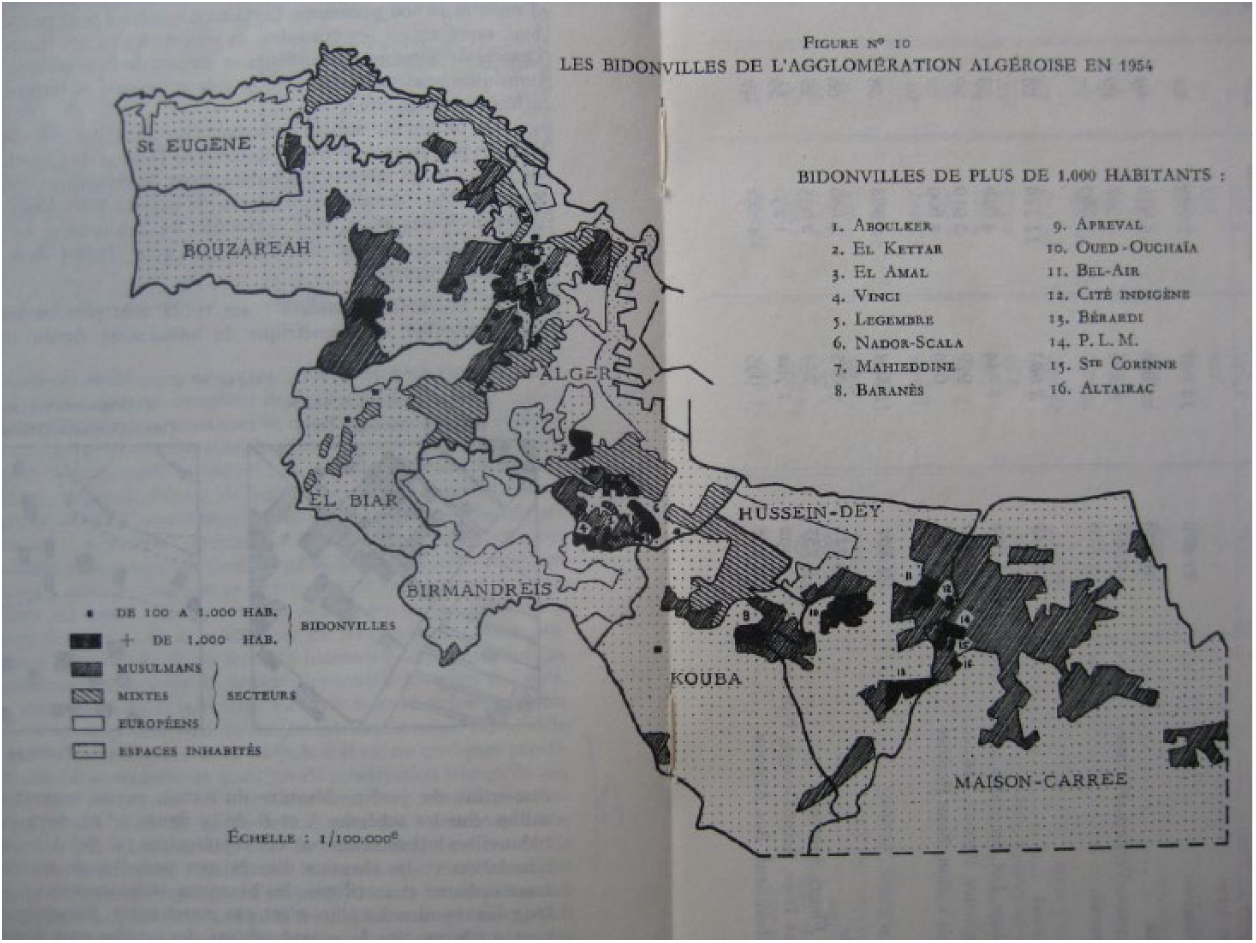
Map of shanty towns in greater Algiers (including the suburbs) in 1954 with those of over 1000 residents indicated, and showing the types of population by area. Taken from Descloîtres, Reverdy and Descloîtres, L’Algérie des bidonvilles, pp.72–73. All possible efforts have been made to contact the publisher, which is no longer in existence.
While all the colonized, notably male, might be viewed as potentially dangerous, and only capable of understanding physical force or its active threat, certain areas and their inhabitants were seen as more threatening than others. But this ‘geography of urban risk’ differed between Casablanca and Algiers. 55 In Casablanca, there was a near-total focus on shanty towns: 56 the December 1952 protests therefore simply confirmed existing security fears centring on the possible explosion of violent, politically-motivated disorder coming from such areas. As Resident General Alphonse Juin had put it in July 1950 (referring here to Casablanca, Fez, Rabat and Marrakech), there was the need to ‘gain back control over the people in the shanty towns that have been left to their own devices, seriously jeopardizing security in the four large cities’. 57
In Algiers, the situation was less clear-cut: while the Casbah remained an important focus for police and military after 1957, shanty towns in general, as we have just seen, also remained a source of concern, with the FLN in such areas looking to recruit single men for the armed struggle. 58 In Algiers in December 1960, the participation of shanty-town dwellers in the demonstrations therefore confirmed that the FLN in Algiers was regrouping, and brought back earlier fears linked to the uncontrollable FLN support base in 1956–7. For some SAU officers, however, notably those in Clos-Salembier, until the arrivals from the Challe Plan especially, and even more so the December 1960 events, shanty-town inhabitants might be seen as less likely to be pro-FLN since the SAU viewed demands for rehousing as a possible means of exercising political leverage over such residents. 59 For these officers, it was those in the new housing estates, such as Diar El-Mahçoul in Clos-Salembier, who were seen as the most politically radicalized. 60
In reality, the reasons explaining what made one urban area more or less politically active were immensely variable and remain poorly understood. However, it is unquestionable that for nationalists in both cities, the scale and relative ease of rural–urban migrations, and intra-urban migrations, represented an opportunity. Taking advantage of the greater anonymity afforded by the city, the FLN used Algiers as a support structure and hence resource for the guerrilla struggle in the interior, through the provision of weapons, supplies and people, and migrants’ links between countryside and city were fully utilized.
Nationalists in both Algiers and Casablanca took advantage of socio-ethnic residential segregation to hide personnel and material. However, as had been tragically shown with the ‘Battle of Algiers’, this potential advantage for the nationalists, as they constructed (or reconstructed) an ‘underground city’, 61 came with an important rider: ethnically segregated spaces, most famously the Algiers Casbah, also provided opportunities for higher levels of repression carried out without any potentially ‘indiscreet’ European observers exterior to the security forces. Such a scenario also applied to Carrières centrales in December 1952. In 1959–61, many shanty towns in suburban Paris (Nanterre) had been particularly targeted by police since they were reputed to be FLN strongholds. 62
In all three cities, the late colonial state tolerated circulation into, within and around the city for economic reasons, but the political consequences of such mobility were often feared. The mobility caused by the colonial situation was thus both an economic opportunity and a potential political danger as seen by police, army, city councils and much of the wider European population.
III. Units, Repertoires and Antecedents
Before examining the nature of the repression and where it took place, we need to analyse the wide variety of units involved in policing demonstrations and street gatherings. In Casablanca, European police officers worked with and often oversaw the Moroccan police (mokhaznis) and neighbourhood guards, the number of the latter having been increased during 1952. 63 While these Moroccan forces were nominally under the control of the Sultan to maintain the diplomatic façade of shared power between him and the French Protectorate, in reality, most power lay with the French. Where public security was considered to be seriously threatened, as in December 1952 once the Istiqlal and trade unions called for a general strike, the Head of Region (akin to a Prefect), in this case hardliner Philippe Boniface – operating under the similarly repressive Resident General Guillaume – could call on various units as part of a well-established ‘defensive’ plan and without recourse to the State of Siege (which would have seen the army take over some civilian powers): police and military were to stop Moroccan demonstrators from entering the city’s ‘European’ areas by sealing off entire areas and using round-ups and mass arrests. 64 This ‘defensive’ policy mobilized elements such as the Moroccan regular soldiers (tirailleurs), irregular elements (goums) and a further line of more ‘elite’ units such as legionnaires, gardes mobiles, Marine commandos, and the much-feared sub-Saharan African (‘Senegalese’) troops. 65 Such troops – who only intervened when necessary – were often paraded for dissuasive effect along chosen itineraries. 66 The explicit spatialization of the perceived threat is strongly conveyed by a November 1951 report underlining the need for an entire reworking of the protection plan for Casablanca, ‘to adapt it to the constantly evolving political situation and to the seriousness of the increasing danger weighing on the European areas brought about by the continual development of shanty towns’. 67
This militarization of policing was typical of colonial contexts, whether or not emergency measures, such as a State of Siege, were deemed necessary: soldiers would often be called upon to police demonstrations. Here, Algiers was no exception: the 7 January 1957 measures granting full policing powers to the army in Algiers came on top of the State of Emergency (3 April 1955), and the voting of the Special Powers Act in March 1956 that had radically increased military powers, eroded civil liberties and provided a conducive legal framework to fight pro-independence movements. The range of units deployed to maintain law and order included the SAU’s mokhazni guards, the Algiers police, units of riot police CRS, mobile gendarme units, and army units including both the regular parachutists and the Foreign Legion parachutists.
Many of the administrative and judicial measures against Algerian nationalism forged in Algeria from 1955 onwards were then applied to Metropolitan France. However, contrary to Algiers in December 1960, in Paris, the police were always in charge, calling in support from CRS and gendarmes where needed: army units, in October 1961 as at other moments, were not called in against the FF-FLN on any large scale. Ways of policing Algerians in Paris had nonetheless become influenced by models brought over from North Africa by military personnel employed by the Paris police, notably after Maurice Papon’s appointment (March 1958). 68 One key example is the presence, from 1959 onwards, of the Auxiliary Police Force (FPA), headed by the former SAU chief from Clos-Salembier in Algiers, and which was mainly staffed by Algerians and would raid majority FLN-areas of the capital, notably in the outer-lying 13th, 18th and 19th arrondissements, and in industrial suburbs such as Nanterre. 69
This militarization of policing often resulted in Moroccan or Algerian demonstrators being termed opponents (adversaires) and described in official reports as ‘troops’ or ‘shock troops’. However, in the majority of cases, such demonstrators either did not have guns or at least did not use what firearms they possessed against the security forces. A mixture of colonial and anti-Communist imaginaries, such representations had become commonplace in Paris, presupposing an aggressive street presence. They also existed in Casablanca, with the overall military commander for Morocco referring in 1948, for example, to the ‘potential shock troops’ formed by working-class men. 70
This vision of demonstrators arguably enabled moral disengagement and hence facilitated the conditions of possibility for violence: colonial security forces had a long record of violent intervention against demonstrations, notably in Algeria. 71 In Morocco, fatalities caused by security force intervention had occurred during peaks in protest against the Protectorate in 1937 and 1944. 72 Nationalist street demonstrations on 1 November 1951 had already led to five Moroccan deaths by police in Casablanca. 73 In Paris, the 14 July 1953 killing of seven protestors (six of whom were Algerian) at Place de la Nation further underscored that the police had no qualms about opening fire on unarmed colonial protestors. 74 When non-violent forms of monitoring and control failed to prevent or contain protests, the response could therefore be violent and, often, lethal, whether or not the military were involved: this configuration makes massacre a latent possibility and showed the normalization of violence as a control strategy against the colonized whether in the colonial theatre or Paris. 75
IV. The Struggle Over Who Demonstrates Where
During the events in Casablanca, Algiers and Paris, an attempted policy of spatial containment to limit demonstrators’ mobility and hence political agency formed an important component of the security forces’ mission. The legitimacy of this ‘repressive mandate’ came with the knowledge of impunity for lethal violence considered as justified. However, as we shall now see, the colonial situation was always experienced locally, and the three urban contexts were not identical, just as spatial containment was never the sole consideration.
In Casablanca, the main dynamic on 7–8 December 1952 was between the colonial state and demonstrators. Here, one key form of state violence arose from the attempted spatial containment of protestors. In this respect, the most widely reported violent incident was on the Route de Mediouna early afternoon on 8 December. By this time, Boniface had instigated the aforementioned ‘defensive plan’ designed to protect key sites and Europeans, and this incident exemplified the multiple threat perceptions informing interventionist strategy, linking fear of strikes, nationalist uprising and the need to ‘defend’ Europeans. After having buried many of those killed during the violence of 7 and early 8 December, a cortège of several thousand Moroccan demonstrators headed from a cemetery along the main road towards the central, European district in order to take part in a meeting at the Trade Union Meeting House to protest against the repression. These demonstrations were overseen by the nationalist Istiqlal, with Moroccan flags prominently displayed, making the protestors’ objectives explicit. Furthermore, these demonstrators were perceived as following the banned strike, suggesting a punitive element to what followed.
In order to stop these demonstrations from moving closer to the central city, 50 Moroccan police (goums), under European command, and European police officers fired on the protestors to disperse them, resulting in 14 deaths and the scattering of the crowd into neighbouring streets where three Europeans were killed. 76 To justify this lethal police intervention, Resident General Guillaume wrote of the ‘attempted march on the European city’. 77 Similarly, Boniface’s deputy reported that ‘all measures had been taken to thwart the invasion of the European city’. 78 Ultimately, the civilian authorities then tolerated the meeting at the Trades Union Meeting House in order to arrest the Moroccan political leaders who had come to speak there, and upon exiting, Moroccans faced a gauntlet of police and European vigilantes. 79
In Paris, also, the attempted reimposition of segregation through spatial containment was blended with other strategic priorities. With the FLN appealing to French and international opinion against the ongoing repression in Paris, the police wanted to prevent the arrival of many Algerians from the industrial suburbs, and therefore blocked access on many gateways and bridges over the Seine leading to the central city, using the FPA to do so on the Pont de Neuilly, which is the only place where the French authorities recognized police killings of Algerians (two) on 17 October 1961 (Map 4). Certainly an underestimation, these deaths were undertaken by units (FPA) with no training in crowd control and armed with automatic weapons and who fired into the crowd, supposedly in legitimate defence. 80 Other police units charged the demonstrators, with some of the injured being thrown into the Seine from the Pont de Neuilly. 81 Algerians’ status as second-class citizens here was readily apparent: by 1961, Metropolitan French security forces in France would very rarely open fire on Metropolitan French protestors. 82
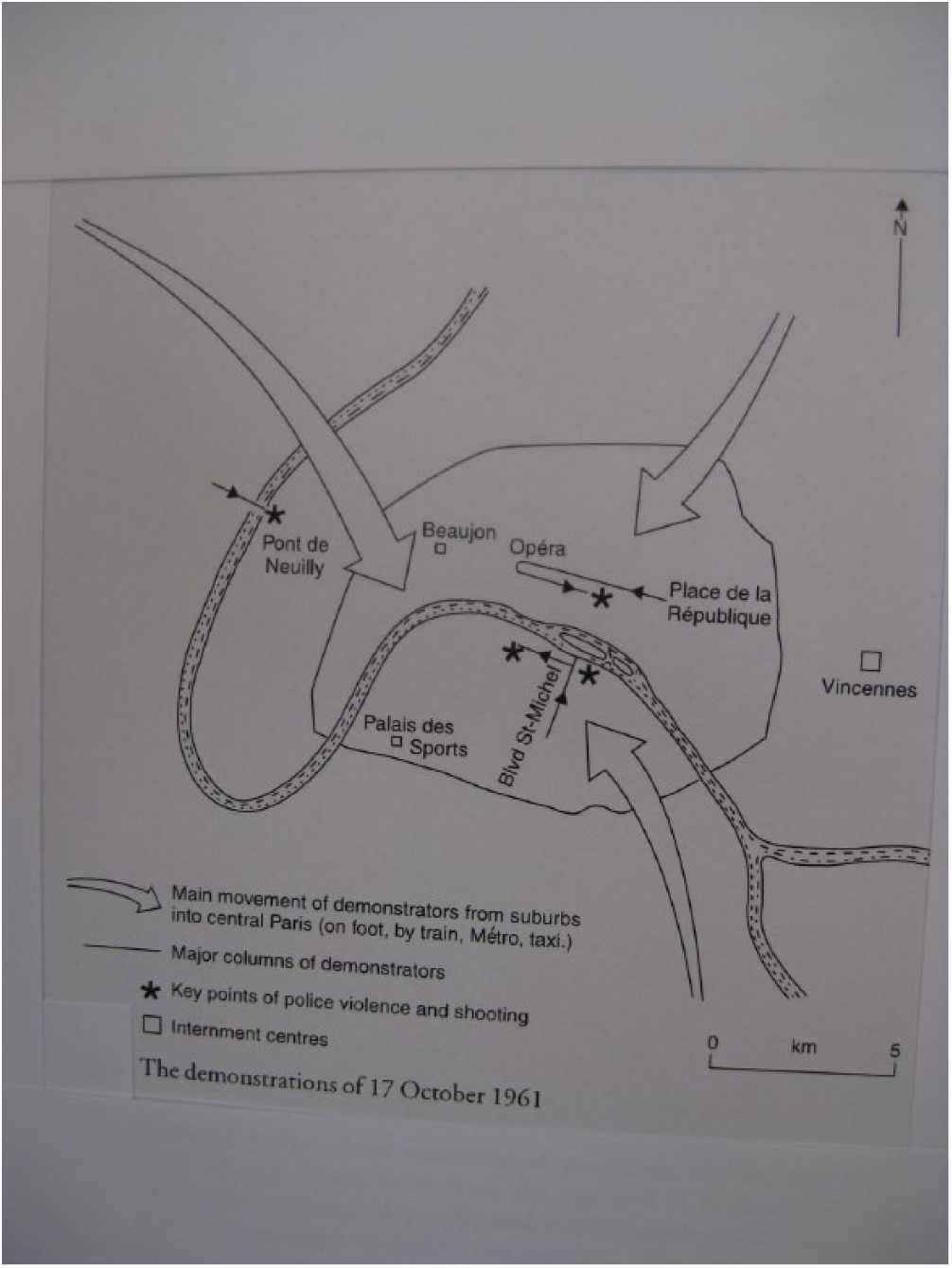
The demonstrations of 17 October 1961. From House and MacMaster, Paris 1961, p.116, by permission of © Oxford University Press.
Ultimately, however, thousands of Algerians managed to congregate in central Paris, defying the de facto ethnic segregation many faced and thereby sending a powerful symbolic message. 83 Yet these huge gatherings were in part tolerated, since police also aimed to arrest as many Algerians as possible to gain information on FF-FLN activities and disorganize the money-collecting process, which was another strategic priority for the force, alongside dispersal. Indeed, the number of arrests in one day was exceptional, with some 11,500 Algerians held on the night of 17–18 October and 14,094 altogether detained between 17 and 19 October (as protests continued): many Algerians faced (further) violence in detention centres. 84
Spatial containment, or at least attempted containment of demonstrators, was arguably as important in Algiers during the December 1960 events as in Casablanca in December 1952. In Algiers, however, the violent dynamic between Algerians and European pro-French Algeria activists – the latter sometimes carrying firearms – was as significant as the evolving dynamic between security forces and Algerian demonstrators. Crowd control aimed first and foremost to avoid or limit confrontations between Algerians and Europeans, and was well-established policy. 85 Such intervention was, however, principally designed to protect Europeans and their property – a frequent target of demonstrators – as opposed to shield Algerians from Europeans.
The military entirely sealed off the Casbah, with some Algerian demonstrations occurring within that area. This sealing-off thus created an opportunity for other areas to demonstrate. However, how this occurred reflects the complex socio-ethnic geography of Algiers where residential segregation, unlike in Casablanca, had often occurred more indirectly, and where, alongside the Casbah, shanty towns and most rehousing estates there existed several ethnically mixed areas. 86
While Algerian protests were spread over several days, it was on 11 December when they reached their peak. The nationalist ‘core’ was undoubtedly Belcourt and Clos-Salembier, at the centre of the main nationalist axis that ran from the west (the huge Climat de France housing estate, and the Casbah) to the east (Hussein-Dey, Maison-Carrée) (see Maps 2 and 3). Belcourt and Clos-Salembier were districts with both sizeable Algerian populations and many Europeans. Given that demonstrators aimed to take the argument to Europeans, Algerians from other areas either headed ‘down’ to Belcourt, near the port, or ‘up’ to Clos-Salembier, about 1 km away. The police and army attempted to stop Algerians from reaching either zone or from moving between one and the other, and wanted to keep Algerians from different districts from joining forces: however, since both Belcourt and Clos-Salembier were ethnically mixed spaces, the security forces did not attempt to entirely seal them off as they did with shanty towns, since Europeans (as opposed to Algerians) had the implicit right to move around the city. Generally seeking to disperse rather than arrest protestors, the army opened fire in many instances. 87
One well-known episode of the 11 December 1960 protests saw riot police attempting to stop several thousand demonstrators, some holding the Algerian national flag, from moving onto one of the main streets in Belcourt, the rue de Lyon. Where had these protestors come from? Immediately up the hill, only several hundred metres away, there were densely populated Algerian-only areas renowned for their nationalist activism (for example, El-Aguiba). However, some demonstrators had also managed to come down from Mahieddine shanty town, approximately 500 metres away, despite the SAU’s apparent sealing-off of that area. Some of those living in Clos-Salembier were in fact originally from Mahieddine shanty town, and had been temporarily rehoused in the former area: many were used to crossing Belcourt on their way to work in the nearby port. The flashpoints that occurred at the interstices of Belcourt and Clos-Salembier therefore resulted from the opposition between the aims of protestors and their reading and practice of urban space on the one hand, and, on the other hand, policing strategy that aimed to limit such intended mobility.
While the Belcourt SAU chief’s report of these events might have attempted to exaggerate the presence of many Algerians from outside ‘his’ zone on 10–11 December (including those from Mahieddine and Clos-Salembier) in order to underline SAU control of those under his remit living in Belcourt itself, his version shows that the security forces were in effect incapable of fully overseeing urban mobility both between and within certain city districts, as the ‘urban masses’ erupted upon the political scene. 88 There were other flashpoints: as large numbers of Algerians moved from the Climat de France housing estate towards mostly European Bab el-Oued on 11 December, parachutists opened fire, and, here as elsewhere, Europeans also shot dead many Algerians. 89
Senior French military figures judged the area in and around suburban Maison-Carrée as ‘another critical point’ (especially on 12 December), as Algerians sought to move from shanty towns and rehousing estates and into majority European areas to demonstrate, and to attack property and those Algerians seen as complicit with the colonial administration, objectives that were common across Algiers. 90 Here again, parachutists intervened, causing fatalities. 91 In nearby suburban Léveilley, the SAU regretted that during 10–11 December 1960, ‘some people that had seemed the most loyal to us, some committed neighbourhood leaders turned out to be agitators and FLN flag-bearers’. 92 The SAU in Maison-Carrée reported that ‘the vast majority of demonstrators came from the shanty-town areas’, confirming some SAU commanders’ worst fears. 93
Repressive violence also occurred within other specific areas. For example, in addition to Belcourt, parachutists were deployed in the large Diar El-Mahçoul estate in Clos-Salembier on 11 December 1960: this flagship but militant estate with approximately 8500 inhabitants formed one of the rare ethnically mixed ventures of the Chevallier reformist era, although the cheaper housing was mostly Algerian-inhabited. 94 After lethal gunfire by Europeans, Algerians reacted and police stepped in to protect Europeans and the SAU and then parachutists tried, often unsuccessfully, to stop local residents heading down to Belcourt. 95
Local-level interventions in Casablanca centring on Carrières centrales on 7–8 December also prioritized spatial containment and the violent re-establishment of colonial order. In December 1952, beyond the Route de Mediouna incident previously analysed, the local focus was arguably within Derb Moulay Cherif, a militant nationalist area of concrete housing with some employer-built workers’ estates, situated only 100m from the start of the neighbouring shanty towns and existing in close socio-economic relation to them. 96
The police station in Derb Moulay Cherif – a key symbol of colonial rule – became a focal point of protests on 7 and 8 December, albeit in circumstances that remain highly unclear. 97 All versions agree, however, that in the evening of 7 December 1952, at least several thousand protesters (men and women) from across the Carrières centrales area congregated around this police station, and police reinforcements were called for, whose arrival met with hostility (notably stone-throwing). This soon led to shots being fired by goums and European police and caused at least six deaths amongst protestors, as three Moroccan police were also killed.
On the morning of 8 December 1952, the violence continued: some accounts describe security forces shooting indiscriminately from raised buildings within or next to the shacks, as demonstrators again attempted to move from the shanty town across into adjacent Derb Moulay Cherif. 98 Numerous deaths here were recognized by public officials, one of whom spoke of the ‘unfortunate innocent Muslim victims who died in their shacks’. 99 One adolescent told officials he was shot in the leg while digging a ditch in his family’s shack to shelter from bullets. 100 There was no suggestion that any civilian Moroccans were responsible for these shootings. 101
Despite the high levels of violence involved, these attempts to limit mobility within the Carrières centrales district on 8 December clearly proved unsuccessful, since a larger crowd than the night before was present outside the police station in Derb Moulay Cherif, and, as with the previous night, official versions spoke of ‘rioters’ attacking a building bravely defended by outnumbered personnel. Yet internal French reports also acknowledged ‘a large number of dead’ (often around 20) among protestors next to the police station as a result of gunfire, mostly by the goums who, along with the European police officers, seem to have been responsible for most deaths during the two days. 102 It was only at this point that Europeans were targeted for violence by the Moroccan crowd, and that the small number of European residents were evacuated from Derb Moulay Cherif.
While, as we have already seen, many Moroccan inhabitants were then able to leave the area to bury the dead, Carrières centrales was in theory surrounded by midday on 8 December. 103 However, police were not only interested in stopping people from accessing, leaving or moving around the area, but also in undermining the strikes taking place, showing a variety of strategic logics at play. As Boniface’s deputy, Capitant, put it in relation to Sunday 7 December 1952, ‘all measures had been taken to ensure order was maintained and the freedom to go to work and do business was guaranteed the following day’. 104 At a further nationalist strike on 11 December 1952, this time to protest against the repression, those shops remaining closed in Carrières centrales were demolished. 105 Some European police boasted about their use of gunfire during punitive raids inside homes. 106 Throughout the December 1952 events in Carrières Centrales, we can distinguish a punitive response from the colonial authorities, with spatial containment being one of a number of factors behind physical and material violence suffered by the local population, and intervention going beyond the violent dispersal of crowds.
V. Punishment and Intimidation
As Martin Thomas has shown, violence has a communicative, rhetorical function: violence has perpetrators, victims and witnesses, but it also has local, national and possibly international audiences to whom it sends one or more messages. 107 For the French authorities, strong repression and the reassertion of colonial control were designed to communicate resolute defence of the colonial order to local (European) colonial and Metropolitan audiences, and to show world opinion that the Moroccan and Algerian conflicts could be dealt with without UN intervention. 108
In terms of the signal that such repression aimed to convey to the colonized and their political organizations, we can note in all three case studies the demonstrative nature of the violence in order to reassert colonial control, deter, inspire fear and often punish. Demonstrations constitute the moment when the colonized occupy public spaces in a deliberate act of embodied self-expression and political defiance (violent or otherwise), often in the face of known high risk of repression. 109 In this respect, the very presence of large numbers of demonstrators signalled a failure of colonial domination, and protestors were therefore deemed worthy of ‘punishment’ as a deterrent, even if, as we shall see, some security force units might be more inclined to respond violently than others. 110
Holding the colonized collectively responsible for resistance had been a key element of colonial conquest. 111 Now, the violence against protestors in both Paris (17 October 1961) and Casablanca was viewed by the French authorities as reprisals for the Istiqlal’s and FF-FLN’s political (and, in the latter’s case, armed) resistance, along with protestors’ spatial transgression. In Paris, police officers had waited for years for Algerians to ‘come out into the open’, and there was considerable excitement amongst officers at the chance to dispense ‘summary justice’, notably through the choice of weapons (large clubs, guns) to use on 17 October 1961. 112 As one of the colonial officials in Casablanca responsible for law and order put it after the December 1952 events, Istiqlal had progressively taken ‘command of the streets, until the point when, having moved out of line, it was put back in its place in a manner that it had in fact long deserved’. 113
However, as the following example shows, just how punitive this violence ought to be created tensions amongst Algiers security officials. In Algiers, perhaps the key ‘punitive’ moment had been the ‘Battle of Algiers’ (1956–7), a moment of ‘dirty war’ during which the security forces were far more united in their repressive aims (as were the Moroccan Protectorate authorities in December 1952), when the message was to hit hard. 114 By late 1960, however, there were severe tensions between the largely pro-French Algeria parachutists and other elements of the professional army on the one hand, and, on the other, mostly gendarmes and riot police (CRS) favouring de Gaulle’s policy of gradual ‘disengagement’ from Algeria. 115
These tensions help explain why, after the December 1960 events in Algiers, elements of the professional army thought that the CRS deployed during the events, and who were mostly from Metropolitan France, had failed to disperse the demonstrators, allowing them to wave Algerian national flags under the watchful eye of the media in a central, socially ‘visible’ city district and, in some cases, proceed into majority European areas unchallenged. For example, Bernhardt, the (military) head of the Belcourt SAU, criticized what he viewed as the ‘passivity’ of the CRS who had allowed 3000 demonstrators to congregate on 11 December 1960 and ‘display FLN flags and placards that offended France and the army’. For Bernhardt, such tolerance had given demonstrators an impression of impunity. 116 Immediate dispersal might have necessitated opening fire, and for Roger Le Doussal, a former Algiers police superintendent, the Algiers police tried, through CRS and also gendarmes, to deal with these demonstrations in a ‘Metropolitan’ way (i.e. without opening fire). For Le Doussal, security forces treated Algerians in the same way as Europeans. 117
Le Doussal’s claim is weakened by the fact that security forces fired no shots at Europeans throughout the week across Algiers, despite this dynamic being one key element of the events and, by the army’s own admission, Europeans having caused ‘very much the majority’ of injuries amongst military personnel. 118 The presence of the CRS certainly kept the number of Algerian deaths lower than it might otherwise have been, since in Algiers, neither CRS nor gendarmes opened fire on Algerian protestors. 119 According to Jean-Pierre Peyroulou, the CRS from Algeria (i.e. those units mostly made up of Algerian Europeans) were less affected by pro-French Algeria activism than other police units. 120 However, soldiers in Algiers were more violent than CRS or gendarmes, as Le Doussal himself does point out: the military did not have truncheons, only firearms. 121 Within the military itself, parachutists, and the parachute regiment of the Foreign Legion, were more violent than others and were deployed to discourage demonstrators.
The SAU commander in Belcourt was not the only critic of the supposed inaction of CRS and gendarmes. 122 One key focus, as we have just seen, centred on the Algerian flag, the symbolism of which was intrinsic to Algerians, the FLN and the French security forces who, since the May 1945 repression in eastern Algeria, had grown accustomed to opening fire with impunity whenever and wherever this emblem was displayed. 123 The war situation had further radicalized such positions, facilitating what was often tantamount to a shoot-to-kill policy. 124
As one army officer explained just after the December 1960 events: ‘as soon as I spot the FLN flag, I shoot. It’s the enemy emblem. There is no call for hesitation.’ For him, this might mean firing into a crowd: ‘[o]nce that crowd is an FLN crowd, it is the enemy’. 125 In Belcourt, the SAU recognized that shots had been fired on unarmed demonstrators carrying the Algerian flag. 126 One demonstrator there, Bahloul Seddik, says that he was pursued by parachutists. When they caught up with him, a ‘first round hit me in the legs and I fell: one parachutist seized the chance to kick me with his boots, while the other ripped the [Algerian] flag from me that I was gripping tightly. A further round left me for dead, in a pool of blood.’ 127 Such violence contradicted the army’s official position that it was there as a neutral observer to separate Algerians and Europeans. 128 Such a scenario was partially replicated on 1 November 1961, which saw mass strikes and demonstrations in Algiers to mark the seventh anniversary of the start of the war. As in December 1960, the security forces attempted to contain Algerian demonstrators within their residential districts, and violently repressed the carrying of the Algerian flag, with the army again taking the lead in lethal repression. 129
The supposed ‘reserve’ displayed by CRS and gendarmes in Algiers during December 1960 did not necessarily apply in Paris during the 17 October 1961 repression, where both units were involved in lethal violence. Here, the locally specific context of Paris, with police being killed by FLN operatives, a virtual blank cheque being given to officers by their superiors and in turn to rank and file by officers, and the wider policing culture often infused with pro-French Algeria (and anti-Communist) sympathies, arguably provided an ideal background for the venting on Algerians of these and longer-standing hostilities. 130
However, ‘punishment’ could also result from the passive as opposed to active agency of the colonial state, for example by allowing Moroccans or Algerians to fall into the hands of European vigilantes. Indeed, vigilantes often shared the punitive violence with state agents. 131 While in Algiers in December 1960, many Europeans were challenging official policy on Algeria, as we have seen, the security forces often did not protect Algerians from Europeans since this was not their foremost mission. Vigilantism in Algeria had especially sinister antecedents with, for example, the very large numbers of deaths caused by European militias during the May 1945 repression and again after the 20 August 1955 FLN uprisings in the Constantine region. 132 In Casablanca, vigilante violence also occurred, encouraged by inaccurate rumours circulating on 8 December 1952 of shots fired from the Trade Union Meeting House, overestimations of the number of Europeans killed and false press reports of European women being raped. 133
VI. Fear and the Aftermaths of Violence
In essence, behind much of the physical violence arguably lay a desire to create fear and intimidation through demonstrative repression and thereby deter future acts of ‘insubordination’. In Algiers, the deployment of parachutists on 11 December was a ratcheting-up of repression but also a dissuasive measure. In Casablanca, displays of force took the form, on 8 December 1952, of military aircraft overflying urban areas and the deliberate parading of the Foreign Legion. 134 Carrières centrales was then surrounded by tanks, armoured vehicles and mobile machine-gun posts, and spotter planes flew overhead, as the authorities (wrongly) feared a general uprising. The military commander for Casablanca judged on 14 December 1952, as the trouble died down, that if the violence had not been more serious, it was because firstly Moroccans did not possess firearms but also because ‘military force inspires salutary respect’. 135 According to an internal security note one month after the events, Moroccan opinion had vastly improved, due to the security forces’ ‘energetic measures’ so that Moroccans, ‘perhaps out of fear, are proving better behaved and more deferent towards the French authorities’. 136
We have seen the different levels of fear and thus threat perceptions that the French colonial authorities displayed and upon which they acted. However, we also need to take into account the fear and feelings of vulnerability thus created amongst groups targeted by measures of physical intimidation. The reluctance of the wounded to seek hospital treatment in Paris, Algiers and Casablanca allows us to examine such fears.
In Casablanca, the Moroccan wounded were often treated in mosques, pharmacies or in their shacks. On 16 December 1952, the police forcibly entered shacks in Carrières centrales to find the wounded as part of an operation to ‘purge the area of its subversive elements’. 137 Likewise in Paris in October 1961, the Nanterre shanty towns, for example, proved a haven for the wounded. 138 In Algiers, the FLN had its own urban field hospitals and medical staff. In Algiers, hospital treatment was a particular problem not only since the colonial authorities, as in Casablanca and Paris, wanted to identify who had been injured and why, but also since the hard-line Europeans might attempt to remove Algerians from hospitals to assassinate them. 139 Lack of access to, or avoidance of, adequate healthcare after these demonstrations no doubt added to the death toll and, furthermore, complicated precise estimations of fatalities.
A further dimension showing the fear experienced by Algerians and Moroccans relates to the complex issue of the carrying off of the dead by demonstrators and subsequent clandestine burials. This was no doubt part of micro-resistance strategies designed to ensure burial according to Islamic ritual. However, as with the wounded, the local population wanted to avoid a veritable arsenal of possible reprisals, which ranged from prosecution to internment, torture, sacking from state sector jobs and loss of housing. 140 In Carrières centrales, some victims were buried within shacks. 141 Somewhat paradoxically, the colonial authorities in Algiers and Casablanca did not seek to hide the existence, or the potential existence, of clandestine burials from the public. In effect, therefore, the authorities admitted a partial inability to control urban space and hereby recognized that the colonial state was neither all-seeing nor all-knowing. 142 Yet such admissions constituted a lesser risk where the death toll among protestors was a sensitive issue, since in effect, clandestine burials, as with lack of access to adequate healthcare, unwittingly reduced the number of officially recognized deaths and helped undermine allegations of disproportionate violence. Indeed, after the repression in all three cities, the critique of deliberate official underestimations of the death toll became the centre of a campaign by anti-colonial activists with national but also international dimensions and audiences. 143
In response to such charges, official narratives aimed to justify the forms and levels of repression, through the denial of political agency and legitimacy of the anti-colonial demonstrators. Such framing was attempted through the discursive criminalization of protestors, and their portrayal as essentially violent ‘rioters’ and/or political subversives, against whom lethal repression was both legitimate and necessary. In Algiers, official discourses tried to downplay the political elements of the protests, underlining the low age (adolescents) of many participants and the noticeable presence of Algerian women, many of whom were used to protesting after the burial of war dead and were in fact highly politicized. 144 In both Algiers and Paris, given the marked prominence of women at the head of demonstrations and in columns of demonstrators – on 20 October 1961, roughly 1000 Algerian women gathered in central Paris to protest against the repression of 17 October and were duly detained – their political ‘visibility’ in the eyes of police was strongly enhanced. 145
As we have seen, official responses to the events were not limited to violent repression. In Casablanca over the following week there was an unprecedented security crackdown, under the pretext (invented) that nationalists and communists were in cahoots to destabilize the regime and encourage UN intervention, hence the banning of the Istiqlal, UGSCM and Moroccan Communist Party. 146 The courts eventually (1954) threw out all charges and hence the assumptions on which official positions had been based. 147 In Algiers, preventive arrests of previously released FLN activists took place in some areas, but the military authorities were genuinely surprised at how swiftly the FLN had managed to seize control of initially mostly spontaneous protests. 148 In Paris, hundreds of Algerian ‘suspects’ were interned following the 17 October 1961 events. 149
The results of the repression were, in some respects, merely temporary, since Moroccan nationalists regrouped and were often radicalized due to the repression. For Resident General Guillaume, the repression had freed the Moroccan population from ‘extremist coercion’, thus facilitating his reformist agenda. 150 Yet others within the colonial apparatus were less jubilatory, with even Boniface admitting that, due to the December 1952 events, Casablanca had become ‘Morocco’s political centre’. 151 As Morocco slid into armed conflict, with the exiling of the Sultan Muhammad Ben Yusuf in August 1953, and the emergence of pro-independence urban guerrillas, further lethal repression in and around Carrières centrales occurred, most notably on 20 August 1955, when police killed at least 45 demonstrators in and around Carrières centrales, again seeking to contain protest within that area and ensure the protection of nearby Europeans. 152
If the December 1952 events marked a first stage of ethnic polarization in Casablanca, in Algiers, such polarization, already profound, was further exacerbated as a result of the December 1960 violence. Furthermore, rather than putting off the FLN nationalist leadership, these protests simply marked the start of several high-profile street demonstrations aiming to show the FLN’s huge urban support base and hence influence negotiations for independence, notably via the UN. However, the FLN demonstrations in Algiers on 5 July 1961 and 1 November 1961, as well as those in Paris on 17 October 1961, were instigated by FLN leaders determined to more fully control demonstrators’ behaviour and limit damage to property and symbolic targets. 153 Despite the colonial authorities’ best efforts, it was the public display of demonstrators’ political agency that, with hindsight, was arguably the defining feature of the December 1960 events, even where in Algiers these had not necessarily been closely planned or initially controlled by the FLN apparatus. Since 1958, public space in Algiers had been dominated by pro-French Algeria Europeans: much to the surprise of some SAU officers and the dismay of many Europeans, the December 1960 protests radically changed this dynamic.
Conclusion
Mobility both into and within key colonial cities like Algiers and Casablanca, and the linked question of the spatial distribution of the urban poor, all posed significant problems for the colonial authorities, whose ability to politically control and ‘contain’ large cities such as Algiers and Casablanca was hugely complicated by the emergence of mass nationalist movements after 1945. Many colonial actors viewed certain urban areas and their inhabitants – notably shanty towns in Casablanca especially – as more politically ‘dangerous’ than others. Pro-independence demonstrations and wider urban disorder called attention to issues of spatial containment in a particularly spectacular way, since nationalist participants sought to occupy, move around and use public space in ways that the colonial authorities found threatening. Often highly localized flashpoints were further complicated by the triangular relationship between the colonial state, Algerians/Moroccans and Europeans, marking an important distinction between the colonial situation in Algiers and Casablanca on the one hand and that in Paris on the other, notwithstanding the many similarities highlighted in this article. The stakes were high when what occurred in one district of a ‘showcase’ city could have significant repercussions on the international stage for various political audiences. This was especially the case in Algeria and, to a lesser extent, Paris.
All three events studied here show the extent to which urban mobility was a key site of struggle. Consequently, we need to think of spatial factors as an important component in the study of anti-colonial mobilizations and the repressive violence used as a response. Such violence stems from choices made by a range of state actors, municipal authorities and local populations. In this sense, the urban terrain, as well as the ‘mental map’, plays a key role in explaining the conditions of possibility for large-scale violence, the forms it takes (e.g. spatial containment, punishment), the levels used (lethal violence or otherwise) where it occurs, and the often highly differential ways in which groups are violently targeted by state agents.
Footnotes
Acknowledgements
The author gratefully acknowledges funding from the Institut d’Études Avancées de Paris and the Leverhulme Trust enabling the research and writing of this article. He would also like to thank Emmanuel Blanchard, Bart Luttikhuis, Neil MacMaster, and the anonymous readers of War in History for their comments on draft versions of this essay.
Funding
This research was funded by fellowships from the Institut d’Études Avancées de Paris and the Leverhulme Trust.
1
Zeynip Çeylik, Urban Forms and Colonial Confrontations. Algiers under French Rule (Berkeley, CA, 1997); Adria K. Lawrence, Imperial Rule and the Politics of Nationalism. Anti-Colonial Protest in the French Empire (Cambridge, 2013).
2
For a comparative approach to decolonization in North Africa, see Daniel Rivet, Le Maghreb à l’épreuve de la colonisation (Paris, 2002).
3
For an interesting analysis of these dynamics in colonial India, see Stephen Legg, Spaces of Colonialism. Delhi’s Urban Governmentalities (Oxford, 2007).
4
See, however, Emmanuel Blanchard, La Police parisienne et les Algériens (1944–1962) (Paris, 2011), pp.377–91.
5
There were approximately 150,000 Algerians in the greater Paris region (Seine département) in 1961. See Jim House and Neil MacMaster, Paris 1961. Algerians, State Terror, and Memory (Oxford, 2006), p.63.
6
In this article, the terms ‘Moroccan’ and ‘Algerian’ refer to the majority (Muslim) colonial inhabitants in Casablanca and Algiers respectively (and to Algerians in Paris).
7
See House and MacMaster, Paris 1961; Blanchard, La Police parisienne.
8
See Daniel Zisenwine, The Emergence of Nationalist Politics in Morocco (London, 2010); for an overview of the December 1952 events, see Jim House, ‘L’impossible contrôle d’une ville coloniale? Casablanca, décembre 1952’, Genèses. Sciences sociales et histoire 86 (2012), pp.79–104.
9
Protestors also died in Rabat and Beni-Mellal on 9 December 1952: see Robert Barrat, Justice pour le Maroc (Paris, 1953), p.247.
10
On the December 1960 events, see G. Mathias, ‘La fin d’une rumeur: l’organisation des manifestations de décembre 1960 à Alger par les officiers des SAU d’Alger’, in Jean-Charles Jauffret, ed., Des hommes et des femmes en guerre d’Algérie (Paris, 2003), pp.509–24; special edition of Naqd, 11 décembre 1960. Le Diên Biên Phu politique de la Guerre d’Algérie (Algiers, 2010).
11
This term is retained, but in inverted commas: the asymmetry of the violence deployed by the French state in relation to that of the FLN suggests that ‘battle’ is inadequate.
12
On Oran, see Mohamed Freha, Décembre 1960 à Oran (Oran, 2013).
13
See Martin Evans, Algeria. France’s Undeclared War (Oxford, 2013), pp.286–9.
14
This official figure is an underestimation. There were also six European deaths (Le Monde, 15 December 1960).
15
On the May 1945 protests and their repression by police, European militias and the army (causing many thousands of deaths), see Jean-Louis Planche, Sétif 1945. Chronique d’un massacre annoncé (Paris, 2006) and Jean-Pierre Peyroulou, Guelma, 1945. Une subversion française dans l’Algérie coloniale (Paris, 2009).
16
House and MacMaster, Paris 1961.
17
Blanchard, La Police parisienne, p.382.
18
See House and MacMaster, Paris 1961, pp.161–79.
19
J. Cole, ‘Massacres and their Historians: Recent Histories of State Violence in France and Algeria in the 20th Century’, French Politics, Culture and Society 28(1) (2010), pp.106–26.
20
P. Mann, ‘Les Manifestations dans la dynamique des conflits’, in Pierre Favre, ed., La Manifestation (Paris, 1990), pp.271–303.
21
G. Balandier, ‘La Situation coloniale: approche théorique’, Cahiers internationaux de sociologie, 11 (1951), pp.44–79.
22
See Georgina Sinclair, At the End of the Line. Colonial Policing and the Imperial Endgame, 1945–1980 (Manchester, 2006).
23
For Casablanca, see André Adam, Casablanca. Essai sur la transformation de la société marocaine au contact de l’Occident (Paris, 1968); Robert Montagne, Naissance du prolétariat marocain (Paris, 1950); for Algiers, see Robert Descloîtres, Jean-Claude Reverdy and Claudine Descloîtres, L’Algérie des bidonvilles (Paris, 1961).
24
Pierre Bourdieu and Abdelmalek Sayad, Le Déracinement. La Crise de l’agriculture traditionnelle en Algérie (Paris, 1964).
25
René Gallissot, Le Patronat européen au Maroc (1931–1942) (Paris, 1964); Rachid Sidi Boumedine, ‘Présentation’, in Jean Pelletier, Alger 1955. Essai d’une géographie sociale (Algiers, 2015), pp.17–85.
26
Archives nationales de France (hereafter ANF), 200000046/63, article 1712, Roger Maneville, Prolétariat et bidonvilles, 1950, p.15.
27
Robert Descloîtres, Jean-Claude Reverdy and Claudine Descloîtres, L’Algérie, p.81.
28
In greater Algiers, the percentage of Europeans to (Muslim) Algerians was 48.5% in 1954, falling to 36.9% by 1960 (Maria Sgroï-Dufresne, Alger 1830–1984. Stratégie et enjeux urbains (Paris, 1986), p.100). In Casablanca, whereas Europeans had represented 28% of the total population (Muslim and Jewish included) in 1936, this figure had fallen to 19.7% by 1951–2 (Adam, Casablanca, p.149).
29
Janet L. Abu-Lughod, Rabat. Urban Apartheid in Morocco (Princeton, NJ, 1980), p.144.
30
Abu-Lughod, Rabat, p.221.
31
See Jean-Louis Cohen and Monique Eleb, Casablanca. Mythes et figures d’une aventure urbaine (Paris, 2004), pp.288–337.
32
See Ed Naylor (ed.), France’s Modernising Mission: Welfare, Citizenship and the Ends of Empire (London, 2017).
33
Paul Puschmann, Casablanca. A Demographic Miracle on Moroccan Soil? (Amsterdam, 2011), p.74.
34
See Mahfoud Kaddache, La Vie politique à Alger de 1919 à 1939 (Algiers, 1970).
35
See Çeylik, Colonial Forms. The Constantine Plan also applied to Algerians living in Metropolitan France: see Amelia H. Lyons, The Civilizing Mission in the Metropole. Algerian Families and the French Welfare State during Decolonization (Stanford, CA, 2013).
36
Vincent Viet, La France immigrée. Construction d’une politique 1914–1997 (Paris, 1998), p.203.
37
Omar Carlier, Entre Nation et Jihad. Histoire sociale des radicalismes algériens (Paris, 1995); Zisenwine, The Emergence; Najib Taqi, Djuānib min dhākirat Karyān sentrāl – al-hay al-Muhammadi bi Dar al-Bayda’ fi-al Qarn al-’shrīn: Muhāwala fi-atawthīq (Casablanca, 2012), pp.165–203.
38
See Fouad Benseddik, Syndicalisme et politique au Maroc. Tome 1, 1930–1956 (Paris, 1990).
39
Montagne, Naissance.
40
Archives diplomatiques, Nantes, Moroccan Protectorate Archives (hereafter CADN, APM) Direction de l’Intérieur (hereafter DI) 380, De la Porte des Vaux, Le Parti de l’Istiqlal à Casablanca, July 1953.
41
For such views, see Montagne, Naissance.
42
CADN, APM, Direction des Affaires Indigènes 448, Roger Maneville, Où en est le syndicalisme marocain à Casablanca? October 1951, p.22.
43
See CADN, APM, DI305, Contrôle urbain.
44
Technical Assistance Department for French Muslims from Algeria.
45
See House and MacMaster, Paris 1961, pp.70–80, and Blanchard, La Police parisienne, pp.319–22.
46
ANF, 200000046/63, article 1712, Maneville, Prolétariat et bidonvilles, 1950, p.111.
47
Service historique de la défense, Vincennes (hereafter SHD), 1 H 2408/2, 5e Bureau, Note d’orientation, 10 April 1957.
48
Çeylik, Urban Forms, p.211, note 57.
49
See Christopher Griffin, ‘Major Combat Operations and Counterinsurgency Warfare: Plan Challe in Algeria, 1959–1960’, Security Studies 19 (2010), pp.555–89.
50
Algiers Regional Archives, Algiers (hereafter AWA), SK84, Letter to Secrétaire général de la Préfecture d’Alger, 28 December 1960.
51
Archives nationales d’Outre-mer, Aix-en-Provence (hereafter ANOM), 1K875, SAU de Belcourt, Monographie, 31 January 1958; AWA, SK84, Chevillion, Rapport sur les bidonvilles et le Contrôle de l’habitat, 31 October 1960.
52
ANOM, 2SAS65, SAU Maison-Carrée, report of 23 January 1960.
53
AWA, SK84, Chevillion, Rapport sur les bidonvilles et le Contrôle de l’habitat, 31 October 1960.
54
See Mathias, ‘La fin’, pp.510–11.
55
Legg, Spaces of Colonialism, p.82.
56
However, colonial officials considered the Ben M’sik shanty town as less politically dangerous, since the Istiqlal party was weak there (Taqi, Djuānib, p.166).
57
CADN, APM, DI 300, note to the Secrétaire général du Protectorat, Problème des agglomérations urbaines, 12 July 1950.
58
AWA, 5K84, Head of SAU Mahieddine to Prefect of Algiers, 8 April 1957.
59
For this viewpoint across Algiers, see ANOM, 2SAS52, Synthèse des rapports mensuels des SAS d’Alger, 31 January 1961.
60
ANOM, 2SAS59, SAU Clos-Salembier, reports dated July 1958; 8 December 1958; July 1959.
61
Chris E. Goscha, ‘Colonial Hanoi and Saigon at War: Social Dynamics of the Viet Minh’s “Underground City”’, War in History 20(2) (2013), pp.222–50.
62
On Nanterre, see Monique Hervo, Chroniques du bidonville. Nanterre en guerre d’Algérie (1959–1962) (Paris, 2001). On spatialized policing in Paris, see Blanchard, La Police parisienne; House and MacMaster, Paris 1961 (especially pp.43–4 on the sealing off of urban areas in Morocco and Algiers). On Algerians’ housing problems, see Lyons, The Civilizing Mission in the Metropole.
63
CADN, APM, DI 674A, File ‘Services assès municipaux – divers’.
64
CADN, APM, Cabinet civil, 400B, Note pour l’Ambassadeur, 23 February 1946: SHD, 3 H 684.
65
On 8 April 1947, marauding ‘Senegalese’ troops had killed probably one hundred Moroccans in Casablanca (see CADN, APM, Cabinet Civil, 400B).
66
SHD, 3 H 684, Note de service du Commandant supérieur des troupes au Maroc / 3e Bureau au sujet de l’emploi des Unités au Maroc pour la sécurité intérieure – 1950, 30 December 1950.
67
CADN, APM, Cabinet civil 397, Rapport de l’Inspecteur général des services politiques, 30 November 1951.
68
See House and MacMaster, Paris 1961, part I.
69
On the FPA, see Blanchard, La Police parisienne, pp.322–7.
70
SHD, 3 H 1331, Division territoriale de Casablanca, 3è bureau, Notice sur l’emploi des groupements d’infanterie dans les opérations du maintien de l’ordre, 29 February 1948.
71
See Planche, Sétif 1945.
72
See William A. Hoisington, The Casablanca Connection. French Colonial Policy, 1936–1943 (Chapel Hill and London, 1984); Lawrence, Imperial Rule and the Politics of Nationalism. See also Note 65, above.
73
See L’Humanité, 3 November 1951.
74
On this repression, see Blanchard, La Police parisienne, pp.129–43.
75
See Alain Dewerpe, Charonne 8 février 1962. Anthropologie historique d’un massacre d’Etat (Paris, 2006), p.168.
76
On this sequence, see ‘Le Drame marocain devant la conscience chrétienne’, Cahiers du témoignage chrétien 35 (1953), pp.21–8.
77
CADN, APM, Cabinet Civil 397, report to Robert Schuman, Les émeutes de Casablanca et la situation politique, 13 December 1952. See also Maroc-Presse, 13 August 1953.
78
CADN, APM, DI375, Capitant, Rapport sur les incidents de Casablanca les 7 et 8 décembre 1952, 13 December 1952.
79
Témoignage chrétien, Le drame marocain, pp.28–32.
80
See Blanchard, La Police parisienne, p.383–4, who underlines that the FPA’s deployment in such a context shows that violent repression was envisaged. For a demonstrator’s account, see Hervo, Chroniques, pp.198–202.
81
See House and MacMaster, Paris 1961, pp.115–19.
82
At the Charonne massacre of 8 February 1962, when Paris police killed nine Communist Metropolitan French protestors at an antifascist demonstration, none of the deaths stemmed from gunfire. See Dewerpe, Charonne, pp.119–20.
83
While many Algerians came in from the Paris suburbs, a sizeable number also lived centrally. On the spatial dimensions of 17 October 1961, see also E. Blanchard, ‘“Montrer à de Gaulle que nous voulons notre indépendance, même s’il faut crever”. Algériens et Algériennes dans les manifestations d’octobre 1961’, in Pierre Bergel and Vincent Milliot, eds, La ville en ébullition. Sociétés urbaines à l’épreuve (Paris, 2014), pp.205–33.
84
House and MacMaster, Paris 1961, pp.129–36.
85
For an earlier example, see ANOM, 1K836, Note du directeur du Cabinet de la Préfecture d’Alger à l’attention de M. l’Inspecteur général, 28 December 1956.
86
See Sidi Boumedine, ‘Présentation’.
87
This paragraph summarizes the SAU reports (ANOM) on these events.
88
ANOM, 2SAS53, SAU Belcourt, Rapport du Capitaine Bernhardt chef de la SAU de Belcourt concernant les circonstances dans lesquelles se sont déroulés les événements du 8 au 16/12/60, 21 December 1960.
89
Roger Le Doussal speaks of 18 Algerians killed in Bab el-Oued (Commissaire de police en Algérie (1952–1962) (Paris, 2011), p.725). See also Albert-Paul Lentin, Le dernier quart d’heure (Paris, 1963), pp.146–7.
90
ANOM, 81K137, Commandant de la Région Territoriale et du corps d’Armée d’Alger au Commandant en Chef des Forces en Algérie, Manifestations à l’occasion du voyage du Chef de l’État en Algérie, 23 December 1960.
91
See the testimonies from suburban demonstrators in Association historique et culturelle du 11 décembre 1960, Commémoration du 44e anniversaire du 11 décembre 1960, 1960–2004 (Algiers, 2004), pp.53–61.
92
ANOM, 2SAS63, SAU Léveilley, Rapport consécutif aux événements du 9 au 13 décembre 1960, 20 December 1960.
93
ANOM, 2SAS65, SAU Maison-Carrée, Rapport sur les événements de décembre 1960, 20 December 1960.
94
ANOM, 2SAS59, SAU Clos-Salembier, Monographie du Quartier Clos-Salembier, 1960.
95
ANOM, 2SAS60, SAU Clos-Salembier, Rapport concernant les événements survenus au Clos-Salembier du 9 au 13 décembre 1960, 22 December 1960.
96
See Taqi, Djuānib, pp.66–71.
97
For an overview, see Témoignage chrétien, Le drame marocain.
98
Taqi, Djuānib, p.227, note 15.
99
CADN, APM, DI375, statement by French state representative (Commissaire du gouvernement), ‘Procès des assassins de M.Mira’, 1 July 1953.
100
CADN, APM, Contrôle civil de Casablanca 4, statement by Brahim X., 18 December 1952.
101
The list compiled by Istiqlal activists details male and female deceased from the same address (Institut d’Histoire du temps présent, Paris, Archives Paret, Box 2, Liste des victimes des émeutes du 8 décembre 1952 Casablanca – Béni-Mellal, December 1952).
102
CADN, APM, DI375, Capitant, Rapport sur les incidents de Casablanca, 11 December 1952.
103
CADN, APM, DI375, Bulletin de renseignements spéciaux, 12 December 1952.
104
CADN, APM, DI375, Capitant, Rapport sur les incidents de Casablanca, 11 December 1952.
105
CADN, APM, DI375, Bulletin de renseignements spéciaux, 11 December 1952.
106
‘Les événements de Casablanca racontés par la presse et les témoins’, Esprit 21(2) (1953), pp.180–95, here pp.192–3.
107
M. Thomas, ‘Repression, Reprisals, and Rhetorics of Massacre in French Algeria’, in Martin Thomas and Richard Toye, eds, The Rhetoric of Empire (Manchester, forthcoming).
108
See Samya El-Machat, Les États-Unis et le Maroc. Le choix stratégique, 1945–1959 (Paris, 1996); Matthew Connelly, A Diplomatic Revolution: Algeria’s Fight for Independence and the Origins of the Post-Cold War Era (Oxford, 2003).
109
Fearing repression, both Istiqlal and the UGSCM had advised Moroccans to stay at home during the strikes.
110
On punitive violence, see Manuel Eisner, ‘The Uses of Violence: An Examination of Some Cross-Cutting Issues’, International Journal of Conflict and Violence 3(1) (2009), pp.40–59, here p.49.
111
For Algeria, see William Gallois, A History of Violence in the Early Algerian Colony (Basingstoke, 2013).
112
See House and MacMaster, Paris 1961, pp.116–17.
113
CADN, APM, DI 380, De la Porte des Vaux, Le Parti de l’Istiqlal à Casablanca, July 1953.
114
See Pierre Pélissier, La Bataille d’Alger (Paris, 1995).
115
See the article by Alain Jacob in Le Monde, 15 December 1960.
116
ANOM, 2SAS53, SAU Belcourt, Rapport du Capitaine Bernhardt Chef de la SAU de Belcourt, 21 December 1960. See also Mathias, ‘La fin’.
117
Le Doussal, Commissaire, pp.726–9, 733.
118
SHD, 1 H 1426–2, Commandement en chef des forces en Algérie, 2e bureau, Bulletin mensuel de renseignements du décembre 1960, 13 January 1961. In 1960, tensions had grown between pro-French Algeria Europeans and pro-Gaullist elements within the security forces, and these would intensify in 1961–2.
119
Lentin, Le dernier, pp.138–57.
120
‘Rétablir et maintenir l’ordre colonial: la police française et les Algériens en Algérie française de 1945 à 1962’, in Mohammed Harbi and Benjamin Stora, eds, La Guerre d’Algérie (Paris, 2004), pp.137–86, here pp.180–1.
121
ANOM, 81K137, unsigned/undated report, Les Événements d’Algérie du 9 au 16 décembre 1960.
122
See Le Doussal, Commissaire, p.733.
123
Jean-Pierre Peyroulou, Guelma, 1945, pp.103–9.
124
The Moroccan national flag, and, to a certain extent the Algerian flag when displayed in Paris, were less contentious.
125
Le Monde, 15 December 1960.
126
ANOM, 2SAS53, SAU Belcourt, Rapport du Capitaine Bernhardt Chef de la SAU de Belcourt, 21 December 1960.
127
Association du 11 décembre 1960, Commémoration, p.27.
128
SHD, 1 H 2467-4, Délégation générale du Gouvernement en Algérie, Direction de l’Information (Alger), Note d’information no.2, 22 December 1960.
129
See El-Moudjahid, No.87, 22 November 1961; ANOM, 2SAS59, SAU Clos-Salembier, report of November 1961.
130
See House and MacMaster, Paris 1961, pp.117, 124, 132. Much remains to be known about the impact of tours of duty performed by gendarmes and CRS in Algeria.
131
Here following French army versions, Le Doussal suggests that more Algerians were killed by European civilians than security forces in Algiers during 10 to 12 December 1960 (Commissaire, pp.734–5).
132
See Peyroulou, Sétif; Planche, Guelma; Claire Mauss-Copeaux, Algérie, 20 août 1955. Insurrection, répression, massacres (Paris, 2011).
133
Témoignage chrétien, Le drame marocain, pp.17–28, 30–31. Such vigilantism would then become commonplace in Casablanca until 1956.
134
SHD, 3 H 691, Commandant de la Division de Casablanca, Synthèse des mesures prises pour les 7 et 8 décembre 1952, 14 December 1952.
135
SHD, 3 H 691, Commandant de la Division de Casablanca, letter to Commandant supérieur des troupes du Maroc, 14 December 1952.
136
CADN, APM, DI 375, Bulletin de renseignements spéciaux, 7 January 1953.
137
CADN, APM, DI 375, Note de renseignement du 18 décembre 1952.
138
See Hervo, Chroniques.
139
Author’s interview (Algiers, 31 May 2009) with Mahious A., a former FLN activist in Maison-Carrée, whom the FLN removed for his own safety from an Algiers public hospital where he was being treated for gunshot wounds sustained during the December 1960 demonstrations. Many Algerians felt vulnerable in the face of European vigilantism.
140
In Casablanca, there were 1206 convictions before the lesser (pacha) courts relating to the December 1952 events: see CADN, APM, DI375, ‘Tableau des arrestations opérées durant la période du 6 au 18 décembre’, 20 December 1952. See also Taqi, Djuānib, pp.212–24.
141
Taqi, Djuānib, p.227, note 15.
142
For Casablanca, see the witness statement (13 August 1953) by the DAU’s De la Porte des Vaux (CADN, APM, DI 375, Procès des assassins de Ribes).
143
House and MacMaster, Paris 1961, pp.216–47; ‘Que s’est-il passé à Casablanca?’ Revue socialiste 67 (1953), pp.479–97.
144
ANOM, 81K137, weekly message from Military Commander in Algeria to French President and Government, 19 December 1960. On Algerian women’s role in December 1960, see Djamila Amranne-Minne, Les femmes algériennes dans la guerre (Paris, 1991), pp.203–7.
145
For Paris, see House and MacMaster, Paris 1961, pp.127–9. Algerian women in Paris were taken to hospitals and social centres, again showing official unwillingness to treat them as political actors.
146
See Témoignage chrétien, Le drame marocain, pp.63–9. On the Istiqlal’s campaigns at the UN in 1952–3, see El-Machat, Les États-Unis, pp.70–3, 109–10.
147
See Taqi, Djuānib, pp.212–24.
148
SHD, 1 H 2467–4, General Crépin to M. le Délégué en Algérie, 20 December 1960.
149
See House and MacMaster, Paris 1961, p.138.
150
CADN, APM, Cabinet Civil 397, letter to Robert Schuman, 24 January 1953.
151
CADN, APM, DI 380, letter to Resident General, 18 July 1953.
152
See CADN, APM, Contrôle Civil de Casablanca 5, DAU, Chef de la Circonscription urbaine de Moulay Cherif, Août 1955. Liste des blessés et des tués, 16 August 1955. See also Taqi, Djuānib, pp.268–9.
153
Evans, Algeria, pp.286–9. On 12 December 1960, the main Algiers synagogue had been ransacked by Algerian demonstrators.