







Abstract
One of the immediate results of the Cold War was the growing global fear of the possible outbreak of a new world war, one in which weapons of mass destruction would be used. This fear was shaped not only by international developments but also by each country's unique circumstances. Based on contemporary Turkish press, this article examines the public discourse about a possible outbreak of a Third World War, thus contributing to our understanding of how the early days of the Cold War were experienced in Turkey, a Middle Eastern Muslim country.
Introduction
A cartoon titled ‘The Haunted House!’ published on 31 January 1946 in the widespread daily newspaper Cumhuriyet depicts the following scene: in the centre of the cartoon, surrounded by flames and under attack, stands a house titled ‘United Nations Assembly’ (see Figure 1). The characters of ‘Hunger’, depicted as the Grim Reaper holding a scythe, and ‘Strike’, in red garments that hint at Communism, attack it from below, hand grenades are thrown at the house from all sides by what is labelled as ‘the Greek question’, ‘the Iranian question’, ‘the India question’ and so on. At the centre of the house, the characters of the United States, Britain and the Soviet Union are sitting scared and surprised; other nations are lying on the floor attempting to duck the attack, while a lamp shaped as a globe is barely holding on. In the attic, two cats, a black one titled ‘Arab unity’ and a white one titled ‘Palestine’, are threatening one another. On the right side of the roof, a Nazi eagle attacks the building, and on the left, Mars, the Roman God of War, wearing a beard, helmet and armour, ‘Third World War’ tattooed on his arm, is trying to put his sword through the chimney to attack the nations hiding inside. 1 The house's shaky foundations, its broken windows and its falling roof tiles tell us how Cemal Nadir Güler, one of Turkey's most prominent cartoonists, perceived the massive challenges the United Nations were facing at the time. The presence of the character of ‘War’, a prominent figure in contemporary cartoons, demonstrated that fears did not dissipate with the end of the Second World War, but were immediately succeeded by new ones, especially the anxiety that every crisis could manifest and lead to a new world war (as demonstrated by the hand grenades in the cartoon). Given that the cartoon was published in Cumhuriyet, one of Turkey's largest newspapers, one character is conspicuously missing: that of Turkey. This was not the only case. As we will see below, although cartoons were one of the means that the contemporary Turkish press used to express its fears of the possible eruption of a new world war, Turkey was usually absent from them, at least until it consolidated its alliance with the West via its participation in the Korean War in 1950. 2
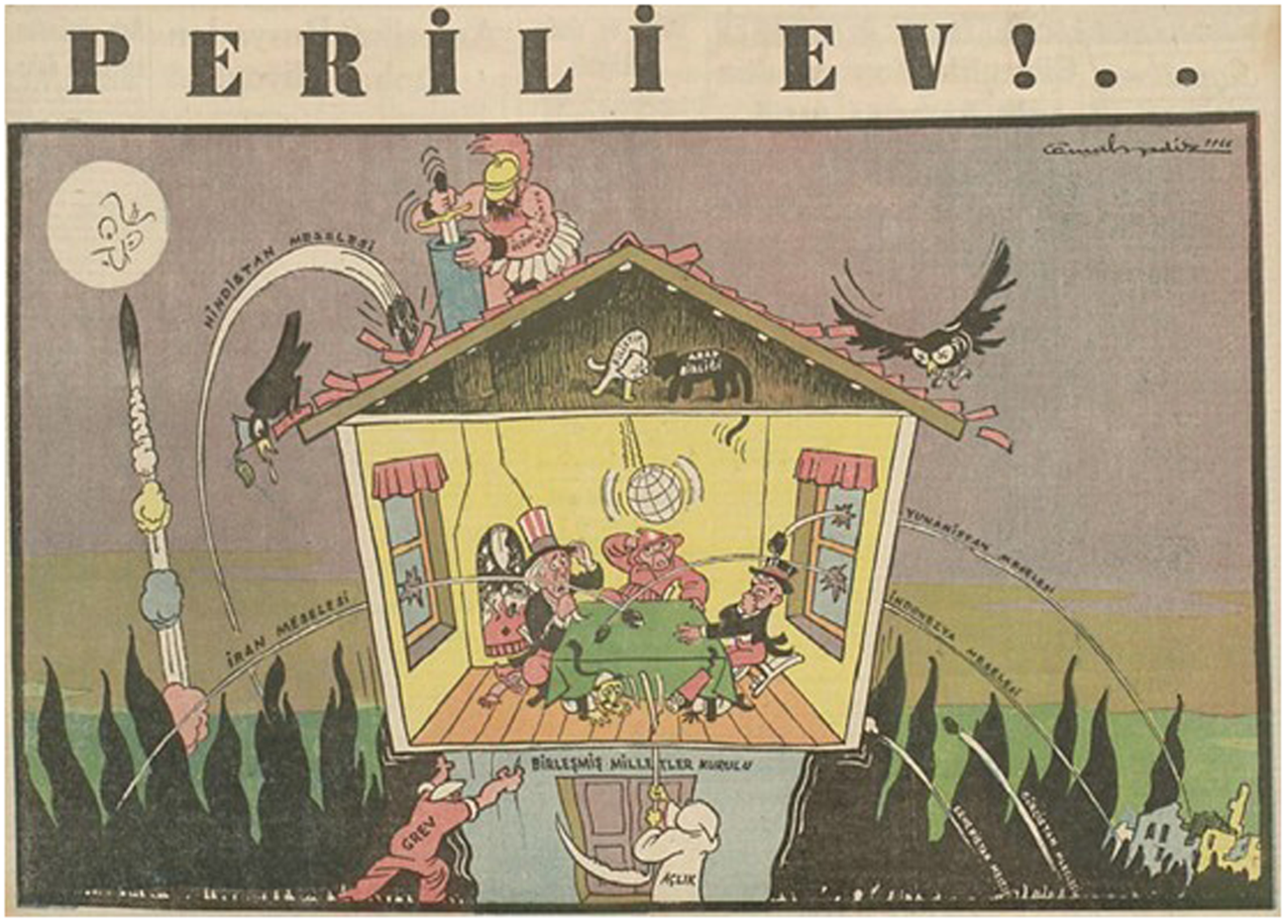
‘The Haunted House’. Source: Cumhuriyet, 31 January 1946.
The emergence of the Cold War in the aftermath of the Second World War and the growing struggle between the United States and the Soviet Union over spheres of influence quickly led to the emergence of a bi-polar world. One of the immediate results of this new power dynamics was the growing global fear of the possible outbreak of a new world war, one in which nuclear weapons would likely be used. This fear was shaped not only by international developments but also by each country's own unique circumstances. While Turkish concerns of a new world war and the possible deployment of nuclear weapons received very limited scholarly attention in later stages of the Cold War, their immediate representation post-Second World War was thus far neglected. 3 This should not come as a surprise, because, according to Rana Mitter and Patrick Major, many studies of the Cold War are geographically biased, focusing on the United States and Europe and neglecting other areas such as the Middle East and the Far East, consigning themes, such as Cold War ‘home fronts’, nuclear fears, and the production and reception of propaganda and intellectual traffic, to other places. 4 Based on contemporary Turkish press, this article attempts to localize the global anxiety about a Third World War and examine the way it was experienced in Turkey in the early days of the Cold War. Given that Turkey did not participate in the Second World War, did similar fear exist in the country? Was the discourse in the local press any different from that of countries that did fight in it? More generally, what can it tell us about the Turkish experience of the early Cold War? To do so, this article examines the public discourse in Turkey regarding the possible outbreak of a Third World War between the end of the Second World War and the beginning of the Korean War on 25 June 1950, which was the first time in which a local conflict in the Cold War turned hot, involving the rest of the world.
This article argues that while the Third World War was omnipresent in the Turkish press during the examined period, at no stage did it become a full-fledged panic or hysteria. Moreover, the discussion in the local press focused mainly on the possibility of an outbreak of a new war and its potential impact on other countries or even the world in general, but very rarely referred to the possible impact of a new world war on Turkey. In addition, while the Turkish press included many translated pieces from the foreign press, these were not adapted for the Turkish readers and thus focused mainly on other countries and their fear of a forthcoming war, giving the impression that on some level this was a European problem. The prospect of a new world war was also represented in Turkish cartoons, which reminded the Turkish public that a new war might start, but their humorous nature also served as a defence mechanism, thus shielding the public and decreasing its concerns. To understand how the possibility of a new world war was expressed in the Turkish press, I begin by showing how the fear of a new war was viewed in other countries such as the United States and Britain. Next, I continue by describing the state's oversight and censorship of the Turkish press in the 1940s. The following section analyses op-eds, cartoons and translated articles published in a wide range of Turkish national contemporary newspapers representing various political and ideological groups within Turkish society, and especially Cumhuriyet, Hürriyet, Akşam, Milliyet and Vakit, as well as the Islamist journal Büyük Doğu, the leftist journal Barış and the humorous magazine Mizah.
The Global Anxiety About a Third World War
When the First World War ended in 1918, many, faced with the enormous number of casualties and the mass destruction of Europe, believed that such an event would never take place again. In contrast, the end of the Second World War was accompanied by immediate fear that another world war would soon follow. As Hannah Arendt had noted in the preface of her prominent Elements and Origins of Totalitarianism: ‘Two world wars in one generation, separated by an uninterrupted chain of local wars and revolutions, followed by no peace treaty for the vanquished and no respite for the victor, have ended in the anticipation of a third World War between the two remaining world powers. This moment of anticipation is like the calm that settles after all hopes have died’. 5 Studies on the immediate period after the Second World War reveal that Arendt was not the only one to feel this way. Joanna Bourke, author of Fear: A Cultural History, argues that the post-war world was consumed with fears and anxieties that had arisen out of the Second World War. According to her, the dropping of the nuclear bombs on Hiroshima and Nagasaki in August 1945 and the publication of John Hersey's immensely popular book Hiroshima (1946) forced readers to recognise that ‘It could happen to us!’ But the real spark of nuclear terror came on 24 September 1949, when it was announced that the Soviet Union had tested an atomic bomb. 6 According to a series of Gallup polls taken in the first decade of the Cold War, most Americans expected to see yet another world war in their lifetimes. In 1947, more than 50% expected such a war within the next 10 years. Similar results arrived in the 1948 survey, when 32% of the Americans believed that the United States would find itself in ‘a big war’ within the next year. 7 However, according to Bourke, most people in the United States responded in an inconsistent manner to this new nuclear threat. For instance, in a survey conducted in the late 1940s, around 60% of Americans answered that they believed that they would be killed in the event of an atomic attack. Nevertheless, as another major survey in 1946 revealed, only a quarter of Americans confessed to being worried about the atomic bomb. The ‘non-worriers’ were not unaware of their parlous state, but they could not see the point in fretting about a threat regarding which they were powerless, nor did they believe it was worthwhile worrying incessantly about a danger that would kill them so quickly anyway. 8
Fear of another world war was not unique to the United States. According to Matthew Grant, ‘the prospect of nuclear destruction was a central, defining part of the British experience in the years following the Second World War’. 9 In his book, After the Bomb, Grant also examines the British civil defence plans for a possible Third World War, which were put in place from the 1940s onwards. 10 However, it seems that not everyone feared a new war. David Holloway, author of Stalin and the Bomb, argues that the Soviet Union assessed the probability of a new world war in the late 1940s as quite low. According to him, in August 1949, Stalin told a member of the Politburo that ‘the Soviet Union is now strong enough not to be frightened by the nuclear blackmail of the United States’ and that ‘a third world war was improbable’. 11
The fear of a new world war was based on and fuelled by a series of crises between the West and the Soviet Union in the post-Second World War era. The first serious crisis in the immediate aftermath of the war revolved around the Soviet reluctance to withdraw from Iran in 1946, which was answered by Churchill's famous ‘Iron Curtain’ speech, but soon others followed. The activity of Communist parties in Europe, in addition to Soviet territorial demands from Turkey (see below) and the Greek civil war (1946–1949), led to the formation of the Truman Doctrine (1947) and the Marshall Plan (1948), aimed at containing Soviet expansionist policies. Global angst increased in 1948 as Czech Communists executed a coup in Czechoslovakia, and the Soviets started their blockade on Berlin (1948–1949). The rather positive atmosphere of the Soviet decision to lift the blockade in 1949 was short-lived, as news about the Soviets’ successful nuclear test on 29 August reached the West, and a few weeks later, in October 1949, the Communist People's Liberation Army, headed by Mao Zedong, won the Chinese civil war. Less than a year later, in June 1950, the Korean War started when the communist forces of the Korean People's Army (North Korea) invaded South Korea, which was officially an American sphere of influence, becoming the first hot conflict of the Cold War. Many of these incidents were viewed at the time as having the potential to cause an escalation which might lead to a new world war.
One should also remember that fear of a nuclear war, or a new world war, was not always a direct result of international developments but was stressed on occasions by governments to promote their agenda. The United States government, for example, used this fear on several occasions to press for funding programs for Europe in Congress in the late 1940s, and Senator Joseph McCarthy instrumentalized it to gain political power in the 1950s. The Soviet Union, on its part, supported international peace movements exploiting people's fear of war for international political gains, discourse that also received much support at home due to the public's reluctance towards a new war. 12 Before delving into the Turkish coverage of a Third World War, the next section explores the state of the Turkish press in the 1940s.
The Turkish Press in the 1940s
While the press in the late Ottoman Empire received considerable scholarly attention (especially during the reign of Abdülhamid II), the Turkish press in the early republican period received less attention. 13 Scholars of the modern Turkish press point out that ever since the establishment of the republic, the Turkish press had been limited by various press laws, restrictions and in some cases martial laws; the Law for the Maintenance of Order (1925), for example, allowed the president to close any form of organization or publication that encouraged ‘reaction’ or ‘rebellion’ or threatened the order and peace of the country. 14 The Press Law of 1931 went even further, listing certain topics that could not be reported on in print, notably anything to do with the sultanate, the caliphate, Communism, or anarchism. Later amendments of the law allowed the cabinet to collect all copies and forbid the distribution of offensive publications produced abroad and in Turkey. Moreover, in exceptional circumstances, the Ministry of the Interior could also order the collection of such publications before the cabinet even reached its decision. In 1938, amendments made it even more difficult for an individual to establish a new publication, and further changes in 1940 addressed punishments for those whose publications might offend ‘national sentiments’ (milli hisleri), threaten the nation's security, or promote incorrect statements about the country's history. 15
In addition, in 1940, the government passed the National Defence Law (Milli Korunma Kanunu), which granted authorities power over the press. While the law did not give the government the right to censor press coverage, it did allow the Press Directorate of the Interior Ministry to use administrative, rather than judicial, means to close newspapers and magazines, and to fine their owners, for printing stories deemed detrimental to the national interest. During the Second World War, prominent newspapers were closed repeatedly; Cumhuriyet was closed 5 times, for a total of 5 months, Tan was closed 7 times, Vatan was closed 9 times, and the other major independent daily newspapers all suffered similar punishment. 16 Even after the war had ended, the government continued to close or ban newspapers and journals for various reasons; the cabinet used the powers invested in it by the Press Law to ban issues of Necip Fazıl Kısakürek's Islamic journal, Büyük Doğu, and temporarily halt its publication on a number of occasions between 1943 and 1950. 17 In addition, the owners and the editors of several newspapers were arrested for printing a speech given by Adnan Menderes, the head of the opposition party, in parliament. 18 But the government did not limit itself to closing newspaper after the publication of controversial articles but also tried to play a part in the production of the press.
According to Gavin D. Brockett, the government concerted efforts to influence the actual production of print media and their content, and deputies themselves controlled many of the most prominent metropolitan newspapers, including prominent figures such as Hakkı Tarık Us (Vakit), Necmettin Sadak (Akşam), Hüseyin Cahit Yalçın (Tanin) and Yunus Nadi (Cumhuriyet). 19 However, after the transition to a multi-party system in 1946, a partial press amnesty was instituted, and the press law was amended to increase freedom of the press in September that year. As a result, major newspapers such as Cumhuriyet and Yeni Sabah started to openly support the Democrat Party (DP; as well as Zafer, established in 1949), while others became more critical of the government. Other newspapers, such as the Republican People's Party's (CHP) official newspaper Ulus, as well as Akşam, Tanin and Vakit, were still viewed as close to the government. 20
However, according to Feroz Ahmad, in light of the Soviet threat, before 1950, both the CHP and DP shared a similar view of international developments and foreign policy, such as their desire to join the Western bloc, and more importantly, the North Atlantic Treaty Organization (NATO). These views were also reflected by both governmental and oppositional newspapers, except for the socialists such as Zekeriya and Sabiha Sertel, publishers of the leftist journal Tan. As a result, no real alternative was expressed by the large dailies regarding foreign policy, and most of the controversies between these newspapers were limited to domestic issues. 21
To conclude, the Turkish press in the 1940s was never really free and was under various mechanisms of state control, either in the form of newspaper ownership by party members, direct censorship that led to issues being collected by the state, or the constant threat of being closed for publishing content forbidden by the state. It is safe to assume that these threats also led to self-censorship in order to avoid the abovementioned repercussions and penalties. However, some newspapers were willing to pay such a price (such as Büyük Doğu), while others used political cartoons or translated articles from the international press to try to represent issues that would have attracted the censorship's eyes otherwise.
The Third World War in the Turkish Press
Towards the end of the Second World War, Turkey, which remained neutral throughout most of the conflict, found itself relatively isolated in the emerging bi-polar world and under growing pressure from the Soviets. 22 In March 1945 the Soviet Union informed Turkey of its decision not to renew the Turkish–Soviet Friendship Treaty of 1925, and a few months later, the Soviets made the signing of a new treaty conditional upon ‘joint’ Turkish–Soviet defence of the Dardanelles and the Bosporus via the establishment of Soviet bases in Istanbul, the annexation of the eastern Turkish provinces of Kars and Ardahan (occupied by Russia in 1878 and repatriated in 1918), and the amendment of the Montreux Convention of 1936 to allow free passage of Soviet warships through the straits and their closure to non-Black Sea states. 23 As a result of this Soviet pressure, and in an attempt to protect its sovereignty, Turkey tried to tie itself to the West, and especially the United States, first by accepting American aid as part of the Truman Doctrine, and later by applying several times for NATO membership until officially being accepted in 1952. 24
After the end of the Second World War, Turks were hopeful about the future. Hüseyin Cahit Yalçın, Tanin's editor and a parliament member from the CHP, expressed that hope by stating: ‘Those who end the war victorious will certainly find a way not to start a new war’. 25 However, hope did not last long. A few weeks later and in light of Soviet territorial demands from Turkey, Tanin published an article titled ‘Turkey faces the danger of a Third World War’. 26 Yalçın rejected the Soviet demands and pointed out that the Third World War might start in the Middle East. However, very little was said about the chances of an outbreak of a new world war and its impact on Turkey. Most of his article was dedicated to criticizing the leftist publishers of Tan Zekeriya and Sabiha Sertel, which was burned down a few months later after the publication of another inflammatory article by Yalçın. A few days later, Necmettin Sadak, a prominent CHP member who later that year was appointed Turkish Foreign Minister, pointed out that the Third World War was unlikely to occur as long as both the big and small nations could come to an agreement. 27
A few months later, in November 1945, the ‘Iranian crisis’, one of the first crises of the Cold War, erupted, sparked by the Soviet Union's refusal to withdraw its forces from occupied Iranian territory, despite repeated assurances.
28
This crisis, which lasted until June 1946, was one of the first instances in which the fear of a new world war emerged and was covered by the Turkish press. Writing on the United Nations in February 1946, Nadir Nadi, Cumhuriyet's editor-in-chief (and DP Member of Parliament between 1950 and 1954), stated that there are those who try to use the fear of a Third World War as a tool to promote the idea of a ‘world state’ organized under the United Nations. According to him, these people claim that: New weapons, especially the atomic bomb, have made war intolerable for humanity and civilization. A third war that will break out on earth will destroy all nations without distinguishing between big, small, strong, and weak, and will cause disasters that will leave no living creature on the fronts and in the cities… One day, you will see that an unexpected country learns this secret and starts making bombs. Then the fate of the world will depend on the mood of those who rule that country.
29
In March 1946, Vakit published an article titled ‘Heading to a Third World War?’ 31 The article's author, Asım Us, explained to the readers the latest developments regarding the ‘Iranian question’ and the fear that it might lead to a new war. While he accused the Soviets of trying to implement their expansionist policy under the pretence of protecting their borders, he stated that causing a new war would be insane and that ‘such madness cannot be expected from any of the men who successfully managed the Second World War’. 32 He thus expressed his hope that the issue would be resolved in the forthcoming meeting of the UN Security Council and called on the participants to draw a plan that will cover all the conflicts between the Anglo-Saxon and the Slavic worlds, because ‘only then will it be understood whether the world will go to war or peace’. 33 However, like others before him, Us neglected to analyse the possible impact such a war might have on Turkey. Moreover, describing it as a conflict between the Anglo-Saxon world and the Soviet Union gave his readers the impression that they would not be affected by it. Interestingly, this article was accompanied by a cartoon that represented ‘War’ as the Roman God of War, Mars, wondering why he is being awakened so early after the last time, referring thus to the short time that has passed since the Second World War. The cartoon also depicted the clouds of ‘atom’, ‘suspicion’ and ‘defiance’, darkening the horizon. 34 The fact that the cartoonist, Orhan Ural, used the awakening character of War to accompany the article somewhat contradicted its optimistic message and suggested that not everyone shared this view.
According to Fatma Müge Göçek, cartoons have the potential to generate change by freeing the imagination, challenging the intellect and resisting state control. Cartoons may also provide a glimpse of the public's thoughts and opinions. 35 One should remember that cartoons not only address the illiterate public, but through their use of humour as a shield, they can also touch on more sensitive topics. Ilan Danjoux argued that cartoons ‘capture the bias, prejudice and suspicion often sanitized from other mass media content’. According to him, cartoons also express popular fears among the public. 36 Such fears were indeed represented in Turkish cartoons at the time. One such example is a cartoon titled ‘Magic Bottle’, published on 5 September 1946 in Cumhuriyet, during the Paris Peace Conference between the victorious wartime Allied powers (which took place from 29 July to 15 October 1946). The cartoon depicted the members of the western camp, represented by the United States, Britain and France, on the one side, and the members of the eastern bloc including the Soviet Union, Bulgaria, Yugoslavia and Romania, sitting near an open ‘magic’ bottle titled ‘Paris conference’ while the genie of a Third World War, depicted as a skeleton, is out, holding the atom bomb in one hand, and a knife between its teeth (see Figure 2). 37 The cartoonist, Güler, thus used this work to represent the fear that a failure of the peace conference might lead to the eruption of a new war.
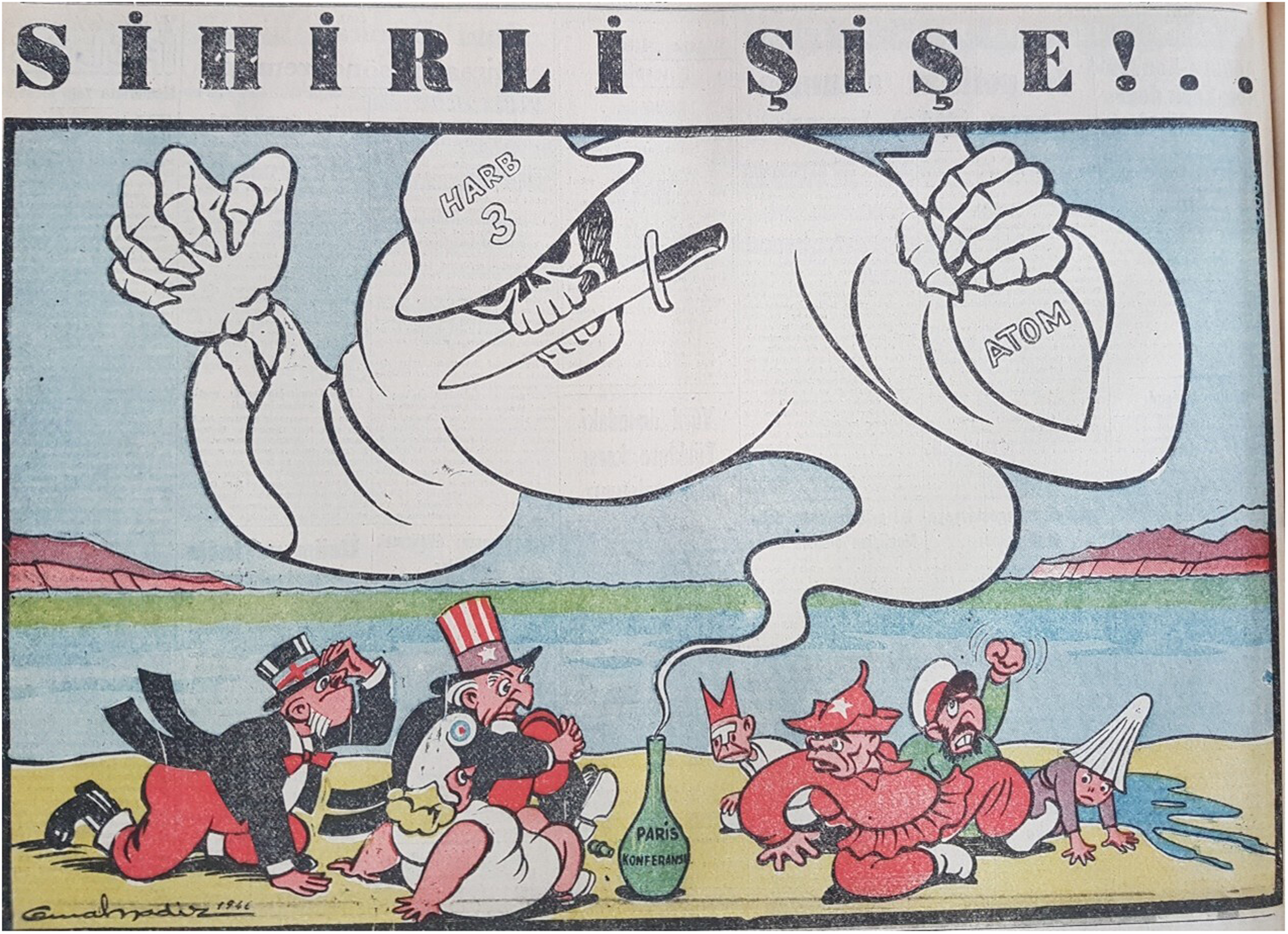
‘Magic Bottle’. Source: Cumhuriyet, 5 September 1946.
The fear of a new world war was also present in the satirical magazine Mizah [Satire], headed by Ramiz Gökçe, a famous political cartoonist of that time. On 27 September 1946, during the Paris Conference, Ramiz depicted Uncle Sam as the mythical character of Noah, standing on board of his ark, named ‘Peaceful Agreement’, while all the animals except for a bear (representing Russia) come on board (see Figure 3). Uncle Sam is depicted calling towards the bear: ‘My friend, it seems that a third flood is coming. If you want to survive, fast, come to our boat!’–but the bear ignores him and goes the other way. 38 The flood mentioned in the cartoon is, of course, a third world war, but the fact that the Soviet bear is turning its back on the ark and refusing to join the other animals is used to cast the blame of a possible war on the Soviets. The cartoon also sends the message that those who follow the United States will survive such a war, should it start, as the animals in Noah's ark survived the flood in the biblical tale. The same issue also dedicated another, less optimistic cartoon to the topic, titled ‘Preparing for a Nuclear Clash’, showing the character of ‘War’, holding the world in one hand and a huge atomic bomb in the other. The caption beneath the cartoon reads, ‘There are a few safe places left, I will try to hit them with this!’ 39

‘Noah's Ark’. Source: Mizah, 27 September 1946.
During the period of its publication (1946–1951), Mizah published many cartoons referring to the possible outbreak of another war. 40 In that period, cartoons regarding a third world war were also published on the national press, in many cases, by the same cartoonists. One such cartoon, published in Cumhuriyet on 27 September 1946, depicted the world as a globe, represented as an ill person, surrounded by former US Vice President Wallace, former British Prime Minister Churchill, former British Foreign Secretary Anthony Eden, and Soviet leader Stalin, dressed as four Mullahs (Muslim religious clerics), trying to exorcise the demon of ‘Doubt’, holding a dagger inscribed with ‘Third World War’ in one hand, and the atomic bomb in the other. The cartoon included a caption of the world addressing its healers: ‘Mullahs, do not waste your breath in vain! The devil above me is not the kind that can be exorcised!’ 41 Unlike the optimistic articles mentioned above, these cartoons expressed the message that war was inevitable, suggesting that a similar mindset to the one described above by Bourke in the United States also existed in Turkey at some level, since if war was inevitable, why worry about it?
Some columnists and editorials focused on what might happen if the Soviets were to discover how to manufacture the atomic bomb. One editorial published in Cumhuriyet on 8 November 1947 argued that: ‘The day the Bolsheviks learn this secret, they will openly threaten the world and immediately start using it. Since this is certain and they are talking about peace as a dry word, thank God, they have not learned the secret of manufacturing the atomic bomb’. 42 A few months later, Hürriyet accused Russia of conducting a duplicitous policy as well, claiming that: ‘Cursing the imperialist states, Russia now appears as the most vivid example of imperialism. The whole world, and especially the United States, is complaining about this, and it goes around word of mouth that a third world war will happen’. However, the editorial was somewhat optimistic about the chances of avoiding a new war, stating that ‘Russia will certainly not want to bear the responsibility of a third world war in the face of history’. 43
In contrast, in a speech in Sivas 10 days later, Turkish Foreign Minister Necmettin Sadak referred to the global situation and the Cold War reality as follows: ‘As the days pass, we see that the path toward peace is blocked, hopes are dwindling, and nations live in constant fear of war. It is said that there will be no war, but no one sees the possibility of reaching peace’. 44 Sadak did not try to sugar-coat matters and explained the ramifications of that fear to the crowd: ‘As this situation of peace without peace and war without war continues, loose nerves are completely broken, the world economy is getting shaken, and the prosperity and peace that nations have been missing for 10 years is getting farther and farther away’. 45 The ‘loose nerves’ Sadak mentioned quickly faced an even greater challenge a month later.
In June 1948, after the three western zones of Berlin were merged into one, the Soviet Union enforced a blockade on the western part of the city, which became ‘a powder keg in the centre of Europe that might ignite a third world war’. 46 Interestingly, not even the Soviet blockade could hamper Hürriyet's optimism, and an editorial published in August 1948, 2 months after the start of the blockade, argued that ‘if there is one thing that is certain, it is that both sides do not want a war. Neither side can afford blood and misery. Both parties want nothing more than to be able to withdraw with their honour intact’. 47 Similarly, in October that year, another editorial argued that Russia would not start a new war because it does not possess atomic bombs, in addition to the fact that its economy cannot support a new war at the moment. 48 However, other newspapers were not as optimistic and viewed a Third World War as a likely possibility. In March 1949, in light of the Turkish disappointment over its exclusion from NATO, Ulus published a column by the prominent publicist Peyami Safa arguing that while Turkey's exclusion deprived it of NATO members’ official support, it left the country with its ‘freedom of action, as in the Second World War, in the event of a Third World War’. Safa also reminded the readers that it was not certain that a Third World War would start on Turkish soil or eventually spread there. 49 Safa's view regarding the ‘freedom of action’ was criticized a few days later in a couple of editorials in Cumhuriyet. According to these editorials, Turkey was only able to remain neutral in the Second World War because its territory was not crucial to the belligerent parties’ war efforts. However, since international circumstances have changed, that was no longer the case: ‘The states that will fight in the Third World War are divided into two groups: democracies and the reds. We are allies and friends of democracies, while the reds are constantly showing their hostility towards us’. Therefore, the article explained, ‘saying that we will remain neutral against our eternal enemy means leaving the community of democratic and civilized nations; it means giving up our alliance and friendships; it means being deprived of America's military and even financial aid; it means… remaining alone against the pressure of Soviet Russia’. 50
After American President Harry S Truman announced on 23 September that the Soviets conducted a successful nuclear test, Turkish newspapers adopted a slightly different discourse. While before the announcement they trusted American military supremacy to prevent a new war, now they stressed that fear of reciprocity would prevent such a war. An editorial published in Hürriyet 2 days later explained that the Soviet bomb does not change the power balance between the two sides and that both will be reluctant to use nuclear weapons for fear of retaliation: In our opinion, Russia's possession of the atomic bomb will not change its current situation, because this weapon is also available on this side, and is in stock. The last war had suggested that a formidable weapon would become unusable if found on both sides. The most vivid example of this is germ warfare. Even when the war was hopeless for them, the Germans did not dare to use their germ-scattering bombs. They knew very well that as soon as these microbes rained down from the air, the Allies would use the same means and cause the same destruction. Therefore, germ warfare remained a bluff and did not even enter the pages of war history.
51
A Third World War in the Foreign Press
During the 1940s, the Turkish press translated many articles from the foreign press regarding the possibility of a new world war, including American, German, French and Swiss magazines such as The New York Times, The American Mercury, Gazette de Lausanne, La Tribune des Nations, Die Weltwoche, Reader's Digest and many others. These included articles depicting a future nuclear and chemical war and its outcome, describing the various weaponry among members of the Western camp and especially the United States, and pieces on possible conflict zones, trying to determine whether they would lead to the outbreak of a new world war.
One such example is an article published in Hürriyet on 10 May 1948, translated from the London-based Near and Far East News Group (NAFEN) which argued that according to the British physicist Professor Sir Nevill Francis Mott (who later won the Nobel Prize for Physics), ‘the complete destruction of cities in the first days of the Future War is nothing but a nightmare. Atomic bombs can be manufactured very slowly and very expensively. No country can produce a few thousand of these a year’. 52 A few days later, another article titled ‘Why There is Not Going to Be a War’ was published in Hürriyet. According to the article, translated from the Swedish newspaper Stockholm Tideningen, a new war was unlikely to start because of the Soviet fear of the atomic bomb and the fact that it takes several years to prepare for war. 53
Fear of a new world war also creeped into the family-oriented weekly magazine Hafta [Week] after the Soviets achieved the atom bomb. An article titled ‘The Third World War Cannot be Won with Atomic Weapons’, published on 21 October 1949, referred to the inevitability of a new war by sharing with its readers some of the main insights of a book by British Nobel prize laureate for physics, Professor Patrick Maynard Stuart Blackett, Fear, War, and the Bomb: The Military and Political Consequences of Atomic Energy, published in 1948 in England. 54 According to the article, and as we have already seen in the Turkish press, Blackett's main point was that while nuclear and biological weapons are effective, fear of retaliation makes them ‘essentially ineffective’. 55 However, the magazine neglected to mention the fact that Blackett was one of the most vocal demonstrators against nuclear weapons in Britain at the time. Hafta was not the only one to give voice to Blackett's views. A similar article titled ‘Nuclear War’ was also published by the leftist magazine Barış [Peace] in April 1950. 56
Since these articles were just translations without any adaptation and without an examination of the possible effects of such a war on Turkey, they may have reproduced the foreign discourse about a third world war and given the impression that it was not a Turkish concern. One of the best examples of this was an illustration of the possible destruction radius of a nuclear bomb dropped on the city of New York, published in Cumhuriyet on 26 April 1949. This illustration included famous locations such as the Empire State Building and the Rockefeller Center to demonstrate the damage radius of such bomb (see Figure 4). The caption beneath the illustration stated that according to Dr Ralph Eugene Lapp, ‘a well-known atomic scientist and advisor to the War Department and the National Military Bureau’, an atomic bomb exploding in the air would be able to devastate cities in North America. According to the text, the illustration was supposed to show ‘how the deadly gamma rays emitted by an atomic bomb exploding on 42nd Street and Fifth Avenue in New York would filter through the tall buildings into the city’. 57
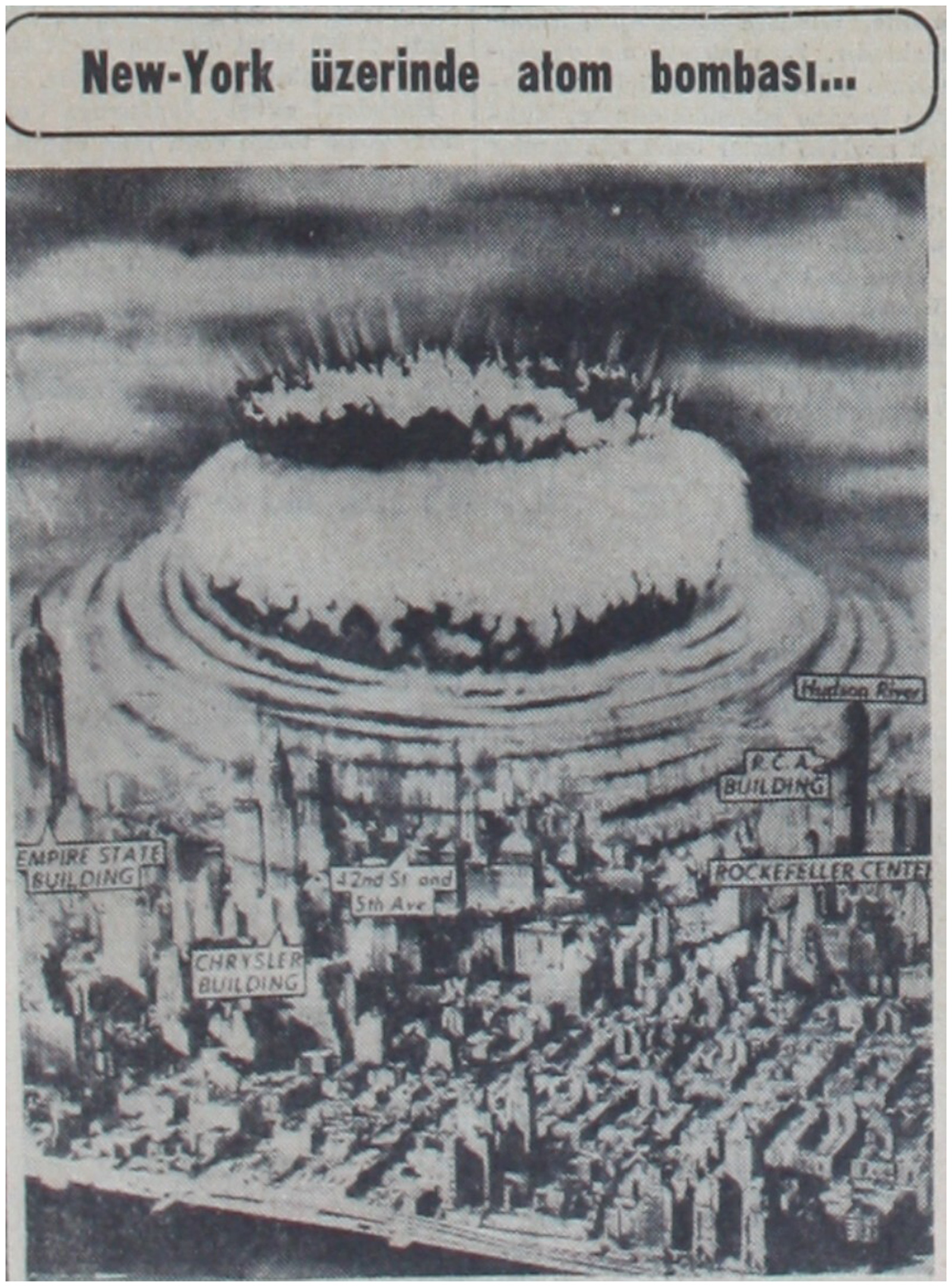
‘A Nuclear Bomb on New York …’. Source: Cumhuriyet, 26 April 1949.
However, since most Turks had never been to the United States, this illustration was meaningless for them. One might assume that if the article's aim were to inform the Turkish public there would have been a genuine attempt to translate it into terms the public would have understood, for example, by including a similar illustration of Istanbul, but that of course might have caused panic and shattered the belief that the war would not impact Turkey–and potentially incur the censorship's wrath. The same tactic was also used by the provincial press. Antakya's Atayolu, for example, reported in November 1947 that three atom bombs would be enough to destroy a city the size of London. But then again, what did that mean to the simple Turkish citizen? 58
As we have seen above, most articles in the Turkish press analysed the prospect of a new world war rationally, ignoring its emotional dimension, that is to say, how people might have or should have felt because of what was described by some as an inevitable war. One of the few attempts to place Turkey within the discussion on a third world war and express such fear in an emotional way was made by the Islamic journal Büyük Doğu [The Great East], edited by the famous Necip Fazıl Kısakürek (1904–1983), an Islamist ideologue, poet, novelist and playwright. 59
Büyük Doğu's Third World War
During the late 1940s, Büyük Doğu published several original articles on the topic of a Third World War, the first of which was published in March 1948 by one of the journal's authors, known as Professor H. H. According to him, the only way in which a third world war could be averted would be if a revolution were to occur in the Soviet Union. However, he was not very hopeful that this would happen from within, because according to him, the Communist regime expunges the next generation of personal and social emotions. Therefore, he claimed that such a revolution would not occur unless planned and organized from the outside. In that case, ‘if a revolution does not happen in Soviet Russia, a third world war is unavoidable’. He called upon the readers to prepare for such a war spiritually and materially (ruhla ve maddede hazir olmasi). 60
A few months later, in August 1948, and shortly after the Berlin blockade had begun, Necip Fazıl Kısakürek published another article under the same title, this time using his pseudonym, Detective X Bir. Kısakürek opened his article by informing the readers that ‘while we were sleeping, the Third World War is about to begin!’ While he acknowledged that it might take a few years for it to come to pass, he was pessimistic about the chances of avoiding such a war altogether. Contrary to those who counted on American nuclear weapons to prevent such a war, Kısakürek informed his readers that Russia possesses the scientific and practical knowledge for manufacturing an atomic bomb (which was proven right a year later). He also warned that every area that is touched by Communism is soon lost. But according to Kısakürek, not everything was dire, as if all the democracies join forces, it is possible to ‘choke the monster of Communism in its den’. Otherwise, he warned, Communist forces might arrive suddenly. To mobilize the journal's readers, Kısakürek stressed that Communism was in an open war against all religions and that Russia was waging ‘a cruel war against Islam’ in the Caucasus. While these were all international circumstances which individual citizens could not influence, Fazıl also had practical advice on the local level. He thus warned the public to make sure that no supporter of Communism be appointed as a Turkish minister. 61 While not all authors mentioned this point, it seems that the in-depth coverage of this topic in the journal was due especially to the ideological confrontation between Communism and religion in general, as suggested by Kısakürek's article.
A year later, on 14 October 1949, Numan A. Binatlı discussed the revelation made a few weeks earlier by US President Truman, about the successful Russian nuclear test. 62 According to Binatlı, Truman's announcement raises a few questions: Could the Russians really manufacture an atomic bomb? What is the quality of the Soviet bomb in comparison to American nuclear weapons? How does this situation affect the probability of a third world war? How would these new circumstances affect the buffer countries between the two rival blocs? 63 Binatlı then tried to downplay the importance of the Soviet achievement, stating that the theory and knowledge of the atom were never kept fully secret. According to him, the question is whether it can be produced systematically or not, and he estimated that the Soviets would run into difficulties trying to achieve that. He added that the United States used this occasion to increase the world's fear of Soviet Russia and the impending Third World War; but at the same time, he had a soothing message to his readers, stating that ‘there is no doubt that the American atom [bomb] will explode in Russia before the atomic fear represented by the Russians grows and become serious’. 64 However, a month and a half later, Binatlı was not as calm and self-assured about the prospect of a new world war. According to him, ‘the Soviet Union will annex Poland, Romania and Bulgaria as soon as possible, and that is a definitive proof that the curtain is about to rise on the Third World War. We are certain that the episode of the story of the Third World War, of which we heard so much, is about to begin’. 65 Binatlı, like many before him in the national press, chose to ignore how this new war might impact Turkey. Shortly after, the world entered one of the most pivotal moments of the Cold War, with the outbreak of the Korean War.
Conclusion
While at no stage did the Turkish press transmit major concerns about the possible outbreak of a new world war, the representation of such a war underwent a transformation during the examined period. Immediately after the Second World War and with the establishment of the United Nations, Turkish newspapers were hopeful and referred to a new world war as something that could be prevented. However, after the Soviet demands of Turkey and the rising global tensions, this hope quickly dissipated and was replaced by more nuanced and analytical opinions. While most authors stated that there is a possibility of a new world war, they were optimistic that such a war would not start and sent a soothing message to their readers. Some also stated that even if a new war were to start, the United States would be victorious due to its nuclear weapons. That remained the most common analysis even after the Soviet Union was in possession of the atomic bomb, explaining either that no side would be willing to use it fearing retaliation, or that the Americans possess more bombs than the Soviets. Interestingly, the Turkish press very rarely referred to the possible impact of a new world war on Turkey should it start, thus giving the false impression that such a war would not affect Turkey. Whether this approach reflected the authors’ honest hopes and beliefs or was a form of denial is impossible to determine. Another option is that authors, fearing censorship or a ban, were extremely careful not to incite panic that might lead to their newspaper's closure. Translated articles from the foreign press also played an important role in shaping Turkish public opinion regarding the possible war. Most of the analytical articles that were translated and printed by the Turkish press supported the opinion that a new war would not break out. Cartoons also changed during this period, and especially the character of ‘War’. While in 1946, ‘War’ appeared as a frightening character, depicted as a monster or even as the Grim Reaper, thus representing an immediate and imminent threat, as time passed, it underwent a certain personification process. The character still symbolized the possible war, but it was depicted in a less frightening way and was put in somewhat comical situations. One such example is a cartoon published in Hürriyet on 3 September 1949, depicting ‘War’ celebrating ‘Peace Day’ by holding hands with Stalin, or another cartoon published roughly a month later in which he is depicted standing shivering in the freezing Russian winter as part of the ‘cold’ war. 66 This might suggest that while the possibility of a third world war, which seemed an actual danger immediately after the Second World War, became less probable as time passed, and Turks felt more and more secure, especially after their acceptance to NATO in 1952.
This raises the question, why did the Turks not fear the war, as did their western allies such as Britain, France or the United States? The most probable explanation is that while Turks were concerned as much as everyone else at the prospect of a new war, the fact that they did not participate in the Second World War shielded them to an extent from the horrors of modern warfare, unlike their NATO allies such as Britain or France. Another possibility is that Turks saw the Soviet Union as the successor of the Russian Empire, against which the Ottoman Empire had fought throughout the 19th century. 67 For the Turks, this was just the latest round in a cycle of Russian expansionist policies. In an article analysing the possibility of a new world war, Abidin Daver of Cumhuriyet depicted the Soviet Union as ‘Soviet Russia, inheriting all the territorial ambitions of Tsarist Russia, also pursues an aim to spread the Bolshevik ideology to the world and to be the patron of Communism everywhere’. 68 Similarly, the religious-nationalist journal Serdengeçti [Martyr] reminded its readers of the old rivalry with Russia, stating that ‘the Russians are our oldest and toughest enemies’, and pointed out that since Ottoman times every policy against the Russians is in Turkey's interests, because ‘Russia may be Czarist, may be socialist, may be Bolshevik, but it always remains Russia. Its politics never change’. 69 Therefore, fighting the Russians again did not seem so frightening for them as for other countries. Reading the Turkish press during the late 1940s also suggests that the great threat of a third world war was somewhat compartmentalized to many small crises. Very often, one would see articles dealing with ‘the Berlin question’, ‘the Greek question’, ‘the Iran question’ and so on. Although each of these had the potential to develop into a new war, this framing might have sent the message that these were local problems that could be solved more easily.
Footnotes
Declaration of Conflicting Interest
The author declared no potential conflicts of interest with respect to the research, authorship, and/or publication of this article.
Funding
The author received no financial support for the research, authorship, and/or publication of this article.
