







Abstract
Background:
Since 2006, the Korean Ministry of Education, Science and Technology, and the National Research Foundation of Korea have taken the lead in developing an institutional guideline for research ethics.
Objectives:
The purpose was to identify the effectiveness of the Good Research Practice program, developed on a fund granted by the National Research Foundation of Korea, for nurses and nursing students whose knowledge and perception of research ethics were compared before and after the implementation of the Good Research Practice program.
Research design:
This study was conducted to compare the levels of knowledge and perception of research ethics in the participants before and after the program was implemented.
Participant and research context:
The participants included 45 nurses and 69 nursing students from hospitals, colleges of nursing, and the Korean Nurses Association, located in Seoul, Korea.
Ethical considerations:
This study was approved by the Institutional Research Board in Korea.
Findings:
Based on the Analysis, Design, Development, Implementation, and Evaluation model, the Good Research Practice program was made up of a total of 30 h of the blended learning both online and off-line. The results of this study showed that there were statistically significant differences in both knowledge and perception of research ethics in nursing students and nurses before and after the program had been implemented.
Discussion:
The concepts of professional nursing ethics, moral issues, and bioethics were often confused with one another and not clearly defined. Therefore, the concept and scope of bioethics, moral judgment, and overall nursing ethics should be well defined and conceptualized in the future.
Conclusions:
This study suggested integrating research ethics education in the nursing curriculum as a required course of study for nursing students and as part of the in-service training program for nurses in order to improve research ethics in nursing research in Korea.
Keywords
Introduction
The guideline for research ethics published by the Ministry of Science and Technology of Korea defined research ethics as a set of fundamental moral principles and rules applying to any researchers to follow with a responsibility when doing research. 1 Ethical merit embraces respect for the dignity of research participants, in terms of their integrity, privacy, safety, and human rights. Researchers must obtain the informed consent of all the participants in the research, and the strategies for minimizing risks are required to balance risks against benefits, to make appropriate recompense for time, to provide compensation for any injuries which may occur during the research, to protect confidentiality, and to avoid conflicts of interest. 2,3
In response to satisfy the need of a recent change in research ethics, the Korean Society of Nursing Science played a critical role in providing nursing educators with educational opportunities to establish the ethicality of nursing research. However, it has been reported that the efforts to secure nursing research ethics were not as active as other biomedical fields. A study done with 240 master and doctoral students at seven nursing colleges in Korea showed a very low rate of receiving the research ethics education. 4 It also showed that the course of research ethics was mainly implemented in the form of seminars, suggesting the need of developing more standardized programs for research ethics with more formal methods of learning. Recently, although clinical nursing research has been actively carried out in Korea with the concept of evidence-based practice in clinical nursing, educational efforts focused on the responsible conduct of research have not been made to keep the same pace with the activation of research studies in nursing, only to be made sporadically by some university hospitals that organized the Institutional Review Board (IRB), or focused only on the Universal Declaration on Bioethics and Human Rights, and some other considerations of professional ethics education. 5 Although the scope of research ethics may differ from discipline to discipline, it generally includes the protection and welfare of human participants, conflicts of interest, data management practice, mentor and trainee responsibilities, collaborative research, authorship and publication, and peer review. 6 On top of everything, it is important for the recipients of research ethics education to have easy access to the various educational programs for research ethics in order to make ethical preparation for doing research. One of the advantages of web-based learning is that learners will be able to access the online programs any time and at any place. Especially, for nurses with irregular work schedules, time saved by not commuting to and from class or cruising parking lots may be used on studies. 7 In addition, the web-based learning will allow a number of learners to take part in conversing so as to reinforce the class participation. According to a study with nurses on web-based learning in ethics education, there was an increase in accurate knowledge of ethics through learning by repetition, which, in turn, changed their perception to influence critical thinking and decision making. 8
Therefore, there is an urgency to provide nurses with education for responsible conduct of research, which can be applied to empirical studies on evidence-based practice in clinical settings. 9,10 However, considering the complexity of clinical nursing settings and the working condition of nurses with three shifts, it is very difficult to organize an accessible and diverse program for research ethics, which fits in with the working condition of nurses. Furthermore, if research ethics education is planned to offer via collective training or to a cluster of learners, the accessibility of the program to the prospective recipients will decline significantly. On the other hand, if research ethics education is provided online, the online program can serve as an effective way of learning due to constant and repeated use, taking no notice of time and space. It is highly predictable that the educational needs for research ethics will increase rapidly in numbers since clinical case studies, evidence-based clinical studies, and research on nursing education have proliferated. Therefore, it would be high time to develop, implement, and evaluate nursing research ethics education to which nurses and nursing students have access. Therefore, awarded a research grant by the National Research Foundation of Korea, this study was conducted to develop and implement a systematic educational program for Good Research Practice (GRP) appropriate for and highly accessible to nurses and nursing students so as to use it without any restraints from time and space. In addition, this study was conducted to compare the levels of the participants’ knowledge and perception of the GRP program before and after the education was given, for the purpose of evaluating the effectiveness of the GRP program.
Methods
Design of the study
This study was conducted to develop an educational program for GRP for both nurses and nursing students and to compare the levels of knowledge and perception of research ethics in the participants before and after the program was implemented.
Participants
The participants in this study were collected from three sources, including hospitals, colleges of nursing, and Korean Nurses Association, located in Seoul, Korea. As many as 55 nurses and 125 nursing students agreed to participate in the GRP program. Among nursing students, freshmen and sophomores who had not had clinical training in a clinical setting were excluded from the study, only to include junior and senior students who had had clinical training experience. Among those 180 participants, 45 nurses and 69 nursing students, 114 in total, were included in the final analysis for both pre- and post-tests. The data were collected twice in December 2009, before the GRP program was initiated, and March 2010, after the GRP program was completed.
Ethical considerations
Although the procedure of this study did not contain any danger to the participants, considerations were taken to protect the human rights of the participants. Specifically, with the principle of voluntary participation, the purpose, content, and methodology of the study were clearly explained to the participants, and the consent form was distributed to and collected from each of the participants with the researcher’s identity revealed on it. Only those who enlisted to participate were included in the study. In addition, the data were not used for any purpose other than this research. Participants were completely informed that they could withdraw at any time if they wished to do so, and that the research was being carried out anonymously to avoid dissemination of personal information. This study was approved by the Institutional Research Board of Red Cross College of Nursing in Korea (09-08).
Measurement
This study was conducted to measure the knowledge and perception of research ethics in nurses and nursing students in order to identify the effectiveness of the GRP program. Through an advisory group of two medical faculty members and two nursing professors who were in charge of medical ethics and nursing ethics, a self-reported questionnaire of 24 items on a 5-point Likert-type scale was developed to assess the knowledge and perception about research ethics. Twenty-four items consisted of bioethics, research ethics, IRB, research misconduct, publishing ethics and copyright, collaborative research, and conflicts of interest in nursing. To assess the levels of knowledge and perception of the subcategories of research ethics, the participants were asked to respond on a 5-point Likert-type scale, with 1 being the lowest level and 5 the highest level, indicating the higher the score, the better the knowledge and perception. Cronbach’s α for the reliability of the study instrument for the nurses was .895, whereas Cronbach’s α for the nursing students was .861.
Procedure of developing GRP program
The GRP educational program was developed based on the Analysis, Design, Development, Implementation, and Evaluation (ADDIE) model, which has been known as a general model for instructional systems design.
11
The stages of the program development were as follows:
Analysis stage. Analysis stage was a stage that defined what to teach, which included the score concepts and contents for research ethics drawn not only from the existing literature and educational programs in other countries but also from the Center for Research Ethics Information of the National Research Foundation of Korea. By analyzing and evaluating those programs, the core concepts and contents were revised to fit the Korean situation.
Design stage. Design stage included a process that specifies what to teach. The initial core concepts for the GRP educational program included research ethics, research misconduct, intellectual property rights for research papers and publication, data management system, cooperative research, responsibility of researcher, and bioethics.
12
Upon composition of the program contents, the expert group was founded to measure the content validity, consisting of two experts on research ethics, two hospital nursing managers, and two nursing faculty members. The content validity of each item was measured on a 5-point Likert-type scale, with 1 being the least appropriate and 5 the most appropriate. Based on the result of the content validity, some of the detailed topics were modified and revised to come up with the final version of the GRP program, which included the following six topics of bioethics, research ethics, research misconduct, IRB, publication ethics and copyright, and collaborative research and conflicts of interest. Subcategories of each topic included the historical background of research ethics and bioethics, the overview of ethical theories, bioethics law, social issues on bioethics, definition and importance of research ethics, definition and functions of IRB, IRB for research with human subjects, research misconduct, data management, research notes, prevention of plagiarism, intellectual property rights, ethics of publication process, ethics on collaborative research and conflicts of interest, and relationships with advisors.
Development stage. At the development stage, teaching materials were developed to be used in the program, based on the design specifications that were determined at the design stage. The GRP program was made up of a 2-h credit course for 30 h in total. In order to provide easy access to the participants, the GRP program contained the blended e-learning program in both online and off-line learning packages, each of which has a 15-h program. Web contents for the online program were produced based on the curriculum composition. One medical faculty member and two nursing professors were engaged in teaching as experts on bioethics and research ethics. The web contents consisted of 6 topics and 18 subtopics, which were instructed in a one-credit-hour course for 15 h in total (Table 1). The evaluation of the academic achievement of the participants who took the online course was done by the accumulated learning hours recorded on the distance learning system, and the warning alarm was set up to be sent to the participants via short message service (SMS) if they did not complete the requirements for the online instruction.
Implementation stage. Implementation stage is a stage that employed the educational program, developed at the development stage, to learners. The GRP program proceeded with a 15-h-online instruction with web-based learning materials as well as a 15-h-off-line instruction. The primary function of the web-based online educational program was to elicit participants’ self-directed learning ability and iterative learning so as to increase the effectiveness of research ethics education. The satisfaction level with the online program was evaluated during the off-line program, through quiz taking and discussion sessions. The 15-h-off-line instruction comprised a 3-h review of the core contents given on the online program, 9-h case analysis and small group discussion, and 3 h of miscellaneous activities such as orientation to the program, completion ceremony at the end of the program, and evaluation of the program. In the 3-h small group discussion, which was divided into three sessions, the clinical cases of conflict in research ethics that the participants had experienced in clinical settings were discussed and analyzed based on what they had learned from the online program.
Evaluation stage. The effectiveness of the program was evaluated by the pre-test before the GRP program and the post-test after the GRP program. The pre-test was conducted with a structured questionnaire in December 2009, in order to identify the levels of their knowledge and perception of research ethics. The result of the pre-test was used as the baseline data to compare with that of the post-test to identify the effectiveness of the program. The post-test was conducted in March 2010, when the GRP program was completed, and the result of the post-test was compared with that of the pre-test.
Composition of nursing research ethics curriculum.
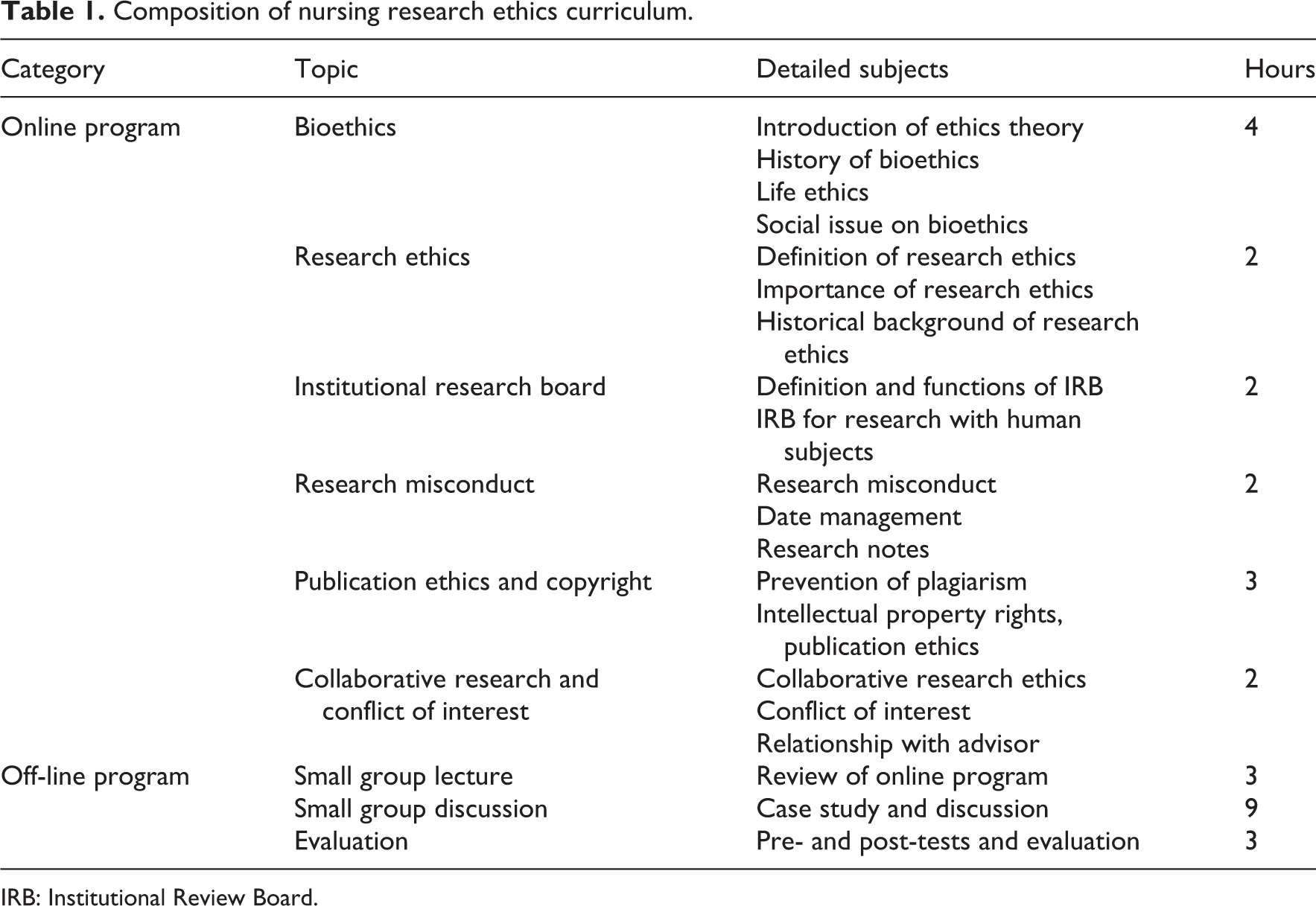
IRB: Institutional Review Board.
Data analysis
Using SPSS version 20.0 program for Windows (Chicago, IL), demographic data of the participants were analyzed to create frequency and percentage, while knowledge and perception of research ethics in the participants were represented in means and standard deviations (SDs). To compare the differences in knowledge and perception between the pre-test and the post-test, a paired t-test was calculated, and the differences in knowledge and perception between nurses and nursing students were analyzed by analysis of covariance (ANCOVA). In addition, the Duncan test was used for the post hoc test. Significance level was set at p < 0.05.
Results
Demographic characteristics
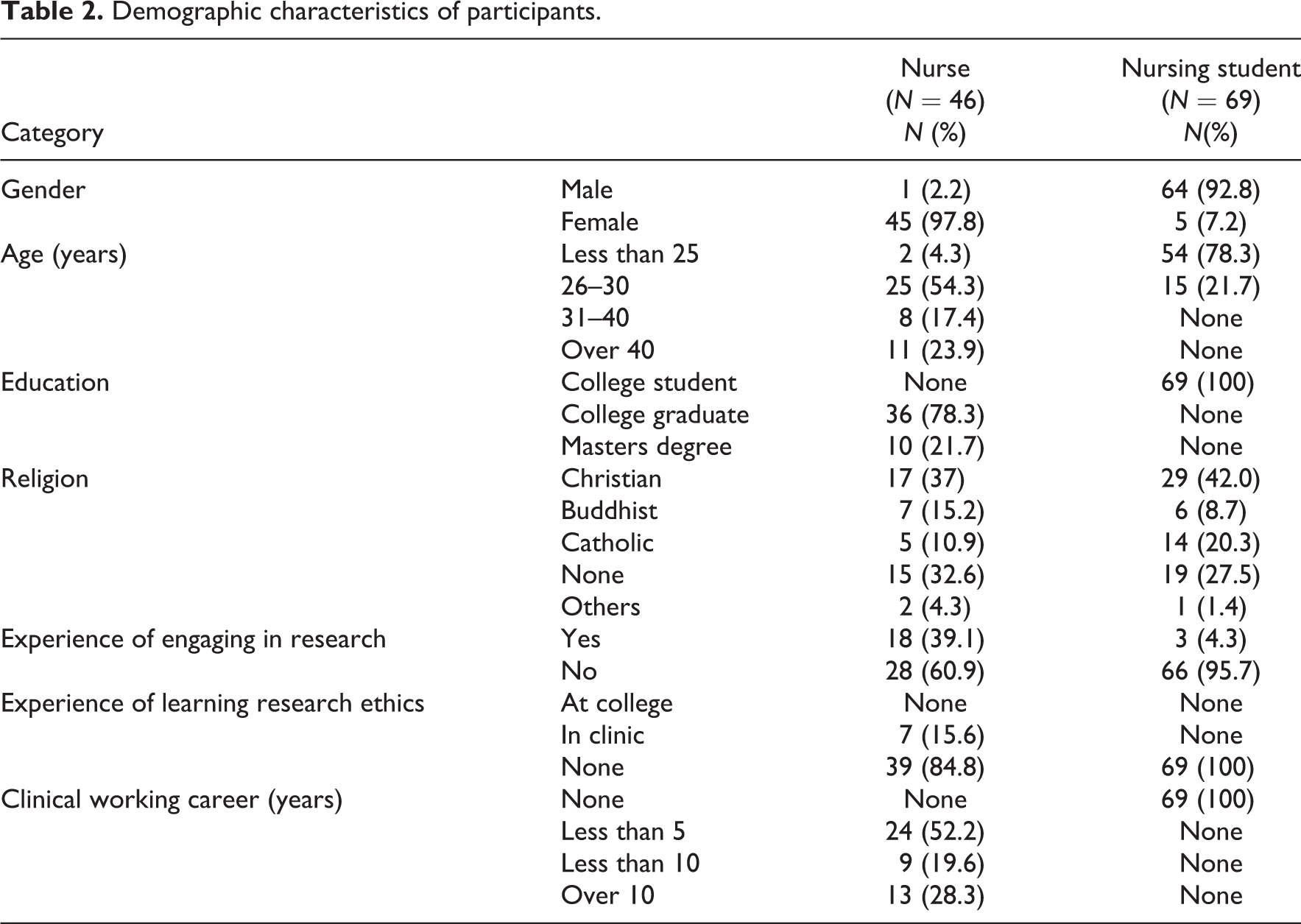
Among 114 participants, there were 108 female and 6 male participants. The average age of nursing students was 23.4 years (SD = 1.94 years), and the average age of nurses was 31.6 years (SD = 1.94 years). The average length of the nurses’ clinical working career was 9 years and 1 month (SD = 1.3 years). As much as 39.1% of the nurses appeared to have experiences of participating in nursing research, whereas only 6.7% of nursing students did (Table 2).
Demographic characteristics of participants.
Knowledge about research ethics
On a scale of 1–5, nurses’ average score of knowledge on research ethics was 3.24 (SD = 0.67) and nursing students 2.67 (SD = 0.50) before the implementation of the GRP program, whereas the nurses scored 3.96 (SD = 0.83) and the nursing students 3.86 (SD = 0.60) after the program, which showed the statistically significant differences in knowledge between the nurses and the nursing students before and after the program (Table 3). For the subtopics of research ethics, before the program was implemented, both the nurses (2.64) and the nursing students (1.96) showed the lowest scores on bioethics but showed the biggest change in scores after the program (nurses, 1.36 and nursing students, 2.12). The result of the comparison between the nurses and the nursing students in terms of knowledge on research ethics showed significant differences in bioethics (F = 11.13, p = .001), research ethics (F = 11.44, p = .001), IRB (F = 28.30, p = .000), research misconduct (F = 18.66, p = .000), and publication ethics and copyright (F = 8.79, p = .004) before the program, whereas bioethics (F = 90.02, p = .000) after the program, respectively.
Knowledge level of participant’s research ethics.
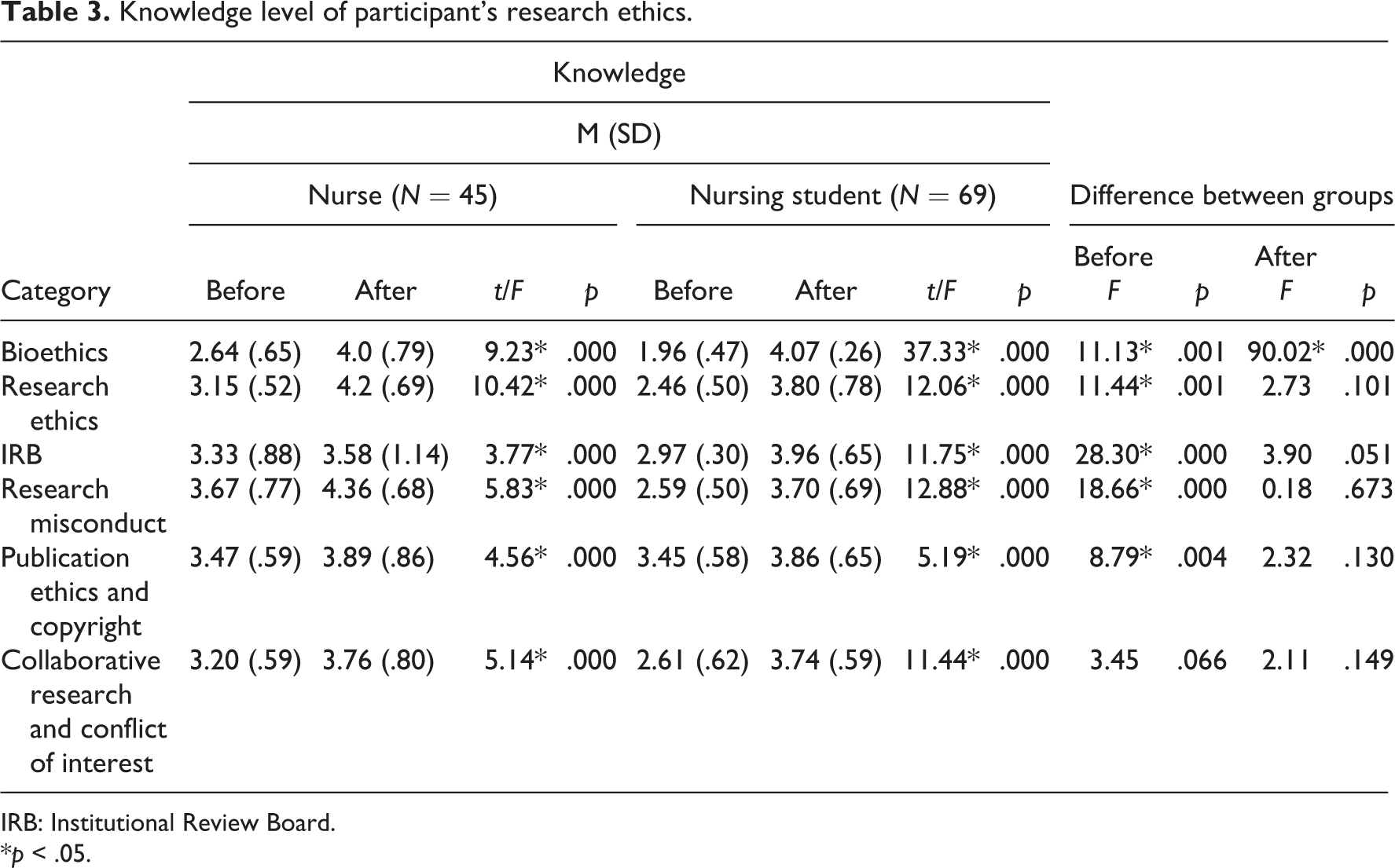
IRB: Institutional Review Board.
*p < .05.
Perception of research ethics
On a scale of 1–5, nurses’ perception of research ethics was 3.17 (SD = 0.68), and nursing students 2.71 (SD = 0.53), on the average, before the program was implemented, whereas the nurses averaged 3.30 (SD = 0.78) and the nursing students 3.94 (SD = 0.62) after the program was completed, which showed significant differences in perception of research ethics between the two groups before and after the program (Table 4). There were significant differences between the two groups in the perception of IRB (F = 7.91, p = .006) and publication ethics and copyright (F = 12.30, p = .001) before the program, whereas bioethics (F = 9.77, p = .002) and IRB (F = 8.05, p = .004) after the program.
Perception level of participant’s research ethics.
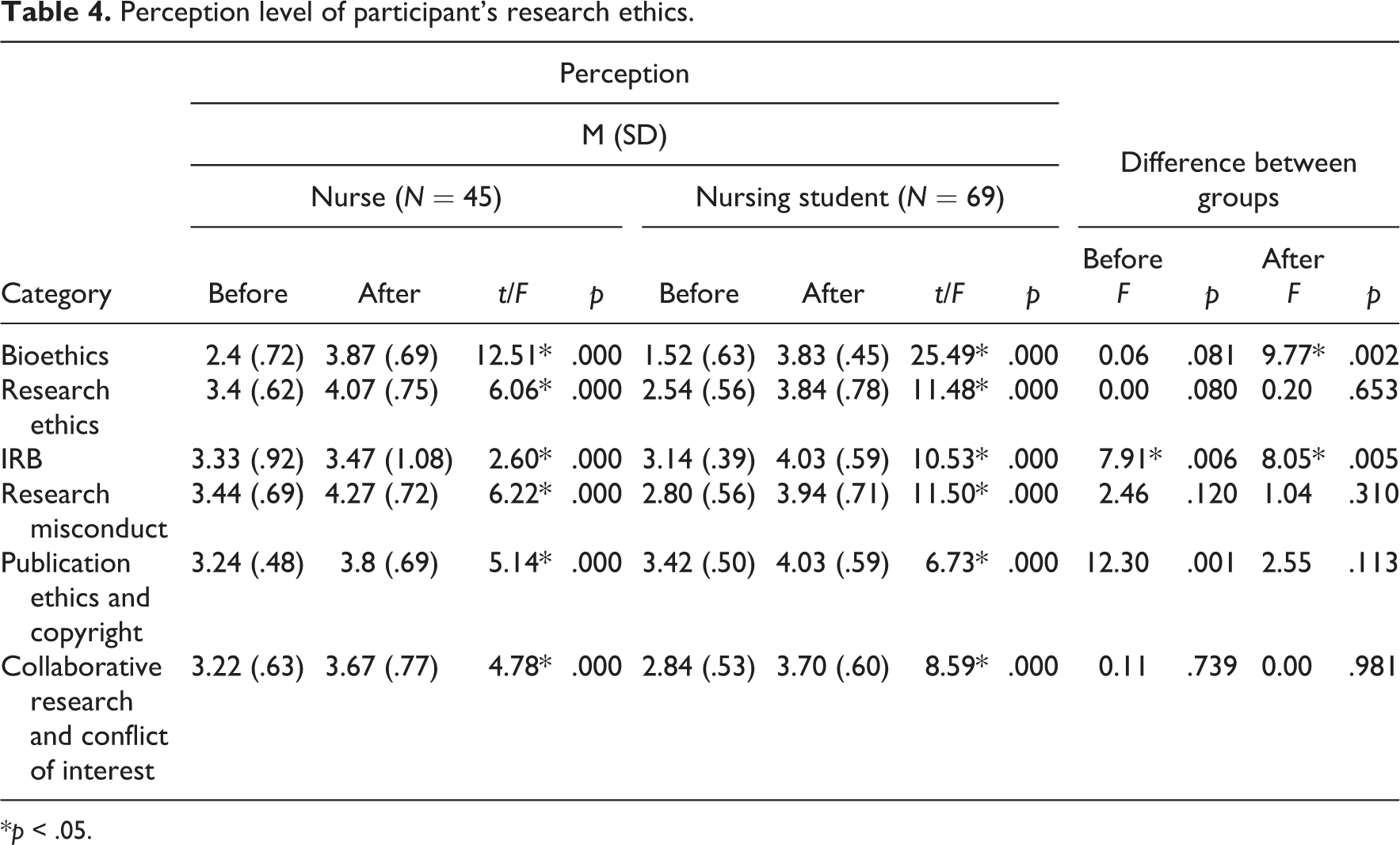
*p < .05.
Knowledge and perception of research ethics with experience of research and clinical career
Table 5 showed the relationships of knowledge and perception of research ethics with the participants’ experience of engaging in research efforts and clinical career. Those who had had experience of participating in research studies were more likely to have high scores on research ethics, IRB, research misconduct, publishing ethics and copyright, and collaborative research and conflicts of interest than those who had not, which was statistically significant (p > .05). Furthermore, there were significant differences both in knowledge and perception of research ethics according to the clinical working career of the nurses.
Participants’ knowledge and perception of research ethics by demographic characteristics.

*p < .05. a, b, c, d: Post hoc test.
Discussion
This study was conducted to develop and implement a GRP program, which both nurses and nursing students had an easy access to. It was also to compare the levels they had experienced in real clinical settings. Therefore, among other findings in this study, the following two considerations were particularly worthy of further discussion. First, the participants of this study appeared to show significant increase in both knowledge and perception of research ethics after they had participated in the GRP educational program. The concept of bioethics has a twofold meaning: One is related to life ethics as part of interdisciplinary research areas, and the other is professional ethics which is a set of behavioral standards and rules adopted by a professional community. On the contrary, research ethics are referred to as the researcher’s ethical principles or behavioral patterns that should be followed throughout the entire process of research when the researcher carries out any research. 2,3 Generally, the effectiveness of bioethics education has been evaluated with the learners’ Defining Issues Test, and it has been reported that bioethics education for Korean nurses, medical students, and nursing students was not statistically effective. 13,14
Especially, the existing research studies have shown that Korean nurses and nursing students did not cope adequately with the ethical problems, indicating that there were not many Korean universities that have set up research ethics education as an independent course of study in the nursing curriculum, and that the research ethics courses were taught by instructors or professors who had not majored in ethics. 15 Furthermore, research ethics education for Korean nurses and nursing students was not organized as a required course of study in the university curriculum. According to a study on the research ethics education with 161 nursing faculty members, 31.7% of the participants taught research ethics, but the average length of instruction for research ethics was only 2 h, indicating that the research ethics education was not sufficiently given. 16 By and large, there was little or no existing research work to measure the effectiveness of research ethics education so that the implications of this study could not be compared with existing study findings. Nevertheless, the results of this current study and its implications for the effectiveness of research ethics education were of significance as the great emphasis has been placed in competitiveness of nursing research since 2005, not to mention the importance of integrating research ethics education into the university curriculum. A study on needs assessment of research ethics among Korean nursing researchers reported that 99.4% of nursing faculty and 100% of nursing students perceived the need for nursing research ethics education and ethical conducts for research, which was consistent with the findings of this study in establishing constructive ethical paradigm for research within universities. 16
The result of measuring the levels of knowledge and perception of subcategories of research ethics before and after the GRP program showed that both nurses and nursing students scored lower than the average on bioethics before the program, but the biggest difference after the program, which indicated that the prior knowledge of the concepts of professional nursing ethics, moral issues, and bioethics was often confused with one another and not clearly defined. In fact, the key to nursing ethics education has only been on instructing nurses to have moral sensitivity to deontological ethics or utilitarianism with which they faced and dealt in diverse and complex clinical settings. 17 –19 The concept of bioethics, which is also called medical ethics or life ethics, was introduced in the United States long before the Nuremberg Laws, the 1974 Declaration of Helsinki, and the Belmont Report, which laid the foundation of principles of ethics to a variety of research activities involving human subjects. 20 Therefore, the concept and scope of bioethics should be included in GRP education as an essential subject, and moral judgment and overall nursing ethics should be well defined and conceptualized in the future.
The results of this study showed that nurses were more likely to show the change in perception of IRB after the GRP program than nursing students, which indicated that the education on professional ethics has been provided in the nursing curriculum, but not research ethics for nurses. The reason that it is important to provide nurses with GRP education is that nurses have the inclination to judge the ethical situation based on their personal viewpoint, value system, and belief, all of which represents the reflection of the traditional healthcare workplace. Therefore, it is strongly recommended that the nurses should avoid subjective judgment when it comes to establishment of proper research ethics.
Second, the participants’ levels of knowledge and perception of research ethics appeared to be different as they had a different experience of engaging in research activities and a different nursing career. More specifically, the participants who had conducted research studies were more likely to have high levels of knowledge and perception of research ethics than those who had not. A study on the perception of research ethics with those who majored in biology reported that regardless of the participants’ educational background, there was a difference between the perception of research ethics and the length of doing research, and that most of the participants had difficulty carrying out research, which is consistent with the findings of this study, implying that research ethics education should start with junior nursing students, who have not had any experience of doing research. 16 Those who did not have any research experience in this study appeared to have the lowest scores on the knowledge level on collaborative research and conflicts of interest as well as the perception level on IRB. Similarly, a study reported that the nursing faculty members appeared to have a hard time understanding the knowledge of collaborative research and conflicts of interest, while graduate students had a low level of perception of publication ethics and IRB, which supports the result of this study that the learners’ experience of engaging in research studies should be taken into consideration when developing an educational program for research ethics. 16 Furthermore, this study confirmed that the more clinical experience the participants had, the higher the scores on knowledge and perception of research ethics after the GRP education. A number of studies on the relationship between moral development and decision making based on the ethical aspect of nursing practice in nurses and nursing students showed that individual experiences of the participants and clinical environmental factors affected the relationship between moral thinking and ethical decision making. 21,22 These findings suggested that the participants’ individual experiences and clinical environment appeared to influence the knowledge and perception of research ethics. Therefore, considering such factors, a series of educational programs for research ethics with different stages should be developed and implemented in a step-by-step fashion, from a program targeted at those who have never had research experience to a more advanced program targeted at those who have had experience of clinical cases that create a wide diversity of debatable issues and require ethical decisions to be made.
Limitations
This study has a few limitations. First, without having a standardized study tool to measure research ethics, this study relied solely on the participants’ personal judgment on their knowledge and perception of research ethics, which might cause a problem with lacking a more objective interpretation, resulting in the limitation of generalizing the research findings. Moreover, statistically speaking, the use of the mean, not the median or the mode, as a measure of the central tendency for the ordinal variables on a Likert-type scale for the knowledge and perception levels of research ethics in this study was justified on the basis that the interval differences among ordinal ranks were constant, but still the use of relatively few rank intervals with 5 points would limit a more accurate calculation of true means of their knowledge and perception. However, these ordinal variables in this study were used meaningfully to explain the differences in the acquisition of knowledge as well as the improvement in perception, both of which were statistically significant.
Second, since the GRP education has not been integrated into the current nursing curriculum or the clinical in-service training program in Korea as the standardized course of study, the findings of other studies with different topics, teaching methods, and teaching hours with different target audiences might produce different outcomes. Therefore, this study risked being generalized. However, despite all of these limitations, the findings of this study showed the increase in nurses’ and nursing students’ knowledge and perception of research ethics after the GRP program was implemented. Therefore, this study suggested providing the nursing students and nurses with the GRP education as a required course of study or as part of the in-service training program. Development of diverse learning materials and efficient teaching methods would strengthen and reinforce the effectiveness of the program to improve ethical principles and rules in nursing research which deals with participants.
Conclusion
In conclusion, this study demonstrated the needs for the GRP educational program through the blended e-learning method in order to increase knowledge and perception of research ethics in nursing students and nurses. In Korea, the education of research ethics which subject nurses and nursing students have majorly been conducted in a form of education similar to a seminar, rather than a regular curriculum. Also, there have been insufficient developments of educational programs and research for the ethical education of nurses and nursing students. Therefore, it can be decided that research ethics must be included in the regular curriculum of universities and research for an effective way of conducting research ethics education must be initiated.
Footnotes
Funding
This research received no specific grant from any funding agency in the public, commercial, or not-for-profit sectors.
Conflict of interest
The authors declare that there is no conflict of interest.