






Abstract
Background:
Essential for the help relation, empathy is the ability to understand, share, and perceive the subjective experience of other human beings.
Objective:
The objective in this non-experimental, exploratory, and descriptive research was to verify, observe, and document empathy in nursing professionals.
Research design:
Non-experimental, exploratory, and descriptive research. Participants and research context: the study was conducted at two large hospitals, one public and the other private, across all shifts. The sample included 159 individuals. A questionnaire was used to identify sociodemographic characteristics and the empathy inventory was applied.
Ethical considerations:
This study received approval from the Research Ethics Committee at the University of São Paulo at Ribeirão Preto College of Nursing, opinion 1348/2011, and authorization from the health institutions involved.
Findings:
The association tests demonstrated that professionals working in the night shift and in a work scale rotation scheme, older professionals, and professionals with longer professional experience are less empathetic. On the other hand, professionals working in the day shift and in a single shift are more empathetic. Other influential factors are the time on the job, education, and work shift.
Conclusion:
There is a lack of empathy studies in professional practice contexts, in human resource development programs, and throughout the professional education process.
Introduction
Empathy permeates all human relations and is defined as a projection of an observer’s internal predisposition in response to the perception of an esthetic object. It means getting to know another person’s awareness through internal imitation or efforts of the mind, getting into that person’s feelings, and being able to perceive the other person’s subjective experience. 1 –4
Empathy is essential for the help relation; it can be defined but not described; it is only experienced and acknowledged. 5 It is the ability to understand what the person is feeling and transmit that understanding to the patient. 6 It can also be defined as skill needed to understand a person’s behavior and reactions, 7 or the skill to be close, present, and capable of sharing the other person’s feelings.
Empathy can be considered as intrinsic to health professions, considering that nurses, physicians, physiotherapists, psychologists, among others, should use it as a work method, putting themselves in the patients’ place and thus allowing them to assess the efficacy of each professional’s practice as they see it. 8 It is a critical and essential component of the nurse–patient relation, which demands that professionals possess self-knowledge to be able to understand the patient’s feelings. 9
Over the years, it was considered a merely cognitive or affective phenomenon; recent studies, however, have revealed a multidimensional triad that comprises cognitive (ability to understand another person’s feelings and perspectives), affective (feelings of compassion and sympathy for the other person, as well as concern with his or her well-being), and behavioral (transmission of other person’s feeling and perspective, so that he or she feels profoundly understood) components. 10 –14
An in-depth study about the sympathy and empathy constructs demonstrates how and when each of them was defined. Sympathy originated four centuries ago in the philosophic sphere and was later introduced in the social sciences as a response deriving from the other person’s emotional condition; although this emotional response of the other is not identical, it provokes feelings of sadness or concern with the person’s well-being. Therefore, despite awareness of the other person’s feelings, these are not absorbed, which distinguishes sympathy from empathy. While sympathy can be defined in summary as a With-feeling, empathy is characterized as an In-feeling. 15 The term empathy was only introduced in the English language in the 20th century, exactly to distinguish it from sympathy (with-feeling). Thus, empathy involves a person’s ability to internally absorb the other person’s emotional condition. In short, sympathy and empathy are sequential dimensions related to emotional responses, in which sympathy precedes empathy. 15
Signs of empathy can be found in values like devotion, opening, and generosity; the skills required to achieve sympathy, on the other hand, include sensitivity, tenderness, and empathy. Considering sympathy as the starting point of ethical reasoning, it is impossible to incorporate fundamental values without sympathy—which is also considered a prerequisite for morality. 16
As nursing practice involves a partnership centered on the relationship between the nurse and the patient, it is fundamental to consider sympathy, so that presence can give rise to empathy, altruism (AL), responsibility, and professional and human giving. 17,18
Empathy is seen as the ability for enhanced understanding, expressing that comprehension in such a way that the other person feels understood and validated, turning empathy into a social skill that distinguishes between human and non-human species in terms of perspective, self-conscience, awareness of the other, flexibility, and reassessment of emotion with verbal and non-verbal expressions of comprehension. 11
In search of humanized and high-quality care, the use of empathy is fundamental in nursing practice from a professional–patient focus, in the health–disease process, in the development of technical skills, and in the balance among all of these branches, combining scientific knowledge with interpersonal relationship, which is fundamental for clinical and teaching practice and for human resource management. 18–20
Among the nursing theories, Empathy can be considered within the perspective of Interpersonal Relations, as an interpersonal process focused on the nurse–patient relation, aiming to identify concepts and principles that support the interpersonal relations processed in nursing practice, with a view to transforming the care situations into learning and personal growth experiences. 21
Empathetic care, when provided, offers patients immeasurable gains; therefore, new teaching strategies need to be considered to promote the development of this feeling during nursing students’ teaching–learning process. 17,22,23
The experiences that can lead to the development of empathetic situations should start as early as during nursing undergraduates’ education, whether in direct relations with patients or in practical simulations that become technically more reliable and ethically fundamental each day. As a result of this experience, nursing students may develop this skill in the affect, cognitive, or behavioral experiences they acquire in their undergraduate program, even if they were not empathetic at the start of the program. This strategy would offer immeasurable gains in their professional profile, reflected in competences for qualified nursing care delivery, based on an in-depth and personalized nurse–patient relation.
Despite controversies on the depth of the emotional involvement and the limits between the personal and professional dimensions, 24 –26 a consensus exists on the acknowledgement of empathy as an essential attribute of high-quality care delivery in the professional context; it is also agreed upon that empathy is associated with patient satisfaction, treatment adherence, and less complaints of negligence. 27
With a view to seeking strategies aimed at positively influencing the quality of care delivery, the objective in this study is to get to know the empathetic profile of nursing professionals in clinical practice.
Method
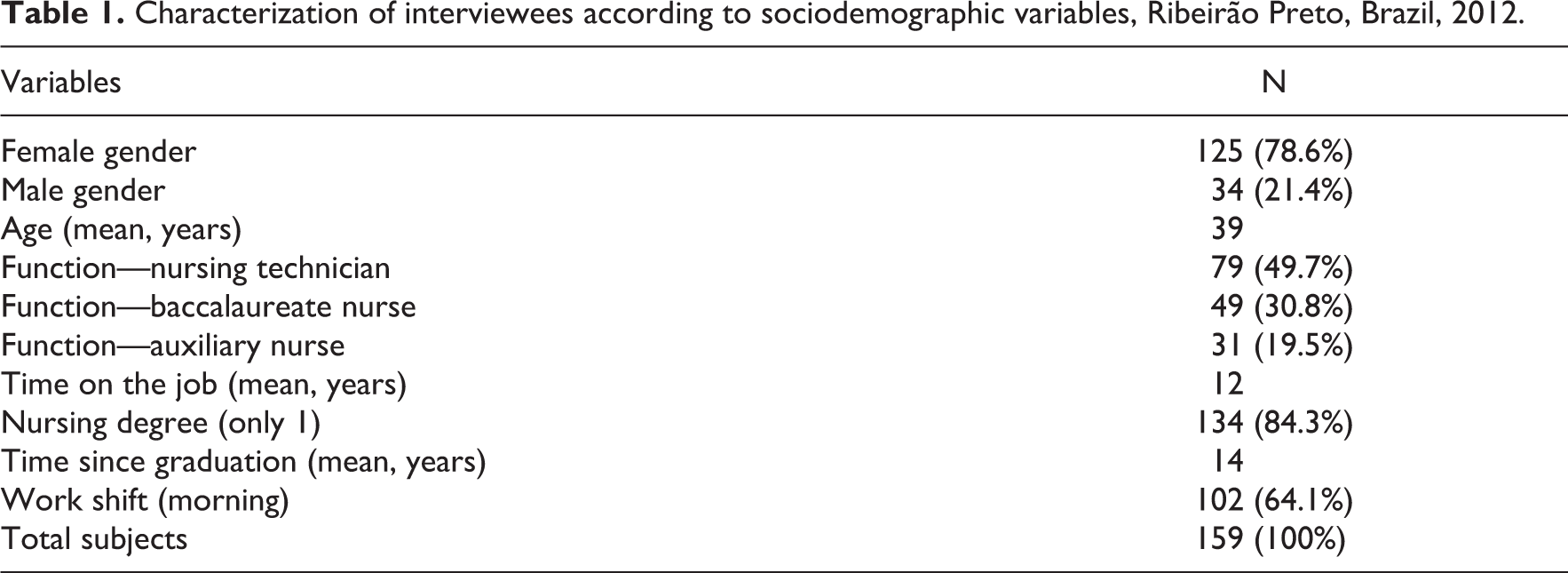
This non-experimental, exploratory, and descriptive study was aimed at observing and analyzing empathy in nursing human resources. This study received approval from the Research Ethics Committee at the University of São Paulo at Ribeirão Preto College of Nursing, opinion 1348/2011, and authorization from the health institutions involved. Data were collected at two large hospitals, one public and the other private, located in an interior city in São Paulo State—Brazil. A convenience sample was selected, involving all nursing professionals who were active at the pre-established data, working in all shifts (morning, afternoon, and evening). Thus, 159 individuals accepted to participate in the research and composed the sample. Two instruments were used for the study: a questionnaire for sociodemographic characteristics and the empathy inventory (EI) (Tables 1 and 2). 2
Characterization of interviewees according to sociodemographic variables, Ribeirão Preto, Brazil, 2012.
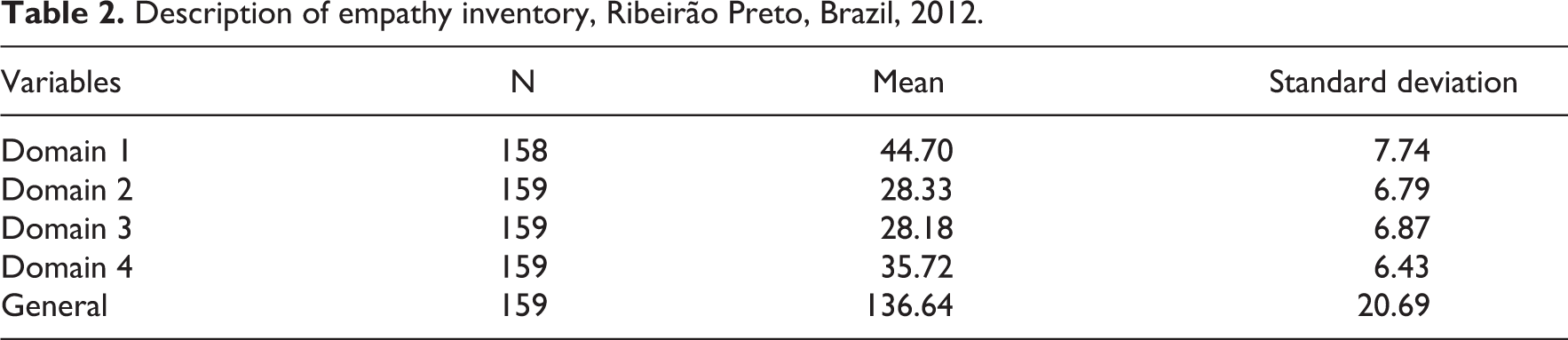
Description of empathy inventory, Ribeirão Preto, Brazil, 2012.
Empathy inventory
The EI consists of 40 questions to measure cognitive, affective, and behavioral components. The answers are indicated on a five-point Likert scale in which one corresponds to never, two rarely, three regularly, four almost always, and five always. Its score ranges from 40 to 200, with higher scores corresponding to higher empathy levels.
The first domain is called Perspective Taking, contains 12 questions and relates to the ability to understand the other person’s perspective and feelings, even in situations that involve a conflict of interests and require efforts to understand the other person’s motives before expressing one’s own perspectives.
The second domain is called Interpersonal Flexibility (IF), consists of 10 questions and is characterized by the ability to tolerate other people’s behaviors, attitudes, and thoughts, which are very different or provoke frustrations. A low score on this factor indicates the person’s difficulty to accept different viewpoints and trend to get easily annoyed in situations of conflicting interests or interpersonal frustrations.
The third domain is characterized as AL, consists of nine questions and reflects the ability to sacrifice one’s own interests to benefit or help someone. A low score on this factor reflects that the person is selfish.
And the fourth domain is called Affective Sensitivity (AS) and contains nine questions. It reflects feelings of compassion and interest in the other person’s emotional status. A low score indicates that the person pays little attention to or takes little care with other people’s needs.
Cronbach’s alpha was used to analyze the instrument’s psychometric characteristics, as well as Pearson’s correlation coefficient and Fisher’s exact test.
Results
The Cronbach’s alpha coefficients on the psychometric tests corresponded to 0.81 for the general scale, 0.80 for the decision-making domain, 0.68 for IF, 0.67 for AL, and 0.66 for AS.
The statistical tests (Table 3) demonstrated that empathy is associated with the variables gender, age range, work shift, function, and education level. The shift variable is not associated with domains 1 and 2 (Perspective Taking and IF). In the correlation test (Figure 1), it is shown that the professionals with less time since graduation and less time on the job obtain higher empathy scores.
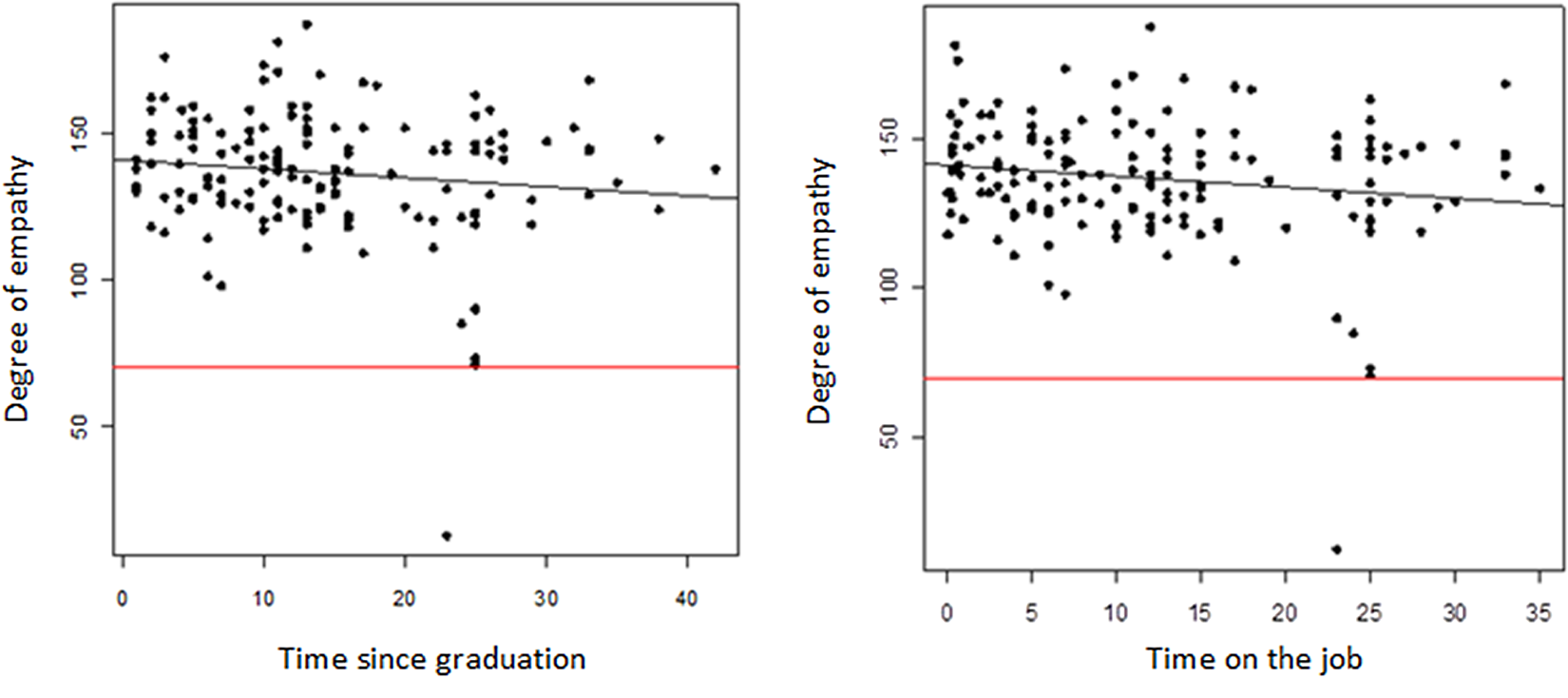
Pearson’s correlation test between the degree of empathy, time since graduation, and time on the job; Ribeirão Preto, Brazil, 2012.
Distribution of nursing professional according to gender, age range, shift, function, and education, Ribeirão Preto, Brazil, 2012.
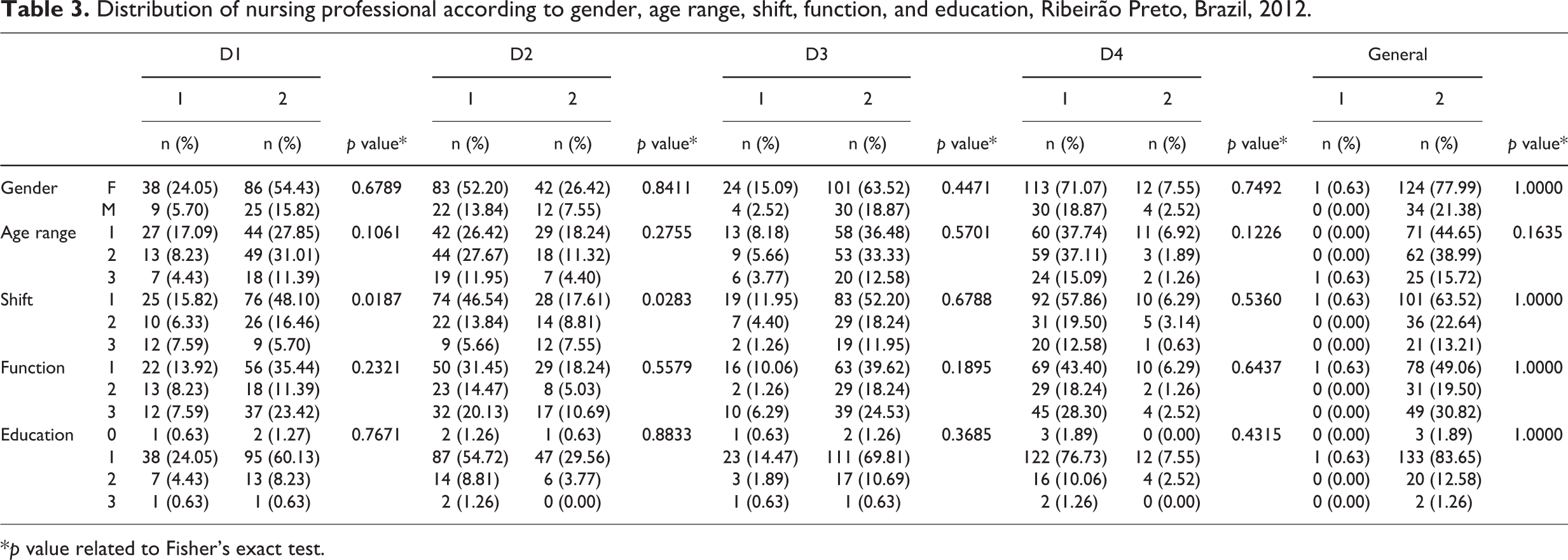
*p value related to Fisher’s exact test.
Discussion
Few articles in the literature explore empathy among nursing professionals. Most existing studies are focused on students. Therefore, the intent in this study was to verify the actual situation of this feeling and/or skill among nursing professionals working in hospital care.
The internal consistency of the EI was verified using Cronbach’s alpha, resulting in 0.81; when observing the domain coefficients, however, the inventory did not demonstrate good consistency levels for three domains (IF, AL, and AS). In other studies, 11,28 on the other hand, the EI showed good consistency for all factors. Coefficients inferior to 0.70 are generally considered acceptable for psychometric scales, although values superior to 0.80 are recommended as good or even 0.90 as excellent internal consistency coefficients. 29
Most of the interviewees were female. This fact may have caused a bias in this research, as other studies reveal that women are generally more empathetic and present more pro-social behaviors than men. 30 Since childhood, women tend to be more empathetic than men. Socialization in the family can explain this fact, that is, men are exposed to maternal behaviors like giving care and comfort, and thus, they absorb this trend toward concern with others more than boys. 31
A study of 459 health students also indicated gender differences, with higher empathy levels for women than men. 32 Since the start, nursing is mainly practiced by the female gender. 33,34 As few men participated in this research, this variable was not explored further; therefore, we acknowledge the need for further research to understand the influence of this variable among professionals.
As to the professionals’ mean age (39 years), some authors report that between the ages of 35 and 50 years, individuals actually mature, have established their identity, tend to be professionally defined, and are able to link up with other people in conditions of equality. 33 The domain results of the EI showed higher scores in domain 4 (AS), followed by domain 1 (Decision Making), domain 3 (AL), and domain 2 (IF). These results are in line with recent research findings, indicating differences in some empathy aspects according to age and education among adults (mean age 32 years), showing that higher ages correspond to less AL and greater AS and that higher education levels correspond to higher levels of IF and AL. As the sample in that study predominantly included young individuals with a professional education degree, 18 these results are in accordance with our research results. 21
In the Brazilian reality, nursing human resources in the hospital area mainly consist of nursing technicians and auxiliary nurses. COFEN Resolution No 293/2004 defines that between 33% and 37% of professionals need to be baccalaureate nurses and the remainder nursing technicians or auxiliary nurses for minimal and intermediary care delivery. In semi-intensive care, between 42% and 46% of baccalaureate nurses are recommended and the remainder technicians and auxiliary nurses, and in intensive care, between 52% and 56% of baccalaureate nurses are recommended and the remainder nursing technicians. 35 These nursing staff dimensioning parameters differ among institutions though; hence, the methods and criteria adopted should permit the adaptation of human resources to the actual care needs, so that patients receive high-quality care that makes them feel confident. Therefore, in the staff calculation method, some factors need to be taken into account, such as the clients and the sociocultural and economic reality of the care population. 36
As regards empathy, it was observed that the investigated professionals scored 136.64 on the general inventory. There is a lack of studies that assess the degree of empathy among nursing professionals; most existing studies are related to nursing students. In a study of Portuguese students from different programs, in which the same research instrument was used, the undergraduates’ empathy score corresponded to 137.60 points, lower than in the Social Service and Veterinary Medicine programs, but higher than in Agronomic Engineering (133.70), Electrotechnical and Computer Engineering (132.70), Energy Engineering (130.55), and Civil Engineering (129.75). 37 In a longitudinal study about the development of empathy among nursing students, increased empathy was demonstrated between the first and final years; it was verified, however, that empathy dropped between the first and the second and third years, 38 and that empathy can be developed throughout the course. In other studies of undergraduate and graduate nursing students, it was concluded that empathy can be learned and enhanced, provided that it is taught. 13,39
According to many authors, hospital work puts an excessive strain on nursing professionals, including direct contact with borderline situations, lack of social prestige, high stress levels, concentration, physical and mental effort, besides high risks for themselves and others. Double work journeys lead to long work periods, which negatively affects many professionals’ physical and mental integrity, particularly when the wages are insufficient to keep up a dignified life. 34,40 –48 According to the nursing professionals, this strain is related to the nature of their work and to frequent contact with situations of pain and death. 49–51 All of these factors correspond to the results of this study, as the most empathetic professionals worked only single shifts. Nowadays, stress in nursing professionals, mainly among those working more than one shift, represents a relevant occupational health problem and one of the main challenges in modern nursing. 52 The unfavorable economic situation and low wages practiced in the profession contribute to the need to maintain different job contracts; hence, these professionals assume a double work day with different shifts and perform interventions that demand great attention, negatively affecting their quality of life and, consequently, their degree of empathy.
Health systems need to count on nursing professional with empathetic communication skills, as they contribute directly to the patients’ rehabilitation process. 52 Hence, knowing the empathetic profile of nursing professionals permits outlining strategies that can favor the development of this feeling and/or skill, mainly communication.
Besides empathy, educational and service leaderships need to treat many other values seriously, with a view to promoting behavioral changes; these include AL, sympathy, freedom, respect, dignity, trust, justice, safety, equality, benevolence, and compassion. This means that the leaderships need to face the difficulties and challenges, as well as the opportunities, with empathy and compassion toward their collaborators, thus influencing the people all of them are serving.
Conclusion
As an intrinsic value of nursing practice, empathy should be studied in professional practice context, in human resource development programs, and throughout the professional education process. In this study, the empathy of nursing professionals was assessed in two Brazilian hospitals: one public and the other private. According to the EI, the most empathetic professionals work only one shift, and night shift workers are less empathetic.
In view of the importance of further investments in the theme, involving nursing schools and nursing services’ continuing education programs, further research is recommended to be able to obtain more solid evidence.
Footnotes
Acknowledgements
The authors are grateful to all participants.
Conflict of interest
The authors declare that there is no conflict of interest.
Funding
The study received funding from São Paulo Research Foundation (FAPESP) and Brazilian Council for Scientific and Technological Development (CNPq), Brazilian governmental research agencies.