







Abstract
Background:
Maintaining dignity is important for successful aging, but there is lack of validated research instruments in the nursing literature to investigate dignity as perceived by the old people.
Objective:
This is a methodological study aiming to investigate the psychometric properties of the Greek version of Jacelon Attributed Dignity Scale as translated in the Greek language.
Research design:
A methodological approach consisting of translation, adaptation, and cross-cultural validation. A sample of 188 Greek-speaking old Cypriot persons drawn from the Hospital outpatient departments was asked to complete the Greek versions of Jacelon Attributed Dignity Scale and the Instrumental Activities of Daily Living. Data analyses included internal consistency reliability (Cronbach’s alpha coefficient), item analysis, and exploratory factor analysis using principal component method with orthogonal varimax rotation.
Ethical considerations:
The study protocol was approved by the National Bioethics committee according to the national legislation. Permission to use the research instrument was granted from the author. Information about the aim and the benefits of the study was included in the information letter.
Findings:
Cronbach’s alpha for Greek version of Jacelon Attributed Dignity Scale was 0.90. Four factors emerged explaining 65.28% of the total variance, and item to total correlation values ranged from 0.25 to 0.74 indicating high internal consistency and homogeneity. Mean item score in Instrumental Activities of Daily Living was 5.6 (standard deviation = 1.7) for men and 6.7 (standard deviation = 1.7) for women, and the correlations between demographics, Instrumental Activities of Daily Living, and the four factors of the Greek version of Jacelon Attributed Dignity Scale were low; also in multiple linear regression, the values of R2 are presented low.
Discussion:
Demographic characteristics and degree of functionality seem to be associated with some of the dimensions of dignity but with low correlations; therefore, they cannot predict attributed dignity.
Conclusion:
The Greek version of Jacelon Attributed Dignity Scale is a valid and reliable tool to measure attributed dignity in Greek-speaking older adults, but further testing of the psychometric properties and other potential factors that may affect the attributed dignity is needed.
Introduction
Through the theoretical and empirical literature, the meaning of dignity is presented as a complicated phenomenon. While the concept has been addressed by many researchers and there is extensive reference to the literature, the true notion of the concept does not seem to have been clarified. In the health field research, dignity is defined in various ways. Fenton and Mitchell, 1 in their definition, refer to dignity as “a state of physical, emotional and spiritual comfort,” and they consider that dignity is promoted when “individuals are enabled to do the best within their capabilities, exercise control, make choices and feel involved in the decision-making that underpins their care.” Jacelon et al. 2 define dignity through literature review and older adults’ focus groups and state that dignity is inherent in human beings; it can be subjectively felt as “an attribute of the self” and is expressed through behaviors of self-respect and respect of others. It can also be affected by the treatment received from others.
Researchers use many different approaches to describe the concept of dignity. Jacelon et al. 2 describe the four dimensions of dignity: (a) philosophical, (b) attributed, (c) behavioral, and (d) developmental. Anderberg et al. 3 refer to dignity’s inherent and external dimensions which can be influenced by cultural and social factors. Their theoretical framework for preserving older adult’s dignity, through nursing care, is based on the attributes of dignity, the antecedents, and the consequences. The attributes of dignity include individualized care, control restored, respect, advocacy, and sensitive listening; the antecedents are professional knowledge, responsibility, reflection, and non-hierarchical organization; and the consequences are strengthening of the life spirit, an inner sense of freedom, self-respect, and successful coping.
However, contemporary philosophical approaches give a different interpretation to the concept. Kant is the first philosopher who places respect and dignity at the center of moral theory and considers autonomy as a central phenomenon in dignity. 4 –7 More recently Edlund et al. 8 developed the “concept model of dignity” in which dignity is approached from the three dimensions of the human being: the body, the soul, and the spirit. In these three dimensions, relative and absolute dignity is enclosed. The core of dignity consists of values like holiness and human worth. In order to maintain dignity in the life course, people’s values move and change hierarchically, especially in older people, who experience physical and mental deterioration and most of the times are dependent on others while their values are threatened.
Dignity is an important value in nursing, and special emphasis is given on the educational programs regarding the role of the nurse in maintaining and enhancing the dignity of older people. 2 Also, respect of dignity is considered an overarching principle in nursing ethics codes 7 and plays a crucial role in 2005 United Nations Educational, Scientific and Cultural Organization (UNESCO) Universal Declaration on Bioethics and Human Rights that guides biomedical practice. 6 Everyday nursing care is a concept that often comes to the fore, particularly in regard to the older people. 3
Older people are the main users of the healthcare system’s services internationally. It is a fact that very often their dignity is violated through the provision of care as is shown in recent reports and inspections made, in care homes and hospitals from bodies like Picker Institute report, 9 Care Quality Commission, 10 Abraham report, 11 and Francis report. 12 The aim of this study is to explore the psychometric properties of the Jacelon Attributed Dignity Scale (JADS) 13 that has been translated in the Greek language, hoping to add some knowledge to the methodological investigation of dignity.
Literature review
Many qualitative researches describe the views on dignity of the older people and healthcare providers, through interviews and focus groups. Most of them refer to dignity at the end of life and were conducted in nursing homes, rehabilitation units, long-term care units, or palliative care units. 14 –31 Only a few describe the views on dignity of older people living in the community. 2,32 –35 For the older people, very important factors in maintaining and enhancing their dignity were respect, 14,15,32,33 recognition, 14,33 participation in society, 29,33 participation in decisions concerning their lives and their health, 32,33 autonomy, 22,32 control of bodily functions, the feeling that they are worthy, 18 the supportive attitude of the staff and their relatives, 18,20,22,29 good professional practice, adequate skills to adapt to the changes they experience in their lives, 29 cleanliness, 22 not to be exposed, 14,21,22 and the protection of their personal lives. 15,21 The views on dignity of healthcare professionals included encouraging older people to become more autonomous, 16,20,33 care of the appearance of the older people, 23 respect, 31 participation of older people in decision-making, 14,20,31 and the protection of privacy. 14,31 Healthcare professionals also believe that good organization of the care institution and the care environment plays an important role in maintaining the dignity of older people. 15,18,21,24,25,27,33
There is an increased need internationally to use standard health status measurement tools, in order to improve the care provided to patients. 36,37 Most of these tools have been developed for a particular culture. Researchers need to consider the differences in health and illness perception among cultures to adapt and validate those tools, through standard procedures, in the culture they intend to use it. 36 Cultural adaptation of a tool includes all the processes from the selection of the translators to the evaluation procedures. What is important through the whole process is to take into consideration, at all stages, the cultural and linguistic differences among populations. 38 With the cultural adaptation, different populations with different backgrounds are compared, using the same theoretical and methodological perspective, so as to identify cultural differences and commonality of cultures. 39 Also, it allows the comparison of research findings internationally. 40,41 Nevertheless, there is no agreement between researchers on how to adapt a tool for use in another culture. The only point, on which there is consensus, is that it is not correct to simply translate and use a tool. 38,39,41 Very important is the semantic, linguistic equivalence, and consistency between the original and the translated instrument, and also the evaluation of its psychometric properties. 39
Several tools for assessing dignity have been developed in healthcare but were designed to measure dignity at the end of life. The patient dignity inventory (PDI) is a valid and reliable instrument to detect end-of-life dignity-related distress. 42 The Dignity Card-sort Tool (DCT) and the preserving of Dignity Card-sort Tool (p-DCT) were designed to help clinicians identify key factors resulting in perceptions of loss and preservation of dignity, respectively, in adult palliative care patients. 43,44 The above tools have been used and validated in terminally ill patients. Only the JADS is designed to measure attributed dignity in community-dwelling older adults. The JADS establishes a baseline level of dignity and can be used to study the concept in relation to changes over time. 45 In the development of JADS, particular emphasis was given on assessing the “attributed dignity” of older people. 45 Attributed dignity refers to the value or worth people attribute to individuals according to their characteristics or abilities depending on what circumstances are in a specific moment. So depending on the circumstances, one can have more or less dignity. It is therefore variable and is based on the autonomy of individuals as to their ability to make important choices in their lives. 46 According to Jacelon and Choi, 13 attributed dignity is affected by human interaction and environmental stimuli and fluctuates depending on the interpretation that a person gives in a situation. Attributed dignity is also inextricably linked to the intrinsic dignity, which is a virtue of human beings. 45 So when attributed dignity is threatened, there is an increased risk of violation on intrinsic dignity. 47
The JADS was developed and validated in United States by Jacelon et al. 45 The items included in the instrument were derived through literature review and older adult focus groups, 2 and then a group of experts evaluated the items for relevance and clarity. Further assessment of the items was conducted through cognitive appraisal interviews, and at the end, a pilot testing with older adults was conducted so as to gain information about the sequence of the items, effectiveness of the response set, and for exploring the content validity and clarity. 45 The final instrument includes 18 statements and measures attributed dignity of older people who do not have cognitive problems and live in the community. According to Jacelon et al., 2 attributed dignity is a component of self-value and also has an external behavioral component, behaviors of self-respect, and respect of others. These three dimensions are interrelated since a strong sense of self-value is considered important for human beings in order to behave with respect both to themselves and to others. Alongside, attitudes of respect for oneself and others enhance the feeling of self-value. In assessing the psychometric properties of the instrument, another dimension of dignity was discovered, which refers to behaviors of respect of other people as perceived by older people. 13 The 18 items of JADS are grouped into four factors: (a) self in relation to others (SRO), (b) behavior that demonstrates respect for others (BRO), (c) individual self-perceived value (SV), and (d) perceived value from others (PVO). This is the first time that JADS is translated in a different language and used in a different culture.
Aim of the study and research questions
This is a methodological study aiming to investigate the psychometric properties of the Greek version of JADS (JADS-GR).
More specifically, the research questions are as follows: What is the reliability and factor structure of the JADS-GR? How older people rate the level of their daily living activities? Is there any relation between older people’s characteristics and their attributed dignity? Is there any relation between older people’s attributed dignity and their competence in their daily living activities?
Research design
A two-phase methodological approach was followed consisting of translation, adaptation, and cross-cultural validation. A sample of 188 Greek-speaking old Cypriot persons drawn from the outpatient departments was used and asked to complete the JADS-GR and the Greek version of Instrumental Activities of Daily Living (IADL-GR).
Data analyses included internal consistency reliability (Cronbach’s alpha coefficient), item analysis, and exploratory factor analysis (EFA) using principal component method with varimax rotation. The IADL was given to explore a possible relation between dignity and functional independence.
Participants and research context
The study involved older people, who visited the outpatient department of Limassol General Hospital in Cyprus, from July to September 2013. The participants involved met the following criteria: Age ≥60 years; Be able to understand and communicate in Greek language; Be able to give their consent for participation; Any morbidities or comorbidities were not taken into consideration.
The sample size was decided by various rules that exist within literature. Many researchers suggest the number of cases to the number of items in the questionnaire ratio. The most common guideline in the literature is the norm of 10 cases per element (10:1); this rule is supported by the majority of researchers 48 –51 and this was the method of choice for the development and evaluation of the psychometric properties of JADS. 13 The questionnaire consists of 18 statements; therefore, 180 people should be considered as enough; however, 20 additional people were included in case of any returned blank questionnaires.
Research instruments
The questionnaire included three sections. The first part included the demographic characteristics; the second part, the attributed dignity scale; and the third was about the activities of daily living. The demographic questionnaire included statements about age, gender, marital status, living status, educational level, and monthly income. JADS-GR is an 18-item scale, and participants are asked to respond to each statement, whether it is true during the past week on a Likert-type 4-point scale. Responses range from 1 = untrue to 4 = completely true. High score is indicative of an increased perception of attributed dignity, while low score indicates that people are physically and psychologically vulnerable. Because of the hypothesis that attributed dignity may be related to the ability of a person to perform his or her daily activities, it was also decided to administer the IADL questionnaire developed by Lawton and Brody. 52 The IADL is a well-structured and widely used questionnaire that aims to describe the degree of dependency of older people, as regards their ability to perform their daily activities independently. For the purpose of this study, the IADL-GR was used, published by Tsolaki and Kounti. 53 The score of the questionnaire ranges from 0 to 8, where 0 means that the person is a dependent, a score of 8 means that the person is an independent, and score <8 means that the person has limitations while performing daily activities.
The translation procedure
The JADS was translated to Greek following the rules and criteria of translation and cultural adaptation proposed by Squires et al. 54 First, separate experienced nurses with an excellent knowledge of both Greek and English conducted a forward and back translation. Then, the research panel reviewed the translated version, and a second panel, consisting of experienced nurses, commented so as to obtain a semantic and technical equivalence. A pilot test of the final draft was applied on a sample of old people. This application provided a useful exercise that resulted in certain modifications which enhanced the overall rigor of the JADS.
Data collection process
In all, 200 senior people, who visited the outpatients’ department of a district hospital, were approached by the researcher while they were sitting in the waiting area. A total of 188 agreed to participate, giving a response of 95%. Then, they were given a letter, explaining the aim of the research. The questionnaires were completed by the older people themselves.
Data analysis
The reliability of both scales was examined with Cronbach’s alpha correlation coefficient. The construct validity of the JADS-GR was examined with EFA and principal component analysis using orthogonal varimax rotation. Several strategies were employed for factor extraction as this is recommended by Williams et al. 51 These were cumulative percentage of variance and Kaizer’s eigenvalue. Factors with eigenvalue >1 were included in the analysis. The correlations were examined with the Pearson correlation coefficient and multiple linear regression analyses.
Ethical considerations
The study protocol was submitted to the National Bioethics committee (according to the national legislation) and the Research committee of the Ministry of Health. Access to the Hospital’s outpatient department was obtained from the hospital administration board. Permission to use the research instrument was granted from the author. Information about the aim and the benefits of the study was included in the information letter and the completion of the questionnaire was considered as informed consent. All the questionnaires were anonymous and they were kept in a safe place where only the primary investigator had access.
Findings
Sample characteristics
The characteristics of the participants are presented in Table 1. In summary, the average age of participants was 71 years (standard deviation (SD) = 6.02) and ranged from 63 to 93 years. There was a small difference in the number of participants in terms of gender, with the percentage of men slightly higher (50.5%) than the percentage of women (49.5%). Regarding the educational level, the majority (50.5%) were primary school graduates, 77% were married, and a 15% lived alone. The monthly income of the majority of participants (50%) ranged from €501 to €1000, while 34% had an income of less than €500.
Sample characteristics.
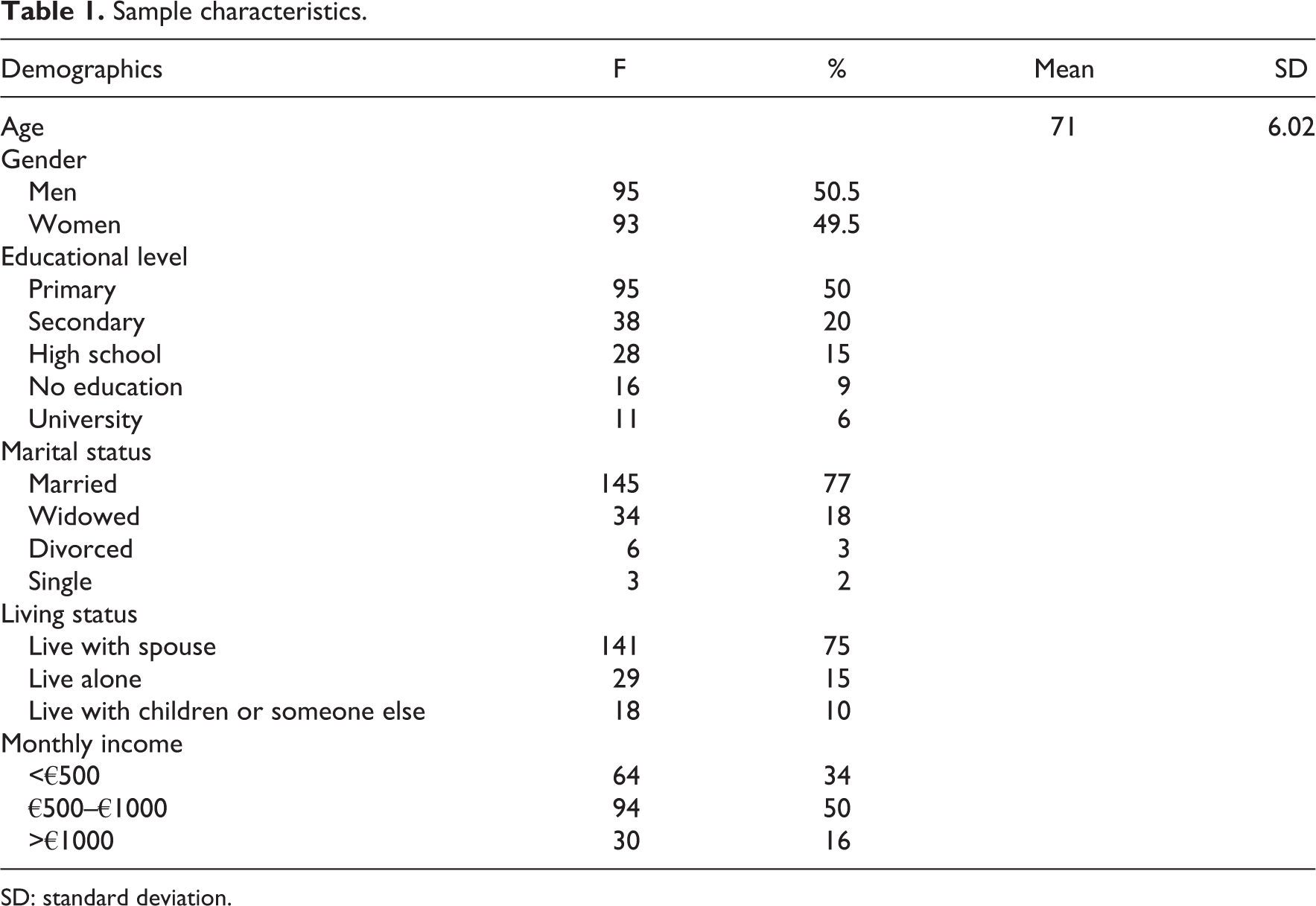
SD: standard deviation.
Level of independence in the activities of daily living
The average score for men on IADL was 5.6 (SD = 1.6) and for women 6.7 (SD = 1.7). To explore the possible difference in average score between men and women in each category of IADL, t-test for independent samples was conducted. The analysis showed significant statistical difference in averages between men and women in the categories “food preparation,” “housekeeping,” and “laundry” (p < 0.001), with women having the highest averages in relation to men. Additionally, statistically significant difference was found in the average score of men and women in the category of “mode of transportation” (p < 0.001), although this time men presented higher averages than women. Item analysis of IADL is presented in Table 2.
Item analysis for IADL.
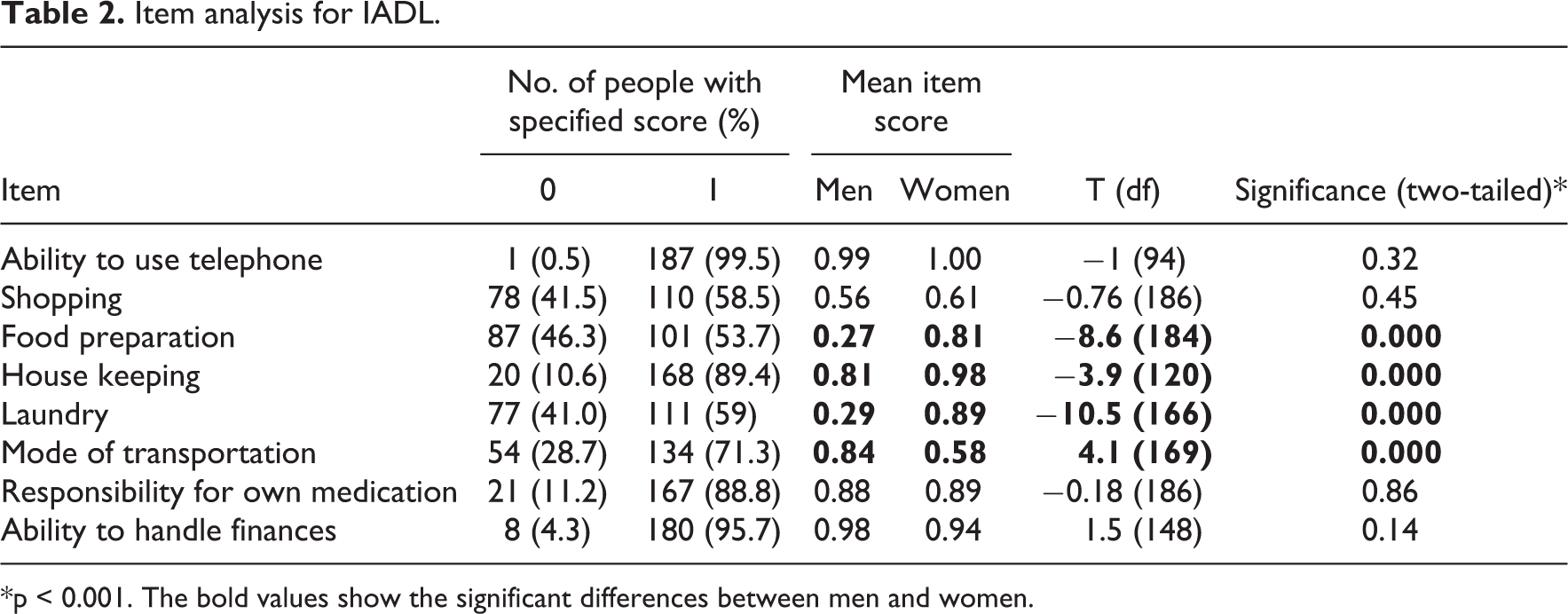
*p < 0.001. The bold values show the significant differences between men and women.
Psychometric properties of the JADS-GR
Factor structure
Construct validity was determined by EFA. To determine whether the data complied with the conditions to perform a factor analysis for the adequacy of the sample and the correlation matrix, Kaiser–Meyer–Olkin (KMO) value and Barlett’s test of sphericity were calculated. The KMO value was high (0.91) and Barlett’s test of sphericity was statistically significant (χ 2 = 1914.53, p < 0.001). Therefore, the data were suitable for performing factor analysis.
The factor analysis yielded four factors, as the original instrument, that interpret 65.28% of the total variance. For the definition of the factors, the research team was based on the English version of the questionnaire and named factors: (a) SRO, (b) BRO, (c) SV, and (d) PVO. The first factor (SRO) interprets the greater variance with 18.93% and includes five items with loadings, ranging from 0.59 to 0.83. The second factor (BRO) includes six items with loadings ranging from 0.42 to 0.81. The third factor (SV) includes four items with loadings from 0.46 to 0.76. Finally, the fourth factor (PVO) includes three items with loadings from 0.70 to 0.77. Statement 15 “I respected myself” loaded similar to two factors: BRO with 0.45 and SV with 0.46. Thus, the research team after contacting the author decided to include it into the factor SV. This factor is interpreted as how a person perceives self-value and appreciates his importance. A further EFA was also conducted after deleting items with low loadings, that is, 14 (0.42) and 15 (0.46). The results showed a very similar four-factor structure instrument, so the research team decided to retain these questions because of their conceptual relevance and also because they loaded low in the original scale as well. The results from factor analysis are presented in Table 3. Correlations among factors were moderate to high ranging from 0.44 to 0.68 (Table 4).
Results of exploratory factor analysis on JADS-GR.

JADS: Jacelon Attributed Dignity Scale; JADS-GR: Greek version of Jacelon Attributed Dignity Scale; SRO: self in relation to others; BRO: behavior that demonstrates respect for others; SV: individual self-perceived value; PVO: perceived value from others.
Extraction method: principal component analysis.
JADS-GR factor correlation.
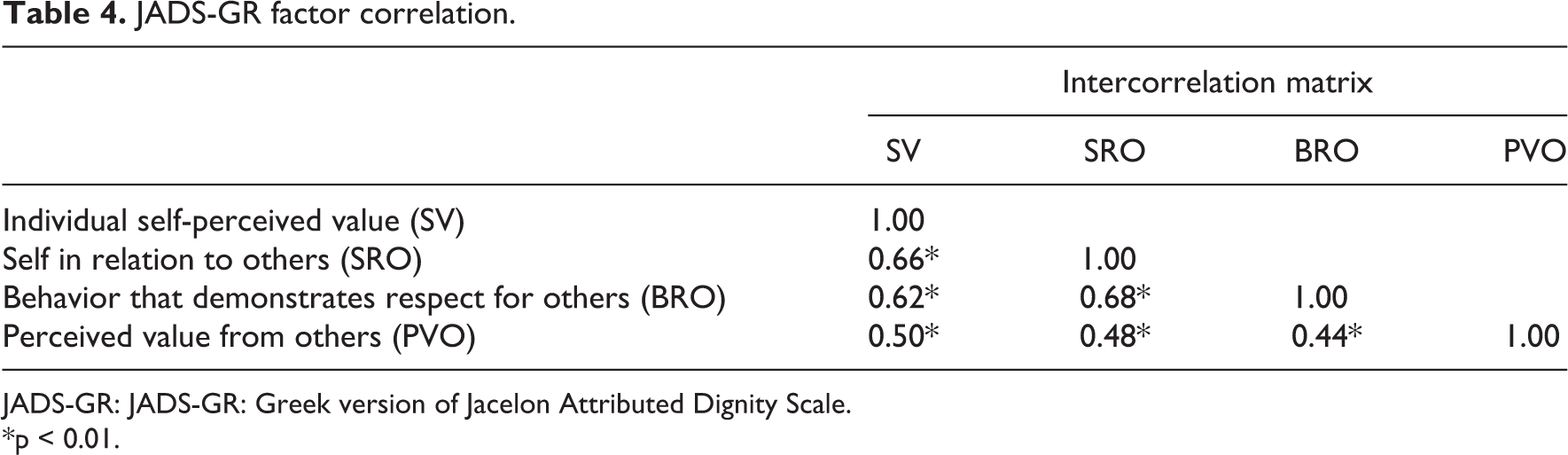
JADS-GR: JADS-GR: Greek version of Jacelon Attributed Dignity Scale.
*p < 0.01.
Internal consistency
Reliability and homogeneity were evaluated by measuring the internal consistency and item analysis. Cronbach’s alpha for the JADS was 0.90 and for the factors separately ranged from 0.72 to 0.80, a result which shows that the scale and the factors separately had a satisfactory internal consistency reliability. The item analysis consisted of estimating items mean, standard deviation, item to total correlation coefficients, and changes in Cronbach’s alpha if a question was deleted (Table 5). Item to total correlation coefficients support the homogeneity and consistency. Only item 14 had a low correlation coefficient (0.25); however, the team decided to retain it in the scale because its loading was 0.42.
Item analysis of JADS-GR.
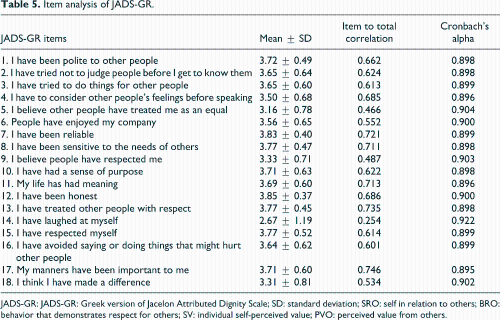
JADS-GR: JADS-GR: Greek version of Jacelon Attributed Dignity Scale; SD: standard deviation; SRO: self in relation to others; BRO: behavior that demonstrates respect for others; SV: individual self-perceived value; PVO: perceived value from others.
Correlation among factors, IADL, and demographics
In order to examine the correlations between the factors, demographics, and IADL, the parametric Pearson’s coefficient was used as the sample size and format of the data justified this choice. 55 The test results showed that the first factor (SRO) has a statistically significant positive correlation with the variable IADL (r = 0.190; p < 0.01). The second factor (BRO) has a statistically significant negative association with marital status (r = −0.162; p < 0.05) and a positive correlation with the variable IADL (r = 0.297; p < 0.01). The third factor (SV) has a statistically significant negative correlation with gender and age (r = −0.149; p < 0.05 and r = −0.176; p < 0.05, respectively) and a positive correlation with the level of education and income (r = 0.304; p < 0.01 and r = 0.191; p < 0.01). The fourth factor (PVO) shows no statistically significant correlation with any variable (Table 6).
Factor, demographic, and IADL correlations.
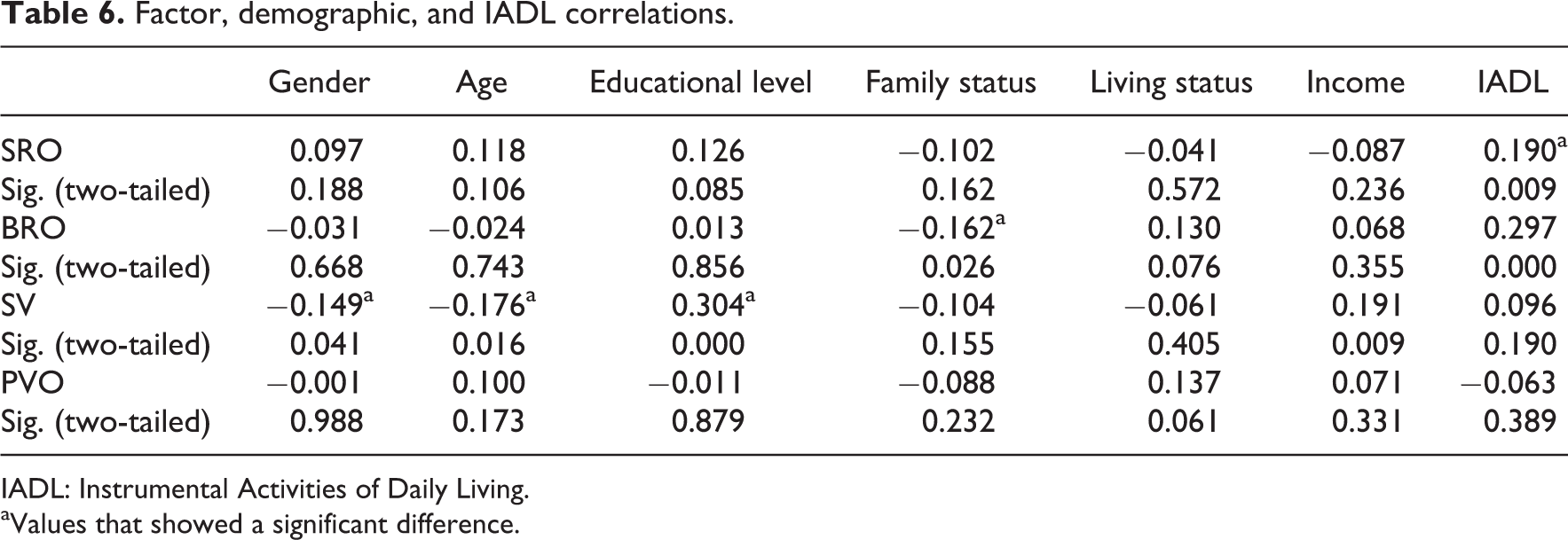
IADL: Instrumental Activities of Daily Living.
aValues that showed a significant difference.
Multiple linear regression
An attempt was made to create statistical prediction models of four factors through the process, using multiple regression analysis with enter method. Three models occurred, but R2 scores confirm that the models are not quite powerful predictive tools, as the percentage of variance of the dependent variables (factors SRO, BRO, and SV) which is interpreted by each model is low (12%–13%).
Discussion
In this study, an instrument measuring attributed dignity was translated in Greek language and culturally adapted. The results showed high reliability, internal consistency, and validity of the translated instrument. The psychometric properties of the JADS-GR were evaluated through EFA, using a sample of 188 senior adults living in the community. Four factors derived, interpreting the true meaning of the concept, and their structure was at 80% similar to the American version of the instrument. Three items loaded on different factors in relation to the original instrument; this may be due to cultural differences since in Cypriot culture, special importance is given to the opinion of others, as well as to the image that one presents. This is merely because they live in small communities and they often know each other. The difference in loadings could also be explained by the fact that the two factors SRO and BRO in JADS-GR have the strongest correlation (r = 0.68) and both refer to behavior. A further research with larger sample is needed to confirm the psychometrics of the scale.
The level of functionality in older people appears to positively affect their attributed dignity, at least in their relationship with other people and in behaviors that demonstrate respect toward others. Although the correlations between dignity and autonomy of the older people in this study were low, in many empirical studies of dignity, in relation to the care of older people, it is argued that the two concepts presuppose each other. 15,16,18 –20,28,32 –34 Older people consider autonomy the most important element in maintaining their dignity. 19,20,28,32 It was also noted that with the support of their independence, their integrity is protected and thus their dignity is enhanced, 14,15 while limitations in their autonomy violate their personal dignity 32 which along with dependence on others, leads to a loss of dignity. 33
Healthcare professionals need to consider that the provision of care for older people should not be focused only on their disease but also on their lives and their relationships. In addition to medication and therapeutic interventions, very important is the creation of a relationship that will allow adequate expression and satisfaction of needs of older people. 11 Most of the time, health professionals work in the narrow context of the biomedical model, searching for the disease behind the symptoms and physical problems. The best approach for the care of older people, though, would be through the use of the bio-psycho-social model which is wider. The symptoms experienced are mainly due to social factors and physiological changes of aging rather than a specific disease. 56 Coventry 57 states that decent care requires a relationship between provider and patient, which takes into consideration the autonomy, individual diversity, truth, justice, rights, and obligations. Cairns et al. 31 believe that in order to develop the necessary policies and procedures to prevent the violation of dignity by providing care for the older people, dignity must be addressed through the eyes of older people and healthcare professionals.
Limitations
The sample selection from one district hospital of Cyprus could be a limitation in this study, as to the generalization of the results. However, the main purpose of the study was the validation and cultural adaptation of JADS-GR. Another limitation is that the selection of the participants from the outpatient department could involve participants mainly with chronic health problems that might have affected their perception of dignity. The low correlations between dignity and autonomy may be due to the sample size or perhaps the option of the measuring tool for autonomy (IADL). Perhaps the use of a more sensitive tool would give different results. Attributed dignity of autonomous, not hospitalized older adults has not yet been studied many times in the literature.
This is the first time after the evaluation of JADS’ psychometric properties in United States that it is translated in a different language and culturally adapted in a European population. The fact that JADS-GR is a valid and reliable instrument for measuring attributed dignity in older people could mean a lot to the health research worldwide.
Conclusion
Dignity is a constant value in the life of every human being regardless of age. In older people, dignity presupposes healthy aging and attributed dignity encloses concepts such as self-value, perceived self-value as defined by other people, a reflection of the self through interaction with other people and behavior that demonstrates respect for other people.
The importance of attributed dignity to healthy aging and quality of life of older people can be confirmed with extensive research. That will enable health professionals to develop interventions to enhance the dignity and thus to improve the functionality of older people and the management of their health.
This study demonstrated that the JADS-GR is a valid and reliable instrument that can be used in Greek-speaking populations and is comparable to the original American version. Further psychometric testing of the instrument is needed on larger samples and several settings. After further testing, the JADS-GR can be used in combination with other tools that measure relevant concepts or concepts related to older people, such as independence, cognitive function, dementia, and other. 2,3,5,8,21,31 This will increase the body of knowledge relating to the concept of dignity and will provide the potential to clinical advancements in practice, through which the understanding of the patients will be increased, identifying what influences their perception of dignity.
Footnotes
Acknowledgements
The authors would like to express their gratitude to Dr Cynthia Jacelon for allowing us to use the instrument, as well as her continuous support during this project. Special thanks to all the participants who were willing to spend their time to fill in the questionnaires and provide the data.
Conflict of interests
The author(s) declared no potential conflicts of interest with respect to the research, authorship, and/or publication of this article.
Funding
The author(s) received no financial support for the research, authorship, and/or publication of this article.