







Abstract
Background:
With increased attention to patient privacy and autonomy, privacy protection and information provision for patients are becoming increasingly important.
Objectives:
The aim of this study was to identify and analyse nurses’ and patients’ perceptions of the importance and performance of protecting patients’ privacy and providing them with relevant information.
Research design:
This study is a descriptive cross-sectional investigation. Participants and research context: Participants were 168 patients hospitalised in medical and surgical wards and 176 nurses who cared for them.
Ethical consideration:
This study was approved by the Chung-Ang University Bioethics Committee, and informed written consent was collected from all participants.
Findings:
Nurses’ recognition of the importance of protecting patients’ privacy and providing adequate information was higher compared to their actual performance, and the nurses’ level of performance was higher in comparison with the patients’ recognition of its importance.
Discussion:
Although a holistic approach to patient privacy protection and information provision is needed, the medical field has not embraced this model of care.
Conclusions:
These findings provide empirical data to create an ethical environment for the future, as considerable attention has been devoted to patients’ rights and medical institutions’ liability for providing explanations to patients.
Introduction
The ethical principle related to respect for personal autonomy emphasises self-control and personal protection. 1 Helping patients maximise their autonomy in decision-making is an important aspect of patient-centred care. 2 Thus, to respect the autonomy of individuals in medical institutions, healthcare professionals should protect their privacy and promote their self-determination by providing them with accurate and complete information about their care. The requirement to protect patients’ personal information has increased as information processing related to medical treatment occurs widely due to recent advances in informatisation. 3 Patients’ demands to determine their treatment methods themselves, also, are increasing due to easy access to a variety of information. 4 Therefore, efforts to create an ethical environment that protects patients’ privacy and provides information to patients should be ongoing in the clinical setting.
Patients’ health-related information is highly sensitive and personal, and thus, more elaborate measures are needed to protect their privacy. 3 Nurses consider privacy a basic need, and therefore, an important concept. 5,6 Personal privacy protection is the basis of a trusting relationship between a patient and nurse, which thereby enables effective nursing. 7 The realisation of self-determination requires that a person is informed about his/her disease, the tests to be done, the direction of future treatment and is fully aware of the situation. Positive results can be expected when patients assertively participate in their treatment plan. The person and the medical staff can avoid unnecessary worries and ethical concerns when the individual is allowed to make treatment decisions. 3,8
The Korea Nurses Code of Ethics 9 provides information about the protection of patients’ privacy and the provision of adequate information: ‘In principle, a nurse should protect the privacy of nursing subjects and keep a secret and share only the information necessary for nursing’, and ‘A nurse should involve nursing subjects in the entire process of nursing and help them to make a decision by themselves through the provision of sufficient explanations’. Therefore, the protection of patients’ privacy, respect for confidentiality and provision of information are regarded as essential duties of healthcare providers. 10 –12 Thus, a nurse should not regard a person’s agreement as a binding relationship with the medical staff but should advocate for the person by providing sufficient information, thereby respecting their autonomy as much as possible. 13 However, nurses are less likely to protect treatment-related information in medical institutions than persons in other administrative jobs or medical engineers, 13 and they may violate individuals’ privacy unknowingly. 14,15
Previous studies concerning nurses’ recognition and performance related to patient privacy have been limited to specialty areas, such as obstetrics and gynaecology, 7 the emergency room (ER) 16 and the newborn unit. 17 Therefore, an investigation of privacy infringement, as perceived by inpatients on general units, is needed. Only one study of ER nurses and patients who visited the ER 16 compared the recognition and practice of privacy protection behaviours between nurses and patients. The study found that the nurses recognised patients’ privacy protection behaviours as more important than the patients did, and that the patients evaluated the nurses’ performance more favourably than the nurses did. However, no studies have compared nurses’ and patients’ perceptions of the importance or practice of information provision. Nevertheless, studies on information provision and patient privacy in several countries 12,18 –24 emphasise that prior consent, based on respect for the patient’s privacy, and the provision of essential information are essential to improve the quality of nursing care. A study 11 of the development of a protocol to improve privacy protection and patient satisfaction, demonstrated the mediating effect of an ethical environment.
In Korea, it is necessary to investigate differences between nurses’ and patients’ perceptions of the importance and performance of nursing interventions associated with privacy protection and information provision in order to develop an ethical environment related to patients’ medical information. Therefore, this study was conducted to examine the differences between patients’ and their nurses’ perceptions of the importance and performance of behaviours to protect patients’ privacy and provide information to patients.
Objectives
First, we sought to determine differences in nurses’ perceptions of the importance and performance of privacy protection and information provision according to their general characteristics. Second, we investigated differences in the patients’ perceptions of the importance of privacy protection and information provision according to patients’ general characteristics and the performance of the nurses, as perceived by the patients. Third, we investigated the differences between the nurses and patients in terms of their perceptions of the importance and performance of behaviours regarding privacy protection and information provision.
Methods
Design
We conducted a descriptive cross-sectional study to investigate the differences between nurses’ and patients’ perceptions of the importance and performance of privacy protection behaviours and information provision. We targeted patients hospitalised in medical institutions and the nurses who cared for them.
Sample and data collection
The participants were nurses working in the medical or surgical wards of four university hospitals located in Seoul, Gyeonggi-do and Gangwon-do, and persons aged 19 or older who were hospitalised in the medical or surgical wards. The sample size was calculated based on the average value used in a previous study. 16 Using G*Power, 25 the number of participants required was calculated as 210, based on a power of .95, an effect size of .50, a significance level of .05, using independent t-test and a two-tailed test. However, we recalculated the sample size based on an effect size of .40 because no previous studies comparing the perceptions and practice of information provision had been conducted between nurses and patients previously; as a result, we found that 328 participants were required. Thus, considering the dropout rate, the sample size required was determined to be 400 participants.
Questionnaires were distributed directly to 200 nurses and 200 hospitalised patients, from 15 October to 15 November 2014, who were asked to complete them. Of the 400 questionnaires, 195 and 183 were collected from nurses and patients, respectively (total return rate: 95%). Data from 344 participants – 176 nurses and 168 patients – were used for the analysis, excluding 34 copies with missing or inappropriate responses.
Instruments
Importance and performance of behaviours related to privacy protection
This study’s instrument is based on surveys of privacy protection developed by Lee and Park, 26 Lee and Song 27 and Joung et al. 16 The present study’s instrument has three subscales: physical privacy, patient information management and communication. Each question is rated on a 5-point scale, with higher scores indicating the perception of greater importance of privacy protection and performance of the nurse, as perceived by the patient.
In Joung et al.’s 16 study, Cronbach’s αs were as follows: .85 for the importance of the nurse, .83 for the performance of the nurse, .90 for the importance of the patient and .91 for the performance of the nurse, as perceived by the patient. Cronbach’s αs in this study were as follows. For the importance of the nurse, it was .92 (physical privacy, .72; patient information management, .74; and communication, .92). For the performance of the nurse, it was .89 (physical privacy, .83; patient information management, .61; and communication, .91). For the importance of the patient, it was .94 (physical privacy, .81; patient information management, .78; and communication, .93). For the patients’ perceptions of the performance of the nurse, it was .95 (physical privacy, .86; patient information management, .81; and communication, .95).
Importance and performance of behaviours related to information provision
We translated and back-translated an instrument developed by Ingravallo et al. 21 and used it after obtaining permission from the first author. This questionnaire consists of four questions about information provision related to nursing care plans, medication administration, discharge plans and before invasive nursing procedures. Responses are rated on a 5-point scale, with higher scores indicating higher importance of information provision and nurse performance. Cronbach’s αs in this study were .79 for the importance of the nurse, .81 for the performance of the nurse, .86 for the importance of the patient and .87 for the performance of the nurse, as perceived by the patient.
For this study, the content validity of the instruments were verified by two nursing professors and two chief nurses with more than 20 years of clinical experience. The content validity also was verified by conducting a preliminary survey of 15 people, including 3 from each age group (ranging from 20 years of age through 70) to examine the clarity and adequacy of the terminology.
Ethical considerations
This study was approved by the Chung-Ang University Bioethics Committee (Institutional Review Board (IRB) No. 1041078-201408-HR-121-02). A questionnaire was administered after explaining its purpose to the developers by email, and obtaining permission for its use. For data collection, we contacted the nursing department of four university hospitals in Seoul, Gyeonggi-do and Gangwon-do to describe the study’s purpose and methods and obtained permission for data collection after we submitted our research plan, questionnaire and an official request for data collection and site visits. The questionnaires were distributed to the participants through the nursing department, and the chief nurses of each ward were asked to seal the completed questionnaires and keep them in a secure place. Then, the researcher visited the clinical sites to collect them. We explained the study’s objective to the participants and informed them that they could withdraw at any time, that the data would be used only for research purposes, and that their anonymity would be maintained. Finally, we obtained written consent from the nurses and patients who agreed to participate in the study.
Data analysis
Data were analysed using SPSS version 20.0. To identify the characteristics of the study’s participants and the importance and performance of privacy protection and information provision, we used frequency analysis, descriptive statistics and importance–performance analysis (IPA). To identify the difference between the perceptions of the importance and performance of interventions for privacy protection and information provision, according to the nurses’ and patients’ general characteristics, t-tests and analysis of variance (ANOVA) were used. Independent samples t-tests were performed to identify differences in the perceptions of the importance and performance of interventions for privacy protection and information provision between the nurses and the patients. All statistical tests were two-tailed, and the significance level was set to p < .05.
Results
Nurses’ perceptions of the importance and performance of privacy protection behaviours and information provision by their general characteristics
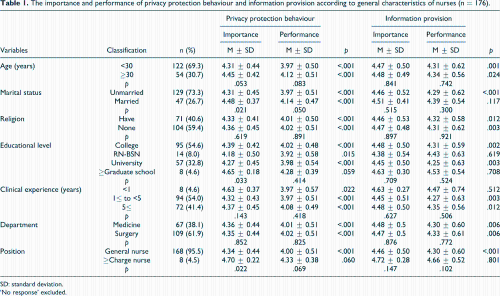
The differences in the nurses’ perceptions of the importance and performance of privacy protection behaviours and information provision, according to the nurses’ general characteristics, are shown in Table 1. The nurses’ perceptions of the importance of privacy protection behaviours showed significant differences by marital status (p = .021), level of education (p = .033) and nursing position (p = .022). Those who were married, had a higher level of education and had a charge nurse or higher position attributed greater importance to privacy protection behaviours. On the other hand, the nurses’ perceptions of the performance of privacy protection behaviours did not differ by their general characteristics. The degree to which nurses regarded privacy protection behaviour as important was significantly higher than their actual performance level, except for those with a university or higher degree, or those who had a charge nurse or higher position.
The importance and performance of privacy protection behaviour and information provision according to general characteristics of nurses (n = 176).
SD: standard deviation.
‘No response’ excluded.
No significant differences were found between the perceived importance and performance of information provision by the nurses’ general characteristics. However, a significant difference between the importance and performance of information provision, as perceived by the nurses, was found. The degree to which nurses regarded information provision as important was significantly higher than their actual performance, except for nurses who were married, were graduates of an RN-BSN or graduate programmes or higher, had less than 1 year of clinical experience and had a charge nurse or higher position.
Patients’ perceptions of the importance and performance of privacy protection behaviours and information provision by their general characteristics
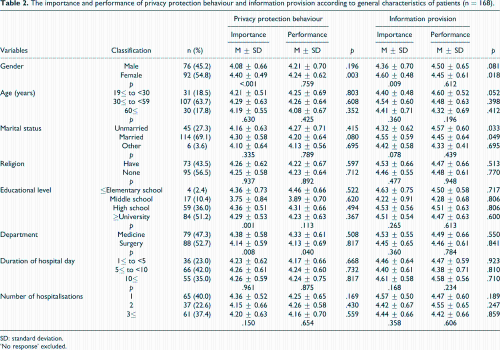
Differences between the importance of privacy protection behaviours and information provision by patients’ general characteristics and the performance of nurses as perceived by the patients are shown in Table 2. The importance of privacy protection behaviours showed significant differences by sex (p < .001), educational level (p = .001) and hospital ward (p = .008). A higher level of recognition of the importance of privacy protection behaviours was found among female patients, patients with an educational level at or below elementary school or at the high school level and patients who were hospitalised in the internal medicine wards.
The importance and performance of privacy protection behaviour and information provision according to general characteristics of patients (n = 168).
SD: standard deviation.
‘No response’ excluded.
The level of the nurses’ performance of behaviours regarding privacy protection, as perceived by the patients, showed a significant difference by hospital ward (p = .040). The degree of nurses’ performance of privacy protection behaviours, as perceived by the patients who were hospitalised in the internal medicine ward, was higher than it was for those hospitalised in the surgical wards. The level of importance that patients attributed to privacy protection was higher than the level of performance to protect their privacy, but only in the case of female patients (p = .003).
Among the patients, the importance of providing information significantly differed by sex (p = .009), with the female patients placing more emphasis on information provision than the males did. In contrast, no significant differences were found by patient characteristics in their perceptions of the nurses’ degree of information provision. However, the patients’ recognition of importance was higher than their perceptions of the nurses’ performance in providing information among female (p = .018) and married patients (p = .049). In contrast, perceived performance was higher than was important in single patients (p = .033).
Differences in the perceptions of the importance and performance of privacy protection behaviours and information provision between nurses and patients
To assess the importance and performance of privacy protection behaviours and information provision for nurses and patients, the y-axis was set as ‘Importance’ and the x-axis was set as ‘Performance’. Data were analysed using IPA, and the results are shown in Figure 1. The results of the analysis of each sub-factor of privacy protection behaviours are as follows. Patient information management, located in the first quartile, showed higher importance but below-average performance, and physical privacy, located in the second quartile, indicated that both importance and performance perceived by the patients were high. For communication, located in the third quartile, both importance and performance were below average. The sub-factors of information provision (medication administration, and information provision before invasive nursing procedures) were located in the second quartile, and both importance and performance were higher than average. Importance and performance of the nursing care plan, located in the third quartile, were below average, and discharge plans, located in the fourth quartile, was below average in importance and above average in performance.
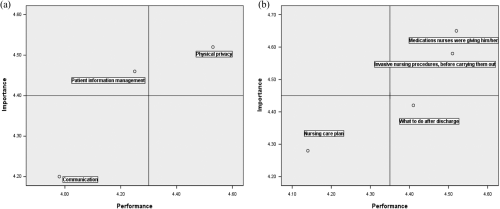
Comparison between importance and performance of privacy protection behaviour and information provision among subjects: (a) importance and performance of privacy protection behaviour among subjects and (b) importance and performance of information provision among subjects.
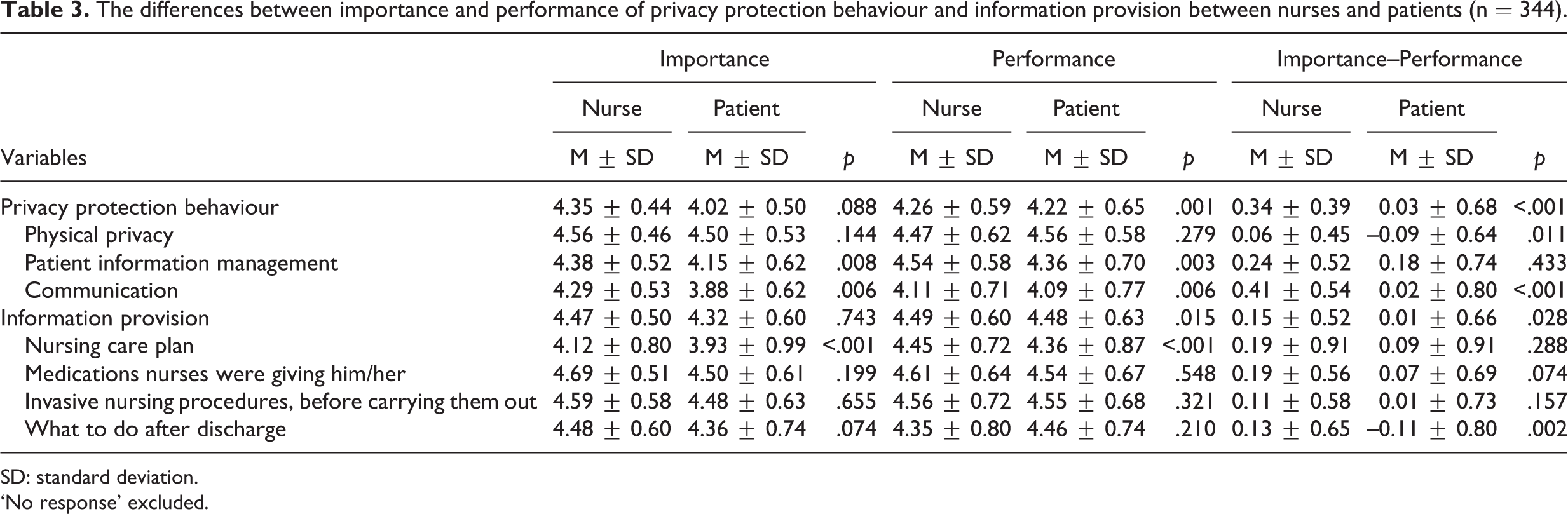
The difference between the importance and performance of privacy protection behaviours and information provision, as perceived by nurses and patients, is shown in Table 3. The importance of each sub-factor of privacy protection, as perceived by the nurses, was found to be higher than that perceived by the patients in patient information management (p = .008) and communication (p = .006). The performance perceived by the nurses was higher than that perceived by the patients for privacy protection (p = .001), patient information management (p = .003) and communication (p = .006). Significant differences between importance and performance were found for privacy protection (p < .001), physical privacy (p = .011) and communication (p < .001), and differences between the nurses’ perceptions of the importance and performance were higher than the patients’ perceptions of privacy protection and communication. The difference in the patients’ perceptions of importance and performance was higher for physical privacy. The importance of information provision for nursing plans (p < .001) was higher for nurses compared to patients, and the nurses’ perceptions of performance of providing information were higher than that perceived by the patients for information provision (p = .015) and the nursing care plans (p < .001). The differences between the nurses’ and patients’ perceptions of information provision (p = .028) and discharge plans (p = .002) were statistically significant, and the difference between the nurses’ perceptions of the importance and performance was greater than that of the patients.
The differences between importance and performance of privacy protection behaviour and information provision between nurses and patients (n = 344).
SD: standard deviation.
‘No response’ excluded.
Discussion
A nurse is the healthcare provider who is closest to the patient and has a duty to recognise the importance of providing information. The nurse also has an obligation to create an ethical medical environment based on understanding and using various practices to ensure the protection of patients’ privacy.
The differences in the nurses’ perceptions of the importance and performance of behaviours regarding privacy protection were analysed by the nurses’ general characteristics. Married nurses, nurses with a higher level of education and nurses in a charge nurse or higher position recognised privacy protection for patients as important; however, there was no significant difference in their perceptions of nurses’ performance in this area. This finding was similar to the results of previous studies reporting that nurses with more clinical experience 7,16,17,24 and nurses in higher positions 17 showed a higher level of recognition of the importance of privacy protection for patients. This result also is partly consistent with the results of previous studies 7,16,24 reporting no differences in performance by nurses’ general characteristics; but it differs from a previous study 17 that reported differences in accordance with the nurses’ clinical experience and position. These differences might emerge due to the variability of the work settings of the participants in previous studies. In this study, the level of importance assigned to privacy protection and information provision by the nurses with less than 1 year of clinical experience was highest, whereas their performance was lower but not significantly lower. The degree of importance perceived by the nurses with clinical experience of more than 5 years was the next highest, and their perceived performance was the highest in this group. This finding is similar to the results of previous studies 16 reporting that new nurses recognise the importance of patient privacy protection and information provision. As they become more familiar with the clinical site, their recognition of the importance of both needs gradually declines. The recognition and level of practice to ensure privacy protection and information provision may increase with further clinical experience, and therefore, with further educational experience related to privacy protection. The roles and responsibilities of nurses increase in accordance with increases in rank. 16,17 Therefore, it will be necessary to offer different educational programmes to promote nurses’ understanding and interventions for privacy protection and information provision depending on their clinical experience.
The importance and the performance of information provision did not differ by the nurses’ general characteristics, and no definite conclusions can be reached given the lack of previous research in this area. However, the nurses’ recognition of the importance of privacy protection and information provision was higher as compared to their performance. That is, the recognition of privacy protection or information provision among nurses was relatively high, but their level of performance did not match their recognition. Various factors, such as policies and regulations, the healthcare system and nurses’ general characteristics may have affected this difference. Specifically, the type of healthcare model (e.g. primary vs team nursing), nursing system (e.g. charge nurse system) and the hospital’s physical environment may have affected the nurses’ performance of behaviours regarding patients’ privacy protection. 7,16,28 Therefore, multilateral efforts at the institutional and individual level of the nurses are required to create an ethical medical environment.
Privacy protection was recognised as highly important by female patients, patients with an elementary school or lower level of education, a high school graduate or higher level of education and those hospitalised in the internal medicine wards. The importance of information provision was also higher in the female patients. These results differ from those of a previous study, 26 which found that patients with a higher level of education and those hospitalised for the first time showed higher levels of recognition of the importance of privacy protection. However, a direct comparison is difficult because there are no other previous studies. The present findings suggest that women may be more sensitive to body exposure and the confidentiality of personal information, showing a higher need for information provision as compared to men. Furthermore, those with a lower level of education may require greater protection of personal information, and internal medicine patients with extended hospital stays may assign greater importance to privacy protection as compared to surgical patients discharged after a relatively brief time following surgery. Generally, hospitalised patients prioritise medical treatment over their privacy protection and tend to show low levels of awareness of privacy protection implemented in the hospital. 16,29 Recently, however, as patients’ awareness of their rights increase, the demand for privacy protection increases, and lawsuits related to violations of patients’ rights and liability for explanations increase at a faster rate than those related to medical technology mistakes. 4 Hence, research is necessary to identify the factors affecting patients’ perceptions of the importance and the performance of privacy protection and information provision with respect to diseases, situation-related characteristics and the individual characteristics of the patients in future studies.
The difference in perceived importance and performance of privacy protection between nurses and patients and the IPA analysis of privacy protection can be interpreted as follows. Of the sub-areas of privacy protection, patient information management requires intensive attention – it was located in the first quartile, showing high ratings for importance but low performance. Physical privacy was located in the second quartile, demonstrating a need for continuous maintenance due to high ratings of importance and performance. Communication, which was located in the third quartile, can be lowered as a management priority due to its low ratings on importance and performance. However, given the assumption that all aspects of patients’ privacy should be protected, the present findings indicate that the current state of importance and performance of privacy protection interventions in the clinical setting are insufficient.
According to this study’s results, both nurses and patients perceived the importance and performance of providing physical privacy as the highest among the behaviours intended to protect patients’ privacy. This finding is consistent with the results of earlier research on privacy from European countries 30,31 and recent Korean studies 7,16,26 reporting that physical privacy is recognised as the most important need for both patients and nurses. Recently, the importance of an ethical environment has been highlighted for its potential in developing policies to address the confidentiality of personal information, provide adequate measures to protect the emotional and physical privacy of patients and provide auditory privacy with regard to communication involving patients’ personal information. 7,32 Therefore, multidimensional efforts are considered necessary. Nurses should participate in substantive and ongoing education based on an understanding of the needs in different areas to ensure physical and emotional privacy protection. Medical institutions should establish related policies and strategies with the ultimate goal of protecting patients and providing effective nursing care.
The difference in the importance and performance of information provision between the nurses and patients and the IPA analysis of information provision can be interpreted as follows. Information provision before medication administration and invasive procedures, which were located in the second quartile, require continuous monitoring to maintain the high ratings of both importance and performance. Information provision related to nursing care plans, located in the third quartile, can be lowered as a priority because of its low importance and performance; information provision related to discharge plans, located in the fourth quartile, requires a strategy to eliminate or improve excessive management. In particular, both importance and performance of providing nursing-related information, as perceived by the nurses and patients, were lower. This finding is similar to a previous one in which patients assigned the lowest rating to the level of the usefulness of information related to nursing plans that they received from the nurse. 20
A nursing plan is a systematic and scientific process developed by nurses. During an explanation of a nursing plan to a patient, the nurse can assess the patient’s involvement, thereby increasing the likelihood of a positive outcome. The present findings suggest, however, that both nurses and patients showed lower levels of recognition of the importance of nursing plans as well as lower levels of implementing them. Accordingly, both patients and nurses should increase their recognition of the effectiveness of nursing care plans. The nurses’ and patients’ recognition of the importance of discharge plans was slightly lower, and in the case of the patients, performance was unusually higher than importance. 33,34 This finding might have resulted from a reduction in patient satisfaction because the discharge education currently conducted at the clinical site is implemented based on the educational needs identified by nurses in accordance with formal procedures, as opposed to their proper identification in collaboration with patients. Therefore, nurses should provide truthful information that can satisfy patients by evaluating their individualised educational needs before discharge and providing specific information about plans after discharge.
The limitations of this study are as follows. First, since this a cross-sectional study, which sampled participants from only four university hospitals in South Korea, a causal relationship between the importance and performance of privacy protection and information provision by nurses and patients cannot be inferred. Second, because the study used self-report measures, the level of nurses’ practices regarding privacy protection and information provision might have been underestimated or overestimated.
Conclusion
The variety of uses of patient information in medical institutions requires special attention to protect the patient’s privacy. It also is important to provide adequate information to patients with an emphasis on their right to know and self-determination. Thus, this study compared the importance and performance of practices to ensure privacy protection and information provision, as perceived by patients hospitalised in medical institutions and the nurses caring for them. In this study, the nurses’ perceptions of the importance of privacy protection interventions and information provision were rated higher as compared to performance, whereas in the case of the patients, the level of performance was rated higher than importance. Furthermore, the nurses’ perceptions of the importance of privacy protection and information provision were higher than the patients’ perceptions, but performance was rated lower. Nevertheless, this study’s findings suggest that the clinical sites are not maintaining necessary performance given that the need for protecting patient privacy and providing information should be fulfilled entirely. Patients’ needs are being met, as the importance of these needs recognised by nurses is higher and the performance is lower compared to patients’ perceptions; however, further efforts are needed to provide complete protection of patient privacy and information provision, as the patients’ bill of rights and liability for explanations have been emphasised more recently in medical institutions.
This study is important in that it is the first study comparing the importance and performance of privacy protection and information provision, as perceived by nurses and patients. The difference between the recognition of the importance and the performance of privacy protection and information provision between nurses and patients should provide information to develop interventions to create an ethical medical environment. However, to verify the difference between the relevant variables, future research should include multidimensional variables related to individual characteristics, disease-related characteristics, environmental characteristics of medical institutions and general characteristics of nurses and patients. 34
Footnotes
Acknowledgement
The authors thank Dr Ingravallo for granting permission to use the questionnaire.
Conflict of interests
The author(s) declared no potential conflicts of interest with respect to the research, authorship and/or publication of this article.
Funding
The author(s) disclosed receipt of the following financial support for the research, authorship, and/or publication of this article: This research was supported by Chung-Ang University nursing doctoral alumni association.