







Abstract
Background:
Education is considered the first function and mission of the university, and observing educational ethics guarantees the health of the teaching–learning process in the university.
Aim:
The aim of this study was to explore ethical values in nursing education from the perspective of Iranian nursing students and educators.
Research design:
This qualitative study was conducted using the Thematic Content Analyses method. The data were collected from seven semi-structured individual interviews and three focus group discussions from July to November 2015.
Participants and research context:
The participants were faculty educators of nursing and nursing students in Tehran, capital of Iran, who were selected through purposive sampling. They were recruited gradually. Sampling was continued until data saturation when no new codes were extracted.
Ethical committee:
This study was conducted after obtaining the approval of Shahid Beheshti University of Medical Sciences Ethics Committee, and informed consent were ensured before conducting the research. The principles of voluntariness, confidentiality, and anonymity were respected during the research process.
Findings:
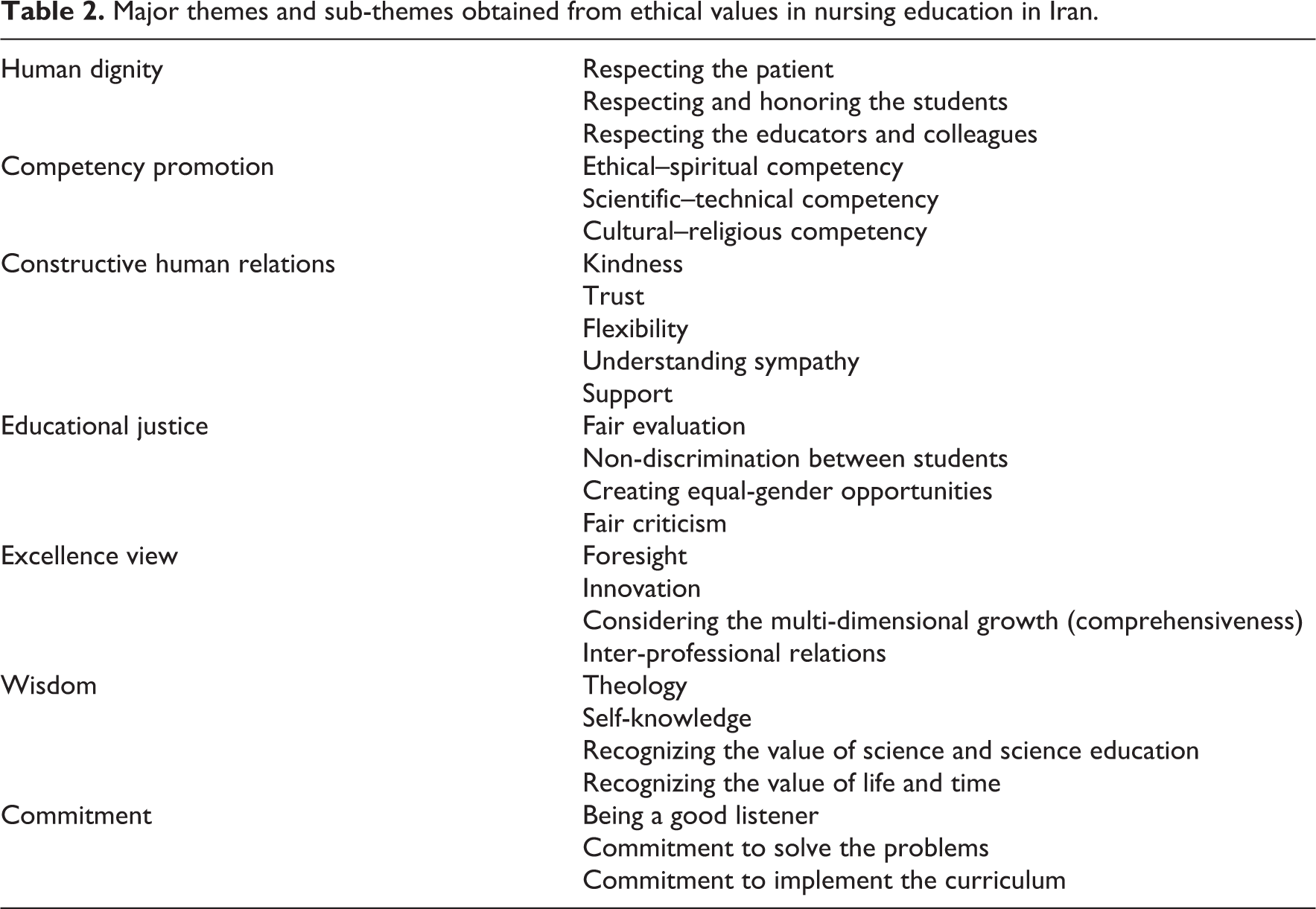
Seven major themes emerged: human dignity, constructive human relations, educational justice, competency enhancement, excellence view, wisdom, and commitment and accountability.
Conclusion:
The results of this study indicated that although many of the values, as universal values, were similar to those of other countries—which can be a reflection of the globalization process in the nursing profession and the presence of humanistic and spiritual approaches at the roots of the discipline, some differences could be found in the content of values due to factors such as the people’s beliefs, culture, and religion. Iranian nursing students and educators revealed a unique and culture-based set of ethical values.
Introduction
Values are defined as a set of concepts determining the world view of the individuals, and encompassing their likes and dislikes, viewpoints, requirements, tendencies, realistic and unrealistic judgments, and prejudices. 1 It is stated that the preferences of individuals are related with their values and may change through social interaction. These values are standards for working and provide a framework for behavior evaluation 2 and are hierarchically prioritized according to each individual’s value system. 3 Values are considered a major source of ethics. In other words, ethics is the implementation of values. 4 Personal beliefs, values, and ethical standards are developed over time. They are shaped by culture, familial and social experience, political structures, religion, and much more. Professional ethical beliefs are not only derived from these factors but also from interactions with faculty and colleagues. 5
Nursing begins with education. In order to have nurses who observe professional ethics in future, it is important to consider universities as one of the most influential environments for institutionalizing the ethical values and principles. After admission to the university, the students are entitled to appropriate education. Proper ethical relationships are very helpful in achieving this goal. 6 Meanwhile, faculty members have to undertake a major role in managing and directing the educational affairs. Faculty members’ adherence to the principles and values of professional ethics is significantly important in developing an ethics-based organizational culture, transferring distinctive features and human values to the students, and consequently spreading them in the society. 7 Salminen et al. conducted a study in 2015 which describes ethical principles and issues relating to the work of nurse educators from the perspectives of both nurse educators themselves and nursing students. The result indicates that students most often named professionalism, justice, and equality as the main ethical principles for a nurse educator. Nurse educators considered justice, equality, and honesty as the main ethical principles. 8
Several studies have been conducted around the world in relation to ethics in nursing education, but according to Fowler and Davis,
9
The literature labeled “ethics in nursing education” is entirely devoted to curricular matters of ethics education in nursing schools, that is, to what ought to be the ethics content that is taught and what theory or issues ought to be included in all nursing curricula.
Iran is an ancient country with over 2500 years of rich history, culture, and civilization and a population of over 70 million people. 12 About 98% of Iranians are Muslims, who consider nursing as an act of worship. Iranian religion and culture are rooted in country’s healthcare system and nursing performance. Nursing is regarded as a profession that helps better serve mankind and perform good deeds for God’s sake. 13 The religious discipline and cultural beliefs of the Iranian people have entered the realm of the education system. 14
The recent increase in ethical conflicts in healthcare necessitates further addressing of ethical values in education. As a result of the lack of a precise definition for ethical values in Iranian nursing education, the problems in this area are not managed well. Developing ethical values in nursing students strengthens their capacity for reasoning and ethical decision-making in challenging situations and enables the provision of safe, legal, and ethical care. Considering all mentioned here, it was decided to conduct a study with the aim to explore ethical values in nursing education from the perspective of Iranian nursing students and educators through a qualitative method that enables a clear, comprehensive, and in-depth assessment and understanding of this concept. As naturalistic paradigm and qualitative methods accept that reality is context-based and also agree to the possibility of the existence of multiple realities, such approaches are better suited for investigating less familiar areas of knowledge. 15
Methods
This qualitative study was conducted using the Thematic Content Analyses method, deemed appropriate to investigate and explore ethical values in nursing education.
Participants
The study participants were selected from the faculty educators of nursing and nursing students of selected nursing schools in Tehran through purposive sampling. The study inclusion criteria consisted of knowledge about the subject and willingness to share one’s experiences about it. Four of the faculty educators were males and three were females, and all aged 34–55 years and had a work experience of 3–25 years. Their faculty position varied from instructor to professor. A total of 19 women and 6 men, 13 undergraduates, 7 graduates, and 5 PhD students, from different years of their university program aged 18–35 years entered the study.
Data collection
The data were collected from semi-structured individual and group interviews with 32 participants from July to November 2015. Seven individual interviews were done with educators and three focus group discussions (FGDs) were carried out with 13 undergraduates, 7 graduates, and 5 PhD students. In all individual interviews, the first and second authors (M.B. and A.A.) arranged and conducted all the interviews together. To this end, contacted faculty member on the phone or in person, and briefed them about study method and objectives. In individual interviews, the process continued by asking questions such as, What is your experience of ethical values as a nursing educator? Would you please explain one day when you are satisfied with your work? Which educator from your graduate level do you consider as an ethical role model? What were his/her main ethical traits? What outstanding ethical traits do you remember when thinking about him/her? In your opinion, what ethical values should be prominent in nursing students?
In FGD with students, the homogeneity of the group-discussion participants was ensured so as to create an interactive atmosphere of free expression. The first and corresponding authors (M.B. and F.B.) directed the discussion and recorded the conversations. Interactive dialogues and exchanges in each group and within the groups were documented. Such an approach helped gather field notes by observing participants’ interaction within the groups and obtaining perspectives derived from personal experiences which could be compared with other individual views. Prior to the beginning of each session, written informed consent was obtained and continued with asking questions such as, What is your experience of ethical values as a nursing student? Which one of your educators do you consider an ethical role model? What are his/her main ethical traits? What outstanding ethical traits do you remember when thinking about him/her? Please explain more about them.
Data analysis
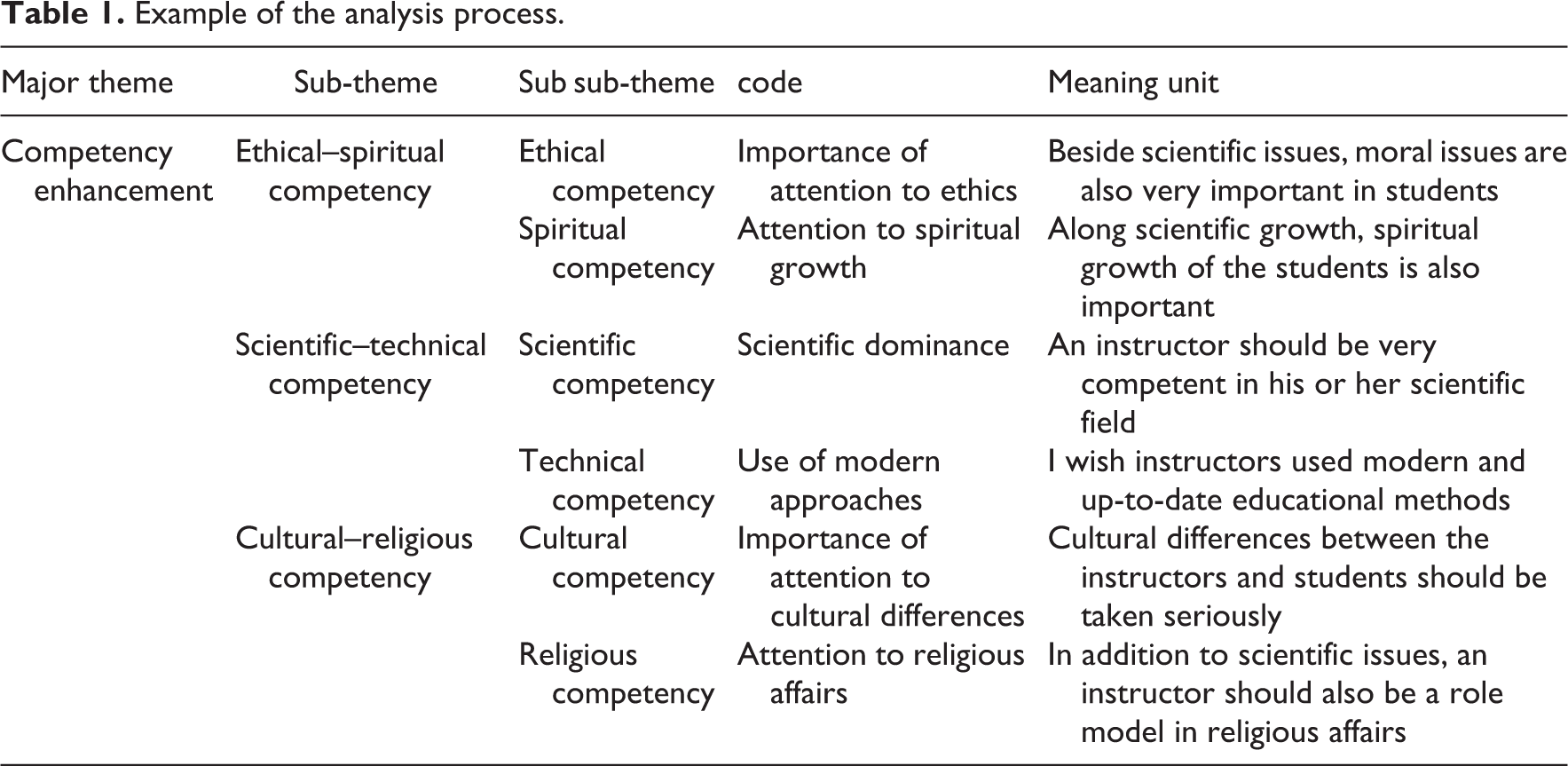
Data were analyzed concurrently as they were collected using conventional content analysis in MAX-Q software. In this study, qualitative content analysis included eight stages, as recommended by Graneheim and Lundman beginning as follows: (1) listening to the recorded interviews and repeated reading of the recorded audio files and notes; (2) interviews were transcribed verbatim and saved in MS Word 2010, and the data were inserted into the MAX-Q 10 software; (3) data from field notes were analyzed and integrated; (4) content areas were determined; (5) data from interviews, FGD, and field observations were collected and tabulated to obtain a general idea about the contents; (6) data were coded by two independent reviewers; (7) categorized data were coded based on similarities; and (8) major themes and sub-themes were identified 16 (Table 1).
Example of the analysis process.
Data trustworthiness
To ensure the rigor of the data, accurate scientific criteria were used, including credibility, trustworthiness, and Guba–Lincoln conformability and compatibility, quoted by Speziale et al., 15 as well as different credibility methods such as long-term involvement with the subject and data (as a colleague and instructor), presenting the data to participants, and comparing similarity of extracted data with participants’ views. Furthermore, parts of interviews, codes, and themes were examined and confirmed by external check through two qualified researchers and nursing ethics specialists, and a specialist who had previously worked on ethical values in nurses. All stages and processes of the study were recorded and reported to make follow-up possible for other researchers. For transferability of results, participants’ quotes were exactly presented, so as to enable readers to decide about use of codes.
Study limitations
Since Iran is a country with ethnic, cultural, and religious diversity, one of the limitations of this study was that it was conducted only in Tehran. The research team members tried to overcome this limitation through selecting the participants with maximum diversity in terms of age, teaching history, employment location, and educational level.
Results
During the coding process, 602 primary codes and 35 sub-themes, based on which 7 major thematic contents were found expressing the participants’ understanding of ethical values in nursing education (Table 2).
Major themes and sub-themes obtained from ethical values in nursing education in Iran.
Human dignity
Sub-themes such as respecting the patient, respecting and honoring the students, and respecting the educators and colleagues originated from the primary codes representing the major theme of human dignity. Special attention to patients’, students’, and educators’ dignity was something that was expressed and stressed in most interviews: …Some educators humiliated the students and found faults with them in front of the patients. Until the last day of internship, whenever the patients saw us, they said, “Hey! You’re the one who doesn’t know how to do his job.” (Graduate student, semester 1) …We once went to the conference room for a lecture. A doctor knocked on the door and said, “We need the room for a lecture now.” Our educator did not even ask them to wait for ten minutes. Instead, s/he said to us, “Hurry up! Hurry up! Leave the class at once”…(Graduate student, semester 3)
Competency enhancement
Ethical–spiritual competency, scientific–technical competency, and cultural–religious competency that originated from primary codes constituted the major theme of “competency enhancement” as a value in nursing education. The nature of nursing education requires that educators and students in the process of professionalism consider traits and characteristics such as honesty, truthfulness, patience, confidentiality, scientific modesty, and kindness as the components of ethical competency. Moreover, the educators should pay attention to the students’ spiritual matters as an element of spiritual competency.
Students emphasized that educators should have specialized knowledge and try to promote it to maintain their academic status. Perseverance in learning, enhancement of learning, careful planning for each class, active participation of students in learning, and using new teaching approaches were considered as values in nursing education, forming the “scientific–technical competency” sub-theme.
The “cultural–religious competency enhancement” theme was obtained from sub-themes such as the importance of the students’ fostering issues, students’ educational issues, training of civilized behaviors, educators’ faithfulness, educators’ religious behaviors, attention to students’ religious affairs, and using and seeking help form religion in teaching ethical values: It is very important that an instructor, in addition to making efforts for scientific improvement, try to enhance his/her students’ spirituality and bring them close to God. (An associate professor with 10 years of experience)
Constructive human relations
This theme was composed of sub-themes such as kindness, trust, flexibility, and understanding sympathy. According to the participants, establishing constructive human relationships between educators and students was one of the important ethical values in nursing education. The participants believed that in cases of emergency and/or non-compliance with one of the educational values on the side of the students such as being late, the educator’s knowledge of his or her students by name and having a background of them in mind could help the educator to reasonably and logically decide about the students, and if there were some excuses from the opposite side, the educator should rely on the background of the students. This was one of the highlighted requests of the students from their educators: For instance, I happened to be late for some minutes. The educator did not care who I was; I was always punctual; s/he just said, “Go to the faculty and they will decide what to do about your case”…I could have had an accident. (Graduate student, semester 2)
Educational justice
According to the experience of participants in this study, one of the themes referring to ethical values in nursing education was educational justice. Fair evaluation, non-discrimination between students, creating equal opportunities for male and female students, and fair criticism comprised this value: One of our female educators had better relations with the boys than the girls. (Graduate student, semester 1)
Excellence view
Foresight, innovation, attention to multi-dimensional growth, and inter-professional relations were among the values depicting the major value of “excellence view.” Many students considered interaction with other disciplines, especially medical students and educators, effective in prosperity and depth of learning and welcomed it: We had an educator who had a good relationship with doctors. His self-confidence was high enough. He also taught us not to be afraid of the doctors and to communicate with them. When there was a special procedure in the ward, he took us along with the residents, explained everything as far as he could, and asked the doctors any supplementary question. (Graduate student, semester 3)
Wisdom
According to the experience of participants, one of the themes referring to ethical values in nursing education was wisdom, which included sub-themes such as theology, self-knowledge, recognition of the value of science and science education, and recognition of the value of life and time. Conversely, the educators stated that they wished the students would know that they were paying the price of learning with their life and youth, and that they would take the lessons more seriously. Since nursing education requires working with humans, the participants viewed theology and self-knowledge as two factors that produced love and kindness: …When I teach them to love each other, they will learn to love and to be kind to everyone. They will learn to love God in the first place, love themselves, and regard themselves with value and respect. (Faculty member instructor)
Commitment and accountability
Listening well, commitment to solving the problems, and commitment to implementing the curriculum were among the values representing the major value of “commitment and accountability.”
According to the experience of the participants, commitment to implementing the curriculum was one of the values portraying the major value of “commitment” in nursing. As stated by the participants, a part of the regular and hidden curriculum should be done with careful planning in each session. Both instructors and students must be committed to its implementation to achieve the educational goals.
Discussion
The participants believed that abiding by educational ethics was one of the factors guaranteeing educational health. In this study, the participants mentioned human dignity as an important ethical value. The simplest definition of human dignity is an inherent value considered for an individual because of his or her human virtue. 17 Human dignity is a complex and multi-dimensional concept. 18 The Center for Nursing Scholarships Excellence in Italy has analyzed the concept from two perspectives: the first is related to the dignity of the patients which is referred to as an inherent value in healthcare whose most particular manifestation is in the work the nurses do. The second, however, is unclear and named as nursing professional dignity. It is considered to be an inalienable right that is very effective in one’s self-esteem and professionalism process. In an effort to define the nursing professional dignity, this study discussed values such as showing respect for the dignity of the profession, students, educators, and the healthcare personnel. 19
Another value obtained in this study was “competency enhancement.” Competency is an ambiguously complex concept and one of the controversial issues in healthcare which is of great significance in various fields of nursing, including education, bedside nursing practice, and management. Competency, which is defined as behaviors based on safe actions and outcomes, 20 is a varying and dynamic process. 21 One of the aspects of this value is the cultural–religious aspect on which the participants put much emphasis. Chenowethm et al., 22 quoting Yoder et al., stated that cultural competency could be defined as raising self-consciousness, increasing the knowledge about the audience, and understanding health and cultural beliefs of different groups. Campinha-Bacote 23 also described the five components of cultural inclination, awareness, skill, knowledge, and confrontation as requirements of cultural competency. Many of the students regarded being understood by educators as one of their major concerns. They also stated that having a particular culture, language, and/or being from a certain city was either a negative or a positive factor—depending on the case—in the relationship between the instructors and students. Therefore, the role of the faculty members is important both in teaching cultural competency to students, serving as a role model for them, exhibiting good personality traits and the ways of interactions with the patients, as well as the multicultural diversity of the students at universities. 24 Throughout its long history, Iran has always been the land of different ethnic and religious groups. Nowadays, in addition to ethnic diversity, Iran is considered to be one of the major refugee foci in the world, and foreign immigrants make up part of its demographic composition. Furthermore, one of the important issues of the Iranian higher education system is the presence of foreign students in the universities. Another issue, in addition to this diversity, is the presence of the religious minorities in the universities. The presence of such ethnic and religious groups necessitates a cross-cultural perspective in the face of such cultural diversity. It indicates the importance of religious competency in addition to cultural competency. According to many studies, since nursing is a profession in which the probability of the exposure to patients with diverse cultural and health beliefs is high, it is recommended that this competency should be specially promoted in nursing students, and that nursing instructors should be more sensitive to the cultural differences among their students.
Another aspect of competency enhancement was the scientific–technical side of this value that can be viewed from a perspective related to the knowledge and expertise of educators, which is indisputable and indispensable according to the study participants. The Medical Council of India ethical codes necessitate 3 years of experience as the minimum standard for obtaining the degree of an assistant educator. 25 It shows the importance of education, teaching, and experience. Another aspect of this competency can be viewed from the perspective of competency-based education (CBE). According to many experts of nursing education, CBE is considered to be the foundation and the philosophy of nursing education. 26 In this model, the emphasis is more on outcomes rather than acquiring knowledge, and by outcome, values such as efficiency, effectiveness, quality, and accountability in students are intended. 27
Another important aspect of competency enhancement was ethical–spiritual competency as a value in nursing education. In the ethical codes developed by the New Zealand Medical Association, 28 respecting the rights of others, independence and freedom of choice, avoiding exploitation, privacy, confidentiality, promotion of medical knowledge and skills, and respecting the profession, its values, and principles were mentioned as ethical values. 29
The participants in this study recognized “constructive human relationships between educators and students” as one of the most important ethical values in nursing education, and as a factor to improve professional satisfaction and decrease educational weariness. They believed that the friendship between educators and students was important, only if the boundaries were observed. The participants expressed their dissatisfaction with their educators’ not keeping their social class, and being too close to their students. Educators, however, considered such cases as a result of the teachers’ little social experience and unprofessional behavior. In a study in 2013 on the ethical issues in the context of nursing education, it was found that in higher education papers, issues such as sexual relationship between educators and students were discussed in depth. However, in nursing studies, only a few articles aimed at alerting the educators have discussed the potential risk of sexual relationship between the patients and the students. 9 Even in this study, nothing was mentioned about informal relationships between instructors and students, and/or patients and students in any of the interviews. What was listed as the value of the relationship between educators and students was observing the boundaries of friendship. In Iran, as a result of the “gender conformity” plan—that is, the nurse and the patient must be of the same gender—and the cultural–religious atmosphere prevailing in educational organizations and hospitals, the probability of such issues is minimized. Given the prevailing view of such misconducts as something truly disapproved in the society, even if there are such cases, they are never officially reported.
Another aspect of human relations emphasized by the students was the mutual trust between the educators and students. Many studies have been conducted on the trust between nursing educators and students. The trust between educators and students is a basic principle in pedagogy. 30,31
Educational justice was expressed as another important value in nursing education. Justice is the core of ethics in nursing education. 32 Educational justice means giving all talents equal opportunities and making equal efforts in empowering all the learners. 33 A study by Zarandi et al. 34 on the status of educational justice in clinical nursing education in Iran showed the five themes of educational justice “in the clinical evaluation,” “in having an appropriate physical environment for clinical training,” “in having equal rights for all students from different disciplines,” “in having the experienced trainers regardless of geographic location,” and “about communications at the bedside.”
Among the values introduced in this study as the major themes was the excellence view with sub-themes such as foresight and innovation. According to the participants, monotony in education and using teaching methods such as lecture were viewed as counter-values in education. From a broader perspective, the educators also underlined the need for foresight on the side of nursing managers, regarded conservatism as inefficient, and called for the use of development strategies instead of sustaining the status quo to make some advances in nursing and professionalization. In line with these experiences, the findings of other studies on innovations in nursing education suggest using modern methods such as e-learning and online teaching. 35 Moreover, in one study addressing the strategies to explore innovations in nursing, it was explained that innovation required time and space to work successfully. 36
One of the important ethical values in nursing education according to this study was the value of wisdom. Wisdom is the path toward excellence of mind and virtue with the help of knowledge and personality integration. Wisdom is one of the people’s intellectual development goals that can be achieved with the help of knowledge, critical thinking skills, creative problem solving, and philanthropy. 37 Promoting wisdom in nursing education as a value can be regarded as a unique vision on curriculum development and an answer to the problems of the nurses in the 21st century.
Conclusion
Although the results of our study showed that many values were similar to values of other countries, which could be a reflection of the process of globalization in nursing and the presence of humanistic and spiritual facets in the roots of this profession, differences are seen in the content of the values due to differences in factors such as beliefs, culture, and religion. Despite its similarities to higher education in other majors, nursing education has some characteristics that distinguish it from other majors. The characteristics of compassion and care are not exclusive to the nurse–patient relationship but are manifested in the daily interactions of the nursing instructors with all people, including the students, patients, and colleagues. Therefore, there is a marked difference in training and education between nursing and other higher education major. Moreover, order and discipline in performing nursing tasks and the simultaneity of training with providing nursing care to patients in the field and at the patient’s bedside are other differences of nursing with other majors, which makes some ethical values unique to this major. Ethical values do not transform to action on their own until they become objective principles. Since ethical values form the basis of ethical codes and because not much attention has been paid to ethical codes of nursing education when they were codified, the findings of this study can be a basis for systematization of ethical codes in nursing education in Iran.
Footnotes
Acknowledgements
The authors would like to thank all the students and educators who participated in this study and exchanged their experiences in the interviews.
Conflict of interest
The author(s) declared no potential conflicts of interest with respect to the research, authorship, and/or publication of this article.
Funding
The author(s) disclosed receipt of the following financial support for the research, authorship, and/or publication of this article: This project was supported by the Shahid Beheshti University of Medical Sciences.
Ethical considerations
Formal research approval was obtained from ethic center of Shahid Beheshti University of Medical Sciences and nursing schools (ethics code: SBMU2.REC.1394.101). A letter including information on the methodology and protocol of the study was given to all the educators and students who then granted their written informed consent to participate in this study. The form stated that only research team members had access to identifiable data, and all the information would be kept confidential in a secured case in the office of the senior researcher. Before the interviews started, the aim of the study was re-presented and informed consent was obtained from all participants to record the data. It was also explained that every participant had the right to withdraw from the study at any time.