







Abstract
Objective:
To analyze the empathic profile and the empathy scores of freshmen of the nursing course.
Design and participants:
Descriptive study involving 399 freshmen students of two modalities of nursing courses: Bachelor and Bachelor and Teaching Diploma, in the period from 2012 to 2015. A sociodemographic questionnaire and the Empathy Inventory were applied.
Ethical considerations:
The research received approval from the Research Ethics Committee of the University of São Paulo at Ribeirão Preto College of Nursing. The students registered their acceptance to participate in the research by signing the Free and Informed Consent Form and anonymity was guaranteed.
Findings:
The mean age of the participants was 19 years, being 85.5% female. The students were grouped by course modality and all groups presented high empathy scores. A significant difference (p < 0.001) was found, which indicates that students of the Bachelor and Teaching Diploma program presented a higher degree of empathy for the General Score, Domain 2 (Interpersonal Flexibility), and Domain 3 (Altruism) in relation to students in the Bachelor program.
Conclusion:
Results show that nursing undergraduate freshmen are emphatic, with minimum differences between the two courses. This profile is relevant for the development of future professionals capable to demonstrate a balance between instrumental and expressive competences.
Introduction
Even before its concept was defined in the nineteenth century, it was acknowledged that empathy pervades human relationships. The origin of the word “einfühlung” dates back to 1873, when the German philosopher Robert Vischer defined it as a projection of an observer’s internal predisposition in response to the perception of an object. 1 Translated into English in 1909, the word was called empathy, meaning a set of internal characteristics that stimulate the search for knowledge of the other. 2
Nursing is characterized as a profession whose mission is to promote the human being through care, considering and respecting it in its freedom, oneness, and dignity. It is a profession that is sensitive to the internalization of values that, in conjunction with specific knowledge, guide and sustain professional practice. Caring presupposes the need for a set of attitudes that promote the full application of acquired knowledge, taking into account that knowledge is always necessary, but not enough: the attitudes in tune with the knowledge are crucial for a good practice of this profession. 3
Care favors and strengthens the professional experience that takes place in the extensive possibility of meeting and relationship between nurses and the human beings they take care of. In this context, the constant presence of nurses at the side of those who are cared for determines the significance of the social role of nursing. 4
In the performance of their role, nurses need to harmonize two sets of skills: expressive and instrumental. The simultaneous use of rationality and sensitivity requires technical–scientific competence, dexterity, politeness, kindness, delicacy, affectivity, and courtesy, that is, having the competence to develop evidence-based care adjusted to the rhythm of scientific and technological developments and, at the same time, benefiting from their sensitivity, showing their presence as sensitive professionals. 5
Thus, nurse–patient interaction and empathy are fundamental, being a condition for nurses to understand patients’ feelings and to jointly build a care plan that seeks to promote their well-being. 6 This is only possible for individuals who have the will, dedication, commitment, responsibility, and are able to harmonize the instrumental and expressive skills. 7 The communication with the patient has therapeutic effects and supports the healing process, demonstrated by the achievement of positive results in psycho-social aspects, such as quality of life, anxiety, and depression, as well as in the improvement of objective parameters, such as the reduction of blood pressure and blood glucose levels. 8
Empathy is the basis for the understanding between the patient and the health professional and is considered a basic element in caring, also being associated with patient satisfaction. 9 It makes the relationship between the professionals and the patients more intense, allowing the latter to express their needs. 10 It is a prerequisite for nursing care and provides for improvements in the patients’ clinical and psychological conditions. 11
Considering the importance of empathy for nurses in their relationship with patients, the aim of this study was to analyze the empathic profile and empathy scores of nursing freshmen students, aiming at learning their level of empathy at the beginning of the program and addressing changes in the curriculum according to these data, with the purpose to maximize their learning on ethical aspects of care. The sample was formed by students from the two modalities of Nursing programs offered by the institution, as they have a different curriculum and structure. The results of this study may contribute to leverage learning and action based on the ethical principles of future nurses. These results will also offer a means to support pre-course assessments of nursing freshmen students. Although it is a study focused on Brazil and Brazilian Nursing students, these findings may be of interest to other nursing courses from different parts of the globe, showing the relevance of the empathic profile and empathy scores and of working with them in Nursing curricula in the process of forming nurses who will be able to provide an ethical care in their future career.
Design and participants
This is a descriptive, cross-sectional study with a quantitative approach. It was developed with freshmen enrolled in two nursing undergraduate courses at a Public Higher Education Institution in the interior of the state of São Paulo, which offers two modalities of nursing course: a Bachelor (lasting 4 years) and a Bachelor and Teaching Diploma (with duration of 5 years, which provides training for comprehensive professional practice, in addition to the pedagogical training legally required for professionals who will work in secondary nursing education, preparing nursing technicians). The research received approval from the Research Ethics Committee of the University of São Paulo at Ribeirão Preto College of Nursing (protocol 1348/2011).
Data were collected between 2012 and 2015, from first-year undergraduates from both courses, who were present in the classroom on the dates scheduled for the collection. The dates were scheduled in advance with the teachers responsible for the disciplines. The questionnaires were applied after the students registered their acceptance to participate in the research by signing the Free and Informed Consent Form. All the graduates present at the collection dates were invited to participate in the study, and the average time for completing the questionnaire was 20 min. Of the 520 (100%) graduating students in the years from 2012 to 2015, 399 (76.73%) participated in the research and answered two questionnaires, one regarding the sociodemographic data to characterize the participants and the Empathy Inventory (EI). 12 Research using the EI has been used to evaluate the levels of empathy, whether in adult volunteers 13,14 or in nursing professionals. 15
The EI consists of 40 questions that measure cognitive, affective, and behavioral behaviors. The answers are indicated on a 5-point Likert scale, in which 1 (one) corresponds to “never” and 5 (five) to “always.” The EI score can vary from 40 to 200 points, and the higher the score, the higher the individual’s empathic degree. The inventory has four domains, namely, Domain 1—Perspective Taking (PT), with 12 questions about a person’s ability to understand the perspective and feelings of the other; Domain 2—Interpersonal Flexibility (IF), consisting of 10 questions about the person’s ability to tolerate other people’s behaviors, attitudes, and thoughts, which are very different or frustrating. A low score in this factor indicates that the person has difficulty to accept different points of view and tends to be easily annoyed in situations of conflict of interest or interpersonal frustration; Domain 3—Altruism (AL), with 9 questions that reflect individuals’ ability to sacrifice their own interests for the purpose of benefiting or helping someone: a low score on this factor shows that the person is selfish; Domain 4—Affective Sensitivity (AS), which contains 9 questions that reflect feelings of compassion and interest in the emotional state of the other: a low score indicates that the person has little attention or care in relation to other people’s needs. 12
For data analysis, Student’s t-test was used, comparing two means from non-paired samples. For the use of this test, it is necessary to test if the variances of the two groups are statistically equal and if the data follow a normal distribution. This procedure was performed using the PROC TTEST, as well as the PROC generalized linear model (GLM) for analysis of variance (ANOVA), both in SAS® 9.0 software. For the comparisons, orthogonal contrasts were performed based on the t distribution. For the analysis of the EI’s general and domain reliability, Cronbach’s alpha coefficient was calculated.
Results
The sample comprised 399 nursing students, 341 (85.5%) of whom were female, with a mean age of 19 years, minimum variation of 18 years and maximum of 48 years. Eight groups of undergraduate freshmen students were analyzed: Group B1 consisting of freshmen from the Bachelor program of 2012 (15.8%); Group B2 Bachelor of 2013 (15.8%); Group B3 Bachelor of 2014 (13%); Group B4 Bachelor of 2015 (15.5%); Group L1 Bachelor and Teaching Diploma of 2012 (11.3%); Group L2 Bachelor and Teaching Diploma of 2013 (10.3%); Group L3 Bachelor and Teaching Diploma of 2014 (8.3%); and Group L4 Bachelor and Teaching Diploma of 2015 (10%).
The psychometric tests presented a Cronbach’s alpha of 0.87 for the General Score and 0.84 for Domain 1—PT; 0.83 for Domain 2—IF; 0.71 for Domain 3—AL; and 0.73 for Domain 4—AS.
Table 1 presents the general average of the students’ scores in each domain of the EI according to the course. The empathy score for the General Score between the total group of Bachelor students (group B) and the total group of Bachelor and Teaching Diploma students (group L) does not present considerable variation between the groups.
Mean, standard deviation, and minima and maxima of the students’ general and domain (n = 399) on the Empathy Inventory according to the course (Ribeirão Preto, SP, Brazil, 2017).
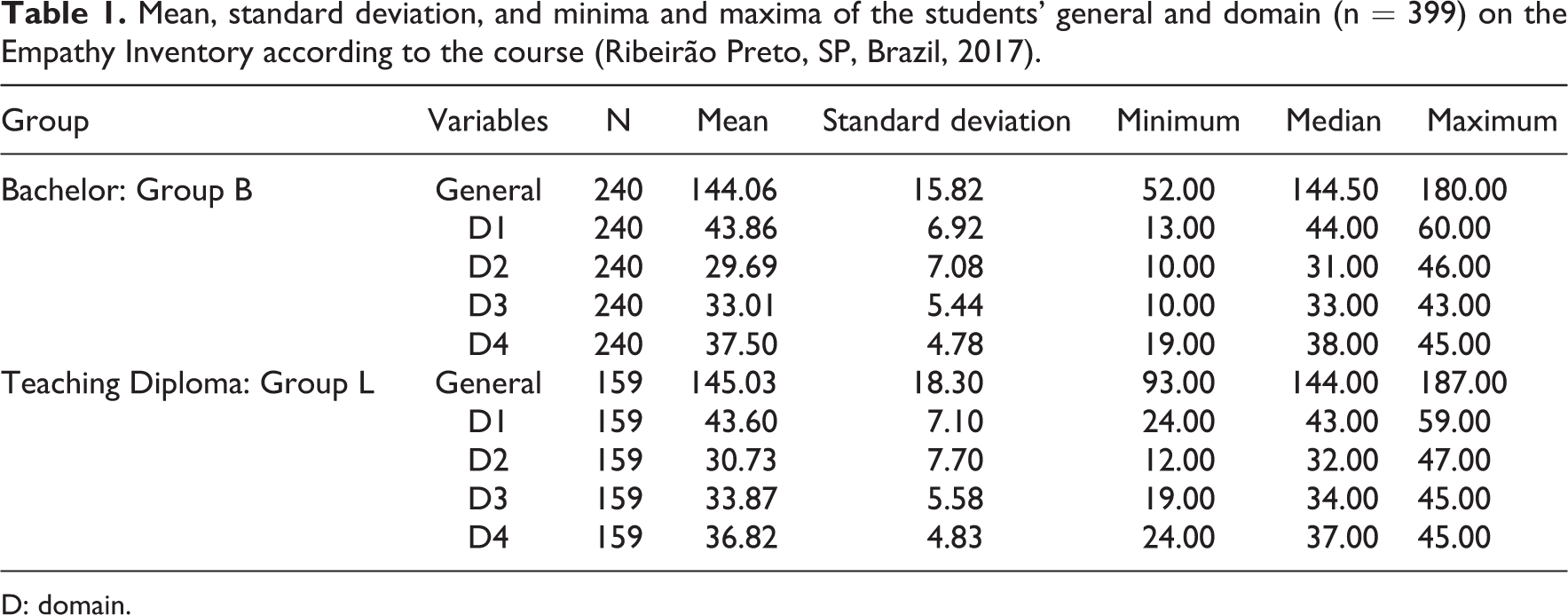
D: domain.
Table 2 shows the comparisons between the general and domain scores of the EI between the groups of the two course modalities. It was observed between groups A3 (Bachelor 2014) and L3 (Bachelor and Teaching Diploma 2014) that the Bachelor group presented a higher degree of empathy for the General Score (p = 0.04), in Domain 2 (p = 0.02), and in Domain 3 (p = 0.01). In the individual analysis by groups and by domains, a significant statistical difference was observed between B3 (Bachelor 2014) and L3 (Bachelor and Teaching Diploma 2014), where the teaching diploma group had a higher degree of empathy for the General Score (p = 0.04), in Domain 2 (p = 0.02), and in Domain 3 (p = 0.01).
Comparisons between general and domain scores of the Empathy Inventory for the groups of freshmen from the Nursing Bachelor (B) Bachelor and Teaching Diploma (L) programs between 2012 and 2015 (Ribeirão Preto, SP, Brazil, 2017).
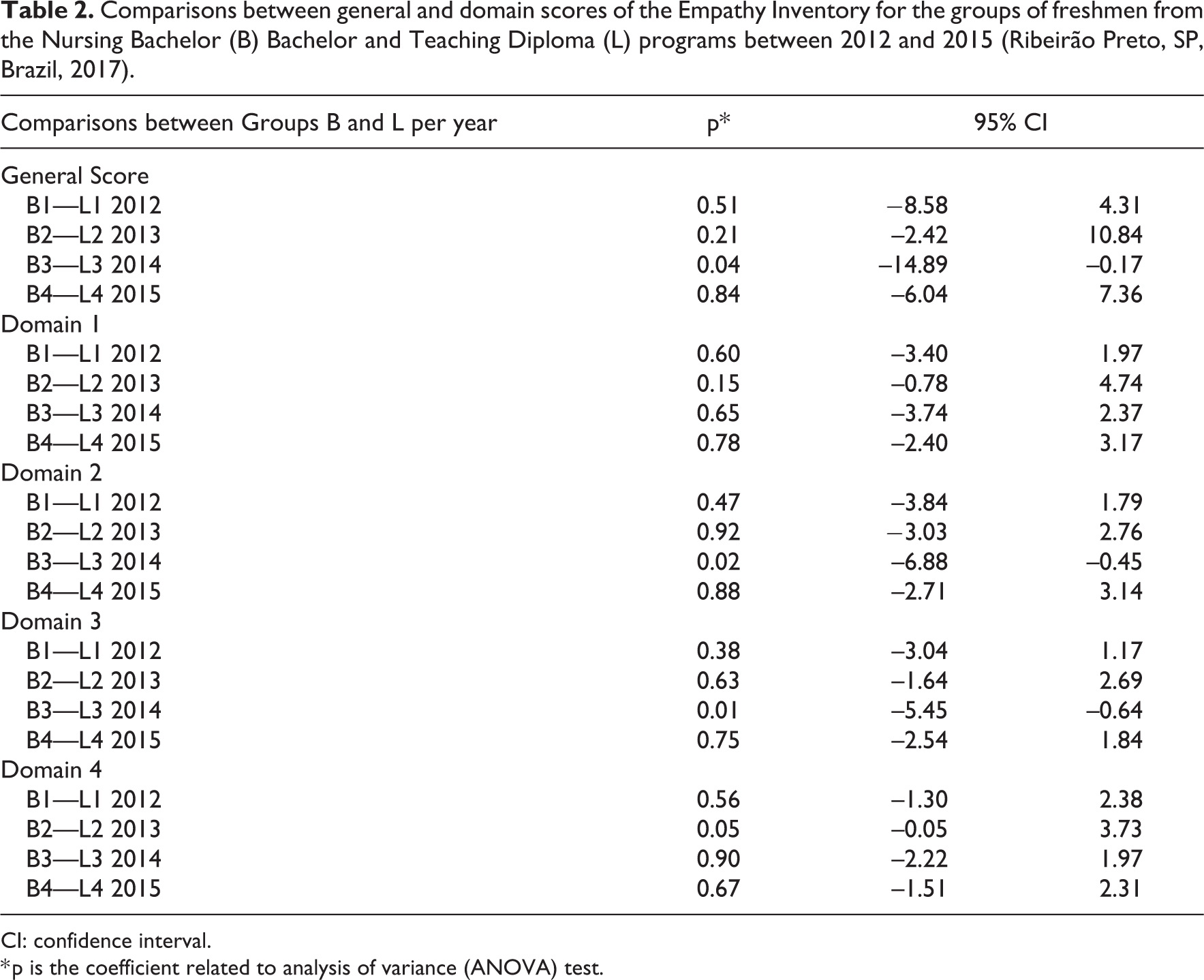
CI: confidence interval.
* p is the coefficient related to analysis of variance (ANOVA) test.
Finally, Table 3 summarizes the overall score of all subjects in each course modality: Bachelor (B) and Bachelor and Teaching Diploma (L), in each of the four domains of the EI.
Comparisons between groups for general and domain scores on the Empathy Inventory for freshmen in Nursing Bachelor (B) and Bachelor and Teaching Diploma (L) program between 2012 and 2015 (Ribeirão Preto, SP, Brazil, 2017).
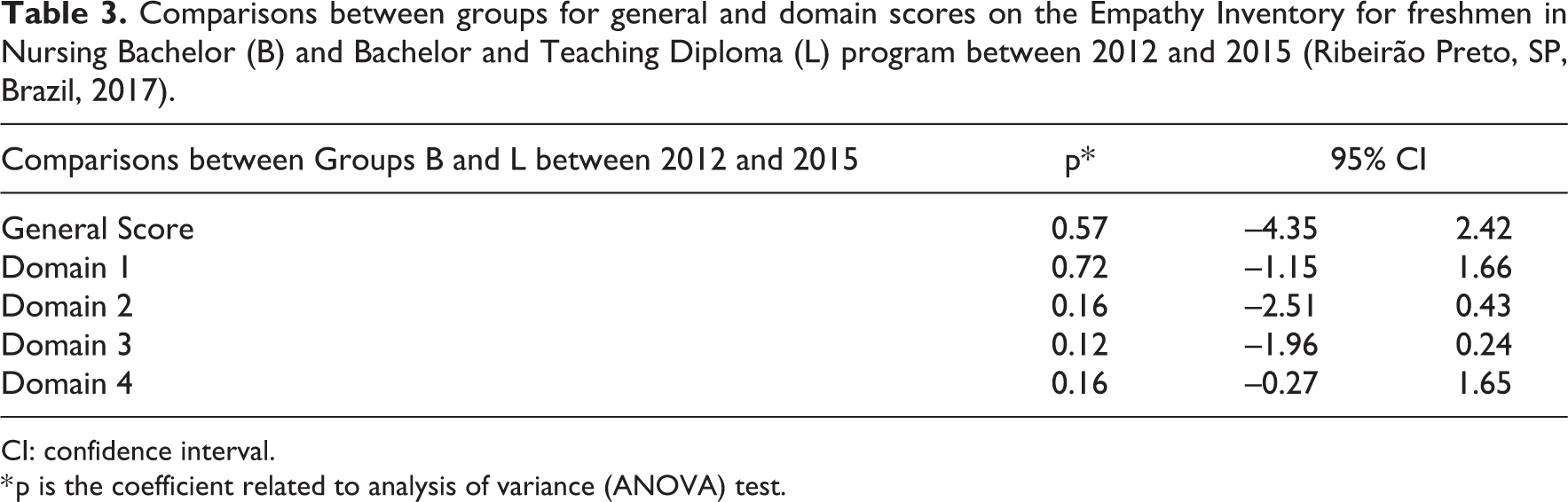
CI: confidence interval.
* p is the coefficient related to analysis of variance (ANOVA) test.
Discussion
All the groups analyzed presented high empathy scores, which shows that, from the start, the individuals who choose the nursing course for vocational training already present levels of empathy compatible with the needs of this course. Researchers state that there is a statistically significant decline in empathy among nursing and medical freshmen compared to senior students, and this prevails after the clinical internships. 11,16 –18
A study involving nursing undergraduates revealed that junior students have a higher degree of empathy compared to freshmen, and some researchers attribute this to maturity and because they have more opportunities for training, besides empathic skills. 19 However, comparing the levels of empathy among the nursing students in each course year at an Australian university showed that the sophomores and junior students showed higher levels of empathy than the freshmen. 20
Freshmen in health courses in general were also submitted to this evaluation, which concluded that nursing students have higher levels of empathy 8 than other students in the health area. Comparative analyses of freshmen, sophomores, and junior students’ perceptions, however, did not demonstrate significant differences in the levels of empathy between these groups. 17,21
There is a gap in the literature regarding studies analyzing the empathic profile of Nursing undergraduate freshmen students. However, a study about the profile of Nursing undergraduate students from the same institution showed that the majority of freshmen students from the Nursing and Teaching Diploma program are from public high schools and the majority of students from the Nursing Bachelor’s Program are from private high schools. Other characteristic found is that the majority of freshmen students work or have worked before enrolling the university. Thus, they are more mature due to their previous life experiences and are able to better understand the context of the course and the importance of valuing interpersonal relationships. 22
This difference shows how empathy develops in the individuals inserted in society in different ways. This factor may depend on several aspects, such as the social, cultural, academic, and family environment, being the most characteristic and influential in people’s character. As known, the family environment fosters emotional stability, later expressed in society through attitudes and behaviors; when the individual goes to college to take a course, however, especially in the health area, he can only develop empathy depending on his academic performance, course, and family life. 23 But fundamentally, if human values are at the heart of the set of values professed to support the mission in the nursing education institution, its teachers will be alert and dedicated to developing relational skills in students and to emphasize the exercise of empathy during the course, understanding that this should be an investment goal in working life. All teachers should engage in this undertaking throughout the course. Our results showed satisfactory levels; but sufficient levels of empathy may be reached if further investments are made in this regard. To the extent that further investments are made, better and therefore sufficient levels can be achieved in terms of clinical empathy.
If we want to offer patient-centered care, we need to be attentive to our professionals’ degree of clinical empathy. 24,25 There is evidence that skills required to deliver patient-centered care, and specifically to develop empathy as learned behavior, can be taught and learned, although there is no clarity about the sustainability of the outcomes. 24,26 –29 Therefore, a training program is useful to maintain levels of empathy that are compatible with the progress of the professional and the student, in tune with the development of critical thinking. 25,30,31
Our experience dedicated to the study and analysis of undergraduate nursing students’ empathic profile as from their entry into the course converges to the understanding that cognitive empathy is a learnable skill whose seed needs to be planted in the undergraduate student’s fertile soil and continuously nurtured both during the course and throughout the professional activity. 32
Empathy is, therefore, an essential asset of the health professional, which adds qualification to care and improves patient outcomes. The recognition of this asset is based on evidence, 32 which maintains positions favorable to the change of focus in the health professional’s curriculum: instead of being only focused on knowledge acquisition, teaching needs to be refocused to prioritize cognitive empathy, to the same extent, in order to be able to rely on empathic professionals.
This study has some limitations. Although the research is anonymous and voluntary, students may not have answered the questionnaire honestly. In addition, we should also consider that our study was conducted in Brazil only, involving undergraduate students from one of the 104 public nursing schools and 601 private nursing schools in this country, limiting the generalization of the results. Replicating the study in a more representative number of nursing schools in the country would be indicated. In addition, there are other scales to assess levels of empathy, which can be used and compared to the scale adopted in this study. There is, however, a need to check whether this degree of empathy is maintained throughout and at the end of the course.
Conclusion
Results showed that the students are empathic with minimum differences between the two courses. The students from the Nursing and Teaching Diploma Program presented better results in “Interpersonal Flexibility” and “Altruism” domains, when compared to students from the Bachelor’s Nursing Program. This profile means that they are capable to tolerate behaviors, attitudes and thoughts of others, and can deny their own interests with the aim to benefit or help other person. This result is important, as an empathic profile among freshmen in undergraduate nursing programs is fundamental to develop future professionals who are able to demonstrate a balance between their instrumental and expressive competences in their practice.
Footnotes
Acknowledgements
M.A.T. and I.A.C.M. developed study idea. M.C.S., S.S.d.S., and I.A.C.M. performed data collection. V.D.S., S.d.G., M.C.S. performed statistical analysis. M.C.S., V.D.S., M.A.T., and I.A.C.M. drafted manuscript with contribution from S.d.G., C.A.A.V., and S.S.d.S. All authors read and approved the final manuscript.
Conflict of interest
The author(s) declared no potential conflicts of interest with respect to the research, authorship, and/or publication of this article.
Funding
The author(s) disclosed receipt of the following financial support for the research, authorship, and/or publication of this article: This study was supported by the Ministry of Science, Technology, Innovation and Communications, Brazil, by its National Council for Scientific and Technological Development—CNPq, and by the Ministry of Education, CAPES, Brazil.
