






Abstract
Background
Currently a variety of novel scenarios have appeared within nursing practice such as confidentiality of a patient victim of abuse, justice in insolvent patients, poorly informed consent delivery, non-satisfactory medicine outputs, or the possibility to reject a recommended treatment. These scenarios presuppose skills that are not usually acquired during the degree. Thus, the implementation of teaching approaches that promote the acquisition of these skills in the nursing curriculum is increasingly relevant.
Objective
The article analyzes an academic model which integrates in the curriculum a series of specific theoretical concepts together with practical skills to acquire the basic ethic assessment competency.
Research design
The project includes designing two subjects, General Anthropology and Ethics-Bioethics, with an applied approach in the nursing curriculum. The sequential structure of the curriculum in both subjects is constituted by three learning domains (theoretical, practical, and communicative) with different educational strategies.
Ethical considerations
No significant ethical considerations as this is a discussion paper.
Findings
The model was structured from the anthropology’s concepts and decision-making process, applied to real situations. The structure of the three domains theoretical–practical–communicative is present in each session.
Discussion
It is observed that theoretical domain fosters the capacity for critical analysis and subsequent ability to judge diverse situations. The practical domain reflected two significant difficulties: students’ resistance to internalizing moral problems and the tendency to superficial criticism. The communicative domain has frequently shown that the conflicting points are in the principles to be applied.
Conclusion
We conclude that this design achieves its objectives and may provide future nursing professionals with ethical competences especially useful in healthcare practice. The three domains of the presented scheme are associated with the same process used in decision making at individual levels, where the exercise of clinical prudence acquires particular relevance.
Keywords
Introduction
The evolution of biomedicine has risen new ethical problems that have become a topic of public debate. 1 In addition, there are dilemmas that require anthropological reflection which are not usually included in nursing curricula. 2,3 Consequently, nursing professionals have to make decisions beyond their competency and often referred to law professionals. 4 However, in general, these professionals are resistant to legislate to preserve the main function of the law and prevent a judicialized society which could jeopardize any personal initiative and avoid individual responsibility leading to the collapse of the system. 5 Even so, the question remains unresolved. As the technological capacities grow in clinical practice and healthcare is constantly extended to all spheres of society, the dilemmas and moral decisions made by healthcare professionals are increasingly more difficult to address, including their technical aspect. 6
Currently, most areas of healthcare are inserted into a dual system of public and private health providers. In these scenarios, the basic principles of traditional medicine may not be sufficient to address possible ethical conflicts that may arise. 6 Thus, students and new practitioners have seldom addressed ethical conflicts during their training: for example, confidentiality of a patient victim of abuse, justice in insolvent patients, poorly informed consent delivery, or non-satisfactory medicine outputs. 6,7 In addition, the requests by over-informed new patients owing to the accessible digital networks and Internet, together with a greater awareness of healthcare rights, are forcing practitioners to acquire legal and communicative skills that had previously been unnecessary. 8 The zenith of this process is the advent of a recognized “medicine of desire” taking advantage of new technologies. Therefore, requests for advice to address situations within the nursing professional practice have increased looking for more precise solutions. 9,10
Usually, these scenarios were resolved by competent professional associations (e.g. Professional College, Academy of Sciences, etc.) which remain the reference institutions for discussion and consultation. However, the growing sensitivity toward the patient’s views constitutes a dimension that begins to be reflected in codes, laws, or protocols. This dimension includes their concept of freedom to accept a specific treatment, their perspective of justice toward the assessment of the results, their idea of “good” when facing a risky intervention, or their sense of dignity when patients claims for their rights. 11,12
These needs have resulted in various initiatives. The first one has been the search for tools and decision-making methodologies that could facilitate the tasks of nursing professionals. This would include an interdisciplinary reflection, with the aim to protect both the patient and the healthcare personnel in the controversial actions that occur in daily practice. At times, attempts have been made to assimilate ethical-clinical decision making to the processes followed in the business sphere or in judicial systems. 8,11 Various authors consider these approaches to be valuable, but they run the risk of being reductionist when applied to a patient. Furthermore, these authors think it is essential to structure a reasoning system that combines agility in decision making with the most basic anthropological basis of clinical ethics. 8,9,12,13
A second initiative is the need to strengthen the ethical-anthropological dimension in nursing training. The analysis of ethical competences in university curricula begins to be frequent in all professional fields 14 and, in the case of healthcare-related fields, the ethical and moral dimensions of any action have become essential. At present, nursing schools have gradually gained moral sensitivity driven by current changes in social paradigms and the advancement of new technologies. 15,16 Subsequently, the incorporation in the curriculum of ethical and anthropological dimensions is an emerging phenomenon. 17 However, this dimension is embedded in a cross-sectional model of several areas, which may be difficult to assess its goal. In fact, this approach has the risk to dilute the ethics curriculum within other contents, decreasing its singularity and objectivity without a core ethics course. 18,19
These highly dynamic situations have generated a reaction with growing interest for the ethical dimension of nursing procedures. These procedures do not aim at the clinical performance itself, but the focus targets the importance of the patient, not only as a patient who desires a result but as an individual who seeks help. This constitutes a paradigm shift which makes necessary to include in the curriculum a series of specific theoretical concepts together with practical skills to acquire the basic ethic assessment competencies. But new concepts and skills require particular planning that avoids improvisation of contents and facilitates the interrelationship with other areas of the curriculum. 20 We consider essential, therefore, the design and inclusion of ethical-anthropological disciplines that provide tools to facilitate research on the ethical aspects of clinical practice and improve its development. We propose a new curricular design that can be implemented in the nursing degree.
Description of the curriculum
Our proposal is framed within the context of the various initiatives proposed by health schools to include the ethical dimension in their curriculum. These strategies may include constructivist teaching strategies, 20 moral sensitivity education, 2 science-based bioethics, 18 strategies based on virtuous acts 17 or moral reasoning, 8 or ethically sustainable models of care. 10 In our case, the proposal is framed within the learning of virtues, especially the virtue of prudence, understood as the ability to decide the best means to achieve the best objective. 13,21
This design is part of a larger project undergoing at the International University of Catalonia (Barcelona, Spain), which aims to implement the ethical-anthropological dimension in all professional activities, starting with those taught in the university. Thus, the ethics curriculum for the Nursing Degree has been incorporated at the Faculty of Nursing of this university. It is structured in two courses delivered along two semesters: General Anthropology, during the first semester of the first year, and Ethics-Bioethics, during the first semester of the second year.
The first subject, General Anthropology, deals with the basic features of the human being as well as human actions and seeks to establish a common language that facilitates dialogue to establish the fundamental principles related to human life. The second subject, Ethics-Bioethics, aims to establish a set of criteria to facilitate the critical analysis and capacity to assess routine, standardized everyday situations. It systematically develops the specific aspects of healthcare ethics and promotes the acquisition of the necessary skills for decision making.
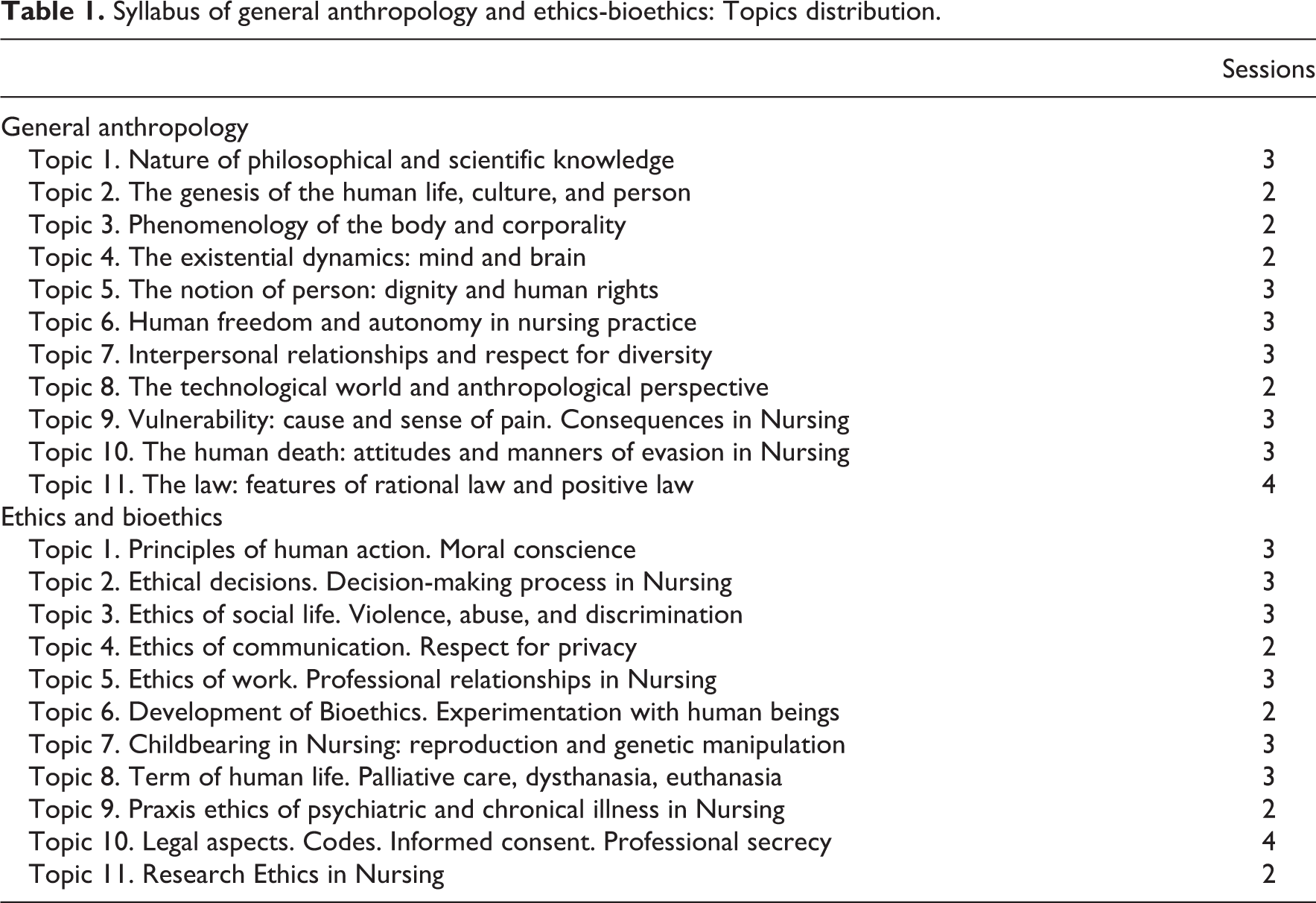
The program is distributed in 60 sessions of 2 h each: 30 sessions are devoted to General Anthropology and the remaining 30 sessions to Ethics-Bioethics. The sequential structure of the curriculum in both subjects integrates three learning domains with different training aims. The three domains are present in each session throughout the respective semester of each subject (Table 1).
Syllabus of general anthropology and ethics-bioethics: Topics distribution.
Theoretical domain
The theoretical domain is constituted by the contents of the General Anthropology and Ethics-Bioethics subjects, based on the different declarations, codes, reports, legislative bodies, and philosophical studies common in Western culture. It especially includes the conceptual developments since the middle of the 12th century without leaving out the large European tradition of previous centuries. 21 –23
The theoretical domain is developed following the scheme of the master explanation and presents the topics listed in Table 1. The contents may be delivered through lectures, interactive tests, or open question sessions. On the contrary, the topics covered in General Anthropology range from the concept of human life, the phenomenology of corporality, the person, freedom, vulnerability, and death. In Ethics-Bioethics, aspects of human action, decision making, moral awareness, as well as issues related to new technologies (genetic manipulation, palliative sedation, or transhumanism) are discussed. The students’ learning in this domain is assessed through multiple-choice questionnaires throughout the sessions with cumulatively scores. This methodology allows establishing the level of assimilation of the contents which will be necessary to put them into practice in the remaining domains.
Practical domain
The practical domain is delivered through the case method, based on the principles of philosophical ethics applied to clinical praxis. 23 These cases offer the students real-like situations and scenarios in routine practice and require reflection and implementation of the most basic professional qualities, fundamentally prudence. 13,24
Prudence-based case method is arranged in a novel structure that will serve as a basis for clinical practice 25 and is presented to students by means of a film scene or critical reading of news and, above all, through the analysis of a clinical case. Its structured formulation allows differentiating three phases in the moment of making decisions in the ethical-healthcare scope: diagnosis, decision, and execution. This scheme is developed in a simplified manner in the first sessions of General Anthropology and it is progressively expanded until its full development in the Ethics-Bioethics subject. The practical domain is evaluated through written scripts in each of the sessions where the student is asked to analyze the scene, situation, or case following the model described. Then, it is assessed according to the coherence of its analysis.
Communicative domain
This domain aims to train the ability to critically express the various moral situations. It is implemented in the classroom and requires dialogue and exchange of positions, with a certain pedagogy ability to explain humanistic subjects in an orderly manner avoiding stereotype emotions and responses. 26 The scheme follows a logical order and incorporates the procedural dynamics of legal procedures into the field of medical care using the framework of laws and medical care regulations to make decisions.
However, the fundamental principles that serve to make decisions are anchored in the principles of medical ethics jointly with the moral conscience of the members of the group or panel. This can lead to different interpretations, even antagonist views, although the basis for discussion may be clear. 27 For this reason, this domain requires a deep knowledge of the subject, through reviews of the literature and data sources. When assessing the domain, students’ ability to present all positions with coherence and without circumventing any arguments is especially valued. All this is carried out through individual dissertations, group presentations, and structured debates.
When applying and evaluating this domain, it is suggested to follow a scientific publication structure (e.g. introduction, method, results, discussion, and conclusion) similar to a conference presentation. The score will vary according to the suitability of the model used, the internal coherence of the presentation, and the argumentation of the questions raised.
Description of prudence-based case method
The objective of sessions is development of moral reasoning and exercise of decision making in students, applied to real situations. This is the motive to develop a particular model of case method. The working frame is structured on the broadest concept of prudence in philosophical ethics. According to the classical Greek philosophy, prudence is a virtue that governs the other virtues, 13,21 which in turn, regulate the appropriate actions to direct them to their specific objective. This line of thought in embedded in current culture, so that prudence is considered a category well assumed by the whole society. The usual description of prudence recognizes three elements or components: the “counsel” (search information and deliberation on the action being evaluated), the “judgment” (evaluation of the elements referred to the good of the action, deciding the most correct action), and the “command” (determination to act on what is judged prudent). 13 With these references, it is possible to elaborate a working scheme that forms the basis of the philosophical prudence applied to clinical praxis, suggested by other authors. 4,8,11 Its formulation allows differentiating three phases in the moment of making decisions in the healthcare scope: diagnosis, decision. and execution. The complete development is as follows (Figure 1):
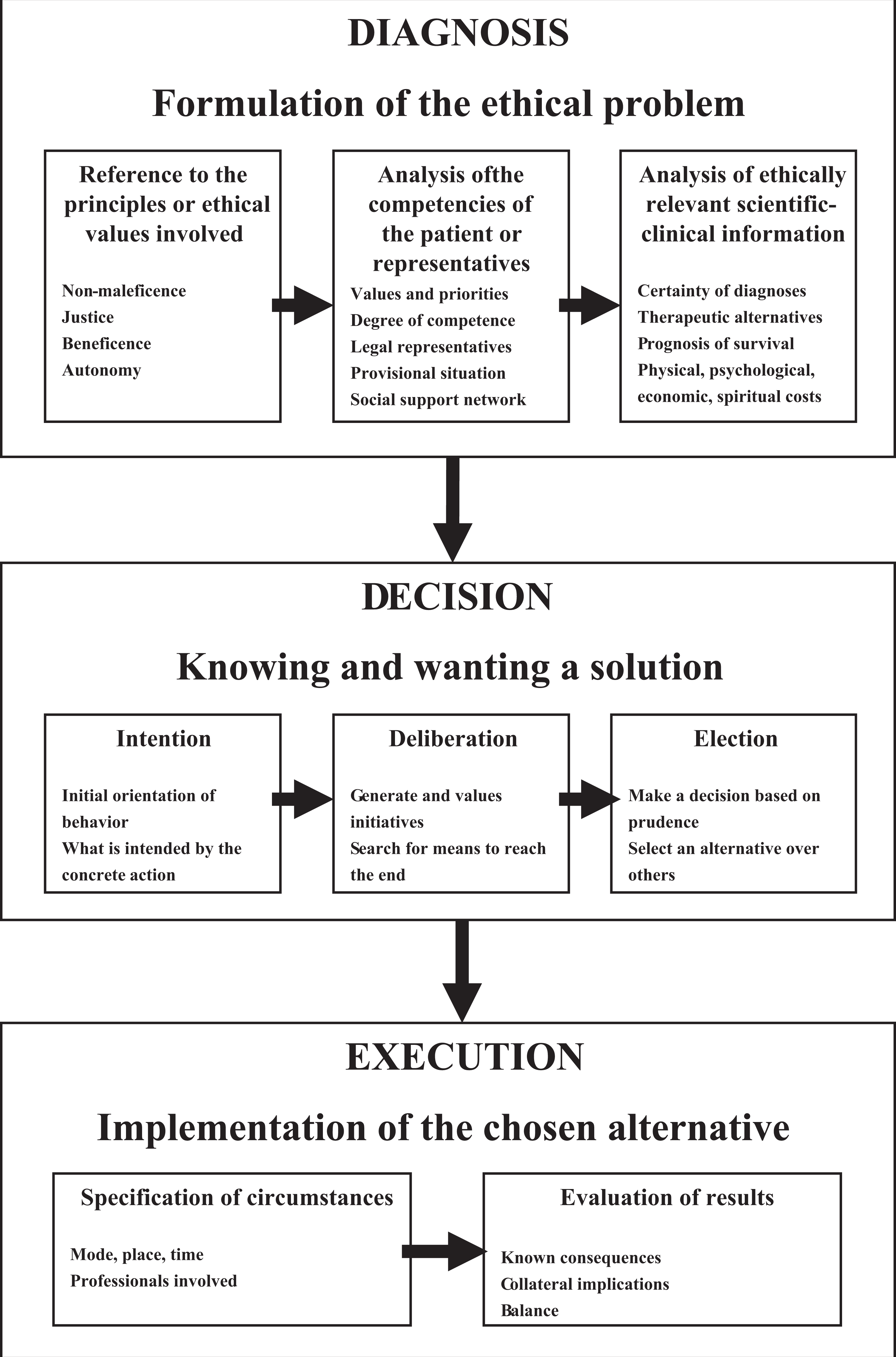
Conceptual ethical decision-making framework.
Diagnosis
It is the concrete formulation of the ethical problem in the situation under study. It should not be confused with the clinical diagnosis. Here it is important to detect the moral dimension of the problem, something that can be difficult for many students and untrained professionals. It seeks to know the reality of the problem, resorting to cumulative experience and decisions made by others. This first phase is subdivided into three other stages:
Reference to the ethical principles or values involved. Although they may vary according to the experience or culture of each professional, they generally coincide in their most general aspects. Reference should be made to the principle of non-maleficence, understood as not harming and respect for the life and integrity of the human being; the principle of beneficence that tries to produce the good in the patient including the principle of therapeutic proportionality; the principle of autonomy, understood as the freedom to accept or reject a treatment; and the principle of justice, which takes into account the principle of solidarity among the components of society.
Analysis of the competencies of the patient or their representatives. This includes identification of patient values and priorities, degree of competence of the patient to participate in decision making, identification of legal representatives, and the network of social-family support in the patient’s provisional situation.
Analysis of ethically relevant scientific and clinical information. Its focus is on the certainty of the diagnoses and the possible therapeutic alternatives with their respective benefits and risks, evidence-based survival forecasts, costs, and patient burden (physical, psychological, spiritual, and economic).
Decision
We want to reach a solution and, therefore, the balance of positive and negative elements is evaluated, alternatives are analyzed, and the most suitable possible solution chosen. This second phase is also subdivided into three other ones:
Intention. It aims to clarify what we pursue with my action (initial orientation of behavior), understood toward an improvement of the current situation. It is the ultimate reason for the action, which means, sometimes, overcoming topical, premeditated, or politically correct solutions.
Deliberation of the alternatives. Search for the means to reach the end, taking into account the hierarchy of those means. Concepts such as double effect action, lesser evil principle, or material cooperation are commonly used and it is the most creative part of the process, where all the possibilities and alternatives that can be collected are evaluated.
Election. Making a decision taking into account the precautionary principle, where prudence acquires special importance, while rejecting other alternatives, using the most relevant arguments.
Execution
It consists in the determination and concretion of the decision, the implementation of the chosen way to implement it. It includes the specific circumstances, assumes the possible consequences, and monitoring the action itself, from which new experiences will be extracted. We may subdivide it into two phases:
Specify the circumstances. It is the determination of the conditions of time, place, and mode to implement the selected decision, as well as the professionals who will carry it out.
Evaluation of results. Monitoring of the known consequences of the decision, its collateral implications, and its balance.
Discussion and limitations
An issue that could arise in this phase is the specific need for extensive training in the proposed situational topics. As already described in the introduction, the need for ethical tools begins to be essential when making decisions. At the same time, there are also within the same process of teaching health practice some immediate concerns that underlie the same nursing learning. The statements made by the students in the different courses reflect the concern about the main problems: the need of time for reflection (Table 2). This lack of reflection can often lead to states of anxiety and stress that may jeopardize the full development of the profession. 28 –30 Reflection on these issues facilitates the organic exercise of the nursing profession, giving it a deeper meaning beyond the purely pragmatic view. 31,32 At present, the implementation of the General Anthropology and Ethics-Bioethics curriculum in two semesters has provided encouraging aspects together with a variety of difficulties. First, their implementation in the Nursing degree curriculum has been successful integrating a humanistic atmosphere in the degree for delivery and discussion of the topics of interest. Furthermore, since the initial training steps, a healthcare outlook was generated which set the stage for subsequent years of the degree. This has clearly facilitated the integration of the concept of person within clinical practice in the upper semesters of the degree, providing a larger perspective of the multiple variables, circumstances, and problems of the patient. 33 This is consistent with the outlook in professional decision making and validated in preliminary studies. 24 The initial theoretical reflection on moral concepts and the coherence with which the dilemmas are raised in both General Anthropology and Ethics-Bioethics facilitates critical evaluation of the ethical questions in a larger perspective. 34
Representative comments of the students: The comments were collected anonymously.

In reference to the theoretical domain, the integration in the curriculum has also fostered the capacity for critical analysis and subsequent ability to judge diverse situations. 35 This assessment included the legislative basis which displays the degree of maturity of the trainees for the upcoming professional exercise. This also allows an enhanced capacity for dialogue among the students and the openness to understand diverse attitudes of individuals or communities including patients, colleagues, and institutions. 36 In this sense, sensitivity to detect situations requiring further attention and non-clinical solutions was reinforced through a spiral approach to teaching and learning anthropology and ethics in the curriculum. The presentation and subsequent revisions and the insistence on the human factor in each intervention seem to raise a deeper awareness toward the patient’s problems. This awareness also enhances the individual reflection on the proper way of acting and reacts upon the different situations presented during the case study sessions along the academic year. 26
Nevertheless, the practical domain reflected students’ resistance to internalizing moral problems and overcoming their tendency to superficial criticism, both significant difficulties. Unlike technical interventions, ethical thinking does not follow a mechanical, automatic, or protocol-based approach to problem solving. Thus, the internal rationalization of the conflict to avoid a light approach becomes a barrier for many students and generates difficulties to properly contextualize the solution without applying a mechanical protocol. 37 Consequently, it is important to insist on the complete development of the various sections of the analysis and their possible management. For example, the evaluation of the patient’s competencies may require to consider their subjective situation (what the patient thinks and feels about their situation) and their objective situation (individual or social limitations, observable by others), which sometimes facilitate the resolution of the case. Similarly, knowledge of the clinical aspects that affect the moral dimension of the problem, especially the costs generated, can help to accurately reach the solution. In the area of intention, the most problematic aspect is the dispersion of the end pursued, that is, “what is intended.” Here, the debate generally reflects the principles that underpin each opinion, but they agree when looking for alternatives that improve the current situation. The elaboration and exhibition of alternatives that try to reach the intention sought is the part that requires greatest effort, since each one requires reflection and argumentation. The choice of the most correct decision will be the one that best assumes the points described in the diagnosis. In this context, it has to be added that sometimes, an ideal decision from the ethical point of view may fail at the time of applying it, for not having known how to concretize its implementation. 38 For this reason, the last element of the scheme is very important, the execution. All circumstances must be materialized, especially if it is a question of developing an ethical opinion. It is possibly the most practical phase of the decision and, therefore, more laborious, but it is important to externalize it to avoid the logistical or bureaucratic problems that can accompany these processes. Likewise, following up with the decision taken is often tedious, but it is especially instructive to improve the dynamics of decision making in the clinical setting.
Finally, the communicative domain has frequently shown that in the course of the debate, in which ethical cases or dilemmas for students in the health field are raised, the agreement is not common, but makes the debate more fluid. 39 Logically, the conflicting points do not center the deliberation of alternative treatments or in their execution, rather in the principles to be applied. That is why we start with a deeper knowledge of the elements of anthropology and general ethics, including concepts such as “patient’s good,” “autonomy,” “dignity,” “justice,” “vulnerability,” “integrity,” or “truth.” 40 From these elements, the principles to be followed can be discussed, either using the principles of Beauchamp and Childress or the principles developed by the UNESCO in 2006. In this scenario, there are two limitations that make it difficult to assess the acquisition of moral abilities. First, the assessment of the narrative analysis elaborated by each student may incorporate possible bias in the evaluation, which could prevent an accurate and standardized comparison about the knowledge acquired by the trainees. 41 Second, it is perceived as a challenge to achieve the equal participation of all students, as well as avoiding their anonymity in large groups. 42 Therefore, efforts to create an environment that encourages participation should be a high priority among faculty and teaching staff. 19
The principal limitation of the study is the evaluation of results. We may not have appropriate scales to assess the degree of implementation of the project. Despite this, we have been able to secure estimates based on results of the surveys carried out on the students at the end of the second course The average satisfaction in the 7 years (2012–2018) of implementation of the project is 4.17 over a maximum score of 5, with a response rate of 37.9% (Supplemental Annex). This rate is moderately representative of student’s opinion but do not value the integration of ethic methodology in clinical praxis. More studies are necessary in this area within the practicum environment.
Finally, we have included a sample of the anonymous comments that students made at the end of the course. They appreciate the structural difficulties of the subject taught and suggest some improvements for future cohorts (Table 2).
Conclusion
The moral dimension in nursing professionals and other health sciences requires deep humanistic training in the areas of Anthropology, Ethics, and Bioethics, not only because of the diversity of problems that arise but also because of the challenges offered by new technologies for the patient’s self-information process. 43 The design of a complete program that includes all aspects of nursing that require ethical reflection has proved highly satisfactory.
For this, three learning domains have been developed—theoretical, practical, and communicative—that are implemented in each of the topics discussed in the course. We emphasize the importance of the elementary knowledge of humanistic sciences and the communicative skills that students must acquire. But we consider more important the implementation of an analysis strategy for the resolution of ethical dilemmas in Nursing. The scheme allows rigor and order when deciding, established in more elementary concepts of ethics. Among them, the exercise of clinical prudence acquires particular relevance. The three phases of the presented scheme are associated with the same process used in decision making at individual levels.
We think that the implementation of the model has been a success, in view of the results of the surveys carried out on the students. We consider therefore that it is a valid instrument for the formation of ethical competencies in nursing practice.
Supplemental material
Supplemental Material, Annex - Moral dilemmas involving anthropological and ethical dimensions in healthcare curriculum
Supplemental Material, Annex for Moral dilemmas involving anthropological and ethical dimensions in healthcare curriculum by Ignacio Macpherson, María Victoria Roqué and Ignacio Segarra in Nursing Ethics
Footnotes
Authors’ contributions
I.M. and I.S. developed and conceptualized the initial idea and carried out the analysis and the description; M.V.R., I.M., and I.S. contributed to the discussion. All authors revised the manuscript.
Conflict of interest
The author(s) declared no potential conflicts of interest with respect to the research, authorship, and/or publication of this article.
Funding
The author(s) received no financial support for the research, authorship, and/or publication of this article.

Supplemental material
Supplemental material for this article is available online.
References
Supplementary Material
Please find the following supplemental material available below.
For Open Access articles published under a Creative Commons License, all supplemental material carries the same license as the article it is associated with.
For non-Open Access articles published, all supplemental material carries a non-exclusive license, and permission requests for re-use of supplemental material or any part of supplemental material shall be sent directly to the copyright owner as specified in the copyright notice associated with the article.
