







Abstract
Background:
The COVID-19 pandemic has produced high stress in nurses, affecting their professional quality of life. Different variables affect psychological stress response and professional quality of life. In this context, the role of professional values represents an interesting object of research.
Objectives:
To analyze the relationship between professional values, perceived stress, and professional quality of life among nurses during the COVID-19 crisis.
Research design, participants, and research context:
Descriptive cross-sectional study. Participants were 439 registered nurses from the public health system. Perceived stress, professional quality of life, and professional values were evaluated by using measuring instruments adapted and validated in the geographic context of research. Data were collected online in December 2020 during the second wave of the COVID-19 pandemic in Spain.
Ethical considerations:
This study was approved by the Ethics Committee on Clinical Research of the Principality of Asturias.
Findings:
Within professional values, ethics obtained higher scores showing the primacy of ethical values among nurses. Moderate correlations between ethics, mastery, expertise, and compassion satisfaction were found. Frontline nurses informed high perceived stress. The correlations between professional values and compassion satisfaction were higher in non-frontline nurses. A moderate negative correlation between perceived stress and compassion satisfaction was found in both groups, which implies that the higher the stress, the lower the satisfaction in the helping relationship.
Conclusion:
Professional values positively influence compassion satisfaction during the COVID-19 pandemic. Compassion satisfaction presents a negative correlation with fatigue compassion and burnout in frontline and non-frontline nurses. Given the functionality of values both to guide clinical practice professionally and ethically, and prevent dissatisfaction with one’s professional quality of life by reinforcing compassion satisfaction, it is necessary to reinforce them with an intensive and cross-sectional learning during the university training.
Introduction
Values represent a field of research of great interest. Values function as action guides for an ethical life because ethics has to do with values in every culture, even including clinical culture. 1 In the nursing context, professional values are guidelines for action accepted by professionals, 2 and their importance lies in their capacity to generate convictions, attitudes, and behaviors. 3,4 Nursing professional values guide clinical practice professionally and ethically 5 and shape the identity of nurses. 6,7
Values do not exist outside of a certain culture that allows their learning. Hence, it is not surprising that the integration of nursing professional values is a priority responsibility of nursing educational institutions. In this sense, it has been pointed out that the more experienced nurses play a key role in the transmission of knowledge and values to younger generations. 8
The integration of professional values into clinical practice is fundamental in nursing due to their benefits for society, patients, and the nurses themselves. For example, nursing professional values show a positive correlation with the pleasant feeling derived from providing care, a dimension of the professional quality of life (ProQOL) known as compassion satisfaction, which in turn improves the quality of clinical care and the nurses’ job satisfaction. 9
The current pandemic has produced work overload and high stress in nurses, 10 including also high levels of burnout along with compassion fatigue. 11 In this context of work overload in nurses, it is interesting to know an essential question: whether the 2019 novel coronavirus (COVID-19) health crisis has altered the relationship between professional values and ProQOL, especially under conditions of high stress.
Background
The COVID-19 which emerged in Wuhan, China, led to a pandemic unlike any other in the last century. 12 The spread of the pandemic has been dizzying worldwide. Spain has been one of the countries with a very high number of affected people with a very high proportion of deaths from the coronavirus. 13 The health crisis has produced an impact of such magnitude that it has put the response capacity of our public health system to the limit. 14
Since the beginning of the crisis, health professionals have faced a scenario that exposes them to psychosocial risk factors that can lead to signs of psychological distress. 15,16 The absence of a specific treatment for COVID-19, the severity of its complications in many patients, and the work overload have produced high stress in nurses during the pandemic. 10 Moreover, during the crisis, healthcare professionals have to provide healthcare while making far-reaching ethical decisions, 17 and this further increases their perceived stress. In this complex situation, the ProQOL is negatively affected. 11 ProQOL 18 is a concept which includes three dimensions: burnout (emotional exhaustion, depersonalization, and lack of personal fulfillment at work), compassion fatigue (resulting from the exposure to the suffering of others in healthcare), and compassion satisfaction (a protective factor experienced when professionals are satisfied with their work in the care relationship).
Our research question is how all these variables (perceived stress, burnout, compassion fatigue, compassion satisfaction) are related between them and with nursing professional values during the current health crisis.
Methods
The aim of this research was to analyze the relationships between nursing professional values, perceived stress, and the ProQOL during the COVID-19 crisis.
Design
This study used a descriptive cross-sectional design.
Participants
A convenience sample of 439 Registered Nurses was recruited for this study. The inclusion criteria were being over 18 years, working as a nurse in the public health service of the Principality of Asturias (Spain), and working uninterruptedly during the second pandemic wave in Spain (September–December 2020). The exclusion criterion was having been without work (temporary disability) due to illness (mental or physical) or accident between September and December 2020.
Data collection
A socio-demographic questionnaire was used to collect information about variables such as age, sex, marital status (single, married or in civil partnership, and separated or widow/er); work setting (primary care, ICU, emergency departments, regular hospital care, specific COVID-19 unit, and others); professional experience in years; type of shift (fixed or rotating); and type of contract.
To assess professional values, we used the “Escala de Valores Profesionales de Enfermería” (EVPS), 19 which is an adaptation and validation in the Spanish context from the original Nurses Professional Values Scale. The EVPS includes 26 items grouped into three dimensions: ethics (9 items), professional expertise (8 items), and professional mastery (9 items). Each item is rated on a 5-point Likert-type scale ranging from “not important” to “very important,” where high scores inform of a greater weight of professional values. Items about the ethics dimension include questions referring to aesthetic, moral, and ethical values like “oppose professionals who perform inappropriate or questionable practices.” The professional expertise dimension includes items referring to active engagement in one’s professional development, like “initiate actions for the improvement of professional settings.” The third dimension, professional mastery, includes technical aspects of the profession but also tacit knowledge (know-how, etc.) and it uses items like “establish quality criteria as a guide to practice.” Basurto et al. 20 informed a Cronbach’s alpha from 0.70 to 0.77 for the three dimensions of EVPS, which is considered an acceptable reliability. However, in our sample, we obtained a Cronbach’s alpha of 0.88 for ethics, 0.85 for expertise, and 0.87 for professional mastery which is considered a good reliability.
Perceived stress was assessed by using the Spanish version of the Perceived Stress Scale (PSS). 21 This instrument measures the level of perceived stress experienced in the last month. PSS consists of 14 items rated on a 5-point Likert-type scale ranging from “never” to “very often.” Higher scores indicate higher levels of perceived stress. The PSS has been proven to have a good reliability when used in the Spanish population, with a Cronbach’s alpha of 0.81. 21 In our sample, we found an alpha of 0.9, which is considered an excellent reliability.
ProQOL was assessed by using the Spanish version of the ProQOL. 18 This instrument consists of 30 items rated on a 6-point Likert-type scale ranging from “never” to “always.” This scale is divided into three subscales of 10 items each: compassion fatigue, compassion satisfaction, and burnout. Higher scores in each dimension indicate higher levels of compassion fatigue, compassion satisfaction, and burnout, respectively. The Spanish version of ProQOL presents a Cronbach’s alpha of 0.782 for compassion fatigue, 0.774 for compassion satisfaction, and 0.537 for burnout. 22 In our sample, we obtained an alpha of 0.86 for compassion fatigue, 0.88 for compassion satisfaction, and 0.57 for burnout, respectively.
Data collection was conducted online through a Google Forms questionnaire designed ad hoc, including both scales and the socio-demographic survey. For the recruitment, we had the institutional collaboration of the Professional Nursing College of the Principality of Asturias. This institution published information on its website about the study and the link to the questionnaire. Access to the questionnaire was available between 2 and 24 December 2020, which corresponded to the remission period of the second pandemic wave in Asturias.
Ethical considerations
This study was approved by the Ethics Committee on Clinical Research of the Principality of Asturias (No. 563/2020). The ethical principles enshrined in the Declaration of Helsinki were observed at all times. Professionals were informed of the goal of this research and its voluntary and anonymous nature. All participants provided informed consent prior to accessing the questionnaires. No incentives were offered for participation. The confidentiality of the data and the anonymity of the patients were preserved in compliance with the Spanish Organic Law 3/2018 of 5 December on Personal Data Protection and Guarantee of Digital Rights.
Data analysis
The statistical analysis was performed with the SPSS program v.24.0. We described the descriptive data of socio-demographic and employment variables using frequencies and percentages. Differences in perceived stress were studied by comparing frontline with non-frontline professionals by using the Student’s t-test of differences of means. We descriptively analyze stress levels, burnout, and compassion fatigue into three levels of severity (low/medium/high) according to their corresponding cut-off points. Percentages and total frequencies were calculated based on gender and high/low exposure to COVID-19 patients. In addition, the effect size was calculated by using Cohen’s d. We calculated the means and deviations (SDs) of the three groups of professional experience (less than 10 years, from 11 to 20 years, and more than 20 years) for every one of the three dimensions of professional values, considering the scores as a quantitative variable. A one-factor analysis of variance (ANOVA) was conducted to study whether there were significant differences between the three professional experience groups, and the effect size was calculated through the eta-squared. Finally, a Pearson correlation was carried out between the professional values, the ProQOL, and the perceived stress differentiating between frontline and non-frontline nurses. Values of p < 0.05 were considered statistically significant.
Results
A total of 439 nursing professionals participated in this study, with a mean age of 41.53 (SD = 11.38). Gender distribution was 87.2% woman (n = 383) and 12.8% man (n = 56). All descriptive data of socio-demographic and employment variables are provided in Table 1.
Descriptive data on socio-demographic and employment.
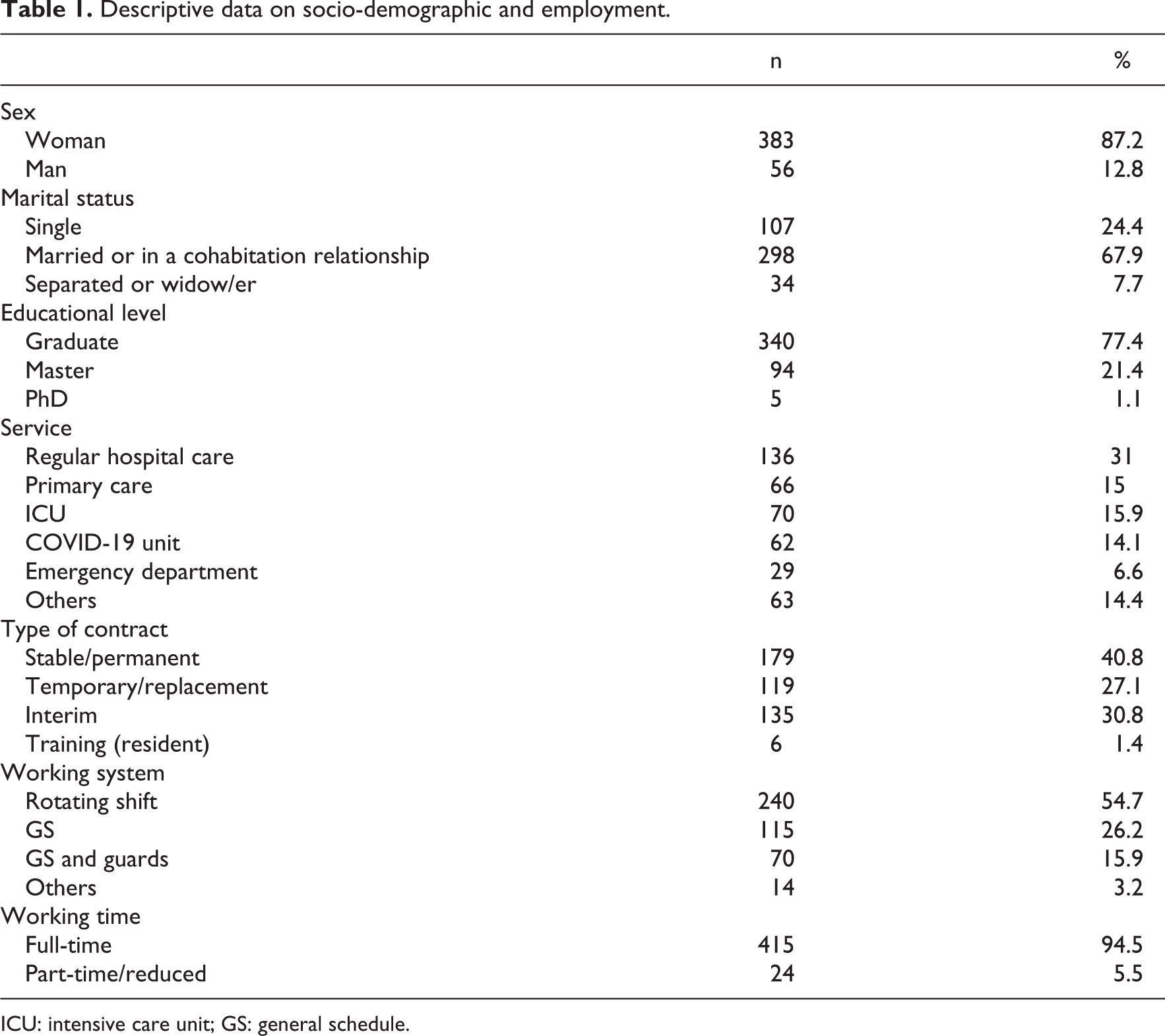
ICU: intensive care unit; GS: general schedule.
The sample was divided in two groups: frontline and non-frontline nurses in function of having a greater/lesser direct exposure to COVID patients, because according to previous studies, 23,24 a high direct exposure produces more emotional distress in healthcare providers. Frontline nurses here were those who worked in emergency departments, specific COVID-19 units, and in intensive care units (n = 161). The rest of the nurses were grouped as non-frontline (n = 278). The levels of perceived stress were different in function of the work setting distribution. Frontline nurses showed higher levels of perceived stress with a small effect size. These results could be seen in Table 2.
Mean differences of perceived stress between frontline and non-frontline nurses.

N = 439; SD; Standard Deviation; T: value of the T statistic; p: p value of the test of difference of means; d: effect size according to Cohen’s “d.”
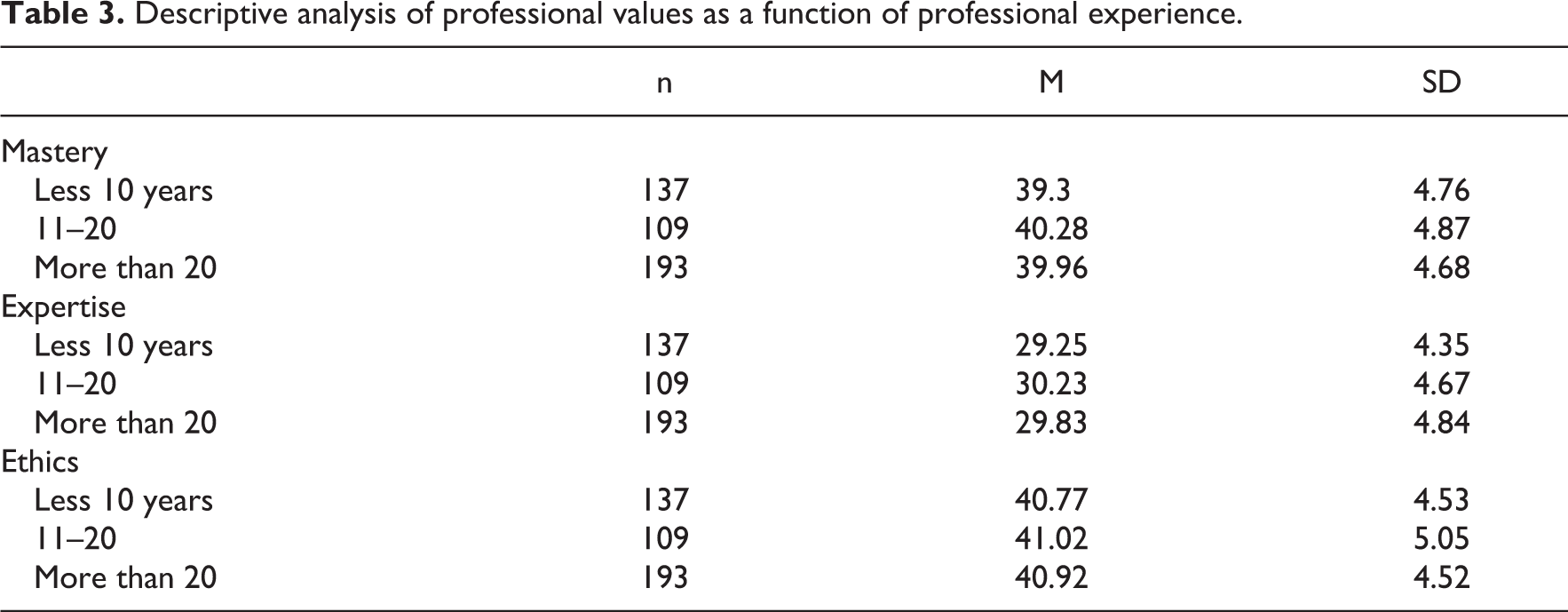
Results of the three dimensions of professional values could be seen in Table 3. In line with previous studies, 8 we found the highest scores in ethics and mastery. A slightly higher mean was found in the 11–20 years age group of professional practice in the three subscales of professional values. However, after performing an ANOVA, no significant differences were found between the different professional experience groups, neither in the professional mastery (F(2.436) = 1.423, p = 0.242) nor in professional expertise (F(2.436) = 1408, p = 0. 246), nor in ethics (F(2.436) = 0.093, p = 0.911).
Descriptive analysis of professional values as a function of professional experience.
Regarding the relations between the perceived stress and the three dimensions of the professional values, we found a negative correlation between PSS and two dimensions of nursing professional values: ethics and professional mastery. This effect was slightly greater in the group of non-frontline nurses. We detected no statistically significant correlation with the professional expertise.
Variables as gender or high/low exposure to COVID-19 patients were especially relevant in terms of stress, burnout, and compassion fatigue. As shown in Table 4, low levels of perceived stress were twice as high in men as in women, while high levels were doubled in women compared to men. Likewise, low levels of burnout and compassion fatigue were more frequents in men, although the differences between the high levels of these variables in men and women were smaller. The percentage of professionals with low levels of stress was double in non-frontline nurses compared to frontline, and, as expected, high levels of perceived stress, burnout, and compassion fatigue were more frequent in frontline nurses.
Frequencies and percentages of nurses grouped in three levels of perceived stress, burnout, and compassion fatigue based on gender and level of exposure to COVID-19 patients.
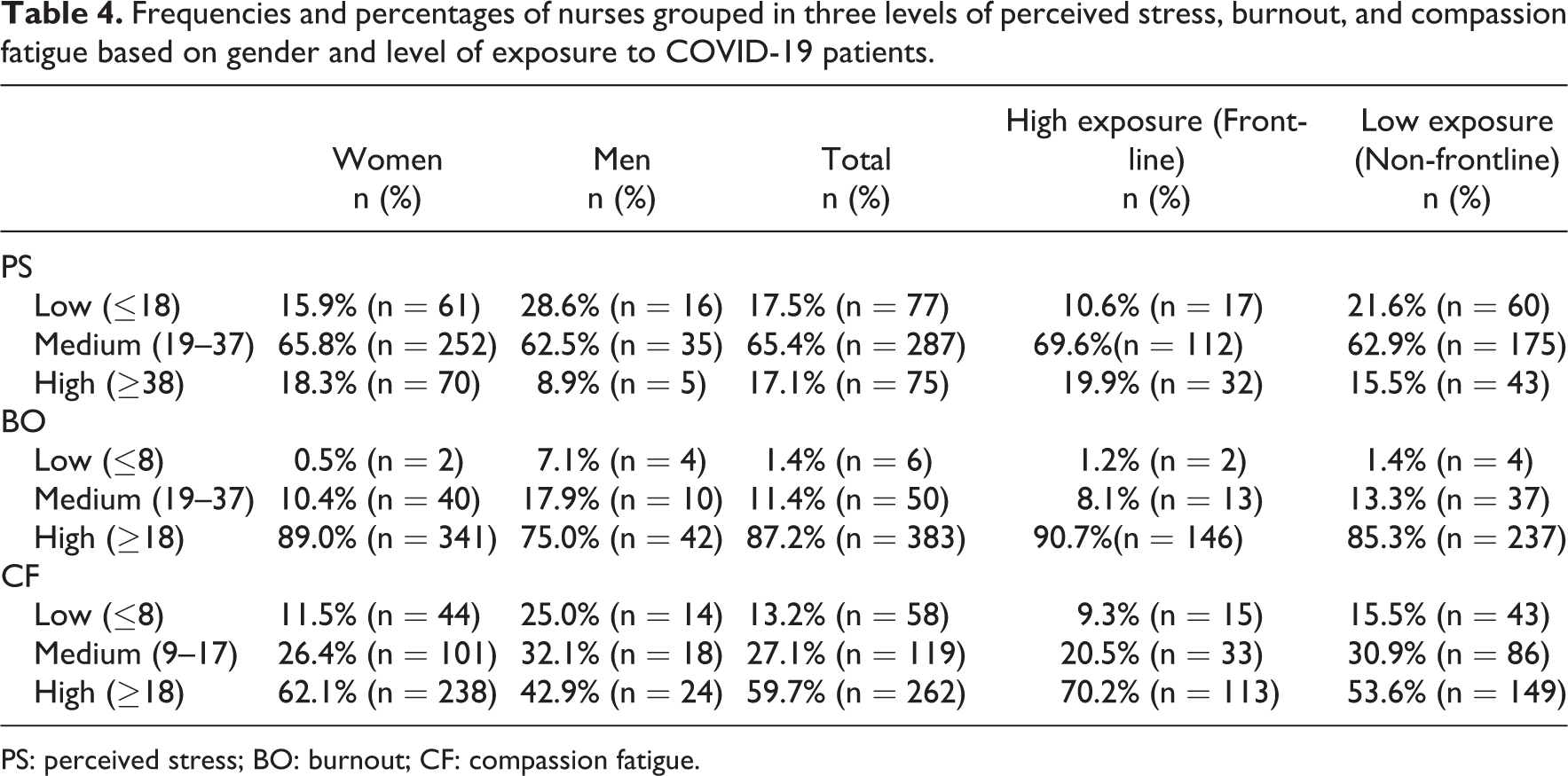
PS: perceived stress; BO: burnout; CF: compassion fatigue.
Finally, we calculated the Pearson correlations between the scores of PSS, EVPS, and ProQOL both in frontline and non-frontline nurses. Results are shown in Table 5.
Pearson correlations between perceived stress, professional values, and professional quality of life in frontline and non-frontline nurses.
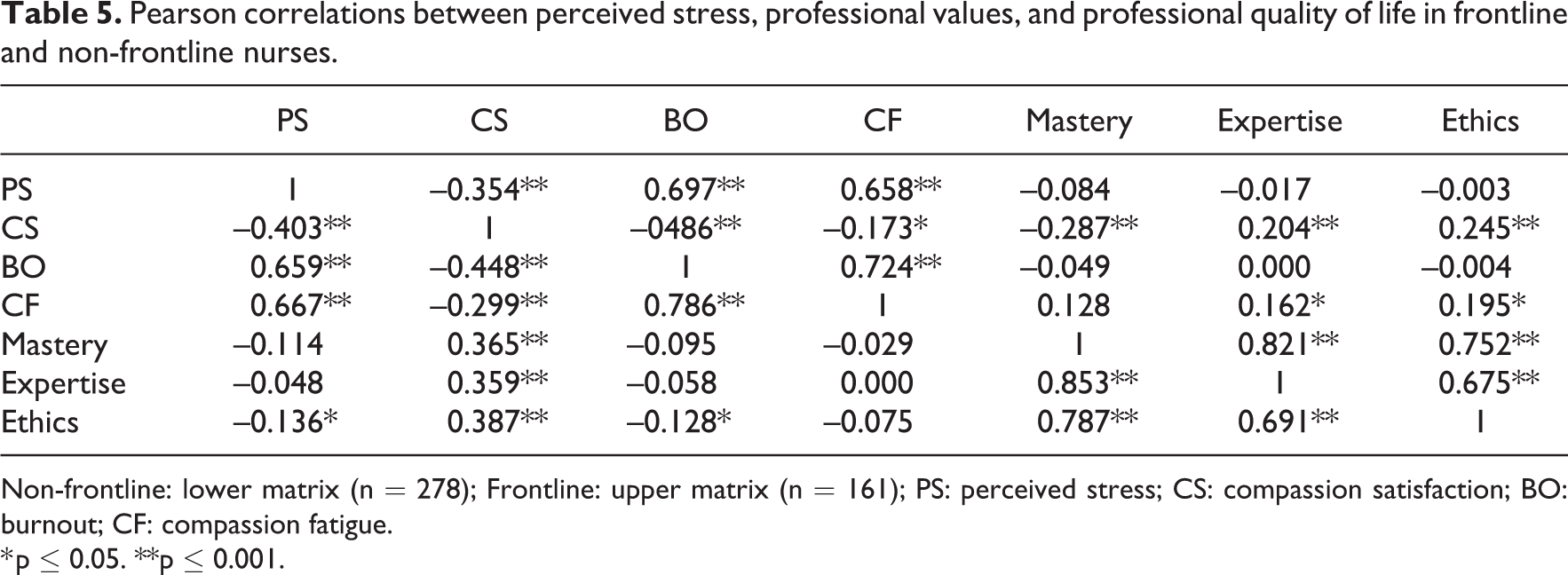
Non-frontline: lower matrix (n = 278); Frontline: upper matrix (n = 161); PS: perceived stress; CS: compassion satisfaction; BO: burnout; CF: compassion fatigue.
* p ≤ 0.05. **p ≤ 0.001.
We found a moderate negative correlation between perceived stress and compassion satisfaction in both groups, which implies that the higher the stress, the lower the satisfaction in the helping relationship, but also that the higher the compassion satisfaction, the lower the stress. Perceived stress and burnout showed a moderate-high positive correlation in both groups. Compassion satisfaction and burnout showed a negative moderated correlation, indicating the protective factor of compassion satisfaction against burnout, and this finding was also observed with compassion satisfaction and compassion fatigue in both groups. Also, burnout and compassion fatigue showed high correlations both in frontline and non-frontline nurses.
Regarding the role of nursing professional values, we found moderate correlations between the three dimensions (mastery, expertise, and ethics) and compassion satisfaction. This correlation was higher in non-frontline nurses and lower in frontline; thus, the correlation decreases in those professionals exposed to high stress. However, correlations between nursing professional values and compassion fatigue were low in frontline professionals and inexistent in non-frontline. Finally, we found moderate-high correlations between the three dimensions of nursing professional values, which were high between expertise and mastery.
Discussion
The aim of this work was to study the influence of professional values in the perceived stress and the ProQOL among nurses during the COVID-19 pandemic. To the best of our knowledge, this is the first study focused on these relations during a health crisis. The hypothesis was that professional values could affect the perceived stress or/and the different dimensions of the ProQOL (burnout, compassion fatigue, compassion satisfaction) in nurses during the health crisis. Not in vain, coping with stressful situations related with severe work overload is actually a process that depends on the context and multiple other variables.
Nurses who are in direct contact with patients are found to be exposed to more emotional exhaustion and despersonalization that leads to burnout. 25 Recent studies conducted during the hardest weeks of the first wave of the pandemic revealed that nurses show medium to high levels of compassion fatigue, burnout, and perceived stress, especially those professionals who care for COVID-19 patients. 11 Our data reveal similar levels of stress and compassion fatigue in nurses between the first and the second wave of the pandemic in Spain, but much higher levels of burnout. The percentage of professionals with high burnout detected by using the ProQOL has grown from 36% in April 2020 11 to 87% in our study (December 2020). We are facing one of the main problems of health professionals that affects between 40% and 75% of them. 26
Regarding nursing professional values, previous studies on nursing professional values in our geographic context 8 revealed that ethics obtains higher scores followed by professional mastery, while expertise was rated the lowest. Our results confirmed this order of importance showing again the primacy of ethical values. In fact, ethics has to do with values, and the perspective of values links with the humanistic models of important authors like Maslow, whose postulates influenced nursing models based on needs that have a high weight in nursing. Ethical values are the most highly appreciated among nurses, especially those such as equity, equality, freedom, tolerance, justice, or the unconditional defense of human dignity. It is important to note that values, especially ethical values, are far-reaching directions and their absence dehumanizes the person. For this reason, values play a fundamental role in the humanisation of nursing care.
Our results show a negative correlation between ethics, professional mastery, and the perceived stress, but these correlations are so low that they do not allow us any valid conclusions to be made. However, the finding about the relation between professional values and compassion satisfaction during the health crisis is very interesting and it is coherent with previous studies. A qualitative study conducted by in-depth interviews 27 indicated that compassion satisfaction was closely associated with all the dimensions of professional values. Kim et al. 6 showed that awareness of professional values has a positive impact on nurses’ ProQOL, especially their compassion satisfaction. Recent studies conducted among nurses before the COVID-19 crisis 9 found a significant correlation between professional values and compassion satisfaction (r = 0.56). In line with these findings, we obtained moderate correlations between the three dimensions of professional values and compassion satisfaction, but this correlation was slightly lower between frontline professionals. While the correlations between Expertise and Ethics and compassion fatigue were positive in the group of nurses more exposed to COVID-19 patients, these correlations were non-existent in non-frontline nurses. This result in first-line nurses could be interpreted according to the psychological function of values. If professional values introduce a tension between what is and what “should be,” the nurses who attach more importance to them would be more aware of the distance between the healthcare provided (due to the situation of work overload produced by the health crisis) and the healthcare which would be desirable. This heightened awareness could produce in nurses an additional stress and higher levels of compassion fatigue. Also, we observed that the correlations between the three dimensions of professional values and compassion satisfaction are lower among frontline nurses. It implies that as perceived stress increases, the correlation between professional values and compassion satisfaction weakens. Thus, in the work overload produced by the health crisis, the role of nursing professional values to facilitate compassion satisfaction would be slightly reduced. In any case, our results show that even in situations of high stress and work overload, the professional values still influence favorably the positive outcome of helping others. This is very important because the pleasant feeling which caregivers derive from providing care, which is the essence of compassion satisfaction, improves the quality of clinical care for patients, which in turn increases nurses’ job satisfaction. 9 We consider that the relations between compassion satisfaction and nursing professional values could be dynamic and bidirectional. Nurses’ efforts to care patients according to nursing professional values produce compassion satisfaction, and compassion satisfaction produces a reinforcement of nursing professional values as guides of action for future behaviors that lead to rewarding consequences. In any case, by reinforcing compassion satisfaction, we could prevent burnout according to the finding that compassion satisfaction and burnout show a moderated negative correlation. This is consistent with previous research 9 that points out the possibility of improved compassion satisfaction and lower burnout by implementing strategies that reinforce nursing professional values. Thus, professional values are not only important for professional identity, quality of care, and the satisfaction of patients and the professionals themselves 8 ; professional values could play a role in nurses’ mental health by reinforcing the compassion satisfaction, because compassion fatigue or burnout puts them at risk of mental health problems. 11 In our perspective, this is an important finding because nurses are fundamentally a female collective (87.2% of the sample), which implies a greater probability of mental disorders related to stress as anxiety or depression, and this vulnerability would be increased during the health crisis, especially if professionals are in close contact to COVID-19 patients. 28,29
Our data indicate that, even during the health crisis, nursing professional values represent a protection factor for compassion satisfaction which in turns reduces the risk of compassion fatigue and burnout. Therefore, these values allow nurses to provide better care to patients by maintaining higher levels of compassion satisfaction. At the base of this would be the fact that values provide a framework of meaning to the choices and behaviors that nurses made moment by moment.
The implications of our findings are relevant. If some authors 11 pointed out the need to implement prevent strategies for burnout and compassion fatigue in healthcare professionals, nursing professional values could be the answer for this important problem in the nursing profession due to its strengthening effect on compassion satisfaction. First, it is absolutely essential to address professional values in nursing students stressing their importance in professional practice. The absence of significant differences between different levels of clinical experience shows that nursing professional values depend decisively on the training received at the university. In this sense, we must emphasize that values are learned in community. This community must reinforce these values, modeling and promoting them appropriately to train more competent and capable professionals in the face of adverse circumstances, such as the pandemic we are living in. Values must be radically integrated into nursing training, but the question is how to guarantee the contingencies that are necessary to generate and strengthen those values. So, health institutions must guarantee the conditions that favor their generalization, maintenance or strengthening, especially considering that values could tend to weaken in professionals with more years of experience. 8 We must strengthen nursing professional values in all educational and clinical contexts. In this way, we will achieve excellent care at the human and scientific-technical levels, as well as more resilient professionals for the future.
Study limitations
It is important to point out some limitations. First, we must consider the non-probabilistic sampling used. This type of sampling does not guarantee that the participants represent all the professionals of the collective studied, neither frontline nurses nor those who remain in other activities during the COVID-19 pandemic. Second, the voluntary nature of this study and the context of the crisis may have introduced a response bias if the non-participants were too stressed to respond. Third, it is important to consider that most of the sample are women (87.2%), and this gender imbalance, even being generalized in the nursing community, should be considered as a limitation. In addition, we must recognize a possible bias of acquiescence in the importance granted to the different professional values. Also, assessment by using online questionnaires can discourage potential respondents in the age group over 60, as older people are often less familiar with new technologies. Finally, another limitation is the cross-sectional design used. Obviously, the effects of the pandemic are dynamic and its variations are not reflected in this kind of research, so longitudinal studies are needed. For all these reasons, our results should be evaluated with caution, especially regarding its generalization.
Conclusion
Nursing professional values positively influence the compassion satisfaction among nurses during the COVID-19 pandemic. High scores in compassion satisfaction reduce the risk of fatigue compassion and burnout. Frontline professionals, those exposed to high contact with COVID-19 patients, inform higher levels of perceived stress and the correlation between professional values and compassion satisfaction declines in them. The protective function of nursing professional values on satisfaction in the helping relationship weakens as perceived stress increases. It is necessary to reinforce professional values in all contexts, especially by an intensive and cross-sectional learning during the university training, to provide society more satisfied nurses and more resilient professionals for the future.
Footnotes
Acknowledgements
Authors would like to thank the Professional Nursing College of the Principality of Asturias and all the nurses who participated in this study for making it possible.
Conflict of interest
The author(s) declared no potential conflicts of interest with respect to the research, authorship, and/or publication of this article.
Funding
The author(s) received no financial support for the research, authorship, and/or publication of this article.