







Abstract
Background
Ethical sensitivity is a foundational competency that enables nursing interns to recognize and respond to ethical issues in clinical practice. Understanding its heterogeneity is essential for designing tailored educational interventions.
Aim
This study aimed to identify distinct latent profiles of ethical sensitivity among nursing interns and to examine their associations with critical thinking and readiness for artificial intelligence (AI) in healthcare.
Research design
A cross-sectional study design was employed.
Participants and research context
A total of 458 nursing interns from 32 medical colleges across seven provinces in China completed a general information questionnaire, the Ethical Sensitivity Questionnaire for Nursing Students (ESQ-NS), the Simplified Critical Thinking Scale (S-CTS), and the Medical Artificial Intelligence Readiness Scale for Medical Students (MAIRS-MS).
Ethical considerations
Approved by the Institutional Review Board (No. 2025-1380). Informed consent was obtained. Data were anonymous and confidential.
Results
Latent profile analysis identified four distinct profiles of ethical sensitivity: Rights-Privacy Focused (14.2%), Justice-Beneficence Focused (57.9%), Balanced-Intermediate (10.9%), and High Overall Sensitivity (17.0%). Significant differences were observed across profiles in critical thinking (S-CTS) and AI readiness (MAIRS-MS) scores. Multinomial logistic regression revealed that lower critical thinking scores were significantly associated with higher odds of belonging to the Balanced-Intermediate and Rights-Privacy Focused profiles, compared to the High Overall Sensitivity profile.
Conclusions
Ethical sensitivity among nursing interns is heterogeneous, manifesting in four distinct profiles. Critical thinking differed significantly across these profiles. The findings underscore the need for tailored educational strategies that address specific profile characteristics to better prepare future nurses for ethically complex and increasingly technology-driven healthcare environments.
Keywords
Introduction
The transition from academic learning to clinical practice confronts nursing interns with an increasingly complex landscape of ethical challenges, including respecting patient autonomy, maintaining confidentiality, allocating limited resources, and managing end-of-life care. 1 Foundational to navigating these dilemmas is ethical sensitivity, defined as the ability to recognize the ethical dimension of a clinical situation, identify the needs and rights of involved parties, and anticipate the consequences of decisions. 2 For nursing interns, cultivating this capacity is particularly important, as it directly influences their ability to provide compassionate, patient-centered care and forms the foundation for ethical judgment and action in high-stakes clinical environments.3,4
Ethical sensitivity is a multidimensional construct, encompassing respect for individuals, distributive justice and confidentiality. 5 Existing research has predominantly employed variable-centered approaches,6,7 which may overlook meaningful subgroup heterogeneity. Person-centered analytical approaches, such as Latent Profile Analysis (LPA), are better suited to identify distinct subgroups with differing patterns of ethical sensitivity.8,9
The cognitive and technological competencies associated with different ethical sensitivity profiles remain poorly understood. Critical thinking provides the analytical tools necessary for ethical reasoning, 10 while readiness for artificial intelligence (AI) reflects preparedness for increasingly technology-driven healthcare environments.11–13
To address these gaps, this study aimed to (1) identify distinct latent profiles of ethical sensitivity among Chinese nursing interns using LPA, and (2) examine how these profiles differ with respect to critical thinking and AI readiness. By shifting from a variable-centered to a person-centered perspective, this study seeks to provide a differentiated understanding of ethical sensitivity, informing the design of tailored educational strategies for an increasingly technology-driven healthcare environment.
Background
Ethical sensitivity and moral sensitivity
It is important to distinguish ethical sensitivity from moral sensitivity. While the terms are sometimes used interchangeably, a nuanced differentiation exists within the literature. 14 Moral sensitivity often refers to an individual’s general capacity to recognize that a situation poses a moral problem. 15 In contrast, ethical sensitivity is frequently framed within the context of professional standards and codes of conduct. 14 Within nursing education, ethical sensitivity emphasizes the application of professional knowledge to discern the ethical implications of a situation. 16 For nursing interns being socialized into a profession, ethical sensitivity is the more precise and appropriate construct.
Heterogeneity of ethical sensitivity
Existing research on ethical sensitivity among nursing students has mainly employed variable-centered approaches, focusing on aggregate mean scores and their correlations with demographic or educational factors.6,7 While these studies have identified influential variables such as clinical experience, ethical education, and humanistic care ability,6,7 such approaches may overlook meaningful subgroup heterogeneity, as they implicitly assume uniformity across individuals. However, Ethical sensitivity is a multidimensional construct, encompassing respect for individuals, distributive justice and confidentiality. 5 It is plausible that nursing interns exhibit qualitatively different patterns of strengths and vulnerabilities across these domains, forming distinct, naturally occurring subgroups. Person-centered approaches, such as LPA, are particularly suited to identifying such subgroups, and their value has been demonstrated in recent nursing research on related constructs such as moral resilience and moral courage.3,4,17
Critical thinking and ethical sensitivity
As a disposition toward analytical, systematic, and evidence-based inquiry, critical thinking is essential for analyzing ethical complexity. 10 It provides the cognitive tools to move beyond mere recognition of an ethical issue to analyzing its components, evaluating competing values, and anticipating the consequences of various actions. While empirical studies have predominantly focused on the relationship between critical thinking and moral sensitivity among nursing students,18,19 demonstrating significant positive correlations, the direct relationship between critical thinking and ethical sensitivity remains unexplored. A recent study by Wang et al. provides preliminary evidence that critical thinking may enhance nursing interns’ ethical decision-making through the mediating role of ethical sensitivity, 20 suggesting that students with stronger analytical abilities may be better equipped to recognize and interpret ethically charged situations through the lens of professional ethics. However, this relationship warrants direct empirical examination.
AI readiness and ethical sensitivity
The rapid integration of Artificial Intelligence (AI) into healthcare introduces a new layer of ethical complexity. AI applications in clinical decision-making, from predictive analytics to diagnostic support, present novel challenges related to data privacy, algorithmic bias, the erosion of humanistic care, and shifts in professional accountability.11,12 Nursing interns’ readiness to engage with AI, which encompasses their understanding of its capabilities, limitations, and ethical implications, may be closely related to their broader pattern of ethical sensitivity. 13 A student highly sensitive to principles of justice and fairness may be more attuned to the potential for algorithmic bias, while one focused on patient autonomy may be more concerned about data privacy and informed consent in AI-driven care. Examining this relationship is timely given that nursing interns entering the workforce will increasingly encounter AI-augmented clinical decision-making. However, this relationship remains unexplored.
Methods
Design
A descriptive, cross-sectional study was conducted, adhering to the STROBE guidelines for observational studies.
Setting and participants
Data for this study were collected by the researchers in October 2025 at a teaching hospital. This hospital serves as the largest clinical nursing training base, receiving over 500 nursing interns annually from various regions across the country. All participating nursing interns had successfully completed all the required theoretical courses during the University before internship. The participants were recruited from 32 medical colleges across seven provinces in China. In the Chinese nursing education system, “nursing interns” refers to pre-licensure students in their final year who undertake a full-time, supervised clinical practicum across hospital departments, typically lasting 8 to 12 months.
Inclusion criteria were: (1) full-time pre-licensure nursing students in their final year; (2) Clinical practice time ≥3 months; and (3) voluntary participation in the study. Exclusion criteria were: students on leave or suspension of internship.
Sample size
To date, there is no formula or standard for estimating the required sample size for LPA, 21 previous methodological studies suggest that the commonly used fit indices for LPA can operate effectively when the sample size reaches 300–5008. This study included 458 participants, which meets the analytical requirements.
Data collection
With the assistance of the hospital’s nursing department, the researchers distributed electronic questionnaires through the “Wenjuanxin” platform during a scheduled student training session. Before the students completed the questionnaire, the purpose and instructions of the survey were explained, and participants’ consent was obtained. Questionnaires were collected on-site upon completion.
Instruments
General information questionnaire
The questionnaire collected demographic and background information, including gender, age, only-child status, internship duration, internship experience, whether the nursing profession was voluntarily selected, and level of satisfaction with the nursing profession. Satisfaction with the nursing profession was rated on a 5-point Likert scale (1=“very dissatisfied” to 5=“very satisfied”). All responses were self-reported.
Ethical Sensitivity Questionnaire for Nursing Students (ESQ-NS)
The ESQ-NS is a validated instrument used to define the ethical sensitivity of nursing students as the ability to identify ethical issues in nursing practice. It was developed by Muramatsu et al. 5 and translated into Chinese by Hu et al. 6 . It includes four dimensions of beneficial to patients, respect for individuals, distributive justice, maintaining patients’ confidentiality, with 13 items. The items are rated on a 4-level Likert scale (1=“I do not think at all” to 4=“I think very”). The total score ranges from 13 to 52. The higher the score, the better the ethical sensitivity of nursing students. The scale’s Cronbach’s alpha was reported 0.801. In this study, the Cronbach’s alpha was 0.799.
Simplified Critical Thinking Scale (S-CTS)
The S-CTS was revised by Yu et al. 22 and tested by Yang et al. 23 among medical students and showed good reliability and validity. The scale includes six dimensions of truth-seeking, analyticity, systematicity, self-confidence, inquisitiveness and maturity, with 31 items. The items are rated on a 6-point Likert scale (1=“strongly disagree” to 6=“strongly agree”). Negatively worded items were reverse-scored prior to analysis. The total score ranges from 31 to 186, with higher scores indicating stronger critical thinking dispositions. The scale’s Cronbach’s alpha was reported 0.821 and 0.865. The Cronbach’s alpha of the scale in this study was 0.953.
Medical Artificial Intelligence Readiness Scale for Medical Students (MAIRS-MS)
The MAIRS-MS is a standardized tool specifically used to evaluate the AI literacy of medical students. It was developed by Karaca et al., 24 and has been widely used in nursing students.25–27 The scale includes four dimensions of cognition, ability, vision and ethics, with 22 items. The items are rated on a 5-point Likert scale (1=“strongly disagree” to 5=“strongly agree”). The total score ranges from 22 to 110, with higher scores indicating greater AI readiness. The scale’s Cronbach’s alpha was reported as 0.877. The Cronbach’s alpha of the scale in this study was 0.966.
Data analysis
Latent Profile Analysis (LPA) was conducted using Mplus 8.3 software to explore potential latent profiles of ethical sensitivity among nursing interns. The scores of 13 items for ESQ-NS were used as observed indicators. Models specifying one to five latent profiles were estimated. By comprehensively analyzing a number of model fitting indicators, including Akaike Information Criterion (AIC), Bayesian Information Criterion (BIC), adjusted Bayesian Information Criterion (aBIC), entropy, Lo-Mendell-Rubin Test (LMRT), and Bootstrap Likelihood Ratio Test (BLRT), the optimal number of model features was determined. The lower the AIC, BIC, and ABIC values, the higher the fitting degree of the model. A significant result (p < .05) for the LMRT and BLRT suggests that the fitting effect of class k model is better than that of class (k-1) model. Entropy value is used to evaluate the classification accuracy. If the value exceeds 0.8, it means high accuracy. After determining the optimal number of profiles, Average Posterior Probabilities (AvePP) were examined as a post-hoc diagnostic of classification quality, with values ≥0.70 considered acceptable. 21 Based on these fitting indexes, the best potential characteristic model of nursing interns’ ethical sensitivity was identified.
SPSS 25.0 software was used to analyze the data. Categorical data are presented as frequencies and percentages, with group comparisons made using the chi-square test, one-way ANOVA, or Kruskal-Wallis H test. Continuous data conforming to a normal distribution are described using mean and standard deviation. Univariate analyses and multinomial logistic regression were used to evaluate the influence of various factors on different potential profiles. A p-value <.05 was considered statistically significant.
Ethical considerations
This study was approved by the Ethics Committee of the Second Affiliated Hospital of Zhejiang University School of Medicine (Approval No. 2025-1380). This research strictly adhered to medical ethical principles and relevant legal regulations, with all research procedures conducted under the committee’s approval. Informed consent was obtained from all participants, who were informed about the confidentiality of their responses and the purpose of the study. All personal information was strictly protected, and the data were used solely for research analysis.
Results
General information
A total of 486 questionnaires were collected in this study, 458 of which were valid (effective response rate: 94.2%). Participants included 399 females (87.1%) and 59 males (12.9%). The mean age was 21.27 ± 0.72 years, and the mean internship duration was 4.45 ± 1.19 months. The majority of interns were from non-only child families (74.9%), and 90.6% reported voluntarily choosing nursing as their major. In terms of clinical rotation, surgery (80.3%) and internal medicine (69.2%) were the most frequently experienced departments.
Latent profiles of ethical sensitivity
Model fit indices for latent profile analysis.
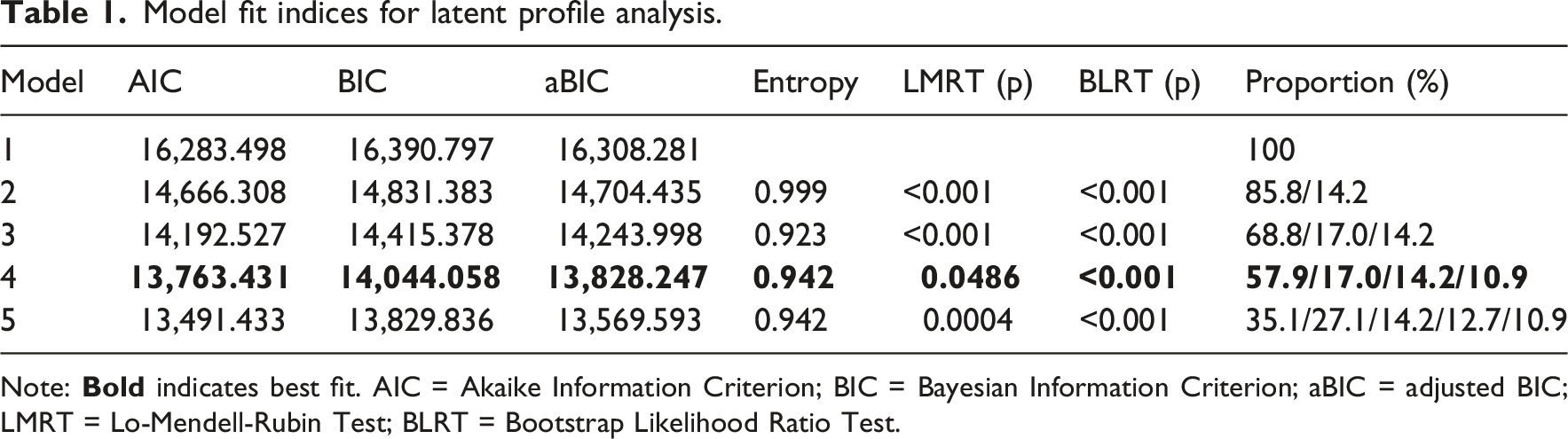
Note:
The profiles were characterized by distinct patterns of strengths and vulnerabilities in different ethical domains (Figure 1). Results of latent profile analysis of ESQ among nursing interns. Note: Factor 1: Beneficial to patients (No.1-3, 5); Factor 2: Respect for individuals (No.4, 6-8); Factor 3: Distributive justice (No.9-11); Factor 4: Maintaining patients’ confidentiality (No.12-13).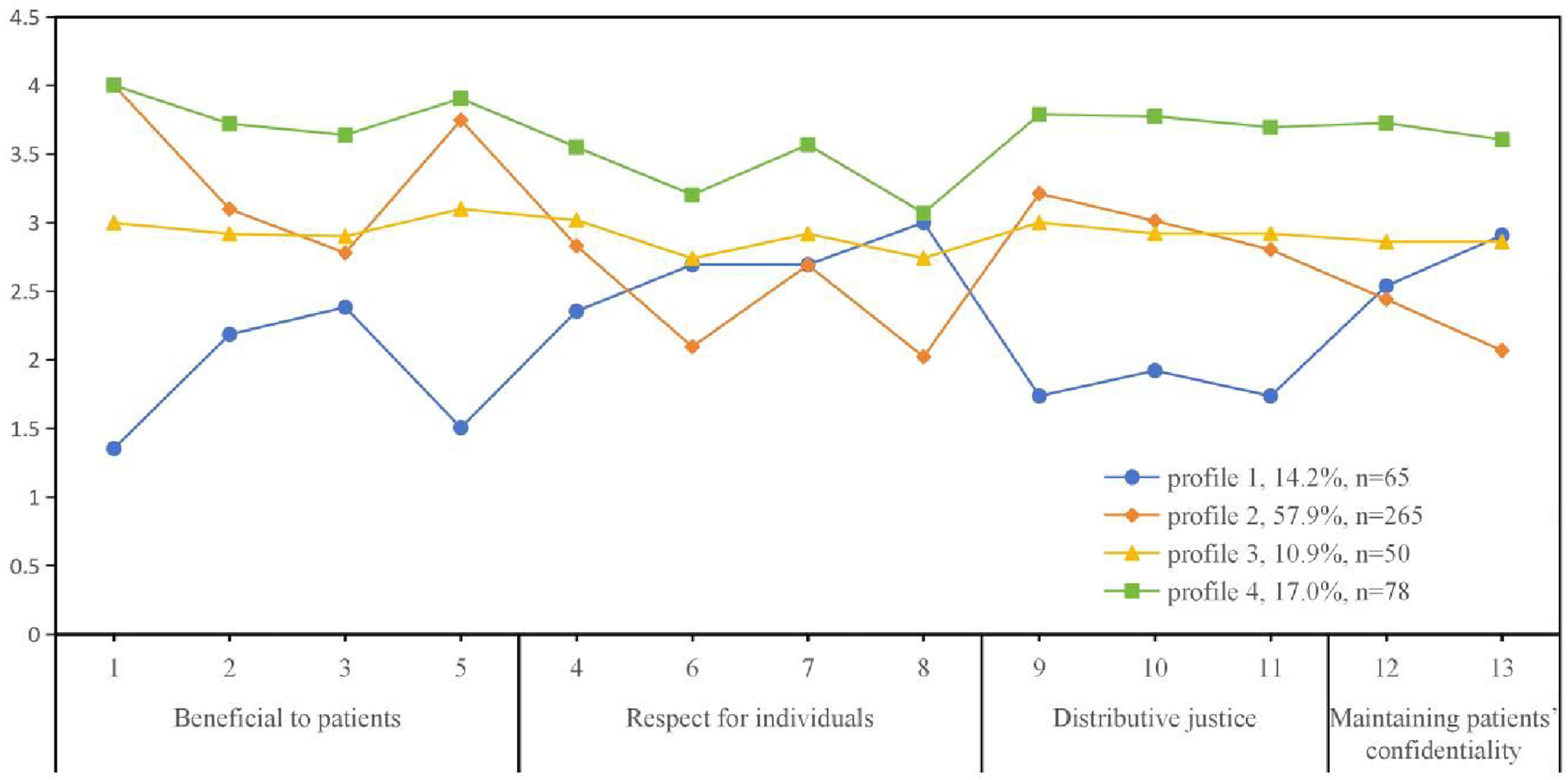
Profile 1: Rights-privacy focused (n=65, 14.2%)
This profile exhibited the greatest variability in scores across factors. Participants demonstrated relatively higher sensitivity in Respect for Individuals (Factor 2) and Maintaining Patients’ Confidentiality (Factor 4), but notably lower sensitivity in Beneficial to Patients (Factor 1) and Distributive Justice (Factor 3). This pattern suggests a primary ethical orientation towards individual autonomy and privacy.
Profile 2: Justice-beneficence focused (n=265, 57.9%)
This profile also showed considerable score fluctuation. In contrast to Profile 1, it was marked by higher sensitivity in Beneficial to Patients (Factor 1) and Distributive Justice (Factor 3), coupled with relatively lower scores in Respect for Individuals (Factor 2) and Maintaining Patients’ Confidentiality (Factor 4). This indicates an ethical prioritization of utilitarian principles and fair resource allocation.
Profile 3: Balanced-intermediate (n=50, 10.9%)
This profile presented the most stable response pattern, with moderate and relatively uniform scores across all four ethical factors. It represents a group with a well-rounded, though not exceptional, level of ethical sensitivity without pronounced strengths or deficits in any specific domain.
Profile 4: High overall sensitivity (n=78, 17.0%)
This profile achieved the highest overall scores with minimal inter-factor variability. Participants demonstrated strong sensitivity across all domains, particularly excelling in Respect for Individuals, Distributive Justice, and Maintaining Patients’ Confidentiality. This profile embodies a comprehensively high level of ethical sensitivity.
The four profiles formed two complementary pairs. The Rights-Privacy Focused and Justice-Beneficence Focused profiles showed opposite patterns across the ESQ-NS domains, suggesting two distinct trajectories of ethical sensitivity development. The Balanced-Intermediate and High Overall Sensitivity profiles represented undifferentiated and fully integrated ethical sensitivity, respectively.
Characteristics and differences across profiles
Differences of demographic and related variables across latent profiles (N=458).
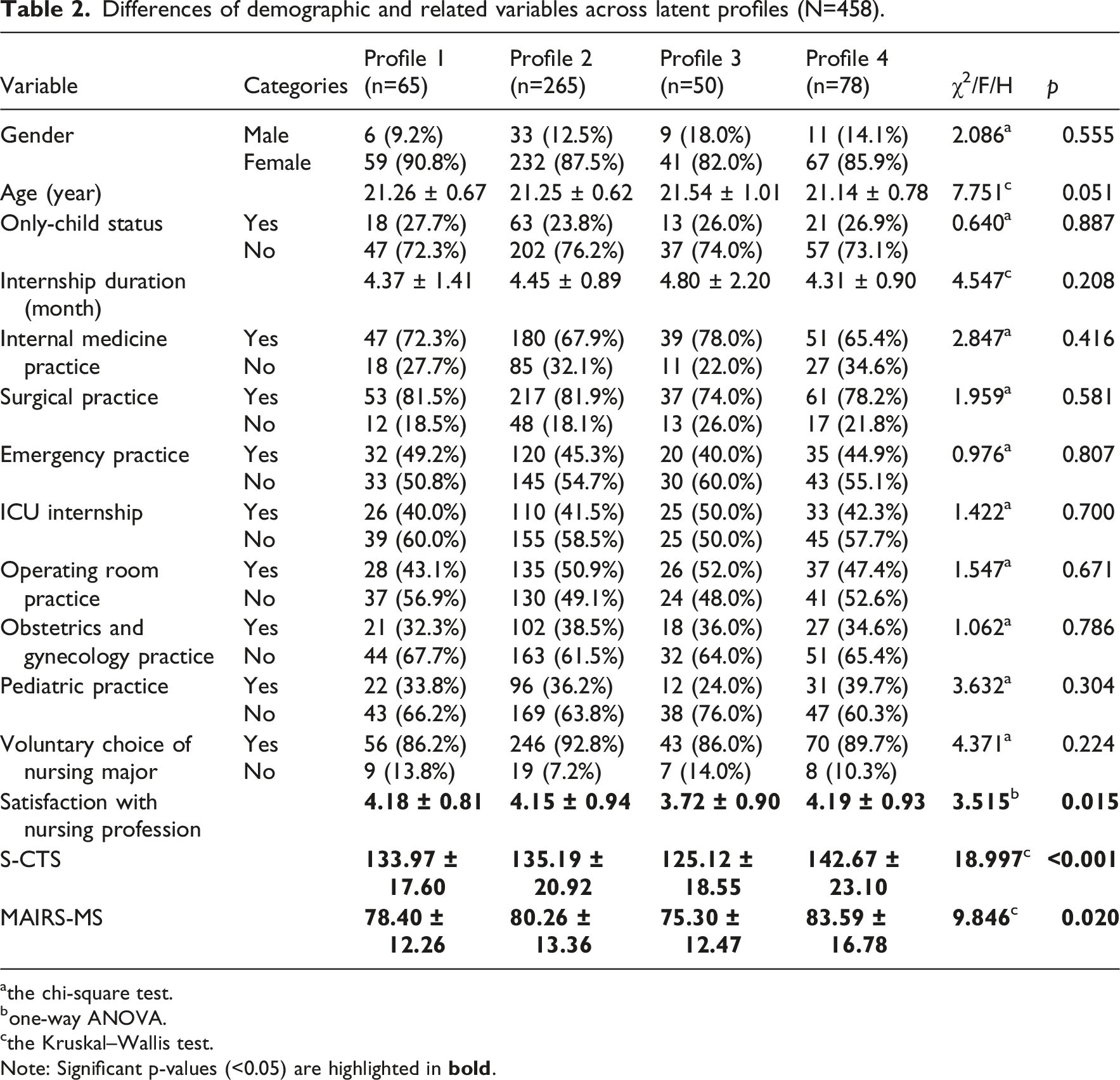
athe chi-square test.
bone-way ANOVA.
cthe Kruskal–Wallis test.
Note: Significant p-values (<0.05) are highlighted in
To identify specific pairwise differences, Games–Howell post hoc tests were conducted for S-CTS and MAIRS-MS. For critical thinking, the High Overall Sensitivity profile scored significantly higher than the Balanced-Intermediate profile (p < .001). Additionally, the Justice-Beneficence Focused profile scored significantly higher than the Balanced-Intermediate profile (p = .005) and the Rights-Privacy Focused profile (p = .005). For AI readiness, the High Overall Sensitivity profile scored significantly higher than the Balanced-Intermediate profile (p = .009). No other pairwise comparisons were statistically significant (all p > .05). These results delineate a gradient where the High Overall Sensitivity profile is associated with the most favorable cognitive and readiness outcomes, while the Balanced-Intermediate profile consistently demonstrates the lowest scores on both measures.
Predictors of ethical sensitivity latent profiles in nursing interns
Multinomial logistic regression analysis of factors associated with latent profiles of ESQ among nursing interns (N=458).
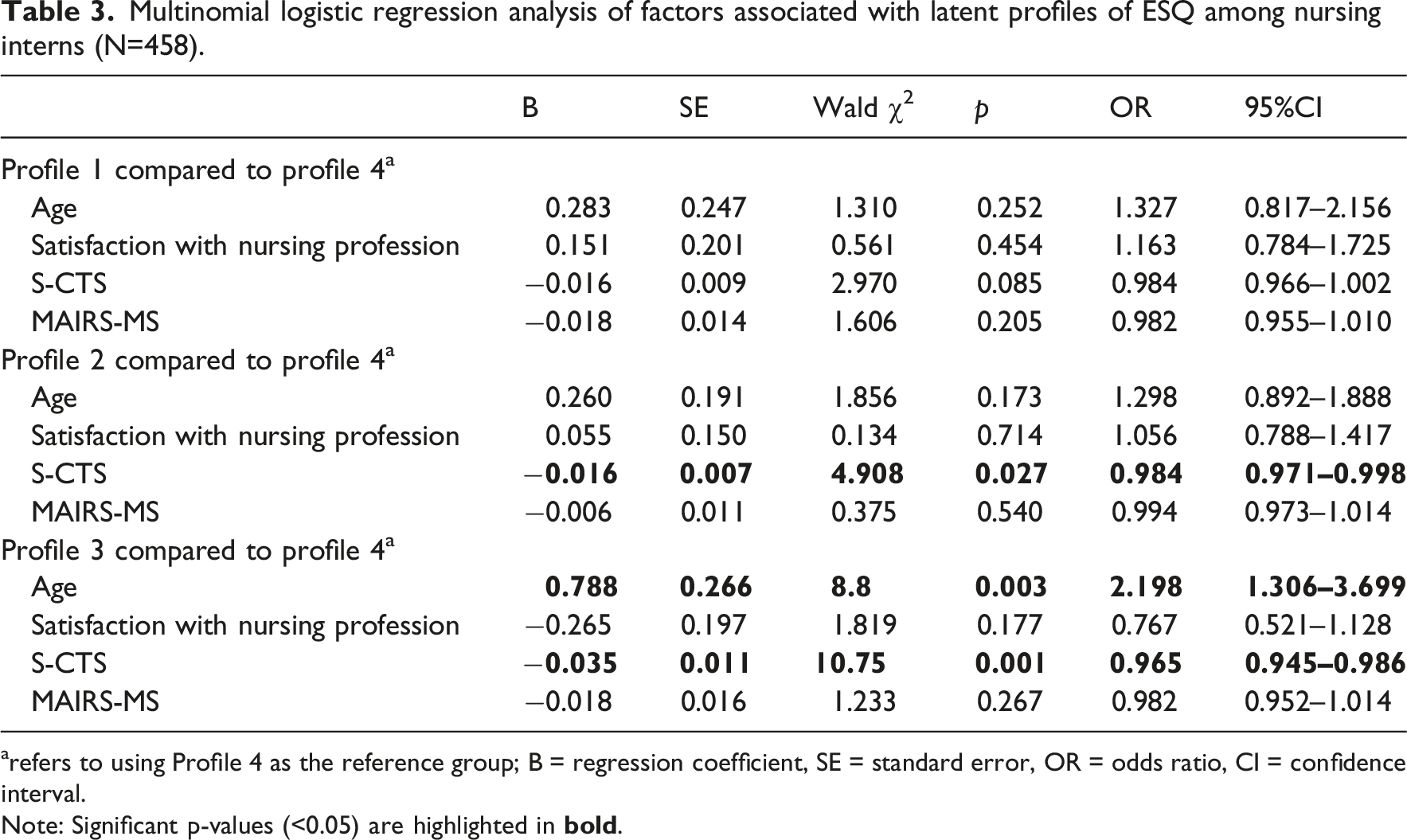
arefers to using Profile 4 as the reference group; B = regression coefficient, SE = standard error, OR = odds ratio, CI = confidence interval.
Note: Significant p-values (<0.05) are highlighted in
Discussion
This study employed a person-centered approach to investigate the heterogeneity of ethical sensitivity among nursing interns, identifying four distinct latent profiles: Rights-Privacy Focused (14.2%), Justice-Beneficence Focused (57.9%), Balanced-Intermediate (10.9%), and High Overall Sensitivity (17.0%). These profiles reveal that ethical sensitivity is not a unitary trait but rather a multidimensional competency that develops unevenly across different ethical domains. Furthermore, our findings demonstrate that critical thinking disposition is a key factor differentiating these profiles, providing the empirical evidence linking critical thinking to ethical sensitivity as defined within professional nursing contexts. The association between comprehensive ethical sensitivity and higher AI readiness offers preliminary insights into preparing nurses for technologically infused healthcare environments.
Heterogeneity of ethical sensitivity among nursing interns
The identification of four distinct profiles confirms that meaningful heterogeneity exists in how nursing interns perceive and respond to ethical dimensions of clinical practice. This finding aligns with previous person-centered studies in nursing ethics that have identified heterogeneous profiles in related constructs such as moral resilience 4 and moral courage. 17
The Justice-Beneficence Focused profile, comprising the largest proportion of the sample (57.9%), represents a particularly noteworthy finding. Nursing interns in this profile demonstrated heightened sensitivity to principles of patient benefit and fair resource allocation, yet showed relative insensitivity to respect for individual autonomy and confidentiality. This pattern may reflect the explicit emphasis on efficiency, protocol adherence and resource management during clinical rotations, which can inadvertently prioritize utilitarian considerations over relational ethics.28,29 The study by Kim et al. has noted that clinical learning environments often foreground procedural correctness and institutional efficiency, potentially at the expense of cultivating sensitivity to patients’ individual dignity and privacy needs. 30
Conversely, the Rights-Privacy Focused profile (14.2%) exhibited the opposite pattern: strong sensitivity to individual autonomy and confidentiality coupled with lower sensitivity to beneficence and distributive justice. This profile may represent nursing interns who have internalized the principle of patient-centeredness but have not yet developed the capacity to balance individual rights against broader considerations of justice and collective welfare.14,31 The existence of these two contrasting profiles underscores the need for ethics education, which should clearly emphasize the integration of multiple ethical principles, rather than presenting them in isolation. 32
The High Overall Sensitivity profile (17.0%) represents the ideal integrated type, nursing interns who demonstrate strong, balanced sensitivity across all ethical domains. This profile likely reflects individuals who have successfully synthesized the various dimensions of ethical sensitivity into a coherent framework, enabling them to navigate complex situations where principles of justice, beneficence, autonomy, and confidentiality intersect and potentially conflict. The relatively modest size of this group highlights the challenge of cultivating comprehensive ethical sensitivity during the internship, and suggests that for most interns, ethical development remains a work in progress.
The Balanced-Intermediate profile (10.9%) exhibited moderate and uniform scores across all domains without pronounced strengths or deficits. While this pattern might initially appear unremarkable, its association with the lowest critical thinking scores suggests that this uniformity may reflect a less differentiated pattern of ethical sensitivity rather than genuine integration. 33 These interns may be aware of the existence of ethical issues, but they lack the analytical tools to identify their specific contours or weigh competing considerations.
These profiles carry distinct implications for clinical practice. A nursing intern in the Rights-Privacy Focused profile (14.2%) would be attentive to patients’ autonomy and confidentiality but may be less attuned to equitable resource allocation. Conversely, an intern in the Justice-Beneficence Focused profile (57.9%) would demonstrate conscientiousness regarding fair resource distribution and patient well-being, yet may overlook individual privacy. Interns in the Balanced-Intermediate profile (10.9%) would recognize that ethical issues exist but would struggle to articulate specific ethical principles or prioritize competing values. Finally, those in the High Overall Sensitivity profile (17.0%) would recognize nuanced ethical tensions and weigh multiple ethical considerations simultaneously.
Analysis of factors influencing nursing interns’ ethical sensitivity profiles
Interns in the Balanced-Intermediate profile reported significantly lower professional satisfaction compared to those in other profiles (p = .015). This finding suggests that undifferentiated ethical sensitivity may be associated with diminished professional fulfillment, potentially because these interns have not yet developed the differentiated ethical lens needed to derive meaning and purpose from their clinical encounters. 29 The study by Numminen et al. has established that ethical competence contributes to nurses’ professional identity and job satisfaction, 29 and our findings extend this by showing that even among those with moderate ethical sensitivity, the absence of a clearly defined ethical orientation may undermine professional satisfaction.
Regarding age, although the overall test showed only marginal significance (p = .051), multinomial logistic regression revealed that older interns were significantly more likely to belong to the Balanced-Intermediate profile (p = .003) compared to the High Overall Sensitivity profile. This counterintuitive finding warrants careful interpretation: older interns are more likely to exhibit undifferentiated ethical sensitivity. One possible explanation is that age in this sample (mean 21.26 ± 0.73 years) reflects academic progression rather than chronological maturity, with older interns being those who have spent more time in clinical rotations. 34 Prolonged exposure to clinical environments without corresponding ethics education may lead to a normalization of ethical tensions, resulting in a “flattening” of ethical sensitivity over time. 14 Alternatively, this finding may reflect cohort effects or unmeasured confounding factors, such as differences in prior ethics education or clinical experiences. Future longitudinal research is needed to clarify the relationship between age, clinical exposure, and ethical sensitivity development.
Critical thinking as a key correlate of ethical sensitivity profiles
A central finding of this study is the robust association between critical thinking and ethical sensitivity profile membership. Post hoc analyses revealed that interns in the High Overall Sensitivity profile scored significantly higher on critical thinking than those in the Balanced-Intermediate profile (p < .001). Additionally, interns in the Justice-Beneficence Focused profile scored significantly higher than those in the Balanced-Intermediate profile (p = .005). These findings address a critical gap in the literature: while previous studies have documented relationships between critical thinking and moral sensitivity, 19 this study provides the empirical evidence linking critical thinking to ethical sensitivity as defined within professional nursing contexts.
The mechanism underlying this association warrants consideration. Critical thinking may serve as a cognitive catalyst that transforms the initial, undifferentiated recognition that an ethical issue exists—ethical awareness—into the more fully developed capacity to discern specific principles and weigh competing considerations—ethical sensitivity. 35 Interns with stronger analytical abilities are better equipped to deconstruct complex clinical situations, identify the specific ethical principles at stake, and recognize how different principles may conflict or align. This capacity is particularly important for developing sensitivity to nuanced ethical dimensions such as distributive justice or the tension between beneficence and autonomy, as these require more than intuitive recognition and instead demand systematic analysis of contextual factors and competing values.14,20
The particularly low critical thinking scores among nursing interns in the Balanced-Intermediate profile are striking. This profile’s moderate, uniform scores across all ethical domains may reflect a form of ethical “satisficing,” which refers to a tendency to recognize that ethical issues are present without engaging in the deeper cognitive processing required to discern their specific nature or implications. 36 Dreier argues that ethical satisficing involves settling for morally adequate rather than optimal responses, particularly when circumstances constrain deliberation. 36
Conversely, the superior critical thinking scores of the High Overall Sensitivity profile show that these interns not only have cognitive resources to identify ethical issues but also can integrate multiple ethical perspectives and navigate trade-offs between conflicting principles. This interpretation aligns with recent work by Wang et al., who found that ethical sensitivity mediates the relationship between critical thinking and ethical decision-making among nursing interns, 20 suggesting that critical thinking enhances ethical competence precisely by sharpening the capacity to perceive and interpret ethically charged situations.
AI readiness and ethical sensitivity
The association between AI readiness and ethical sensitivity profile membership, while more limited than for critical thinking, offers preliminary insights into an unexplored area of nursing ethics. Post hoc analyses revealed that interns in the High Overall Sensitivity profile scored significantly higher on AI readiness than those in the Balanced-Intermediate profile (p = .009). No other pairwise comparisons reached statistical significance. This finding suggests a possible link between ethical sensitivity and AI readiness, though the association appears modest and was limited to a single pairwise comparison. Whether comprehensive ethical sensitivity facilitates engagement with emerging healthcare technologies, or whether undifferentiated ethical sensitivity poses a barrier, requires further investigation.
It is plausible that interns with comprehensive ethical sensitivity are better positioned to engage with AI technologies, as their well-integrated ethical framework may provide the confidence and cognitive flexibility to approach novel challenges as opportunities for ethical reflection. 37 Mohammed et al. demonstrated that higher levels of ethical sensitivity correlate with greater proficiency in navigating the subtleties of generative AI in nursing care. 37 Conversely, interns in the Balanced-Intermediate profile, whose ethical sensitivity appears less differentiated, may be less equipped to discern the multifaceted ethical implications of AI integration, although this hypothesis requires direct empirical testing.38,39 Given the modest nature of this association, these findings suggest, but do not confirm, a role for ethical sensitivity in AI readiness. Further research with larger samples and more comprehensive AI readiness assessments is needed before drawing firm conclusions about this relationship.
Implications for nursing education and practice
The four profiles identified in this study provide a framework for targeted educational interventions. For interns in the largest group, the Justice-Beneficence Focused profile, interventions should broaden their ethical lens to encompass relational dimensions of care, leveraging their solid critical thinking skills to facilitate reflection on under-appreciated ethical domains. 28 For the Rights-Privacy Focused profile, educational efforts should develop sensitivity to broader systemic considerations through problem-based learning exercises involving resource allocation and population health ethics. 40 The Balanced-Intermediate profile, characterized by moderate and relatively uniform levels of ethical sensitivity and the lowest critical thinking and AI readiness scores, requires the most intensive support: foundational interventions that explicitly link critical thinking development with structured ethical decision-making frameworks. 29 For the High Overall Sensitivity profile, educational efforts should focus on consolidation and leadership development, with advanced ethical reasoning challenges to refine their capabilities. 41
Limitations
This study has limitations that should be considered. First, the cross-sectional design precludes causal inferences about the relationships between critical thinking, ethical sensitivity, and AI readiness. Longitudinal research is needed to examine how these profiles evolve over time and whether educational interventions can shift interns from less developed to more developed profiles. Second, self-report measures may be subject to social desirability bias, particularly for ethically sensitive items. Future studies should consider incorporating objective measures or behavioral assessments, such as standardized patient encounters or ethical dilemma simulations. Third, while we identified four meaningful profiles, latent profile analysis is inherently exploratory; validation in independent samples is necessary to confirm the stability and replicability of these profiles. Finally, the modest sample size in some profiles (Balanced-Intermediate, n=50) may have limited statistical power to detect additional between-group differences. Future multi-center studies with larger, more diverse samples are needed.
Conclusion
This study identified four distinct latent profiles of ethical sensitivity among nursing interns: Rights-Privacy Focused, Justice-Beneficence Focused, Balanced-Intermediate, and High Overall Sensitivity. These profiles reveal that ethical sensitivity is not a unitary trait but a multidimensional competency that develops unevenly across different ethical domains. Critical thinking differed significantly across profiles, distinguishing more developed profiles from less developed ones. This provides empirical evidence linking critical thinking to ethical sensitivity as defined within professional nursing contexts. The association between comprehensive ethical sensitivity and higher AI readiness offers preliminary insights into preparing nurses for technologically infused healthcare environments. These findings underscore the need for tailored, profile-informed educational strategies that recognize the heterogeneity of ethical development among nursing interns and prioritize the cultivation of critical thinking skills as a foundation for ethical competence.
Footnotes
Acknowledgments
The authors would like to thank all nursing interns for their participation and contribution in this study.

Author contributions
All authors have made substantial contributions to this study. Y Zhang and J Hua conceptualized and designed the study. D Lin collected, analyzed the data, and wrote the main manuscript text.
Funding
The authors received no financial support for the research, authorship, and/or publication of this article.
Declaration of conflicting interests
The authors declared no potential conflicts of interest with respect to the research, authorship, and/or publication of this article.
Data Availability Statement
The data supporting the findings of this study are available upon reasonable request from the corresponding author, and will be shared in accordance with the ethical standards of our institution and any applicable legal requirements. Please note that the availability of data may be subject to certain restrictions, which are necessary to protect the privacy of participants and abide by the confidentiality agreement.