






Abstract
Introduction
Wisdom is frequently invoked as a hallmark of good nursing, yet its meaning and practical implications remain conceptually under-specified. Grounded in virtue ethics and the Aristotelian notion of phronesis, this paper aims to clarify the concept of “wisdom in nursing care” to support ethically grounded nursing practice.
Methods
A concept analysis was conducted using the Walker and Avant method. The literature search was carried out in January 2026 using the PubMed and CINAHL databases, focusing on uses of the concept of wisdom relevant to the nursing profession. Twenty-five publications were included and analyzed to identify multidisciplinary uses, defining attributes, antecedents, consequences, and empirical referents of wisdom in nursing.
Results
The analysis delineates wisdom as a morally grounded, relational, and practice-based capacity. Defining attributes include deliberation and context-sensitive judgment oriented toward fairness and patient wellbeing; morally informed action (praxis) undertaken for the right reasons; open-mindedness and humility regarding the limits of knowledge; perceptiveness and moral perception of ethically salient features of situations; reflexivity; empathy and moral imagination; emotional regulation; self-awareness; and understanding of others. Antecedents are organized into personal conditions (values, learning orientation, knowledge base, clinical experience, and mentorship) and environmental conditions (context familiarity, situational awareness, and informational resources). Consequences include progression toward expert practice, integration of theoretical and practical knowledge, ethically attentive navigation of uncertainty, and reinforcement of nursing’s commitment to human flourishing.
Discussion
This conceptual clarification supports education, leadership, and ethical practice by rendering wisdom more teachable, discussable, and amenable to study in nursing care. The integration of rigor and compassion positions wisdom as both steward and guide of the person within nursing practice.
Keywords
Introduction
Wisdom represents a multifaceted construct that integrates knowledge, experience, and ethical judgment. Within healthcare contexts, the American Nurses Association (ANA) defined wisdom as “the appropriate use of knowledge to manage and solve human problems” and “knowing when and how to apply knowledge to deal with complex problems or specific human needs. 1 This definition emphasizes wisdom as an active process that transcends mere knowledge accumulation, requiring sophisticated integration of cognitive, ethical, and experiential dimensions. The relevance of wisdom to nursing gained formal recognition when it was incorporated into the ANA definition of nursing informatics in 2008. 2 However, beyond the informatics domain, wisdom in nursing and its practical implications remain insufficiently specified. 3 This conceptual gap is educationally relevant, because nurses and students are expected to navigate complex clinical situations requiring not only technical competence but also value-informed judgment and ethically attuned action.1,4 Given the relevance of wisdom as a virtue within nursing practice and the conceptual ambiguity surrounding its application beyond nursing informatics, a systematic concept analysis is warranted. This study aims to conduct a concept analysis of wisdom in nursing care using the Walker and Avant method, providing definitional clarity and identifying attributes, antecedents, and consequences to advance both theoretical understanding and practical application of wisdom in nursing contexts. 5
Background
The philosophical foundations of wisdom trace back to Aristotelian virtue ethics, which distinguishes between intellectual and moral virtues. 6 Central to this framework is the concept of phronesis, or practical wisdom, described as the capacity to perceive situations accurately, engage appropriate emotions, deliberate on contextually appropriate actions, and execute them effectively. 6 Aristotle conceptualized practical wisdom as an intellectual virtue that enables individuals to consistently choose correct actions in given circumstances and execute them well for the right reasons. 6 Critically, practical wisdom cannot exist in isolation from moral virtues such as courage, temperance, and justice, as these virtues establish the correct targets toward which practical wisdom directs action. 6 Contemporary scholarship has expanded this classical understanding by emphasizing the relational and emotional dimensions of wisdom. D'Antonio characterized wisdom as an integration of knowledge and character, manifested through strong intellectual, social, and emotional qualities including insight, virtue, empathy, and refined interactions between thought, emotion, and motivation. 7 Core values underpinning wise practice include sincerity, respect for others, equity, and the desire and capacity to help others achieve their potential. 7 Wise individuals demonstrate concern for others’ needs rather than exclusive focus on personal happiness, coupled with strong communication skills and commitment to personal growth. 7 The emotional component of practical wisdom merits particular attention within caring professions. Svenaeus argued that phronesis is fundamentally rooted in empathy, understood as the capacity to perceive and understand another person’s state and situation. 8 This empathic discernment enables the practically wise person to see and judge what is at stake in a given situation, feeling “the right things at the right time, about the right things, towards the right people, for the right end, and in the right way.” 8 Rather than being emotion-free, practical wisdom relies on feelings that facilitate appropriate perception and judgment. 8 This integration of emotion and reason distinguishes practical wisdom from other forms of human knowledge. 8 Virtue ethics has been proposed as a useful framework for cultivating such professional formation, emphasizing character, moral agency, and practical wisdom (phronesis) as foundations for good nursing practice.9,10 In contemporary healthcare environments, wise practice may be challenged by procedural and organizational pressures that can limit reflective deliberation and marginalize relational aspects of care, making the cultivation of practical wisdom a priority for education and leadership.4,6 Educational approaches such as mentorship and preceptorship, reflective writing, and structured dialogue have been described as key strategies to foster practical wisdom and support students’ transition toward more context-sensitive clinical reasoning.7,11 Consistent with this, the Wisdom in Action perspective frames wisdom as emerging in practice through cycles of judgment, action, and reflection, reinforcing the need to design curricula that explicitly support experiential learning and reflective feedback. 12
Study aim
Given the relevance of wisdom as a virtue within nursing practice and the conceptual ambiguity surrounding its application beyond nursing informatics, a systematic concept analysis is warranted. This study aims to conduct a concept analysis of wisdom in nursing care using the Walker and Avant method, 5 providing definitional clarity and identifying attributes, antecedents, and consequences to advance both theoretical understanding and practical application of wisdom in nursing contexts.
Methods
Design
This study employed concept analysis methodology to systematically examine wisdom in nursing care. Concept analysis is a fundamental research approach for expanding and developing nursing knowledge by examining the principal elements of a concept through review of its. 13 This analytical process deconstructs concepts to enhance understanding, create accurate definitions, enable measurement, and provide comprehensive insights into phenomena of interest. 13 The purpose is to examine conceptual structure and function by identifying unique attributes that distinguish the concept from others. 14 The Walker and Avant eight-step method was selected to achieve conceptual clarity through inductive identification of attributes, antecedents, and consequences.5,15 This structured approach clarifies meanings and develops operational definitions by considering evidence from diverse information sources applicable to research and clinical practice. 15 The eight steps comprise: (1) concept selection; (2) determination of analysis aims; (3) identification of all concept uses; (4) determination of defining attributes; (5) model case construction; (6) construction of borderline, contrary, invented, and illegitimate cases; (7) identification of antecedents and consequences; and (8) definition of empirical referents. 16
Literature search strategy, study selection, and data extraction
A comprehensive literature search was conducted in January 2026 using the PubMed and CINAHL databases. The search strategy combined controlled vocabulary terms and free-text keywords. In CINAHL, the search employed the following strategy: (MH “Nurses” OR nursing) AND (wisdom OR phronesis). In PubMed, the strategy consisted of (wisdom OR phronesis) AND (nursing OR nurses). The following inclusion criteria were applied: qualitative studies, quantitative studies, and discussion papers that focused primarily on the concept of wisdom in the nursing profession. The search was conducted without restrictions regarding publication year or study design. Articles concerning healthcare professions other than nursing were excluded. Two reviewers (SC and MR) independently screened all titles and abstracts identified through database searches using Rayyan software (https://www.rayyan.ai/), removing duplicates and irrelevant records. Conflicts were resolved through discussion, with arbitration by a third reviewer (AV) when consensus could not be reached. Full-text articles of potentially eligible studies were retrieved and independently assessed for inclusion by two reviewers (SC and MR) using the predetermined eligibility criteria. Disagreements were resolved through consensus meetings, with final arbitration provided by the third reviewer (AV). Data extraction focused on definitional components, contextual uses, defining attributes, antecedents, consequences, and empirical manifestations of wisdom in nursing. Two reviewers (SC and MR) independently extracted data using a standardized form developed from Walker and Avant’s analytical framework. 5 Extracted data were synthesized through iterative discussion and constant comparison across sources to identify conceptual patterns and relationships. Quality appraisal of individual studies was not conducted, as concept analysis methodology prioritizes conceptual breadth and theoretical contribution over methodological rigor of individual sources. 5
Results
Literature search outcomes
The systematic search identified 1663 records across both databases. Following duplicate removal and screening for relevance to the nursing profession, 1207 articles underwent title and abstract review. Subsequently, 50 full-text articles were assessed for eligibility. Twenty-five articles focusing on non-nursing healthcare professions were excluded, resulting in 25 articles included in this concept analysis (Figure 1). PRISMA 2020
17
flow diagram of the process of record selection.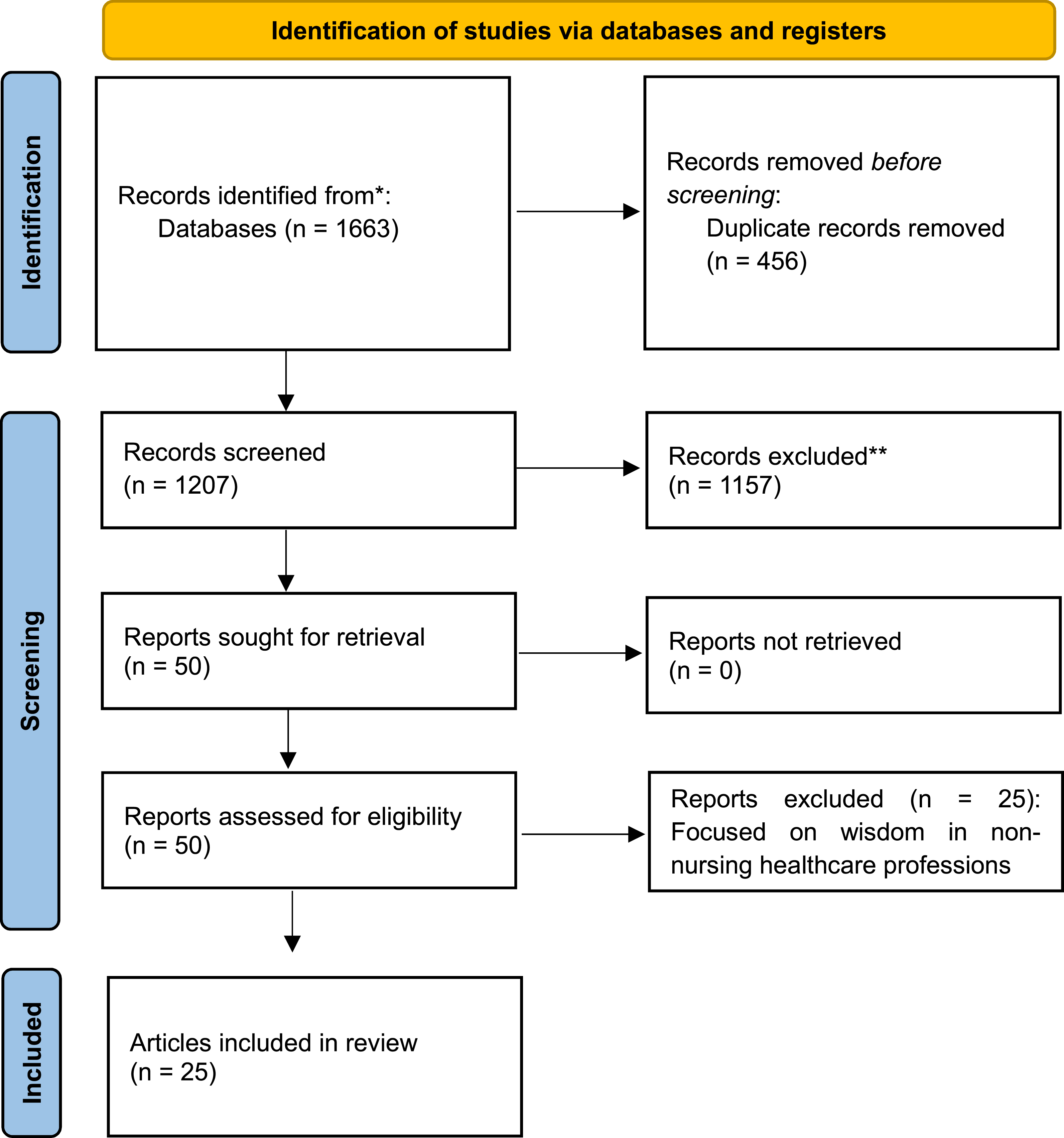
Organization of results
Consistent with Walker and Avant’s framework, results are presented sequentially to build conceptual clarity. 5 The analysis begins by examining wisdom’s multidisciplinary uses and foundational definitions, progresses through identification of defining attributes derived from nursing literature, and illustrates these through model and contrasting cases. Subsequently, antecedent factors enabling wisdom’s development and consequences of its application are explicated, concluding with empirical referents that operationalize the concept for research and practice.
Uses of the concept across disciplines
Linguistic and dictionary definitions
Foundational definitions establish wisdom as the capacity to follow reason in behavior and judgment, moderation in desires, equilibrium and prudence in distinguishing good from evil, and in evaluating situations, deciding, speaking, and acting based on experience and reflection on things, particularly concerning moral behavior and practical activity. 18 The Oxford Dictionary defines wisdom as “capacity to judge soundly in matters relating to life and conduct; soundness of judgment in choice of means and ends; sometimes, less strictly, sound sense, especially in practical affairs.” 19
Psychological perspectives
From a psychological perspective, wisdom is commonly understood as a form of practical knowledge and judgment oriented toward addressing complex and often existential human problems, involving the capacity to discern appropriate goals and to act in ways that promote morally defensible outcomes. 1 This account emphasizes that wisdom is not value-neutral but inherently moral, requiring attentiveness to others and the ability to balance personal interests with concern for the common good. Within nursing ethics, this moral dimension resonates with accounts that locate ethical practice in moral perception and sensitivity, namely, the capacity to recognize what is ethically salient in concrete situations of care and to respond appropriately to vulnerability and need. 20 Psychological and ethical scholarship further suggest that wisdom encompasses both an outward-oriented concern for others and an inward, reflective engagement with one’s own experiences. In nursing practice, these dimensions converge in the ongoing integration of attentiveness to patients’ wellbeing with reflective learning from lived clinical encounters, rather than reliance on abstract rules or procedural reasoning alone. 11 From this perspective, wisdom develops through sustained engagement with morally significant situations, where judgment is shaped by experience, reflection, and responsibility toward others.
Importantly, wisdom cannot be reduced to age or length of experience. Instead, psychological accounts highlight dispositional qualities such as openness to experience, reflective thinking, creativity, social understanding, and moral integrity as enabling conditions for wise judgment. 3 These qualities align closely with ethical expectations of nursing practice, particularly the capacity for empathy and moral imagination. Empathy, in particular, has been described as a necessary psychological condition for practical wisdom, as it allows practitioners to grasp what is at stake for another person and to orient judgment toward ethically appropriate action in situations of uncertainty. 8 Taken together, these perspectives position wisdom as a morally grounded psychological capacity that supports ethically responsive nursing practice.
Philosophical foundations
Philosophical inquiry into wisdom predates psychological investigation, as reflected in the etymology of philosophy derived from the Greek “philo” (love) and “sophia” (knowledge or wisdom) literally meaning “love of wisdom.” 1 Socratic wisdom emphasizes awareness of the limits of one’s knowledge, recognizing that assuming understanding without analysis represents a flaw in judgment. Acknowledging these limits is thus a fundamental element of wisdom. 3 Aristotle further distinguishes theoretical and practical knowledge, asserting that understanding human capacities and virtues is essential to moral goodness. In Ethics, he describes practical wisdom (phronesis) as the capacity to deliberate rightly about what is good both for oneself and for others. 1 For Aristotle, wisdom is a virtue acquired through habituation and guided by reason to achieve moderation of emotions and actions. Practical wisdom is inherently action-oriented, while wisdom itself represents “the most finished form of knowledge,” integrating demonstrable truth with intuitive understanding1(p 61.) Contemporary philosophical perspectives extend this view by identifying self-reflection as essential for authenticity and as a vital component of wisdom in navigating the complexities of human existence. 1
Wisdom in nursing context
Within nursing, wisdom is grounded in clinical judgment and “thinking-in-action,” integrating intuition, emotion, and sensory awareness. 21 Clinically wise nurses are characterized as competent and expert, embodying a synthesis of experience, intelligence, creativity, and knowledge directed by values toward the common good. 2 These conceptions link wisdom directly to nursing practice, emphasizing that it is realized through actions informed by professional competencies and knowledge. 3 In nursing literature, phronesis (practical wisdom) requires contextual awareness before action, reflecting the moral and intellectual dimensions of nursing decision-making. 3 The wise nurse integrates scientific and patient-specific knowledge to determine priorities of care, balancing the good of individuals, groups, and society. 1 Developing wisdom as a core educational principle may address the challenge of preparing nurses for the complexities of contemporary practice. 7 Wisdom as an educational goal is reflected in the cultivation of a strong knowledge base, critical thinking, creativity, moral responsibility, and altruism. Pedagogical strategies such as case studies, group discussions, mentorship, reflective writing, and professional networking effectively foster wisdom among nursing students. 7 In leadership contexts, wisdom is vital to centering human flourishing in nursing practice and guiding reflective evaluation of institutional policies. Nurse leaders require moral discernment and practical wisdom to balance competing demands and to create conditions that enable ethical and effective nursing practice. 6
Defining attributes
Analysis of the literature identified multiple attributes constituting the essential characteristics of wisdom in nursing practice:
Deliberation involves inquiry aimed at determining actions that are fair and just, requiring the ability to frame situations from multiple perspectives. As Aristotle noted, wisdom entails the capacity to deliberate nobly about what supports living well, not only for oneself but also for others. 6
Judgment refers to discerning and deciding the right course of action by balancing virtues appropriate to a given situation. Rooted in Aristotle’s Nicomachean Ethics, judgment is “characterized by decision,” integrating empathy and compassion to evaluate fairness and to act justly. 6 In this regard, wise judgment in nursing also entails the capacity to establish moral priorities when competing claims are present, balancing the good of individual patients with the good of other patients and, at times, with broader organizational or societal considerations. 1
Morally Informed Action (Praxis) links wisdom to action guided by reason and moral purpose. The wise nurse chooses and performs the right action for the right reason, seeking patient wellbeing through moral and just decisions. 6 In this sense, morally informed action also entails the nurse’s capacity to integrate the central purpose of care, the prescription of action, and the concrete realities of the situation, thereby assuming moral responsibility for how actions are enacted and for their consequences within clinical practice. 22
Open-mindedness requires commitment to one’s views while remaining receptive to revision when confronted with new evidence or argument. 6 Sellman identifies humility as integral to open-mindedness, describing the wise person as one who questions even deeply held convictions, aware that existing knowledge may be incomplete or outdated.3,4,6
Perceptiveness denotes intuitive discernment that bridges habitual knowledge and the uniqueness of particular situations.6,23 It reflects a refined “eye,” “ear,” and “feeling,” enabling expert nurses to perceive situational nuances essential for right and good action. 6
Reflexivity is “the act of interrogating interpretive systems,” requiring ongoing critical examination of assumptions, values, and beliefs within socially and organizationally constructed contexts 6 Reflexive practitioners think deeply, reassess experiences, and derive meaning to guide future actions. 3
Moral Perception refers to the ability to recognize and interpret morally relevant aspects of situations, including virtues, motivations, and contextual details. Morally perceptive nurses discern meaning within these elements to guide ethical practice. 20
Moral Sensitivity involves recognizing and responding appropriately to others’ needs, acting with awareness of moral implications and patient uniqueness.1,20
Moral Imagination, closely tied to empathy, allows nurses to envision what it means to be a patient within specific circumstances, fostering compassionate understanding. 20
Empathy forms the emotional foundation of wisdom, enabling understanding of others’ suffering and guiding the pursuit of the best outcomes for all involved. Without empathy, wisdom cannot be exercised. 8
Emotional Control is the ability to perceive and manage one’s emotions appropriately while remaining calm and sensitive to others. 3
Self-Knowledge entails awareness of one’s own values, ethics, abilities, and limitations, serving as the foundation for authentic and moral practice. 3
Understanding of Others reflects genuine interest and comprehension of people across individual, social, and cultural dimensions. 3
Life Knowledge encompasses both experiential and theoretical understanding, integrating common sense, reflection, and competence in life matters. 3
Willingness to Learn and Learning Orientation highlight humility and motivation to expand knowledge through continuous inquiry and reflection. 3
Interaction with Others expresses wisdom’s relational nature, grounded in genuine care, compassion, and dedication to the common good. 3
Model cases
Six model cases from the literature exemplified wisdom in nursing practice (see Supplemental File 1). A model example is given below.
Case 2: In situations involving adolescents with severe but non-fatal brain injuries, nurses initiate authentic dialogue with families, recognizing depth of grief, uncertainty about the future, and need for different processing times. Dialogue becomes integral to the care process, breaking down distances between professional and family, enabling shared decision-making accounting for each case’s uniqueness. 24
As no explicit instances of contrary, illegitimate and borderline cases emerged from the literature search, illustrative examples were constructed by the authors following Walker and Avant methodological indications to further clarify concept boundaries. 5
Contrary Case: An emergency department nurse, faced with a migrant person with limited local language comprehension who refuses blood draw out of fear, dismisses the refusal as “cultural ignorance” and proceeds to immobilize the patient to complete the procedure quickly without attempting communicative mediation. This scenario completely lacks wisdom’s defining attributes (deliberation, judgment, empathy, open-mindedness, perceptiveness, and reflexivity), with action guided solely by technical urgency without consideration for human wellbeing or moral implications.
Illegitimate Case: A young nurse states: “I used much wisdom today: I found a quick way to handle all bureaucratic practices without having to disturb the doctor, so I finished my shift early.” Here “wisdom” is improperly used, associating it with mere technical expedient aimed at personal efficiency and workload reduction, lacking all defining attributes. This shows how illegitimate use can obscure wisdom’s original meaning, reducing it to technical competence or opportunistic behavior.
Borderline Case: A ward nurse faces an elderly patient with chronic pain requesting increased analgesic therapy. The nurse listens empathically, perceives patient suffering, shows moral sensitivity and open-mindedness, and briefly reflects on ethical implications and side effect risks, demonstrating some deliberation capacity. However, rather than actively involving the team and patient in shared evaluation of options, she autonomously proposes asking the physician for pharmacological adjustment without further exploring patient values or available non-pharmacological alternatives. This scenario manifests some key wisdom attributes (empathy, perceptiveness, and partial deliberation) but lacks full integration of critical judgment, reflexivity, and morally informed action, positioning it as a borderline case.
Antecedents
Antecedent factors are preexisting conditions influencing wisdom development, aggregated into two dimensions: person-related and environment-related.
Person-related dimension
Personal Factors include age, education, social interactions, culture and religion, values, relativism and tolerance, cognition, life experiences, openness to learning, assertiveness, and confidence. These aspects impact how nurses integrate competencies, values, and relationships in daily practice. 12
Knowledge Factors: Wisdom presupposes a solid knowledge base articulated in foundational, procedural, psychosocial knowledge and lifespan contextualism, enabling nurses to adapt decisions and actions to specific situations and individual needs. 12
Clinical Factors: Mentorship, experience, and clinical training constitute indispensable pillars for competency development and integration of theoretical knowledge into care practice. 12
Environment-related dimension
Environmental factors concern care context and align with situation awareness theory, the perception of components in the environment, understanding of their meaning, and their projected future state. 12
Type of Environment: Nurses practice wisely when they possess clinical knowledge concerning a specific environment, such as emergency department, and are comfortable in their environment. 12
Familiarity with Environment: Beyond familiarity, nurses show experience within the specialty environment. Benner describes experience as practical and theoretical knowledge, meaning a nurse must have both technical and non-technical competencies such as communication and emotional regulation.12,21
Electronic System Information: Includes use of computerized data, information, and knowledge. When providing care, nurses utilize data, information, and knowledge from electronic records and various devices to assist in decision-making, with data transformed into information to provide care. 12
Consequences
Advanced nursing practice
Progression from novice to expert is marked by increasing wisdom, which develops through the integration of thought and action rather than theoretical knowledge alone. Practical knowledge enables nurses to access personal and particular insights, refine goal setting, and enhance the likelihood of achieving care outcomes. Expert practice is thus characterized by accumulated wisdom, refined through clinical experience and the interaction between general and particular knowledge between theory and awareness of the other. 25
Integration of theoretical and practical knowledge
Wisdom requires openness to techne knowledge rooted in concrete situations and experience and to episteme, theoretical and universal knowledge. This openness allows nurses to engage in the healing art of viewing each patient holistically, within their unique life context. The continual enhancement of competence is therefore a process of ongoing cultivation of wisdom. 24
Elevating particulars over generality
While research is essential to understand general phenomena, wise nurses critically evaluate how such findings apply to specific clinical situations. Without wisdom, deliberation risks becoming a purely intellectual activity and practice an exercise in technical execution. Wise nurses question the a priori superiority of research and deliberate on the applicability of all forms of knowledge whether derived from evidence, tradition, or authority before use. 26 In this regard, clinical wisdom enables nurses to critically mediate between generalized, research-derived evidence and the particularities of individual patients, preventing the mechanical application of evidence and allowing professional judgment to guide when, how, and to what extent evidence should inform care decisions. 27
Guiding light for nursing practice
Because patient needs and clinical contexts fluctuate constantly, wisdom enables nurses to select among multiple possible actions and to remain open to revising or challenging established protocols when appropriate. 6 Placing wisdom at the center of nursing practice reaffirms the discipline’s core values, which risk marginalization in increasingly proceduralized care environments. Nursing’s eudaimonia (the pursuit of human flourishing) entails helping patients achieve their own wellbeing while also nurturing nurses’ professional integrity and capacity to act wisely within moments of care. 6
Negotiating uncertainty
Wisdom enables nurses to navigate uncertainty, contradictions, and differences in order to make decisions aligned with patients’ best interests, especially where evidence-based guidance is lacking. Overreliance on algorithms and standardized evidence may hinder the development of nuanced competence grounded in experience, tolerance of ambiguity, and ethical judgment, ultimately obscuring the individuality of the patient. 28 This capacity becomes particularly salient in contexts of heightened vulnerability, where external resources such as health, autonomy, and social engagement are diminished, and wisdom assumes a compensatory function in sustaining meaning, orientation, and wellbeing under end-of-life conditions. 29 Furthermore, wise clinical judgment also entails recognizing that morally justified decisions may still leave a moral remainder, as irresolvable or tragic dilemmas can generate residual regret or emotional unease that does not indicate failure, but rather reflects the ethical complexity of nursing practice. 30
The professionally wise nurse
The professionally wise nurse embodies virtue through a caring disposition informed by right reason, striving to provide safe and effective care that promotes patient wellbeing. Such a nurse possesses awareness of current and missing competencies, a commitment to continuous learning, and willingness to address gaps in knowledge and practice. Wisdom entails recognition that nursing care cannot be reduced to prescriptive responses, but instead requires moral discernment and contextual understanding. 4
Empirical referents
The Wisdom in Action (WIA) model describes how wisdom emerges during clinical action. WIA articulates into two dimensions: general, concerning wisdom application in care situations, and personal, manifesting in nurses’ subsequent reflective process coinciding with Schön’s reflection-on-action where professionals critically review and interpret experience, attributing meaning. 12
General wisdom in action
Technically, general WIA comprises information collection and processing, identification of relevant knowledge, use of critical thinking, and clinical judgment formulation. These processes translate into care decisions and concrete interventions, followed by outcome evaluation feeding back into the decision cycle. 12 Beyond cognitive competencies, intuition plays a significant role, understood as immediate and not always conscious understanding of clinical situations, described as integral part of care “art” capable of orienting nurse attention toward less visible patient needs. Documented interventions span from medication or oxygen administration to emotional support and patient education to technical procedure execution. Outcome evaluation through vital parameters, laboratory results, or clinical observations represents the conclusive passage closing and relaunching the WIA cycle, enabling concrete recognition of wisdom in action. 12
Personal wisdom in action
A second set of empirical referents concerns personal wisdom in action, manifesting through the reflective-feedback cycle. This cycle, occurring during or after clinical events, comprises moments of reflection, learning, and meaning attribution. Nurses document this dynamic through diary practices, awareness, meditation, or colleague confrontation, transforming errors and successes into new resources for the future. 12 Reflection leads to learning, reintegrated into clinical practice and increasing competence in addressing new uncertain situations. In this perspective, wisdom in action is not a final goal but a dynamic process accompanying entire professional careers, emerging in capacity to integrate technical and affective competencies during clinical practice, critically reflect on assumed decisions, and learn from experience, translating such learning into continuous care improvement. 12
Discussion
This conceptual analysis highlights that wisdom is a fundamental requirement for safe, competent, and good nursing care, representing the very spirit of the art of nursing. According to Benner, good nursing practice centers on helping patients achieve wellbeing. However, technical skill alone is insufficient for addressing the multifaceted and morally complex realities of nursing practice; wisdom guides nurses to act in these circumstances. 21 Both technical competence and wisdom are essential for safe and effective nursing: technology without wisdom lacks discernment, whereas wisdom without technical proficiency is imprudent. 11 Authentic concern and care for patients and families remain central to the professional mandate of nursing, countering the depersonalization that may accompany technological advancement. The capacity to act with discernment derived from wisdom is thus essential to preserving the human spirit and meaning in care. 11
The lived experience of wisdom in practice is powerfully illustrated in patients’ and nurses’ narratives. Patients describe wise nurses as a stabilizing presence in moments of profound vulnerability, evoking the experience of finding support and reassurance when one’s own strength is exhausted. 31 Such accounts convey the sense of safety, trust, and emotional containment that characterizes nursing wisdom when individuals are most at risk.
Other narratives contrast technical proficiency with the artistry of wise care, emphasizing that wisdom in nursing involves more than technical safety or compassionate intent alone. Wise nurses are described as possessing a depth of understanding that enables them to discern when to be present and when to step back, responding sensitively to the particular needs of each moment rather than adhering rigidly to predefined roles or procedures. 31 This distinction reflects the Aristotelian view that wisdom integrates technical excellence (techne) with moral discernment (phronesis), guiding action through attuned and context-sensitive responsiveness.
Nurses’ own reflections further illuminate the generative dimension of wisdom in practice. Experienced nurses describe feeling motivated to encourage and support those aspiring to enter the profession, drawing on their own experiences to sustain others and to affirm their capacity to grow into the role. 31 Such reflections exemplify wisdom not only as a personal virtue enacted in care, but also as a relational and generative force that fosters mentoring, continuity, and the transmission of virtuous practice across generations.
Implications for nursing education
In light of the preceding analysis, which conceptualizes wisdom in nursing as a morally grounded, experience-based, and relational capacity, several implications can be drawn for nursing education. If wisdom is enacted through situated judgment, empathy, and moral discernment, educational approaches must extend beyond the transmission of technical knowledge to support students’ ethical and professional formation. Students often model their professional behavior and reasoning on mentors who embody wise practice through compassionate and ethically grounded decision-making. Mentorship and preceptorship therefore represent key educational contexts in which students can witness wisdom in action, learning that nursing care extends beyond technical competence to include reflection, empathy, and moral courage. 11 From this perspective, the development of professional wisdom cannot be achieved through didactic instruction alone. Rather, educators themselves must aspire to wise practice, as wisdom is learned through observation, imitation, and emulation within relational contexts. 4
Consistent with virtue-ethical accounts, educating for professional wisdom involves fostering character development and self-awareness, enabling students to transform altruistic intentions into sustained professional goodwill. 4 This formative process is supported by the cultivation of core virtues such as honesty, justice, and courage, which sustain ethical practice over time. 32 Accordingly, pedagogical strategies that promote moral reflection and perspective-taking such as reflective writing, small-group discussions, mentoring relationships, and case-based learning can be understood as practical responses to the need to cultivate wisdom identified in this analysis. 7 In addition, professional socialization through peer networks and participation in professional organizations further supports the development of wisdom-related dispositions beyond formal curricula. 7 Importantly, fostering wisdom in nursing education also entails helping students to recognize the limits of their own knowledge, an attribute central to wise judgment and to actively seek further understanding or guidance when faced with uncertainty. 7 Taken together, these implications suggest that nursing education should aim to prepare practitioners who are not only clinically competent, but also wise, ethical, and compassionate problem-solvers committed to promoting human flourishing.
Implications for nursing leadership
The “swamp” of professional practice, characterized by regulations, policies, and organizational pressures, often constrains wise decision-making. Nursing leaders face tensions between managerial models and professional values. 6 As Sellman observed, the economic imperative to “do more with less” can distort behavior and threaten core professional values4,6 For Aristotle, wisdom enables individuals to act rightly and nobly33(p 129); within nursing, wisdom is thus imperative to place human flourishing at the center of practice. 6 Wisdom allows nurse leaders to engage reflectively with institutional norms and policies, cultivating discernment, humility, and moral balance in decision-making. 6 As Cathcart and Greenspan note, nursing managers require the moral capacity of wisdom to balance competing demands and create opportunities for good nursing practice while implementing organizational agendas.6,34 Through reflective dialogue, nurse leaders can examine their values, acknowledge uncertainty, and act constructively within it, reflecting an understanding of wise practice discussed in nursing leadership contexts by Jenkins et al. 6
Implications for clinical practice
The findings of this concept analysis suggest that wisdom should be considered a core dimension of clinical nursing practice, particularly in situations characterized by uncertainty, ethical complexity, and individualized care needs. Wise nursing practice enables clinicians to integrate evidence-based knowledge with contextual understanding, empathy, and moral discernment in order to provide patient-centered care.
In everyday clinical settings, wisdom may support nurses in prioritizing care, navigating conflicting values, communicating with patients and families, and adapting interventions to the uniqueness of each clinical situation. The concept also highlights the importance of reflective practice, interdisciplinary dialogue, and experiential learning as essential elements for sustaining clinically wise decision-making. 31
Furthermore, recognizing wisdom as a professional competency may encourage healthcare organizations to create practice environments that support reflection, ethical discussion, mentorship, and relational care, rather than focusing exclusively on procedural efficiency and task completion.
Strengths and limitations
This analysis provides a systematic examination of wisdom using an established methodology and transparent case construction. However, several limitations warrant acknowledgment. The literature search was restricted to the PubMed and CINAHL databases and to English-language publications, potentially excluding relevant conceptualizations from non-English literature and alternative cultural perspectives on wisdom. The focus on nursing excluded interdisciplinary insights from other healthcare professions. Although rigorous, the Walker and Avant method represents one among several available frameworks for concept analysis, each characterized by distinct analytical procedures. 5 Furthermore, the inherently interpretive nature of attribute identification means that different researchers might emphasize alternative conceptual dimensions. In addition, the available literature included a limited number of empirical studies specifically exploring wisdom in nursing practice, with several included sources consisting of theoretical or discussion papers. Consequently, empirical evidence regarding the operationalization and observable manifestations of wisdom in clinical settings remains relatively underdeveloped.
Future research directions
Several research priorities emerge from this analysis. First, development and psychometric validation of instruments to measure wisdom in clinical contexts is essential, capturing the multidimensional nature identified while remaining feasible for practice settings. Second, longitudinal studies examining wisdom development across the professional lifespan would illuminate trajectories from novice to expert and identify factors facilitating or hindering acquisition. Third, intervention research testing educational approaches including mentorship, reflective practice, and case-based learning through rigorous designs is needed to establish evidence-based pedagogical strategies. Fourth, studies examining relationships between nursing wisdom and patient outcomes (satisfaction, quality indicators, and adverse events) would provide empirical rationale for prioritizing wisdom in education and practice. More empirical studies exploring how wisdom is enacted in everyday nursing practice are particularly needed. Fifth, cross-cultural comparative research would enhance understanding of wisdom’s universal versus context-specific elements across diverse clinical settings. Finally, implementation science investigating organizational facilitators and barriers to wisdom-based practice would inform practical strategies for translating conceptual understanding into sustained practice change.
Conclusion
This concept analysis advances understanding of wisdom in nursing by clarifying it as a morally grounded, relational, and practice-based capacity, rather than a trait reducible to experience, age, or technical expertise. By systematically identifying defining attributes, antecedents, consequences, and empirical referents, the study delineates wisdom as a form of ethical knowing enacted through deliberation, judgment, and morally informed action in concrete situations of care. Nursing wisdom represents a vital concept within the discipline. It enhances professionalism and supports the development of genuinely reflective and morally grounded nursing knowledge. As Matney et al. note, wisdom in nursing should not be understood as a fixed endpoint or a final achievement; rather, it is enacted through practice as an ongoing process that develops and becomes visible over the course of nurses’ professional lives. 12 Wisdom in nursing care represents a way of being characterized by dual commitments: intentionality anchored in scientific evidence and intensity of action driven by profound regard for the person’s humanity and inherent dignity. This integration of rigor and compassion positions wisdom as both steward and guide of each person in nursing practice.
Supplemental material
Supplemental material - Wisdom in nursing care: A concept analysis
Supplemental material for Wisdom in nursing care: A concept analysis by Simone Cosmai, Michela Renda, Alessandra Valsecchi, Cristina Chiari, Diego Lopane, Alberto Gibellato, Stefano Mancin, Michela Piredda and Beatrice Mazzoleni in Nursing Ethics.
Footnotes

Author contributions
SC: Writing - Original draft preparation; MP and BM: Conceptualization, Methodology Data curation, Reviewing and Editing; MR: Investigation; AV: Supervision; AG and CC: Software, Validation; SM and DL Data curation, Reviewing and Editing; BM: Project administration.
Funding
The authors received no financial support for the research, authorship, and/or publication of this article.
Declaration of conflicting interests
The authors declared no potential conflicts of interest with respect to the research, authorship, and/or publication of this article.
Supplemental material
Supplemental material for this article is available online.
References
Supplementary Material
Please find the following supplemental material available below.
For Open Access articles published under a Creative Commons License, all supplemental material carries the same license as the article it is associated with.
For non-Open Access articles published, all supplemental material carries a non-exclusive license, and permission requests for re-use of supplemental material or any part of supplemental material shall be sent directly to the copyright owner as specified in the copyright notice associated with the article.
