







Abstract
This paper presents a study of the Irish experience of EU cohesion policy, with a view to exploring what the Irish case can tell us about the conditionality of state’s adaptation to EU policy values and practice. Using Bache’s (2008) framework for the analysis of Europeanization, Multi-Level Governance and Cohesion policy, the paper finds that Europeanization has resulted in a reorientation of domestic policies, practices and preferences in the Irish case, but the consequence has been the creation of Multi-Level Governance Type II not I (Börzel and Risse, 2003). The governance changes that have occurred have been ad hoc and messy, and central government’s response to them has been short-termist and financially expedient. This raises concerns about the sustainability of knowledge transfer impacts from Irish Multi-Level Governance and partnership projects within the formal system of Irish government. More generally, it suggests that if the desired impacts of EU Cohesion policy are to be sustainable in the longer-term, more attention needs to be given to effectively measuring and explaining EU policy influence, so that we might begin to understand how it can be supported and sustained in a variety of state contexts.
Introduction
Ireland’s relationship with, and responses to, the EU are well documented (Laffan, 2000, 2003, 2004, 2005, 2006, 2007; Laffan and O’Mahony, 2003, 2004, 2007, 2008) and there are considerable primary and secondary sources detailing Ireland’s interactions with, and experience of, EU Structural Funds and Cohesion policy (Adshead, 2002; Hegarty, 2003; Laffan, 1996; McCarthy, 2002; Moylan, 2011; Quinn, 2009). Using the Irish case as an exemplar, this paper sets out to find a way of measuring and accounting for EU influence in Cohesion policy. The intention is to find out what conditions are conducive to the most efficacious transfer of EU Cohesion policy aims and ambitions to member states. Using Bache’s (2008) framework for analysis of Multi-Level Governance and Cohesion policy, which deploys Risse et al.’s (2001) conceptualizations of state adaptation to EU influence, an examination of the Irish case shows that when a state’s domestic impetus towards adaptation coincides with EU incentives for adaptation, the impact of EU Cohesion policy can be significant. What the Irish case also demonstrates, however, is that this level of impact is not necessarily or intrinsically sustainable. The implication is that if the EU is to continue to influence domestic states’ cohesion policies, then it needs to continue to set conditions of conditionality with appropriate incentives, in order to sustain Europeanization gains after their initial impact. In order to illustrate this, the paper proceeds by setting out a framework by which to measure whether or not Europeanization has occurred; then to explain the conditions that supported its occurrence; and finally to determine what effects this has had on state systems of governance. The theoretical and empirical work in this paper sets out the procedure for answering these questions, and uses the experience of the Irish case to raise issues more generally about the sustainability of EU policy influence.
The paper is divided into four parts. The first lays out the framework for analysis and the methodology used to measure and explain EU Cohesion policy impact. The second presents the Irish case study. The third part deploys the analytical framework to explain the Europeanization experience and outcomes in Ireland. The fourth and concluding part extracts the lessons that might be learned about EU Cohesion policy sustainability and development practice from the Irish case.
Multi-Level Governance – a framework for analysis
This study uses Bache’s (2008) framework for analysis of multi-level governance and cohesion policy, which is an adaptation of Risse et al.’s (2001) study. Bache (2008: 15–17) adapts Risse et al.’s definition of Europeanization, defining it as ‘the emergence and development of EU policies, practices and preferences’ which lead – as a consequence of adaptational pressures and mediating influences – to a ‘re-orientation or reshaping of politics in the domestic arena’, resulting in a form of Multi-level governance. This model (see Figure 1) has four elements.
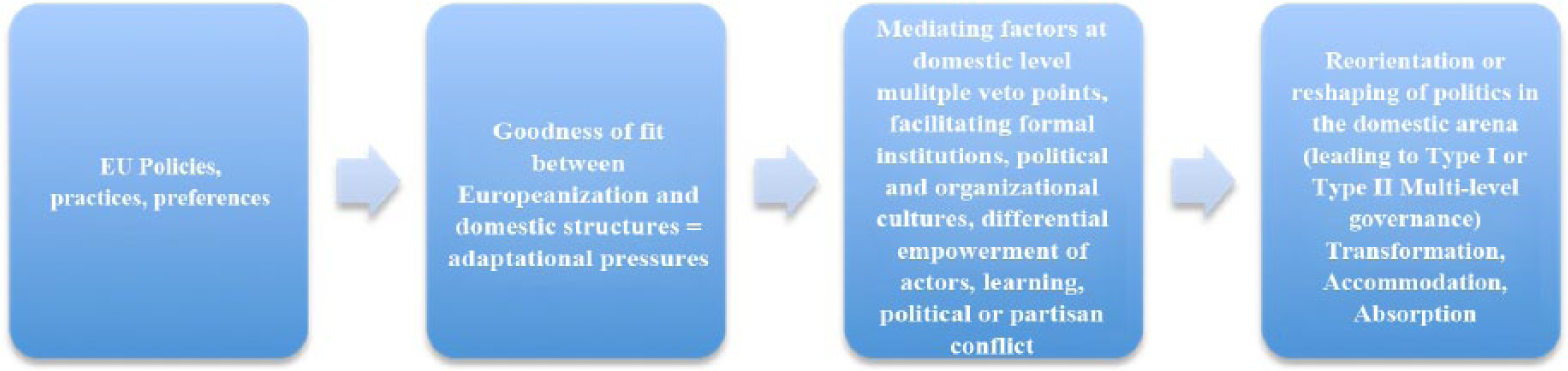
Europeanization and domestic change.
The problematic of conceptualizing this process as a linear one was addressed in Bache’s (2008: 18–19) model by an acknowledgement of the potentially circular and/or multi-directional complex causality that is associated with multi-level governance investigations (see: Saurugger, 2005); and is well-rehearsed in ‘second generation’ literature on Europeanization that characterizes the process as (potentially, at least) a ‘two-way street’ with opportunities for policy up-loading and down-loading (Dyson and Goertz, 2003: 20; Mulcahy, 2009: 23). For the purposes of this paper, however, where the primary purpose is to examine Irish state responses to EU Structural Funding over time, with a view to measuring and accounting for EU influence in Cohesion policy, the simpler linear model will be retained. Examining the effects of different variables and explaining causality is a task that can only be carried out after the initial empirical investigation to identify Europeanization has been conducted. It is this foundational task that this paper is concerned with.
Defining Europeanization
In order to test for the ‘emergence and development of EU policies, practices and preferences’, in Irish approaches to regional policy, the study uses Bulmer and Radaelli’s (2004: 4) definition of Europeanization, where: Europeanization consists of processes of a) construction, b) diffusion and c) institutionalisation of formal and informal rules, procedures, policy paradigms, styles, ‘ways of doing things’, and shared beliefs and norms which are first defined and consolidated in the EU policy process and then incorporated in the logic of domestic (national and subnational) discourse, political structures and public policies.
Using this approach, the analysis illustrates that the effects of Europeanization on national institutions may be either direct and/or formal, relating to the institutional structures, processes, procedures and conventions of government; or indirect and/or informal, concerning the shifting patterns of norms, values and identities that together comprise ‘the national system’ (Bulmer and Burch, 1998). It is this ‘new-institutionalist leaning’ definition of Europeanization that enables a full examination of domestic changes in terms of the ‘policies, practices and preferences’ outlined in the framework for analysis.
Explaining the adaptational pressures
Most accounts of adaptational pressures leading to Europeanization tend to stress the ‘goodness of fit’ or conversely, the degree of ‘mismatch’ in institutional and policy design between member state/EU approaches to policy. Briefly, it would appear that the literature offers two views of its significance: those who think that a degree of mismatch between EU and domestic policies is always a precondition for domestic adaptation (Börzel and Risse, 2000; Risse et al., 2001); and those who think that its significance varies depending on the policy (Radaelli and Bulmer, 2004). Of the former, Börzel and Risse (2000) argue that some degree of misfit presents the state with adaptational pressures and that where there are some facilitating factors, such as actors or institutions, responding to these adaptational pressures, Europeanization is likely to occur. Similarly, Risse et al. (2001) suggest that in order to produce domestic effects, EU policy must be somewhat difficult to absorb at the domestic level. If the policy of the member states fits well with the EU policy, there will be little impact or change. Alternatively, if the member state has a policy that is wholly different from the EU policy, it may be almost impossible to adapt to it. In consequence, they argue that the effect of Europeanization will be most marked in cases where the ‘goodness of fit’ is moderate. An explication of how these adaptational pressures correlate with Europeanization outcomes is provided in Table 1.
Categorizing domestic response to the EU.
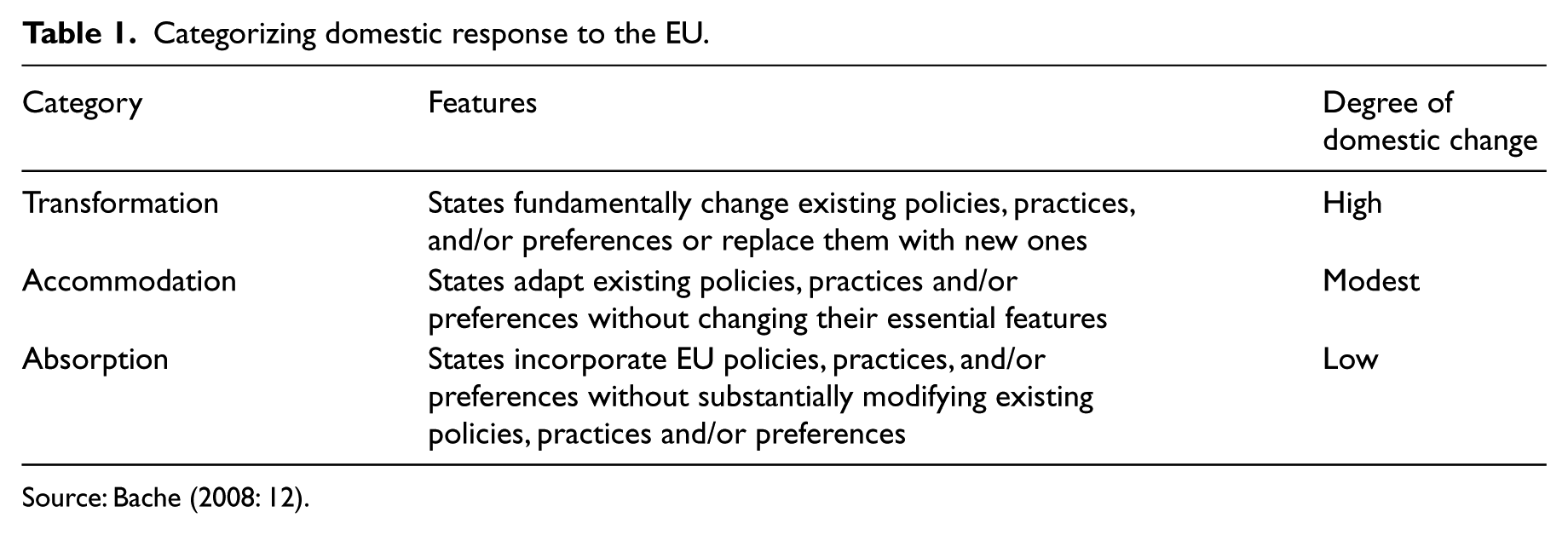
Source: Bache (2008: 12).
Mediating factors
Bache (2008: 16–17), following Risse et al. (2001: 6), identifies five key mediating factors that determine the impact of Europeanizing influences at the domestic level. First, multiple veto factors, refers to the (new) institutional structure of domestic politics and the suggestion that the more dispersed power is within the domestic arena, the more likely it is that adaptational pressures from the EU will be slowed or even blocked. These may be ameliorated to some extent, however, by a second set of mediating factors in the form of facilitative formal institutions that may empower domestic actors to bring about change or counter-act veto elements. The third mediating factor, political and organizational culture, refers the prevalence – or absence – of consensus or cooperative oriented decision-making policy contexts. Fourth, the differential empowerment of actors refers to the notion that Europeanization depends to a large extent on the redistribution of resources within the domestic arena, in a manner that facilitates a re-orientation towards EU policies, practices and preferences. Fifth and finally, learning is identified as a mediating factor in terms of the process of policy learning and adaptation of policy activities that begins to redefine actors’ interests and preferences in a way that supports Europeanization. To these original five, Bache (2008: 17) added a sixth mediating factor, Political partisan conflict, designed to account for the transformative outcome of general elections in the British majoritarian electoral system, which may have significant impacts upon the prospects for Europeanization depending on the dominant value structure of the elected government. In Ireland, the mainstream political consensus has always been supportive of the EU (O’Brennan, 2003). Even in the momentous electoral upheaval of 2011 (Gallagher and Marsh, 2011), EU sceptics were an unambiguous minority, comprising Sinn Fein and a small group of independent representatives banding together as ‘People before Profit’. As such, anti-EU sentiments are confined to the fringes of Irish electoral politics and do not warrant the introduction of an additional mediating variable to account for political partisan conflict as is the case in Britain.
Re-orienting or re-shaping domestic politics
In an attempt to categorize the domestic responses of EU member states to Europeanizing forces, Bache (2008) borrows three concepts from Börzel and Risse (2003: 69–70), which describe the adaptive strategies deployed by member states to Europeanizing forces: transformation; accommodation; and absorption (see Table 1). These different adaptive responses result in variable degrees of domestic change that may be correlated to Type I, or Type II, Multi-level governance (see Table 2). Type I multi-level governance reflects a more federal or quasi-federal arrangement, in which dispersion of authority is clearly de-limited.
Types of Multi-Level Governance.
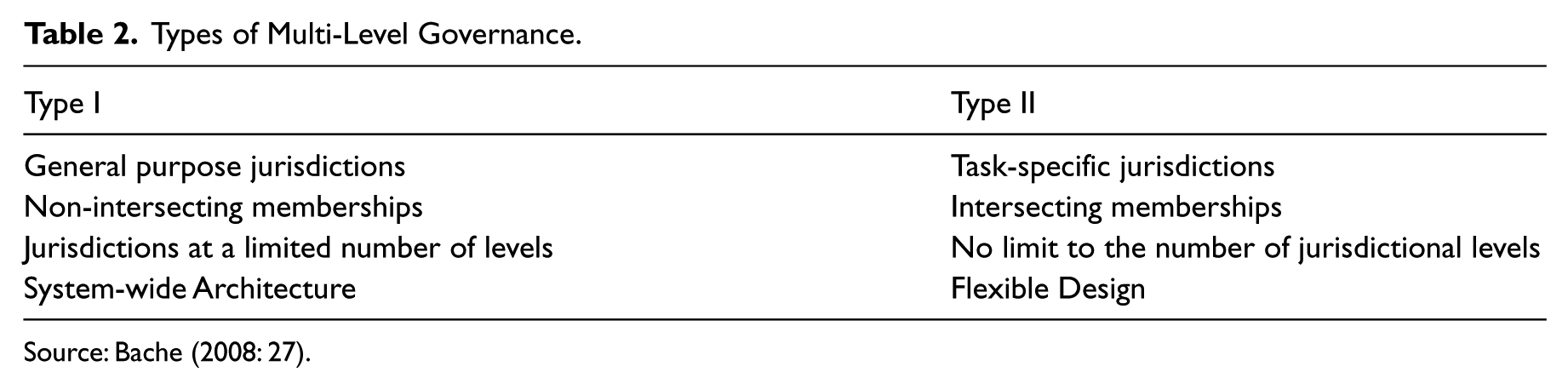
Source: Bache (2008: 27).
Type II multi-level governance describes ‘governing arrangements in which the jurisdiction of authority is task-specific, where jurisdictions operate at numerous territorial levels and may be over-lapping’ (Bache, 2008: 27). Bache (2008: 29) notes that whilst type I MLG refers increasingly to more formal devolution of powers; type II is altogether more messy and ad hoc, ‘capturing the complex array of quangos, agencies, and partnerships’ that may overlap in the spaces in between and below more formal levels of government. In the following section, details of the domestic governance arrangements that emerged in response to EU structural and cohesion policies suggest that multi-level governance arrangements that emerged in the Ireland are closer to type II than type I.
EU Structural Funds and cohesion policy in Ireland
This section provides an overview of EU Structural Funds implementation and Cohesion policies in Ireland, demonstrating that it is not possible to think of domestic Irish development initiatives without acknowledging their relations to, and referents in, EU policy developments. The remainder of this section provides a chronology of these developments, in order to give the necessary empirical detail for the analysis that follows in the next section.
1988 Structural Funds reform
The negotiations resulting in the 1988 reform of EC Structural Funds cemented Ireland’s successful bid for a lion-share of structural funding, but came at the price of treating Ireland as a single region. Nevertheless, as a consequence of the reforms, the Irish government was obliged also to set up a seven ‘sub-regions’, (sub-regions because under EC funding criteria, the whole island of Ireland is treated as a region), in order that they might contribute to the preparation of a 4-year National Development Plan (NDP) being submitted to Brussels.
1989 submission of national development plan
In fact, the development plan submitted in 1989 was based on a national programme rather than a regional one and the input of regional groups was regarded by central government as a largely ‘cosmetic exercise’ in order to satisfy EC funding criteria (Coyle, 1990: 11; Rees, 1992: 141). Although the NDP did not include the promotion of regional development as an overall objective, measures aimed at rural development (and the necessary acknowledgement of a variety of programmes, initiatives and pilot schemes as part of regional consultation exercise) did establish a framework for future policies. These, combined with attempts to coordinate EU and national development activities and to avoid duplication of efforts or costs, contributed to an inevitable shift of emphasis in the second National Development Plan that supported a more meaningful implementation of EU conditionality criteria.
1988–1990 introduction of the pilot area programme for integrated rural development
Administered by the Department of Agriculture and Food, this pilot programme was the first attempt to apply the principles of integrated rural development in a systematic way (O’Malley, 1992). The emphasis was on encouraging viable private and community sector enterprises by stimulating and co-ordinating local effort and facilitating linkages between local groups and various statutory agencies (Walsh, 1995: 5). Another important feature of the programme was an emphasis on shared learning through workshops and other forms of networking. This approach was followed by the LEADER initiatives (Liaisons entre actions de developpement de l’economie rurale) for the period 1991–1994, which gave locally-based integrated development strategies a new lease of life.
1991–1994 LEADER initiatives
In March 1991, the European Commission issued an invitation to local groups to prepare and submit ‘integrated’ business plans for their areas, so that local people might be empowered to direct development towards identified local needs and priorities. Sixteen groups were chosen, covering areas representing 61% of the land area of Ireland and almost 30% of the population (Kearney et al., 1995: ii). The success of the LEADER model encouraged support for a similar ‘area based response’ in urban areas (National Economic and Social Committee (NESC), 1990: 74).
1991 area-based response (ABR) initiatives
Under the government concordat entitled Programme for Economic and Social Progress (PESP), an area-based response (ABR) to long-term unemployment was established on a pilot basis as using previous EU LEADER programmes as a template (Government of Ireland, 1991). Twelve ABR areas were selected (eight urban and four rural), each with a board of directors comprising six directors from the local community, six from the social partners, and six from the state agencies in the area.
1992 EC Global Grant to Ireland
In September 1992, following negotiations with the Irish government, the European Commission established the Global Grant for the period 1992–1995, comprising a 64% contribution from the ERDF and 36% from the ESF, valued at IR£8 million (Haase et al., 1996: 6). This grant maintained support for the ABR initiatives, as well as a number of other small-scale, local development groups. 1 All support was conditional on the submission of ‘an integrated area action plan drawn up in consultation with such other local groups and bodies, public agencies and local representatives of the social partners’ (Commission of the European Communities (CEC), 1993: Article 4).
1993 creation of County/City Enterprise Boards (CEBs)
Organized according to the partnership template used for LEADER and ABR projects, County/City Enterprise Boards were intended to develop local enterprise and development and incorporated the local authority by including its Executive Manager in their Board.
1993 extension of the operation of PESP and global grant area-based partnerships
Government recognized 33 designated areas of disadvantage (adding an extra 11 urban and 10 rural areas), making all funding allocations conditional on the presentation of an integrated socio-economic plan that has been mediated through local representative structures and prepared jointly by local community groups and agencies involved in development (thus extending the objectives and conditions of the first Global Grant, covering the period 1992–1995).
1994–1999 second national development plan
By the time the second National Development Plan was introduced, a discernable shift of emphasis was apparent. The new principles of programming, partnership, concentration and additionality, the government’s explicit attempt to ‘build upon the experience gained from the implementation of initiatives stemming from EC actions’ (Government of Ireland, 1995: 12), and the inclusion of a specific Operational Programme devoted to Local Urban and Rural Development (OPLURD), illustrated not only a major innovation in national planning, but also an important political response to demands from local and regional interests to concretize the spirit of partnership envisaged in the 1988 Structural Funds reforms (Walsh, 1995: 13). The seven regions from the first NDP were replaced by eight as a consequence of recommendations made in the Barrington Report (1992) on reform of local government. These authorities were to coordinate public services in their region and advise on the implementation of the NDP (Callanan, 2003: 435).
1995 Rainbow government reforms
In 1995, a three-way coalition between Fine Gael, the Labour Party and Democratic Left, created the ‘Local Development Liaison Team’ – a small group of civil servants seconded to the Taoiseach’s Office with special responsibility for improving the coordination and cooperation between local development actors and agencies across Ireland. The Local Development Liaison Team was designed to support the operation of County Strategy Groups (later re-organized as Strategic Policy Committees) in every county, reflecting the government’s desire to ensure that local development actors and agencies worked as effectively as possible together.
1996 Government White Paper Better Local Government
Better Local Government addressed itself to enhancing democracy by increasing the role of local elected representatives in policy making, and improving the co-ordination of existing local development activities. Strategic Policy Committees (SPCs), replaced County Strategy Groups and included an elected official in their membership: they were established for all major service areas in each local authority. County/City Development Boards (CDB) established multi-agency coordination structures in each local authority area, acting in close cooperation with their local authorities and were required to prepare and oversee the implementation of a 10-year county/city Strategy for Economic, Social and Cultural Development – providing the template guiding all public services and local development activities. The intention of both was to bring more accountability and coherence to the planning and delivery of services at local level.
After the BLG white paper, the introduction of Local Traveller Accommodation Consultative Committees (LTACC) in all city/county local authorities (Government of Ireland, 1998, Housing [Traveller Accommodation] Act) introduced more participatory policy procedures. Later, in 2001, the fourth national partnership agreement, the Programme for Prosperity and Fairness (PPF), introduced the Revitalizing Areas through Planning, Investment and Development (RAPID) programme to address the needs of 45 disadvantaged urban areas. Other similarly formalized mechanisms were also created, including County Childcare Committees, Local Sports Partnerships, Territorial Employment Pacts and local and regional drugs task forces. All of these policy responses applied the partnership template model imported from the EU, thus marking the inception of formal processes of state-sponsored participatory democracy at local level.
1998 Ireland is divided into two EU NUTS II regions
In July 1997, the European Commission’s (CEC, 1997) Agenda 2000, sought to address the financial provisions for an enlarged EU, mindful of calls from net EU contributors for a reduction in their contributions. The subsequent reorganization, plus Ireland’s own economic growth since 1993, placed Ireland over the 75% GDP per capita threshold to qualify for full Objective One status in the allocation of EU Structural Funds. Anxious that they would not loose all of their funding eligibility, the Irish government quickly acted to combine its eight regional (NUTS III) authorities into two new combined NUTS II regions (NUTS being the acronym derived from ‘Nomenclature of Territorial Statistical Units’ used by Eurostat). At least three of these NUTS III regions, the Border, Midlands and West (the BMW group), had GDP per capita below the 75% Structural Funds threshold (O’Leary, 1999), leaving the remaining Southern and Eastern Region qualifying as an Objective One area in transition (Boyle, 2000). The rationale for this ‘overnight conversion’ to regionalization was clearly announced by the Minister for Finance, Charlie McCreevy, when he explained that ‘the government’s objective in this round of Structural Funds will be to secure for Ireland the optimum level of funding’ (Dáil Debates, 29 April 1998).
2000–2006 third National Development Plan
One of the four core objectives of the third NDP included ‘balanced regional development’, leading the creation of two regional assemblies as the designated managing authorities for the two Regional Operational Programmes (in the two recently-created NUTS II regions). The NDP also promised a National Spatial Strategy (NSS) within a short time-frame, intended to develop a detailed spatial blueprint for the long-term co-ordination of major public investment decisions (Fitzgerald et al., 1999). Arguably, in consequence, the 2000–2006 NDP ‘was weak in its spatial application, specifying indicative expenditure forecasts at NUTS II (Regional Assembly) level that were not always adhered to’ (Moylan, 2011: 69). A mid-term review of the third NDP noted the heterogeneity of regional performance within the two Irish regions and the persistent disparities in regional output and productivity (Fitzgerald et al., 2003). Still, ‘the achievement of the NDP objective of reducing disparities within and between regions was not explicitly addressed in the evaluation’ (Moylan, 2011: 70).
2002–2020 National Spatial Strategy
Prompted by several reports (CEC, 1999; Fitzgerald et al., 1999; NESC, 1997), the National Spatial Strategy (NSS) sets out a framework within which gateways, hubs, urban centres and rural areas can act together to realize more balanced regional development (Department of the Environment Heritage and Local Government (DEHLG, 2002) and calls for improved spatial planning to achieve this ambition. Still, however, it was noticeable that in its early years, the NSS did not operate in tandem with the extant NDP (Moylan, 2011: 69). The mid-term review of the third NDP noted that: the measures in the Regional OPs were not tailored to meet specific regional needs; there were no measures in place to build critical mass in designated gateways and hubs; and that the selection criteria (for regional OPs) were not taking account of the NSS. (Moylan, 2011: 70)
Until the NSS is given a higher recognition in other investment and public policy decisions, its impact will remain limited.
2007–2013 fourth National Development Plan
The fourth NDP attempted to address the dissonance between the NSS and the previous NDP with, amongst its seven general goals, one goal aiming to integrate regional development within the NSS framework (Government of Ireland, 2007a: 57). Although this ambition addresses the weaknesses of its predecessor, in terms of coherence with the NSS, other government difficulties (in terms of financial crisis and recession) will likely hamper its implementation. Moreover, this NDP sets a precedent in that it no longer provides the primary strategic basis for the determination of investment priorities for EU co-financing. These are now addressed separately in the National Strategic Reference Framework (Government of Ireland, 2007b) and detailed in the three Operational Programmes included within it. Because of this separation, the Irish government is no longer obliged to specify indicative NUTS II level allocations in the NDP, and have chosen not to do so. The absence of clear measurable objectives for regional policy and of specified regional investment targets severely constrains the means of evaluation the regional impact of the NDP (Moylan, 2011: 75).
National Strategic Reference Framework (NSRF) 2007–2013
Under the 2007–2013 round of Structural Funds, both NUTS II regions in Ireland are in the ‘regional competitiveness and employment objective’ (formerly Objective 2). Ireland is set to receive €901m, a reduction of 76% on the €3.8bn allocation over the 2000–2006 period (Moylan, 2011: 75). The NSRF provides the strategic framework for the funds deployment, allocated via the two Regional OPs. In addition, an ESF co-financed OP is to be implemented with ringed fenced NUTS II allocations (Moylan, 2011: 76).
Using multi-level governance and Europeanization concepts to measure and explain Ireland’s policy re-orientations
In this section, the four elements of the framework for analysis of Multi-level Governance, Europeanization and an examination of Irish regional policy are applied to the case study material. The first part identifies the evidence for Europeanization and finds that it did occur. The second part outlines the particular mismatch and accompanying financial incentives that made for positive adaptational pressures. The third part examines the synergy of mediating factors that were unusually supportive of Europeanizing influences. Finally, the fourth part examines the longer-term impact of all of these changes in the Irish case and points to multi-level governance type II as the outcome. It is the identification of this type II outcome that has significant consequences for the sustainability of EU policy learning.
Did Europeanization occur?
Looking at Ireland’s experience of EU structural funding and cohesion policies, it is clear that, using Bulmer and Radaelli’s (2004: 4) definition of Europeanization, the emergence and development of EU policies, practices and preferences did occur in terms of: regional policy construction; diffusion; and institutionalization.
Policy construction
Clearly the policy architecture associated with regional development and cohesion policies in Ireland has changed dramatically since 1988. The over-arching instigation of successive National Development Plans was a new and unprecedented approach to policy in Ireland – shifting the emphasis from annual budgeting to strategic, multi-annual planning involving regional consultation. The development in the first NDP of seven NUTS III regions, then eight NUTS III regions in the second NDP and the creation of a regional tier in the two NUTS II regions created in the third NDP, appear to point to a significant re-calibration of national policy architecture. Certainly the creation of the two NUTS II regions in the third NDP obliged the government to design a more spatially-oriented NDP with the additional commitment to the creation of the National Spatial Strategy. The third NDP was the first to commit the Irish government to two regional Operational Programmes, in addition to the other three – and more usual – sectoral programmes (Enviroment and Social Infrastructure; Employment and Human Resources; Productive Sector, see: NDP 2000–2006).
The regional OPs were designed to deliver local and regional development of: infrastructure, enterprise, agricultural and rural development, as well as targeted initiatives for social inclusion. Still, however, when the mid-term review, carried out in 2003 (Fitzgerald et al., 2003), noted a significant under-spend in both regions, it was probably a reflection that these regions did not have the necessary institutional and organizational capacity to deliver and implement regionally differentiated programmes. Membership of the Regional Authorities and Regional Assemblies consists of local authority elected officials: there is no regionally-elected tier of government in Ireland and no commensurate regional administration. The regionalization of Ireland was at best superficial and the state remained dominated by the long-standing centralized system of national programming. This conclusion is almost certainly confirmed by the current and widespread view, that given the reduction in EU funding and the current financial crisis, the future of Regional Assemblies after the fourth NDP 2007–2013 has run its course, may well be called into question.
Policy diffusion
Notwithstanding the continued dominance of centralized government, it is nevertheless clear that many of the formal and informal policy rules, styles and ‘ways of doing things’ which were originally adopted to satisfy EU structural funds criteria have since been adopted by Irish policy makers. The revised five principles of the Structural Funding criteria: programming, monitoring, control, evaluation and partnership had a significant impact on Irish policy-making.
Programming meant that funds had to be disbursed and managed through multi-annual programmes, grouping together projects instead of funding them individually on an annual basis. This naturally entailed a greater degree of forward planning and strategic organization. Monitoring required periodic reporting on the implementation of funded projects to optimize their deployment. Control meant that the EU now sought more transparent and accountable systems of accounting rules and reporting for project delivery. Evaluation meant that any EU-funded project would require three evaluations during the programming period: ex-ante, mid-term and ex-post. Finally, partnership placed a requirement for consultation between all policy stakeholders in the preparation, financing, monitoring and evaluation of structurally-funded programmes. During the period of the first NDP, all of these principles were new to Irish policy making. Yet, the second NDP makes explicit references to ‘building upon the experience gained from the implementation of initiatives stemming from EC actions’ (Government of Ireland, 1995: 12) in the area of local development.
Consultation with policy stakeholders (though often criticized as being inadequate or ill-thought out) is now a routine part of Irish policy processes. This is most clearly reflected in the institutionalization of partnership approaches (discussed below) but also evident in a significant change of culture regarding policy planning and evaluation. McCarthy (2002: 140) notes that EU requirements for evaluation altered policy practice and resulted in the establishment of Evaluation Units in a number of government departments. Commenting on this, one department official noted that prior to the EU involvement, ‘evaluation was not a word in the dictionary of national government departments’ (McCarthy, 2002: 140). This view is substantiated by Hegarty (2003: 3), who notes that until our engagement with EU structural funding ‘there was little prior tradition of formal evaluation of public expenditure programmes in the Irish public administration’, whereas ‘it is [now] clear that the requirements of the EU regulations have helped promote an evaluation culture and capacity in Ireland (Hegarty, 2003: 13).
Policy institutionalization
At national level, Social Partnership refers to a governance process where representatives of employer organizations, trade unions, farmers and – from 1997 – community and voluntary sector (i.e. the ‘Social Partners’) worked in common institutions with government to deliberate about economic and social policy. Between 1987 and 2009, all Irish economic and social policy was conducted within the framework of ‘Social Partnership’, referred to by O’Donnell (2008: 73) as a form of ‘negotiated governance’.
Partnership governance became the established modus vivendi for Irish policy-making, supported by developments within and outside the state and reinforced by a recognizable set of norms and values (Adshead, 2011). Though typically this governance shift was interpreted as an attitudinal and value shift in favour of partnership, still the involvement and approval of less well-established ‘social partners’ from the community and voluntary sector was mixed. Social partnership clearly worked for those amongst whom there was a shared vision and a shared understanding of the process and its objectives (Adshead, 2011). For others, who did not enjoy this same synergy of perspectives but who saw participation in partnership processes as important, the tangible benefits were less immediate (Adshead and McInerney, 2008). According to O’Riain (2008: 179): the extensions of social partnership itself have been damaged by the withdrawal, and subsequent exclusion, of some sections of the community and voluntary sector from partnership processes at the national level and the reassertion of central authority over the local partnerships (for example, in the reconstitution of Area Development Management Ltd around a model of service delivery rather than community empowerment and the sidelining of the Community Workers’ Cooperative).
Eventually, the internal contradictions of national level Social Partnership, together with the external impact of recession, combined to bring to a close the system of national concordat. But this did not end the policy approach of partnership that was now widely pursued in many other areas of governance.
At local level, the growing enthusiasm for partnership structures, which developed in parallel with national level Social Partnership led to the growth of a wide range of partnership structures. As a result it is possible to conceive of the institutionalizing of partnership approaches in Ireland (O’Donnell et al., 2011). Still, it has been noted that this institutionalization is a process whereby we are seeing a gradual convergence of various partnership approaches into one generalized model (Adshead and McInerney, 2008). The irony of course, is that this model, which was in many ways fostered by EU policy approaches designed for broader social inclusion, is now often criticized in local contexts for being exclusionary and detrimental to genuine participatory democracy. That is to say that Irish policy approaches are now sometimes characterized by a ‘partnership template’ without the necessary institutional capacity to support genuine partnership approaches (McInerney and Adshead, 2010).
What were the adaptational pressures?
The degree of ‘mismatch’ in institutional and policy design between Irish and EU approaches to cohesion was conspicuous in the first round of structural funding: equally conspicuous was the Irish government’s willingness to adapt to the revised Structural Funding criteria. Significant EU funding provided the impetus to Irish government to adapt to EU policies, practices and preferences.
Ironically, however, even these changes did not fundamentally alter the centralized nature of the state. The need to develop a single National Development Plan for Brussels meant that the Department of Finance maintained its pivotal role in the Irish administration system, ‘now reinforced by the European Commission’s recognition of its role as the national managing authority for Structural Funds’ (McCarthy, 2002: 140). Nevertheless, compliance with EU funding conditions was equally forthcoming at the sub-national level of governance and adaptation was enthusiastically facilitated by the range of sub-national actors and institutions that were keen to use the opportunity afforded by a variety of EU programmes for economic and social development.
The plethora of local urban and rural community partnerships, facilitated by policy developments at sub-national level testifies to the enormous appetite for local initiatives in Ireland. Moreover, ‘the stark choice between increasing irrelevance and a reinvention of its role, led local Irish local government to embrace new ways of supporting regional development through cooperative relations with a range of development agencies empowered to deliver services and carry out tasks that local government could no longer manage single-handedly’ (Adshead, 2002: 156). In short, there were a range of actors and institutions, both willing and able to adapt to EU policy processes and procedures in exchange for developmental capacity they could only dream of without considerable EU structural funding.
By the time of the second and third National Development Plans, the degree of mismatch was considerably reduced: EU formal and informal ‘ways of doing things’ had become ‘standard operating procedures’ and the incentives for further policy adaptation were limited. In consequence, we see that by the time of the fourth National Development Plan, there is some decoupling of national and EU policy approaches evidenced in the separate establishment of the NSRF. The Irish policy landscape is left with a common vocabulary and discourse of partnership, but – with no substantive governance reforms and reduced Structural Funding – limited institutional capacity to deliver it (McInerney and Adshead, 2010).
Mediating factors
In an examination of the five key mediating factors that determine the impact of Europeanizing influences at domestic level, we can see that the configuration of Irish policy interests and environment was unusually supportive of Europeanizing influences.
Multiple veto factors
This refers to the institutional structure of domestic politics and the suggestion that the more dispersed power is within the domestic arena, the more likely it is that adaptational pressures from the EU will be slowed or even blocked. From the Irish perspective, the fact that the state was highly centralized and that power was not well dispersed throughout the state diminished the potential veto points. Moreover, those actors and institutions outside of central government, that might act to slow the process, were equally happily engaged within it. This level of consensus is possible in a small state, with a political and historical pre-disposition in favour of Europe.
Facilitative formal institutions
In the absence of dispersed power within the domestic arena, the government (and within that, the Department of Finance) was able to exercise a strong directive control over the deployment of structural funds. The instigation of National Development Plans to facilitate their disbursement is evidence of the willingness of Irish governments to create the kinds of institutions necessary to facilitate European approaches to policy. The creation of other regional units exemplifies their willingness to act to the letter – if not the spirit – of EU programming criteria and create the necessary institutions to deliver EU programmes.
Political and organizational culture
In addition to a highly expedient approach to governance organization (in order to avail of significant EU funds), there was undoubtedly in Ireland a political culture characterized by a positive consensus towards the EU and an equally positive consensus towards ‘government by partnership’. These combined to create a political and organizational culture that was highly adaptive to EU policies, practices and preferences.
Differential empowerment of actors
It could be argued that for Ireland, the large Structural Funds transfers, combined with the Irish government’s willingness to put up the matching funding to avail of the maximum EU funding gave a ‘positive sum’ character to EU policy approaches. Notwithstanding the conspicuous differential empowerment of actors between central and local levels of government, still all could count themselves better off by participating in EU programmes.
Policy learning
Taken together, the overall positive attitude towards EU programmes and projects, in the context of a broader pro-EU environment, combined with a facilitative disposition to the creation of new policy architecture and processes, meant that the policy environment was very supportive of policy learning (Adshead, 2002: 167–168). The range of projects and the levels of funding meant that EU approaches to policy, practices and preferences were positively endorsed by the broadest range of actors in a wide variety of institutions: this greatly facilitated policy transfer from the EU to domestic level and meant that policy learning was a continual and reflexive process throughout each of the subsequent rounds of EU structural funds.
Has there been a re-orienting or re-shaping domestic politics?
Using Börzel and Risse’s (2003) categorization of domestic responses to the EU, an examination of Irish cohesion policy since the first revised structural funds deployment in 1988 suggests a transformative effect in the early years, when both the initial degree of ‘mismatch’ and consequent degree of domestic change was high. Over time, however, as EU approaches were mainstreamed, there was clearly an accommodation of existing policies and practices, without changing their essential features: the state remained highly centralized, but new styles of policy making that were much more in tune with EU approaches began to emerge. In other words, an accommodation was reached between the EU and Irish domestic policy approaches, where the degree of change necessary to implement successive rounds of structural funds – compared to that necessary at the outset – was modest. In the latest round of funding, no changes were required at the domestic level and the Irish state could easily absorb EU cohesion policy, practice and preferences.
Over time, as both the financial incentives and the degree of mismatch reduced, there was a commensurate decrease in adaptational pressure. The extent of change in Irish policy architecture was minimal (and possibly subject to reverses in regionalism), but still common discourses of partnership and planning remained, pointing to subliminal changes in communities of discourse and emergent belief systems and criteria about the praxis of policy – as might be expected in a case of Europeanization that ‘hinges on horizontal mechanisms of governance rather than the vertical imposition of models coming from Brussels’ (Bulmer and Radaelli, 2004: 11).
Multi-Level Governance Type I or II?
In the Irish context, the designation of the whole island of Ireland as a single region worked to buttress the centralized power of the state and it is even argued that successive structural funds programming increased the centralization ‘as central departments increased the reporting requirements of local authorities’ (McCarthy, 2002: 145). The regional changes that were made, and might be pointed to as evidence of increasing devolution of authority, were ad hoc and clearly not deeply institutionalized. It was possible to introduce seven NUTS III regions, change them into eight, disband them and then introduce two new NUTS II regions, whose longer-term future is already regarded as vulnerable. This is not the kind of system-wide differentiated policy architecture, which is expected to occur on foot of a significant devolution of powers envisaged in Type I Multi-Level Governance.
Instead, the Irish case exhibits far more clearly the ‘more messy and ad hoc’ arrangements associated with Type II Multi-Level Governance. On the one hand, it is clear that partnership has become default policy mode, widely accepted. Since the mid-1980s, a relatively high level of policy co-ordination has been achieved between a wide range of policy actors including the European Union, state-sponsored agencies and institutions, the national Social Partners, as well as local communities and groups. On the other hand, there is no permanent, formalized system of co-ordination between these groups. The entire policy structure of the EU-sponsored Operational Programmes is designed to last only as long as the Community Support Framework that funds them. There is, therefore, no guarantee that this level of integration will continue, though the fact that it has been achieved so successfully to date may also reflect the organizational advantages that Ireland enjoys as a consequence of its relatively small size and population compared to other European states. Still, without central government support, it is not clear how long this level of policy integration could endure.
There has undoubtedly been a proliferation of quangos, agencies and partnerships that often overlap in the spaces in between and below more formal levels of government, which has led some to talk of the creation of a ‘governance mire’. Taken together, these arrangements have added a degree of complexity to Irish sub-national government, which was already referred to by Irish commentators as ‘an administrative jungle’ (Chubb, 1992). Some of this complexity is, however, being cleared. Following the economic crisis of 2008/2009 and the extraordinary unravelling of Irish governmental capacity, the Irish state engaged in a slash and burn budget exercise that either completely culled or critically cut back many local governance projects. Added to this, the widespread association of national level Social Partnership with economic mismanagement, has curbed the contemporary Irish appetite for partnership approaches in central government. Nevertheless, a number of successful sub-national initiatives still survive. If they are able to maintain themselves in the current policy climate, they might yet be the best evidence for Europeanization in Ireland.
Conclusions
So what can the Irish case tell us about the potentials for regional policy and multi-level governance elsewhere? First, despite the acknowledged and extensive role of EU structural and cohesion funds in Ireland, changes to the fundamental policy architecture of the state were minimal. Notwithstanding EU desires to promote the role of sub-national actors and sub-national policy capacities, Irish regionalization was superficial and the state remains a highly centralized one. This reaffirms the view of the state as ‘gatekeeper’ to EU influence.
Second, however, is the equally acknowledged and highly significant impact on Irish policy styles and approaches. Whilst the central institutions of government were not substantially altered, the ways of operating within and between them have completely changed. Policy programming, monitoring, evaluation and partnership are now firmly established Irish policy protocols. This seems to uphold Bulmer and Radaelli’s (2004) view that even where national governments remain the key actors, Europeanization impacts can still be significant in establishing EU-wide vocabulary, criteria and belief systems implicit in the ‘communities of discourse’ co-created with EU cohesion funding.
This paper demonstrates that whilst there has been significant success in Ireland’s operationalization of both Multi-Level Governance and partnership approaches, much of the associated policy-learning has taken place outside the formal institutions of local government. In many cases, the Managing Authorities for successful cohesion and development initiatives have been independent partnership companies, funded by EU regional policies, with the support and approval of the Irish government, but outside its own formal remit. In the current climate of financial crisis, these are the very organizations that are now first in line for funding cutbacks.
In Ireland then, the outcome of type II – as opposed to type I – Multi-Level Governance illustrates that without real regional devolution, the addition of regional as well as sectoral EU Operating Programmes was not accompanied by any increased accountability because the regional administrative infrastructure did not exist to give it (or even to provide sufficient administrative capacity to ensure a full programme spend). Therefore, notwithstanding the notable shifts in governance, the Europeanization effects in the Irish case demonstrate clearly that type II multi-level governance impacts are inherently less sustainable and that without the longer term, MLG type I policy architecture to support them, Europeanization gains are vulnerable to reverses. This suggests that if EU cohesion policy values and practice are to be sustainable in states, more thought needs to be given to the conditionality criteria that encourage type I as opposed to type II multi-level governance.