







Abstract
The film “Homes for Games” consists of documentary footage showing the profound transformation of Imeretinskaya Bay, the location of the Olympic Coastal Cluster in Sochi, situated on the Black Sea coast near the border between Georgia/Abkhazia and Russia. In the tradition of local history, the documentary footage collects the local residents’ stories about their experiences with the Olympic relocation. Through the people’s narrations that come from periodic interviews, the film explores the links between space, place and the creation of individual and collective identity. By commenting on video stills and specific film sequences, this article reflects the gradual replacement of fields and settlements as the master plan of the Games is being implemented. By giving voice to the residents, whose views go unnoticed in the official media, the film shows to what extent the Olympic Winter Games change the residents’ living and working situation.
The film “Homes for Games” consists of documentary footage showing the profound transformation of Imeretinskaya Bay, the location of the Olympic Coastal Cluster in Sochi, situated on the Black Sea coast near the border between Georgia/Abkhazia and Russia. The film is part of a long-term study 1 (2008–2013) that focuses on making visible the remodelled landscape and the impact of the Olympic megaproject on residents of Imeretinskaya Bay.
By commenting on video stills and specific film sequences (which are hosted on a video sharing platform and linked below), this article reflects the gradual replacement of fields and settlements as the master plan of the Games is being implemented. According to “Olympic Law” 310, local residents are compensated with alternative accommodation and/or cash payments. Most of them have to trade in their large plots for a modern house on a smaller site. By giving voice to the residents, whose views go unnoticed in the official media, the film shows to what extent the Olympic Winter Games change the residents’ domestic and working lives. The residents’ perspective is contrasted with the perspective of Sochi’s mayor, Anatoly Pakhomov. He represents the city administration’s patronising approach to handling residents’ complaints.
Prologue
The inhabitants of Imeretinskaya Bay traditionally earned their living from agriculture (Figure 1). In the course of the preparations for Sochi 2014, the residents have been relocated from their fertile land. On their plots, the Olympic Park, hotels and infrastructure are being constructed (cf. Müller, 2011). During the first years of the construction, there was no coherent information as to how many residents would be resettled and if they would be adequately compensated. A crucial question was whether only the 800 people living next to the future “Coastal Cluster” would be resettled or, in addition to this, also the 3000 residents of the main settlement, the Sovkhoz Rossiya, would be resettled. In the first years of the planning circulated conflicting land-use maps and information, so that up to 2011, when construction was already in full swing, even planners who were involved in the master planning of the Olympic Park were convinced that the Sovkhoz Rossiya would be cleared of residents and their homes.
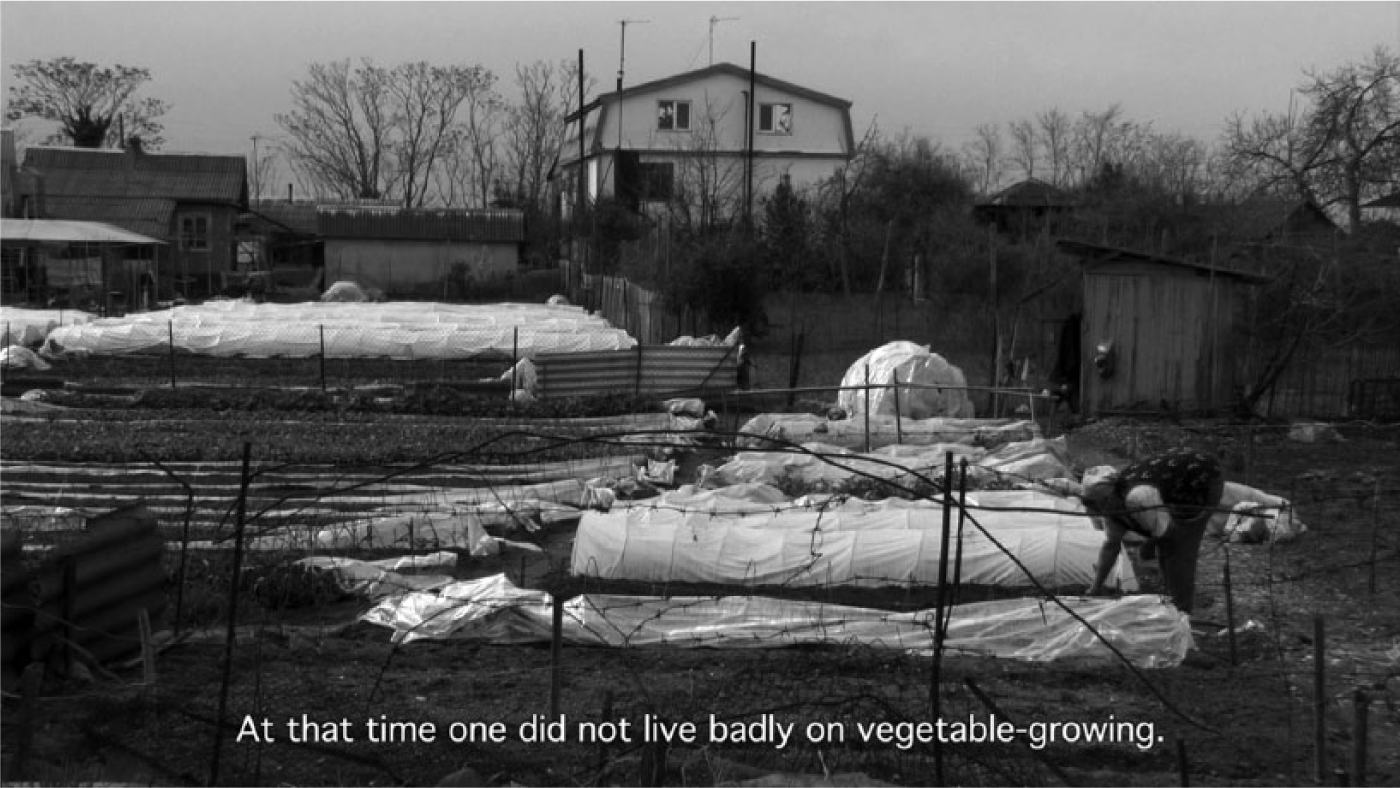
Vegetable gardens, Imeretinskaya Bay 2009.
Accordingly, residents’ debates have been dominated by anxiety and rumours for a long time. Statements like “I’m rather going to set myself on fire than leave this place” were uttered at kitchen tables and speak to the strong link between residents and their land. The popular anger led to protests and spread on the internet in blogs such as “До олимпиады жил в Сочи” – “Up to the Olympics I lived in Sochi”. 2
Due to the economic crisis, the originally promised compensation for residents’ properties was reduced by one-third. This, again, fuelled protests. Along with eight other residents, Pavel Masurian went on hunger strike, although with little effect. In the official media, the hunger strikers were marginalised as “scoundrels who want to ride in a golden carriage to the Olympics.” 3
The documentary
The Film “Homes for Games” jumps into the thick of the Olympic reorganisation of Imeretinskaya Bay in 2011–2012. Observing the microcosm of the bay, the shots document the process of turning an overgrown area into an extensively built-up urban area. This commentary presents three short film sequences in this context. They portray two residents who are coming to terms with the relocation in two contrary but typical ways.
The first sequence 4 begins with a slow camera pan over the impressive construction site of the Central Stadium. A tremendous steel structure is about to span the future arena (Figure 2). As if casting a glance out of the window of a landed UFO, the camera picks up the surrounding coastal strip that is just about to be cleared of residents and their homes (Figure 3). Through the stadium skeleton we are looking at the rugged area, demolished houses and houses soon to be razed. The debris is not yet cleared away; old and new structures, destruction and construction merge into each other on this messy territory. The size of the Olympic project and the new arena contrast starkly with what used to be the residents’ modest huts and homes.
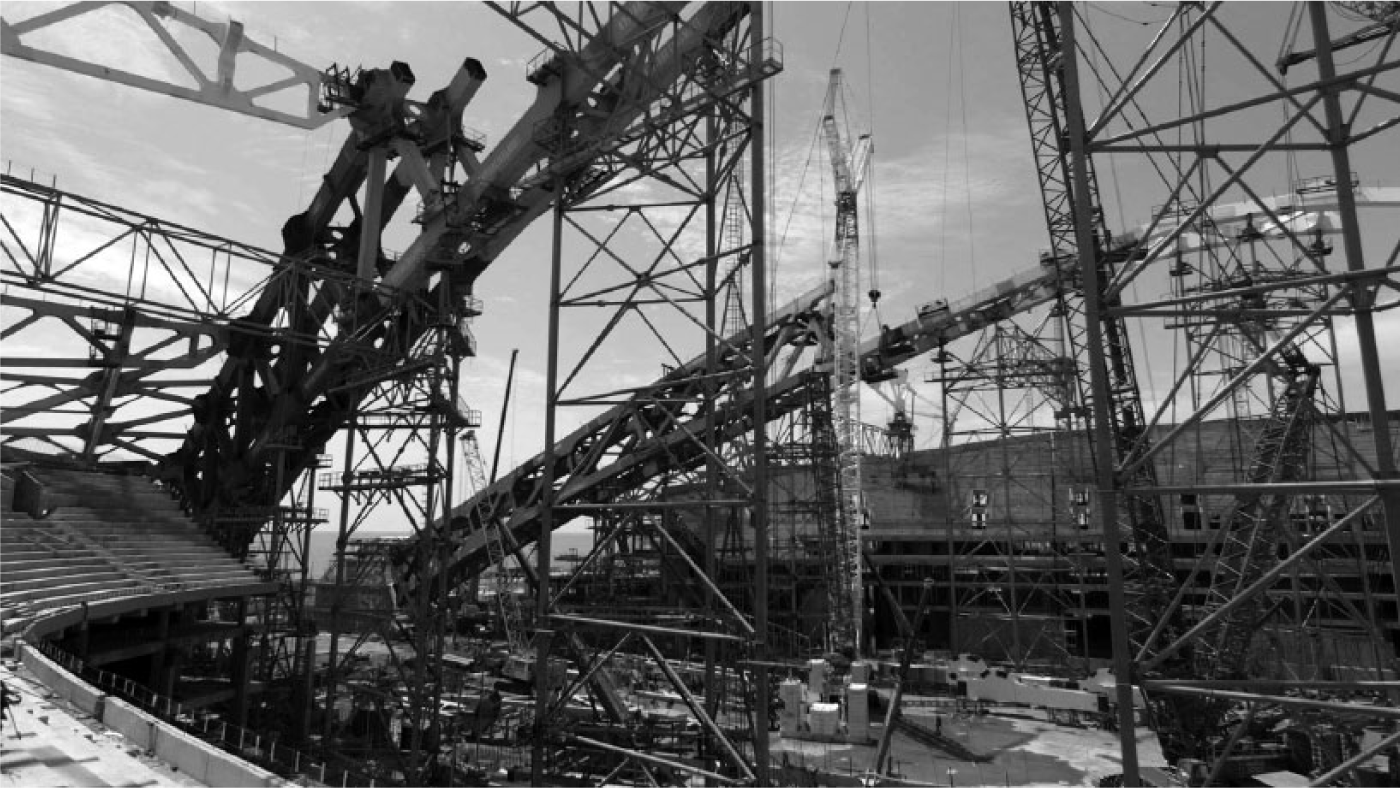
Construction site of the Central Stadium 2012, 12:35 min.
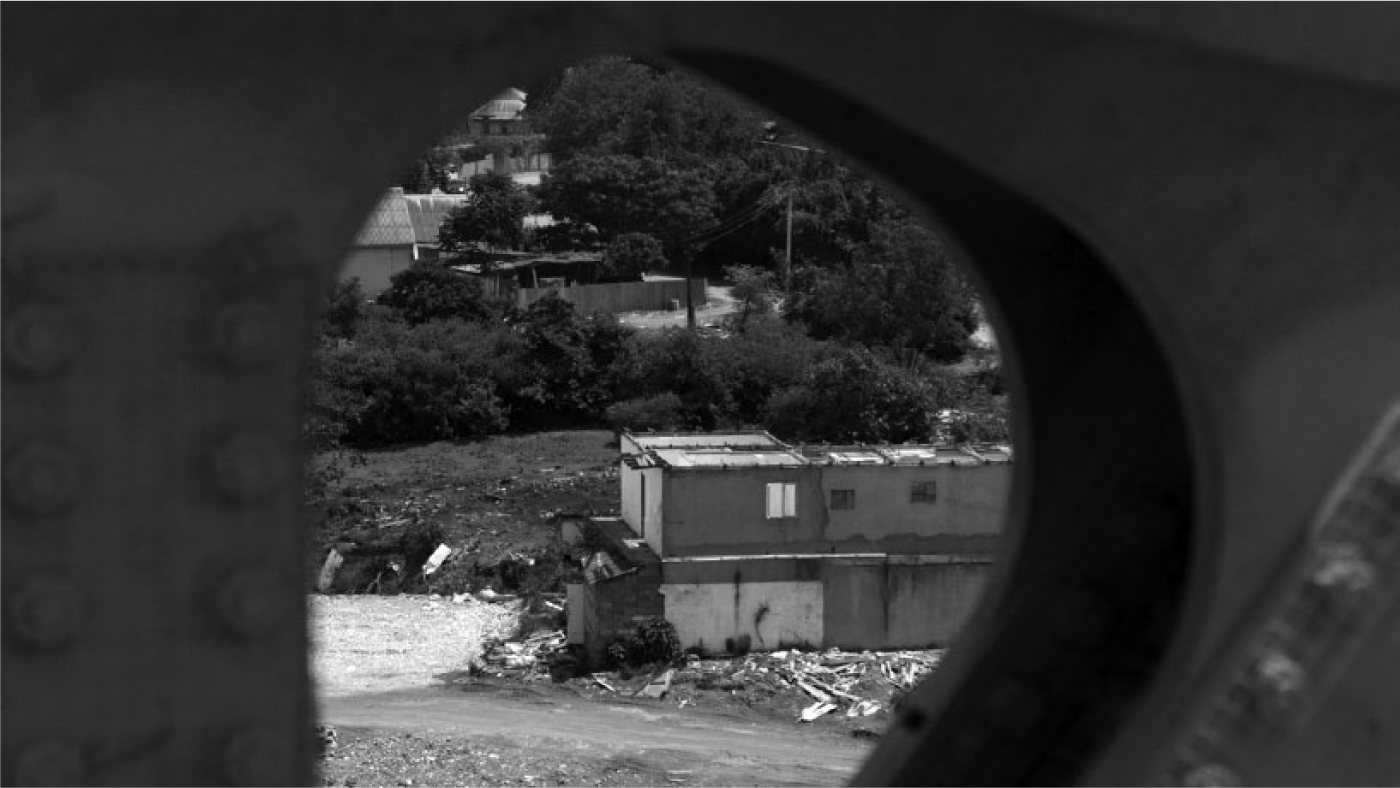
View through steel skeleton of the Central Stadium, 12:46 min.
Pavel Masurian is just about to move from his generous plot at Nizhne Imeretinskaya Street (Figure 4) into a modern house in the newly built settlement, Tavricheskaya. He complains that the property valuations were not in residents’ favour. In his view, the compensation payments do not correspond with today’s purchase price of land and properties: If people got an OK to sell their property today, to those who want to build hotels on the shore or whatever, people would make a profit. They could get at least twice as much.
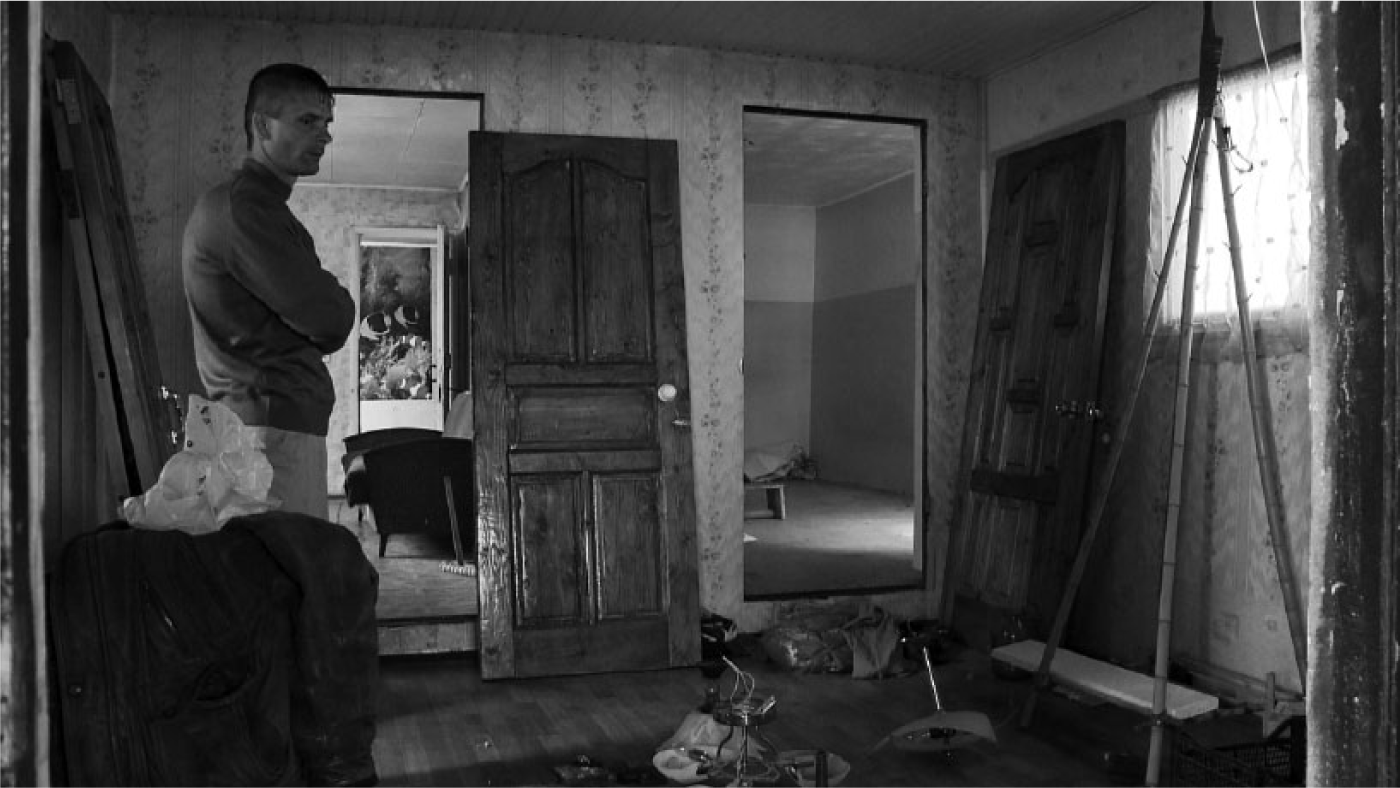
Resident Pawel in his home before the move, 13:35 min.
He explains that the residents could have gained more, but there had not been a real choice or possibility of participation. The property value was estimated by the state and the people had to accept what was offered to them. They could only choose between a house, a smaller house plus monetary compensation or mere monetary compensation. In addition, many residents were unable to provide official documentation of land tenure for their plots, a situation that is a rather typical result of post-Soviet privatisation (Allina-Pisano, 2008). This situation allowed for the confiscation of land according to Olympic Law 310. Pavel recollects the tiring recent conflicts and the uneven power relations between the authorities and the people, which leave little choice but to accept what the government is offering: I think everyone would have psychological problems when you throw them from one place to another. Let’s put it this way: voluntarily under compulsory measures. All this talking about “Redevelopment area”, “new legislation”, “you have to subordinate”, but of course: we will subordinate.
Against the backdrop of the towering Central Stadium, the shots picture local inhabitants cutting up the metal skeleton of what now has become a ruin. They are gathering the scrap of demolished houses for further use. Mountains of debris bury bushes and trees along the roads (Figures 5 and 6).
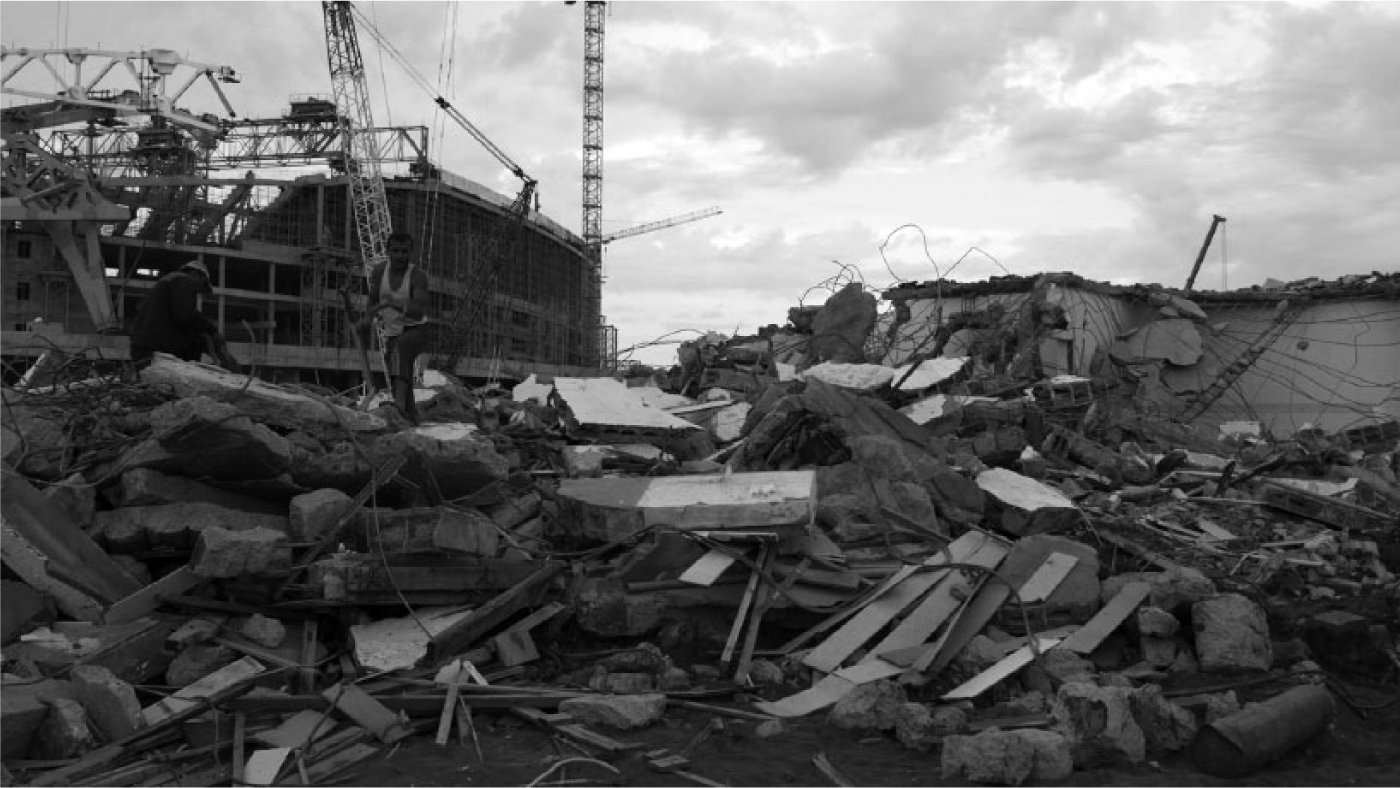
Scrap collectors in front of construction site, 14:34 min.
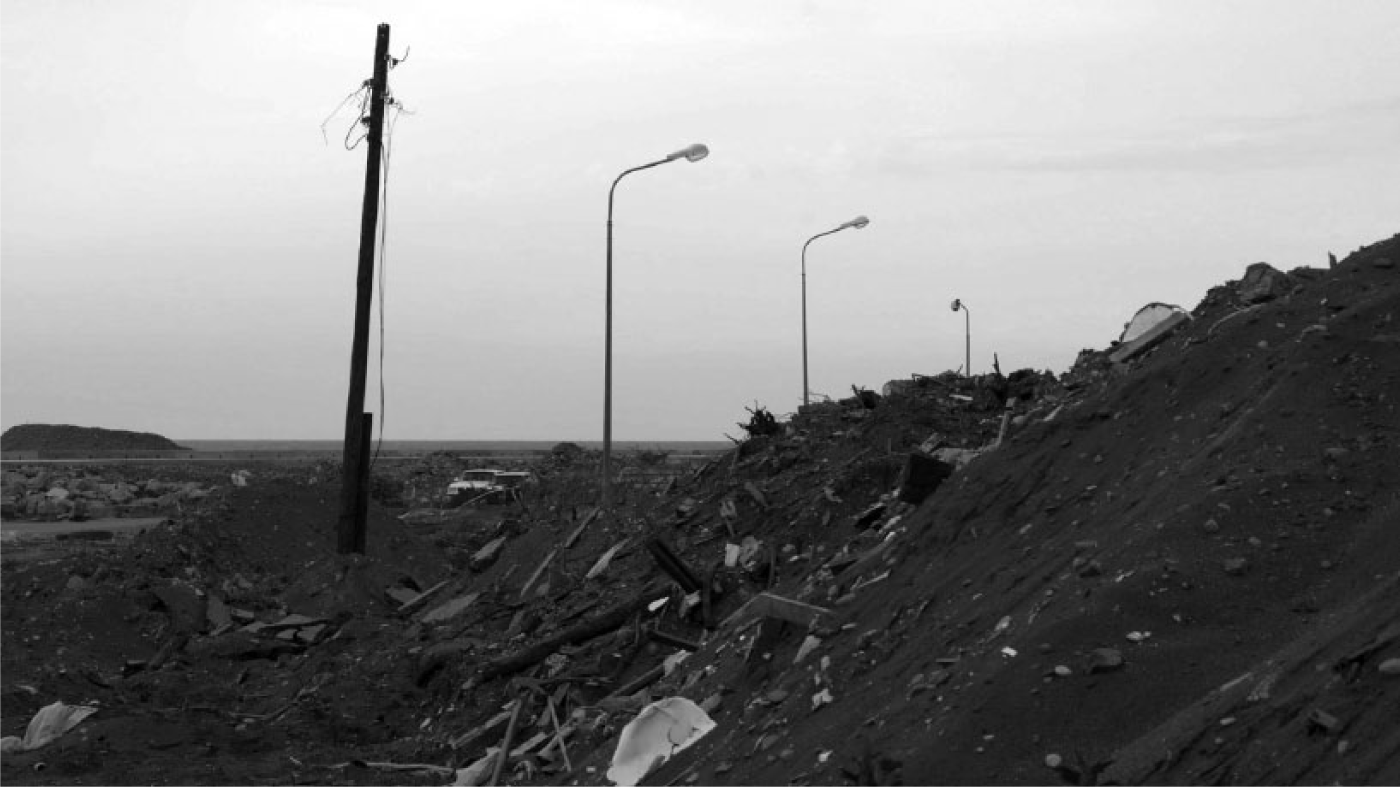
Demolition landscape, 14:48 min.
Later on we see Sochi mayor Anatoly Pakhomov in his car (Figure 7). A police escort with sirens is opening a passage through the traffic jam. Visibly proud, he describes the city’s effort in dealing with the bad mood of the “more than 2000 resettlers”. In his opinion, the number of people who approve of the Olympic Games is continuously increasing, not least because
We – the city council – are with you, the people. We will minimise your inconveniences. I myself have given my mobile phone number to every resident.
5
And when people are angry, I convince them that I am about to take action. They react particularly well when they see that I immediately go there myself. I often do so.
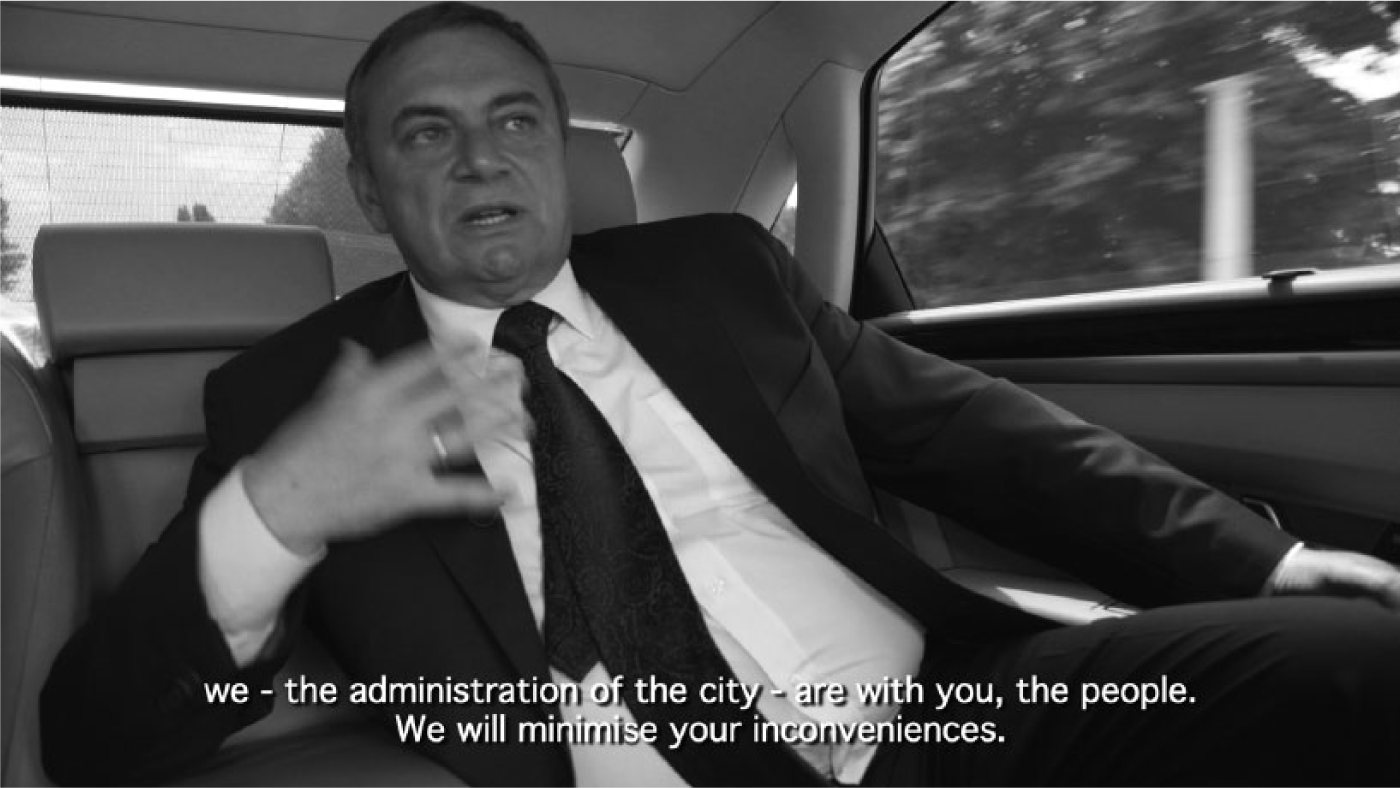
Anatoli Pachomov, Mayor of Sochi, 14:59 min.
The way he characterises his own commitment is reminiscent of Putin’s frequent trips to crisis areas, regularly broadcast on TV on the evening news, and the principle of “manual control” (ruchnoe upravlenie) that is at the heart of political power in Russia (Monaghan, 2012). Like the cultural figure of the good tsar, Putin and Pakhomov have an open ear for their subjects’ concerns and personally attend to people in dire straits. With big gestures, the mayor repeats that the demands of the relocated people will be satisfied and that he is going to give his full attention to each person’s concerns.
We skip ahead in the film and proceed with pensioner Ludmilla Victorovna,
6
whom we saw earlier on in her old home in Golubaya Street (Figure 8). She is sitting next to a stack of official letters – answers to her complaints, all identical. Ludmilla did not succeed in getting satisfactory compensation for her family. The three people – Ludmilla, her daughter and her son-in-law – were compensated with a studio apartment, because the son-in-law had not been registered as a resident in the bay. As a consequence, the young couple moved away and Ludmilla moved into the studio in the backcountry. Earlier she had let rooms to tourists and had had additional earnings from growing vegetables in the garden. Now she lives on her small pension and with a cat in a quickly constructed apartment block, feeling offended and betrayed: The distance to the sea at that time was 50 m. But now we live 2–3 km away.
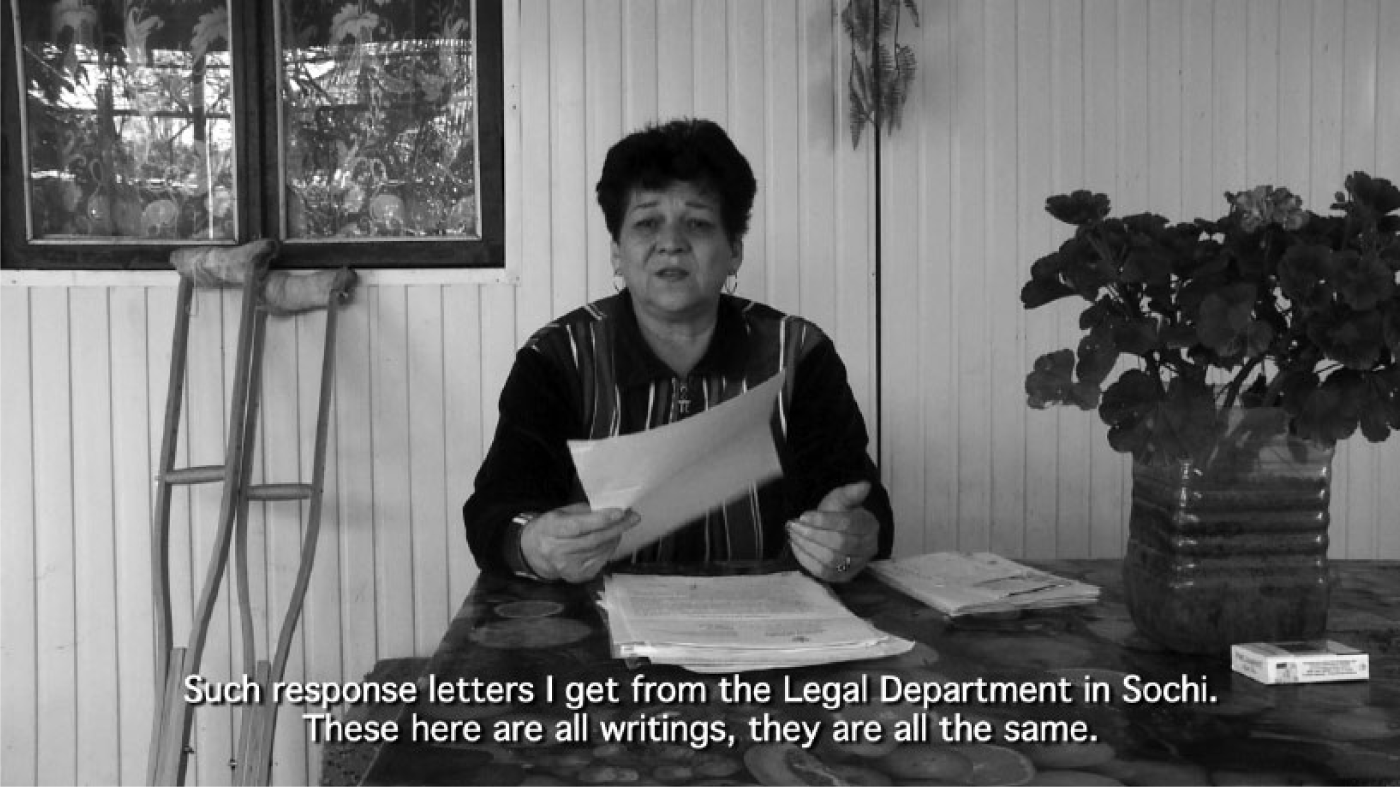
Ludmilla in her old home, 05:00 min.
Life has become more expensive. For this reason, many of her former neighbours decided to sell their new apartments and to buy land that is closer to the mountains, where it is cheaper. Meanwhile the Olympic village is raised on Ludmilla’s former plot. (Figure 9)
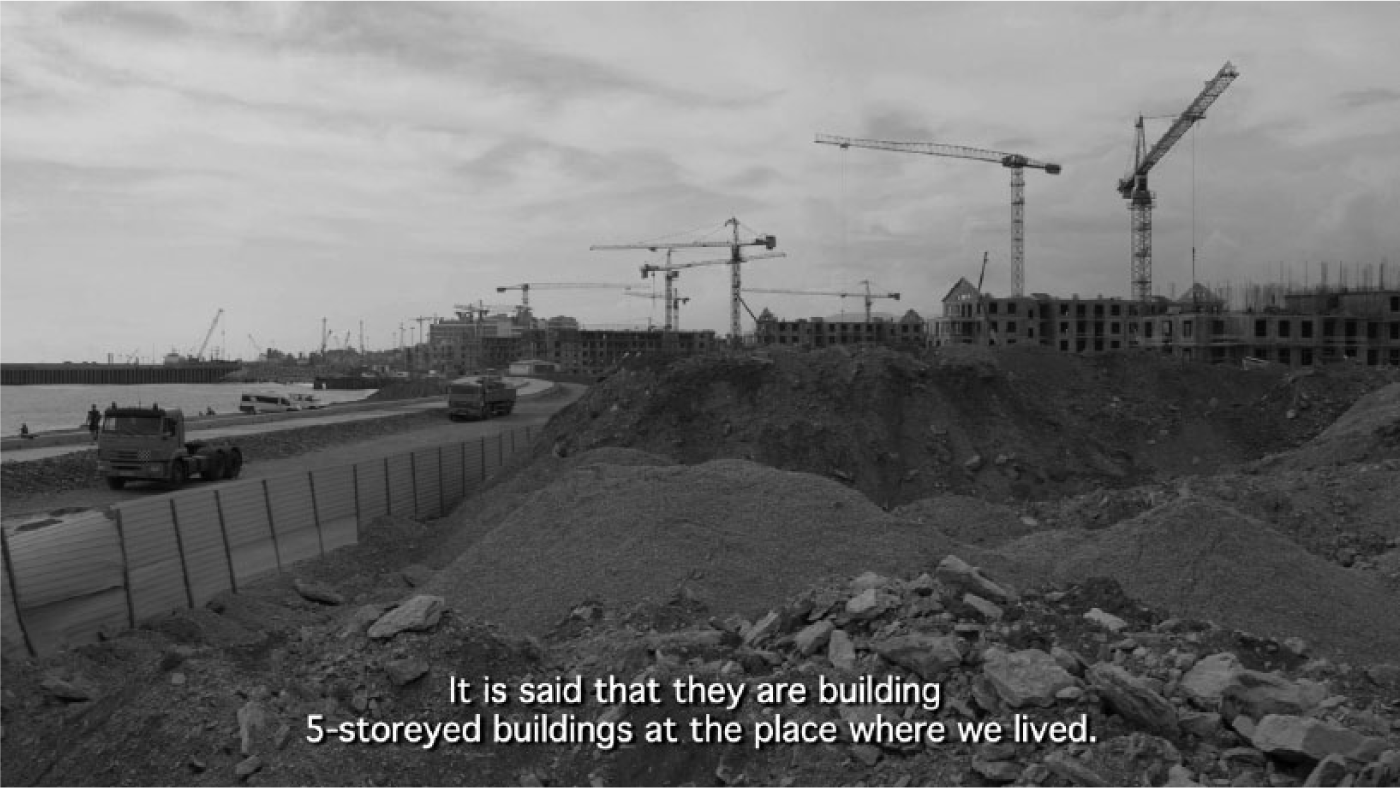
Place of Ludmilla’s former home 2012, construction site of the Olympic village, 26:55 min.
In the final film sequence
7
we see Pavel Masurian in the garden of his new house (Figure 10). He maintains a pragmatic approach to the relocation, although he is emotionally attached to the fertile soil of his old home. Although he took some of the “old” soil with him to the new place with its marshy and rocky ground, he will only grow vegetables for private use. In the first place, he intends to build an Ecohouse – a kind of holiday cottage – in the garden in order to let it to visitors. Pascha’s can-do attitude prevails. He does not feel like a victim of circumstances: As the plot of land is small here compared to what we had before, it is better to make a living from tourism and small business than from the garden. Dealing with the garden is no longer profitable nowadays.
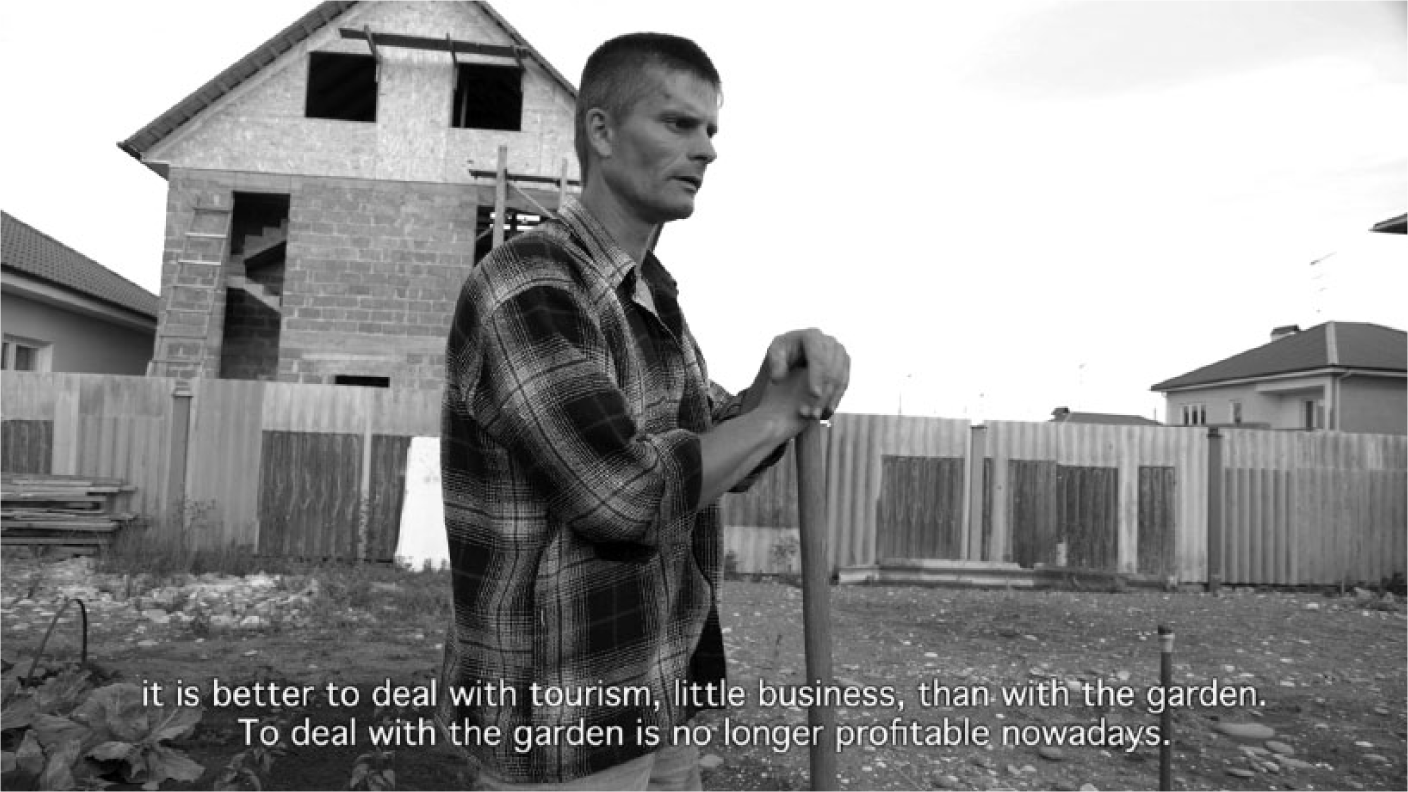
Pawel in his new garden, 26:26 min.
Despite the extensive construction, it is not possible for the residents of the bay area to earn a little extra money on the construction sites. Employers prefer to hire immigrants, who demand lower wages and are unable to complain about inadequate working conditions. Pavel recounts an example of this discrimination: My uncle is an excellent driver. With all kinds of driving licences, from mopeds to the largest truck. When he went to Olympstroj, to a subcontractor who builds the Olympics, and said to them, “I want to apply for a job”, he was asked if he was a local. He said: “Yes.” Answer: “We do not hire locals.”
8
Concluding remarks
In the end, early dramatic stories regarding the resettlements proved to be exaggerated. While 800 residents of the coastal strip around Nizhne Imeretinskaya Street and Golubaya Street were relocated, this was much fewer than initially expected. Was it time pressure, lack of money or fear of overwhelming protests that caused this turn of events? Imeretin people can only speculate about the reasons why their main settlement of Sovkhoz Rossiya was spared.
Also, despite construction defects and boggy ground, the modernised standard of the new homes exceeds that of the old houses. The new cottages have reinforced concrete foundations and will be provided with modern fixtures and infrastructure, including heating and hot water. Nevertheless, the residents felt that their large-scale properties had been undervalued and that the loss of the huge gardens meant a loss of parts of their livelihood.
In consideration of the immense total costs of the Olympic Games and the ultimately relatively small number of people resettled, it is difficult to understand why the process of resettlement took such a dramatic course and why the residents were fobbed off with undervalued properties – not to mention the few hardship cases of people who lost their homes and did not get compensation at all. There is a considerable discrepancy between the official statements and the real development. Mayor Pakhomov’s claim that “the people will be satisfied” contradicts the nerve-wracking fight for adequate compensations and the lack of media coverage.