







Abstract
This paper examines Industrial Symbiosis (IS), the exchange of by-products and pre-consumer waste within industrial networks. Drawing on an established dataset of 46 international cases, we employ a fuzzy set ideal type analysis to identify four IS configurations: Local Related Multilateral Exchanges, Regional Unrelated Bilateral Exchanges, Regional Unrelated Multilateral Exchanges, and Local Unrelated Multilateral Exchanges. We then illustrate these four different configurations in more detail by analysing IS cases from Germany. The analysis indicates that industry diversity, geographic proximity, and network size play a different role in different types of exchanges, underscoring the importance of a nuanced socio-spatial perspective. Findings indicate that different IS types may follow different socio-spatial logics and thus require specific tailored policy approaches. Focusing on by-product exchanges as the core of IS allows us to more effectively address the contingent characteristics and materiality of the resources involved.
Keywords
Introduction
The circular economy model represents a fundamental shift in the way resources are managed. It moves away from the traditional linear process of resource extraction, processing, utilisation, and subsequent disposal through landfilling or thermal recycling (Potting et al., 2017). The circular economy provides a comprehensive range of solutions for the entire product life cycle, ranging from product design and resource use over production processes to reuse and recycling solutions. In this context, Industrial Symbiosis (IS) is frequently depicted as one practice that facilitates the optimisation of resource utilisation through the recovery and repurposing of pre-consumer waste, particularly industrial by-products (Arfaoui et al., 2024; Chembessi et al., 2024).
Researchers have been interested in the utilisation of by-products since the late 19th and early 20th centuries (Desrochers and Leppälä, 2010). However, IS received particular interest in the 1990s (Chertow, 2000), and the idea is currently gaining further traction in the context of discussions about the circular economy (Cecchin et al., 2020).
In contrast to national circular economy strategies, such as recycling programs, or intra-company solutions, IS operates at the meso-level, thereby contributing to the environmental sustainability of industrial clusters, cities, and regions (Cecchin et al., 2020). By emphasising the use of by-products and pre-consumer waste, IS can be seen as complementary to product-based approaches like cradle-to-cradle and eco-design. As it builds on existing industrial configurations or can be applied to create green industrial zones (eco-industrial parks), it is discussed as a strategy for sustainable regional development (Deutz and Gibbs, 2008; Gibbs and O’Neill, 2017).
With a growing body of research on IS, varied interpretations of the concept have emerged, largely due to its diverse manifestations across different contexts (Boons et al., 2015, 2017). Chertow’s definition “Industrial Symbiosis engages traditionally separate industries in a collective approach to competitive advantage involving physical exchange of materials, energy, water and by-products. The keys to Industrial Symbiosis are collaboration and the synergistic possibilities offered by geographic proximity.” (Chertow, 2000, p. 313) remains one of the most influential and is frequently cited (Boons et al. 2017). However, recent research challenges certain elements of this initial conceptualisation, particularly the emphasis on industry separateness and geographic proximity as key factors (Kasmi, 2021; Lombardi and Laybourn, 2012; Velenturf, 2017; Velenturf and Jensen, 2016). So, while most definitions agree on by-product exchanges as key component of IS, they differ significantly regarding other components or (pre)conditions such as geographic proximity and industrial diversity. This article departs from Chertow’s (2000) definition, puts exchanges at the core of IS, and uses more recent definitions to further characterise different types of IS.
This article deals with two critical questions: (A) What role do industrial diversity, geographic proximity, and the size of network actors play in various types of IS? (B) How can policy interventions effectively support different configurations of IS to strengthen regional resource efficiency?
To address these questions, this study focuses on by-product exchanges, the material flows behind IS, as the foundational element. This approach allows us to categorise real-world cases along the other, often debated, conditions or “contingent characteristics” (Deutz, 2014, p. 6): proximity, industry diversity, and network size. The analysis draws from a dataset of 46 cases and 281 specific resource exchanges (Evans et al., 2017) to identify various configurations or types. This involves a qualitative assessment of spatial dynamics, sectors, resources involved, and other contextual factors. The typology is then applied to categorise IS cases in Germany, a territorial context that has not been analysed thoroughly and has been considered not particularly conductive to IS, as there are no policies directly aimed at fostering symbiosis (Boons et al., 2015; Kühn and Busch, 2019).
Territorial dimensions of the circular economy and Industrial Symbiosis
Circular economy business models and practices are strongly interconnected with different spatial scales and regional industrial contexts. Government policies and national circular economy strategies aim at local implementation, as effective solutions often build on local factors such as existing networks or local values (Bourdin et al., 2022; Veyssière et al., 2022).
One specific concept for resource efficiency frequently discussed from a territorial development perspective is IS (Kasmi, 2021; Veyssière et al., 2022). IS is understood as a tool for resource efficiency, environmental protection, and regional economic development (Deutz, 2014; Deutz and Gibbs, 2008; Gibbs and O’Neill, 2017). Scholarly conceptualisations of the phenomenon date back more than a century (Desrochers and Leppälä, 2010) and have been especially promoted by scholars of industrial ecology (Cecchin et al., 2020). Recent research and policy, however, increasingly frame IS as a specific circular economy practice (Cecchin et al., 2021; Chembessi et al., 2024; Sommer, 2020). As there are different understandings of what IS is and which characteristics are at its core, it is helpful to differentiate between them to understand how they are connected to territories and space, and how they can contribute to regional circular economies.
Conceptualising Industrial Symbiosis
The Industrial Symbiosis Network in Kalundborg, Denmark, which has evolved since the 1970s, is frequently cited as the archetypical example (Chertow, 2007; Chertow et al., 2008; Valentine, 2016). However, academic discourse on IS presents various diverging definitions (see Table 1). Chertow’s (2000) seminal definition of IS characterises it as a phenomenon in which traditionally separate industries collaborate for competitive advantage through the exchange of materials and energy, facilitated by geographic proximity. Since then, research in diverse cultural contexts has broadened the understanding of IS, opening discussions about different conceptualisations and manifestations of the phenomenon (Boons et al., 2017). Lombardi and Laybourn (2012) critique the emphasis on geographic proximity and industry separateness, advocating a broader, practitioner-focused definition that emphasises networks fostering eco-innovation and cultural change that may not only incorporate resource exchanges but also efficiency benefits due to shared use of utilities or infrastructure. They argue that green innovation and economic development are what have been the driving factors that lead to global interest in IS and challenge a narrow focus on geography and specific industrial arrangements. Moreover, even those conceptualisations that initially concur on proximity and industry diversity as pivotal conditions for symbiosis diverge in their interpretation of these terms (Boons et al., 2017). In this context, Deutz (2014) advocates for a focus on the utilisation of underused resources and by-products, which dismisses other characteristics altogether.
Definitions of Industrial Symbiosis.
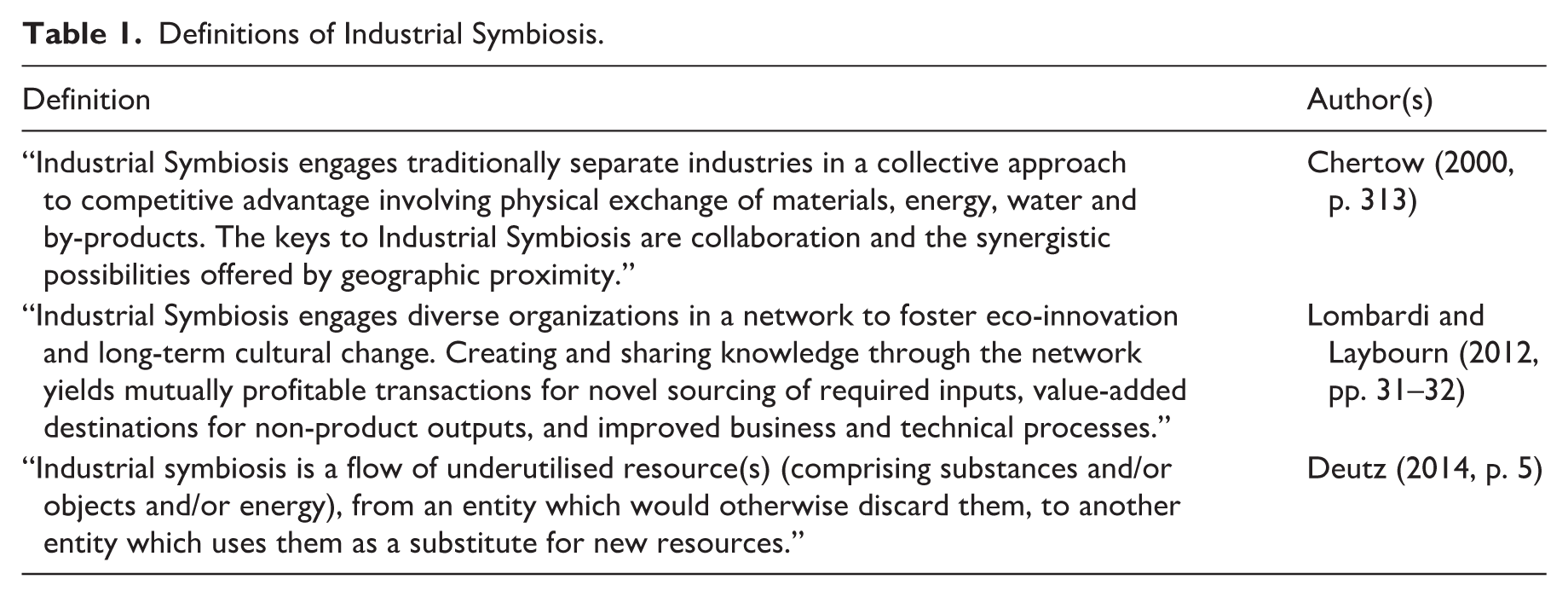
Given the significant diversity among phenomena labelled as “Industrial Symbiosis” by researchers, practitioners, and policymakers (Boons et al., 2015), conceptualisations navigate a spectrum of narrower and broader interpretations, each of which is relevant in its specific territorial or disciplinary context. Most definitions agree on the exchange and utilisation of industrial by-products, pre-consumer wastes, or underutilised secondary resources (Boons et al., 2015; Deutz, 2014), although other conditions and elements remain debated. Synthesising these arguments allows us to conclude that IS manifests in a variety of forms, distinguished by factors such as industry diversity, geographic proximity, network size, and the types of resources exchanged. While these variations are not problematic in individual cases, they do have implications for research and policy (Deutz, 2014).
As the phenomenon of IS encompasses a variety of concepts, approaches, and real-world manifestations, the establishment of taxonomies and typologies has been a recurring topic in IS research (Boons et al., 2015; Chertow, 2000; Chertow, 2007; Domenech et al., 2019). However, most of these approaches have focused on a limited number of in-depth case studies (Chertow, 2000), specific regions (Boons et al., 2015; Domenech et al., 2019), or have relied too heavily on a single “contingent characteristic” (Deutz, 2014, p. 6) of symbiosis. This emphasises one dimension while neglecting the others. Earlier typologies were, therefore, often based on a focus on some of the relevant aspects, such as co-location and network size (Boons et al., 2015; Buda and Ricz, 2023; Chertow, 2000; Domenech et al., 2019) or technological dimensions (Scafà et al., 2018). In summary, previous attempts to categorise IS were often highly conceptual in nature, prevalently based on a limited number of cases, only considered manifestations in specific countries or regions, inadequately addressed intra- and inter-sectoral dynamics, overlooked the specific materialities of by-products, and failed to capture long-distance exchanges due to their narrow focus on localised networks.
This paper aims to deliver a more comprehensive picture based on a large dataset. Engaging with existing conceptualisations of IS, it extends previous approaches to categorise real-world manifestations by drawing on research about proximity, industrial relatedness and diversity, and networks. It examines how these conditions shape symbiosis across different contexts, as well as their connection to the material dimension – specifically, the resources and infrastructures involved.
Characteristics of Industrial Symbiosis: Proximity, diversity, and networks
Research on regional economies has consistently demonstrated the significance of proximity, industry relatedness, and networks for innovation and regional development (Asheim et al., 2011; Balland et al., 2022; Glückler and Panitz, 2021). It is, therefore, unsurprising that geographical studies on the circular economy apply or critically engage with these dimensions to understand their role for the emergence and success of circular economy solutions. Here, proximity is said to facilitate the exchange of ideas and materials while fostering a sense of community as local circular economy initiatives as well as inter-firm relationships, often building on trust and embeddedness (Arfaoui et al., 2024; Chembessi et al., 2024). However, examining IS as a specific practice or approach in this context points to a variegated picture concerning the role and interplay of proximity, relatedness, and networks.
Proximity plays a complex role in the dynamics of different types of IS. An analysis of the UK’s National Industrial Symbiosis Programme (NISP) found that materials in symbiotic relationships travel a median distance of 20.4 miles (32 km), indicating the prevalence of a certain degree of proximity between the actors in the case of facilitated IS (Jensen et al. 2011). Self-organised industrial symbioses, however, have been found to often operate in larger radii of up to 75 miles (120 km) (Velenturf, 2017). This suggests that networks organised by firms cover greater distances than those facilitated by national programs. Moreover, geographic proximity alone is insufficient to understand the emergence of IS. On the one hand, higher-value resources such as metals or critical materials (Domenech et al., 2018) may justify longer transport distances (Domenech et al., 2019; Velenturf and Jensen, 2016). So different by-products and resources are relevant at different geographical scales (as discrete categories of proximity), from the local to the national or even international scale (Domenech et al., 2018, 2019). On the other hand, research frequently highlights the role of trust and reliability: Geographic proximity can facilitate interactions and trust-building (Gibbs, 2003; Hewes and Lyons, 2008). This highlights the necessity for a more nuanced understanding that incorporates additional dimensions of proximity, such as cognitive or organisational proximity (Kasmi, 2021; Velenturf and Jensen, 2016).
The degree of industry diversity or relatedness is frequently discussed as a condition for the success of IS as “a diversity of industries provide the collective functions and adaptability within an industrial ecosystem that are essential to its continued functioning and stability” (Jensen 2016, p. 94). IS research shows that industry diversity can improve resource reuse and recycling, though top-down promotion of diversity may have negative effects (Jensen, 2016; Velenturf and Jensen, 2016). However, an analysis of the Dunkirk IS network shows that 67% of new companies came from the same sectors as existing firms, while 33% were unrelated firms (Kasmi, 2021), so that the degree of industrial relatedness, not diversity, may play a role in some IS contexts. In economic geography, the concept of relatedness refers to the overlap of organisational and cognitive proximities – such as routines, technical skills, or market knowledge – between companies, which supports innovation, market expansion, and enhanced local activity (Balland et al., 2022; Kasmi, 2021). This suggests that in contrast to Chertow’s (2000) definition that highlights “separateness” (i.e. diversity) as a precondition, some degree of relatedness may foster new industrial activities in existing IS networks. IS itself may represent a variety of “related variety” in the form of environmentally related co-location (Kasmi, 2021; Chertow et al., 2008). However, assessing relatedness is challenging, as sectoral classifications (e.g. NACE codes) capture only part of the picture; firm organisation, common resources, and technologies also matter (Lombardi and Laybourn, 2012), which may explain divergent findings in prior research.
Networks form the backbone of IS, providing the structure necessary for exchanging materials, energy, and information as well as for trust and embeddedness (Ashton and Bain, 2012; Gibbs, 2003; Hewes and Lyons, 2008). Networks often involve core members collaborating locally, with occasional transactions at larger scales dictated by resource type, transport costs, and market values (Domenech et al., 2019). The success of industrial networks hinges on several factors. Network diversity and multilateral resource flows enhance resilience against shifts in industrial composition (Domenech Aparisi, 2010). While diversity is beneficial, overly loose networks can impede necessary investments in process adaptations and infrastructure development. Anchor firms, as central nodes, provide stability as they are situated at the core of the respective network and can be providers or recipients of several by-product exchanges, increasing network effectiveness (Chertow, 2007). Various dimensions of social embeddedness – such as trust, reciprocity, and shared norms – may play different roles based on the network context, complicating the understanding of network dynamics (Ashton and Bain, 2012; Domenech and Davies, 2011). Finally, while networks might be identifiable from a macro-perspective, involved actors may not recognise their full scope. In self-organising symbiotic networks, firms may have limited awareness of other actors or exchanges occurring elsewhere in the network. Single firms might focus on specific bilateral resource exchanges without broader interest in other exchanges existing within the same setting or network (Boons et al., 2017). The NISP in the UK (Laybourn and Lombardi, 2007) serves as a quintessential example of a facilitation model that achieved substantial environmental and economic benefits by efficiently coordinating waste exchanges between individual actors and leads to large networks in some but not all cases.
The multifaceted nature of IS means that proximity, industry diversity, and networks are interdependent conditions that influence symbiotic relationships in different ways depending on the respective context and industrial configuration. Previous research demonstrates that these elements do not work in isolation, as their influence varies based on factors such as network type, resource nature and value, and embeddedness in existing industrial settings (Ashton and Bain, 2012; Domenech and Davies, 2011; Hewes and Lyons, 2008; Kasmi, 2021; Velenturf and Jensen 2016). Failing to consider these characteristics in a comprehensive manner, or alternatively, oversimplifying their role, risks misunderstanding IS, complicating analysis, and policy recommendations. We, thus, propose to categorise exchanges by common elements such as by-product flows as well as key characteristics such as diversity, proximity, and networks. Recognising nuances in these preconditions and their interplay enables more effective fostering of symbiotic industrial relationships.
Methods and data collection
This study employs a multi-method approach to identify and categorise IS configurations based on proximity, industry diversity, and network size (Figure 1). By focusing on exchanges, we explore real-world cases as combinations of different contingent characteristics. This allows us to group these real-world cases according to theoretical concepts and identify prominent symbiosis exchange configurations or ideal types.
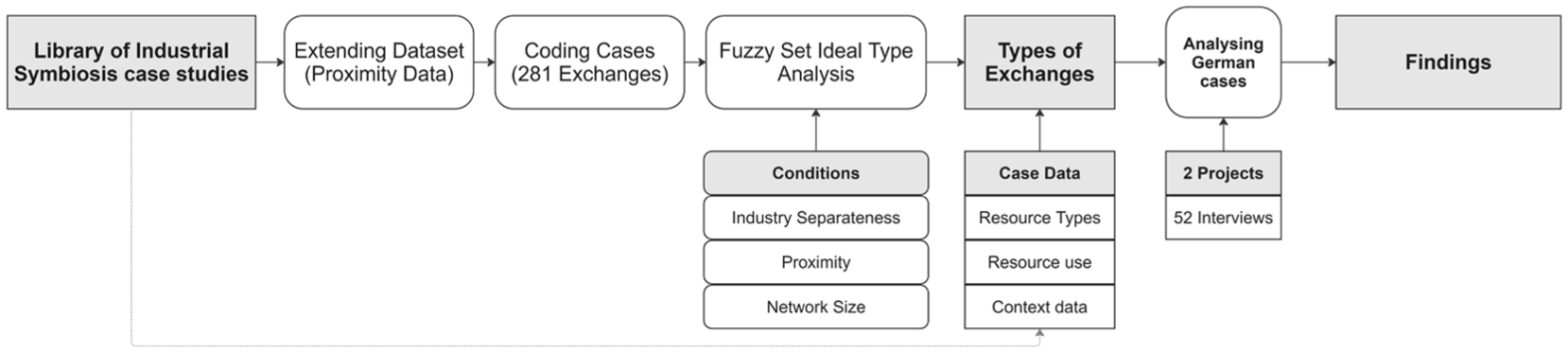
Multi-method approach.
We used fuzzy set ideal type analysis (FSITA), a method grounded in set-theoretic logic and derived from qualitative comparative analysis (QCA). QCA is a method that systematically examines how different combinations of conditions lead to an outcome, aiming to identify patterns of necessity and sufficiency across cases. QCA has grown recently; FSITA remains relatively uncommon in empirical research (Verweij and Vis, 2021). Unlike a complete QCA, which seeks to determine how conditions and their combinations contribute to “success,” FSITA requires only some steps of the QCA-process (a truth table). So, FSITA focuses on conceptualising a case as a configuration of theoretically relevant aspects, QCA goes one step further and places such configurations at the centre of a solution term or formula (Verweij and Vis, 2021).
FSITA is particularly valuable when theory provides clear distinctions between ideal types (Mello, 2021). It treats cases and ideal types as configurations of concepts, enabling their conceptualisation and operationalisation through fuzzy sets (Kvist, 2007). FSITA does not seek necessary or sufficient conditions for a specific outcome but aims at systematic empirical comparison and typological theorising (Mello, 2021). The method is especially suitable for exploratory research and typology development (Mello, 2021; Verweij and Vis, 2021), based on a robust theoretical framework that translates theoretical concepts into membership scores (Kvist, 2007).
FSITA leverages fuzzy set theory, enabling partial membership scores for cases (e.g. 0.33) for enhanced measurement precision (Kvist, 2007). This approach helps differentiate cases based on a qualitative anchor of 0.5, distinguishing “more in than out” from “more out than in” cases (Schneider and Wagemann, 2014). Fuzzy sets define an attribute space in which cases are positioned relative to ideal types; in practice, few cases fully match an ideal (score of 1), though many approximate it (scores between 0.5 and 1) (Mello, 2021). We focused on industry diversity, geographic proximity, and network size as decisive conditions, building on the different conceptualisations of IS introduced above. Membership scores for cases were assigned on a 0–1 scale, using fuzzy sets where possible and crisp sets where more detailed data were unavailable. Table 2 illustrates the calibration based on the work of Chertow (2007), Lombardi and Laybourn (2012), and Kasmi (2021). The analysis was computed using R Studio and the QCA Package (Duşa 2019).
Calibration of the conditions based on the work of Chertow (2007), Lombardi and Laybourn (2012), and Kasmi (2021).
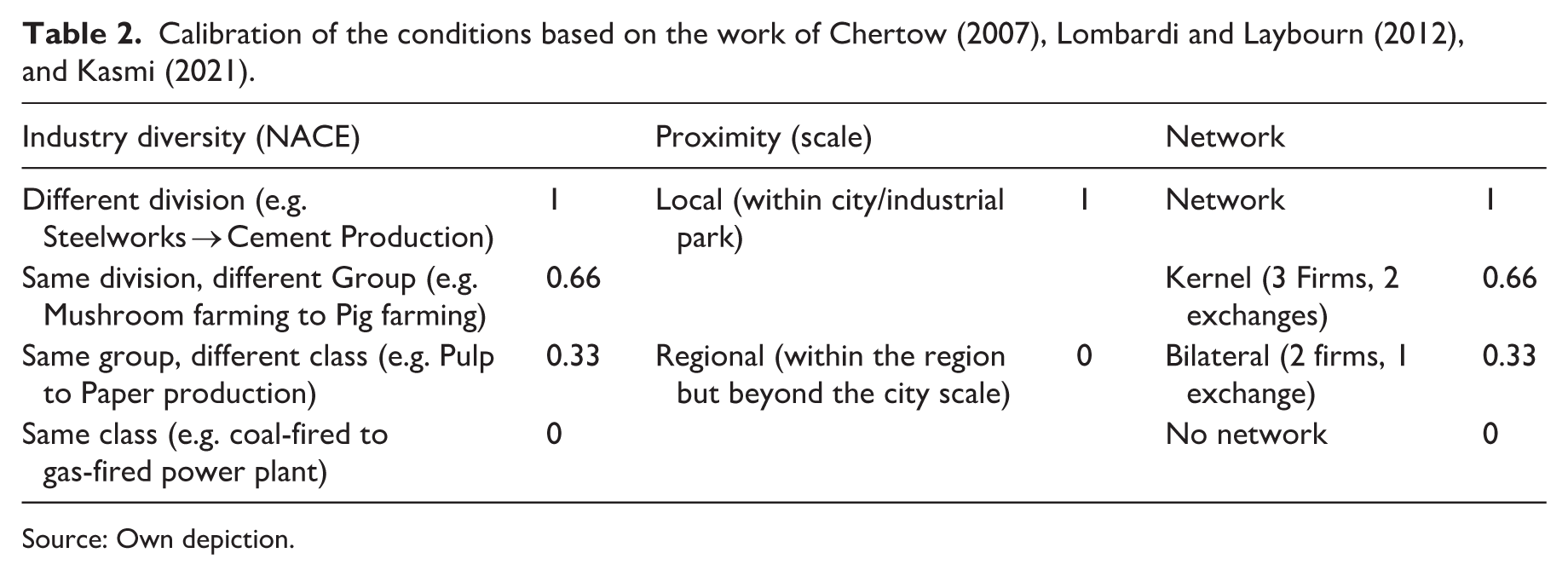
Source: Own depiction.
Our main data source is the “Library of Industrial Symbiosis case studies and exchanges” dataset by Evans et al. (2017), comprising 46 examples with 281 exchanges collected in the Horizon 2020 MAESTRI Project. The database provides detailed case information on Industry NACE codes, resources, and type of utilisation. We added geographic proximity (i.e. regional or local scale) data by looking into the original sources, assigning spatial details to the exchanges by using data such as maps, firm names, and further contextual data from the individual case studies. Where specific data were lacking, we inferred from information about the whole network. Industry diversity – as opposed to relatedness – was calculated based on NACE data (following Kasmi, 2021), and categorisation into network size followed Chertow’s (2007) subdivision into fully fledged networks, kernels, and bilateral connections.
In a subsequent qualitative analysis, we examined the identified symbiotic exchange types in more detail. Here, we focused on resource types and their specific utilisation to explore “what is meant by ‘exchanges’ [. . .] and what types of resources (e.g., industrial and/or municipal solid waste, by-product, or nonmaterial resources)” are utilised in the different cases (Boons et al., 2017, p. 3). For this, resources were clustered based on their material properties and their use (e.g. production resource or fuel) and categorised into six groups: (1) Mineral and Inorganic By-products, (2) Chemical and Organic By-products, (3) Energy & Fuel, (4) Agricultural Residues, (5) Water, and (6) Recyclable Materials.
To validate the findings and assess policy implications, we then applied the typology to assess cases from the German territorial context. The data on exchanges in Germany are based on 52 interviews conducted between 2020 and 2023 as part of two research projects: InSym.Ruhr, funded by the Westphalian University of Applied Sciences and SymbiotiQ funded by the German Federal Environment Agency (Umweltbundesamt) (FKZ 3719 15 101 0). Both projects aimed at identifying manifestations of IS in German industrial regions, especially the Ruhr, northern Germany and the (former) German lignite mining regions of Helmstedt, Rhineland, Lusatia, and Central Germany. The identification of by-product exchanges was based on interviews with firms involved in by-product and secondary resource exchanges, as well as with local and regional economic development agencies, managers of chemical parks, and operators of large industrial estates (see Supplemental Material).
Types of Industrial Symbiosis exchanges
By examining the grade of proximity, industrial relatedness, and network size, four distinct configurations of IS exchanges were identified (see Table 3). Although additional configurations may be theoretically possible (e.g. low proximity, low diversity, and low network-size exchanges), no real-world cases were identified that align with these other possible configurations. Consequently, conceptually possible configurations that could not be connected to real-world cases from the database, which would have been the foundation for any further analysis, were discarded. Further investigation, thus, focused on the four identified types (see Table 3).
Overview of the identified ideal types (simplified depiction using high vs. low).
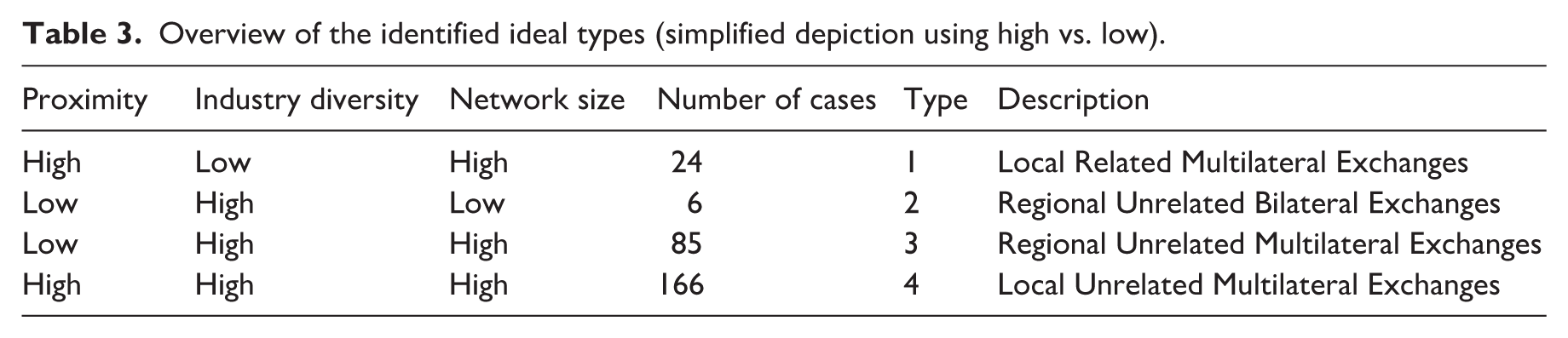
To qualitatively analyse the different types based on specific resource exchanges, these four configurations were examined in detail, focusing on the underlying exchanges. This included an assessment of the sectors of firms involved, the resources used, and their utilisation in each context. This approach enabled us to illustrate each exchange type more comprehensively and to understand the underlying logics.
Type 1: Local Related Multilateral Exchanges
Local Related Multilateral Exchanges (LRME), particularly in sectors like chemicals, farming, metals, and pulp and paper, exemplify the strategic advantage of geographical and organisational proximity. Exchanges centre around local resources such as chemical and organic by-products (e.g. CO2 and H2; 7 occurrences) and water resources (7 occurrences). Energy carriers and fuel (3 occurrences) also play a role, as do some occurrences of biomass and agricultural residues, reusable materials, and inorganic by-products that are managed on-site. The industries involved benefit from being co-located, as it facilitates the exchange of either grid-bound or low-value resources, enhancing efficiency and reducing logistical costs.
Type 2: Regional Unrelated Bilateral Exchanges
Regional Unrelated Bilateral Exchanges (RUBE) involve the exchange of large quantities of by-products with consistent qualities, primarily those that are easily transportable. This includes especially reusable production materials (3 occurrences) as well as biomass and agricultural residues (2 occurrences), which are either utilised as raw materials in specific manufacturing processes or used as an energy source (e.g. in biogas production). Most solutions originate from facilitation programs within specific regions. One notable example is the NISP in the UK, which facilitates the efficient exchange of industrial by-products across numerous initiatives.
Type 3: Regional Unrelated Multilateral Exchanges
Regional Unrelated Multilateral Exchanges (RUME) often involve large quantities of uniform and steadily available secondary resources, as well as resources where the inherent material value or specific policies (e.g. aiming at enhanced carbon or resource efficiency or local environmental protection) justify longer-distance transport. The primary resource categories involved are chemical and organic by-products (23 occurrences), mineral and inorganic by-products (18 occurrences), biomass and agricultural residues (17 occurrences), energy carriers and fuel (7 occurrences), water resources (5 occurrences), and a variety of recyclable or reusable materials (15 occurrences). This type of symbiosis is based on the economic viability of transporting resources over longer distances, particularly those that are bulky or difficult to dispose of. Examples are by-products that are used as fertilisers or mineral components that can be used for cement and concrete production.
Type 4: Local Unrelated Multilateral Exchanges
Local Unrelated Multilateral Exchanges (LUME) involve a variety of resource types and are often centred around anchor entities such as power plants, steel mills, and chemical companies. The larger part of exchanges falling into this category are energy carriers and fuel (69 occurrences), followed by chemical and organic by-products (24), water resources (23 occurrences), mineral and inorganic by-products (21 occurrences), biomass and agricultural residues (20 occurrences), and recycled and reused materials (9 occurrences). The efficient transport and utilisation of steam, heat, electricity, and wastewater rely on grid-bound infrastructure; thus, infrastructure is essential for facilitating these types of local exchanges. Of the various exchanges in the database, 26 stem from power plant outputs, 14 from urban entities (e.g. waste processing), and 16 from iron and steel production.
Industrial Symbiosis exchange types in Germany
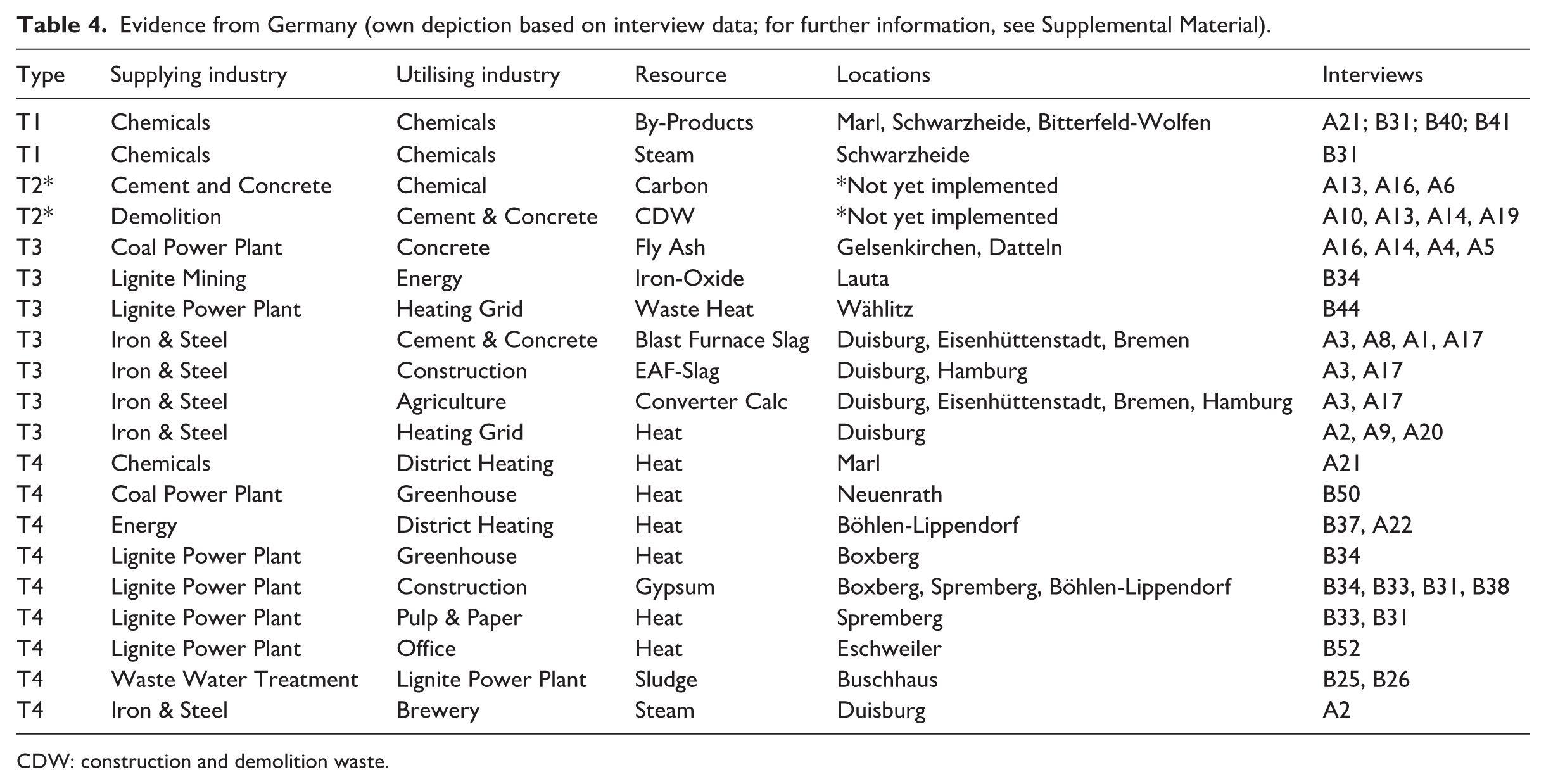
Research has highlighted that IS does not play a prominent role in the German industrial context (Boons et al., 2015; Kühn and Busch, 2019). Aside from a few small-scale research projects, there are no designated national or regional facilitation programmes for IS. One assumption is that a prevalent focus on intra-firm resource efficiency strategies may hinder the development of inter-firm solutions (Kühn and Busch, 2019). However, interviews in two projects allowed us to identify various instances of by-product exchanges in Germany, although these are often not explicitly labelled as IS. This illustrates how analyses at the exchange level may uncover existing solutions that may be overlooked by research that predominantly focuses on large-scale networks as the one in Kalundborg. While the conducted interviews did not cover all German regions and additional cases may exist, findings allow us to present examples of different types. This led to the identification of 32 exchanges, which can be grouped into 20 exchange types, some occurring in multiple locations (see Table 4). Rather than providing a comprehensive account of all exchanges in Germany, this paper aims to illustrate key characteristics and draw on contextual knowledge to explain the underlying logics.
Evidence from Germany (own depiction based on interview data; for further information, see Supplemental Material).
CDW: construction and demolition waste.
In Germany, LRME (Type 1) occur in clusters of related industries, especially chemical parks, where local infrastructure enables efficient flows of materials and by-products as it reduces transportation costs and risks (A21, A22, and B41). Geographical and sectoral proximity optimises resource use, supported by specialised knowledge to identify potential by-products (B40 and B41). Clustering results either from deliberate co-location to enhance synergies or from vertical disintegration, when firms split into smaller entities while maintaining resource flows (B31, B4, and A21).
No RUBE (Type 2) were identified in the interviews, which connects with the assumption that this type mainly depends on national or regional facilitation. Nevertheless, interviewees highlighted growing interest in bilateral regional exchanges due to processes of industry decarbonisation, such as recycling construction and demolition waste for cement and concrete production, or carbon capture and utilisation, aiming at the utilisation of CO2 captured in cement production by the chemical industry (A10, A13, A14, and A19). Both solutions reportedly rely on geographic proximity due to transport challenges. Nevertheless, none of the pilot projects for these types of solution were fully implemented at the time of the study (A10 and A14).
RUME (Type 3) exchanges are prevalent in the utilisation of mineral by-products, such as ground granulated blast furnace slag or fly ash. Regulatory frameworks (e.g. deposition bans or carbon and resource efficiency policies) push industries towards symbiosis, while standardisation processes create market opportunities for secondary resources. Type 3 exchanges often involve longer distance transports and accompanying investments in transport, storage, and processing infrastructure (A3, A8, A17, and A14). Initially bringing together unrelated industries, such as cement production and steelmaking, these synergistic interconnections foster closer inter-industrial ties through common research projects and adaptations to eco-friendly production methods (A8 and A3).
As in the international dataset, fossil power plants in Germany also function as central hubs or anchors in LUME (Type 4). The availability of a variety of locally sourced by-products provided by different industries allows for the formation of diverse symbiotic connections, thereby optimising overall local resource efficiency. Power plants have historically played a pivotal role due to their by-product outputs, which benefit sectors such as construction, agriculture, or local energy-intensive industries such as pulp and paper (B52, B44, B34, and B50). Outputs include heat, gypsum, fly ash, and CO2. Steel plants and chemical parks engage in similar practices, albeit on a narrower scale, as they sometimes also serve as local providers of waste heat or by-products. However, the future role of these anchor sectors is uncertain given the planned phase-out of technologies such as blast furnaces or fossil power plants (A1, A4, A5, and A10). Some of the Type 4 exchanges can be seen as a re-scaling of regional exchanges (Type 3), when processing industries invest in local processing infrastructure at the point of origin (A4 and A3) and, thus, join local networks physically. Finally, while both RUBE (Type 2) and RUME (Type 3) operate at the regional scale, they differ in their organisational and infrastructural characteristics. Type 2 exchanges involve bilateral matching between geographically dispersed industries providing specific by-products (e.g. captured carbon), requiring individual coordination and transport connections. By contrast, Type 3 exchanges are typically found in industrial clusters or agglomerations where existing infrastructures can be adapted for secondary resource flows, facilitating larger exchange networks within the regions. Type 2 exchanges can, thus, be understood as smaller-scale variants that could, if resources such as captured carbon gain importance, evolve into nuclei for future multilateral networks depending on infrastructural integration.
Discussion
Geographical proximity enhances the intensity of circular economy practices, as suggested by Arfaoui et al. (2024). In exploring the dynamics of regional exchange and innovation for IS, it does, however, become evident that IS is connected to a range of factors beyond or interconnected with spatiality. Various elements such as proximity, networks, and diversity, the materiality of resources in question (Angstmann, 2025), as well as multiple social layers, including individual, organisational, and institutional levels, influence IS (Mortensen and Kørnøv, 2019).
In LRME (Type 1) exchanges, proximity enables efficient resource flows and reduces logistical barriers, while shared infrastructure lowers costs and increases profitability. Industry relatedness facilitates optimised resource use and collaboration, while local embeddedness in networks encourages innovation and fosters trust. These networks often connect to wider regional ones, either via infrastructures (pipelines, grids) or through firm linkages. Interconnections are typically bidirectional, with industries exchanging both products and by-products. LRME can further serve as the foundation for larger symbiosis networks, with additional links to other related industry sites in the region.
In RUBE (Type 2) exchanges, geographical proximity is crucial for logistical efficiency (e.g. urban mining and CO2 pipelines), supporting resource transport and cross-sectoral connections. The establishment of such exchanges depends largely on national facilitation or regulatory frameworks and infrastructures that enable bilateral interconnections and synergies between sectors, as there are no sectoral overlaps (i.e. organisational or cognitive proximity) nor geographic proximity that would foster local knowledge exchange of some form.
In RUME (Type 3) exchanges, proximity remains a critical factor despite longer transport distances, as costs strongly influence feasibility. Regulatory and market dynamics bring together industries that are otherwise separate, encouraging collaboration and innovation. These exchanges depend on infrastructure to handle large volumes, and while they are often bilateral and benefit-focused at the firm level, they also contribute to broader regional IS by promoting collaboration, integration, and specialised logistics.
In LUME (Type 4) exchanges, proximity enables place-based networking and supports the integration of diverse by-products into local exchange networks. Thermal or grid-bound resources rely on local infrastructure, while specific industrial configurations lead to context-specific solutions and networks. A favourable institutional framework that promotes resource efficiency further strengthens these exchanges. Since exchanges are often established between unrelated industries, they rely on effective place-based networking to identify symbiotic opportunities within cities or industrial parks. Heterogeneity allows for unique, place-specific solutions. In some cases, the high value of certain by-products prompts a re-scaling of solutions, as firms invest in local processing units at the source.
IS may, therefore, manifest at different scales and both within and across sectors (e.g. regional exchanges versus chemical parks). While regional bilateral solutions stem predominantly from national facilitation programmes, other solutions emerge from sectoral network-building or local place-based approaches. In this context, geographical proximity encompasses the local as well as the regional scale. Regional solutions can be fostered through national or regional facilitation, including matchmaking and the creation of institutional frameworks that foster secondary resource markets, for example through landfill restrictions or establishment of reuse and recycling standards. When it comes to local solutions, however, a spatial perspective emphasises the unique local context, influenced by history, identity, and local industrial developmental paths (Angstmann, 2025). These solutions evolve locally and cannot be transferred or replicated elsewhere easily. This connects to previous research showing that trust and place-based embeddedness, linked to proximity, plays a key role (Boons and Howard-Grenville, 2011; Hewes and Lyons, 2008).
Proximity is, however, not only crucial for social connections but also matters where there is the need for specific infrastructure or when it comes to high transport costs for certain large-quantity by-products. It is directly related to the materiality of resources, affecting transportability and transport costs. This aligns with previous studies indicating that the role transport distances play varies according to the specific resource type, as different waste streams have varying viable transport ranges depending on: (1) waste stream type and characteristics, (2) waste stream value, and (3) the location of resource recovery facilities (Domenech et al. 2019). Against this backdrop, a spatial, material-based perspective is needed to understand dynamics behind IS and circular economy solutions in general.
It has been shown that in circular economy solutions, spatiality and materiality are intricately linked. Material properties influence feasibility – considering transport costs and necessary infrastructure – and can also drive innovation in reuse or recycling. Managing materials (e.g. waste or CO2), which may require costly processing or landfilling, often results in innovative intersectoral solutions. This largely resonates with calls to integrate materiality (i.e. assets, resources, and infrastructures) more directly into economic geography research (Martin and Sunley, 2006; Njøs et al., 2024).
When it comes to emergence and facilitation processes, Boons et al. (2017) identified seven IS dynamics, highlighting variations in emergence processes based on initiating actors, motivations, and outcomes. They proposed that specific conditions – technical, economic, geospatial, social, and institutional – might trigger distinct IS dynamics, urging further exploration, particularly from a non-engineering perspective. The typology established in this paper can be connected to diverse emergence pathways established by Boons et al. (2017). Type 1 (LRME) links to self-organisation and organisational boundary changes within local industry clusters, often due to strategic co-location or vertical disintegration. Type 2 (RUBE) is tied to brokerage facilitation, with all instances arising from national or regional programmes. Type 3 (RUME) exchanges frequently benefit from institutional frameworks that promote brokerage through policies and standards for large-scale secondary resource markets, indicating some government involvement yet less top-down than the Eco-Industrial Parks described by Boons et al. (2017). Type 4 (LUME) may involve both eco-cluster development and self-organisation as location-based processes. These emergence contexts do, however, require further investigation through in-depth case studies to understand the complex relationships better.
Integrating the typology of exchanges with established IS frameworks
IS research has explored various exchange types with distinct characteristics. Most of the cases in the initial dataset used (166) align with Chertow’s (2000) narrow definition, resembling the Kalundborg model, although often in a less extensive manner. Findings do however also indicate the existence of additional types. This aligns with and extends existing IS literature, suggesting that there are different strategies based on exchange types (material) and specific sectoral socio-spatial dynamics.
Chertow’s (2000) analysis of 18 prospective eco-industrial parks identified five material exchange types: (1) waste exchanges, (2) intra-firm exchanges, (3) exchanges among co-located firms in eco-industrial parks, (4) exchanges between local but non-co-located firms, and (5) “virtual” exchanges across broader regions. Types 3–5 are named as particularly relevant in the IS context. The types identified in this paper in the dataset and Germany, partially align with these.
According to Boons et al. (2015), IS in Europe comprises three major types: process-oriented IS (linked to process industries such as forestry and petrochemicals), residue-oriented IS (featuring bilateral networks of residue flows), and place-oriented IS (networks at specific locations). The analysis of international cases aligns with these findings, with a distinction that “residue-oriented” cases were further subdivided into regional networks of related firms and bilateral connections of unrelated firms in this paper. The typology proposed in this paper, thus, adds nuances to the questions of distance and industry diversity and allows us to grasp contextual differences in more detail. Engaging in an analysis of resources and, thus, material and sectoral dynamics behind them deepens the understanding of emergence processes behind different types.
Policy implications
Regional development agencies often act as intermediaries, with coordination and a supportive institutional context named as key factors for the establishment of successful circular solutions (Veyssière et al., 2022). There is, however, an ongoing debate on whether they IS should be planned or emerge from self-organisation and business-driven dynamics. Domenech et al. (2019) highlight a dichotomy between top-down strategies in Denmark and Finland and bottom-up approaches in Iceland, Norway, and Sweden. The UK’s NISP and Eco-Industrial Parks in Asia illustrate different scales of policy intervention, from regional facilitation (Laybourn and Lombardi, 2007) to strategic regional planning (Park et al., 2016) or highly subsidising local solutions (van Berkel et al., 2009). There are, however, also a variety of arguments against direct political steering as it is suggested that self-organising, market-driven long-distance resource recovery solutions deserve more attention as efficient ways to foster symbiosis (Desrochers, 2004; Desrochers and Szurmak, 2017). Market-driven solutions, such as macroeconomic regulation of energy and resource prices or implementation of substantial CO2 certificate trade at the European or OECD level, as well as bans on landfilling for specific resources, could be beneficial for fostering exchanges of large-quantity resource streams (so mainly RUME) (Angstmann, 2025). However, relying solely on these top-down measures may not be sufficient to leverage all potentials, as the cases in the database showed that other types of symbiosis are more prone to emerge from regional facilitation (e.g. RUBE relying on matchmaking) or establishment of local networks (e.g. LRME or LUME).
Based on the findings, a mix of policies and strategies is essential to foster diverse configurations of IS. Rather than striving to replicate fully fledged networks such as Kalundborg, the central question should be which type of exchange, materiality, and configuration is at stake. Local, small-scale initiatives in heterogeneous industrial areas may benefit from place-based networking and local facilitation, whereas large-scale regional symbiosis requires more structured institutional support (e.g. standardisation processes or policies aiming at resource efficiency). As there is not one single type of IS but a variety of real-world manifestations of the concept, there is a need for varied strategies to effectively foster different types of exchanges. While a balanced combination of top-down and bottom-up approaches might be necessary, one central implication of the findings is that policies should focus on the exchange level, as it is the most tangible and relevant aspect for firms as economic actors (Boons et al., 2017): From a firm’s perspective, the local solution to waste management or resource replacement is what matters, not the broader network in which it may be situated conceptually.
In the German context, it remains uncertain whether a central nationwide support program as England’s NISP (Kühn and Busch, 2019; Laybourn and Lombardi, 2007) could significantly increase the emergence of IS, given Germany’s strong industrial regional roots, decentralised development, and a number of existing by-product exchanges in place, even if not under the label of IS. In many cases, these solutions build on long-term historic interconnections between local or regional industries. A local or regional facilitation programme could offer advantages, when there is a focus on materiality in terms of physical properties, quantities, and use cases. The aim should be matchmaking for firms and pooling of low-quantity resources, not on establishing broad social networks, so especially to promote Type 2 exchanges, which are currently underrepresented but also hard to scale-up. Here, more research is needed to explore this further.
Limitations
The database used in this study may be biased towards localised solutions similar to the well-known Kalundborg model (Chertow, 2000, 2007; Valentine, 2016). For example, we did not find evidence for regional intra-sectoral connections. While such resource-based interconnections may certainly exist, they probably closely resemble conventional value chains and may not be recognised or classified as IS. The issue of by-products arises only when viable markets for them are lacking. In such cases, industries that are already well-integrated within a sector may implement by-product solutions without engaging in discussions on IS. Examples of this include the agricultural use of biomass or inter-regional transport of manure (Franz et al., 2018). In this respect, the classification aids in analysing existing cases, while further configurations might exist that warrant further exploration in future research.
Furthermore, the analysis was influenced by the granularity of the data available. The absence of comprehensive data, in part due to the unavailability of the original sources, may have affected the categorisation of certain cases, particularly in differentiating between regional and local exchanges. The lack of detail in the original sources has occasionally resulted in ambiguity regarding the precise locations of exchanges, such as whether they were situated in larger urban or smaller industrial context. A more detailed subdivision (e.g. by different kilometre distances) was, therefore, not possible.
Finally, focusing solely on resource exchanges, as dictated by the database, presents another limitation. Substitution synergies, so those based on complementary resource flows, are only one solution discussed in the IS context, with “mutuality synergies” being another (Castellet-Viciano et al., 2022). Benefits based on shared infrastructure used and other non-resource-based synergies, consistent with Lombardi and Laybourn’s (2012) understanding of IS as collaborative eco-innovation, may follow different principles. Sharing infrastructure or multi-using space can also enhance competitive advantage and aligns with EU sustainability goals, for example when it comes to efficient land use. They are, however, less emphasised in the circular economy debate in which most of the discussion about IS as one solution for resource efficiency is conceptually situated.
Conclusion
IS, as a spatial practice often discussed in the circular economy debate, offers a viable pathway for sustainable territorial development by balancing economic and environmental benefits through strategic regional planning. However, the academic debate on IS includes various partly diverging conceptualisations that emphasise different aspects and preconditions. This leads to challenges when it comes to research, operationalisation, and policy advice: A vague conceptualisation and a variety of diverging definitions complicate the understanding of the phenomenon in question, especially as the relevant socio-spatial context matters when it comes to targeted strategies and policies. Building on previous research in economic geography, this paper categorised real-world manifestations of by-product exchanges based on the conditions of industry diversity, geographic proximity, and network size. This approach allowed us to examine diverse configurations of IS and to identify primary resources, sectors, and infrastructures involved. Findings extend previous classifications, which were often overly conceptual, prevalently focused on some of the relevant characteristics or engaged with material dimensions only superficially.
Findings categorise existing cases into four types: (1) LRME, (2) RUBE, (3) RUME, and (4) LUME. Further illustrating these manifestations in terms of resources used, firm types, and contextual data and assessing how they manifest in Germany revealed that different types of by-product-based exchanges may follow distinct socio-spatial logics and may, thus, need tailored support measures.
Specific characteristics are linked to the resource’s materiality or sector-specific logics. While some solutions may rely on sectoral networks or national facilitation, others emerge as self-organised solutions reacting to a conductive national or regional institutional context. Local solutions in heterogeneous or diverse industrial areas benefit from the creation of local networks and place-making approaches.
These insights have implications when it comes to the objective of fostering symbiosis for regional resource efficiency by policy or strategy. Findings suggests that policy should focus also on facilitating individual exchanges, rather than aiming mainly to replicate large networks such as Kalundborg, as different instruments may be applied to foster different types of exchanges. While facilitation is important, the overall institutional and local contexts that enable or restrict solutions is equally crucial. Matchmaking is only effective when the setting is conducive and there are appropriate incentives or restrictions in place (e.g. encouraging local or regional reuse of by-products) and when there is a supportive local environment (firms, networks, infrastructure, and identity). A focus on exchanges allows us to identify solutions that align with the specific material characteristics of the resource in question, which also determines the appropriate spatial scale for implementation.
Supplemental Material
sj-docx-1-eur-10.1177_09697764261455320 – Supplemental material for Configurations of Industrial Symbiosis: Categorising by-product exchanges by geographic proximity, industry diversity, and network size
Supplemental material, sj-docx-1-eur-10.1177_09697764261455320 for Configurations of Industrial Symbiosis: Categorising by-product exchanges by geographic proximity, industry diversity, and network size by Marius Angstmann and Stefan Gärtner in European Urban and Regional Studies
Footnotes
Acknowledgements
An earlier version of this article was presented at the Workshop of the European Chair of Excellence on Circular Economy and Territories, “Regional Policy and Territorial Governance for the Circular Economy,” co-organised by EM Normandie Business School, INRAE, and European Urban and Regional Studies on 8 October 2024. We thank the organisers, Sébastien Bourdin and André Torre, as well as the participants for their valuable comments. We are also grateful to the anonymous reviewers for their constructive feedback. Many thanks also to Ruven Rößler and Marvin Mosters for assisting at different stages in the research process. Any remaining errors are our own.

Funding
The authors disclosed receipt of the following financial support for the research, authorship, and/or publication of this article: The data collection of this research was partly conducted as part of the Project “Symbiotische Gewerbegebiete: Nachhaltige Ansätze, Potentiale für die Strukturwandelregionen sowie Möglichkeiten und Grenzen der Übertragbarkeit auf nutzungsgemischte Quartiere (SymbiotiQ)” (FKZ 3719151010) funded by the German Environment Agency (UBA). Further research was supported by internal research fund of the Westphalian University of Applied Sciences (H_2022-002).
Declaration of conflicting interests
The authors declared no potential conflicts of interest with respect to the research, authorship, and/or publication of this article.
AI use
Generative AI (DEEP-L and ChatGPT) was used as a supportive tool in the data analysis (R/R-Studio) and in English language editing. Any changes suggested by AI were thoroughly checked manually by the authors.
Supplemental material
Supplemental material for this article is available online.
References
Supplementary Material
Please find the following supplemental material available below.
For Open Access articles published under a Creative Commons License, all supplemental material carries the same license as the article it is associated with.
For non-Open Access articles published, all supplemental material carries a non-exclusive license, and permission requests for re-use of supplemental material or any part of supplemental material shall be sent directly to the copyright owner as specified in the copyright notice associated with the article.
