






Abstract
The transition to a circular economy (CE) is essential to address pressing environmental challenges. This transition heavily relies on technological progress and innovation. However, the geography of CE innovations is uneven, with some regions outperforming others in developing CE-related inventions. In this paper, we aim to deepen the understanding of the geography of CE innovations and its drivers at the regional level. Specifically, we investigate how the composition of regional knowledge bases is associated with CE innovation, distinguishing between knowledge related to the invention of novel products (product knowledge) and knowledge related to the development of new production processes (process knowledge). Our empirical analysis draws on two unique datasets: one uses natural language processing to identify CE inventions from patent data, while the other identifies process and product knowledge from patent data. Combining these datasets, we analyze data from 283 European NUTS-2 regions and 128 CPC technology fields between 1980 and 2016. Our findings reveal that a higher share of process knowledge within a region’s knowledge base is associated with greater regional intensity of CE innovations. These results contribute to the literature on the geography of the CE, highlighting the importance of place-based policy approaches to foster CE innovation.
Introduction
The circular economy (CE) is a major building block for transitioning toward more environmentally sustainable economies. Reaching the target of net-zero emissions in fact requires to urgently switch from the linear paradigm based on “take, make, dispose” to a circular one based on “reduce, reuse, recycle, and recover.” This transition entails different strategies, practices, and behaviors by both consumers and firms, which are also and above all enabled by technological innovations for circularity, or CE innovations (Engez et al., 2021; Piscitello et al., 2026). Consistently with the Oslo Manual (OECD and Eurostat 2018), these CE innovations could be of different kinds, including both technological and non-technological (like organizational or marketing innovations), with the latter encompassing CE innovations in the firms’ business model, like the case of the “pay-per-use” business model (Urbinati et al., 2017). However, available data (as we will see, patent data) enable us to carry out systematic analyses only with respect to technological CE innovations, amounting to new products and processes encapsulating characteristics that reflect one or more of the distinguishing pillars of the CE: such as, for example, new products designed to last longer and return to circulation, and material efficiency improvements to reduce the use of primary raw materials. While the spectrum of CE innovations is wider and encompasses complementary non-technological innovations, the implementation of CE practices in the real economy of production and consumption crucially relies on technological advancements. New products and processes represent the tangible means through which circular principles are operationalized—from design for durability and reparability to material substitution and efficiency improvements. Technological CE innovations thus play a foundational role in enabling the systemic shift required by the CE, providing the core functionalities around which organizational, business model, and behavioral changes can be built.
An extensive literature on the geography of environmental innovation indicates that different regional factors contribute to an uneven geography of innovations with a favorable environmental impact, with some regions exhibiting better conditions than others for developing this special kind of innovations (Losacker et al., 2023). This is apparently so also for CE innovations, whose geographical analysis is, however, still at an incipient stage. Economic geography, particularly in its evolutionary variant, has only recently begun addressing the CE and its enabling innovations, highlighting the critical influence of local factors such as proximity, territorial governance, and collaborative networks (Bourdin and Torre, 2025). Within this stream of research, recent studies have shown the relevance of the kinds of knowledge that constitute the knowledge base of regions (Chembessi et al., 2024; Fusillo et al., 2024; Gonçalves et al., 2022; Meili et al., 2024). Indeed, following the recombinant innovation theory at the regional level (Asheim, 2007; Asheim and Coenen, 2005), new regional technologies can be claimed to emerge through recombinations of local existing knowledge, whose features thus represent a crucial determinant for their emergence. Among these, in the recent research about the geography of the so-called “twin transition,” the local endowment of green and digital knowledge has appeared to be relevant for CE innovations (Fusillo et al., 2024). However, other aspects and characteristics of the knowledge base on which regional innovation systems draw (Asheim and Coenen, 2005) can be deemed important in understanding their capacity for developing CE innovations, and their analysis is still unexplored. Among these factors, little, if any, attention has been given so far to the type of knowledge with which regions are endowed and to how this shapes their local capabilities to generate new CE innovations through the recombination of their existing knowledge base. In particular, the extent to which regional knowledge bases are differentially structured to support product versus process types of CE innovation has remained largely underexplored.
This is unfortunate as neglecting the distinction between product and process knowledge overlooks critical factors shaping how CE innovations are implemented locally. Regions with innovation knowledge of a more product kind may limited to focus on the development of durable, repairable, and circularly designed goods, for reducing resource inputs and extending product lifecycles. On the other hand, regions prioritizing innovations in the process domain can have more chances to engage in the wide and crucial set of CE innovations that pertain to operational efficiency, waste management, and resource reuse. However, research rarely distinguishes between process and product knowledge when explaining regional differences in CE innovation.
In this paper, we address this gap and contribute to the growing body of research on the geography of CE innovation in at least two aspects. First, we add to the extant literature about the regional mapping of CE by proposing a more granular way of detecting CE innovations across regional technologies. To do that, we develop and utilize a unique patent dataset that captures patents related to the CE. Unlike other studies, this patent dataset does not rely on existing technology classes to identify CE content. Instead, it uses a machine learning approach, classifying patents as related to the CE based on the abstract texts (following Kriesch and Losacker, 2024), moving beyond the shortcomings of conventional rule-based approaches to identify CE in patent data (Manera and Quatraro, 2025; Modic et al., 2021; Rainville et al., 2025). This approach enables a highly granular research design, allowing for both cross-regional comparisons of the overall share of CE patents and the examination of regional differences in the distribution of CE patents across specific technological fields. In brief, our CE patent identification strategy enables us to ascertain the extent to which the unfolding of CE innovations is localized in some regional technologies rather than others. Indeed, we find significant variation in the share of CE patents in several technology fields between regions, indicating that the transition to a CE in these fields unfolds heterogeneously between them. The share of CE content in the patent stock of a region–technology observation will serve as the dependent variable in our study. Importantly, focusing on region–technology pairs allows us to disentangle two distinct sources of heterogeneity: (i) cross-regional differences in overall technological specialization and (ii) within-technology differences in the composition of the knowledge base mobilized by regions. In particular, by examining the balance between product- and process-oriented knowledge within the same technological field across regions, we can assess whether differences in CE innovation are associated not simply with the presence of certain technologies in a region, but also with the way knowledge is structured and deployed within those technologies. This design, therefore, enables us to isolate compositional effects in the knowledge base from pure technological specialization effects.
The second contribution of this paper relates to the regional knowledge base conditions associated with new CE technologies. By addressing the gap we have detected above, we add to previous studies by focusing on two types of knowledge available in the region: knowledge related to the invention of novel products (product knowledge) and knowledge related to the invention of new production processes (process knowledge). The relevance of these different types of knowledge has been discussed extensively in innovation studies, at least since the seminal work by Utterback and Abernathy (1975). However, despite some recent classificatory schemes (Engez et al., 2021), their relationship to the CE has not yet been explored. By reflecting on the inner characteristics of the patterns through which the CE unfolds, we maintain that the regional balance between process and product knowledge could be an important correlate of the emergence of new local CE technologies. More precisely, since the concept of the CE primarily revolves around transformations in production processes, we posit that a robust regional knowledge base in process innovation is positively associated with higher levels of CE-related innovation.
From an empirical point of view, we detect this balance by utilizing a novel dataset on the identification of product and process patents (Heinrich et al., 2022) and design our main independent variable as the region–technology-specific incidence of process knowledge. We then test our hypothesized relationship using various regression designs on a comprehensive dataset covering region–technology observations in Europe (NUTS2 regions, CPC three-digit technologies) over the period 1980–2016.
Our findings support the hypothesis that a higher share of process knowledge in a region pertaining to a particular technology field is associated with a higher share of CE patents in that technology field within the region. The findings of our study are important for better understanding the (uneven) geography of CE innovation and the regional knowledge base conditions associated with it, aiding policymakers in supporting the transition to a CE in European regions.
The remainder of this paper is structured as follows. In the section “Background literature,” we provide a review of the emerging literature on the geography of the CE and its innovations, and we present arguments as to why different types of regional knowledge, namely process or product knowledge, are associated with the invention of CE technologies. In the section “Empirical analysis,” we describe in detail the data used for this study and how we identify CE inventions from patent abstracts using a machine learning approach. We also elaborate on the econometric strategy in this section. In the section “Empirical results,” we present the main results of the paper and discuss our main hypothesis. Section “Conclusions” concludes this paper.
Background literature
The geography of the CE and its innovations
Against the backdrop of pressing environmental concerns, including climate change, waste pollution, and resource depletion, there is growing awareness of the potential of a CE to mitigate these issues. The concept of a CE has been discussed in scholarly literature in and across various disciplines for several years, though its definition and understanding vary (Kirchherr et al., 2017, 2023). Among the different approaches, in this paper, we adopt a technological understanding of the CE, omitting its more societal and systemic aspects. We adopt this approach for two interconnected reasons. First, we recognize that, as recent empirical studies suggest (IEA, 2020), a significant portion of the environmental targets set for 2050 relies on the development of new green and CE technologies that are yet to be created. Second, our approach is driven by the way we operationalize the concept of the CE for our empirical analysis.
Following the sensu stricto definition of the CE, as outlined by Bocken et al. (2016) and Moraga et al. (2019), we distinguish the CE from the linear economy by two key characteristics: slowing and closing resource loops. “Slowing” refers to the design of long-life goods and product-life extension, such as service loops to extend a product’s life through repair or remanufacturing. This results in the extension and/or intensification of the utilization period of products, thereby slowing the flow of resources. “Closing” occurs when the loop between post-use and production is closed, creating a circular flow of resources. In this process, waste flows are transformed into secondary resources. This definition specifically focuses on the technological cycle of resources.
Given that the CE also includes the rationale of localized resource flows and territorial governance systems for that to happen, a growing body of research on the CE has emerged within economic geography, regional studies, and related fields (for an overview, see Bourdin and Torre, 2025). From a conceptual point of view, the regional dimension of the CE has been theorized by connecting its working principles with those underlying different approaches in regional studies, such as the knowledge base, the regional system of innovation, and the proximity schools (Bourdin et al., 2022; Chembessi et al., 2024; Fromhold-Eisebith, 2024; Tapia et al., 2021). On this basis, empirical studies about the unfolding of the CE at the territorial level have been growing, enriching our understanding of factors such as collective circular practices, industrial symbiosis, closed resource loops, and other spatial factors in the implementation of the CE. Some of these studies have exploited detailed case studies, like for example that by Gonçalves et al. (2022), which highlights how collective methanization projects in France rely heavily on territorial governance structures and inter-firm cooperation, underscoring the importance of local coordination and embeddedness for successful CE implementation; or the recent study by Fromhold-Eisebith (2024), which shows that addressing CE challenges within regional innovation systems in Germany requires not only technological capabilities but also institutional adaptability and cross-sectoral collaboration.
Exploiting the recent increase in the availability of relevant data, empirical research is also advancing in the systematic quantitative measurement and mapping of the CE at the regional level, thereby offering broader insights into its geographical dimension. In a recent study among firms in France’s chemical sector, Arfaoui et al. (2024) show that collaborating with partners considered to be geographically close is positively correlated with the intensity of CE practices, with some nuances in the types of CE practices. Again, for the French case, but focusing on firm and employment growth, Niang et al. (2024) highlight that the number of companies in the CE is mainly concentrated in metropolitan areas, leading to an uneven geography of CE activities. Using a novel database on regional European funds and text-mining techniques, Barbero et al. (2025) find that the share of EU funds allocated to CE projects reveals an uneven geography and that factors such as institutional quality, employment levels, human capital, and income help explain the regional concentration of CE-related R&D funding. Moreover, their analysis highlights differences in EU financing between technology- and CE-oriented projects. In a recent paper, Platon et al. (2024) provide evidence of a fragmented distribution of CE performance across EU regions, showing that while some regions lead in certain CE indicators—such as recycling rates or CE investments—they lag in others, revealing an uneven and multidimensional regional landscape of CE development.
Besides these findings and more important for the empirical analysis in this paper, there are also a few recent studies that investigate technological innovation in the CE, exploring its (regional) drivers. In a recent study, Fusillo et al. (2021) used technology classes to identify CE inventions in patent data and showed that CE inventions tend to be concentrated in the higher-performing regions of central Europe, while CE relative specialization is highly fragmented and appears stronger in more peripheral regions. In a related study, the same authors examine the relationship between local knowledge bases and recombinant dynamics in CE technologies (Fusillo et al., 2024). By referring to citations of CE patents across regions, they demonstrate that both green and digital complementary localized capabilities are crucial drivers of regional recombinant activities around CE technologies, highlighting that the local knowledge base plays a key role in regional differences in the transition toward the CE. Based on survey data from Swiss firms, Meili et al. (2024) study the role of regional CE knowledge in the implementation of CE innovations in firms. They find that firms located in regions with more CE knowledge are, on average, more likely to introduce CE innovations.
However, the number of studies investigating regional CE innovations quantitatively remains limited. This lack of (quantitative) research may be attributed to the scarcity of systematic data and appropriate indicators for CE innovations, which span all economic sectors and industries, making it challenging to utilize administrative data for measurement. Indeed, standard indicators and classification systems may fall short in accurately capturing circular activities, a challenge that we will address in the section “Empirical analysis.” This shortage of studies has meant that important aspects of the geographical distribution of CE innovations remain underexplored—particularly the regional differentiation between process and product knowledge, which we address in the following section.
A regional differentiation of process and product knowledge
In innovation studies, researchers often distinguish between two types of technological innovations: technological product innovations and technological process innovations. As the operationalization of this distinction in measuring innovation concretely reveals (see the Oslo Manual by OECD and Eurostat, 2018), technological product innovation is a new product with technological characteristics or intended uses that differ significantly from those of previously produced products. Such innovations may involve the development of entirely new technologies, the novel combination of existing technologies with new applications, or the application of new knowledge. In contrast, technological process innovation refers to the introduction of technologically new or significantly improved production (business) methods. These methods may involve changes in equipment, production organization, or a combination of both, often derived from the application of new knowledge. Process innovations are typically aimed at producing or delivering technologically advanced or improved products that cannot be created or provided using conventional production methods (OECD and Eurostat, 2018). 1
The distinction between product and process innovations is fundamental for understanding technological life cycles and technological change. In their seminal study, Utterback and Abernathy (1975) described the stylized dynamics of such life cycles. They observed that product innovations tend to dominate the early stages of a life cycle, as firms compete by introducing a variety of new products. As technologies mature, competition increasingly shifts toward price, and product changes become incremental. At this stage, competitive pressure drives firms to reduce production costs, often leading to the introduction of process innovations to remain competitive and access mass markets. The distinction at stake is also pivotal in the seminal paper by Anderson and Tushman (1990), where product innovations locate in the occasion of technological discontinuities, while process ones follow the advent of a dominant design (i.e., a technological standard). At the firm level, product and process innovations have a different timing and, what is more, require different capabilities and strategies that make the firms’ size and market structure differently relevant (Argente et al., 2020).
While process and product innovation, along with the knowledge required to develop such innovations, have been studied extensively in the economics of innovation literature (Damanpour, 2010; Fritsch and Meschede, 2001; Hullova et al., 2016; Reichstein and Salter, 2006), 2 they have received comparatively little attention in geographical innovation research. In this research field, early studies at the meso level pointed out that regional variations in product and process innovation entail different patterns of regional development (Oakey et al., 1982). More recent studies at the micro level have explored the different (regional) drivers influencing the introduction of product versus process innovations at the firm level (Fitjar and Rodríguez-Pose, 2013). However, to our knowledge, no geographical research so far has mapped and examined the impact of the regional balance of product over process innovations on the subsequent local development of specific technologies, like those related to the CE. This represents a significant research gap regarding the (likely uneven) geography of innovation in general and, for the sake of our paper, the geography of CE innovations, which we aim at filling.
In general terms, the existence of regional differences in the tendency of local innovators to introduce either product or process innovations can be accounted for by considering that regional knowledge bases are heterogeneous and vary in terms of the knowledge required to develop novel products (product knowledge) versus novel processes (process knowledge). This idea can be traced back to the seminal concept of differentiated regional knowledge bases, as introduced by Asheim and Coenen (2005), where the distinction between product and process knowledge, to which we have referred above, is however missing. The standard knowledge base approach identifies three epistemologically distinct and largely independent forms of knowledge creation that are deemed relevant to innovation processes in general: analytical knowledge, synthetic knowledge, and symbolic knowledge. In brief, analytical knowledge is produced through scientific methods and is characterized by its universal, abstract, and largely codified nature. It often involves collaborations with universities and research institutes. Synthetic knowledge, on the other hand, is derived from the application or combination of existing knowledge, typically through interactive learning with customers or suppliers, and is highly tacit and context-specific. Symbolic knowledge, in contrast, is rooted in creative processes within project teams and is crucial for generating meaning, desire, and aesthetic qualities. It is intangible and highly context-dependent. Following the regional knowledge base approach, the regional mix of these three kinds of knowledge can also help explain spatial differences in innovation dynamics: for example, regions that are more oriented toward analytical knowledge—such as those with strong university and research infrastructures—may tend to specialize in product innovations, whereas regions relying on synthetic knowledge—such as those with robust engineering traditions and strong user–producer linkages—may display a comparative advantage in process innovations. As a result, the regional balance between product and process innovation can be interpreted as reflecting the underlying nature of regional knowledge bases.
However, the previous approach neglects the fact that, in several cases, like that of the CE, innovation is likely to rely on different types of knowledge that are less region-specific and instead differ with respect to their prospected technological application, such as a new product or a new technological process. Rather than region-specific—such as the distinction between analytical, synthetic, and symbolic knowledge—this kind of heterogeneity is arguably finer grained and technology-specific, as it relates to the properties of the knowledge base that, together with those of technological opportunities, appropriability, and cumulativeness, constitute a “technological regime” (Breschi et al., 2000). In this respect, the distinction between product- and process-oriented knowledge reflects not merely a regional characteristic, but a structural feature of the knowledge regime within a given technological field. Product knowledge typically relates to the generation of new artifacts and functionalities, while process knowledge concerns improvements in production methods, resource efficiency, and system integration. In the context of CE innovation, where the optimization of material flows, recycling processes, and circular production systems is central, process-oriented knowledge may play a particularly critical role. Crucially, the relative balance between product and process knowledge can vary across regions even within the same technological domain, depending on regional firms’ capabilities, industrial organization, and local green policy stringency. It is, therefore, theoretically meaningful to examine this balance at the technology–region level, rather than exclusively at the aggregate regional level, as the same technology may embody different knowledge structures across regional contexts.
The regime of certain technologies can be made up of knowledge that is typically used in forging new products rather than new processes. 3 As with the other features of a technological regime, this feature of the knowledge base also affects the trajectory along which a technology develops and the features of its inventive outcomes, such as their degree of novelty and, above all, their sphere of application, for example, to the CE. As we will argue more extensively in the following section, irrespective of the regional balance among analytical, synthetic, and symbolic knowledge—and the associated propensity to develop product versus process innovations that may arise from it—CE innovations tend to rely on a technological regime whose knowledge content is predominantly process-based rather than product-based. This is because CE innovations mainly aim to redesign or optimize how resources, materials, and energy flows are managed throughout the production and consumption cycle. They typically involve the reconfiguration of existing processes—such as waste recovery, reuse, recycling, or substitution of raw materials—rather than the creation of entirely new end products. For example, improving material efficiency, introducing modular repair systems, or enabling closed-loop production chains requires deep knowledge of industrial processes, systems integration, and operational routines, all of which fall under the domain of process knowledge. Accordingly, our expectation is that regions where, across different technologies, the balance between product and process knowledge for CE innovation is more in favor of the latter reveal a higher capacity to innovate in the CE realm across the same technologies.
CE innovations in-between regional product and process knowledge
As we have previously argued, CE innovations exhibit a heterogeneous nature, encompassing both the product and process spheres. CE innovations can involve the creation of products that are easier to repair or recycle, which reduce resource inputs, and extend product lifecycles. These innovations contribute to the CE by minimizing waste and enhancing the longevity of products, aligning with the principles of reducing, reusing, and recycling. For instance, designing products for disassembly and recycling, using durable materials, and incorporating modular components are all examples of product-centric CE innovations (Engez et al., 2021). However, innovations that are more directly capable of facilitating the transition from a linear to a CE model are typically process-oriented and involve optimizing production and operational processes to enhance resource efficiency, reduce waste, and enable the reuse of materials. Examples include advanced recycling technologies, sustainable supply chain management, and energy-efficient manufacturing processes.
Unlike product CE innovations, whose circular impact is generally limited to specific market segments and customer categories, CE process innovations are capable to transform entire industrial systems by creating more closed-loop processes for materials and products (Kiefer et al., 2021). Indeed, the effect of CE process innovations extends beyond specific products or sectors by reshaping the foundational processes within entire industrial ecosystems. These innovations do not merely alter the characteristics of individual products but lead to systemic changes in the ways materials are sourced, used, and reused across various industries. They influence the interactions between different stakeholders—such as manufacturers, suppliers, and consumers—and promote more integrated approaches to managing resources and waste. Across regions, and acknowledging the uneven geographical distribution of the CE, CE innovations of a process-oriented nature align more closely with what Bourdin and Torre (2025) describe as “Territorial Circular Ecosystems.” Indeed, they define these ecosystems as “integrated and dynamic networks of actors (such as companies, public authorities, research organizations, non-governmental organizations (NGOs), and citizens), and processes (like eco-design, recovery, recycling, and reuse) that foster economic circularity rooted within the territory” (p. 9, emphasis added).
Given their pivotal role in the unfolding of the CE, our expectation is that regions where, across different technologies (see section “A regional differentiation of process and product knowledge”), the balance between product and process knowledge for CE innovation is more in favor of the latter, reveal a higher capacity to innovate in the CE realm. This is the main hypothesis of our work, which we test with the empirical analysis illustrated in the following section. Importantly, this argument does not imply that product knowledge is irrelevant for CE innovation. Our main claim is not that process knowledge universally dominates product knowledge in this domain. Rather, because many CE solutions depend on the reconfiguration of production processes, material flows, and resource-use systems, we claim that process-oriented knowledge is a particularly relevant component of regional technological knowledge bases for CE innovation.
Empirical analysis
Data
For the empirical part of the paper, we combine two original datasets. Both datasets are based on patents, a key indicator for studying knowledge and innovation (Griliches, 1990). The first dataset is a patent dataset that includes information on whether a patent relates to the CE. The second dataset, also focused on patents, distinguishes between product inventions and process inventions. We will use the first dataset to create the dependent variable and the second dataset to create the main independent variable of interest for this study.
The dataset on CE patents used in this study was created using a natural language processing approach to identify whether, by reading its abstract, a patent relates to the CE. Previous studies that have used patent data to examine CE innovations have typically relied on technology codes, keyword searches, or a combination of both to identify CE technologies (for an overview, see Manera and Quatraro, 2025; Modic et al., 2021; Rainville et al., 2025). However, these so-called rule-based approaches have several limitations, as the CE spans all technology fields, making it difficult to accurately identify CE inventions using such methods. As a result, previous studies are likely to present an incomplete picture of the CE patent landscape. In contrast, we argue that CE inventions can be identified from the patent descriptions provided in the patent abstracts, which contain valuable information about the purpose of the technology, its benefits, and its fields of application. As such, our identification approach is based on all English-language patents taken from the PATSTAT 2022 Spring Edition over the period 1980–2020 and closely follows the process outlined by Kriesch and Losacker (2024). We manually labeled a training set of 1592 patent abstracts according to a sensu stricto CE definition focused on inventions that enable slowing and/or closing resource loops (Bocken et al., 2016; Moraga et al., 2019). The manual annotation was conducted by two researchers familiar with CE concepts and patent-based innovation research. The labeled dataset was constructed iteratively, starting from Y02W patents as likely CE candidates and subsequently expanding the data with non-CE comparison patents, low-margin cases, and manually relabeled cases. The final dataset contained 625 CE and 967 non-CE abstracts. The details of the identification process we used are illustrated in Appendix B. After testing the performance of different machine learning models, we selected “PatentSBERTa” as the final model to flag CE patents. The trained classifier was evaluated using a 50% test set and achieved an accuracy of 88.7%, a precision of 83.9%, a recall of 88.8%, and an F1 score of 86.3%, indicating strong overall performance. Post-prediction analysis of the entire dataset revealed that approximately 6.85% of all patents were classified as CE patents.
During the most recent decades covered by our analysis (1995–2015), 4 the majority of CE patents were found in the following technology classes: B09 (Disposal of solid waste; reclamation of contaminated soil), C05 (Fertilizers), C02 (Water treatment; water supply), F03 (Machines or engines for liquids; non positive displacement machines), and C13 (Sugar; starch; and their derivatives; processing thereof). 5
Figure 1 shows the change in the share of CE patents for the top five CPC technologies over the same period. All of them show a stable or increasing pattern until 2005–2008 with a marked decline afterwards with only technologies in engines remaining at levels higher than the 1995 level. This is in line with the changing focus of CE technologies, which have increasingly focused on other technologies than those in the figure—like electric generation (H02) and the emergence of digital and cross-sector enablers (Y04)—in an attempt to move from waste disposal to reduce, recycle, and reuse, which is a CE imperative (Kirchherr et al., 2017, 2023).
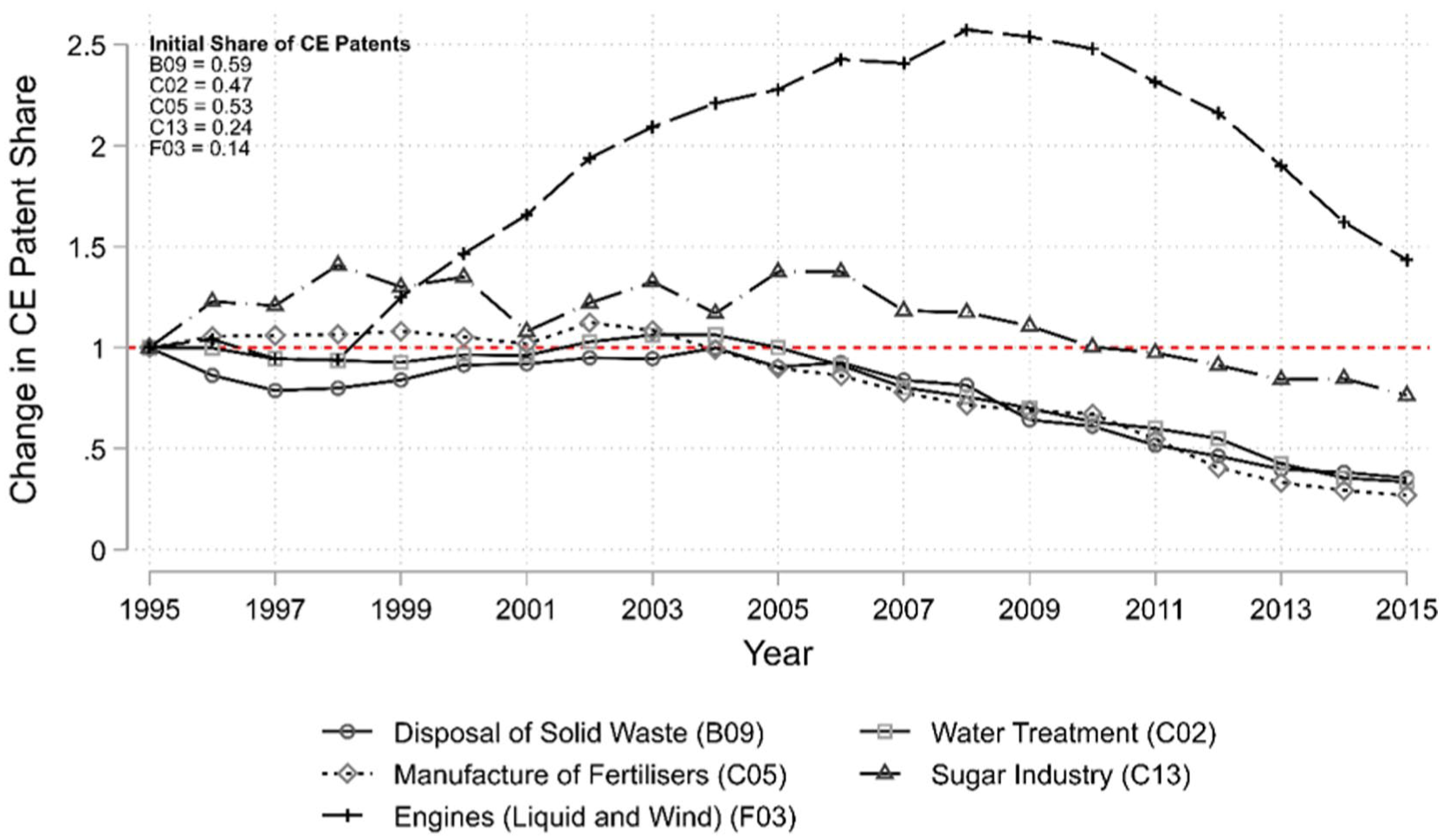
Change in the share of CE patents for top five CPC technologies at three digits, 1995–2015. Top CPC technologies are selected according to the average share of CE patents in the pre-period (before 1995). The change is relative to the pre-period. Due to the discrete nature of patent variables, all values are 5-year moving averages.
In addition to the improvements in classification accuracy, our dataset on CE patents offers a key advantage over previous attempts to identify them from a geographical perspective. Specifically, our dataset enables not only the mapping of the share of CE patents at the regional level, but also an assessment of how this share varies within different technology fields at the regional level. This is consistent with our understanding of the nature of the regional knowledge base for CE inventions, which we have illustrated in the previous section. From an empirical point of view, this is a significant advantage over prior studies, as it captures important nuances in the geographical distribution of CE patents that were detected by them. As shown in Figure 2, when the focus is on regional differences in the share of CE patents relative to all patents (map A), we observe slight regional variations. For example, regions such as Algarve, Portugal, had no CE patents during the study period, resulting in a share of 0%. In contrast, regions with a high share of CE patents include Midtjylland (20.4%) and Syddanmark (18.7%) in Denmark, among others. While some of these differences can be explained by the distinct technological and industrial specializations of regions, we argue that another factor is at play. Specifically, we find that the share of CE patents also varies within technology fields at the regional level. Figure 2 (map B), for instance, illustrates the share of CE inventions within the technology field Y02 (Technologies or applications for mitigation or adaptation against climate change). As shown, there are significant regional differences in the role of CE inventions within the same technology field. We can also observe that the share of CE patents in Y02 is considerably higher than the share of CE patents among all patents.
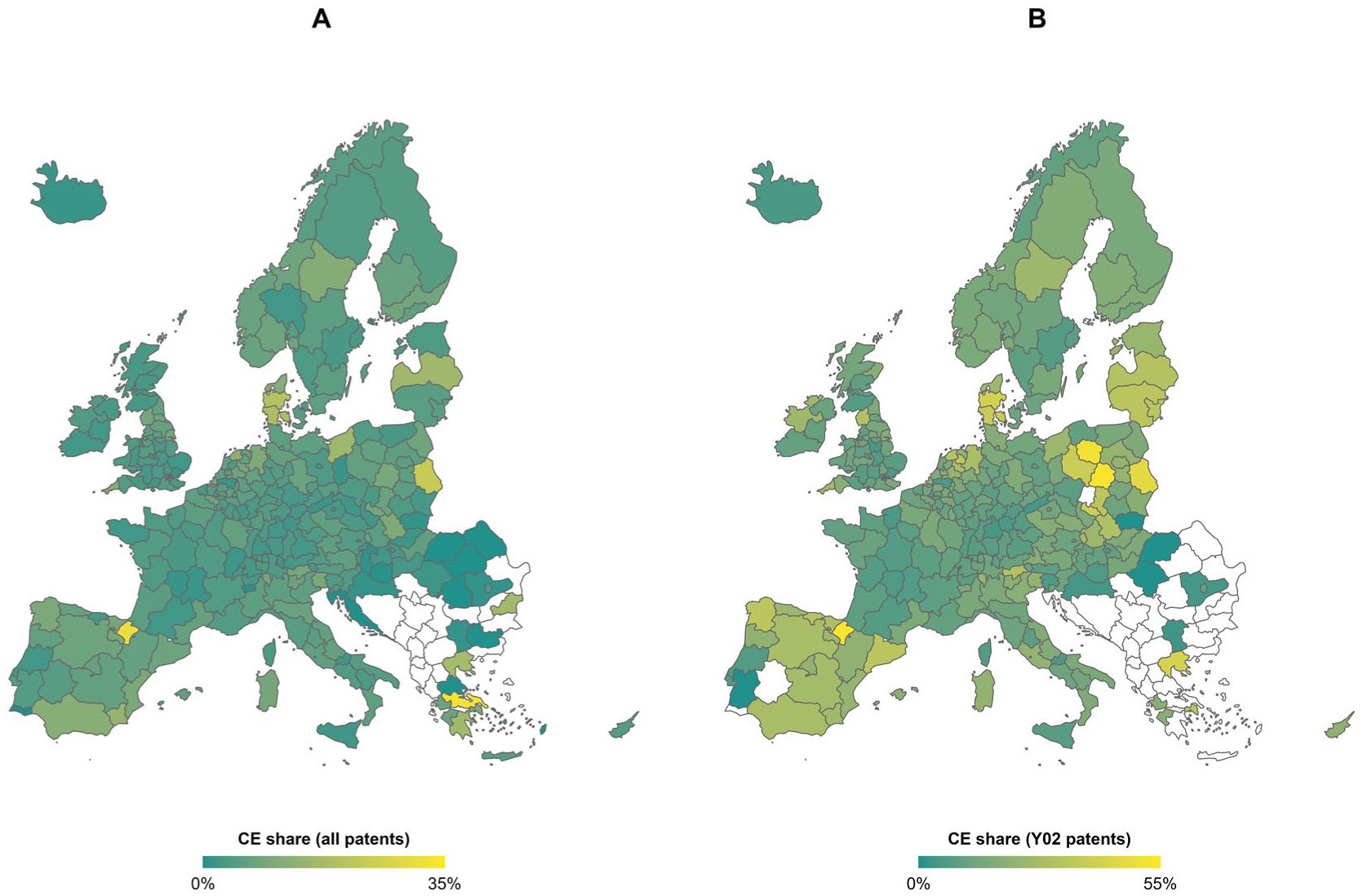
Share of CE patents in NUTS-2 regions, 1980–2016: (Map A) CE share among all patents and (Map B) CE share among Y02 patents. Blank regions indicate either a lack of data or fewer than five patents. The upper limit of the scale is based on the rounded highest value in the respective data subset.
Figure 3 shows the dynamics of CE patent share for the top five NUTS 2 regions, with the highest share of CE patents up to 1995. These regions comprise regions located in Denmark, Greece, Slovakia, and Spain. Notably, Central Denmark and Navarre region in Spain showed marked increases in the share of CE patents starting from 2007, following regional ad hoc policies to spur the CE. 6 However, a limitation of our approach is that patent-based measures may not fully reflect CE activity in practice. Inventions can be deployed for circular purposes without this being explicitly described in the patent abstract, and many circular strategies (e.g., organizational, service-based, or incremental process changes) may not be patented at all. Accordingly, cross-country and regional differences in CE patenting derived from our classifier should be interpreted as differences in patented CE-related inventions rather than as a complete measure of CE implementation. Compared to rule-based identification using selected CPC codes (e.g., Y02W) or keyword searches (Modic et al., 2021; Rainville et al., 2025), our text-based classifier is intended to capture CE inventions across a broader technology space, but it may yield distributions that differ from code-based measures because it relies on how circularity is articulated in abstracts rather than on pre-defined classification boundaries. The results of our analysis align with those of a recent, similar NLP approach to identifying CE patents, both in terms of geographical distribution and differences across technology classes (see Manera and Quatraro, 2025).
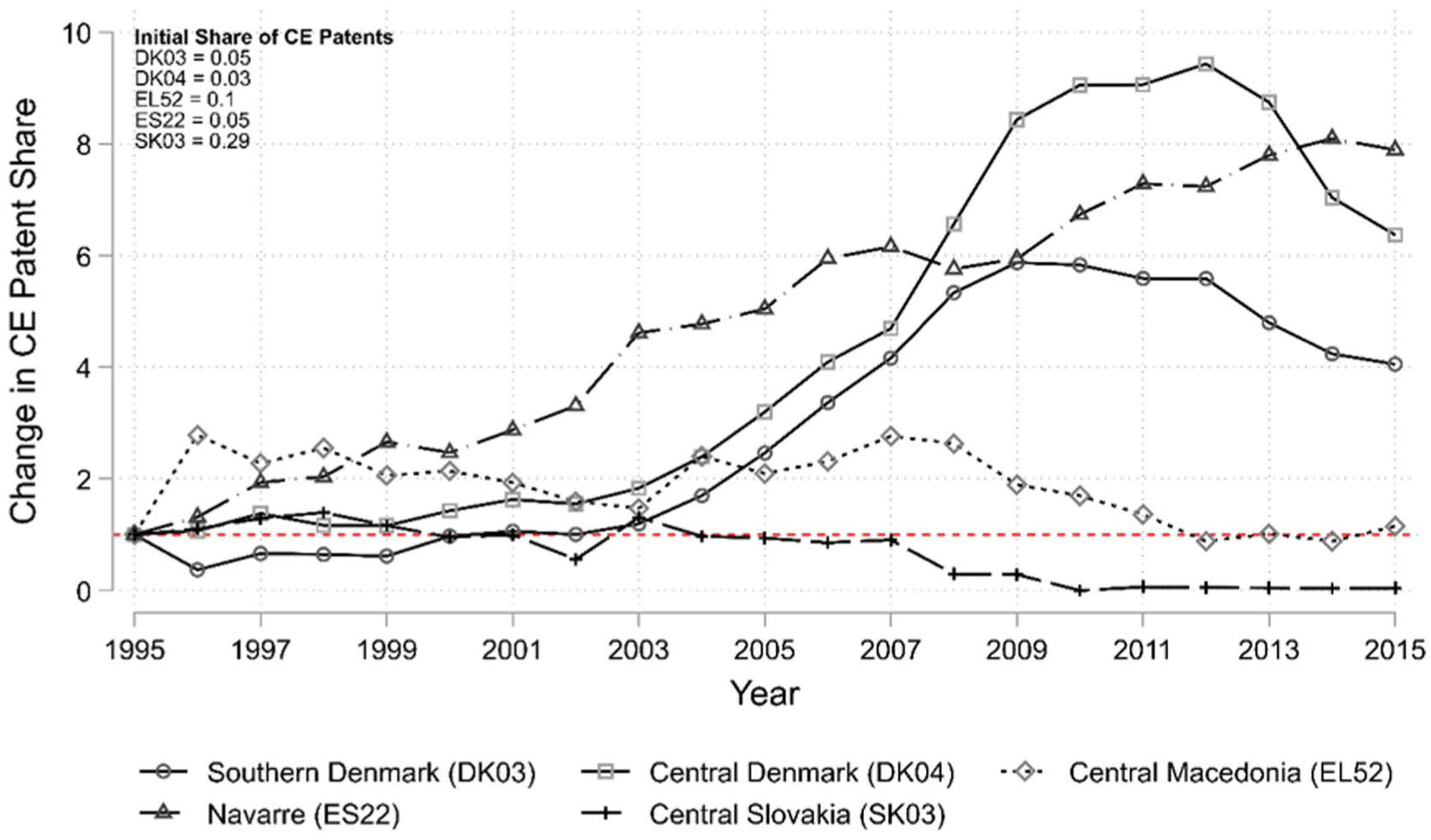
Change in the share of CE patents for top five NUTS2 regions, 1995–2015. Top NUTS 2 regions are selected according to the average share of CE patents in the pre-period (before 1995). The change is relative to the pre-period. Due to the discrete nature of patent variables, all values are 5-year moving averages.
Moving to the second dataset of our analysis, this was created and published by Heinrich et al. (2022). The authors developed a methodology to distinguish between patents that protect process inventions and those that protect product inventions, with the key argument that process and product inventions stem from different types of knowledge. In their approach, they use a keyword search to analyze patent claims, flagging them as relating to either a process invention or a product invention. They then compute the share of claims on a patent that relate to either type of invention, categorizing patents as process-related, product-related, or mixed. Their data, which examine claim texts from EPO and USPTO patents between 1980 and 2016—thus setting 2016 as the upper temporal boundary of our analysis—show that the share of claims related to processes is significantly smaller than that related to products. At the same time, the number of mixed patents, involving both process and product claims, has increased over time. They attribute this to the growing complexity in creating inventions. Additionally, they show that the share of process claims differs considerably between technology fields.
In Figure 4, we present the share of process patents by region for the period 1980–2016, calculated as the average process share of all patents within a region. In Map A, we display the process share among all patents, while in Map B, we show the process share among Y02 patents. Similar to Figure 2, Figure 4 also reveals two key observations: first, there is regional variation in the share of process knowledge across European regions; and second, and more relevant for our study, there is regional variation within technology fields. Additionally, the share of process knowledge in Y02 is, on average, higher than the share of process knowledge among all patents, though this pattern does not necessarily hold for every region.
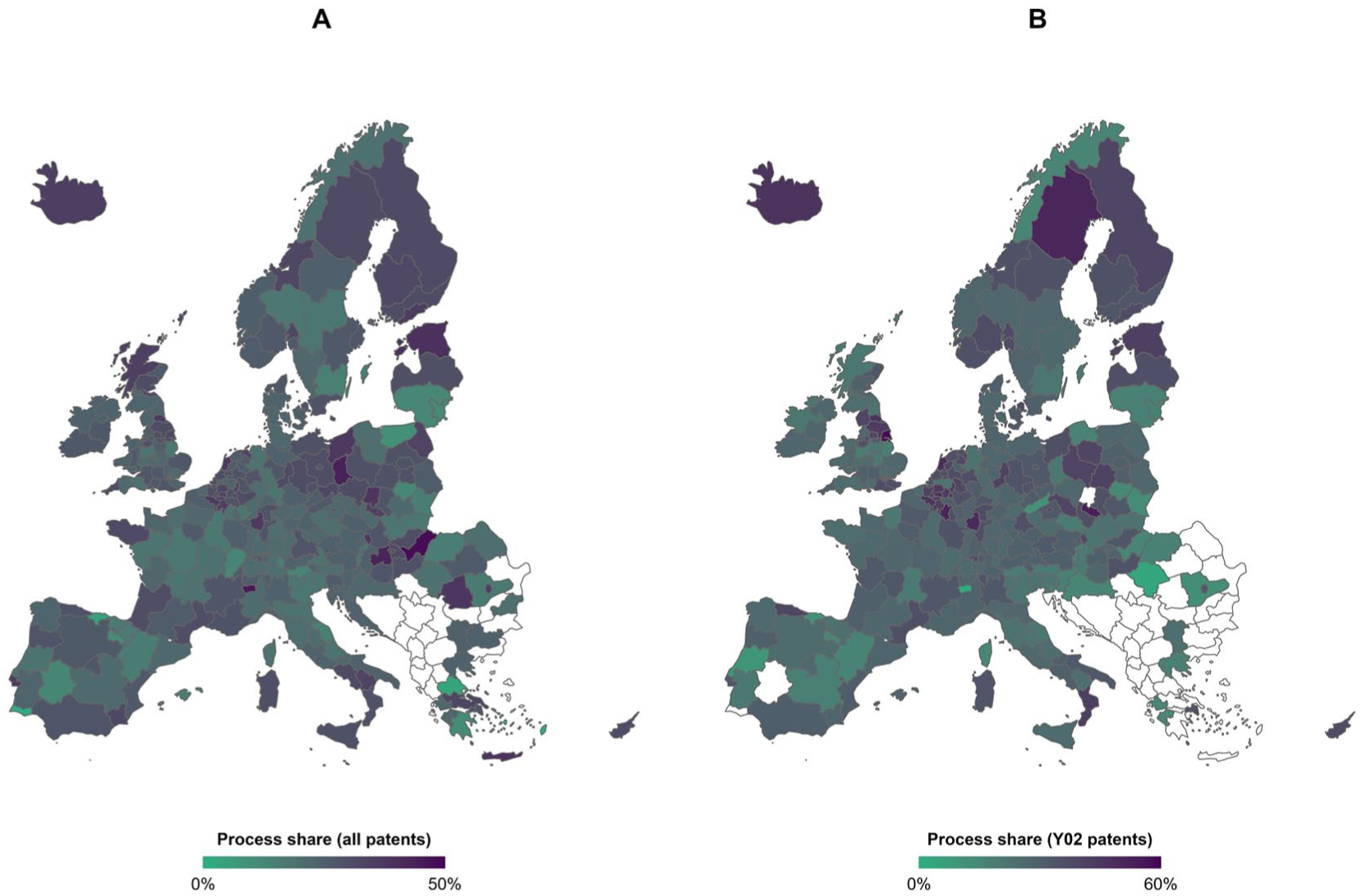
Share of process patents in NUTS-2 regions, 1980–2016: (a) process share among all patents and (b) process share among Y02 patents. Blank regions indicate either a lack of data or fewer than five patents. The upper limit of the scale is based on the rounded highest value in the respective data subset.
In summary, we have two original datasets: the CE patent dataset, spanning from 1980 to 2020, on the one hand, and the process patent dataset, spanning from 1980 to 2016, on the other hand. For the econometric analysis, which we will describe in more detail in the next section, we aggregate and merge both datasets with respect to the period 1980–2016. Specifically, we merge both datasets and aggregate them to the regional level by technology, using geographic information about the patent inventors. More precisely, we assign each patent to an NUTS-2 region in Europe, using full patent counts in cases where a patent has multiple inventors. We then aggregate the data to the technology–region–year level, allowing us to compute the dependent variable as the share of CE patents in a specific technology field, by region and year. We do the same for the independent variable, computing the share of process patent claims in a specific technology field, by region and year. Similar to related studies, in order to account for the cumulative nature of knowledge production and to smooth outliers, we compute a 5-year moving sum when aggregating patents. Thus, for year t0, we consider all patents from years t−4 to t0.
Figure 5 provides a schematic representation of the whole data processing pipeline. Our final dataset consists of 290,025 (out of a potential 1,340,288) technology–region–year observations, covering 128 three-digit CPC technology fields, 283 NUTS-2 regions, and 37 years from 1980 to 2016. The sample used in the regressions is smaller than the full dataset employed to calculate moving sums, as not all regions record patents in every technology field each year. Moreover, we excluded any region–technology–year combination with fewer than five patents in the 5-year moving sum, following similar studies.
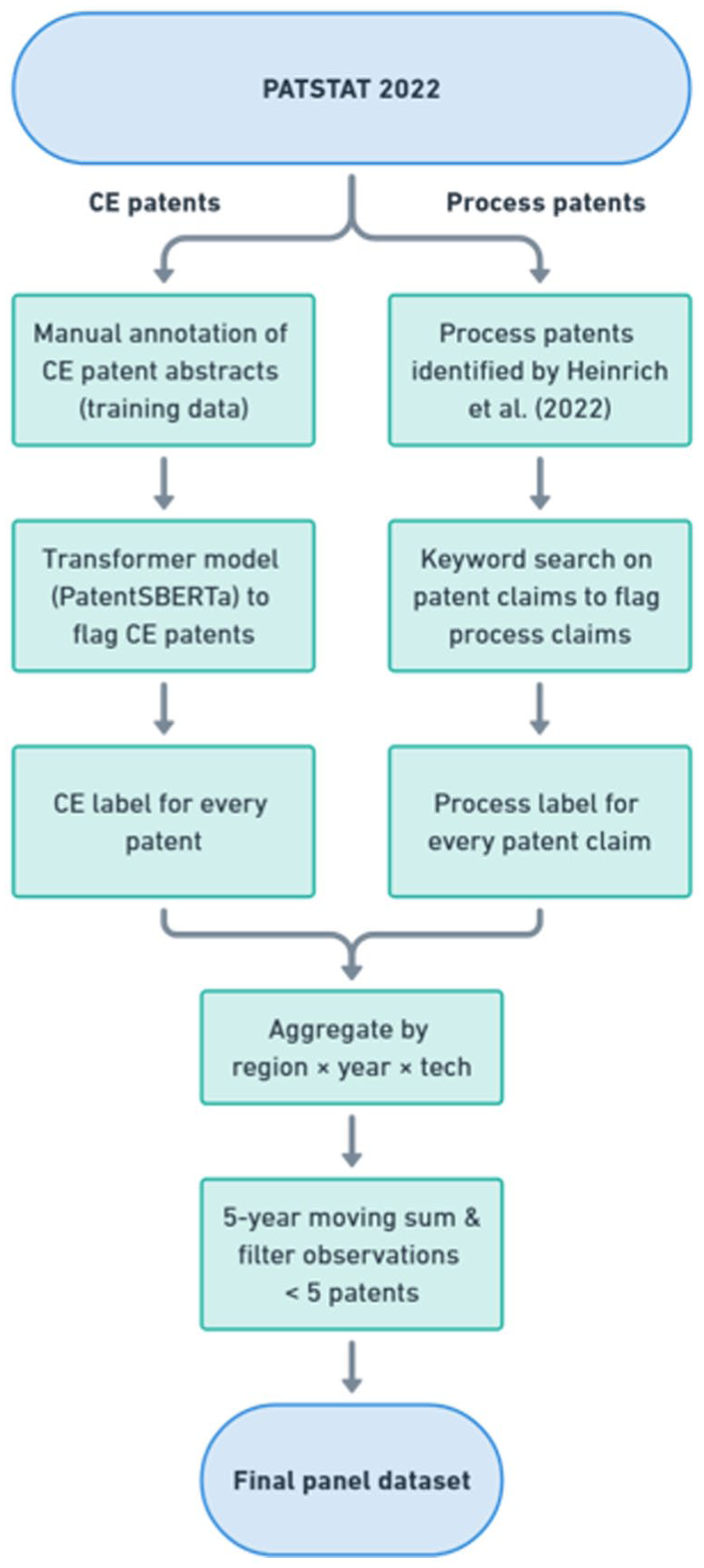
Data processing pipeline.
Methodology
To investigate the relationship between process knowledge and CE innovation, we estimate the following high-dimensional fixed effects linear model:

In this model,
As for the other variables of equation (1),
The previous two specifications of equation (1) allow us to isolate the association between CE innovation
While accounting for unobserved region, technology, and time effects, to identify the net effect of proc_share on ce(m), 7 in equation (1), we control for several regional characteristics, using data whose availability reduces the estimation window from the full baseline period (1980–2016) to 1999–2016. Following related research, we first account for the socioeconomic factors of regions, which shape both demand- and supply-side incentives for CE solutions. For instance, affluent regions may have stronger regulatory pressures and consumer demand for CE, while economically weaker areas may lack the absorptive capacity to adopt or develop CE innovations. By sourcing data from Eurostat and Cambridge Econometrics, we thus include regional GDP per capita (gdp_pc) and regional unemployment rates (unemp). Higher GDP per capita can reflect greater financial and institutional capacity to invest in complex green technologies like those related to CE (Barbieri et al., 2020). Conversely, regional unemployment may signal structural economic weaknesses or social priorities that reduce attention and resources devoted to sustainability-driven innovation like CE ones.
We also control for the industry and technoeconomic structure of regions in different respect. First, we include the share of employees in manufacturing (manuf), which are particularly exposed to resource use, waste generation, and regulatory pressure linked to the CE. Second, agglomeration economies, which have been found to be relevant also in the context of the CE (Pan et al., 2024), are accounted for by including a variable that captures regional population density (pop_dens). Third, we explicitly control for the innovation capabilities of regions, which is of course a key enabling factor for the development and diffusion of CE-related technologies, by including the patent stock (calculated using a 5-year moving window) at the region–technology level (inno_stock).
Finally, to retain the crucial role of environmental regulations in the development of CE patents, we include a variable based on the EUPRO dataset (Scherngell et al., 2024) that captures the share of EU-funded R&D projects dedicated to green purposes across regions (green_funds). However, since this dataset does not cover all countries in our sample (e.g., the United Kingdom, Switzerland, and Norway), it is not used in the main model but included as a robustness check.
Tables A1 and A2 report descriptive statistics for all variables and the relative correlation matrix, respectively.
Empirical results
Main results
The results of the baseline model, in which CE innovations are proxied with the count of CE patents, are reported in Table 1. As expected, in the first specification (Column 1), we find a positive and significant correlation between the share of process knowledge on which regional technologies rely and the number of CE inventions developed across them. This supports our expectation that process-related knowledge is a key correlate of CE innovation at the region–technology level. Indeed, CE solutions mainly require the redesign of production processes, the optimization of material and energy flows, and the development of more resource-efficient manufacturing systems. In this perspective, a knowledge base oriented toward process innovation appears closely aligned with CE inventive activities and with production models aimed at replacing linear “take–make–dispose” systems with more circular modes of production. Despite their generally lower incidence across regional technologies (see Figure 4), the development of CE innovations draws on the gain of new knowledge of a process kind, suggesting that the science and technology policy support to CE technologies should also address the typology, and not only, the size, of regional inventive efforts.
CE innovations (count of CE patents) and share of process knowledge.
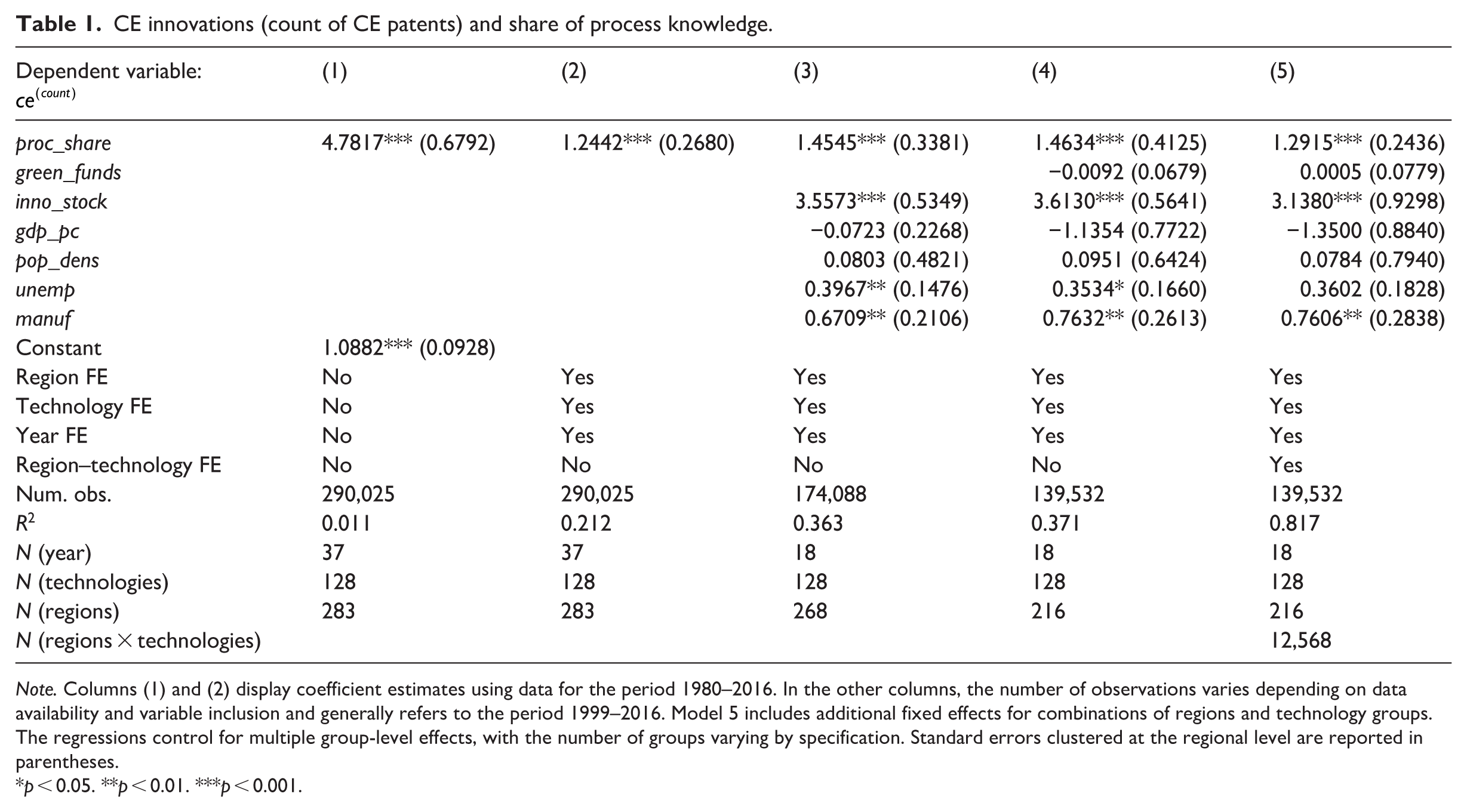
Note. Columns (1) and (2) display coefficient estimates using data for the period 1980–2016. In the other columns, the number of observations varies depending on data availability and variable inclusion and generally refers to the period 1999–2016. Model 5 includes additional fixed effects for combinations of regions and technology groups. The regressions control for multiple group-level effects, with the number of groups varying by specification. Standard errors clustered at the regional level are reported in parentheses.
p < 0.05. **p < 0.01. ***p < 0.001.
This key result remains robust when including regional, technology, and year fixed effects (Column 2). When adding control variables (Column 3), the number of observations decreases slightly due to the lack of data for a few regions and the adjusted time frame. Regarding their effects, we find that the share of employees in manufacturing industries is positively associated with a higher count of CE innovations at the regional level, indicating that CE innovations are more likely to emerge in industrial regions. In contrast, GDP and population density, used as a control for the level of economic development and of agglomeration economies, turn out to be insignificant. These findings suggest that CE innovation is primarily rooted in regions with a strong industrial base rather than in large and developed metropolitan areas. This is consistent with the idea that many CE solutions originate from the reconfiguration of production processes and industrial systems, rather than from urban-scale agglomeration dynamics. Conversely, the stock of local innovation capabilities at the region–technology level is positively associated with the number of CE innovations, suggesting that their development rely on pre-existing regional technological competences. Column 4 includes the share of EU R&D funding related to green purposes to account for the influence of governmental support for environmentally friendly research, but this variable also remains insignificant. Additionally, in this model, the number of observations decreases further due to the lack of data for the United Kingdom, Switzerland, and Norway. In conclusion, it should be noted that the coefficient of CE (counted) patent share remains positive and statistically significant even after including a rich set of region–technology fixed effects that control for different technological specializations across regions (Column 5).
Table 2 reports the estimates of equation (1) when the share of CE patents is used as dependent variable, to capture possible portfolio recomposition toward CE technologies within regional technological portfolios.
CE innovations (share of CE patents) and share of process knowledge.
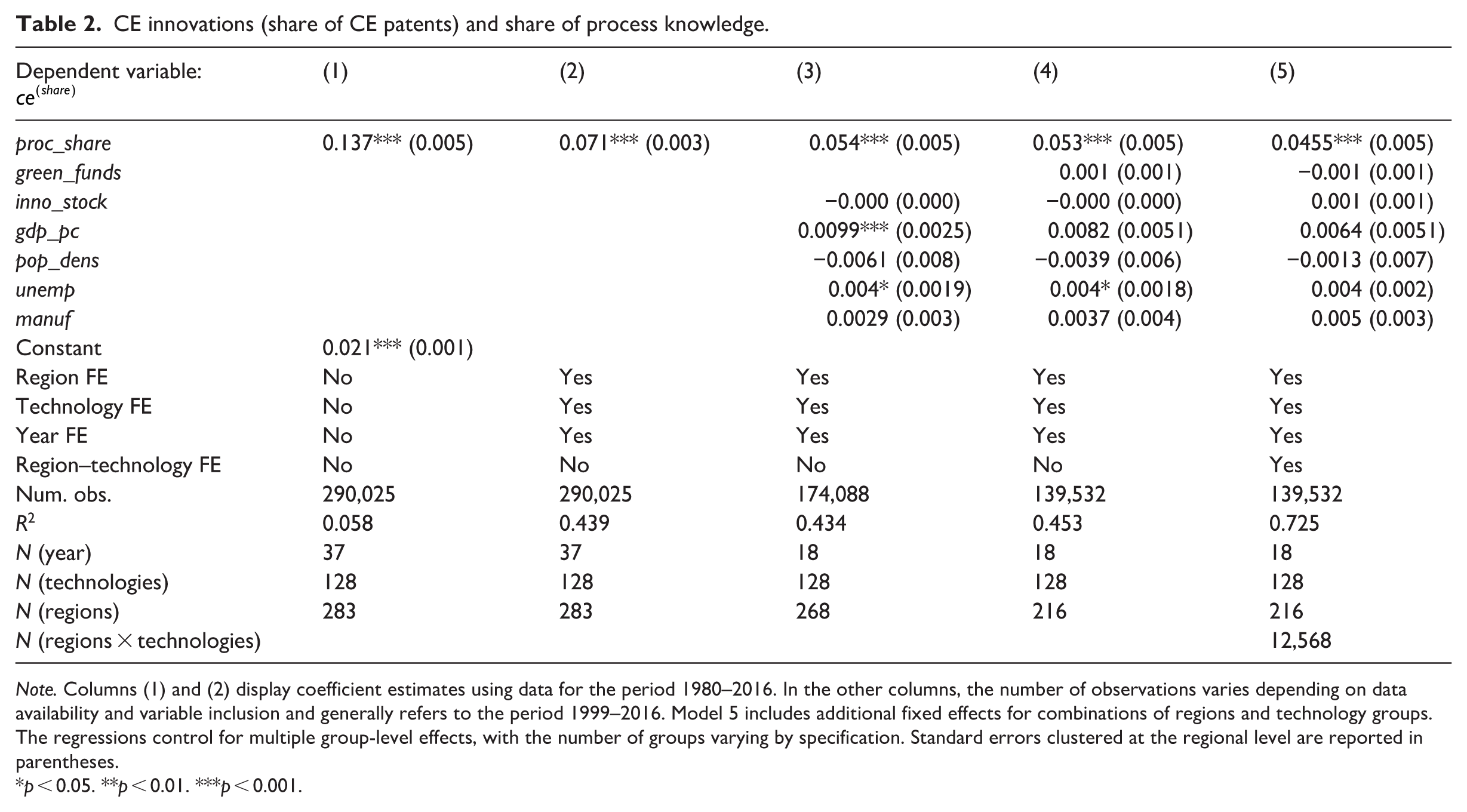
Note. Columns (1) and (2) display coefficient estimates using data for the period 1980–2016. In the other columns, the number of observations varies depending on data availability and variable inclusion and generally refers to the period 1999–2016. Model 5 includes additional fixed effects for combinations of regions and technology groups. The regressions control for multiple group-level effects, with the number of groups varying by specification. Standard errors clustered at the regional level are reported in parentheses.
p < 0.05. **p < 0.01. ***p < 0.001.
The share of process knowledge across regional technologies keeps on correlating significantly and positively with that of CE patents, even in the most stringent of the specifications, with regional technology fixed effects (Column 5). This finding reinforces our idea that a stronger orientation toward process knowledge is systematically associated with a greater relative importance of CE inventions within regional technological portfolios. On the other hand, most of the controls lose the significance they showed in the previous specification (Table 1). This pattern is consistent with the different nature of the dependent variables. While CE patent counts reflect the absolute scale of CE inventive activity, the share specification captures portfolio composition. Variables such as the regional stock of patents and the manufacturing employment share are likely to raise patenting activity more broadly (including non-CE patents), so their effect may largely cancel out when CE patenting is expressed relative to total patenting. In the share specifications—especially when including stringent region–technology fixed effects—these controls therefore lose explanatory power, whereas the orientation of the knowledge base toward process innovation remains systematically associated with CE specialization.
All in all, the hypothesis we put forward is supported by our empirical analysis. The intensity of process knowledge characterizing regional technologies is robustly associated with their propensity to develop CE innovations, which often rely on the redesign of production processes underlying circular production models.
Robustness checks
To verify the validity of our econometric results, we conducted different robustness checks, including testing different model specifications, whose results are reported in Appendix A.
When the absolute number of process and product patents across regional technologies is included as predictors of the number of CE inventions (Table A3), our main findings are confirmed. Both types of knowledge are positively and significantly associated with CE patenting, indicating that circular innovations build upon broader local technological capabilities across the board. Importantly, process patents remain significantly associated with CE patenting even when product patents are simultaneously accounted for. This supports our interpretation that process-oriented knowledge is a particularly relevant correlate of CE innovation, without implying that product-oriented knowledge is irrelevant.
Our main result is confirmed when the baseline model—regressing the number of CE patents on the share of process knowledge across technologies—is estimated using a Poisson pseudo-maximum likelihood (PPML) estimator. Given the count nature of the dependent variable, this specification is particularly suitable for modeling patent counts. As shown in Table A4,
As an additional robustness check, we also replicate the baseline analysis by aggregating patent data at the regional level. While our preferred specification exploits the region–technology dimension to account for technological heterogeneity across regional portfolios, the regional-level estimates allow us to verify that the relationship between process-oriented knowledge and CE innovation is not driven by the specific technological composition of regions. Reassuringly, the results obtained at the regional level confirm the qualitative pattern of our baseline findings. Across all specifications reported in Table A5—using OLS estimators (Columns 1 and 2) and a PPML estimator (Columns 3 and 4), both in weighted and unweighted versions to account for differences in the size of regional technological portfolios—the coefficient associated with
Finally, in a set of unreported estimates, 8 we also tested the robustness of our main result to alternative specifications of the focal variables. Specifically, we varied the moving window approach (using 3 or 4 years instead of 5), ran regressions with subsets of the data by altering the study period and excluding individual countries, tested multiple transformations of the variables, included the lagged value of our main explanatory variable and controls to tackle potential reverse causality (see Note 7 for a more detailed explanation), and changed the unit of analysis to one-digit technology fields. The main results presented above remain robust to these changes and confirm the main insight of our study. Regions with knowledge bases predominantly focused on process-oriented technologies demonstrate a greater tendency to foster CE innovation within those technological domains.
Conclusions
In most recent years, the CE has gained prominence as a critical component in the transition toward net-zero emission targets. This green transition requires a fundamental shift from a linear “take, make, dispose” model to one based on “reduce, reuse, recycle, and recover.” In this context, technological innovations for circularity, or CE innovations, play a pivotal role, involving new products and processes that integrate characteristics such as material efficiency improvements, extended product lifecycles, and designs for disassembly (Engez et al., 2021).
Despite the growing interest in the geography of environmental innovation, the analysis of CE innovations at the regional level remains nascent (Losacker et al., 2023). Economic geography, especially in its evolutionary strand, has only recently begun exploring the CE and its enabling technologies, by highlighting the crucial influence of local factors like proximity, territorial governance, and collaborative networks (Bourdin and Torre, 2025). However, the specific role of the regional knowledge base of regions for their CE innovations remains still underexplored. This research addresses this gap by investigating how the composition of regional knowledge bases influences the regional propensity for CE innovation by examining for the first time the role of product versus process knowledge in them. By integrating the literature on knowledge bases of regional innovation systems (Asheim, 2007; Asheim and Coenen, 2005) with that on technological regimes (Breschi et al., 2000), we argue that technology specificities in the regional knowledge bases should be carefully considered. Indeed, the extent to which technology-specific knowledge is more viable for product than for process innovations is an important aspect to retain in predicting its novelty and domains of application, also and above all to the CE innovation realm. In this last respect, we argue that the distinctive characteristics of the CE and of its enabling technological innovations entail that regions whose technologies are more heavily rooted in process-oriented knowledge are more likely to display higher levels of innovations aligned with CE principles. Indeed, CE solutions mainly require the redesign of production processes, the optimization of material and energy flows, and the development of more resource-efficient manufacturing systems, all of which are intensive of a process kind of knowledge.
By combining a novel dataset of CE patents—identified using advanced machine learning techniques—with a recent database distinguishing between product and process patent claims (Heinrich et al., 2022), and georeferencing the resulting data, we are able to identify regional technologies drawing on product versus process knowledge. This approach allows us to examine the relationship between the prevalence of process-oriented technologies and regional CE innovations, for a comprehensive set of region–technology observations across European regions (NUTS2 regions, CPC three-digit technologies) from 1980 to 2016.
Our findings demonstrate a positive and significant correlation between the share of process knowledge within regional technologies and the count and share of CE innovations at the same level of analysis. This robust result, validated through multiple checks, highlights that regions with a higher proportion of process-oriented knowledge across their technologies are more likely to display higher CE innovation intensity. Importantly, our argument is not that product knowledge is irrelevant, but that process-oriented knowledge constitutes a particularly relevant component of regional technological knowledge bases for CE innovation.
This paper contributes to the existing literature in different respects. First, it enriches the extant evidence of the CE innovation geography by offering a new and detailed map of its distribution at both regional and technological levels. Second, it advances the investigation of the determinants of CE innovation geography by integrating the analysis of the regional knowledge base with that of the balance between product and process knowledge within its composition. This perspective provides a nuanced understanding of the interplay between regional knowledge characteristics and CE innovation potential. Beyond the econometric contribution, this paper provides a transparent text-based approach to identifying CE patents at scale, moving beyond CPC-code and keyword-only strategies (Modic et al., 2021; Rainville et al., 2025), and complementing similar approaches (Manera and Quatraro, 2025).
The results of this study underscore important policy implications for fostering CE innovation. At the outset, our findings highlight the need for a regionalized approach to CE innovation policy, ensuring that interventions align with the specific knowledge strengths and industrial contexts of different regions. More precisely, policymakers should not solely prioritize the scale of CE inventive activities within regions but also pay close attention to the nature and composition of the knowledge base associated with these innovations. The differentiation between product- and process-oriented knowledge is crucial, as regions with a robust base of process knowledge exhibit unique strengths in implementing innovations that could foster operational efficiency, waste reduction, and resource reuse, which are key elements of the CE. By addressing both the quantity and quality of inventive efforts, policymakers can more effectively facilitate the transition to a CE while maximizing regional potentials for innovation.
Despite these contributions, our study has limitations. First, our patent-based measure captures patented CE-related technological inventions, not the broader universe of CE practices and implementation. Many circular activities, including organizational innovations, business-model changes, and process improvements, may not be patented or may not be explicitly identifiable from patent abstracts. The results should, therefore, be interpreted as evidence on the geography of patentable CE inventions rather than as a comprehensive measure of CE innovations. Second, the scope of our dataset is limited to European regions, which may restrict the generalizability of our findings to other contexts. Additionally, while our estimation strategy controls for time invariant factors and we have controlled for a range of relevant time-varying factors, other unobserved time-varying variables might still influence our results. Future research could explore in greater depth the role of institutional factors, such as regulatory frameworks or public policy, in fostering CE innovations across different regional settings. Moreover, expanding the dataset to include non-European countries would provide a broader view of the global geography of CE innovations and the roles played by different types of regional knowledge.
Footnotes
Appendix A
Appendix B
Acknowledgements
We thank Lukas Kriesch for creating and sharing the dataset on circular economy patents. We would like to thank Clara-Marie Mühlberger for her support in labeling the patent data. Also, we would like to thank Sina Sänger for her help with the European funding data. We also thank four anonymous reviewers and the editors for their helpful suggestions.
Author note
Current affiliation: Sebastian Losacker is also affiliated with CIRCLE – Centre for Innovation Research, Lund University, Sweden. The views expressed are purely those of authors and should not in any circumstances be regarded as stating an official position of the European Commission. The usual caveats apply.

Funding
The authors disclosed receipt of the following financial support for the research, authorship, and/or publication of this article: S.L. acknowledges financial support from the German Federal Ministry of Research, Technology and Space (BMFTR 031B1281). F.R. is currently an employee of the European Commission.
Declaration of conflicting interests
The authors declared no potential conflicts of interest with respect to the research, authorship, and/or publication of this article.