






Abstract
Micro, small and medium enterprises (MSMEs) are the key ingredients for economic growth of any country. The engineering and manufacturing sector has an important role to play in this development. This sector contributes to around 40% of the industrial production. This also supports the Make in India movement that has been initiated by Government of India. This sector employs around 15 million people as per the recent survey by Government of India, making it the second largest source for employment, after agriculture. The engineering and manufacturing sector also witnessed a steady growth. This sector employs more casual labours than the permanent workers. Their concentration also depends on the availability of resources as well as the infrastructure. The growth and development also depend on the economic and political scenarios. This study concentrates on factors like correlation among employers, employees and other economic factors based on a time series analysis of data gathered from registered MSMEs in India. The time series taken here is simple seasonal time series analysis.
Introduction
The growth of micro, small and medium enterprise (MSME) sector is very impressive in last few decades, different plan periods aided the growth of the MSMEs by implementing different plans. The journey from being Small Scale Industries (SSI) to MSME is really an exciting one for this sector. The main characteristics that is generating large employment helped the sector to grow and become the contributing one to the gross domestic product (GDP) of the economy, and solving the imbalance in society. Most of the MSMEs look for local resources, from raw materials to workforce thus contributing to the social responsibility being a business. MSMEs contribute about 45% of the manufacturing output and 40% of the total exports from India. It employs more than 130 million people as they are characterised as labour intensive industry and also the total number of units gone up to more than 60 million units, according to the Annual Report of the MSMEs 2018–2019. This sector is seen as the best platform for entrepreneurial development, as most of the start-ups belong to this sector. This sector is also characterised by offering innovative products and working as an ancillary unit to the big manufacturing houses. The development of the rural areas is also concerned with this sector as most backward areas where previously there was no industry or job, these units played a pivotal role in development of those areas, and promoting equitable development and economic growth along with contribution to national income. Low capital cost and labour intensiveness are two major characteristics these units have which contributed to the intensive growth. Being labour intensive in nature, they eye for more and more innovative products at a comparatively cheap cost. The export-oriented units also increases the export of the country. The major role that is being played by this type of enterprises are import substitution—many products that were previously being imported in India are now produced by India and most of them are produced in MSME sectors. Thus, it plays a major role in alleviating poverty level. The entrepreneurs are young and they are motivated to get the success. As the set-up cost is low for this sector, many first generation entrepreneurs find this sector more useful to venture into new business. This sector alone produces more than 6,000 types of products—some are homemade by women workers, some are handicrafts and some are new invented goods—so a beautiful combination of manual labour to improved technologies can be seen—which ultimately helps India to achieve the required growth at a much improved pace. The growth of national income mainly depends upon these units. According to last census, around 70% of the MSMEs are involved in some kind of manufacturing and engineering. As this sector contributes more to the growth of the GDP, in every five-year plan, specific importance has been given so that growth of this sector does not jeopardise.
Literature Review
There are many studies related to MSMEs as the importance is growing day by day in Indian context as well as globally. Most of the studies are related to MSME financing issues and solutions, marketing related issues, labour and production related issues, MSME schemes offered by Government and their performance and aid in growth perspective, etc. But there are very few studies that have been made based on any kind of trend or pattern analysis of the MSMEs. The following studies have been reviewed to complete the present study:
Meyer and Meyer (2017) in their study attempted to perform a quantitative econometric analysis by using pooled panel data analysis of some of the factors for BRICS (Brazil, Russia, India, China and South Africa) countries. The factors that authors considered are GDP, willingness to be entrepreneurs, employment generation, the early stage activities for start-ups and established business activities. The authors performed an interrelationship test between the selected variables for the BRICKS. They performed two model tests based on established business activities, willingness to be entrepreneurs, early stage activities for start-ups and tested against GDP and employment. Using Fisher Johansen Cointegration Analysis they have found that the interrelationship between them exists. So, they found that willingness and early stage activities are definite predictors for growth in GDP. The study proved that interrelationship between the variables does exist and improvement in entrepreneurial activity can actually prove to be beneficial for GDP growth.
Satpathy et al. (2017) in their study presented that there exists a relationship between MSME activities and growth of GDP. The activities are related to total number of products produced, employment generated and capital investment made. The researchers have concluded that this sector has definite potential if taken positively and they also are in view that the Make in India movement can definitely be progressed with the development of this sector.
Subina (2015) discussed in her study about the prospects of MSMEs and their role in economic development. She analysed the growth potentials as well as all the related factors like employment generation, indigenous products produced, development of backward areas and policy frameworks from time to time. She concluded that the government needs to take definite steps to develop this sector on priority basis as it is turning out to be boon for the countries like India.
Clement (2014) in his study made a comparison of original models that was fitted to the identical data set prepared by Box and Jenkins and which is made using the Normalized Bayesian Information Criterion and proved that the proposed model by the researchers is best than the Box and Jenkins model.
Sharma and Afroz (2014) studied the opportunities that have been created by employment generation by the MSMEs. The study found that there is significant amount of employment generation by the MSMEs for rural and backward areas and it contributes to development as well as upholding of the locality.
Oduntan (2014) analysed the operational effectiveness of the SMEs under market driven economy. He discussed about the role played by the SMEs and directly emphasised on the pros and cons of the SMEs. He suggested that government should try strengthen this sector and instead of looking for foreign direct investments, if this sector can be developed it will reduce the dependencies on imports.
Sarma and Talukdar (2013) have analysed the performance trends in Assam with respect to the effectiveness of the Entrepreneurship Development Program under the Khadi and Village Industries Commission (KVIC), Assam. They tried to find out district wise trends. They tried to implement data mining technology to decision making process. The researchers showed that KVIC used on the one hand, the performance measurement system and on the other hand they have used a Balanced Score Card Approach. By using this two approaches to straight line trend method of least squares they commented on the performance of the MSMEs of North Eastern India.
Luor et al. (2013) did a survey of literatures in entrepreneurship for a period of 1996–2012 and have identified 5,478 academic research papers and articles. The researchers conducted study on keywords on the Institute of Scientific Researchers, Web of Science databases. The authors also analysed the citations of each of the articles. The study shows the interest of the academic fraternity on entrepreneurship as well as on MSMEs and their role in entrepreneurship development process.
Srinivas (2013) studied the role of MSMEs in inclusive growth in respect to India. He identified and concluded that contribution of MSMEs in growth of rural economy is immense. The study suggested further measures so that this sector gets enough opportunity to rise in this competitive environment.
Research Methodology
The study primarily depends on secondary data, and by nature it is both descriptive as well as analytical. The data selected are from the published annual reports of period 1991–2015 and comprise the factors like total number of working enterprises, employment generated and capital investment made on the assets by the MSMEs specifically by manufacturing and engineering sector. Simple seasonal time series analysis method has been adopted for the study to predict the future values of the variable obtained from secondary data. The reason behind selecting this period is that during 1990–1991 the SSI Units faced fierce market competition as markets were liberalised and in 2006–2007, the SSI units were converted into MSMEs by the MSMED Act, 2006. The study wanted to show an impact of the same in respect to the manufacturing as well as engineering sector in India.
Objectives of the Study
Following objectives are identified for the undergoing study:
To correlate among the factors of MSME consisting of enterprise, employment generated and investment in fixed assets by the MSMEs engaged in manufacturing and engineering in India. To predict the status of the factors under study after 5 years in India. To evaluate the factor growth in MSMEs in India.
MSMEs in India: Observed and Predicted Values of Total No. of Units, Employment Generated and Capital Investment Made During the Period 1991–2015.
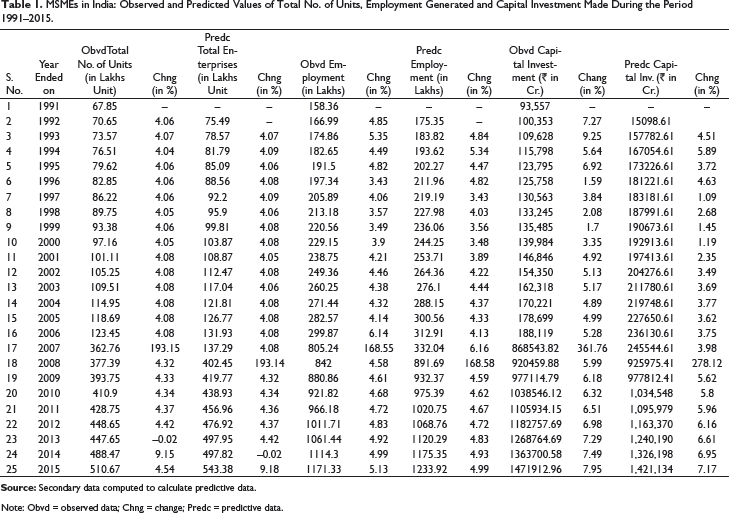
The growth of the capital investments made by the enterprises during the study period is highly dynamic in nature as shown in Table 1. The growth rate started from 1% during the initial years and reached to 7% during the later years. The maximum growth rate that was seen during the period of 2006 and 2007 can be contributed by the factor of merging of two separate Ministries, Ministry of Small Scale Industries and Ministry of Agro and Rural Industries into one umbrella called Ministry of Micro, Small, and Rural Enterprises in May 2007. The merger has been done under Government of India (Allocation of Business) Rules, 1961. The observed values shown in the Table 1 regarding previously determined three variables are obtained from different annual reports and predicted values are calculated from them by the method of simple seasonal trend analysis model.
Simple Seasonal Time Series Analysis of the Variables.
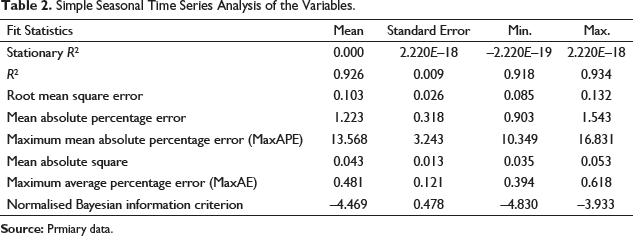
In Table 3, the null hypothesis has been tested as per the following condition:
H0 = No significant auto correlation present for the factors under consideration.
Test of Hypothesis.
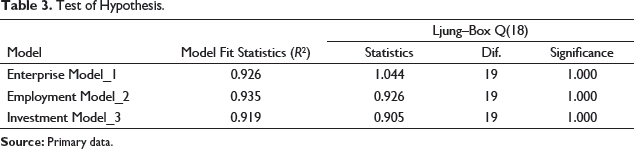
There is a controversy among the results of Table 3. It is shown in the table that as the significant value is one so, the null hypothesis has been accepted that states, there is no significant auto correlation present. But the data shown here prove that there is high correlation among all data. So, it can be inferred from the R2 values, which are closer to one, that the data is highly correlated.
5-Year Time Series Forecast (2016–2021).
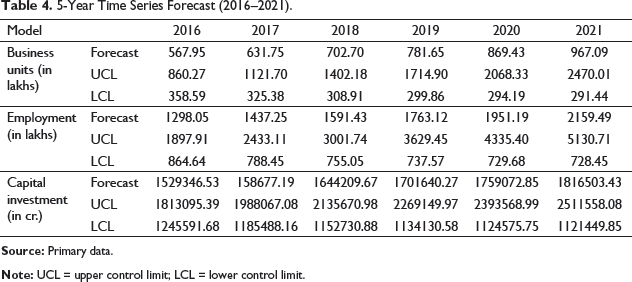
The above predictions are shown in Figures 1–3 for three separate variables which plots actual and predicted values:

Total Number of Units.
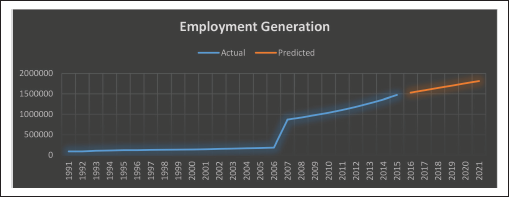
Employment Generated.
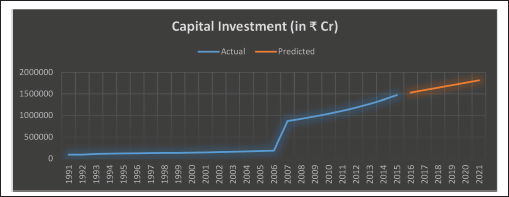
Capital Investment Made (in ₹ Cr.).
Conclusion
MSMEs can be seen as the driver of the growth for any developing countries and India is not an exception to this. They contribute to the growth perspective in terms of employment generation, development of rural areas, contribution to GDP, exploring indigenous products, import substitution, exports oriented units, innovative products and services and helping first generation entrepreneurs to start ups. This sector is labour intensive and is next to the agriculture sector in terms of employment generation activities. The Government of India has given this sector enough priority so that it can grow freely, from merging the rural sectors and SSI sector to policy freedom and considering the MSME lending of all types as priority sector lending. Every commercial banks, Non-Banking Financial Institutions and Small Industries Development Bank of India, all are eager to provide seed finance to working capital finance for this sector. These moves helped the MSMEs to leverage into all domains of activities including manufacturing and engineering. This also led the Make in India movement to a new dimension and the entrepreneurial activities reached a new level. Less dependency on imports and setting up of more export oriented units helped this sector to grow rapidly. The study indicated that in a stable economic and business environment, the capital investment can grow to 6%–7% and the number of units can grow to 4%–5%. The study is made depending on the assumption that the economic environment remains stable and based on the assumption it can be seen that the trend lines for all the variables are uprising.
Footnotes
Declaration of Conflicting Interests
Funding
The authors received no financial support for the research, authorship and/or publication of this article.