







Abstract
About 450 million of 1.2 billion Indians migrated within the country, according to recently released Census 2011 data. Of this, 78 million, or 15.6% of all domestic migrants, moved from rural to urban areas. This is how their numbers have changed over 2001 and where they moved.
Migrant workers show an enhancement in the occurrence of stern maladaptation to the host cities due to slaughter of social eminence, inequity and parting from the family. Several migrant workers are not entitled to avail of basic facilities such as education, social security, housing and medical benefits.
Using a resilience perspective, this study attempted to find out adaptive protective factors responsible for the resilience of migrant labour in the host city. Data was collected through an interview schedule by using a structured questionnaire on 240 migrant workers in the Tiruchirappalli district of Tamil Nadu. The questionnaire was constructed on demographic characteristics and different dimensions of adaptive protective factors such as structural adaptation, labour market competitiveness, opportunity for informal entrepreneurship, language acquisition and access to mobility on the seven-point Likert scale. By doing structural equation modelling (SEM) analysis and confirmatory factor analysis (CFA), it is found that favourableness in structural adaptation and opportunity for informal entrepreneurship stood out as the most predictive adaptive protection factors along with language acquisition, access to mobility and level of competitiveness in the labour market for migrant workers.
Keywords
Introduction
Migrant workers’ resilience can be considered as migrant workers’ capacity to adapt and respond to challenges in the host state environment. Urban towns are characterised by divided resilience owing to different socio-economic and infrastructural differences. Some cities are rich and some are less rich or have the lower economic condition (Vale, 2014). In India, there are different cities with different cultures, languages and food habits. For rural to urban migration, past studies depict that most of the migration takes place in short distances unlike in long distances. In recent years, data shows that migration has increased from North India to South India. This increment in migration is maybe because of rapid changes in transportation facilities, communication facilities and industrial facilities for workers which are more in southern cities. Most of the migrant workers are poor. In India, poverty is the main push factor in the migration process. Migrant workers who decide to move from north to south or rural to urban are below the poverty level (Skeldon, 2008). After entering into a different environment, these workers face many shocks such as different urban culture, language, food, clothing, way of behaviour and, most important, available employment in the host city. After entering into the new environment, questions arise about the resilience of this poor section of the society. Only when resilience is directly linked to the enhancement of the well-being of at-risk groups, for example, migrant workers in the informal sector, can it be deemed a progressive practice (Wu et al., 2018). These shocks can be said as risk factors for migrant workers. To reduce their vulnerability, migrant workers adopt some strategies to overcome the challenges they face after migration. These strategies work as protective factors. Some observed factors are easiness in access to mobility or transport facilities, level of competitiveness in the labour market and the opportunity for informal entrepreneurship. This article is about finding out those factors which consolidate protective factors and migrant workers’ adaptation to those protective factors.
Review of Literature
Migrant Workers and Resilience
A ‘migrant worker’ is described as someone who moves from one location to another (or has moved from one nation to another) to work for someone else (ILO, 2015). Internal migrant workers are individuals or groups of workers who have relocated to urban centres in other states or geographical regions of a country in pursuit of working on a temporary or seasonal basis. Migrant workers from rural to urban areas are generally engaged in low-wage, unskilled labour, which is characterised by low earnings, job instability and economic fragility (Choudhari, 2020). Although there is no universal agreement among academics on a particular definition of resilience, they all concur on the idea of resilience as a protecting characteristic adjacent to traumatic circumstances (Blanc et al., 2020). Regardless of discipline, resilience is distinct as the potential of an individual to bounce back after experiencing stress or risk factors. This definition assumes that stress or risk factors negatively affect the well-being of migrant workers (Mucci et al., 2020).
Relation Between Protective Factors and Resilience
Protective factors or determinants have been defined as situations that interact with risk factors to lessen the negative influence of the latter on the individual, avoiding the emergence of problem behaviour (Smith, 2006). Rutter (1987) defines resilience as follows: ‘Individual differences play a beneficial impact in people’s responses to stress and hardship’ (Reis et al., 2004). Resilience is defined as an assessment of protective factors (such as defensive capacities) that allow a theoretical estimate of an individual’s capacity to adapt to and resist psychological stress (Mokline & Ben Abdallah, 2021). ‘The significant protective factors are those that diminish the shock of menace, decrease the possibility of successive reactions, enhance confidence and self-ability, and escort to favourable outcomes’, according to Szerman (2006, p. 23). Variables are connected to the entity and its capital, factors linked to the dynasty surroundings, and factors associated with the extra-domestic social milieu (as well as the firm; Mokline & Ben Abdallah, 2021).
Adaptive Protective Factors for Migrant Workers in Urban Cities
Feeble family ties and community networks, occupation uncertainty, unsafe accommodation and poor hygiene, in addition to inefficient social fortification programmes, all contribute to the vulnerability of urban migrant workers (Santha et al., 2015). Migrant workers’ adaptation methods to climatic events and environmental hazards are firmly ingrained in the tactics that aid them to deal with their usual livelihood problems (Jaswal et al., 2015). Mobilisation, livelihood diversification, risk sharing and informal entrepreneurship are all strategies that assist migrant workers to maintain their livelihoods in the face of a variety of risks and uncertainties (Santha et al., 2015). Mobility, informal entrepreneurship, structural adaptation, labour market and language acquisition are some strategies followed by the migrant workers in the host cities for adaptation.
Objective of the Study
Following are the objectives of the study:
To develop a conceptual model for adaptive protective factors
To validate adaptive protective factors of migrant workers in the study area
Operationalisation of Variables and Hypotheses Formulation
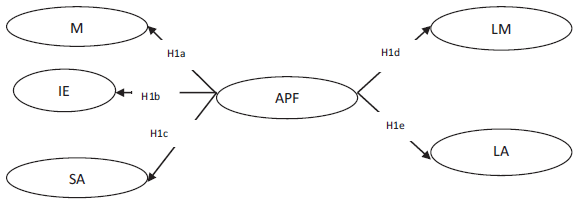
In the proposed research model, different adaptive protective factor dimensions have been proposed based on various literature reviews and empirical studies. In several studies, dimensions for adaptive protective factors have been taken in accordance with the challenges faced by the vulnerable population in a particular social context. While theorising the patterns of migration, King and Skeldon (2010) pointed out that individuals do not wander in the absence of access to mobility (transport facility). Access to mobility is a differentiating factor of migration (Rizvi et al., 2011). In many studies studying resilience in urban cities, transport facilities were found as an influential indicator (Panda & Mishra, 2018; Porst & Sakdapolrak, 2018; Tappe & Nguyen, 2019) while the study on adaptive social protective factors has taken mobilisation, livelihood diversification, risk sharing and informal entrepreneurship as dimensions (Santha et al., 2015). During the development of the theory for resilience, some researchers pointed out that structural adaptation is an important element of protective factors; physical and emotional comfortability and life support facilities such as free hospitals, schools and getting ration cards are some indicators (Michael et al., 2019; Porst & Sakdapolrak, 2018). In addition, language is a very important part of protective factors; language acquisition is a prominent indicator (Bhugra & Gupta, 2010; Ungar, n.d.; Wu et al., 2018). Magdalena Bigos has mentioned the relationship between the labour market and resilience; competitiveness in getting a job and the wage rate are important indicators from the worker’s point of view (Bigos et al., 2013). Based on literature review support, the following hypotheses and conceptual model (Figure 1) are postulated:
H1a: Mobility is a significant determinant of adaptive protective factors.
H1b: Informal entrepreneurship is a significant determinant of adaptive protective factors.
H1c: Structural adaptation is a significant determinant of adaptive protective factors.
H1d: Labour market is a significant determinant of adaptive protective factors.
H1e: Language acquisition is a significant determinant of adaptive protective factors.
Methods and Analysis
Methodology
The researcher has applied descriptive design to explain about the population. Simple random sampling is adopted with a sample size of 240 respondents, covering only Tiruchirappalli district. As the respondents were migrants, the researcher has administered a structured questionnaire with 36 statements. The respondents were migrant workers in the unorganised sectors and informal workers at different shops in the Tiruchirappalli district of Tamil Nadu. From 22 September 2021 to January 2022, 240 migrant workers had been interviewed. It was a scheduled interview. The researcher conducted the interview using a structured interview schedule. The questionnaire was pretested with 20 respondents. In addition to the demographic information, the final questionnaire included 36 questions based on feedback (i.e., 3 questions on ‘mobility’: M1—I am comfortable in moving from one place to another, M2—I am facing problem in transportation and M3—Transport facility is available all time; 2 questions on ‘informal entrepreneurship’: IE1—I am allowed to open my shop or some work according to my skill and IE2—I feel there is more opportunity to start my own business; 3 questions on ‘structural adaptation’: SA1—I feel comfortable to live here, SA2—I feel physically and emotionally comfortable and SA3—I can get ration card easily; 3 questions on ‘language acquisition’, LA1—I take help of my friends in communication with colleagues, LA2—My colleagues help me in communication at my workplace and LA3—My contractor helps me in communication; 2 questions on ‘labour market’: LM1—I feel less competition in getting job opportunity in this city and LM2—I am satisfied with the wage rate of this market). The remaining 23 questions were for demographic data such as the name of the state, area (migrated from), duration of stay (in host city), migrated with, age (years), gender, religion, community, education, type of family, marital status, primary language known, household income, employment status, job type, house provided by, health facility provided by, my neighbour belongs to and transport facility provided by. The responses were calculated employing a seven-point Likert scale that ranged from strongly disagree (1) to strongly agree (7). After data collection through a structured questionnaire, SPSS 21 and AMOS 21 were used for factor analysis and structural equation modelling (SEM).
Factor Analysis
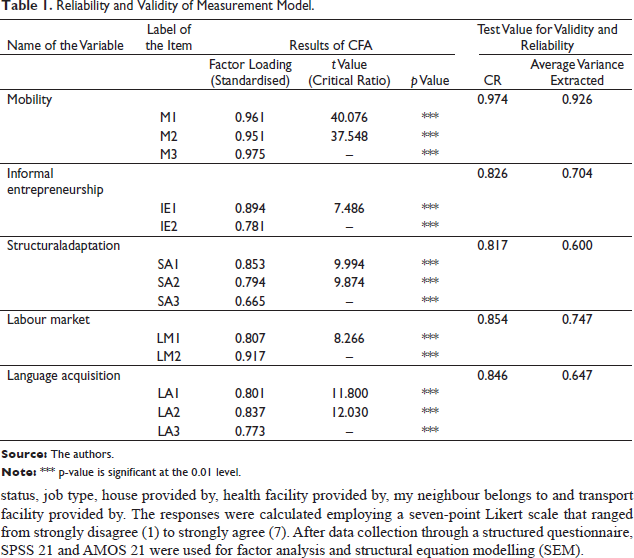
This research study used a two-step method in the SEM approach. During the first step, the evaluation of the ‘measurement model’ was completed by assessing the ‘reliability and validity of latent constructs’ with the help of confirmatory factor analysis (CFA). Further, the SEM tool was tested in the second stage to examine the postulated relationships among hidden constructs in the research model (Table 1).
Reliability and Validity of Measurement Model.
Model Fit Indices for the Measurement Model
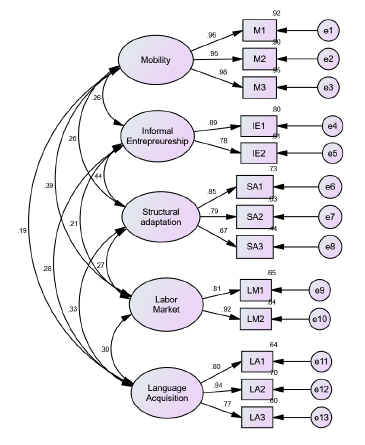
Factor loading less than 0.70 was considered as a threshold value for good CR (composite reliability of the constructs; Anderson et al., 2014). Factor loading for all latent variables was more than 0.70 (Figure 2). The result of the measurement model depicted that the chi-square value for the absolute fit measure was 119.584 with df = 55 being significant at p < .001. The chi-square/degree of freedom value was 2.174, less than the threshold value of 3. It illustrates that the model is fit. The scores for other model fit indices, that is, GFI = 0.931, AGFI = 0.886 and CFI = 0.969 have obtained the required value. RMSEA = 0.070 is less than the cut-off criteria. Therefore, measurement model is fit, based on the evidence of model fit indices measurement and fitted with data.
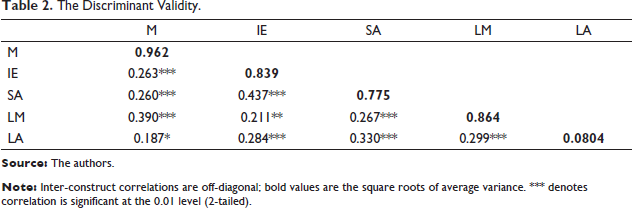
Discriminant Validity of Measurement Model
In Table 2, it is depicted that all value for correlation between two constructs is lower than their respective AVE values. Furthermore, in this investigation, the square root of AVE values performed the inter-correlation constructs. The square root of AVE is implying a high level of discriminant validity for all latent construct.
The Discriminant Validity.
SEM Analysis and Testing of Hypotheses of Variables
In this study, SEM is an analytical approach used for evaluating the validity of postulated relations between variables. SEM is used to analyse the hypothesised relationship once the measurement model has been evaluated (Anderson et al., 2014). The structural model is assessed using a set of fit indices, with the same measured fit statistics used in the CFA model evaluation.
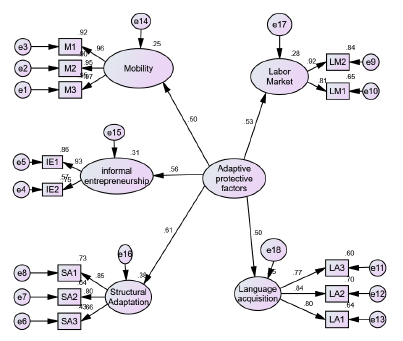
Figure 3 depicts the total structural model. The statistical appropriateness of the structural model signifies that a chi-square value was obtained by satisfactory fit statistics. Chi-square value is 133.655 (df = 60) and is significant (p < .001). The CMIN/df ratio is 2.228, lower than the required cut-off value of 3. All parameters for model fit indices of absolute fit measures (RMSEA = 0.072, AGFI = 0.884, GFI = 0.924) and incremental fit measures (TLI = 0.954, CFI = 0.965, NFI = 0.938, IFI = 0.965 and CFI = 0.965) are included in the incremental fit measures. Required minimum cut-off values have been achieved by all fit indices as recommended by prominent authors (Anderson et al., 2014).
Standardised Path Coefficient for Hypothesised Structural Model
Following the evaluation of ‘model fit’ indices for both the ‘measurement model’ and the ‘structural model’, the latter model was used to investigate the potential link between latent variables. The SEM in this study was built using 13 elements from 5 distinct latent variables, including mobility (M), informal entrepreneurship (IE), structural adaptation (SA), labour market competitiveness (LM) and language acquisition (LA). The standardised regression path coefficient of the structural model is presented in Figure 3. All factor loading values are more than 0.70, showing that each item assesses its construct.
Results of Hypothesis Testing
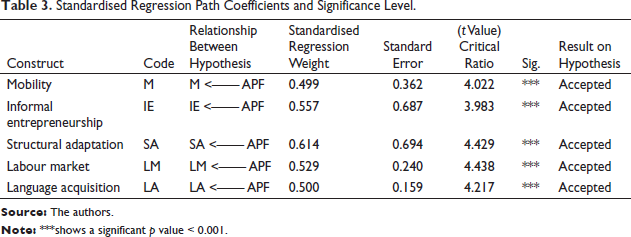
Hypothetical linkages should be investigated after assessing the model appropriateness of both the CFA and structural models. All the five latent variables and their path coefficients are statistically significant at p > .001, (t value) or critical ratio is higher than ± 1.96. All the proposed hypotheses, H1a, H1b, H1c, H1d and H1e are accepted and statistically significant at p < .001. The factors, namely mobility, informal entrepreneurship, structural adaptation, labour market and language acquisition, are significant determinants of the adaptive protective factors from the migrant workers’ perspective. The results indicate that mobility has significantly determined the adaptive protective factor, which is significant at the level of p < .001; t value = 4.022, β = 0.49. Informal entrepreneurship has significantly determined the adaptive protective factor, which is statistically significant found at p < .001, t value = 3.983, β = 0.557. Structural adaptation has significantly determined the adaptive protective factor, found to be at p < .001, t value = 0.614, β = 0.614. The labour market has significantly determined the adaptive protective factor which is found statically at p < .001, t value = 4.438, β = 0.529, and language acquisition has also been found to be a significant determinant of adaptive protective factor, at p < .001, t value = 4.217, β = 0.500 (Table 3).
Standardised Regression Path Coefficients and Significance Level.
Findings
The findings of SEM depicted that among five dimensions of adaptive protective factors, structural adaptation has been demonstrated to be a strong predictor of adaptive protective factors, followed by informal entrepreneurship, labour market, language acquisition and mobility dimensions in lowering migrant workers’ liability.
Conclusion
The objective of the study was to identify adaptive protective factors which facilitate migrant workers in reducing their vulnerability to the new challenging environment. For this purpose, collected data have been analysed. It is observed that structural adaptation and informal entrepreneurship are major predictors of adaptive protective factors, followed by labour market competitiveness, language acquisition and mobility. The findings can assist policymakers in building and consolidating their focus on building resilient migration policies which could help in promoting all these adaptive protective factors.
Footnotes
Declaration of Conflicting Interests
The authors declared no potential conflicts of interest with respect to the research, authorship and/or publication of this article.
Funding
The authors received no financial support for the research, authorship and/or publication of this article.
