







Abstract
This study examines the relationship between work satisfaction and human resources (HR) results, as well as the impact of human resource management (HRM) practices (career planning, job security, technical training, decentralised decision-making and internal promotion) on business success. One-way analysis of variance (ANOVA) and hierarchical regression analysis are used on a sample of 250 workers in Rajasthan, India’s textile sector. The study’s results indicate that company performance and the recently developed construct of HRM practices are positively correlated. Moreover, the relationship between HRM practices and company performance is somewhat mediated by HR outcomes and job satisfaction. The study highlights how crucial employee satisfaction is to improving organisational results. The study has substantially contributed to our comprehension of HRM procedures in the Indian textile sector. Companies should monitor and raise employee job satisfaction levels and put appropriate HRM practices in place.
Keywords
Introduction
According to Gallardo-Gallardo et al. (2013), there are two types of theoretical perspectives on talent: ‘Object’ perspectives, which include natural ability, mastery, commitment and fit; and ‘subject’ perspectives, which include talent as all persons and talent as some people. It is essential for organisations to value their human resources (HR) in order to remain competitive. The VRIN qualities (essential, unusual, inimitable and not interchangeable) are thus present in HR (Barney, 1991). Human resource management (HRM) practices are implemented in organisations with the ability to impact employee behaviour, abilities, attitudes and motivation (Kuvaas, 2008). Furthermore, rather than focusing on certain HR practices that are employed separately or independently, strategic HRM (SHRM) takes a broader approach to bundles of HR practices that are implemented together (Lepak & Snell, 2002). According to Miles and Snow (1984), some HR procedures might be centralised or standardised for all workers, while others might be customised to fit the particular requirements of particular employee groups. This approach allows organisations to balance consistency and flexibility in managing their workforce. Organisations can ensure fairness and efficiency across the board by centralising and standardising certain HR practices, such as payroll and benefits administration. On the other hand, tailoring HR practices for specific employee groups, such as training and development programs for different job roles, acknowledges the diverse needs and preferences within the organisation, ultimately fostering employee engagement and satisfaction. High-performance work practices, including recruitment, compensation and training, can enhance employee knowledge, skills, motivation, shirking and retention and encourage non-performers to leave the firm (Huselid, 1995).
Authors have worked on the link between HRM practices and firm performance for years, taking a resource-based view (RBV) as a base (Fey et al., 2000; Gooderham et al., 2008; Huselid, 1995; Iqbal et al., 2019; Wright et al., 2003). However, much effort has not been put forth to show how HR practices genuinely affect workers’ abilities or behaviours or how these things relate to any performance metrics. But, as of yet, no study has even come close to illuminating the causal model that explains how HR practices are supposed to affect company performance. On the other hand, the set of HRM practices considered has been different for different studies. Nevertheless, studies have incorporated career planning, job security, decentralised decision-making and internal promotion in HRM practices and have studied their influence in the non-Western context.
Scholars have shown great interest in how HRM practices influence individuals’ attitudes, behaviour, motivation and skills (Kuvaas, 2008; Marescaux et al., 2012). They further impact the motivation, retention, commitment, work engagement and turnover intentions of individuals in the organisation, which in turn dramatically affect the firm’s performance (Arthur, 1994; Guest, 1997; Marescaux et al., 2012). However, there is no literature on HRM practices’ influence on HR outcomes in the non-Western context. Since an individual’s behaviour is influenced by their attitude, which in turn influences their happiness level, the company’s performance is ultimately affected (Luna-Arocas & Tang, 2004). This study examines job satisfaction’s role in the relationship between the newly formed bundle of HRM practices and firm performance.
Three topics from previous studies are expanded upon in this article. It uses specific HRM techniques, such as decentralised decision-making, internal promotion, job security and career planning. Second, it uses a different study methodology to reveal the connection between HRM practices and company performance. Third, it provides a conceptual framework that makes clear the impact of HRM practices on the success of the organisation.
As stated below, the topic’s introduction and the motivation supporting the research’s conduct are addressed in the section ‘Introduction’. The literature review is highlighted in the section ‘Literature Review’. The section ‘Overview of the Construct’ outlines the research approach that was employed. The results of the research are suggested in the section ‘Results’. The study’s conclusion is presented in the Section ‘Conclusion’. Finally, the limitations and practical implications are highlighted in the Section ‘Implication and Limitations of the Findings’.
Literature Review
RBV
Resources are defined by Wernerfelt (2007) as any resource that could be seen as a firm’s strength or weakness. Along with intangibles like intellectual property, human capital and brand reputation, resources can also comprise tangibles like real estate, machinery and money. The competitive edge and capacity of a company to meet its strategic goals are largely determined by these resources. Given the growing recognition of internal resources as sources of competitive advantage, HR has increased the legitimacy of its assertion that employees are strategically essential to a company’s success (Wright et al., 2001). Given the need to conceptually justify the value of HR and the tendency of the SHRM field to adopt concepts and theories from the more significant strategy literature, it should therefore be logical that the RBV of the organisation is integrated into the SHRM literature (Wright et al., 2001). Barney’s work in 1991 highlighted the essential qualities needed to achieve a sustainable competitive advantage, which led to the theory’s popularity in strategy and other relevant literature. This groundbreaking framework provided a comprehensive understanding of the factors contributing to long-term success in the competitive business landscape. RBV holds that a company’s resources—which are unique, precious, difficult or impossible to duplicate, and complex to replace—are the source of its sustained competitive advantage (Barney, 1991). HR procedures give businesses a competitive edge, and RBV makes a compelling case (Wright et al., 2001). According to the RBV theory, HRM initiatives produce skilled labour, giving businesses a competitive edge (Wright et al., 2001). This results in higher operating performance, profitability and higher stock prices.
Moreover, Hart (1995) expanded the RBV theory with a natural resource-based perspective. In this perspective, the relationship between the environmental issue and company resources is operationalised through three interrelated strategic capabilities: Sustainable development, product stewardship and pollution prevention. Nonetheless, the majority of empirical research evaluates just two variables, concentrating on HR performance and practices. Thus, the purpose of this study is to determine how HR outcomes and job satisfaction mediate the relationship between the performance of the organisation and the developed set of HRM practices.
Overview of the Construct
HRM Practices
HRM is the set of rules and procedures needed to carry out the daily tasks related to HR in a company, including hiring new staff, developing existing workers, managing performance, setting salaries and promoting employee participation in decision-making. Wright et al. (1994) believed HR practices shape employee views, attitudes and behaviours. The authors argued that when HR practices are aligned with organisational goals and values, they can positively influence employee engagement, job satisfaction and overall performance (Delaney & Huselid, 1996; Pfeffer, 2005). Businesses may build a productive and successful work environment that supports employee growth and development by putting into place efficient HRM procedures. Five HRM practices that have been identified based on the work of Fey et al. (2000) and Huselid (1995) are listed below.
Career Planning
Career planning is an essential process that helps individuals set goals and make informed decisions about their professional future. Individuals can gain clarity about their aspirations by engaging in career planning and developing a strategic roadmap to achieve their desired outcomes. Additionally, career planning enables individuals to stay proactive in a rapidly changing job market by identifying emerging trends and acquiring the necessary skills and knowledge to remain competitive (Marescaux et al., 2012).
Technical Training
By acquiring technical training, individuals can enhance their employability and increase their chances of securing rewarding job opportunities. Moreover, staying updated with the latest technological advancements through specialised training allows individuals to adapt to evolving industry demands and stay ahead in their careers (Marescaux et al., 2012).
Decentralised Decision-making
It empowers individuals to make informed decisions based on their expertise and knowledge, leading to more efficient and effective problem-solving. Additionally, decentralised decision-making fosters a sense of ownership and responsibility among employees, who are trusted to make decisions that directly impact their work (Gooderham et al., 2008). This improves job satisfaction and promotes innovation and creativity within the organisation.
Job Security
Job security creates a sense of stability and peace of mind, allowing employees to focus on their work and contribute to the growth and success of the company (Fey et al., 2000; Ichniowski et al., 1995).
Internal Promotion
Employees who receive training and develop skills become eligible for internal promotion opportunities. Internal promotion also fosters a positive work culture, demonstrating that the organisation values and rewards employee growth and development (Fey et al., 2000). This provides them with career advancement and motivates other employees to pursue training and improve their skills.
HR Outcome
HR outcomes encompass various areas, such as employee retention, motivation, development, work engagement and organisational commitment (Fey et al., 2000). By analysing HR outcomes, organisations can identify areas for improvement and make informed decisions to enhance their HRM practices (Iqbal et al., 2019). HR outcomes also play a crucial role in attracting and retaining top talent, as employees are more likely to be attracted to organisations with positive HR outcomes that prioritise their well-being and development.
Job Satisfaction
‘Job satisfaction is an affective (i.e., emotional) reaction to a job that results from the incumbent’s comparison of actual outcomes with those that are desired’ (Cranny et al., 1992). Job satisfaction is essential to employee well-being and can significantly impact performance and motivation. Various factors influence it, such as the fulfilment of expectations, the level of autonomy and recognition, and the alignment between personal values and organisational culture.
Firm Performance
Financial performance is a company’s market efficiency, affecting its financial stability or health (Fey et al., 2000). Standard measures include revenue, return on equity, return on assets, profit margin, sales growth, capital adequacy, liquidity ratio and stock prices. These measures provide insights into how well a company utilises resources and generates profits. Financial performance indicators are crucial for investors and stakeholders to assess a company’s overall health and potential growth.
Hypotheses Development
HRM Practices ↓ Firm Performance Relationship
A growing body of academic research has examined the relationship between HR practices and performance as businesses recognise the value of their human capital as a competitive advantage (Bowen & Ostroff, 2004; Ferris et al., 1998, 1999). The research has shown a positive correlation between HR practices and profitability (Delery & Doty, 1995; Huselid, 1995; Wright et al., 2003). Furthermore, Delaney and Huselid (1996) and Ichniowski et al. (1995) confirm the positive association between HRM practices and firm performance. Therefore, based on the literature, we conclude with the following hypothesis.
H1: There will be a positive relationship between HRM practices and firm performance.
HRM Practices ↓ HR Outcomes ↓ Firm Performance Relationship
According to Guest (1997), only when HRM outcomes are achieved can we expect behaviour change and higher performance. Furthermore, Ferris et al. (1998) and Huselid (1995) also support the significant association among outcomes and the behaviour of employees. Guest (1997), in his research, provides a framework that emphasises the importance of measuring HRM outcomes to understand its impact on performance. Edgar and Geare (2007) have supported the significant relationship between HRM practices and HR outcomes, which further affects firm performance. However, Arthur (1994) underlines the negative relationship between HR outcomes and firm performance with a given bundle of HRM practices. Accordingly, the hypothesis formed is as follows:
H2: HR outcomes significantly mediate the relationship between HRM practices and firm performance.
HRM Practices ↓ Job Satisfaction ↓ Firm Performance Relationship
According to Petrescu and Simmons (2008), HRM practices boost worker engagement, innovation and voice while also improving motivation and output at work. These practices foster a sense of ownership and commitment among employees (Hackman & Oldham, 1974; Wright & Cropanzano, 2000). Additionally, HRM practices that encourage open communication channels and involve employees in decision-making processes further contribute to their job satisfaction and motivation (Hauret et al., 2022; Petrescu & Simmons, 2008). Vermeeren et al. (2014) state that the mediating role of job satisfaction in the association between HRM and firm performance is influenced by a stimulating leadership style. Therefore, we propose the following hypothesis:
H3: Job satisfaction significantly mediates the relationship between HRM practices and firm performance.
HRM Practices ↓ HR Outcomes ↓ Job Satisfaction ↓ Firm Performance Relationship
Studies (Huselid, 1995; Kuvaas, 2008; Petrescu & Simmons, 2008; Wright et al., 2001, 2003) have supported the positive association between HRM practices and firm performance. As per Guest (2004), employees given flexible working conditions, fair opportunities and compensation have a high chance of being satisfied with their jobs. Supporting this, Marescaux et al. (2012) provide evidence that satisfaction plays a role in mediating the positive association between HRM practices and HR outcomes. Job satisfaction also mediates the relationship between HRM practices and performance (Vermeeren et al., 2014). Therefore, the hypothesis formulated is as follows:
H4: HR outcomes and job satisfaction sequentially mediate the relationship between HRM practices and firm performance.
Method
Participants
This study aims to ascertain whether work happiness and HRM practice characteristics in Rajasthan, India’s textile region, impact business performance. The information for this study was gathered via a standardised questionnaire distributed to 950 workers from 12 textile industries in 2023. We travelled to the textile mills in four important Rajasthani cities—Jaipur, Ajmer, Jodhpur and Bhilwara—to highlight the nation’s northwest. The questionnaires were sent out using email addresses provided by alliance officials. The survey received 250 responses from employees across 12 industries, translating to a response rate of roughly 26 per cent. Each indicator is rated on a Likert scale from 1 (strongly disagree) to 9 (strongly agree). The researcher used a validated descriptive study design. Today’s analysis includes connections to pages with survey questions distributed online and links to polls. A sample of up to 250 employees was taken by proportionally choosing 25 competent individuals randomly from each organisation once a superior employee was selected based on the employer’s choice. Table 1 displays the following traits of the respondents.
Demographic Profile of the Respondents.
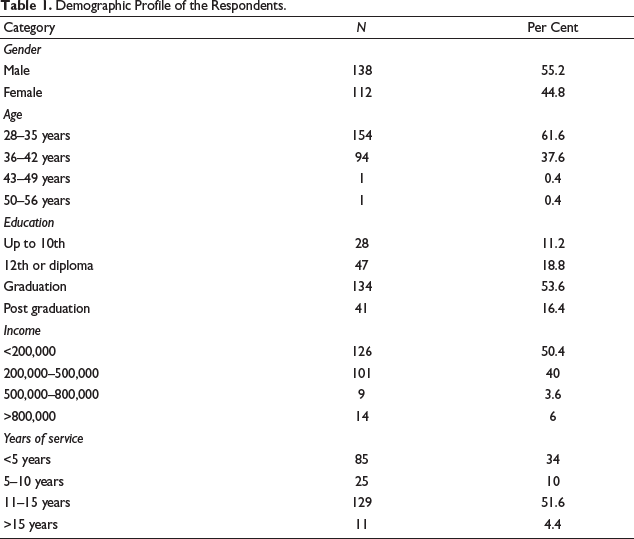
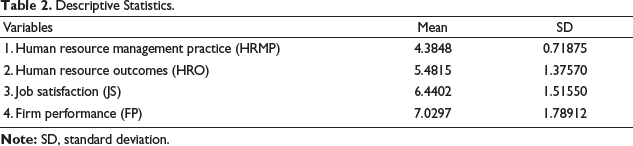
Table 2 displays the data after it has been analysed with SPSS software to produce a descriptive summary of all the main comments made on the study’s variables. For appropriate research and comparison, the mean was divided by the sum of the questions for each kind. Data were gathered using a nine-point Likert scale. Each statement was rated 1–9, with the more unfavourable replies SA signifying strongly disagree (1) and strongly agree (9), respectively. High mean values are more beneficial in this comparison. As a result, when the mean scores were compared, it was discovered in Table 2 that the industry personnel scored favourably for constructs including HRM practice, HR outcomes, job satisfaction and firm performance.
Descriptive Statistics.
Measures
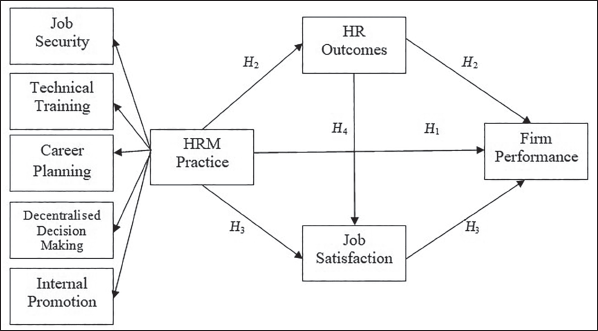
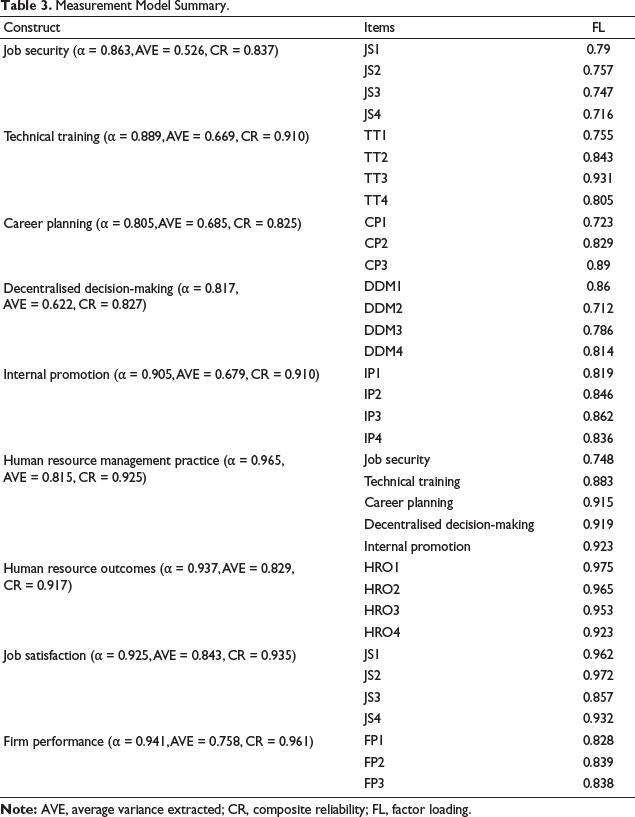
Based on earlier measures, three elements were used to gauge the company’s success (Delaney & Huselid, 1996; Youndt et al., 1996). A four-item scale was used by Delaney and Huselid (1996) to quantify HR outcomes (Dessler, 2019; Robbins & Judge, 2019). A four-item scale was used to measure job satisfaction. Based on a thorough analysis of the HRM literature, a list of things was made to define the HRM practices that organisations embraced. The measure of perception of progressive HR practices was developed for this study, even though it was based on past research (Huselid, 1995). In the survey, respondents were questioned on their perceptions of the practices and the extent to which their business had employed each of the following HRM strategies. We used regression and hierarchical regression analysis to examine the data and assess the suitability of the proposed hypothesised model shown in Figure 1. We first performed a confirmatory factor analysis (CFA) to determine the model’s validity and reliability. After computing the entire model, the hypotheses were evaluated. The evaluation of the measurement model involved CFA. Before assessing the hypotheses, the measurement model should have acceptable validity and reliability. Cronbach’s alpha and composite reliability (CR), the standard metrics for evaluating the dependability of the measures, were applied in this inquiry to test the measures’ trustworthiness. The Cronbach’s alpha for each variable and the CR should be 0.7 or above for optimal reliability. Table 3 shows that the values for Cronbach’s alpha ranged from 0.80 (for career planning) to 0.96 (for HRM practice).
Measurement Model Summary.
Procedure
One-Way Analysis of Variance (ANOVA) for Verifying Significant Effect of Demographic Profile on Study Main Construct
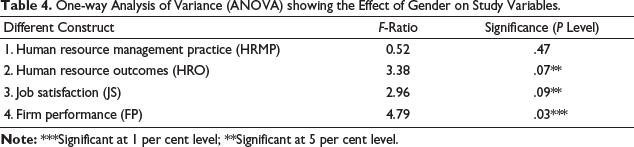
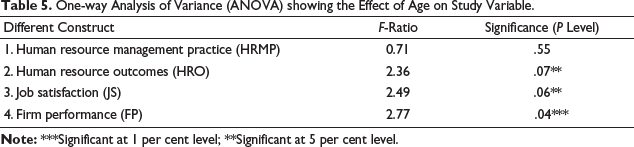
This portion of the data analysis shows the ANOVA performed on all employee replies from the textile industry regarding all sample profile analysis factors. ANOVA was used since the effects of each parameter were examined independently. The impact of gender and age on the study constructs employed in the current analysis is shown in Tables 4 and 5. This characteristic did not alter any research elements other than company performance, according to an ANOVA examination of gender and age. It is the only construct that is significant at the 5 per cent level.
One-way Analysis of Variance (ANOVA) showing the Effect of Gender on Study Variables.
One-way Analysis of Variance (ANOVA) showing the Effect of Age on Study Variable.
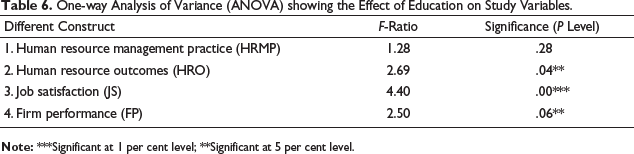
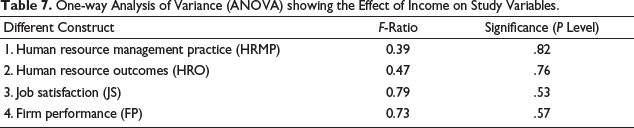
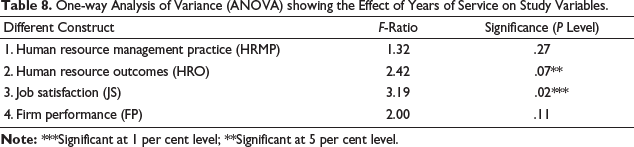
Additionally, it was noted from Table 6 that, except for HRM practice and firm performance, education had a significant impact on HR outcomes and job satisfaction. Table 7 displays the findings from applying ANOVA to ascertain the cause-and-effect relationship between the constructs and the income. The other research variables barely changed as a result of payment. Variations in sample income answers did not affect the textile industry when it came to the other research components. Table 8, which exhibits the one-way ANOVA data extracted using SPSS-23, displays the effect of the years of service on each of the study’s seven components. The number of years of experience had no impact on other components except job satisfaction.
One-way Analysis of Variance (ANOVA) showing the Effect of Education on Study Variables.
One-way Analysis of Variance (ANOVA) showing the Effect of Income on Study Variables.
One-way Analysis of Variance (ANOVA) showing the Effect of Years of Service on Study Variables.
Results
Research Hypotheses Test through Linear Regression Analysis
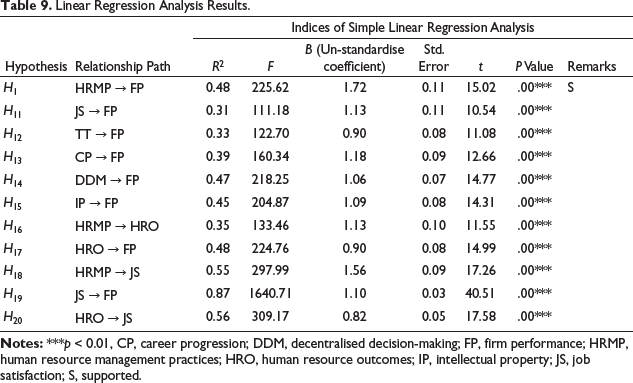
The outcomes of the linear regression analysis are presented in Table 9 in this portion of the study report. With recently collected primary data, Figure 1 describes empirically verified hypotheses for accuracy. All HRM practices were highly significant predictors of HR outcomes, job satisfaction and company success, as shown in Tables 9 and 10. The regression analysis findings at the 1 per cent level suggest that the hypotheses are true. Regression analysis was used to test the H1, which was whether the direct effects of HRM practices are the key factors influencing business performance. Results from Table 9 indicate that HRM practices and all other sub-constructs (adjusted R2 = 0.38, F = 225.62, p < .05) have contributed towards the R2 value. Based on the R2 value of 0.48, these facets of HRM practice could explain 48 per cent of the variation in performance.
Linear Regression Analysis Results.
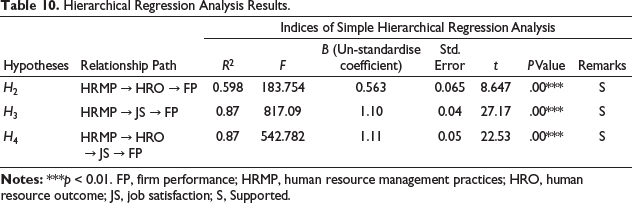
Hierarchical Regression Analysis Results.
Research Hypotheses Test through Hierarchical Regression Analysis
The results of the hierarchical regression analysis (Table 10) indicate a substantial role for HR outcomes and job satisfaction in mediating the relationship between the HRM practice sub-dimensions and firm performance. H2–H4 was acceptable, according to the conclusion drawn. The association between HRM practice and firm performance was shown to be somewhat mediated by HR outcomes and job satisfaction since both the direct and indirect effects were significant. Employees in the textile business were shown to be more sensitive to this effect.
Conclusion
The findings presented in this study offer compelling evidence that HRM practices play a pivotal role in influencing business performance through a comprehensive analysis of empirical data and the hypotheses related to HRM practices, HR outcomes, job satisfaction and company success. According to the regression analysis, these findings exhibit a strong link between HRM practices and firm performance.
The linear regression analysis results emphasise the importance of HRM practices as powerful drivers of HR outcomes, job satisfaction and firm performance. The regression analysis’s extremely low p values (p < .01) highlight the statistical robustness of these results, further validating the assumptions. According to the estimated R2 value, HRM practices and their sub-constructs account for over half of the variance in employee performance. This demonstrates the substantial impact of HRM practices on overall business performance.
Furthermore, the hierarchical regression analysis sheds light on the function of HR outcomes and job satisfaction in mediating the association between HRM practices and business performance. The findings reveal that HR outcomes and job satisfaction mediate this link, providing a deeper understanding of how HRM practices influence firms’ performance. These findings become significant in the textile sector, where employees are inclined to be particularly sensitive to the effects of HRM practices. In essence, this research adds to our understanding of the vital significance that HRM practices play in determining HR outcomes, job satisfaction and company performance, emphasising the need for good HRM in the business sector.
Implication and Limitations of the Findings
Practical Implication
The research results have important real-world implications for organisations, particularly in HRM and business performance optimisation. These implications can be applied in a real-world context to optimise HRM practices and improve company success. The study underscores the critical importance of well-implemented HRM practices. Organisations should prioritise the development and execution of SHRM policies to enhance HR outcomes, job satisfaction and overall business performance. As HRM practices are shown to influence employee performance significantly, businesses should invest in employee training, skill development and motivation strategies. Developing a highly skilled and satisfied workforce can improve performance and business success. Understanding the mediating role of HR outcomes and job satisfaction in the relationship between HRM practices and firm performance is crucial. Organisations should actively measure and manage HR outcomes and job satisfaction to indirectly impact business success. The research highlights the industry-specific effects of HRM practices, with the textile industry being exceptionally responsive. Other sectors should consider tailoring their HRM strategies to align with their specific workforce and business context. The study demonstrates the power of empirical data and rigorous analysis. Organisations should embrace data-driven decision-making in HRM to enhance the predictability and effectiveness of their practices. Given the dynamic nature of HRM practices and their impact on business performance, continuous monitoring and adaptation of HRM strategies are essential. Regularly assessing HR outcomes, job satisfaction and business performance can help organisations stay responsive to changing conditions.
In conclusion, the research findings underscore the pivotal role of HRM practices in shaping business success and provide a roadmap for organisations to leverage HRM strategies effectively. By adopting these practical implications, companies can enhance their HR practices and, in turn, their overall business performance, leading to a competitive advantage in the contemporary business landscape.
Theoretical Implication
The theoretical implications derived from the findings of this research hold significant academic importance, shedding light on the intricate dynamics of HRM practices and their impact on various aspects of business performance. These implications extend our theoretical understanding of HRM and its consequences on HR outcomes, job satisfaction and overall company success. The research substantiates the theoretical framework, suggesting that HRM practices are key determinants of business performance. The strong and statistically significant relationships observed in the regression analyses confirm the theoretical underpinning that effective HRM practices substantially influence HR outcomes, job satisfaction, and, ultimately, firm success. This adds to and enhances current literature on the crucial role of HRM in organisational performance. The understanding that HR outcomes and job satisfaction mediate the relationship between HRM practices and a firm’s performance adds to the theoretical framework. This emphasises the necessity of comprehending the mediating mechanisms via which HRM practices exert influence. HRM theoretical models must include these mediating elements to provide a broader understanding of the processes at work. According to the findings, the consequences of HRM practices on business performance vary by industry, as indicated by a higher level of sensitivity among workers in the textile industry. This theoretical insight emphasises the importance of an integrative approach to HRM research that considers industry-specific aspects. Developing theoretical models should compensate for such impact differences dependent on industrial circumstances. The study’s findings show that the sub-constructs of HRM explain a significant amount of the variance in worker productivity and performance. According to this conceptual knowledge, academics and practitioners ought to further investigate the distinct components of HRM practices to comprehend their individual and collective contributions to performance results. This study’s theoretical implications improve our understanding of the complex linkages between HRM practices, HR outcomes, job satisfaction and business performance. They contribute to the academic development of HRM by emphasising the role of mediating variables specific to industries and the finer features of HRM practices in explaining variances in company success. These findings can help guide the advancement of theory and empirical study on the subject, improving our understanding of the complicated relationship between HRM and organisational performance.
Limitations of the Findings
Although this study gives helpful perspectives into the association between HRM practices and many dimensions of firms’ performance, a few constraints should be observed while interpreting the findings. The study’s concentration on a single industry, the textile sector, may limit the study’s generalisability to other industries. Multiple results could arise from differences in organisational structures, staff qualities and cultural environments across industries. As a result, when extrapolating those results to businesses beyond the scope of the study, caution should be exercised. A cross-sectional methodology is used in the study, which captures a snapshot of the interactions at a particular point in time. The layout makes it difficult to prove causation or predict how these relationships will grow over time. A longitudinal approach would provide a more comprehensive understanding of the dynamic nature of HRM practices and their effects on business performance. The data collected in this study rely on self-reported surveys. Common method bias, where participants respond in a socially desirable manner, could potentially influence the results. Future research may benefit from combining survey data with objective performance metrics or utilising alternative data collection methods to mitigate this bias. While the study examines key factors, there may be additional variables not considered that could influence the relationships observed. Future research should explore other potential confounding or mediating variables to understand the dynamics involved comprehensively. While the sample size was adequate for the analyses, it may not have captured the whole range of organisational variety. A more extensive and more diverse sample could improve the findings’ generalisability.
In conclusion, these constraints emphasise the importance of exercising caution when extrapolating the study’s findings beyond the textile industry, as well as the opportunity for subsequent studies to deal with issues with methodology and further explore the complexities of HRM practices and their influence on business performance.
Footnotes
Declaration of Conflicting Interests
The authors declared no potential conflicts of interest with respect to the research, authorship and/or publication of this article.
Funding
The authors received no financial support for the research, authorship and/or publication of this article.
