







Abstract
This article attempts to bridge this gap by exploring the role of farmer-producer companies (FPCs) in fostering agripreneurship in Haryana, India. Through a mixed-methods approach, data on financial performance, market access and policies related to FPCs are used to conduct this analysis. Electronic national agriculture market (eNAM), a digital platform, improves income stabilisation directly by 18%, and the FPC members show income stability up by a tolerance of 25%–35%. Despite these advantages, regulatory hurdles, cost barriers and technology naivete are persistent problems. Targeted policy action is needed to support them, including regulatory streamlining, access to financial support systems and programmes that build the capacities of FPCs for their long-term sustainability.
Keywords
Introduction
Background and Rationale
Agripreneurship is known as adding a commercial perspective of entrepreneurship to agriculture (Singh & Singh, 2013) and has been acknowledged as a mechanism to ensure improved productivity, better market access and rural economic development. The self-help group (SHG) enables sustainable livelihoods through equipping farmers with the skills and resources as well as establishing market linkages that make them more profitable and reduce their dependence on subsistence farming practices (Kumari et al., 2021). Agripreneurship inspires the farmer to be self-reliant by creating innovation, value addition and linking into the modern supply chain.
Over 80% of the farming community in the country is made up of marginal farmers who have land holdings of less than 2 ha, according to a report released by NABARD (2022). Its overall performance is limited by access to formal credit, fragmented supply chains, as well as high input costs and weak market linkages (Verma et al., 2019). Smallholders lack economies of scale, limiting their ability to negotiate fair prices for inputs and outputs and are exploited by intermediaries. Consequently, the incomes of these farmers are volatile, their productivity levels are low and they are unable to invest in improved forms of agriculture (Govil et al., 2020).
Through the enactment of the farmer-producer company (FPC) under the Companies Act, 2002 (Mitra, 2015), the Indian government integrated cooperative principles of cooperatives and private enterprises’ efficient structures. FPCs facilitate ownership and management of agribusiness initiatives by farmers under professional management, financial autonomy, and market-oriented initiatives (Senthil Nathan & Palanichamy, 2021). Unlike conventional cooperatives, which often engender bureaucratic inefficiency and political intervention, FPCs are governed through a relatively transparent corporate governance structure (Sarkar & Sinha, 2021).
As a leading agrarian country in India, Haryana is an interesting state to study how FPCs are transforming the landscape of agripreneurship. Right-supportive infrastructure for agricultural activity, mechanisation rate and government advocacy for farmers’ collectives (NABARD, 2022). With the maximum number of FPCs, Haryana is an exception, as the state has a predominantly rural population dependent on agriculture and has implemented policies for financial inclusion and digital platforms like the electronic national agriculture market (eNAM) and agritech adoption (Dalwai Committee Report, 2017). To increase the accessibility of institutional credit, input purchase and direct market linkages to farmers, the state government has sponsored the establishment of FPCs, with the remote assistance of NABARD and SFAC (Michael et al., 2018).
Haryana FPCs: Enabling agripreneurship and rural livelihoods through economic resilience for marginal farmers. The study’s results offer evidence of the viability of FPCs as a sustainable agribusiness model, as is sought by evaluating the operational constraints, financial viability and policy interventions supporting these producer organisations.
Research Problem
While transnational corporations (TNCs) are the way to go for Haryana, the government has conducted a lot of programmes from time to time to promote FPCs; many of these organisations are still suffering from operational, financial and technological constraints. Although FPCs have emerged as a mechanism to facilitate agripreneurial growth, market access and financial inclusion, the impact of FPCs is varied and limited as different structural and external challenges have weakened the performance of FPCs (Govil et al., 2020).
Here are some family issues. The first one faced by FPCs in Haryana is financial instability. Many of these organisations have limited working capital, insufficient access to formal credit and are reliant on government subsidies (Mitra, 2015). FPCs owned by smallholders often do not possess the necessary financial literacy and business acumen to outcompete large agribusiness firms, causing them to be unable to sustain activities in competitive markets (Sarkar & Sinha, 2021). Moreover, bureaucratic formalities and stringent compliance requirements make small farmers reluctant to participate in producer organisations actively (Verma et al., 2019).
A major issue is low technology uptake. However, if agritech solutions are revolutionising agribusiness in a big way, from precision farming to digital marketplaces and blockchain-based supply chains, the adaptation among the state’s FPCs has been marginal (Michael et al., 2018). Farmers’ limited digital literacy, expensive initial investment costs and inadequate technical assistance are barriers to technology-driven agripreneurship (Senthil Nathan & Palanichamy, 2021).
In addition, market imperfections are still challenging the development of FPCs. Out of which, even with the assistance of government-supported e-marketplaces such as eNAM, a significant number of producer companies are struggling to negotiate a fair price; their products do not always standardise and they are not able to access high-value markets (NABARD, 2022). The presence of intermediaries and logistical constraints ultimately eat into farmers’ profit margins and their competitiveness in the national and global agricultural supply chains (Dalwai Committee Report, 2017).
In light of these pertinent challenges, this study seeks to analyse the impact of FPCs on promoting agripreneurship in Haryana. It aims to understand the role of FPCs in income generation, market efficiency and rural livelihood opportunities while also identifying policy measures, best practices and strategic solutions to address the long-term sustainability of such organisations.
Research Objectives
This research describes its objectives as follows:
To understand the legal and operational framework of FPCs in Haryana. To assess the economic implications of FPCs on smallholder farmers. To study challenges and best practices in agripreneurial development through FPCs.
Literature Review
Conceptual Framework of Farmer-producer Companies
Singh and Singh (2013) define a producer company as an institutional innovation through which farmers can come together and venture into agribusiness activities. In contrast to traditional cooperatives, FPCs are set up and registered under the Companies Act, 2002, which incurs limited liability and has the benefit of legal and financial independence (Mitra, 2015). Agripreneurship combines farm-oriented economic activities and the modern supply chain (Verma et al., 2019). Successful agripreneurship reduces dependence on subsidies, encourages value addition and promotes sustainable farming (Kakati & Roy, 2021).
Impact of FPCs on Agripreneurship
FPCs provide direct linkages to markets, reducing dependence on middlemen (Govil et al., 2020). Digital platforms like eNAM have further strengthened the market integration of FPCs (Michael et al., 2018).
FPCs facilitate collective bargaining for bank loans and government subsidies (NABARD, 2022). Case studies indicate that FPC members earn 20%–30% higher profits than non-members (Sahu, 2021).
Some FPCs in Haryana leverage artificial intelligence (AI), Internet of Things (IoT) and blockchain for precision farming (Senthil Nathan & Palanichamy, 2021). However, many struggle with low technological adoption due to a lack of skills (Verma et al., 2019).
Research Methodology
Research Design
This study follows a mixed-method approach, integrating both quantitative financial analysis and qualitative insights. The mixed-method approach allows for a comprehensive understanding of how FPCs contribute to agripreneurship while identifying key challenges and best practices (Creswell, 2014).
Data Collection Methods
Primary Data
Surveys and focus group discussions (FGDs) with 100 farmers and 10 FPC managers to gather firsthand insights into the operations, profitability and challenges of FPCs.
Case studies of both successful and struggling FPCs in Haryana to compare agripreneurial performance.
Secondary Data
Review of government reports from SFAC, NABARD, the Ministry of Agriculture and previous academic journal articles to provide contextual and policy-related insights.
Financial statements of FPCs to analyse their profitability, financial stability and sustainability.
Data Analysis Techniques
Descriptive statistics using SPSS and Excel to analyse financial performance metrics such as revenue growth, profit margins and return on investment (ROI).
Thematic analysis using NVivo for qualitative data from interviews and FGDs, identifying recurring themes related to operational challenges and agripreneurial impact.
SWOT analysis to assess the strengths, weaknesses, opportunities and threats in the FPC model, providing strategic recommendations for improving agripreneurial outcomes.
This methodological framework ensures a holistic evaluation of FPCs in fostering agripreneurship while addressing key research questions effectively.
Findings and Discussion
Economic Impact of FPCs
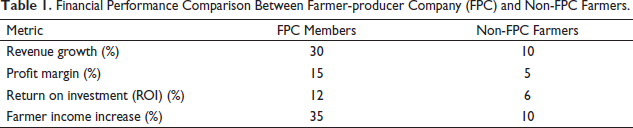
Low-income members of Federally Qualified Health Centres report income instability 25%–35% lower than non-members. This has been credited to direct access to markets, decrease in reliance on intermediaries and better price realisation on their produce (Govil et al., 2020). FPCs also had the most economically notable advantage of being integrated with eNAM, which increased profitability through better price discovery and access to a larger base of buyers by 18% (Michael et al., 2018). In addition, the potential for sustainability in terms of market feasibility and profit margins in Haryana with organic farming and export markets was higher than the adoption of FPCs engaged in the conventional agriculture (NABARD, 2022). Table 1 compares financial metrics between FPC and non-FPC farmers, highlighting the income and profitability benefits associated with FPC membership.
Financial Performance Comparison Between Farmer-producer Company (FPC) and Non-FPC Farmers.
Challenges Identified
However, there are a few major challenges that FPCs in Haryana are currently facing:
Regulatory burden: A lot of FPCs have to deal with complicated compliance processes such as tax returns, governance systems and licensing (Mitra, 2015). Funding issues: Due to inadequate collateral and credit history, only 40% of FPCs are funded by banks (Sahu, 2021). Skill gaps: A large fraction of farmers in FPCs are digitally illiterate, unable to leverage e-commerce platforms and fintech solutions to their advantage (Verma et al., 2019).
Technology Adoption and Its Challenges
While Haryana has seen high levels of membership in FPCs, technology adoption has been slow, with many barriers, including financial constraints, lack of digital literacy and inadequate infrastructure. Although technology in the form of precision farming, IoT-enabled supply chains, and blockchain for traceability can revolutionise agribusiness, a majority of FPCs are unable to integrate such solutions.
Digital and Technological Integration
Limited access to digital tools: Many farmers do not have smartphones or reliable internet access to enable them to use digital marketing platforms, including eNAM and agritech applications.
Limited agritech training: Very low usage of AI-based weather forecasting, automated irrigation systems and remote sensing technology due to a lack of awareness and technical skills.
Blockchain and traceability issues: While some FPCs have piloted blockchain-based supply chains, scalability remains a challenge due to high implementation costs.
Infrastructure Barriers
Cold storage and processing limitations: Many FPCs lack access to cold chain infrastructure, which restricts their ability to store and process perishable produce effectively.
Logistical constraints: Poor transport networks and high fuel costs increase operational expenses, reducing competitiveness in national markets.
Case Study Insights on Technology Adoption
A comparative study of GreenHarvest FPC in Haryana and MahaAgri FPC in Maharashtra highlights key differences:
MahaAgri FPC, with government-backed digital literacy programmes, successfully integrated AI-driven soil testing, resulting in a 15% higher crop yields. GreenHarvest, while implementing blockchain traceability, faced technical bottlenecks in scaling the model beyond niche organic markets.
Policy Recommendations for Technological Adoption
Financial incentives: Subsidies or low-interest loans to FPCs for technology adoption.
Digital literacy programmes: Government and private partnerships to train farmers on digital supply chains, fintech solutions and IoT-based farming.
Public–private collaborations: Encouraging agritech startups to partner with FPCs for customised solutions.
By overcoming these barriers, Haryana’s FPCs can enhance their competitiveness, improve farmer incomes and foster long-term agripreneurship sustainability.
Farmer Engagement and Social Factors
Policy Implementation Gaps: A Comparative Analysis
Haryana has made significant advancements in supporting FPCs, but due to several operational issues, there still exist potential challenges in the effective implementation of the policy. Comparing the situation with Maharashtra, one of the states with one of the most successful FPC ecosystems, could provide some insights. Table 2 provides a comparative overview of the support ecosystem for FPCs in Haryana and Maharashtra.
Financial Support Mechanisms
In Haryana, FPCs primarily rely on financial assistance from government schemes and institutions like the National Bank for Agriculture and Rural Development (NABARD).
With improved access to working capital loans and microfinance in Maharashtra, FPCs have been able to reduce their dependency on government grants.
Infrastructure and Market Linkages
FPCs here are more in touch with agritech startups and export markets, leading to better price realisation.
But despite the advantages of eNAM and other technologies, Haryana’s FPCs remain plagued by logistics issues and a lack of cold storage.
Vulnerability of Regulatory Facilitation and Governance Support
We have a single-window clearance system in the course of registering FPC and tax filings in Maharashtra which eliminates a lot of administrative delays.
Such compliance bottlenecks are often faced by the Haryana’s FPCs and discourage smallholder farmers from either forming FPCs or expanding FPCs.
However, these initiatives have met challenges.
Maharashtra operates state-supported incubation centres that offer training in business development, digital marketing and financial literacy. There are only limited structured training available in Haryana, resulting in a skill gap in finance and management among FPC members.
Comparing Haryana’s Farmer-producer Company (FPCs) with Maharashtra.

Case Study: Success of GreenHarvest Farmer-producer Company in Haryana
Background
GreenHarvest FPC was established in 2017 in Karnal, Haryana, with an initial membership of 200 smallholder farmers. The company focused on collective input procurement, direct market linkages and value-added processing of wheat and mustard crops. Supported by NABARD and the Haryana State Agricultural Department, GreenHarvest aimed to improve farmer incomes by reducing dependency on middlemen and leveraging economies of scale.
Financial Growth of GreenHarvest FPC
Revenue growth: GreenHarvest reported a 35% increase in revenue over 5 years.
Profit margins: Improved from 8% to 18%, primarily due to direct sales through the eNAM platform.
ROI: Recorded at 14% annually, driven by bulk procurement discounts and efficient logistics.
Farmer income growth: Members saw an income rise of 40%, compared to non-members in the region, who experienced only 12% growth.
Key Strategies Implemented
Market integration: GreenHarvest linked farmers directly with retailers and food processing industries, thus ensuring better price realisation to farmers by removing the middlemen.
Value addition: Set up small-scale mustard oil extraction unit helped farmers to earn additional profit of 25%.
Technology adoption: Leveraged blockchain-based traceability platforms for organic wheat, achieving 20% price premiums in niche urban markets.
Financial inclusion: Collaborated with SBI for working capital loans at low interest for stable quarters devoid of any reliance on subsidies.
Impact on Farmers
Higher profitability: Farmers selling through GreenHarvest earned ₹8–₹10/kg more compared to local mandis.
Risk mitigation: Introduced crop insurance partnerships, reducing financial losses due to weather fluctuations.
Skill development: Conducted regular training sessions on financial literacy and agri-business management, increasing farmer participation in decision-making.
Challenges and Lessons Learned
Regulatory compliance: Initial struggles with tax and licensing requirements were mitigated through legal consultancy partnerships.
Scaling operations: The need for more cold storage and processing units was identified as a future growth area.
Farmer awareness: Regular workshops and exposure visits helped enhance trust in the FPC model.
GreenHarvest FPC is an exemplar of agripreneurship in Haryana, showcasing how collective action, technological innovation and financial inclusion lead to significant improvement in farmer incomes and business sustainability. It exemplifies the potential of scaling successful FPCs through government support, private partnerships and digital transformation.
Policy Recommendations
To enhance the effectiveness of FPCs, the study recommends the following policy interventions:
Regulatory simplification:
Learn to cut compliance costs and reduce legal requirements for small FPCs. Single-window clearance for FPC registrations and tax filings.
Capacity building:
Conduct training programmes for farmers on financial literacy and digital marketing. Set up incubation centres for agripreneurs to facilitate business planning and implementation.
Infrastructure development:
Invest in cold storage facilities, food processing units, transport subsidise us to reduce the post-harvest losses. Launch public–private partnerships (PPPs) for rural supply infrastructure development.
Overcoming these challenges will nurture agripreneurial growth and increase farmer income, while promoting sustainability in rural agriculture for the FPCs in Haryana.
Farmer Engagement and Social Factors
Financial and regulatory elements of FPCs are important, but social dimensions are integral to their success as well. There are several factors that influence farmer participation and engagement in FPC models:
Awareness and intent to adopt by farmers:
More specifically, they believe that many smallholders are not yet convinced of the advantages that accrue from membership in FPCs because of a lack of awareness and historical reliance on traditional supply chains. Grassroot-level awareness generation by outreach through agricultural extension agencies and peers success stories can enhance participation.
Gender inclusion in FPC leadership:
While women have a prominent role in agricultural activities, their representation in FPC decision-making is marginal. Training, programmes and incentives targeting women-led FPCs can be important enablers of inclusive agripreneurship.
Cultural and social barriers:
Leadership within FPCs tends to be inaccessible to farmers from disadvantaged communities. Emphasis on developing inclusive membership policies and equitable decision-making structures as a way to create a more representative and sustainable FPC ecosystem.
Qualitative themes from focus groups and interviews:
Interviews with GreenHarvest FPC members found that trust-building and transparent governance are the keys to increasing farmer participation. Need for mentorship programmes involving experienced agripreneurs to guide new FPC members.
Conclusion and Future Directions
Based on the analysis, FPCs have been integral to promote agripreneurship, empower rural economy and to build multiple economic resilience in the state (Haryana). FPCs have been able to add 25%–35% stability to income, provide direct market access such as through eNAM, and increase profit margins for farmers who practise organic farming or want to enter foreign markets. But, those achievements were accompanied by multiple challenges such as regulatory burdens, financial constraints and lack of skills among smallholder farmers.
Policy interventions to reinforce the effectiveness of FPCs are essential. Streamlining compliance requirements and setting up a one-point clearance system will reduce regulatory bottlenecks. Also, capacity-building programmes on financial literacy, digital marketing and agribusiness management will empower farmers to use e-commerce and digital platforms effectively. Also, investment in cold chain, food processing units, transportation subsidies and so on can minimise post-harvest losses and increase value-addition opportunities.
Future studies need to be comparative and based on FPCs existing in Punjab, Maharashtra and Gujarat, specifically looking at variations in policy, success modelling and economic impact. Further, studies should examine the role of technological adoption, financial sustainability and the long-term impact of FPCs on local agripreneurial ecosystems to bolster agripreneurial frameworks within FPCs. Moreover, understanding technology adoption, financing mechanisms and market integration strategies can inform the potential of FPCs as sustainable business models for marginal farmers. Recognition of the existing challenges, along with policy-driven solutions, can help make Haryana’s FPCs full-fledged agribusiness enterprises, contributing to long-term rural economic growth and enhancing livelihood resilience of smallholders.
Footnotes
Declaration of Conflicting Interests
The authors declared no potential conflicts of interest with respect to the research, authorship and/or publication of this article.
Funding
The authors received no financial support for the research, authorship and/or publication of this article.
