







Abstract
This article attempts to study the effect of the employment nature of handloom weaver households on their income and socio-economic status (SES) in Western Odisha. This study is based on primary data collected from weaver households in selected sample villages of Bargarh and Subarnapur districts. The field survey was conducted in 390 weaver households from September 2022 to February 2023. Descriptive statistics and analysis of variance (ANOVA) are used to analyse the primary data. The study shows that weaver households’ income and SES are poor and low, and the different nature of their employment strongly affects their income and SES. Weaver under a master weaver earns the lowest, and their SES is also the lowest in the handloom sector in the study area. However, relatively independent weavers earn better, and their SES is higher than those working under master weavers and cooperative societies in Western Odisha. The study recommends that the government provide loans and credit facilities to weavers to enable them to work independently and ensure the proper functioning of the cooperative society to increase its effectiveness.
Keywords
Introduction
The handloom sector in India represents the artistic skill of handloom weavers and the culture of rural areas, offering employment to over 35 lakhs of weavers and allied workers (Ministry of Textiles, 2019). As it is one of the largest economic activities after agriculture, the handloom sector plays an important role in preserving the traditional skills of artisans and supporting livelihoods in rural and semi-urban regions. However, despite having cultural significance and large-scale employment potentialities, the sector remains informal, with weavers encountering financial constraints, poor working conditions, low remuneration and a lack of government support (Dash et al., 2020). Even the faster growth of the Indian economy did not ensure the conditions of weavers to improve; rather, it remains same, and in many cases, their conditions are deteriorating (Mohapatra & Raha, 2012). The Government of India as well as the Government of Odisha have initiated programmes to improve the social and economic conditions of weaver households. The Government of India programmes such as the National Handloom Development Programme (NHDP): Concessional credit/Weaver MUDRA Scheme, NHDP: Scholarship component and the Government of Odisha programmes such as Mukhyamantri Bayan Odisha Jyoti Yojana (MBJY) and Mahatma Gandhi Bunkar Bima Yojana (MGBBY) did help weaver households to some extent, but they were inadequate to bring a transformational improvement in socio-economic conditions of handloom weavers in Odisha.
The socio-economic situation of handloom weavers in Odisha is influenced by social, economic and technological factors. The handloom sector of Odisha, known for its complex Sambalpuri ikat fabric, faces significant challenges that impact its weavers’ livelihood and social status. Weavers in Odisha experience acute financial constraints, with many unable to afford modern machinery or improve their working conditions. In addition, the lack of technological competence and inadequate infrastructure pose major barriers for weavers, limiting their productivity and market reach (Das & Paltasingh, 2023). Similarly, a significant portion of handloom weaver households are multidimensionally poor, with deprivation in health, education and living standards (Meher et al., 2024). These weavers face numerous socio-economic challenges. Many are dissatisfied with their earnings despite the high market price of their products, primarily due to the exploitative role of intermediaries in the marketing process (Das, 2021). Further aggravating the issue is the high prevalence of micronutrient deficiencies among the weavers, with both men and women exhibiting low intake of essential vitamins and minerals in Odisha (Rani, 2023). This article intends to analyse the effect of the employment nature of weaver households on their socio-economic conditions in Western Odisha.
Literature Review
Socio-economic Challenges
Despite its economic contributions, the handloom sector faces numerous socio-economic challenges. Weavers are struggling with low incomes, poor living conditions, health issues and limited access to education and financial resources (Chinnu & Sheeba, 2021). Again, intermediaries are exploiting the handloom weavers (Das, 2021). It is to be noted that social networks and cooperatives play a crucial role in shaping economic outcomes for handloom weavers. The rural handloom textile industry in Bihar highlights the influence of caste- and religion-based social networks in the economic dynamics of the handloom sector and its effects on the economic outcomes (Sarmistha, 2015). Many weavers struggle with low wages and insufficient income, which limits their purchasing power and ability to invest in better technology. With this, the rising cost of raw materials, such as yarn, further aggravates their financial difficulties (Roy & Chouhan, 2017). Weavers often work in poor conditions, which affect their health and productivity. Again, the handloom sector faces stiff competition from power looms and mill-sector textiles, which offer products at cheaper rates (Prathap & Naidu, 2015).
Technological Inadequacy and Impact of Globalisation
The handloom sector in India faces significant technological inadequacies and infrastructural challenges that hinder its growth and sustainability. Despite its rich cultural heritage and contribution to the economy, the sector remains largely unmodernised, relying on traditional weaving techniques that are labour-intensive and detrimental to the health of weavers. The lack of technological innovation and market access significantly hinders the productivity and competitiveness of the handloom sector. Banerjee and Chakrabarti (2020) point out that, despite high demand, the absence of technological advancements limits the productivity of the handloom sector in the Bishnupur region of West Bengal. Weavers primarily use outdated looms, leading to physical stress and health issues such as back pain and respiratory problems. Many weavers work in poor conditions, which are often congested and unhygienic, contributing to occupational health problems (Paul & Lakshmi, 2022). The lack of modern machinery and equipment limits productivity and innovation, making it difficult for handloom weavers to compete with their products in the global market. With this, there are insufficient legal protections for traditional skill-based knowledge and products, leaving weavers vulnerable to exploitation (Mishra et al., 2022).
Globalisation has intensified competition, pushing handloom weavers to adapt or face displacement (Scrase, 2009). Similarly, liberalisation policies of the 1990s have led to a reduction in government protective measures for handlooms, resulting in a contraction of the handloom industry and a shift towards power weaving. Historically, government policies have supported handloom weavers, but recent shifts towards liberalisation have reduced this support, worsened the weavers’ ability to sustain their livelihoods. The handloom sector, traditionally grounded in local cultures and communities, is now experiencing a decline in traditional garment demand, which threatens the cultural heritage associated with handloom weaving (Roy, 1998).
Women in the Handloom Sector
Women play a crucial role in the handloom sector in India, significantly contributing to both the domestic economy and cultural heritage. In the handloom industry, 77% of the workforce is women, primarily located in rural areas in mainland India, and in case of the Northeastern states of India, the handloom sector has a female adult workforce, which makes up 99% of the total adult workforce (Ramaswamy & Kumar, 2013). Women constitute a significant portion of the handloom workforce, particularly in rural regions, where they often manage both production and marketing (Barooah & Dedhia, 2015). Women artisans are vital in promoting sustainable handloom practices and local craftsmanship, often lead initiatives that enhance market reach through digital empowerment (Mehta, 2024). In the handloom sector, women often experience socio-economic vulnerabilities, including low income and limited access to welfare schemes. Many women being remain trapped in low productivity and poor well-being due to systemic barriers and a lack of capacity upgradation (Rao, 2022). Gendered social relations lead to inequalities, with women facing discrimination in market access and skill development opportunities (Rao, 2021). Women weavers in Mizoram face challenges such as scarce raw materials, inadequate looms and limited marketing avenues, which restrict their economic opportunities (Ramaswamy & Kumar, 2013). Bahuguna and Ramaswamy (2019) in their study on the Ladakh Women Cooperative society, illustrate that cooperative models can provide sustainable livelihoods and enhance socio-economic status (SES) for women through structured support and training.
Employment Challenges
Younger generations are reluctant to pursue handloom weaving as a career, opting instead for alternative employment opportunities (Suhag & Sharma, 2024). This threatens the survival and transmission of traditional weaving skills. Sustaining employment in the handloom sector in India requires a moral economy approach that emphasises cultural nationalism and commercial branding. In his studies, D’Costa found that capitalist progress often threatens traditional sectors, proposing that promoting the cultural and artisanal value of handloom products can attract niche markets willing to pay a premium for authenticity and craftsmanship. The West Bengal state initiative, Biswa Bangla, serves as a model for cultural branding and boosting demand for handloom products (D’Costa, 2022).
The Significance of the Handloom Industry in Western Odisha
Historically, the handloom industry has provided a livelihood to a significant section of the population in Western Odisha. Based on the Fourth All India Handloom Census, 2019–2020, the most significant number of weaver families earn their livelihood in this region, that is, 48%, or half, of the weaver population of Odisha, lives in Western Odisha. Next only to agriculture, handloom is the second most viable economic activity in the rural economy in the region. During the field study, it was observed that whenever someone visits a weaver village in Bargarh or Subarnapur district, where the concentration of the weaver population is higher, they can hear the sound tik-tak (musical sound of looms). A significant part of the population in the region depends on the handloom industry to earn their livelihood and run their families. The handloom industry in the Bargarh district significantly contributes to the local economy by providing employment and fostering regional and international recognition. Mishra and Das (2021), in their study, highlight how the Sambalpuri handloom in Bargarh District, Odisha, supports the local economy and brings national and international attention (Mishra & Das, 2021). Sambalpuri Bandha Saree and Fabrics has a Geographical Indication (GI) tag for its uniqueness, legal protection and to preserve the traditional skill and cultural heritage of Western Odisha.
Independent Weavers
These independent weavers own their looms, procure raw materials and sell finished handloom products directly to consumers in the local market or through intermediaries. Their autonomous status allows for creative freedom to innovate new artistic designs, which used to have the potential for higher earnings during favourable market conditions. However, they are also being exposed to significant market vulnerabilities, including fluctuating demand and unsteady incomes.
They typically operate within family units, where weaving skills are transmitted from generation to generation, and production activities are distributed among family members. This arrangement aligns with what the Legalist school might describe as ‘plucky micro-entrepreneurs’, who operate informally to avoid the costs and complexities of formal registration. However, their choice to remain informal is often driven by necessity and tradition rather than intentional regulatory avoidance. The socio-economic outcomes for independent weavers tend to include the potential for higher income but also come with greater instability due to market fluctuation, stronger preservation of traditional designs and techniques, limited social protection and formal benefits and higher levels of reported job satisfaction despite economic challenges. These characteristics reflect what Kanbur categorises as primarily category D informal workers—those inherently outside regulatory frameworks due to their size or nature of operation (Chen, 2012).
The Master Weaver System
The master weaver system represents a historically significant employment arrangement system in the handloom industry, characterised by hierarchical relationships between master weavers and their employed handloom weavers. Under this system, master weavers provide raw materials, designs and marketing support to weavers who work on a contractual basis. Two primary contractual arrangements exist within this system: ‘loan work’, where weavers take a loan in advance and repay it gradually through working under the master weavers, and the other is a direct payment system based on piece-rate production. Contract durations in this system vary widely from daily arrangements to long-term relationships exceeding 10 years. While master weavers provide financial stability through loans and consistent work orders, this operational system is often criticised for maintaining low wages and exploitation. This arrangement exemplifies what the structuralist school describes as ‘subordinated economic units and workers that serve to reduce input and labour costs’ for larger economic interests. The socio-economic profile of weavers employed under the master weaver system typically includes lower income levels, reduced entrepreneurial risk, limited profit potential, informal social protection through patron-client relationships and constrained creative expression. This arrangement creates what the structuralists view as ‘intrinsically linked’ formal and informal economies, with informal weavers being subordinated to the interests of larger market actors (Chen, 2012).
Cooperative Societies
Cooperative societies movements emerged as an alternative organisational structure following the independence of India, meant to eliminate intermediaries and maximise returns to weavers. The cooperative societies operate on a three-tier structure: primary cooperatives at the village level, regional cooperatives at the district level and apex cooperatives at the state level. Governed and regulated by elected committees, the cooperatives aim to distribute benefits more equitably among member weavers. The effectiveness of cooperative societies varies significantly across different regions, with success in states like Tamil Nadu contrasting with dysfunctional operations in other areas and states. When functioning effectively, cooperatives could provide weavers with more equitable profit distribution, stronger formal social protection through government-linked benefits, and enhanced market access through government procurement and exhibition opportunities. From a theoretical perspective, cooperatives attempt to address what Dualists identify as ‘imbalances between the population’s growth rates and modern industrial employment’ (Chen, 2012) by creating alternative economic structures that combine traditional production methods with modern organisational principles. However, their success depends on effective management, adequate capitalisation and supportive policy environments.
SES
The SES of handloom weavers refers to their position in society as determined by a combination of economic, social and demographic factors specific to their occupation. Most of the handloom weavers earn low and unstable incomes, with a significant proportion earning below ₹50,000 per annum, and very few could exceed ₹1 lakh per year (Panda & Bhuwania, 2022; Prathap & Naidu, 2015; Raju & Rao, 2014). The occupation of weaving is often hereditary, with many weavers working as independent weavers, under master weavers, or in cooperative societies. Their economic security varies depending on the nature of their employment (Khan, 2020; Raju & Rao, 2014). Most weavers possess only basic or secondary education, with very few attaining higher education (Khan, 2020). Many weavers live in poor housing, mostly in their joint family systems, with limited access to health care and basic amenities (Prathap & Naidu, 2015). Mostly, the handloom weavers belong to marginalised or backward communities, and weaving is often their primary or only source of livelihood (Khan, 2020).
Significance and Objective of the Present Study
Despite the significant economic contribution of the handloom industry to both the local and national economies in generating employment and creating livelihoods for lakhs of weavers in the country, the weavers’ households throughout the country, and particularly in the studied region, face problems such as low income, poor health, low SES and so on. The studies in Western Odisha have not focused on the nature of weavers’ employment and its effect on their income and SES, which could help to better understand the conditions of weavers in the handloom industry in the region. The present study empirically measures the income and SES of weaver households. It determines the effect of the nature of weavers’ employment on their income and SES in Western Odisha. In this way, the study tries to find out which category of weaver households, based on their nature of employment, earns better and enjoys a higher SES than other categories, and then suggests correct policy measures to improve the economic lives of weaver households.
Methodology
In this study, the nature of employment of weavers is categorised into three types, that is, independent weavers (weavers who buy the raw materials by themselves and do the whole process of production and marketing by themselves to earn their livelihood, weavers working under a master weaver (weavers who work under a master weaver as wage earners) and weavers working under a cooperative society (weavers who work under a cooperative society as wage earners).
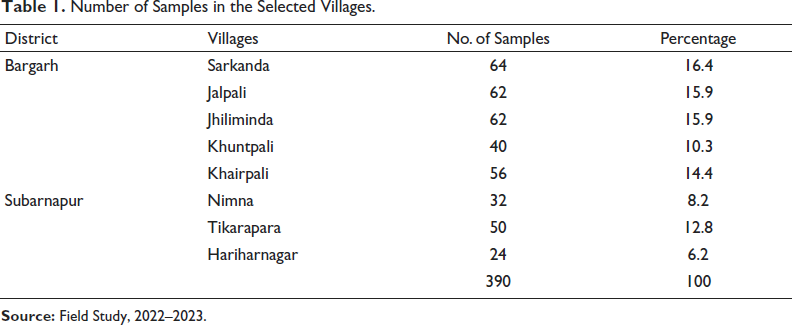
Based on the data source from the Fourth All India Handloom Census 2019–2020, the districts of Bargarh and Subarnapur constitute the highest number of handloom weaver households in Odisha. Therefore, the study has chosen the Bargarh and Subarnapur districts of Western Odisha for the field survey. Based on the highest number of handloom weaver households, Bijepur, Sohela, Bargarh, Attabira and Rajborasambar blocks were selected, and the following villages from each block, that is, Jalpali, Sarkanda, Khuntpali, Jhiliminda and Khairpali villages, were selected, respectively, in the district of Bargarh. Similarly, the same criteria applied to villages and blocks were selected in the Subarnapur district. In Western Odisha, the handloom weaving sector is dominated by weavers from the Other Backward Classes (OBC) category, and except for them, there are weavers from the Scheduled Castes (SC) category also, and other categories are not involved in handloom weaving in studied region; therefore, the study has chosen to collect data from these two categories to understand the role of caste in influencing the social and economic dynamics of weaver households in the industry. As the community-wise data on weaver household are unavailable in Odisha, the survey was conducted in both the OBC and the SC weaver households to have a comparative understanding. However, we did not find many weaver households from the SC community. The study used a simple random sampling method and a lottery method to collect data on handloom weaver households at the village level. The respondent was assured that their data would remain confidential and would be used only for research purposes. The empirical analysis is based on primary data collected from fieldwork conducted in Bargarh and Subarnapur districts, Odisha, from September 2022 to February 2023. The study used the Yamane formula to determine the sample size. The total weaver household population in Bargarh and Subarnapur districts is 20,800, and based on the formula, the sample size became 390 for the study. The number of samples from each district is taken based on their proportional population of weaver households in the total weaver household population. In the Bargarh district, five blocks have been selected, and one village from each block has been selected for data collection. A total of 284 samples have been collected from the Bargarh district, 64 in Sarkanda, 62 in Jalpali, 62 in Jhiliminda, 40 in Khuntpali and 56 in Khairpali. A total of 106 samples have been collected from the Subarnapur district, out of which 32 were collected from Nimna, 50 from Tikarapada and 24 from Hariharnagar (see Table 1).
Number of Samples in the Selected Villages.
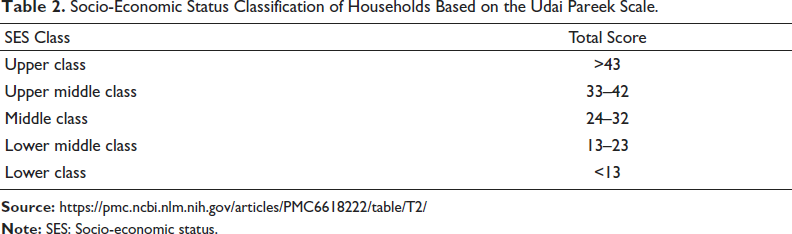
As there is no secondary data available for weavers based on their nature of employment, the study identifies the nature of employment of a weaver by asking the weaver directly in the field. The weavers mostly live in rural regions. Therefore, villages were selected for the field survey. The study used the updated version of the Udai Pareek Scale (Majumder, 2021) to measure the SES of weaver households because it was explicitly designed to measure the SES of rural people. And the Udai Pareek scale, which has nine indicators such as caste, occupation, social participation, house, farm power, education, land, material possessions and family members, can comprehensively measure the SES in the rural region, which has a higher number of indicators than any other scale. The study has used all nine indicators of measurement of the scale. To determine the SES of the weaver households, the scores of every individual for each of the nine indicators of the households were added to calculate the final score. A weaver household becomes upper class if its total score after summation becomes greater than 43, upper middle class if the total score is in between 33 and 42, middle class if the total score is in between 24 and 32, lower middle class if the total score is 13–23 and becomes lower class if the total score is lesser than 13 (see Table 2). This is the rationale behind choosing the updated version of Udai Pareek’s scale over other scales for the present study. The article has used statistical tools such as descriptive statistics, one-way analysis of variance (ANOVA), and Tukey honestly significant difference (HSD) test to analyse the data. The nature of employment of weaver households is categorised into three types, and one-way ANOVA is used to compare the mean of three groups to check if there is a real difference exists in the means to measure the effect, therefore the study has chosen one-way ANOVA for analysis and the rationale for using Tukey HSD for post hoc analysis is to get the pairwise comparison between group means. The study chose Tukey HSD over others because it helps to control type 1 errors and provides clear results that are straightforward to interpret.
Socio-Economic Status Classification of Households Based on the Udai Pareek Scale.
Nature of Employment of Weaver Households
The nature of employment is categorised into three types: independent weavers, weavers working under a master weaver and weavers working in a cooperative society in the handloom industry in Western Odisha. An independent weaver is the one who buys raw materials such as yarn and dyes from the market and then employs their household labour in the production process. After the fabric production is completed, they sell the product on the market. This is how they take the risk of market dynamics. There are weavers who work under a master weaver who are businessmen to earn wages. In this category, the master weaver provides them with the required raw materials, and the weavers produce the fabric with that. Then, weavers give the fabric to master weavers and, in return, earn wages. The third category of weavers is those who work in a cooperative society where the society provides the required raw materials to weavers, and in return, weavers produce the product to earn wages. Here, society takes the risk of selling the product in the market. As the handloom industry is a household industry, women play a crucial role in the production process, especially in allied activities. During the field survey, it was observed that in a significant number of sample households, women in the workforce are the lead weavers and perform most of the production-related activities. They encounter socio-economic challenges at the time of marketing, and it is the men who mostly go to the market or to get a wage.
Income Based on the Nature of Employment
The income of weaver households from weaving activities is low throughout India and in Western Odisha as well. Because of this, weavers cannot afford to have a decent material life and they face economic hardships and challenges in their day-to-day lives. The handloom industry is a household industry where all family members work together in the production process of fabric from early morning to late at night, every day, without having any paid leave. The income or wages they receive from it are the income for the whole households, in other words, the per capita income for every adult worker is very low based on the number of hours and efforts they give every day.
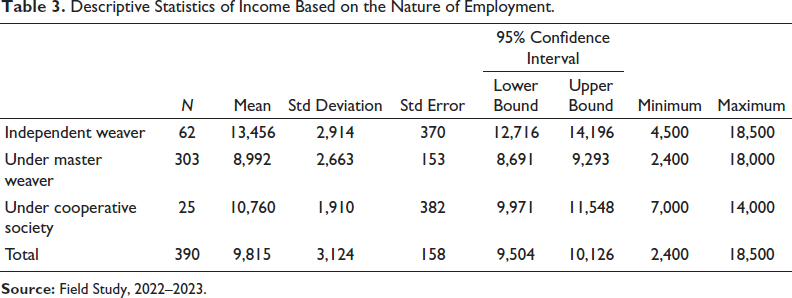
Table 3 presents that independent weavers earn the higher average income per month compared to the other two groups of weaver households in Western Odisha, implying continuous innovation of new designs and taking market risk brings more income to weaver households, given the condition that they have the fortune to access market. In the sample, there are only 62 independent weaver households; all are from Bargarh district, and none are from Subarnapur district. This is because there is a handloom market in Bargarh district, whereas in Subarnapur district, there is no handloom market, and the market in Bargarh district is very far from them. Therefore, the weavers from Bargarh district can access the market, but the weavers from Subarnapur district do not have the fortune to access the handloom market. This inaccessibility to the handloom market becomes the biggest hurdle on the path of weavers from the Subarnapur district to becoming independent weavers. The largest number of sample weaver households, that is, 303 in both districts, work under master weavers for wages. The weavers in this category earn the lowest monthly average income compared to the other two groups, implying that master weavers exploit the weavers largely by taking advantage of the weavers’ weaknesses in this category. The weavers in the Bargarh district reported that, though they can access the market and want to work as independent weavers, they cannot do so because of their poor financial capital, whereas some weavers in the Subarnapur district reported they also want to work as independent weavers, but that is simply not possible for them because of the absence of a market in the district, and the cost of raw materials is beyond their reach. The weavers who work under a cooperative are the lowest in the sample. There are only 25 weaver households working for wages in this category, implying that most of the weavers’ cooperative societies in Western Odisha have stopped functioning. Their mean income is ₹10,760/- per month, which is higher than the mean income of a weaver working under a master weaver, and lower than that of an independent weaver, implying that a cooperative society gives more and fair wages to weavers for their work. In the field, many weavers said that they prefer to work in a cooperative society rather than under a master weaver, but because of the non-functioning of most of the societies in the studied region, they are forced to work under a master weaver.
Descriptive Statistics of Income Based on the Nature of Employment.
Intra-group Income Variation
The study finds that the variation of income within the group of independent weavers is highest compared to the other two groups of weavers, suggesting that, even though they are independent weavers, not all earn higher than the weavers who work under a master weaver, but the majority earn higher than the other two groups of weavers. Interestingly, the study found that all independent weavers belong to the OBC category, and none belongs to the SC category, implying that caste plays an important role in deciding the nature of employment of a weaver household. Even in those households where a woman is the head, she could not work as an independent weaver because of socio-economic challenges such as problems in accessing the market and a lack of adequate financial capacity. The number of adult workers in a weaver household and the skill of producing complex designs fabric with high yarn count together decides the price of a product in the market. In the independent weaver household category, the monthly income range is a minimum of ₹4,500/- to a maximum of ₹18,500/-, suggesting that income inequality exists within the group. The study found that in independent weaver households where the number of adult workers is less, and they lack the skill of producing complex designs, their monthly average income is less, and sometimes even lower than that of a weaver who works under a master weaver. On the other hand, in independent weaver households where the number of adult workers is high, and they can have the skill of producing complex designs with higher yarn count, they earn more, and most of their income falls near the maximum range in the group.
In the case of a weaver working under a master weaver, the variation of income within the group is also higher, implying the presence of income inequality in the group. The study found that the skill of producing complex designs and the demand for the product decides the wage per piece of cloth fabric. Those weaver households where a number of adult workers are more involved in producing complex designs with higher yarn count earn more compared to other weaver households where a number of adult workers are less involved and produce simple-designed fabric with lower yarn count. There are weavers who earn more than some independent weaver households because of the structure and nature of employment, that is, in this group, a weaver does not need to create new designs and does not get involved in many processes of production, which helps him in producing more number of pieces to earn more wages, whereas an independent weaver need to innovate new designs on a regular basis to be in the market and perform all the activities of the whole process of production, which requires efforts and takes time; therefore, the number of pieces they produce can sometimes be less than what a weaver under a master weaver can produce. But in the majority of the cases, the weaver under the master weaver earns less than an independent weaver. The range of income per month in this group is a minimum of ₹2,400/- and a maximum of ₹18,000/-. This is because there are many weaver households who are involved in the production of simple-design fabric only. Therefore, they earn less, and there are weavers who are more skilled and involved in producing complex designs with high-quality fabric; they earn more.
In the third category, where the weaver works under a cooperative society, the group’s income variation is low and the lowest across the three categories of weaver households. This implies that weavers earn more stable income and that income inequality is less in the group. The weavers in this category produce simple to medium designs of fabric but earn better and receive other benefits from a cooperative society. The income range is a minimum of ₹7,000/- to a maximum of ₹14,000/-, whose difference is not very big, implying a more stable and equal income that this category of weavers earns in a cooperative society.
Inter-group Income Variation
All sample weavers across the categories earn a subsistence income level in this unorganised sector, facing a lot of financial vulnerability. Though all weavers earn a very poor income, independent weavers still earn comparatively better than the other two categories of weavers, implying that working in different categories influences their income.
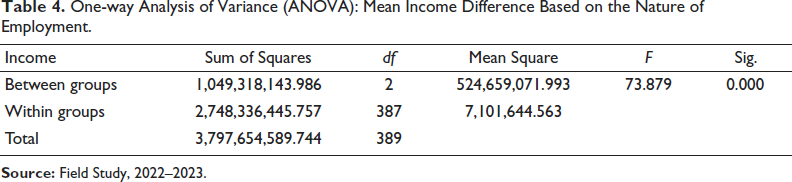
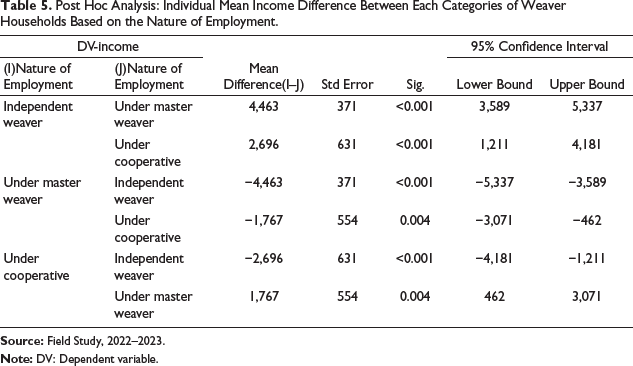
The test results in Table 4 concluded that there is a real difference in income between the three categories of weaver households in Western Odisha, implying that the nature of employment strongly influences the income of weavers. Table 5 presents the results of post hoc analysis conducted using Tukey’s HSD, signifying that the mean income difference between each category of weaver households based on the nature of employment is significant, implying that the nature of employment strongly influences the income of weaver households.
One-way Analysis of Variance (ANOVA): Mean Income Difference Based on the Nature of Employment.
Post Hoc Analysis: Individual Mean Income Difference Between Each Categories of Weaver Households Based on the Nature of Employment.
Independent Weaver and Weaver Under the Master Weaver (See Table 5)
The mean income difference between an independent weaver and a weaver under a master weaver is the highest in the sample, suggesting that in the handloom industry, an independent weaver earns more than the other two categories of weaver households, and the weaver under a master weaver earns the lowest.
Independent Weavers and Weavers Under Cooperative Society (See Table 5)
The mean income difference between these two categories of weavers is also significant, and the independent weaver earns more than the weaver in a cooperative society, implying that taking market risks pays more for the independent weaver.
Weaver under Cooperative Society and Weaver Under Master Weaver (See Table 5)
The mean income difference between a weaver in a cooperative society and a weaver under a master weaver is statistically significant, where the weaver under a cooperative society earns more than a weaver under a master weaver, suggesting that a cooperative society gives a weaver more just wages than a private master weaver, whose main motive is to earn profit.
SES
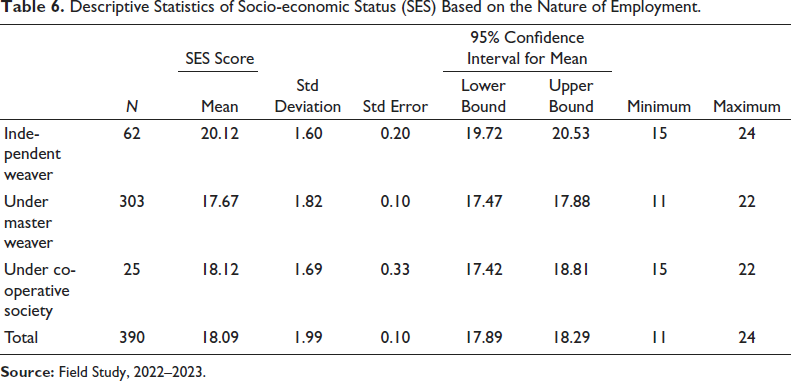
SES refers to a household’s relative social and economic position in relation to other households considered. It can be seen in Table 6 that the SES of independent weaver households is higher than that of the other two categories of weaver households, and SES of weavers working under a master weaver is at the lowest compared to the other two categories, and weavers working under a cooperative society stays at middle, indicating how the nature of employment influences the socio-economic position of a weaver household. As all independent weavers are from the OBC category and none are from the SC category, the association between caste and the choice of becoming independent is powerful. It plays an important role in deciding the SES of weaver households. On the other hand, all weaver households from the SC category work under a master weaver, indicating that weavers of this category are not in a position to choose to work as independent weavers, which hampers the improvement of their SES in the region. Similarly, all independent weaver households are headed by a male, and all the sample households that are headed by a female work under a master weaver, indicating how gender plays an important role in deciding the nature of employment in a weaver household. With higher incomes than the other two groups of weavers, independent weavers can build pucca houses, which improve their SES compared to weavers working under master weavers and cooperative societies. Interestingly, the study found that all independent weavers are from the Bargarh district. None are from the Subarnapur district, indicating that weavers from the Bargarh district have the fortune to access the handloom market located in the district. In contrast, weavers from the Subarnapur district do not have the fortune of accessing the handloom market, which plays a deciding role in choosing the particular nature of employment. Again, many cooperative societies have stopped functioning in the Subarnapur district. Therefore, weavers in the district are forced to work under a master weaver, who does not give them fair wages.
Descriptive Statistics of Socio-economic Status (SES) Based on the Nature of Employment.
SES: Intra-group Income Variation
Independent weavers, having the highest SES and lowest standard deviation in the sample, indicate that their economic lives are better, and the variation in the SES among weavers who work as independent weavers is less, which further suggests that their SES is more equal and on the same plane. The minimum and maximum values of SES for independent weavers in the sample suggest that they achieve the highest SES, and their SES is not as low as that of some of the weavers who work under a master weaver.
The largest group in the sample is weavers working under master weavers, and the weaver working in the group earns the lowest SES, whereas the variation in SES among weavers working here is the highest, highlighting that their SES is poor, and there is the presence of greater inequality among themselves that needs intervention. In this group, weavers of the SC category secure a lower SES than their OBC counterparts. Therefore, this generates more inequality among weavers in the group. The role of gender is also important in this group, as all female-headed households work under a master weaver in the group, which highlights various social challenges that women face in the industry. The statistical analysis can provide better inference about the social and economic dynamics of the weaver population due to the large sample size.
The SES variation among weavers working in a cooperative society is less. It stays between the other two groups of weaver households, implying that SES among weavers in the group is at a more equal level. Therefore, the inequality based on SES among weavers is less. Due to small samples, it is difficult to predict the SES of the handloom weavers of this group in the region.
SES: Inter-group Variation
All the sample weavers across the three categories fall in either the lower middle class or the lower class, implying that weavers in the handloom industry in Western Odisha live a subsistence life, do not have luxuries, and face economic hardship in their daily lives. Among the three categories of weavers, independent weavers earn the highest SES in the sample, whereas weavers working under master weavers earn the lowest SES, and weavers working under a cooperative society earn SES in between the two.
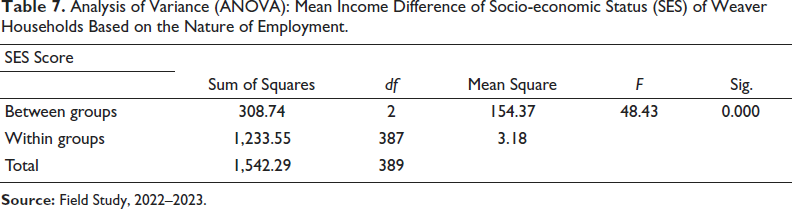
The test results in Table 7 infer a real difference in SES between the three groups of weaver households. It implies that the SES of independent weavers is highest as compared to the other two groups of weavers in the weaver population in Western Odisha, whereas the SES of weavers working under master weavers is lowest in comparison to the other two groups of weavers. The weaver’s SES in a cooperative society stays in the middle.
Analysis of Variance (ANOVA): Mean Income Difference of Socio-economic Status (SES) of Weaver Households Based on the Nature of Employment.
Independent Weavers and Weavers Under a Master Weaver (See Table 8)
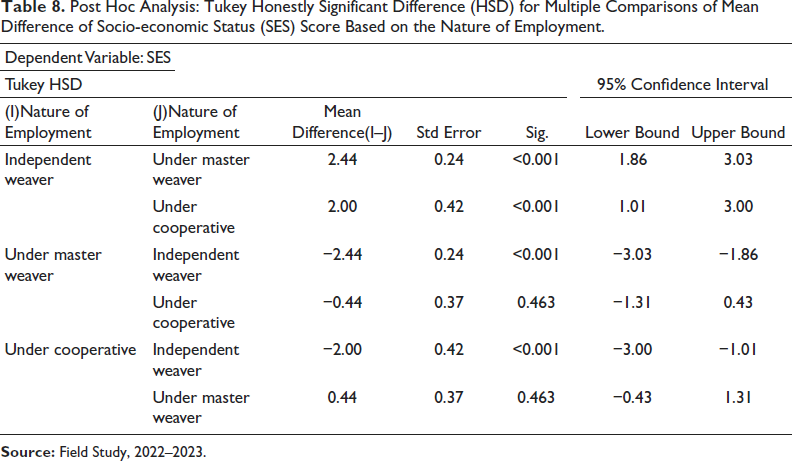
The difference in SES between independent weavers and weavers under a master weaver is the largest, implying that working as an independent weaver allows one to earn a higher SES. In contrast, they work under a master weaver as wage earners, their SES reduced to the lowest in the studied region. The higher income earned by independent weavers in the sample helps them improve their SES. In contrast, the lower income earned by a weaver working as a master weaver hampers the weaver from increasing their SES.
Post Hoc Analysis: Tukey Honestly Significant Difference (HSD) for Multiple Comparisons of Mean Difference of Socio-economic Status (SES) Score Based on the Nature of Employment.
Independent Weavers and Weavers Under a Cooperative Society (See Table 8)
The difference in SES between independent weavers and weavers working in a cooperative society is less in comparison to the difference in SES between independent weavers and weavers under a master weaver, suggesting that the SES of independent weavers remains at the top, and the SES of weavers working under a cooperative society remains in second position.
Weavers Under Cooperative Society and Weavers Under Master Weaver (See Table 8)
There is no real difference in SES between weavers who work in a cooperative society and weavers who work under a master weaver in the population, implying that working either in a cooperative society or under a master weaver does not affect the SES of weaver households. Though it does not affect the SES of weavers while working in any one category between these two, weavers still prefer to work in a cooperative society because they can earn a higher wage and a stable income than weavers under a master weaver, through which they can improve their SES.
Conclusion
Handloom weaver households across three categories suffer from low income and low SES in Western Odisha. Among all the categories, independent weavers are better than the other two categories of weavers in terms of income and SES. It is true that they face uncertainty and difficulties in the handloom market, but at the same time, they are also able to earn profits. Continuous innovation of new and attractive designs, and seasonal preferences, such as the marriage season, play a crucial role in influencing the sale of the product in the handloom market. On the other hand, weavers under the master weaver work as labourers and earn wages. Their skills and labour are being exploited by master weavers, and they are being underpaid in this category of employment arrangements. In contrast, in a cooperative society, weavers also work as labourers for a wage, and they earn a relatively better and stable income. However, weavers frequently face the issue of rejection of their produce due to small human errors, which sometimes are bound to happen in artisanal work in society. The SES of weaver households is measured in the Udai Pareek scale, which found that weaver households across the categories suffer from low SES, either falling in the lower middle class or the lower class in the region of Western Odisha. The SES of independent weaver households is highest, and weaver households working under a master weaver is the lowest in the industry, suggesting that better income associated with independent weavers help them to secure higher SES, and low income associated with weavers under a master weaver becomes a hurdle to achieving better SES. The SES of weaver households working in a cooperative society does not differ much from the SES of weavers under a master weaver, but still stays at the middle, suggesting that relatively higher and stable wages help them to some extent to boost their SES. The government needs to open a handloom market in the Subarnapur district to enable the weavers to access the market and choose to become independent weavers. Moreover, the government needs to provide weavers with yarn and other raw materials at a subsidised price. It also recommends that the government provide loans and credit facilities to weavers to make them work independently and ensure the proper functioning of the cooperative society to increase its effectiveness. It is now important to enable the weavers to use AI-powered tools for new and attractive design innovation, which can increase the demand for their product in the market.
Limitations of the Study
The study is focused on Western Odisha only. As there is no secondary data available about handloom weaver households based on their nature of employment, the study could not decide how many samples to collect from each category’s weaver households. We decided to collect data on the nature of employment of weaver households through directly asking weavers during the field survey.
Footnotes
Declaration of Conflicting Interests
The authors declared no potential conflicts of interest with respect to the research, authorship and/or publication of this article.
Funding
The authors received no financial support for the research, authorship and/or publication of this article.
