






Abstract
It is not uncommon in forensic medicine to receive only the body trunk for postmortem examination. The study intended to derive linear regression formulae for estimating stature with two parameters of the body trunk: the inter-acromial length and the distance from the suprasternal notch to the pubic symphysis, and to correlate them with the known stature. The cross-sectional study was conducted on subjects more than 18 years of age belonging to the North-West region of India. Pearson’s correlation test was applied to assess whether there was a relationship between the parameters measured and stature. Gender-specific linear regression models for estimating stature were established. The paired t-test was employed to compare the known and estimated stature. Pearson’s correlation in the combined gender group showed good correlations between parameters measured and stature. The paired t-test between known and estimated stature was statistically not significant, with a p value of >.05. The present study has established a definite correlation between stature and the parameters measured. Stature can be estimated from these parameters in situations where only the body trunk is available for postmortem examination and subsequent identification.
Introduction
Stature is a decisive parameter for identifying individuals, particularly in cases where bodies are unidentified due to decomposition or mass disasters such as floods, earthquakes, tsunamis, landslides, aviation or train accidents and terrorist activities. 1 It is not uncommon that autopsy surgeons receive only body trunks for postmortem examination. It is the duty of stakeholders and forensic experts conducting medicolegal autopsies to establish the identity of an unknown dead individual, ensuring cremation as per religious customs and practices, while keeping the dignity of the dead. Race, sex, age and stature are the ‘big four’ in the Bertillon identification system, and hence stature estimation plays a vital role in identifying both living and deceased individuals.1–3 Forensic anthropology is a branch that employs data obtained from body parts and skeletons to assist in legal cases. It focuses on identifying individuals, whether living, deceased or reduced to skeletal remains, using measurement techniques known as anthropometry.4–6 Most of the researchers have conducted studies on the estimation of stature from subcutaneous bone length or skeletal remains, percutaneous measurement of various body parts, including arm, forearm, leg, foot and so on,7, 8 the regression analysis has been the most commonly used method. 9 Considering India’s diverse racial, climatic, dietary and ethnic variations, findings from one population may not apply to another,9, 10 and thus, there is a need to estimate stature based on body trunk dimensions across different regions. The present study employs two body trunk parameters: inter-acromial length (IAL) and the distance from the suprasternal notch to the pubic symphysis. The objective is to derive linear regression formulae for stature estimation using these two parameters and correlate them with known stature. This study uniquely focuses on torso measurements for stature estimation in the Northwest Indian population, unlike prior studies focusing primarily on limb measurements.
Material and Methods
This cross-sectional study was conducted at a tertiary care centre in Southern Haryana from January 2020 to June 2020, comprising medical students of age 18 and above, including all ages above 18 years, belonging to the North-West region of India. However, the study included medical students aged above 18 years, and no explicit upper age limit was predefined. The age of participants in our sample ranged up to 28 years. Prior approval was obtained from the Institutional Ethical Committee vide letter no SHKM/IEC/2019/66 dated 19 April 2019. The study was conducted following the ethical principles outlined in the Declaration of Helsinki. Participation of students was voluntary, and informed consent was taken. Subjects with evident physical abnormalities were excluded. The sample size of 240 subjects was determined based on previous similar studies, with an expected moderate correlation (r ≈ 0.4), power of 80% and alpha of 0.05. Using G*Power software, a minimum sample size of 84 was determined as adequate for correlation studies. Our study sample size (n = 240) exceeds this, thus ensuring sufficient power. The following measurements were obtained and recorded in the proforma.
Stature
After making sure that the individuals were not wearing any kind of footwear or headwear, the stature was measured on a stadiometer. They were instructed to stand upright on the stadiometer with their heads in the Frankfurt Horizontal Plane, hands hanging at their sides and feet parallel or slightly divergent. The stadiometer’s movable horizontal headpiece was gently placed on the scalp, and height was recorded in centimetres.11, 12
Inter-acromial Length
The subjects were made to sit erect with their arms hanging freely by the sides, ensuring the shoulders were neither too far nor too forward. The lateral border of the acromial process was located on each shoulder. The blunt end of the spreading calliper was placed on a bony ridge on one side, and then the spreading arm of the calliper was placed on the skin directly next to the lateral border of the acromial process on the opposite side.
Reasonable pressure was applied to compress the soft tissues over the acromial process while precautions were taken not to hurt the volunteers. Each measurement was taken twice, first with the spreading calliper and then with a self-retracting measuring tape.1, 4, 13, 14 The spreading calliper had a precision of 0.1 cm, and the metallic tape had an accuracy of ±0.05 cm.
Distance from Suprasternal Notch to Pubic Symphysis
After locating the suprasternal notch and upper level of pubic symphysis percutaneously, the distance from the suprasternal notch to the pubic symphysis was measured with a metallic tape.15, 16 All measurements were recorded in centimetres to the nearest two decimal places. To minimise diurnal variations, measurements were performed daily between 2:00
Statistical Evaluation
IBM SPSS Statistics Version 23.0 for Windows (Armonk, NY: IBM Corp) was utilised for statistical analysis. Pearson’s correlation test was applied to determine the relationship between measured parameters and stature. A p value of .05 was considered statistically significant. Gender-specific linear regression models were developed for stature estimation. The coefficient of correlation (R), coefficient of determination (R 2 ) and standard error of estimation (SEE) were calculated. Using regression analysis, the equations for multiple regressions were generated based on various parameter combinations. The paired t-test was applied to compare the known and estimated stature.
Results
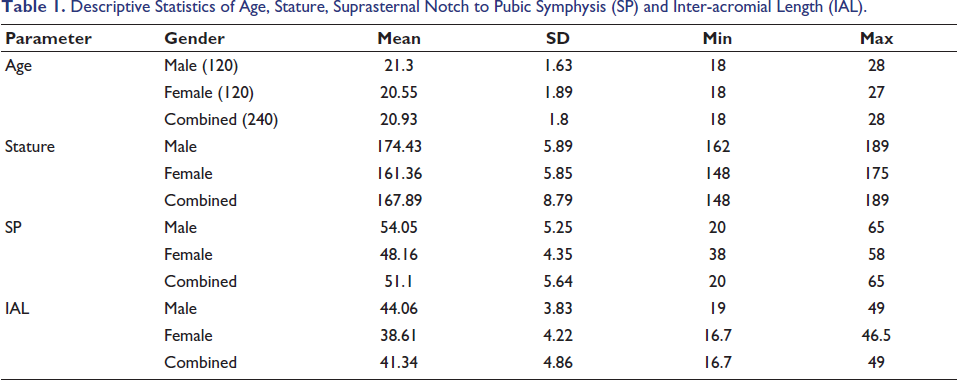
Descriptive Statistics of Age, Stature, Suprasternal Notch to Pubic Symphysis (SP) and Inter-acromial Length (IAL).
Pearson’s Correlation Analysis Between Body Trunk Parameters and Stature.

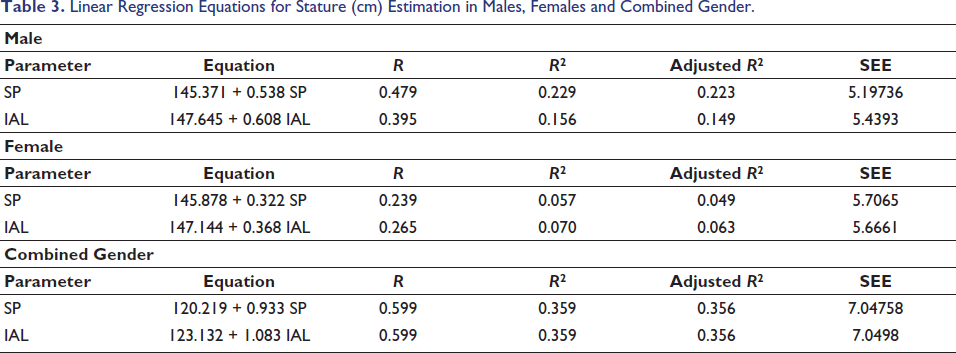
Linear Regression Equations for Stature (cm) Estimation in Males, Females and Combined Gender.
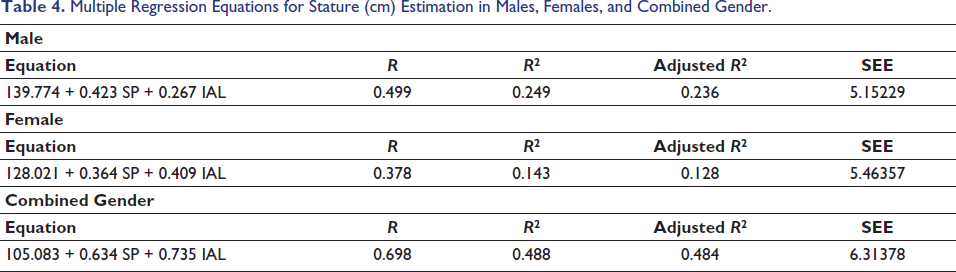
Multiple Regression Equations for Stature (cm) Estimation in Males, Females, and Combined Gender.
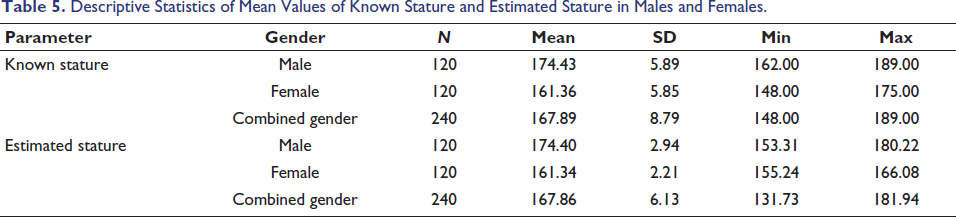
Descriptive Statistics of Mean Values of Known Stature and Estimated Stature in Males and Females.
Paired t-test Between Known and Estimated Height.

Discussion
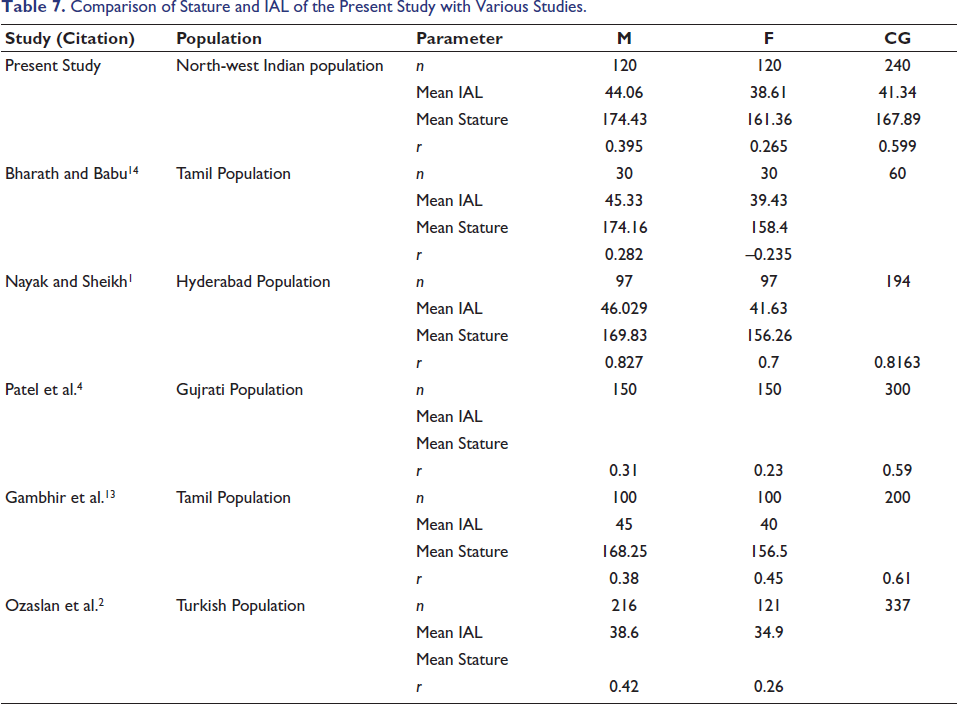
Stature is an important component of the biological profile of an individual and is influenced by several factors, such as racial or ethnic background, hereditary characteristics, climatic conditions and nutritional status. In forensic anthropology, stature constitutes one of the classical ‘big four’ parameters used in identification, along with age, sex and race. Estimating stature plays an important role in identification during a medicolegal autopsy, especially in cases involving unknown bodies, mutilated bodies, advanced decomposition or mass disaster. Anthropometric measurements derived from various body parts have long been used in forensic anthropology to estimate the stature of an individual in cases where the complete body is not available. The current study was conducted in the North-West Indian population to derive the regression equations for stature estimation using IAL and the distance from suprasternal notch to pubic symphysis (SP). In the present study, males exhibited higher mean values for stature, IAL and SP compared to females, which is in concurrence with other studies.2, 17 The age of puberty being 2 years later in males gives additional time for growth; Males are generally taller than females, and hence it explains this difference. In the present study, a positive correlation was observed between distance from the suprasternal notch to pubic symphysis (SP) and stature in males, females and a combined gender group (Table 2). Among the parameters measured, SP demonstrated higher correlation with stature in males, while IAL showed relatively stronger correlations in females. These findings indicate that trunk dimensions can serve as a reliable predictor of stature. The comparative analysis of the correlation of IAL with stature, along with studies on different populations, is depicted in Table 7. It was observed from the results of various studies that IAL exhibits a moderately strong correlation with stature like in studies done by Ozalen et al., 2 Patel et al., 4 Jasuja et al. 17 and Koulapur et al. 18 Our results for correlation of stature with IAL are consistent with studies conducted by Ozalen et al., 2 Patel et al., 4 Jasuja et al. 17 and Koulapur et al. 18 Similarly, distance from suprasternal notch to pubic symphysis depicted moderately strong positive correlation with the stature in the current study as well as in the study by Bandyopadhyay and Dutta. 16 The similarities between the findings of the present study and the previous research suggest that trunk measurements may provide valuable information for the estimation of stature in forensic contexts.
The regression equations were derived for the estimation of stature from IAL and distance from the suprasternal notch to pubic symphysis (SP) in both males and females, as well as in the combined groups (Tables 3 and 4). The accuracy of regression equations in anthropometric studies is commonly evaluated by the SEE, where the lower SEE indicates better predictive accuracy. In the present study, the SEE was lowest for SP in males and IAL in females (Table 3). However, the difference between the SEE for both parameters is minimal. In the study conducted by Gambhir et al., 13 the standard error from the linear regression equation for IAL was ± 6 and ± 5 for males and females, respectively. In another study by Koulapur et al. 18 the standard error from the linear regression equation for IAL was ± 6 and ± 4 for males and females, respectively. The standard errors came out to be ± 8 cm for males and 181 + 5 cm for females in a study done by Momonchand and Devi. 19 The standard errors came out to be ± 6 cm in males and ± 5 cm in females in the study conducted by Patel et al. 4 The SEE value for the linear regression equation, and stature was 2.2395 and 1.8632 in the study conducted by Ozaslan et al. 2 on Turkish population.
The mean difference between the estimated stature and known stature for males, females and in the combined gender group in the current study is depicted in Table 5 and was found to be similar. No statistically significant difference (p value >.05) was observed between the known stature and estimated stature by using a paired t-test (Table 6). Therefore, the derived equations can be employed for the estimation of stature. No statistically significant difference was observed between the known stature and estimated stature based on the IAL by paired t-test in other studies as well.1, 13, 18
Study Limitations
Comparison of Stature and IAL of the Present Study with Various Studies.
Conclusion
The present study has established a definite correlation between stature and two parameters of the body trunk, namely IAL and distance from the suprasternal notch to the pubic symphysis. Out of these two parameters studied, the distance from the suprasternal notch to pubic symphysis showed the highest degree of correlation with stature in males, and IAL showed the highest correlation in females. The regression equations formulated in this study provide valid and reliable stature estimations. The known stature and estimated stature from the derived regression equations were found to be similar, with no statistically significant difference observed. Therefore, it is concluded that stature can be estimated from these parameters of the body trunk in situations where only the body trunk is available for postmortem examination and subsequent identification.
Footnotes
Declaration of Conflict of Interests
The authors declared no potential conflicts of interest with respect to the research, authorship and/or publication of this article.
Ethical Approval
Prior approval was obtained from the Institutional Ethical Committee (SHKM/IEC/2019/66 dated 19 April 2019).
Funding
The authors received no financial support for the research, authorship and/or publication of this article.
Informed Consent
Written informed consent was obtained from all participants prior to their inclusion in the study.
