






Abstract
Medico-legal autopsy is an essential component of undergraduate medical education, enabling future physicians to determine the cause of death through systematic examination. Despite its importance, students often show limited interest due to discomfort associated with autopsy procedures. This study aimed to assess the knowledge of medical interns regarding medico-legal autopsy.
A cross-sectional, questionnaire-based study was conducted among 105 medical interns at a private medical college in South India. A structured, pre-validated questionnaire was used to evaluate knowledge of autopsy procedures and the formulation of the cause of death. Responses were scored and categorized as excellent, good, average, and below average. Data were analyzed using descriptive statistics.
Among the interns, 11% demonstrated excellent knowledge, while 58% had good knowledge. Additionally, 28% showed average knowledge, and 2% had below-average scores. Although the majority of interns possessed satisfactory knowledge, only a small proportion demonstrated a high level of competency. No statistically significant associations were identified.
The findings indicate a need to strengthen higher-level understanding of medico-legal autopsy among interns. Incorporating case-based learning, problem-based learning, and practical exposure may improve engagement and competency. Competency-based medical education can further enhance learning outcomes.
Introduction
Autopsy, also referred to as necropsy, is a systematic post-mortem examination conducted to determine the cause and manner of death. Autopsies are broadly classified into pathological (clinical) and medico-legal autopsies. A medico-legal autopsy is performed in cases of legal significance, with the primary objectives of establishing the identity of the deceased, ascertaining the cause of death, and determining the manner of death. 1
Competency in medico-legal autopsy procedures is an essential component of undergraduate medical education. However, this area often receives limited emphasis during training, resulting in inadequate exposure and practical understanding among medical students. 2 In the Indian healthcare system, medico-legal autopsies are frequently conducted by medical officers working in primary health centers, community health centers, and district hospitals, irrespective of their specialty training. 3
Regional studies and national reviews indicate that, owing to the shortage of trained forensic specialists, a substantial proportion of medico-legal autopsies in India are conducted by general duty medical officers, with considerable variability in expertise and infrastructure across centres.4, 5 This gap in specialized training may affect the quality and consistency of autopsy findings and medico-legal opinions, which can influence judicial outcomes. 6
Previous studies have shown that a majority of interns feel inadequately prepared to perform autopsies independently despite theoretical exposure. 4 Therefore, there is a need to strengthen undergraduate training in medico-legal autopsy through structured and integrated teaching approaches. Improving knowledge and practical competency in this domain will enhance the quality of medico-legal documentation and contribute to the effective administration of justice.
The present study aims to assess the knowledge of medico-legal autopsy among medical interns and to identify effective teaching methods to improve their understanding and competency.
Aim
To assess the level of knowledge regarding medico-legal autopsy among medical interns in a private medical college in South India, and to identify gaps in their understanding.
Objectives
To evaluate the overall knowledge of medico-legal autopsy procedures among medical interns using a structured assessment tool.
To categorize the level of knowledge based on predefined scoring criteria.
To compare the knowledge levels between male and female interns.
Material and Methods
The present study was a cross-sectional study conducted among medical interns in Sri Siddhartha Medical College over a period of 1 year. The sampling method used was convenience sampling. A structured questionnaire comprising 20 multiple-choice questions was developed to assess medical interns’ knowledge of medico-legal autopsy. The items covered key domains, including autopsy indications, legal procedures, techniques, specimen preservation, and post-mortem changes. The validity of the questionnaire was established through Cronbach’s alpha statistical measure, which gave a value of 0.77.
Correct answers of 12 and above were considered an excellent score. Correct answers of 8–11 were considered good, 5–7 average, and below 5 poor. Data were entered into an Excel spreadsheet, and analysis was done using SPSS VERSION 20. Descriptive statistics were computed with frequency and percentage.
Results
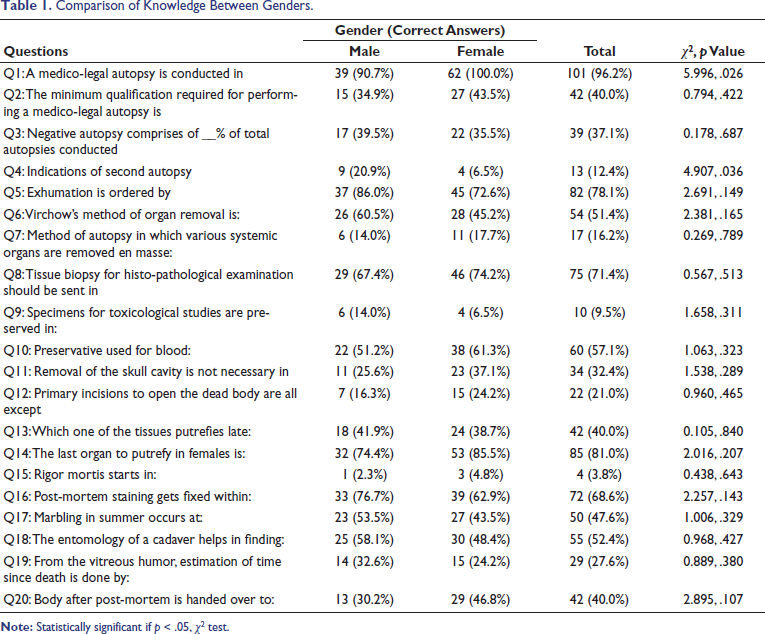
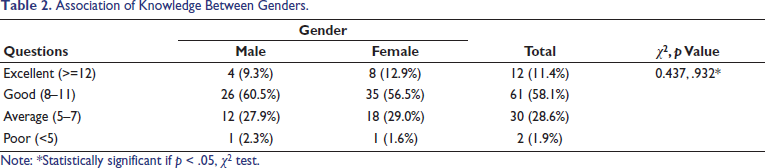
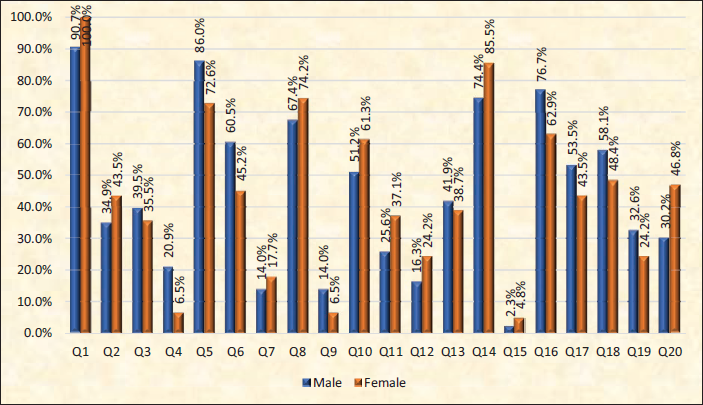
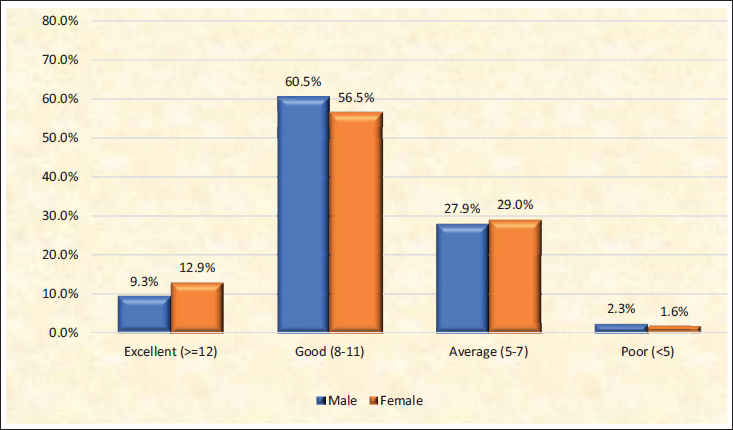
The study was conducted among 105 interns, out of which 43 were males and 62 were females. Only 12 interns, that is, 4 males and 8 females, had an excellent score (score of 12 and above). The majority of the interns (61) had a good score (26 males and 35 females). While 30 interns had an average score (12 males and 18 females), 2 interns had below-average scores (1 male and 1 female). Maximum correct response was received for the first question, that is, indication of medico-legal autopsy and the least correct response was received for question 15, that is, origin of rigor mortis. There was a significant difference in knowledge levels observed among males and females for questions 1 and 4 (p < .05). Overall, there was no statistically significant difference in knowledge levels observed in males and females (p > .05), meaning that there was not enough evidence to conclude that a real difference or association exists (Tables 1 and 2; Figures 1 and 2).
Comparison of Knowledge Between Genders.
Association of Knowledge Between Genders.
Comparison of Knowledge Between Genders in Each Question.
Association of Knowledge Between Genders.
Discussion
Medico-legal autopsy is a crucial component of the MBBS curriculum, traditionally taught during the second year in the non-competency-based medical education structure. Medical interns are expected to develop the ability to observe, interpret findings, and provide an informed opinion regarding the cause of death in medico-legal cases. The present study, conducted among interns in the Department of Forensic Medicine at a private medical college in South India, assessed their knowledge of medico-legal autopsy.
Out of 105 interns (62 females and 43 males), only 11% demonstrated excellent knowledge of autopsy procedures, while 58% showed a good understanding. No statistically significant difference was observed between male and female interns. These findings are consistent with studies conducted in Belagavi, 6 Haryana, 7 and Mysore. 8 However, 28% of interns exhibited average knowledge and 2% performed below average, aligning with observations from a study conducted in Nagpur. 9 Overall, nearly 30% of interns lacked adequate basic knowledge of autopsy procedures. The present study contradicts the previous study done at Bengaluru, 10 where 70% of interns had no proper knowledge in medico-legal work. Our study findings also align with the results of a study done at Kolkota 11 where 30% of interns had inadequate knowledge regarding medico-legal work. Statistically significant gender differences in positive responses were seen in issues such as autopsy skill training from students in a study conducted in Nashik, 12 in contrast to our study, where there was no statistically significant difference in knowledge levels observed in males and females. In a study conducted in Ludhiana medical college concluded that most of the medical students and interns found that demonstrations of the autopsies during their undergraduate phase were a learning experience and wished they could see more autopsies and felt themselves incapable of performing autopsies independently on becoming physicians 4 which was in unison with our study. Studies conducted among practicing doctors, irrespective of the specialty and cadre, were grossly deficient in medico-legal knowledge, which is a primary concern and needs to be addressed at the grassroots level, that is, undergraduate training. 13
This deficiency may be attributed to factors such as limited teaching hours, insufficient exposure to diverse autopsy cases, lack of student engagement, and poor retention of knowledge. Recent curricular reforms have strengthened undergraduate training in forensic medicine by introducing it in the final year and extending teaching across multiple professional phases. This integrated approach is expected to enhance comprehension and retention. It was also determined in a study conducted in Kerala that students taught using a teaching module performed better compared to students in a conventional method of teaching. 14
The internship period is critical to acquiring key skills for the practice of medicine. Previously, the internship program was focused primarily on the clinical aspects, while the medico-legal aspects were often ignored during the training. The National Medical Commission has recently drafted the Compulsory Rotatory Internship Regulations Draft, 2021, which includes a compulsory 1-week training period in Forensic Medicine. 15 This change is likely to improve both knowledge and practical skills. Emphasis on hands-on training during internship, particularly in observing and assisting with autopsy procedures, is essential to ensure that interns acquire the competence required for medico-legal practice.
The present study has certain limitations; being conducted in a single private medical college, the findings may not be generalizable to other institutions. The sample size was relatively limited, which may affect the statistical power of the study. The use of a questionnaire-based assessment evaluates theoretical knowledge but may not accurately reflect the practical competency of interns in performing medico-legal autopsies. The cross-sectional design of the study does not allow assessment of changes in knowledge over time.
Conclusion
The present study revealed that while medical interns possess a basic understanding of medico-legal autopsy, significant gaps exist in specific domains, particularly in procedural knowledge and medico-legal aspects. No substantial difference in knowledge levels was observed across gender, suggesting that these gaps are likely related to training rather than demographic factors.
These findings highlight the need to strengthen undergraduate teaching in forensic medicine, with greater emphasis on practical exposure, problem-based learning, and structured learning approaches. Addressing these gaps may improve the competency of future medical graduates in performing medico-legal responsibilities.
Footnotes
Declaration of Conflicting Interests
The authors declared no potential conflicts of interest with respect to the research, authorship, and/or publication of this article.
Ethical Approval
The study was approved by the Institutional Ethics Committee (IEC No. SSMC/IEC/1/2020).
Funding
The authors received no financial support for the research, authorship, and/or publication of this article.
Informed Consent
Informed consent was obtained from all the participating Interns.They were informed about the purpose of study, procedure involved, right to withdraw at any time.