







Abstract
This article addresses the question of why members of a majority group, despite their more powerful status, may protest against low-power minority groups. The present study addressed this question in the context of immanent intergroup relations between Muslims, as the majority group, and non-Muslims, as the minority group, in Indonesia. It is argued that at the core of such collective protests is a threat by association, a perception of the majority group members that the minority groups are in league with the West which threatens the existence of Muslims worldwide. Based on data collected using a survey questionnaire from Indonesian Muslims (N = 418) this study tested a hypothesised model using threat by association posed by the minority groups, Islamic puritanism and beliefs relating to western conspiracy to predict collective protests and intolerant intentions against non-Muslim minorities in Indonesia by using MPlus version 7.0. The hypothesised model found empirical support. The relationship between threat by association and Islamic puritanism with collective protests was mediated by Western conspiracy beliefs. It was also found that support for collective protests got translated into majority group members’ religious intolerant intentions against the people belonging to the non-Muslim minority groups. The article discusses the theoretical implications and research limitations of these empirical findings.
Keywords
Introduction
In the current globalisation era, some Muslims in the Islamic world perceive the West as exerting its political domination and cultural hegemony (Nurullah, 2008). Consequently, it comes as no surprise that some Muslims feel globalisation as posing a threat to the values or way of life (i.e., symbolic threat) and the economy and power (i.e., realistic threat) of the Islamic world (Mashuri et al., 2015). In this research, we conceptualise Muslim perceptions of threats from the West as distant intergroup threats. Through the lens of threat by association (Bouman, 2015; Bouman et al., 2014, 2015), we tested the idea of why and how such distant intergroup threats carry over into a Muslim majority group’s collective protest against religious minority groups within a country.
Recently, we have seen a surge of protests that spans the globe (Kunst & Obaidi, 2020). Protesters were members of a low-power minority group who felt mistreated by a high-power majority group, as evidenced in the 2019–2020 Hongkong protests, the February 2020 Muslims’ protests on India’s New Citizenship Policy, and the Black Lives Matter protests that peaked on 6 June 2020, in the United States, just to name a few. However, a new pattern of protest has also emerged, primarily orchestrated by right-wing extremists in the West targeting minority groups in their country or elsewhere (Spence, 2020). The protests by groups on both sides tend to be violent, posing a challenge for many societies to cope with intergroup conflict (Kunst & Obaidi, 2020). Against this backdrop, it is important to investigate and ultimately find strategies to tackle the factors driving such hostile collective protests in the contemporary world.
As it will be clear in what follows, we reckon that, first, the threat by association along Islamic puritanism serves as the conduit for such domestic anti-minority protest. Second, we argue that Islamic puritanism in positively predicting anti-minority protest is more apparent among participants expressing high levels of threat by association in contract to a low threat by association. Finally, we demonstrate how Western conspiracy beliefs (i.e., the West has conspired to harm Islam or Muslims) mediate the role of threat by association and Islamic puritanism as positive antecedents of support for the collective protests, and how this support ultimately triggers Muslims’ religious intolerant intentions against non-Muslims in their local environment. Based on these arguments, the primary goals of this research were two-fold. First, to investigate the psychological mechanisms of the impact of threat by association on a religious majority group’s collective protests against religious minorities in Indonesia. Second, to examine the consequences that collective protest has in provoking hostile behavioural tendencies against religious minorities.
The Context of Present Work
Indonesia is a country with the world’s largest Muslim population. With an estimated number of 207 million, Muslims in Indonesia make up around 13% of the total number of adherents of this religious group across the globe (Indonesia-Investments, 2020). According to the 2010 census report, out of the 255 million people in Indonesia, 87.2% are Muslim and 9.8% are Christian. The remaining 4% of the Indonesian population are Hindu, Buddhist and Confucian, as well as other believers (i.e., practitioners of local or indigenous religions; Indonesia-Investments, 2021).
Indonesia was formerly a Dutch colony. During the colonial era (1600–1940), indigenous peoples in Indonesia experienced discrimination and oppression by the Dutch government (Drakeley, 2005). This negative treatment ignited the Indonesian people’s resistance to the Dutch occupants, which reached its highest level when prominent Indonesian leaders, Muslims or non-Muslims, lent their support to the declaration of Indonesia’s independence from the Netherlands in August 1945 and subsequent war during the Indonesian revolution from 1945 to 1949 (Hefner, 2017).
In Indonesia’s history, non-Muslim leaders have also contributed to the establishment of Pancasila (English: The Five Pillars) as a more inclusive national ideology, in contrast to Islamic ideology. Under Pancasila, despite being a Muslim-majority country, Indonesia is not an Islamic republic. Stipulated in The Jakarta Charter of June 1945, the first pillar of Pancasila was once read as ‘Belief in God with the obligation to abide by Islamic law for its adherents’ (Ismail, 2018). In response to the Jakarta Charter, non-Muslim leaders expressed their concern that the phrase ‘the obligation to abide by Islamic law for its adherents’, albeit especially applied to the Muslim community, was discriminatory against non-Muslim minorities. To prevent political separatism, especially in the eastern region of Indonesia where predominantly Christians and Hindus reside, the Committee for the Preparation of Indonesian Independence (Indonesian: Panitia Persiapan Kemerdekaan Indonesia/PPKI) decided to remove the phrase (Elson, 2009). Accordingly, to accommodate non-Muslims’ aspirations, the first pillar of Pancasila has been modified into ‘Belief in One Supreme God’ (Mashuri et al., 2020).
Under Pancasila, the Indonesian government officially recognises five monotheistic religions outside Islam (i.e., Roman Catholicism, Protestantism, Hinduism, Buddhism and Confucianism; Pausacker, 2007). The Indonesian Constitution, by adopting Pancasila as its foundation, grants Indonesian citizens, Muslims and non-Muslims, a legal right to be political leaders, including the head of the national government (i.e., the president; Syarif, 2017). Muslims are thus the majority religious group in Indonesia and have also dominated Indonesia’s national politics. The president of the republic has always been a Muslim (Barton, 2002). Ironically, despite their relatively powerful position and the state’s recognition of some religions outside Islam, some Muslims in Indonesia prefer conflict rather than peace in expressing their dissent towards religious minorities in their country (Mietzner, 2018).
Some Muslims’ hostile tendencies against religious minorities in Indonesia are oftentimes channelled through collective protests. For example, there has been a series of protests by some Indonesian Muslims in 2016, calling for the modification of the Indonesian Constitution to reject non-Muslims as leaders in majority Muslim communities (Fealy, 2018). Other protests also emerged, to articulate Muslims’ negative sentiments against some religious minorities in Indonesia, including Ahmadiyyah followers and Christians. In Indonesia, the Ahmadis (followers of Ahmadiyyah) are estimated to be from 200,000 to 400,000 in number (US Department of State, 2017). They claim to be Muslim however, due to the beliefs of Ahmadis that the founder of their sect Mirza Ghulam Ahmad and not Prophet Muhammad, Islam’s final prophet, some Muslims judge them as a heretical religious group which, as a result, deserve to be classified as non-Muslim (Yuniarni, 2018). The main agenda of some Muslims’ anti-Ahmadiyya protests is to sue the Indonesian government for banning Ahmadiyya, which oftentimes ends in vandalism and persecution (Marshall, 2018). The second is the Christian minority. Collective protests against this religious group have mainly purported to mobilise some Indonesian Muslims’ resistance to the construction of new churches which, for instance, took place in 2015 (Lestari, 2015) and 2019 (Epa, 2019).
In the following sections, theoretical rationale and empirical findings from previous research are reviewed, to explain the psychological mechanisms by which threat by association, Islamic puritanism and Western conspiracy beliefs arguably play consequential roles in explaining Muslims’ support for the anti-minority collective protests. It is important to note that in this research, Muslims in Indonesia are construed as the ingroup and non-Muslims as the proximal outgroup (i.e., the outgroup that may interact with the ingroup in their immediate environment), whereas the West is construed as the distant outgroup (i.e., the outgroup that the ingroup most likely does not encounter in the local, immediate environment). Muslims, in general, and those in Indonesia, in particular, see the West, albeit distant, as a salient outgroup because most Muslim-majority countries, including Indonesia, were once colonised by Western countries. In the present era, controversies about the cartoon Muhammad, wars in Iraq and Afghanistan (Pew Research Centre, 2006), and, most recently, Emmanuel Macron’s criticism of Islam and Muslims (Safi et al., 2020), have rendered the ingroup/outgroup categorisation Muslims and Westerners more salient. In this research, the West is assumed to be a relevant and salient outgroup for Muslims in Indonesia, especially when discussing threat by association and conspiracy beliefs.
Threat by Association
The threat by association is operationalised as perceptions of external and indirect intergroup threats (Bouman, 2015; Bouman et al., 2014, 2015). Within the context of this research, the source of threat by association is external because it relates to the perceptions of the extent to which Indonesian Muslims feel that their group (or ingroup) is threatened by the West across the globe, and not by the non-Muslim minorities in Indonesia (see Greenaway & Cruwys, 2019 for a review of the differentiation between internal and external threats). Besides having an external source, the nature or characteristic of threat by association is also indirect because Muslims in Indonesia do not necessarily interact or are in direct contact with Westerners from different parts of the world. As an indirect intergroup threat, the threat by association stems from ingroup members’ knowledge and observations of the outgroup through historical narratives spread in schools or books (Psaltis et al., 2017), as well as through news or information from the media, such as the internet, radio and television (Saleem & Ramasubramanian, 2019). Finally, the threat by association may take shape via realistic threats or symbolic threats. Realistic threats relate to the perceived threats to tangible resources, such as power, the economy or physical well-being. Symbolic threats have to do with perceived threats to intangible resources, which include identity, values, culture and religion (Stephan et al., 2009).
Extant literature (Mashuri & Zaduqisti, 2015; Mashuri et al., 2015) has demonstrated that some Muslims in Indonesia are highly concerned about how, in the current globalisation era, the West is considered to pose either realistic threats (e.g., power or political domination) or symbolic threats (e.g., cultural domination) to Muslims or Islam. However, thus far there is little to no research that has examined how much such a threat by association elicits anti-minority collective protest. Indeed, some studies have attempted to link the perceived intergroup threats to collective protest. However, these studies (e.g., Çakal et al., 2016; Zhang, 2013) have considered direct threats rather than indirect threats, and the main findings show that the outgroup perceived as threatening the ingroup leads ingroup members to collectively protest against the outgroup.
In this research, we argued that threat by association holds the potential for provoking collective protest against the outgroup that does not pose a direct threat to the ingroup. This is because, the threat by association may induce ingroup members’ overgeneralisation towards a particular outgroup, believed to be the source of the threat (Bouman, 2015). This over-generalisation creates a ‘carryover effect’ that intensifies ingroup members’ negative attitudes towards another group (Bouman et al., 2014, 2015). The source of threat by association in this research is the West, which denotes a particular outgroup. The generalisation ensues when Muslims attribute the West to non-Muslims, a broader category of an outgroup, towards which some Indonesian Muslims have an ongoing tendency (Osman & Waikar, 2018). Herein the carry-over effect operates wherein Muslims’ perceptions of the West as a threat to the Islamic world result in Muslims’ negative attitudes towards non-Muslims in the local environment, believed to represent the threatening outgroup (i.e., the West). Building upon these arguments, the threat by association was hypothesised to be a positive predictor of participants’ support for the collective protests against non-Muslim minorities in Indonesia (Hypothesis 1).
Islamic Puritanism
The second factor of collective protest that was examined in this research is Islamic puritanism. According to Encyclopaedia Britannica (Petruzzello, 2020), puritanism refers to the aspirations and movements of the Church of England in the late 16th and 17th centuries to purify its teachings and practices by eliminating the influence of Roman Catholicism. It turns out later that puritanism is a religious ideology and movement that not only applies to Christianity but also to Islam and other major religions, such as Hinduism, Buddhism and Judaism (Bremer, 2009). Islamic puritanism, in particular, describes the ideology and movement that primarily urges Islam devotees to rely solely on the teachings of the Quran (the most central religious text in Islam) and Hadith (the practices of Prophet Muhammad as the second central religious text in Islam).
Historically, Islamic puritanism was first endorsed by Wahabism, an Islamic sect founded by Muhammad ibn Abd al-Wahab (1703–1792) in Saudi Arabia, which remains the dominant religious faith in the country (Turmudi, 2012). One of the defining characteristics of Wahabism is the desire to establish a pure, pristine version of Islam, which makes this sect hostile to local cultures and traditions (Rohmaniyah & Woodward, 2012). In Indonesia, puritan Islamic movements commenced in 1803 and gained more popularity at the beginning of the 20th century. The movements once operated underground during the New Order Era in Indonesia (1966–1998), due to the oppression of the regime towards conservative political Islamic organisations. After the fall of the New Order Era that marked the inception of the Reformation Era (1998-present), puritan Islamic movements resurfaced through multifarious Islamic organisations and movements (Baskara, 2017). Recently, there has been a growing concern over puritanical Islamic organisations and movements in Indonesia, which blatantly demonstrate intolerance against non-Muslims. This is the case because, first, the movements develop an anti-pluralism ideology where Islam is regarded as the only true religion, casting other believers as infidels. Second, the movements have a political agenda to establish Islamic law or Sharia in Indonesia, which contradicts the national ideology of Pancasila (Anwar, 2007). Taking into account these anecdotal records within the Indonesian context, it may be logical to argue that Islamic puritanism may lead to Muslims’ negative attitudes towards non-Muslims by supporting the collective protests against the religious minority groups. Building upon this argument, we predicted that Islamic puritanism would be positively related to participants’ support for the collective protest against religious minorities in Indonesia (Hypothesis 2).
Framing theory in communication research postulates that construing an outgroup as an international, global threat to an ingroup may function as an organizing principle that leads to ingroup members’ simplified portrayal of the outgroup as a threat to their nation (Powell, 2011; Reese, 2007). This generalised framing of the threatening outgroup (as contended by Araújo et al., 2020), spills over into ingroup members’ negative attitudes towards the outgroup in their local environment, especially among ingroup members high in social dominance orientation and right-wing authoritarianism, and who have hostile tendencies against an outgroup. In support of this notion, research by Araújo et al. (2020) demonstrated that among 21,362 participants from 20 counties in the Americas, Europe, Asia, and Oceania, social dominance orientation and right-wing authoritarianism positively predicted the host society’s resistance to Muslim immigrants, more strongly when Muslim immigrants were perceived as an international threat. Given that Islamic puritanism may share some similarities with social dominance orientation and right-wing authoritarianism in augmenting ingroup members’ intolerance of an outgroup, we argued that frame theory applies in the context of the present research. We accordingly predicted that more threat by association leading to perceptions of the West as a threat to Muslims (or Islam) around the world would strengthen the positive relationship between participants’ Islamic puritanism and support for the collective protests against religious minorities in Indonesia (Hypothesis 3).
The Mediating Role of Conspiracy Belief
Collective protest constitutes a form of collective action that is conflictual and antagonistic (van Zomeren, 2019a, 2019b). This conceptualisation means that collective protest serves as a medium through which ingroup members’ negative sentiments and thoughts (e.g., suspicion, the perceived danger) towards an outgroup are expressed. Conspiracy belief in the context of intergroup relationships implies the suspicions of ingroup members that the outgroup has secret and malevolent intentions to harm them (Bale, 2007). As such, belief in conspiracies is a strong positive predictor of ingroup members’ collective protest against the outgroup accused of endangering the ingroup (Chayinska & Minescu, 2018; Imhoff & Bruder, 2014; Imhoff et al., 2021).
Belief in conspiracies is a worldwide social phenomenon (van Prooijen & Douglas, 2018), and they are surprisingly endorsed by a significant number of citizens in both developed countries and developing countries (Sunstein & Vermeule, 2009). A prominent conspiracy in the Islamic world, narrated by some radical Islamists, like Osama bin Laden, is ‘the war against Islam’ (Slackman, 2006). This conspiracy describes how non-Muslims, associated with the West, have secretly collaborated and used military, economic, or cultural means to achieve their end. The end is the weakening and eradication of Islam or Muslims (Gray, 2010). In Indonesia, prior work has shown that some Muslims strongly believe in outgroup conspiracy theories. These kinds of conspiracy theories, in part, portray how Western countries (i.e., the United States and its supposed allies) are accused of masterminding terrorism in Indonesia (Mashuri et al., 2016). Another conspiracy theory describes how the British are accused of backing up Ahmadis to create a sense of ‘enemy from within’ among Muslims (Putra et al., 2015).
Van Prooijen and Van Vugt (2018) explain that protest behaviour is one of the outcomes of conspiracy belief, and this belief emerges from individual factors like ideological convictions that promote animosity against different groups (e.g., social dominance orientation, right-wing authoritarianism), as well as situational factors including intergroup threat perceptions. Previous work in Indonesia has revealed that the perceptions of the West as a threat to the Islamic world are the significant source of some Muslims’ Western conspiratorial beliefs (Mashuri & Zaduqisti, 2014, 2015). Some underlying factors render Muslims susceptible to Western conspiratorial beliefs. One of those factors is collective victimhood, which resonates with Muslims’ perceptions that their group is illegitimately harmed by Western countries. The colonisation of Muslim countries by the West in the past and the unresolved Israeli–Palestinian conflict in the present ignite Muslims’ sense of collective victimhood (Mashuri & Zaduqisti, 2019). Applying these arguments to the context of our work, we contend that threat by association serves as a conduit for Muslims’ beliefs in the Western conspiracy.
Research that has examined the relationship between Islamic puritanism and conspiracy beliefs is still absent to date. However, puritanical Islamic organisations and their movements propagate conspiracy theories that the outgroups (i.e., the West and non-Muslims) have a hidden, harmful agenda to annihilate Islam (Anwar, 2007). As such, Islamic puritans tend to exhibit intense distrust towards such outgroups (van Bruinessen, 2002). Previous research (Mashuri & Zaduqisti, 2014) has shown that distrust towards Western countries positively predicted Muslims’ beliefs in a theory that Western countries have surreptitiously collaborated to mastermind terrorism in Indonesia. Based on these arguments, in this research, we posit that high Islamic puritanism is arguably associated with high Western conspiracy beliefs.
We also construe threat by association as a positive antecedent of Western conspiracy belief, which ultimately motivates Muslims to support the anti-minority collective protest. The question is how beliefs in a certain outgroup at the center of the alleged conspiracy (i.e., the West) can transfer to collective protests against uninvolved outgroups (i.e., non-Muslim minorities)? To answer this question, we used the argument of attitude generalisation (Brylka et al., 2016; Tausch et al., 2010). It describes how the consequences of negative attitudes towards the primary outgroup members can generalise to the whole outgroup, which in turn generalises to other secondary outgroups. Applying this rationale, we posit that the perceptions of the West as a threat to Muslims (or Islamic) existence induce general Western conspiracy beliefs (i.e., the West has conspired to harm Muslims), and from there to specific Western conspiracy beliefs (i.e., the West has conspired to back up non-Muslim minorities). This negative attitudinal generalisation in turn motivates some Muslims to protest against non-Muslim minorities. Taken together, we argue that Western conspiracy beliefs mediate the role of threat by association and Islamic puritanism in giving rise to support for the anti-minority collective protest. Hence, we predicted that Western conspiracy beliefs would mediate the role of threat by association and Islamic puritanism in heightening participants’ support for collective protests against religious minorities in Indonesia (Hypothesis 4).
Intolerant Intentions
Collective protest in this research reflects negative intergroup attitudes in terms of ingroup members’ support for problematizing the outgroups. According to the theory of planned behaviour (TPB; Ajzen, 1991), attitude is one of the antecedents of intention. Predicating upon this rationale, it makes sense to argue that support for collective protest may transform into intolerant intentions. Accordingly, we predicted that support for the collective protest against religious minorities would be positively related to participants’ religious intolerant intentions towards the minorities (Hypothesis 5a).
Intolerant intentions in this research are related to prejudicial intolerance, signifying that the psychological processes of rigidity and close-mindedness are accountable for provoking ingroup members’ discrimination and rejection against the different outgroups and their practices (Verkuyten et al., 2020). Resonating with this rationale, Islamic puritanism is an ideological belief that may also contain rigidity and close-mindedness. As described in the previous section, the ultimate goal of puritanical Islamic organisations and movements is to propagandise and establish a version of Islam that is freed from the remnants of local cultures and traditions. This kind of exclusionary mission makes puritan Islamic organisations and movements intolerant not only of different versions of Islam but also of other religions and faiths (Shukri, 2008). Taken together, these arguments imply that Islamic puritanism may prompt Muslims to express high levels of religious intolerant intentions. Hence, we predicted that Islamic puritanism would positively predict participants’ religious intolerance intentions (Hypothesis 5b).
Method
Participants
Participants were 418 students from a university in Central Java, Indonesia (292 females, 124 males, 2 participants did not self-report their gender; Mage = 20.42, SDage = 2.07). 1 We recruited participants through convenience sampling based on their availability and convenience in approaching them.
Procedure
A survey questionnaire was used which included measures of all variables that have been used in this study. We administered this questionnaire in a classroom setting to all the participants with the help of research assistants. Participants were asked to indicate their degree of agreement with a statement on a 7-point Likert type scale, which varied between 1 (strongly disagree) and 7 (strongly agree). Total scores for different measures were obtained by averaging participants’ responses to all items of a measure.
After the informed consent of the participants had been taken, we informed the participants that the term ‘the West’ in the questionnaire referred to the United States and its allies (e.g., West European countries, Australia, Canada). This kind of operationalisation of the West was consistent with how it has been used by us in our previous studies (Mashuri & Zaduqisti, 2019; Mashuri et al., 2015). Following this, participants answered items related to a symbolic threat, realistic threat, Islamic puritanism, Western conspiracy belief, support for the collective protest and religious intolerant intentions.
Measures
From the stories I hear, the books I read, or the media [internet, television, radio, newspaper] I read or watch, I fear that the economy of the Western world across the globe, which is more developed and stronger than the economy of the Islamic world, will weaken the influence of the Islamic world in the inter-state competition.
The questionnaire ended with the debriefing of participants, who, thereafter, reported their age and gender.
Results
Descriptive Statistics
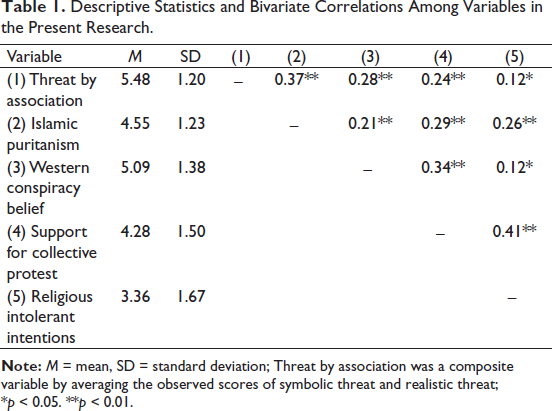
The descriptive statistics and bivariate correlations among variables in this research are presented in Table 1. Each variable, as can be seen, was found positively and significantly correlated with other variables. These correlations ranged from 0.12 to 0.41. The strongest correlation was between support for collective protest and religious intolerant intentions (r = 0.41). The weakest correlations were between threat by association and religious intolerant intentions (r = 0.12), as well as, between Western conspiracy beliefs and religious intolerant intentions (r = 0.12). 4
Descriptive Statistics and Bivariate Correlations Among Variables in the Present Research.
Hypothesis Testing
We hypothesised the relationships among variables in this research into a path model using Mplus version 7 (Muthén & Muthén, 1998–2015). 5 We used some indexes to assess the goodness of fit of the hypothesised path model, including chi-square (χ2), root means square error of approximation (RMSEA), comparative fit index (CFI) and Tucker–Lewis index (TLI). The hypothesised path model fits the data excellently if its chi-square is not significant, and its RMSEA is 0.06 or lower (Hu & Bentler, 1999; Schermelleh-Engel et al., 2003), also if the obtained CFI and TLI are 0.95 or higher (Hu & Bentler, 1999).
The data in this research, unfortunately, did not meet the assumption of multivariate normality (Skewness = 3.37, M = 0.50, SD = 0.12, p < 0.001; Kurtosis = 38.38, M = 34.86, SD = 0.77, p < 0.001). We, therefore, had to use MLR as an estimator that is robust to data that violate multivariate normality assumptions and contain missing values, as recommended by Muthén and Muthén (1998–2015), The results showed that the hypothesised path model (Figure 1) fitted the data very well, χ2(4) = 5.90, p = 0.207, RMSEA = 0.03, CFI = 0.99, TLI = 0.97. The hypothesised model explained 9% of the variance in Western conspiracy beliefs (SE = 0.03, p = 0.001) and 19% variance of collective protest (SE = 0.03, p < 0.001). It explained a 19% variance of religious intolerant intentions (SE = 0.04, p < 0.001).
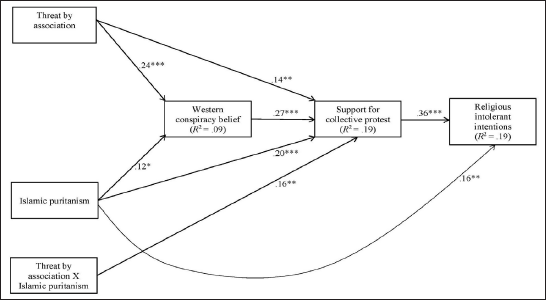
As shown in Figure 1, the threat by association positively and significantly predicted support for collective protest (β = 0.14, SE = 0.05, p = 0.007, 95% CI [0.04, 0.24]), as did Islamic puritanism (β = 0.20, SE = 0.05, p < 0.001, 95% CI [0.10, 0.29]). These results substantiated Hypotheses 1 and 2, respectively. Islamic puritanism significantly interacted with the threat by association in positively predicting support for collective protest (β = 0.16, SE = 0.05, p = 0.001, 95% CI [0.07, 0.25]). As can be seen in Figure 2, probing analysis revealed that, in line with Hypothesis 3, among participants high in threat by association, Islamic puritanism related positively with support for collective protest (B = 0.42, SE = 0.08, p < 0.001, 95% CI [0.27, 0.57]). However, Islamic puritanism was unrelated to support for the collective protest in the case of participants who expressed low levels of threat by association (B = 0.06, SE = 0.08, p = 0.472, 95% CI [−0.10, 0.22]). 6
The Relationship Between Islamic Puritanism and Support for Collective Protest Among Participants with High, Medium and Low Levels of Threat by Association.
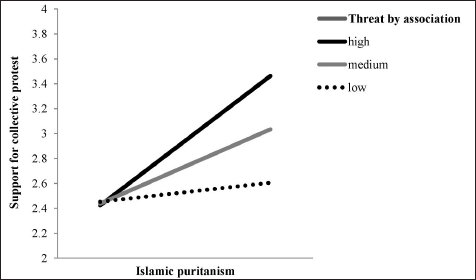
Figure 1 also shows that threat by association (β = 0.24, SE = 0.05, p < 0.001, 95% CI [0.15, 0.34]) and Islamic puritanism (β = 0.12, SE = 0.05, p = 0.019, 95% CI [0.02, 0.22]) were positively related to Western conspiracy belief. We also found that such a belief was associated with support for collective protest (β = 0.27, SE = 0.05, p < 0.001, 95% CI [0.18, 0.35]). Within the context of these relationships which were in support of Hypothesis 4, we also found that Western conspiracy belief significantly mediated the role of both threat by association (Indirect effect: β = 0.06, SE = 0.02, p < 0.001, 95% CI [0.03, 0.10]) and Islamic puritanism (Indirect effect: β = 0.03, SE = 0.01, p = 0.029, 95% CI [0.003, 0.06]) in predicting support for collective protest. These mediating effects are significant due to two conditions (Rucker et al., 2011). The first condition is that direct path coefficients from threat by association and Islamic puritanism as predictors to conspiracy beliefs as the mediator are significant. The second condition is that the direct path coefficient from conspiracy beliefs to support collective protest is stronger than the direct path coefficients from each of the predictors to support for collective protest. Finally, corroborating Hypothesis 5a and Hypothesis 5b, it was also found that support for the collective protest was a significant positive predictor of religious intolerant intentions (β = 0.36, SE = 0.04, p < 0.001, 95% CI [0.28, 0.45]), and so was Islamic puritanism (β = 0.16, SE = 0.05, p = 0.001, 95% CI [0.07, 0.25]).
Alternative Models
We compared the hypothesised model in this research with some competing alternative models that were derived from relevant theories. When the alternative model was not nested within the hypothesised model, the comparison was based on the difference between the hypothesised model and alternative models in terms of Akaike Information Criterion (AIC) and Bayesian Information Criterion (BIC). The difference is said to be meaningful if it amounts to 10 or greater, with smaller AIC and BIC indicating greater parsimony (Danner et al., 2015).
Alternative Model 1
The first alternative model was a non-nested model, based on the premises of the intergroup threat theory of prejudice (Stephan et al., 2009) in which people’s proclivity to perceive an outgroup as a threat to their ingroup may depend on individual differences. More specifically, people who highly value their ingroup are expected to be vulnerable to intergroup threat perceptions. As strong Islamic puritanism in part implicates strong identification with Islam (Osman, 2017), it makes theoretical sense to argue that Islamic puritanism becomes an antecedent variable of threat by association. The results revealed that the AIC (4,343.06) and BIC (4,399.39) of the hypothesised model were significantly lower than the AIC (5,612.11; ΔAIC = 1,269.05) and BIC (5,680.51; ΔBIC = 1,281.12) of the first alternative model (Figure 3 in Supplemental material). To conclude, the alternative model was found more parsimonious in explaining the data than our previous model.
Alternative Model 2
In their model of radicalisation, Doosje et al. (2016) contended that the political, economic and cultural dominations of the West in the current globalisation era mark a macro factor that some Muslims perceive as a threat to Islamic existence. This perceived threat radicalises some Muslims against the West. Building upon this notion, the threat by association appears to spur Islamic puritanism that according to us can be conceptualised as one form of radicalism. This is because it is characterised in part by an extreme desire to establish Islamic law to govern all aspects of life of the Muslims (Anwar, 2007; Osman, 2017). To test this out we tested a second non-nested alternative model in which threat by association preceded Islamic puritanism. We found that the AIC (4,343.06) and BIC (4,399.39) of the hypothesised model were significantly lower than the AIC (5,629.13; ΔAIC = 1,286.07) and BIC (5,697.53; ΔBIC = 1,298.14) of the second alternative model (Figure 4 in Supplemental material). These results confirmed that the hypothesised model as compared to the second alternative model was more parsimonious in explaining the relationships that we obtained in this study.
Discussion
Focusing on domestic collective protest (i.e., collective protest targeting fellow citizens within a country), and using Indonesia as a contextual background, we found that threat by association explains such a phenomenon. In particular, it associates with Islamic Puritanism to influence the perceptions of Muslims in Indonesia that the West threatens the Islamic world which significantly contributes to Indonesian Muslims’ attitudes towards collective protest against local religious minority groups. A significant finding was that the association of threat by association and Islamic Puritanism with attitudes that made Muslims engage in collective protests against the religious minority groups in Indonesia was mediated by their Western conspiracy beliefs and, in turn, was also positively related to intolerant intentions against religious minority groups. Each of these empirical findings was specified in a hypothesised path model, which turned out to fit the data significantly better than two theory-driven alternative models.
Theoretical Implications
The findings of this research clearly point to the significant role that threat by association plays in explaining support for the collective protest which may have a carryover effect to turn it into local unrest. This kind of carry-over effect, according to Bouman et al. (2014, 2015), may get activated through a superordinate outgroup categorisation. This is different from the superordinate group identity which refers to the common group categorisation encompassing both an ingroup and an outgroup (Dovidio et al., 2000), the superordinate outgroup categorisation involves only the outgroup/s. This kind of categorisation in this research puts forward for consideration how the West as a particular outgroup is categorised as a superordinate outgroup of non-Muslims in general. With this superordinate outgroup categorisation, the West as the distant source of threat is generalised to non-Muslims. This eventually feeds negative attitudes of Indonesian Muslims towards local non-Muslim minorities. This observation is noteworthy in the context that prior literature (Glasford & Caraballo, 2016) suggests that locality affects collective protest, in which people are less likely to support or join collective protest to address a distant issue (i.e., a problem that is sourced outside a country).
It was also found in this study that the higher the degree of Islamic puritanism the greater the possibility of an individual supporting the group members engaging in collective protest. This finding highlights the importance that individual differences matter in collective protest. Such a view has escaped the attention of previous researchers who have mainly focused on group-based factors (i.e., group identification, collective efficacy, group-based anger). This view, though, has been brought forth by Jost et al. (2017) who posited that ideological belief is a key predictor of collective protest. Islamic puritanism is an ideology-laden construct. This is because the ultimate goal of puritan Islamic organisations or movements is to implement Islamic law in its entirety. This is likely to turn them hostile towards other religious groups that may not subscribe to such an ideology. Jost et al. (2017)’s study helps in making sense of why and how Islamic puritanism of Indonesian Muslims was found positively related to their collective protest against non-Muslim minorities which as much belonged to them.
A question may be asked about the exact role that is played by the threat by association in this research. The findings of the study suggest that it is best conceptualised as the perception of a contextual factor. It strengthens the role of Islamic puritanism in supporting the collective protest against religious minority groups. Some of the previous research studies have pointed out the importance of contextual factors in investigating collective protest. For example, van Zomeren et al. (2018) extended the Social Identity Model of Collective Action (SIMCA) by incorporating the perceived violation or threat of ingroup norms as a contextual variable. In their revised model, a new assumption was made wherein the perceived violation or threat of ingroup norms was expected to strengthen the impact of group identification, collective efficacy and group-based anger on collective protest. In our case, the positive relationship between Islamic puritanism and support for collective protest is positively moderated by the threat by association which demonstrates its significance as people’s perception of a contextual factor.
Another significant finding of this study was that belief in the Western conspiracy mediated the direct path leading from threat by association and Islamic puritanism to support for the collective protest. This empirical result draws support from the model of the adaptive-conspiracism hypothesis of van Prooijen and Van Vugt (2018) which postulates that conspiracist thinking originates either from contextual factors (in this case, threat by association) or individual difference factors (in this case, Islamic puritanism). This results in approach-oriented responses (in this case, support for collective protest). It is assumed that conspiracy beliefs provoke collective protests, in particular, against an allegedly conspiring outgroup. Our study showed that such belief in the Western conspiracy was projected onto minority outgroups who distantly were not related to such conspiracy, yet such beliefs led the Indonesian Muslims’ to engage in collective protest against such local non-Muslim minorities.
Finally, this research also demonstrated that Islamic puritanism significantly explains intolerant religious intentions. Muslim puritans have a strong tendency to claim that only their religious beliefs are true, whereas other religious beliefs are false (Anwar, 2007). It appears that those believing in Islamic puritanism internalise a sense of exaggerated greatness or a feeling of ingroup superiority. Perceived ingroup superiority in and of itself constitutes one of the indicators of extremism or radicalism (Doosje et al., 2016), which has been found to underlie Muslim acts of intolerance against their outgroups. Doosje et al. (2013), for example, reported that among Muslims in the Netherlands, ingroup superiority positively corresponded with intergroup violence intentions. In all, these arguments suggest that Islamic puritanism is indicative of extremism or radicalism, which is why Muslims may be a little intolerant of the religious minorities in Indonesia.
Limitations and Recommendations for Future Research
The present work has some limitations that are worth mentioning. First, this research assumed that threat by association and Western conspiracy beliefs ignite collective protest against non-Muslim minorities because of the social contexts that have developed based on past or present histories. Such social contexts seem to have arisen from some events that pitted Muslims against the West. Examples of the social contexts are the 11 September attacks in the US, the invasion of Iraq and Afghanistan by the US, and the protracted conflict in Palestine. This assumption related to the evolution of threat by association can be tested in future research by priming participants of those events, and by assessing the extent to which it helps in the development of threat by association on the part of minority group members. Also, do Western conspiracy beliefs give rise to support for the collective protest.
Second, the general model of conspiracy theory as a monological belief system suggests that when people endorse one conspiracy, they tend to also endorse other conspiracies (Goertzel, 1994). Resonating with this model, this research presupposed that Muslims’ beliefs in Western conspiracy, operationalised as the generalised belief that the West has hidden, vicious intentions to harm the Islamic world, will be positively linked to Muslim religious groups’ belief in another conspiracy. Within the context of our work, such a conspiracy pertains to the belief of Muslims that the West secretly works and backs up non-Muslim minorities in Indonesia (i.e., Ahmadis and Christians) to destabilise them. This kind of Western conspiracy belief is likely to translate into Muslims’ collective protest against minority groups. Belief in the West’s conspiracy about Ahmadis and Christians in Indonesia can be assessed in future research, to examine its role in mediating the positive relationship between the generalised belief in Western conspiracy and support for the anti-minority collective protest.
Third, the non-experimental design of this research prevented us from claiming causal effects when reporting and interpreting the empirical findings. To overcome this limitation, future research may use experimental methods by manipulating threat by association to assess the causal effect of this variable on Western conspiracy beliefs and support for the collective protest. Second, the sample in this research was students. Follow-up studies, therefore, may recruit participants from a non-student population to increase the generalisability of the empirical findings.
Supplemental Material
Supplemental material for this article is available online.
Supplemental Material for Threat by Association, Islamic Puritanism and Conspiracy Beliefs Explain A Religious Majority Group’s Collective Protest Against Religious Minority Groups by Ali Mashuri, Chad Osteen, in Psychology and Developing Societies
Footnotes
Declaration of Conflicting Interests
The authors declared no potential conflicts of interest with respect to the research, authorship and/or publication of this article.
Funding
The authors disclosed receipt of the following financial support for the research, authorship and/or publication of this article: This research was funded by Hibah Penelitian Mandiri FISIP Universitas Brawijaya [Grant number 47/UN10.F10/PN1/2020], which was awarded to the first author.
Notes
References
Supplementary Material
Please find the following supplemental material available below.
For Open Access articles published under a Creative Commons License, all supplemental material carries the same license as the article it is associated with.
For non-Open Access articles published, all supplemental material carries a non-exclusive license, and permission requests for re-use of supplemental material or any part of supplemental material shall be sent directly to the copyright owner as specified in the copyright notice associated with the article.
