







Abstract
As universities expand the influence entrepreneurial programmes have on science, engineering, technology and math (STEM) students, we investigate the impact Temporal Construal Theory has on measures of entrepreneurial employment desirability in identifying nascent entrepreneurs. This quasi-experiment sampled 464 undergraduate students over a five-year period, measuring the time construal influence in desirability to start a business between STEM students and an intentionally biased sample of entrepreneurship students. Our findings show that temporal construal significantly influences student entrepreneurial employment desirability in STEM students. The biased sample of entrepreneurship students validated the instrument with positive short-term and highly positive long-term entrepreneurial employment desirability (p < 0.001). Our study suggests the temporal construal effect on employment intention is a key consideration in identifying nascent entrepreneurs at a university, and can heavily influence who is targeted for exposure to entrepreneurship training.
An entrepreneur starting a successful company benefits the local community in terms of job creation and economic growth (Chatterji, Glaeser & Kerr, 2013; Delgado, Porter & Stern, 2010; Glaeser, Kerr & Ponzetto, 2010; Kauffman Foundation, 2008; Mazzarol, Volery, Doss & Thein, 1999). As a result, governments and private organisations focused on economic development have been increasingly interested in fuelling entrepreneurial activity (Schramm, 2006). While there is a high risk of failure involved in new entrepreneurial endeavours, especially technology-based ventures, entrepreneurs expect to earn large returns and continuously expand their wealth if successful (De Nardi, Doctor & Krane, 2007). A 1999 study showed that the three countries with the highest levels of entrepreneurial activity also enjoyed the highest average growth in gross domestic product and the highest levels of employment (Hardy, 1999). Economists believe that entrepreneurial activity is critical to economic progress because entrepreneurs create new businesses, and in turn new businesses create new jobs (Nijkamp, 2003; Quadrini, 2000).
The Global Entrepreneurship Monitor 2011 report estimates that, across the globe, 63 million young entrepreneurs each expect to hire at least five employees over the next five years (Kelley, Singer & Herrington, 2012). Increasing the number of these types of entrepreneurs is expected to be linked to increased profits, wealth creation and economic growth (Luke, Verreynne & Kearins, 2007). Moreover, studies indicate that beyond increased productivity, entrepreneurial thinking and behaviour can help create competitive advantages via business differentiation (Hitt, Ireland, Camp & Sexton, 2001). The benefits of entrepreneurial thinking include the introduction of innovative new products and services in the market that create greater value for consumers while potentially creating entirely new markets (Kelley, Singer & Herrington, 2012).
We believe that identifying potential nascent entrepreneurs early in their lives and enabling them to capitalise on their entrepreneurial spirit is a critical element for economic success. Not all individuals intend to become entrepreneurs, and not all individuals have the necessary psychological makeup to be entrepreneurs (Hjorth, 2011). For this reason, it is very important to differentiate entrepreneurial intent (EI) amongst individuals. Identifying individuals (or groups) with high EI is a precursor to future entrepreneurial development and activity. By identifying entrepreneurs early in their lives, scarce resources associated with entrepreneurial development can be directed to individuals with the highest intent (Figure 1).
Entrepreneurial activity is a type of planned behaviour for which intention models are ideally suited (Krueger, Reilly & Carsrud, 2000). There are two primary intention-based models used to predict EI. The first is the theory of planned behaviour (Ajzen, 1991), which is based on perceptions of personal attractiveness, social norms and feasibility. The second is the model of the entrepreneurial event (Shapero, 1982), which argues that entrepreneurial activity depends on perception of personal desirability, feasibility (Segal, Borgia & Schoenfeld, 2005) and propensity to act. Work by Kolvereid validates the predicative power of these models on EI, and slightly favours the Shapero model (Kolvereid, 1996). Neither of these models finds that individual factors, such as demographics, have a strong effect on predicting EI, but they do find such factors useful in identifying boundaries that define different groups within a population (Hindle, 2010). This is relevant as Shapero found that some groups produce more entrepreneurial events than others (Shapero, 1982). According to Shapero, strong intention to start a business should result in an eventual attempt, with the most obvious entrepreneurial event being the formation of a new, and hopefully successful, company.
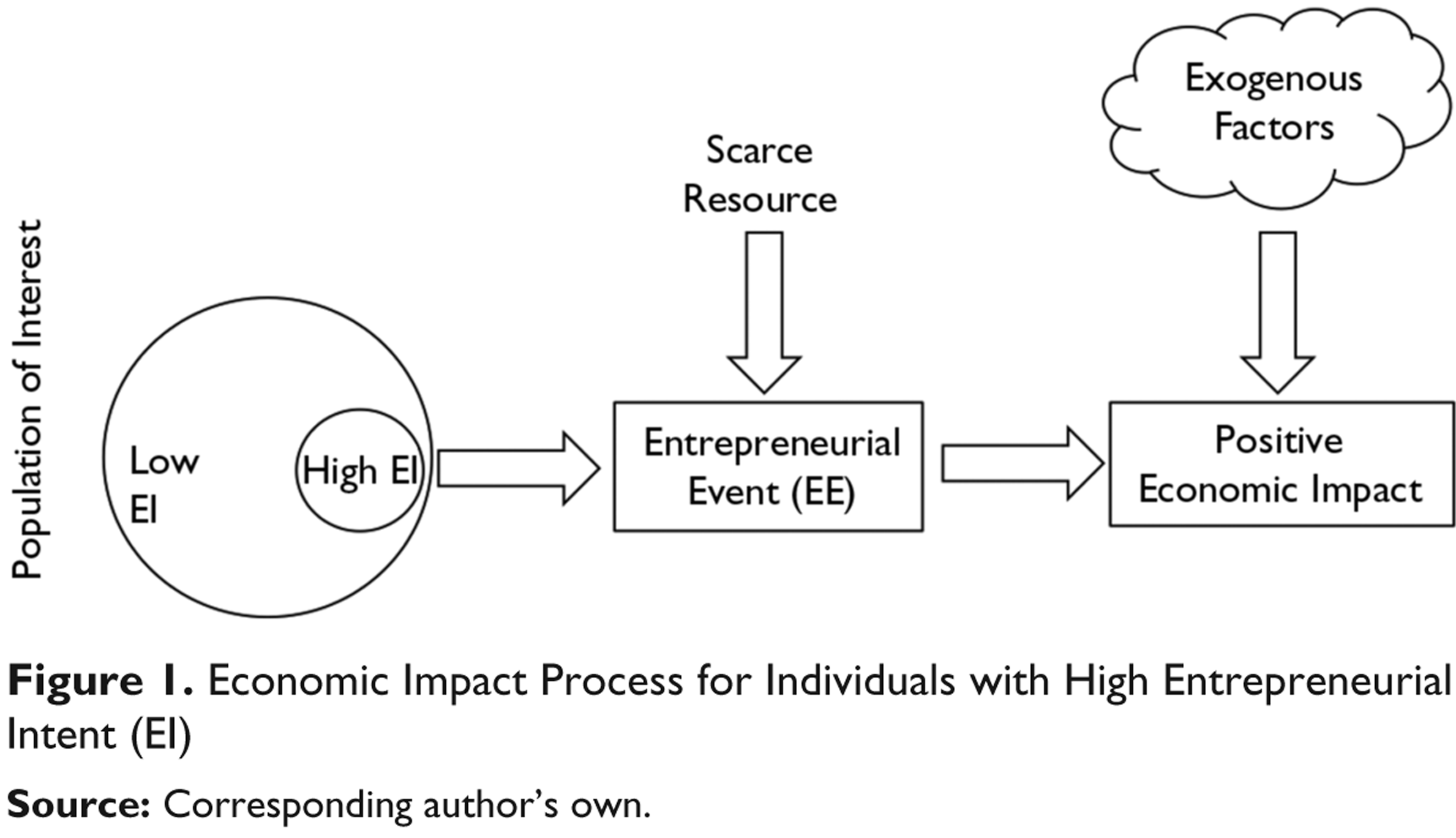
Launching new companies drives economic growth and empowering new entrepreneurs enables new company creation. Thus, a sensible economic goal is the encouragement of successful entrepreneurs who will positively impact the economy. This is a function of creating entrepreneurial events as well as exogenous success factors such as funding, market demand, competition, etc.

The probability of an entrepreneurial event occurring is driven by the level of EI of individuals and the availability of scarce resources to support the event.

But, by definition, under conditions of constant scarce resources, the only mechanism for raising the probability of the entrepreneurial event is by raising the EI in equation 2. Thus, by filtering for individuals with high EI in populations of interest, the probability of an entrepreneurial event increases, and thus the overall positive economic impact increases, all other endogenous and exogenous variables being considered constant for the purposes of the model.
Just as all individuals are not the same in terms of entrepreneurial potential, so too do various economic sectors differ as well. Research has found that the economic impact of high-tech entrepreneurship is much stronger than the balance of private sector entrepreneurship (Hathaway, 2012; Preto, Baptista & Lima, 2009). The high-tech sector is defined as industries with a high share of employees from STEM fields (Hathaway, 2013). As Hathaway (2012) points out, ‘Since the bottom of the dot-com bust was reached in early 2004, employment growth in high-tech industries outpaced employment growth in the entire private sector by a ratio of three-to-one.’ These jobs also earn higher wages compared to workers in other sectors (Hathaway, 2012). This creates a multiplier effect, as the creation of each high-tech job is associated with the creation of four additional jobs in the local economy. In comparison, this is three times larger than the multiplier effect for manufacturing jobs (Hathaway, 2012).
It follows that under an assumption of constrained resources, entrepreneurship education will have the greatest economic impact if it targets individuals with high EI who are focused in high tech sectors (Hamilton & Hamilton, 2012). This logic forms the foundation of the current study. The purpose of our study is to define simple criteria with which to identify individuals in STEM fields with high EI within a target population. The ability to better discriminate between levels of EI would provide the opportunity to optimise deployment of limited resources and support to a target group of individuals that is predisposed to entrepreneurial activity. In so doing, we can maximise the leverage of those resources versus their broad application across a more homogenous population. Specifically, our study focused on differentiating individuals based on the level of their EI using the categorical variable of temporal construal associated with an individual’s entrepreneurial intent and investigating its (temporal construal) value in the process. We also analyse college major and prior experience to validate the approach we have taken to studying temporal construal effects on entrepreneurial intent.
Theoretical Background and Hypotheses
Time Perception as Measure to Differentiate Groups
By definition, asking people about their intent to undertake an entrepreneurial endeavour, as a measure of intent, will bring temporal affects into play. Temporal construal theory argues that intention regarding situations that are in the distant future is mostly driven by desirability, while intention regarding situations in the near future is driven by the feasibility of the activities (Liberman & Trope, 1998). Entrepreneurial intentions are high when both perceived desirability and perceived feasibility are high; but EI is also high when either one of perceived desirability or perceived feasibility is high, and the other is low (Fitzsimmons & Douglas, 2011).
For outcome expectancies, individuals tend to be more optimistic and confident about distant future outcomes than near future outcomes. Past research shows that subjects expect to have better results in the long term than in the short term (Gilovich, Kerr & Medvec, 1993; Nisan, 1972). Given that short-term EI is based on feasibility—including factors such as self-efficacy—we would expect those in the STEM fields, who tend to focus more on scientific learning than entrepreneurial learning, to exhibit lower entrepreneurial self-efficacy and thus lower short-term EI. Thus, it would seem that long-term EI—based on desirability—would be a better measure of whether these individuals are motivated by an entrepreneurial career path; even though they may feel that they lack the necessary tools to succeed, thus impacting their short-term EI. We expect to see entrepreneurial intentions differ based on the distance in time to proposed entrepreneurial action, leading to the following hypothesis:
H1: Long-term entrepreneurial intent is higher than short-term entrepreneurial intent.
College Major as a Measure to Differentiate Groups
When analysing groups of potential entrepreneurs in university environments, academic major may be seen as an important factor that influences entrepreneurial intent (Sánchez, 2011). Differences have been found to exist between college majors as to entrepreneurial attitudes and regarding perceived behavioural control (Wu & Wu, 2008). The current thinking is that some fields of study, or college majors, attract and/or develop more entrepreneurs than others. Whether the major creates the increase in entrepreneurial intent or those with higher intent self-select into the major is not clear. However, research has shown that subjects enrolled in business studies exhibited higher entrepreneurial intent than subjects dedicated to other fields of study, such as, humanities and sciences (Moi, Adeline & Dyana, 2011; Schwarz, Wdowiak, Almer-Jarz & Breitenecker, 2009). One suggested explanation is that business students typically have more extensive opportunities to learn entrepreneurship; and entrepreneurship-related majors do score the highest results in their inclination towards entrepreneurship (Clark, Davis & Harnish, 1984; Guerrero, Rialp & Urbano, 2008). Entrepreneurship programmes can be a source of trigger-events that inspire students, and inspiration has been identified as a programme-derived benefit that increases entrepreneurial attitudes and intentions (Sánchez, 2011; Souitaris et al., 2007). The association between certain college majors and high EI students may be impacted by cultural, country, or region-specific influences, but the general hypothesis can be formed as follows:
H2: Entrepreneurship-related majors have higher entrepreneurial intent than other majors.
Prior Experience as Measure to Differentiate Groups
Past behaviour can have an effect on behavioural intention. Since entrepreneurial intention is considered to follow a behavioural approach, past entrepreneurial experiences can be assumed to affect entrepreneurial intent (Ajzen, 2002). Generally, people will tend to have a more positive intention if they have had a past similar experience. Previous experience in starting a business provides knowledge regarding prioritisation, business processes, contacts, etc., which can place the entrepreneur ahead of competitors lacking this past experience, and can reduce anxiety regarding the unknowns associated with launching a new venture (Stuart & Abetti, 1990).
Dyer and Handler (1994) and Katz (1992), in their research on family businesses, showed that early exposure to entrepreneurship and experience in family business will affect an individual’s attitude and entrepreneurial intention. Research of entrepreneurial behaviour has shown that entrepreneurs often have a family history involving a self-employed mother or father (Dyer, 1992; Fairlie, 2006). Carr and Sequeira (2007) found that a higher level of prior family business exposure is positively associated with entrepreneurial intent and Ouellette and Wood (1998) found that past behaviour emerged as an important predictor of future behaviour. Past behaviour may therefore be a measure to differentiate entrepreneurial intent among groups:
H3: Subjects with past entrepreneurial experience have higher entrepreneurial intent than subjects without past entrepreneurial experience.
Method and Measures
The study was designed as a survey instrument to be administered to university students in the classroom. This design was driven by the ability to control the sample populations and to inform university leadership about the current levels of entrepreneurial intent in given subsets of students (Haus, Steinmetz, Isidor & Kabst, 2013). Since the university has a bachelor’s of business administration with a minor in small business and entrepreneurship, an intentionally biased sample for the study existed. This group of students is presumed to have high entrepreneurial intent based on their act of enrolling in a minor designed to help them become successful entrepreneurs. As a result, the expectation is that they would exhibit high entrepreneurial intent in the survey results.
The test sample was from the college of engineering, including mechanical, civil, electrical and computer engineering students (the ‘E’ in STEM). These students had no entrepreneurial training in their curriculum. However, the college of engineering wanted to understand student entrepreneurial intentions as a precursor to introducing technology entrepreneurship into the curriculum.
To reduce experiential bias in the study, all students surveyed were seniors, and the study was conducted over a five-year period. A seven-point Likert scale was used to measure entrepreneurial intent, with the extremes being highly negative (1) and highly positive (7), respectively, and the middle being neutral (4). The measure of short-term entrepreneurial intent was pinned to the time frame immediately after their graduation as follows:
‘After you graduate do you intend to start your own company or business?’
We included an additional negative confirmatory question to verify the intent in the short term as follows:
‘After you graduate you intend to get a job working for a company?’
This statement is thought to represent the opposite of an entrepreneurial career path and could be expected to negatively correlate with short-term intent, acting as a confirmatory measure of the short-term intent question. The long-term entrepreneurial intent was more open ended as ‘some point in the future’, with no exact time frame defined, as follows:
‘Someday you would like to start your own company or business?’
The long-term intent question was structured to appear in the survey instrument after the short-term intent question, reinforcing that the long-term measure was a more open-ended future-based question. This was structured as a way to observe any effects of temporal construal. Furthermore, a series of questions were included to measure self-perception as a technology entrepreneur, and the understanding of expectations associated with being an entrepreneur. These expectations include expected workload and expected salary of entrepreneurs versus recent graduates. The respondents’ demographics were captured in the study, including major (entrepreneurship or engineering), gender (female or male) and past entrepreneurial experience (y/n). Having a neutral measure of intent in the survey instrument, the data analysis objective was twofold, namely (a) to identify the entrepreneurial intent of a group or subgroup of respondents as either negative or positive, and (b) to test the null hypotheses using a t-test on the sample population and between subgroups of the sample population.
Results
Data were collected from 464 entrepreneurship and engineering undergraduate students over a five-year period. Using an in-class paper survey instrument, the response rate was approximately 90 per cent. The missing 10 per cent of respondents from the population were due to students electing not to participate in the survey as well as absentees from class on the day the survey was administered. The respondents were 79 per cent male, 20 per cent female and 1 per cent did not indicate gender. Thirty-four per cent were entrepreneurship students, 65 per cent engineering students and 1 per cent did not identify their discipline. Out of all the respondents, 10 per cent indicated having had previous entrepreneurial experience. Table 1 shows the average short-term entrepreneurial intent (STEI) and average long-term entrepreneurial intent (LTEI) for the sample population in each of the categories. Recalling that the lowest value on the scale was 1, the highest 7 and neutral 4, the p value represents the level of significance of the null hypothesis t-test determining if the average value of STEI or LTEI was statistically different from neutral intent.
Results Show Entrepreneurial Intent Based on a Likert Scale: Highest Intent = 7 and Lowest Intent = 1, Neutral = 4 (p value of statistically significant difference with respect to neutral)
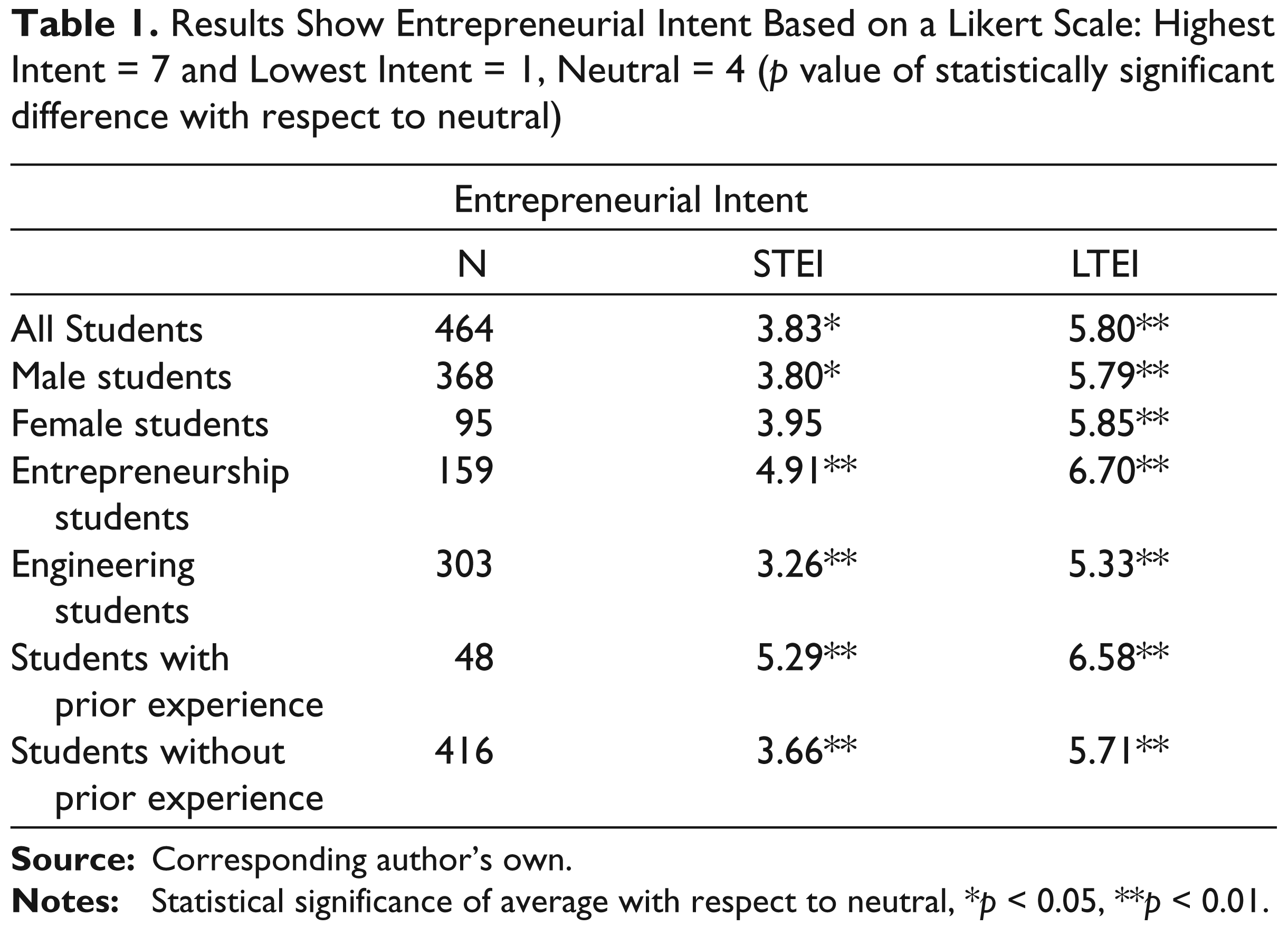
The measure of short-term intent was verified against the respondents’ answer to the question on getting a job working for someone else after graduation. This measure tends to confirm that short-term intent is a valid measure. From the sample, 45 individuals indicated that they had varying levels of negativity towards getting a job for someone else. Their average short-term intent was positive (4.91) and statistically different from neutral (p < 0.05). The 365 respondents who were positive about getting a job working for someone else had a negative average short-term intent (3.54), statistically different from neutral (p < 0.01). A t-test between the two averages STEIs yielded a statistically significant p value less than 0.01, supporting the underlying assumption of using the STEI as a measure.
Table 2 summarises the study results for all respondents, and then subdivides the results into the two main study groups, the entrepreneurship students and the engineering students. Comparison of the average short-term intent and long-term intent of the total sample shows a highly significant difference between the two measures of intent, and supports the rejection of the null hypothesis for H1. The overall short-term intent was slightly negative on average and the overall long-term intent was positive on average.
Temporal Construal, College Major and Past Experience Effects on Entrepreneurial Intent
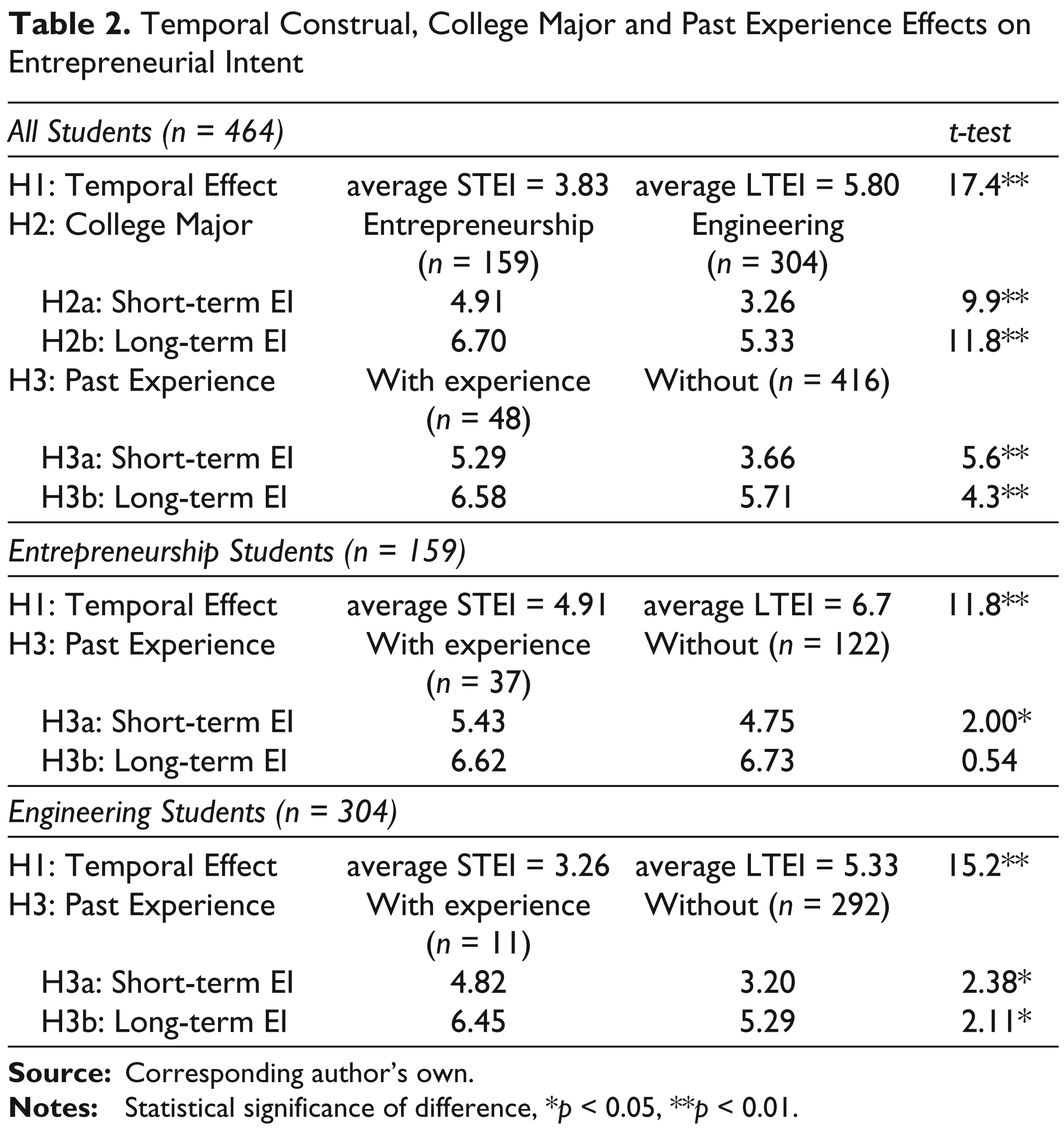
The entrepreneurship students had higher STEI and LTEI than the engineering students. This result helps confirm the validity of the tool, under the assumption that a self-identified group of entrepreneurship majors should have a greater entrepreneurial intent than a random sample of other students. As a result, the null hypothesis for H2 is rejected in both the short-term and long-term measures.
For the population of students with past entrepreneurial experience, the STEI and LTEI are positive, and statistically different from neutral. Those without past entrepreneurial experience are slightly negative in the short-term intent, and are positive in the long-term intent, both being statistically different from neutral. Approximately three-quarters (37/48) of the respondents with past experience are entrepreneurship majors. There is a statistical difference in intent between those with and without experience. As such, the null hypothesis for H3 is rejected.
The temporal effect appears consistent in the sample of entrepreneurship students as whole, with the short-term intent and long-term intent being positive and statistically different than neutral. The LTEI is statistically greater than the STEI for this sample, and supports H1. Separating the sample between entrepreneurship students with and without past experience shows that the sample is positive in STEI and LTEI, and statistically different than neutral. In the short term, those with experience exhibit statistically higher short-term intent than those without experience, supporting H3. In the long term, there is no statistical difference in long-term intent suggesting H3 does not hold; however, the average LTEI for the sample is near the maximum of the scale.
The temporal effect appears consistent in the sample of engineering students as a whole, with the short-term intent being negative and long term being positive at a statistically significant level, thus supporting H1. The sample of engineering students contained very few respondents with past entrepreneurial experience (approximately 3.6 per cent of the sample). On average the respondents with past experience had positive short-term intent and very positive long-term intent. The engineering respondents without past experience had negative STEI and positive LTEI. Comparing the intent of both subgroups of engineering students, we see that those with past experience exhibit statistically significant greater STEI and LTEI than those without, supporting H3.
Self-identification as Technology Entrepreneurs
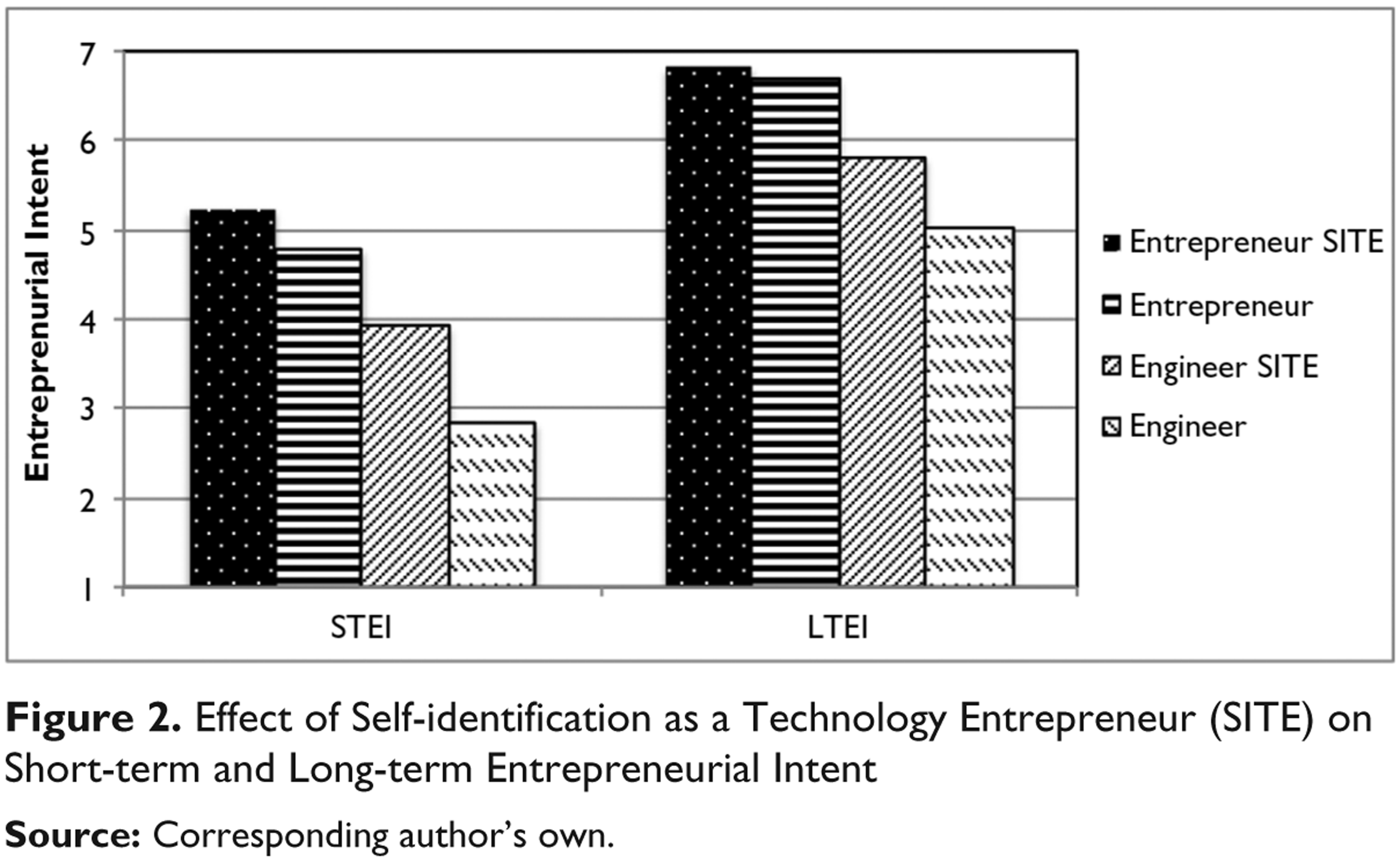
We developed an alternate way to look at the sample population based on their self-identification as a ‘technology entrepreneur’. In the survey instrument, we asked a series of questions about perceptions of salaries and work hours per week associated with new graduates and with entrepreneurs. We further asked the subjects to define ‘technology entrepreneur’ as an open-ended question and then to self-identify whether they considered themselves a technology entrepreneur or not. Almost one-third (32.1 per cent) of the sample population self-identified as technology entrepreneurs. For the entrepreneurship students, this ratio dropped slightly to 30.2 per cent; and, for the engineers, it was slightly higher at 33.1 per cent. Splitting the population amongst self-identified technology entrepreneurs, we found statistically significant differences in the average short-term and long-term intent. On average, subjects that considered themselves technology entrepreneurs had higher intent than those who did not consider themselves technology entrepreneurs (Table 3).
Effect of Self-identification as Technology Entrepreneurs on Intent
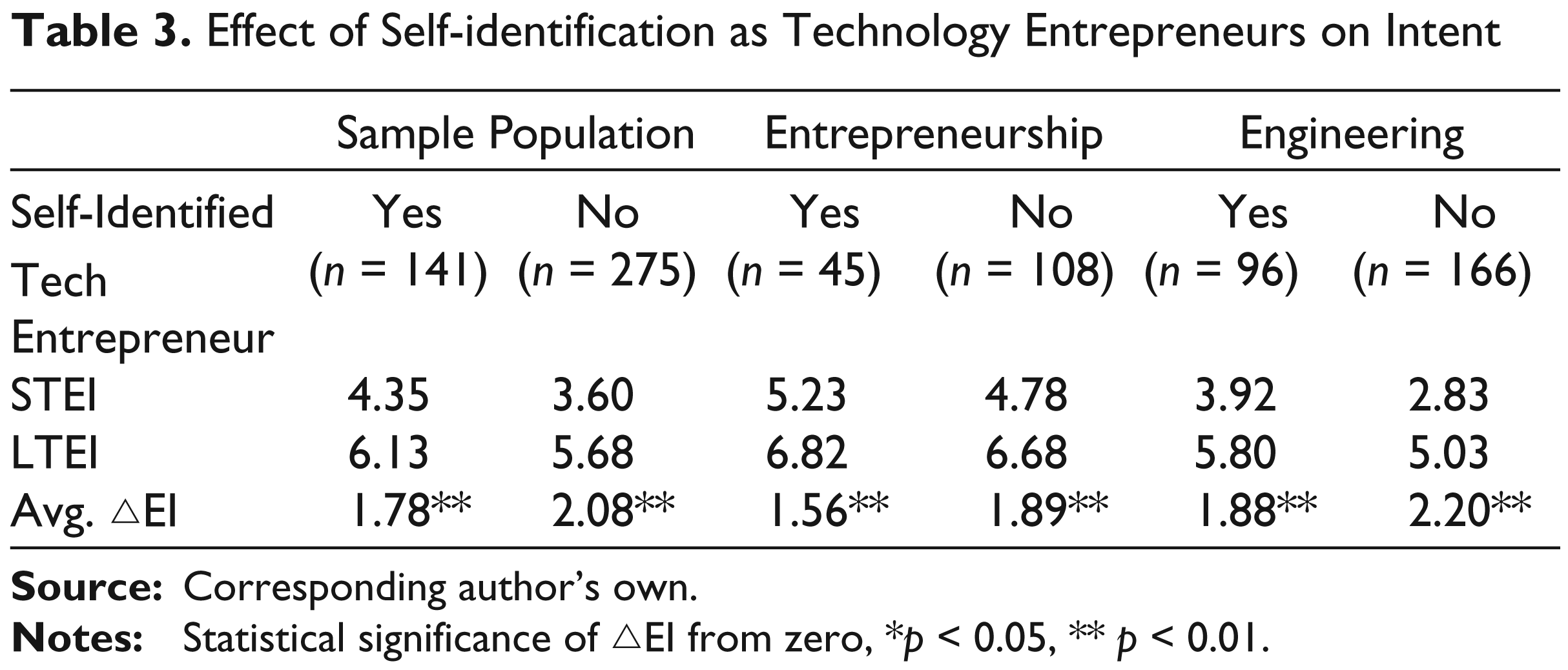
The original assumption that entrepreneurship majors are themselves a self-selected biased sample would suggest that those who do not consider themselves technology entrepreneurs still consider themselves ‘other’ entrepreneurs in non-tech businesses. The weakness in this reasoning is that it does not account for engineers that might consider themselves as part of the ‘other entrepreneurs’ category. For the purposes of this first study we have to accept that if ‘other entrepreneurs’ from engineering majors exist, they create a source of sampling error in our study.
Looking at the difference in average intent between the subgroups, for both short-term and long-term measures, we see that the entrepreneurship students self-reporting as technology entrepreneurs and the other entrepreneurship students do not differ to a statistically significant degree (i.e., p < 0.05) in the measures (Figure 2). An increase in the sample size, yielding the same average and standard deviation, would result in a statistically significant difference, but as the data shows, they are running up against the extreme high end of the scale measure. However, we do see a statistical difference in both short-term and long-term intent between the subgroups of engineers, where the self-identified technology entrepreneurs among the engineers exhibit higher intent. Also worth noting is that the self-identified technology entrepreneurs that are engineering majors exhibit statistically lower intent than either of the subgroups of entrepreneurship students.
Discussion
We were able to confirm the survey tool’s ability to measure differences in entrepreneurial intent in engineering students through the use of the biased sample of entrepreneurship students. Going forward, this gives us more confidence in repeating the study in other universities around the world. Currently, three sister institutions, one in Mexico and two in Spain, are using a Spanish version of the instrument to investigate the entrepreneurial intent of their students. These additional samples will be used to investigate local differences at the specific institutions as well as the potential country and cultural impacts associated with any differences in the measures.
Our survey also yielded similar results to past research finding that there is a significant difference in intent between students with past entrepreneurial experience than those without. Subjects with past experience have higher intent. This leads to several questions about the potential positive role of universities, incubators, business plan competitions and mentoring programmes as sources of experience building that could potentially influence entrepreneurial intent, should a university choose to invest in these areas. It also supports the notion that individuals who have experience through family businesses are a potential pool of high entrepreneurial intent individuals that can be cultivated for future entrepreneurial events or training.
The temporal construal effect was evident in the sample population no matter how we subdivided the respondents. While the biased sample ranged from positive to highly positive on average, the engineering sample showed negative short-term intent and positive long-term intent. This finding indicates that the temporal construal effect on entrepreneurial intent can result in a change in direction from negative to positive depending on the time frame to which the question applies.
Using entrepreneurial without regards to time frame as a discriminator for investing in, and applying entrepreneurial education and resources to potential entrepreneurs has the potential to mislead the investigator. Based on the short-term intent question alone, we would discount the engineering (and potentially by extension STEM) population in this sample as not being interested (on average) in entrepreneurship. However, their LTEI suggests that a significant subset of the population is favourable and interested. Using only the former measure could lead an institution to ignore or overlook a group of individuals who could benefit from entrepreneurial experiences, education and resources to drive future entrepreneurial events. Moreover, given that certain populations may not have had exposure to experiences that may improve short-term intent, comparisons between groups that solely measure STEI will skew against those who may find an entrepreneurial path desirable, but do not feel they have the tools to make such a choice feasible.
Conclusion
Entrepreneurial intent, and its antecedents, has been well studied as a logical predictor of entrepreneurial events (Ajzen, 1985; Audet, 2000; Bird, 1988; Kolvereid, 1996; Krueger, Reilly & Carsrud, 2000; Shapero, 1982). Without it, the likelihood that an individual will pursue an entrepreneurial path is low. But, the devil is in the details. If we are to develop a predictive model, and effectively and efficiently promote entrepreneurship as many of these authors have professed, we must understand other factors that may affect the critical variables that impact entrepreneurial intent, both positively and negatively.
As we explain above, our research was able to establish the validity of our survey tool as a means to measure differences in individual entrepreneurial intent. We were able to identify significant associations between entrepreneurial intent and college major, self-identification as a technology-entrepreneur, and past entrepreneurial experience. These are all variables that affect an individual’s view of their self-efficacy and the feasibility of pursuing an entrepreneurial path, and align well with the existing literature in the field (Ajzen, 1991; Ajzen, 2002; Fitzsimmons & Douglas, 2011; Guerrero et al., 2008; Herron & Sapienza, 1992; Segal, Borgia & Schoenfeld, 2005). More noteworthy are our results regarding differences between short-term entrepreneurial intent and long-term entrepreneurial intent, which we posit arises from temporal construal theory. If entrepreneurial intent is a predictor of entrepreneurial events, we need a solid understanding of how the proximity in time of that intent impacts actual entrepreneurial behaviour. We may have before us a plethora of students—entrepreneurs in potency—with high long-term entrepreneurial intent, but low short-term intent due to their perception that they lack the tools to succeed. This is particularly true in STEM fields, which are the fields in which entrepreneurship can pay the highest economic dividends. We must understand the factors that move the needle in both short-term and long-term intent if we are to impact the growth in technology-based enterprises. We must also better understand the issue of distance in time by analysing a finer temporal spectrum than simply ‘long term’ and ‘short term’ as we have done here.
As with all quasi-experiments, this study may suffer from several limitations, including limitations to generalisability of the results. Within the sample groups we are confident that the high response rate (greater than 90 per cent) mitigates against a sampling bias error in the data. Furthermore, the sampling was repeated with new subjects over a five-year period, also mitigating against a single sample bias. These two elements provide some level of confidence in the generalisability of the results. We have also launched similar studies at three other universities in Spain and Mexico as an extension of this research.
From the scale measure of the instrument itself, a scale ceiling effect was observed with the intentionally biased sample of entrepreneurship students, who tended to group near the highest values on the long-term intent scales. However, this effect did not exist in the engineering sample, which had a much wider response distribution. Furthermore, the results of the intentionally biased sample helped validate the efficacy of the instrument in differentiating between the groups.
In developing a deeper understanding of the entrepreneur, we need to explore not only the existence of the link between entrepreneurial intent and the entrepreneurial event. We must also address the path to successful entrepreneurial events. If governments and educational institutions wish to promote economic development by way of entrepreneurship (Kauffman Foundation, 2008; Morris, Kuratko & Cornwall, 2013), it is critical to understand the variables that impact creation of successful entrepreneurial events. Logic dictates that these are driven by at least two key elements: entrepreneurial intent and entrepreneurial competencies. Much of the work on antecedents associated with entrepreneurial intent—including personality traits and perceived self-efficacy—may exhibit correlations not only with entrepreneurial events, but more importantly with successful entrepreneurial events. While a highly energetic individual with high entrepreneurial intent may start a lot of ventures, only the success of those ventures will have a long-term positive effect on the economy. Expansion of the work into a longitudinal study tracking both short-term and long-term intent through to actual entrepreneurial events and measurement of the success of those events would provide invaluable information towards building a more complete entrepreneurship model. Our ultimate goal would be to develop a deeper model flowing from antecedents to entrepreneurial intent through to successful entrepreneurial events.