






Abstract
This article evaluates critically the competing explanations for informal sector entrepreneurship that read such endeavours to result from either ‘exclusion’ from state benefits and the circuits of the modern economy or the voluntary ‘exit’ of workers from formal institutions. Reporting evidence from a 2003 survey in urban Brazil, it is revealed that similar proportions of informal sector entrepreneurs explain their participation to result from their involuntary exclusion and voluntary exit from the formal economy. The outcome is a call to shift from an either/or to a both/and approach when explaining informal sector entrepreneurship and for wider research on the relative weightings given to exit and exclusion in different contexts so as to develop a socio-spatially contingent explanation for participation in informal sector entrepreneurship across the globe.
Keywords
A recent Organisation for Economic Co-operation and Development (OECD) report highlights that of a global workforce of some 3 billion, 1.8 billion (some two-thirds) work in the informal economy (Jütting & Laiglesia, 2009). Given the enduring importance of this realm, the past decade or so has witnessed the emergence of a small but burgeoning subset of the entrepreneurship literature that has started to seek to explain why entrepreneurs operate in the informal economy both in the global South (Bhatt, 2006; Bhowmik, 2007; Charmes, 1998; Cross, 2000; Cross & Morales, 2007; Das, 2003; Gurtoo & Williams, 2009, 2011; Minard, 2009; Unni & Rani, 2003) and global North (Barbour & Llanes, 2013; Dellot, 2012; Llanes & Barbour, 2007; Small Business Council, 2004; Venkatesh, 2006; Webb, Bruton, Tihanyi & Ireland, 2013; Webb, Ireland & Ketchen, 2014; Williams, 2005, 2006, 2008, 2009; Webb, Tihanyi, Ireland & Sirmon, 2009; Williams, Nadin & Baric, 2011). The result is that competing theories have emerged to explain informal sector entrepreneurship. On the one hand, there is a structuralist perspective which views participants to be pushed into such endeavour by their ‘exclusion’ from state benefits and the circuits of the modern economy (Davis, 2006; Gallin, 2001; Sassen, 1997; Taiwo, 2013) and on the other hand, there is a view that these informal sector entrepreneurs voluntarily ‘exit’ the formal economy, with neoliberals depicting this as a rational economic decision (De Soto, 1989, 2001; Maloney, 2004; Perry & Maloney, 2007) and post-structuralists representing it as a lifestyle choice (Cross, 2000; Gerxhani, 2004; Snyder, 2004). The aim of this article is to evaluate critically the validity of these competing explanations by reporting a survey of the reasons for informal sector entrepreneurship in urban Brazil.
To commence, therefore, a brief review will be provided of the competing explanations that view informal sector entrepreneurship to be a product of either exclusion from the circuits of the modern economy or their voluntary exit from the formal sphere. Second, and to begin to evaluate critically the validity of these rival explanations, a survey of informal sector entrepreneurs and their motives in Brazil’s urban areas will be outlined and third, the results will be reported. This will reveal that participation is the result of neither purely exit nor purely exclusion but instead, that some conduct such endeavour more due to exit and some more due to exclusion. In the final section, therefore, a call will be made for a shift from an either/or to a both/and approach when explaining informal sector entrepreneurship and for wider research on the weighting given to each explanation in different contexts so as to begin to piece together a more socio-spatially contingent explanation for informal sector entrepreneurship across the globe.
Before commencing, however, informal sector entrepreneurship needs to be defined. Given the long-standing problems with finding a common definition of entrepreneurship and how, as Anderson and Starnawska (2008, p. 222) state, ‘entrepreneurship means different things to different people’, a working definition is here employed appropriate to the task at hand. An entrepreneur is defined for the purposes of this article as somebody actively involved in starting a business or is the owner/manager of a business (Harding et al., 2006; Reynolds, Bygrave, Autio & Hay, 2002), while the informal sector is defined as those activities where monetary transactions are not declared to the state for tax, social security or labour law purposes but which are legal in all other respects (Evans, Syrett & Williams, 2006; Williams, 2006; Williams & Windebank, 1998). Informal entrepreneurs, therefore, are those actively involved in starting a business or are the owners/managers of a business engaged in monetary transactions not declared to the state for tax, social security and/or labour law purposes but which is legal in all other respects.
Theorising Informal Sector Entrepreneurship: A Product of Exit or Exclusion?
During the twentieth century, the widely held belief was that economic activity was moving into the formal economy and that the informal economy was small and gradually disappearing. Informal entrepreneurs were thus widely depicted as a leftover or historical legacy from an earlier mode of production. Seen through this lens, the continuing existence of informal sector entrepreneurs, such as street vendors and hawkers, in modern economies represented ‘under-development’, ‘traditionalism’ and ‘backwardness’, while the emergent formal economy represented ‘development’, ‘advancement’ and ‘progress’ (Bairoch, 1973; Geertz, 1963; Lewis, 1959). Informal sector entrepreneurs were consequently viewed as parasitic or at best inefficient; part of a pre-modern traditional economic order that survives only at the fringes of modern society and the antithesis of everything deemed modern.
Over the past decade or so, however, numerous studies have revealed that not only the informal economy (Charmes, 2009; ILO, 2002; Jütting & Laiglesia, 2009; Schneider, 2008) but also informal sector entrepreneurship (De Soto, 2001; ILO, 2012; Minard, 2009; Small Business Council, 2004; Venkatesh, 2006; Volkov, 2002; Webb et al., 2009; Williams, 2006, 2009, 2013; Williams & Round, 2009; Williams, Nadin & Rodgers, 2012) is extensive, enduring and expanding in the global economy. The outcome is that various attempts have been made to explain its persistence and growth. Until now, commentators have largely adopted one of the two broad perspectives. Here, each is briefly reviewed in turn.
Informal Entrepreneurship: A Product of Exclusion
Recognising the widespread persistence and even growth of informal entrepreneurship, a group of structuralist commentators have depicted such endeavour as a by-product of the advent of an increasingly deregulated global economy and informal sector entrepreneurs as unwilling and unfortunate pawns in an exploitative global economic system (Castells & Portes, 1989; Davis, 2006; Gallin, 2001; Portes, 1994; Portes & Haller, 2004; Portes & Roberts, 2005; Sassen, 1997). They are the surplus labour ‘excluded’ from the circuits of the modern economy who engage in this endeavour out of necessity as a survival strategy in the absence of alternative means of livelihood. Read through this lens, informal entrepreneurship is an absorber of surplus labour, provider of income-earning opportunities for the poor, a provider of goods and services that are often unavailable in the formal sector and a primary means of maintaining a low cost of living by providing cheaper goods and services than would otherwise be the case (Bhatt, 2006; Nelson & Bruijn, 2005; Tokman, 2001).
As Fernandez-Kelly (2006, p. 18) therefore puts it, ‘the informal economy is far from a vestige of earlier stages in economic development. Instead, informality is part and parcel of the processes of modernization.’ For these commentators, informal sector entrepreneurship is seen to exist at the bottom of a hierarchy of types of employment and is akin to ‘downgraded labour’ with its participants receiving few benefits, low wages and with poor working conditions (Castells & Portes, 1989; Gallin, 2001; ILO, 2002; Kapoor, 2007; Portes, 1994; Sassen, 1997).
On the one hand, informal sector entrepreneurship is a direct result of employers reducing costs by subcontracting production to the informal economy, such as to people who might have been former employees who now engage in ‘false self-employment’ for one supplier only (Castells & Portes, 1989; Gallin, 2001; Portes, 1994; Portes & Haller, 2004; Portes & Roberts, 2005; Sassen, 1997). On the other hand, it is viewed as an absorber of surplus labour for those excluded from the formal labour market. Those of no use to capitalism are no longer maintained as a reserve army of labour but, instead, are offloaded onto the informal economy resulting in their increasing reliance on informal entrepreneurship as a survival practice. Informal entrepreneurship is therefore extensive in excluded populations where the formal economy is weak since its role is to act as a substitute. It is undertaken by those involuntarily decanted into this realm and conducted out of necessity as a survival tactic (Castells & Portes, 1989; Sassen, 1997).
Informal Entrepreneurship: A Product of Exit
For others, informal sector entrepreneurship is the result of a decision to voluntarily ‘exit’ the formal economy, rather than a product of involuntary exclusion. On the one hand, this is argued from a neoliberal perspective where informal sector entrepreneurs are viewed as rational economic actors making a rational economic decision to exit the formal economy (De Soto, 1989, 2001; Maloney, 2004; Perry & Maloney, 2007). On the other hand, it is argued from a post-structuralist perspective where informal sector entrepreneurs are viewed as social actors making a lifestyle choice (Cross, 2000; Gerxhani, 2004; Snyder, 2004). Each is here reviewed in turn.
Informal entrepreneurship is consequently a rational economic strategy pursued by entrepreneurs whose spirit is stifled by state-imposed institutional constraints. It is a populist reaction to over-regulation. As such, pursuing entrepreneurial endeavour in the informal economy is asserted to offer potential benefits not found in formal economy, including flexible hours, job training, ease of entry to the labour force, opportunity for economic independence, better wages and avoidance of taxes and inefficient government regulation (Gurtoo & Williams, 2011; Maloney, 2004; Packard, 2007).
In a global North context, this has resulted in a re-reading of informal entrepreneurship as a voluntary activity which is conducted largely for closer social relations such as kin, neighbours, friends and acquaintances (Williams, 2006); undertaken more for social and redistributive reasons rather than purely financial gain (Persson & Malmer, 2006; Round & Williams, 2008; Williams, 2004); a resistance practice pursued in response to either waged formal employment or the corruption and bribes that can be part and parcel of operating in the formal economy (Kudva, 2009; Round, Williams & Rodgers, 2008; Whitson, 2007); or an alternative realm in which people transform their work identity and/or display their authentic identities such as by establishing ‘lifestyle’ business ventures (Snyder, 2004).
In a global South context, this representation of informal entrepreneurs as social actors has been similarly adopted but the emphasis has been slightly different. Here, the major thrust has been to depict informal entrepreneurship more as a ‘lifestyle’ choice. First, attention has been drawn to not only how the social relations between informal entrepreneurs differ from normal market relations in that business and friendship relations blur and there is greater community solidarity and reciprocity (Stillerman & Sundt, 2007) but also how exchange relations between informal entrepreneurs and their customers differ from mainstream market relations in that without recourse to a legal contract, interpersonal relations and trust become more important (Cross & Morales, 2007). Second, there has been a focus on how informal entrepreneurship is pursued as a lifestyle choice because of the greater personal freedom and flexibility it affords and allows them to gain control over their lives (Cross, 2000; Hart, 1973) and third and finally, how such informal entrepreneurship is often in the eyes of its participants a family tradition and expression of community support which allows customers to source goods they otherwise could not afford (Cross, 2000).
Until now, these exit and exclusion perspectives have been largely treated as mutually exclusive. Most commentators depict informal entrepreneurship as taking place according to a single unique ‘logic’ (De Soto, 2001; Snyder, 2004). In recent years, some have begun to call for the crude depiction of informal entrepreneurship as universally caused by exit or universally caused by exclusion to be transcended. As Perry and Maloney (2007, p. 2) point out, ‘These two lenses, focusing, respectively, on informality driven by exclusion from state benefits and on voluntary exit decisions resulting from private cost-benefit calculations, are complementary rather than competing analytical frameworks.’ Here, therefore, and in a bid to show the need to move beyond the either/or approach that views them as competing perspectives and towards a both/and approach which examines the weight that needs to be given to each explanation in different contexts, we report some evidence from urban Brazil.
Methodology
In order to evaluate critically the validity of viewing exit and exclusion as competing explanations for participation in informal sector entrepreneurship, we here report a household survey conducted in Brazil during 2003 by the Brazilian Institute for Geography and Statistics (Instituto Brasileiro de Geografia e Estadística (IBGE)), which is the National Census Bureau. This survey of the urban informal sector (Pesquisa Economia Informal Urbana (ECINF)) generates cross-section data representative of the urban self-employed and micro-firm owners with at most five paid employees, excluding domestic workers.
The stratified sampling design, developed in two stages, generated a representative sample of these entrepreneurs both geographically and in terms of the sectors in which they work. In the first stage, the number of households to be interviewed in each of the geographical areas that constitute urban Brazil was decided. To achieve this representative sample, the 2000 census was used to identify the number of these entrepreneurs in the 26 Brazilian states, as well as federal districts, and also each of the 10 metropolitan areas (Belém, Fortaleza, Recife, Salvador, Belo Horizonte, Vitória, Rio de Janeiro, São Paulo, Curitiba and Porto Alegre) and the municipality of Goiânia. Having established the number to be interviewed in each urban area, the second stage then involved generating a representative sample of these entrepreneurs according to the activity or sector in which they worked. Using the 2000 census of population to determine the number of these entrepreneurs operating across different economic activities in each urban area, the number of interviews required in each sector within each urban area was determined. The outcome was a representative sample of the population of micro-entrepreneurs in urban Brazil.
To collect the data for ECINF, two surveys were undertaken. First, the ECINF household questionnaire gathered background socio-demographic information on household members aged 10 or older, including their employment status. This included investigating whether they were self-employed or employers who employ up to five employees. If a household member was identified as being either self-employed or an employer with five employees or fewer, then the second survey was implemented, the ECINF individual questionnaire. This investigated the characteristics of their entrepreneurial endeavour.
First, data was collected on the nature of the economic activity conducted, classified using the Brazilian National Classification of Economic Activities, which is an adaptation of the third revision of the International Standard Industrial Classification (ISIC) of economic activities of the United Nations. Second, data on the income generated, the expenses involved, equipment required, location of production and number of employees were collected. Third, and to evaluate the level of organisation, formalisation and/or visibility of these economic units, the type of accounting adopted for recording the transactions, the status of the employees, whether the enterprise was registered with the authorities, had a licence to trade and whether they paid taxes and made social contribution payments was investigated. Fourth, the main problems confronting the business, their plans for the future (expansion/retraction/maintenance of the level of activity or closing the business) and the difficulties involved in regularising the business were investigated. Fifth, their main reason for starting up the enterprise was investigated using a closed-ended list of reasons that reflects the contrasting rationales cited by the exit and exclusion perspectives discussed above. Sixth, the characteristics of the entrepreneur were investigated, such as, whether they had other jobs, their education level and the prior work they undertook so as to reveal the origin of such micro-entrepreneurs. Finally, data were gathered on their access to various services, such as credit as well as how they paid for goods or raw materials and the location of their customers.
In total, 54,595 households were interviewed. Of the 40,235 individuals identified who reported being either self-employed or owners of businesses with a maximum of five paid employees, just 8 per cent reported paying taxes and/or making social security contributions. Below, therefore, the results will be reported for the 37,016 individuals who are either self-employed or owners of a business with a maximum of five employees who report that they do not pay either taxes and/or make social security contributions, that is, who are informal entrepreneurs.
Results
This survey reveals that 86.7 per cent of informal sector entrepreneurs in urban Brazil operate as sole traders without any employees and 13.3 per cent have enterprises with five employees or less. Examining the characteristics of these informal sector entrepreneurs, Table 1 reveals that two-thirds (66 per cent) are men, rising to three-quarters (73 per cent) amongst those who own informal sector enterprises with employees. Men, moreover, earn some 67 per cent more than women from their informal sector entrepreneurship (R$869 compared to R$520), displaying how informal sector entrepreneurship reinforces the gender disparities in the wider labour market. Most informal entrepreneurs, furthermore, are in the prime working age population aged 25–59 years (83 per cent of all informal entrepreneurs), with nearly one-third (31 per cent) having completed at least their education to high school level and 8 per cent having a university degree. Just 9 per cent have no education or less than 1 year of education. Of those informal entrepreneurs with employees, moreover, around one in five (18 per cent) has a university degree, thus calling into question the depiction of informal entrepreneurs as largely composed of the illiterate and uneducated.
Socio-demographic Characteristics of Informal Entrepreneurs in Urban Brazil, 2003

Turning to the nature of their entrepreneurial endeavour, Table 2 reveals that 52 per cent work for 40 hours or more each week, rising to 70 per cent amongst those with employees. The vast majority work for 21 days or more each month. Consequently, informal entrepreneurship in Brazil is not largely a part-time endeavour used to top up other earnings, as has been found in advanced Western economies (Williams, 2004, 2006). Indeed, just 19 per cent worked less than 20 hours per week and 15 per cent less than 15 days per month. Instead, there appears to be segmented labour force of informal entrepreneurs with at one end, the majority engaged in informal entrepreneurship as a full-time occupation and principal source of earnings and at the other end, a minority conducting such informal entrepreneurial endeavour on a more part-time basis as a means of topping up the household earnings. Analysing the activities conducted, the most common sectors are commerce and repairs (33 per cent), construction (17 per cent), primary and manufacturing industry (16 per cent), social and personal services (8 per cent), transport storage and distribution (8 per cent) and hospitality and food services (7 per cent). Many of these businesses are well established with 31 per cent being established for over 10 years and a further 26 per cent for 5–10 years.
Nature of Informal Sector Entrepreneurial Endeavour in Urban Brazil, 2003

Given that 27.3 per cent of these informal entrepreneurs operate home-based enterprises and a further 27.5 per cent work in their customers home, this clearly signals the importance of conducting a household survey if the full range of informal entrepreneurship is to be captured (Mason, Carter & Tagg, 2008). Indeed, only one-fifth (20.3 per cent) of the informal entrepreneurs operate from a workshop or store, displaying the limited range of informal sector entrepreneurship that would be captured by a business premise survey.
Informal entrepreneurship is sometimes depicted in the ‘exclusion’ perspective to be a result of production activities being increasingly subcontracted into the informal sector and that people who might have been former formal employees engage in ‘false self-employment’ for one supplier only (Castells & Portes, 1989; Gallin, 2001; Portes, 1994; Portes & Haller, 2004; Portes & Roberts, 2005; Sassen, 1997). The finding of this survey, however, is that just 4.1 per cent of these micro-enterprises work for one customer only, just 0.7 per cent for big businesses and 1.9 per cent for small businesses. It therefore appears that entrepreneurial endeavour in the informal economy in Brazil is not a result of subcontracting production functions down the supply chain to the informal sector. Nevertheless, it might still be the case, as other commentaries based on the ‘exclusion’ depiction of these informal entrepreneurs argue, that this realm represents an absorber of surplus labour and provider of income-earning opportunities for those offloaded by the formal labour market (Bhatt, 2006; Nelson & Bruijn, 2005; Tokman, 2001).
Informal Sector Entrepreneurs’ Motives: Exclusion or Exit?
What were their reasons, therefore, for participating in informal sector entrepreneurship? As the literature review revealed, although the twentieth century was characterised by a depiction of such endeavour as a historical legacy leftover from a previous mode of accumulation, the persistence and growth of informal sector entrepreneurship has led to the emergence of new perspectives that view it to be a product either of involuntary ‘exclusion’ from the circuits of the modern economy or voluntary ‘exit’ from the formal economy as a rational economic decision or lifestyle choice.
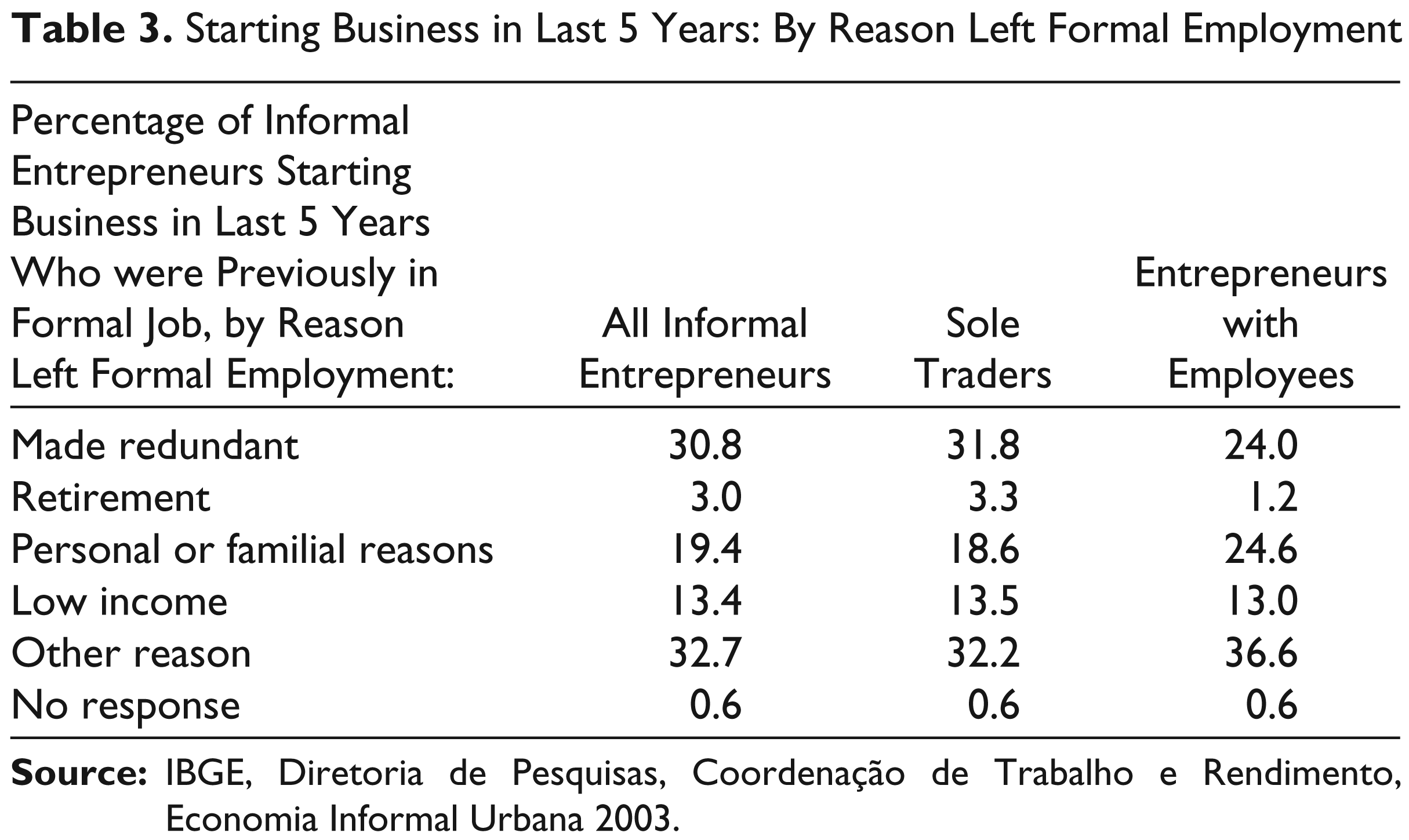
The first clue that informal sector entrepreneurship is not universally a result of exclusion from the formal economy is that of the 27 per cent who were in formal employment before establishing their informal sector micro-enterprise, Table 3 reveals that only 31 per cent cited redundancy as their reason for leaving their formal employment. The remaining 69 per cent leaving formal employment did so for other more voluntary reasons such as to achieve personal goals (such as the desire for autonomy and flexibility). If the structuralist account was correct, then it should have been the case that they involuntarily left their formal job and have adopted informal entrepreneurship as a means of livelihood due to their exclusion from the formal economy. This is not the case for all informal sector entrepreneurs.
Starting Business in Last 5 Years: By Reason Left Formal Employment
To evaluate the proportion of informal sector entrepreneurs who are driven by exclusion into informal sector entrepreneurship and the proportion who voluntarily exit the formal economy, therefore, participants were asked which of the following 10 reasons were their major motivation for starting their micro-enterprise: family tradition; did not find a formal job; to supplement my net income; opportunity presented by partner; experience in the area; promising business opportunity; it was a secondary job; it allowed me to have working time flexibility; and it gave me independence. Table 4 groups these reasons according to whether they are exclusion or exit rationales for participating in informal sector entrepreneurship, so as to enable an evaluation of the weight that needs to be given to each when explaining informal entrepreneurship in urban Brazil.
Motives for Starting Informal Sector Enterprise, Brazil, 2003
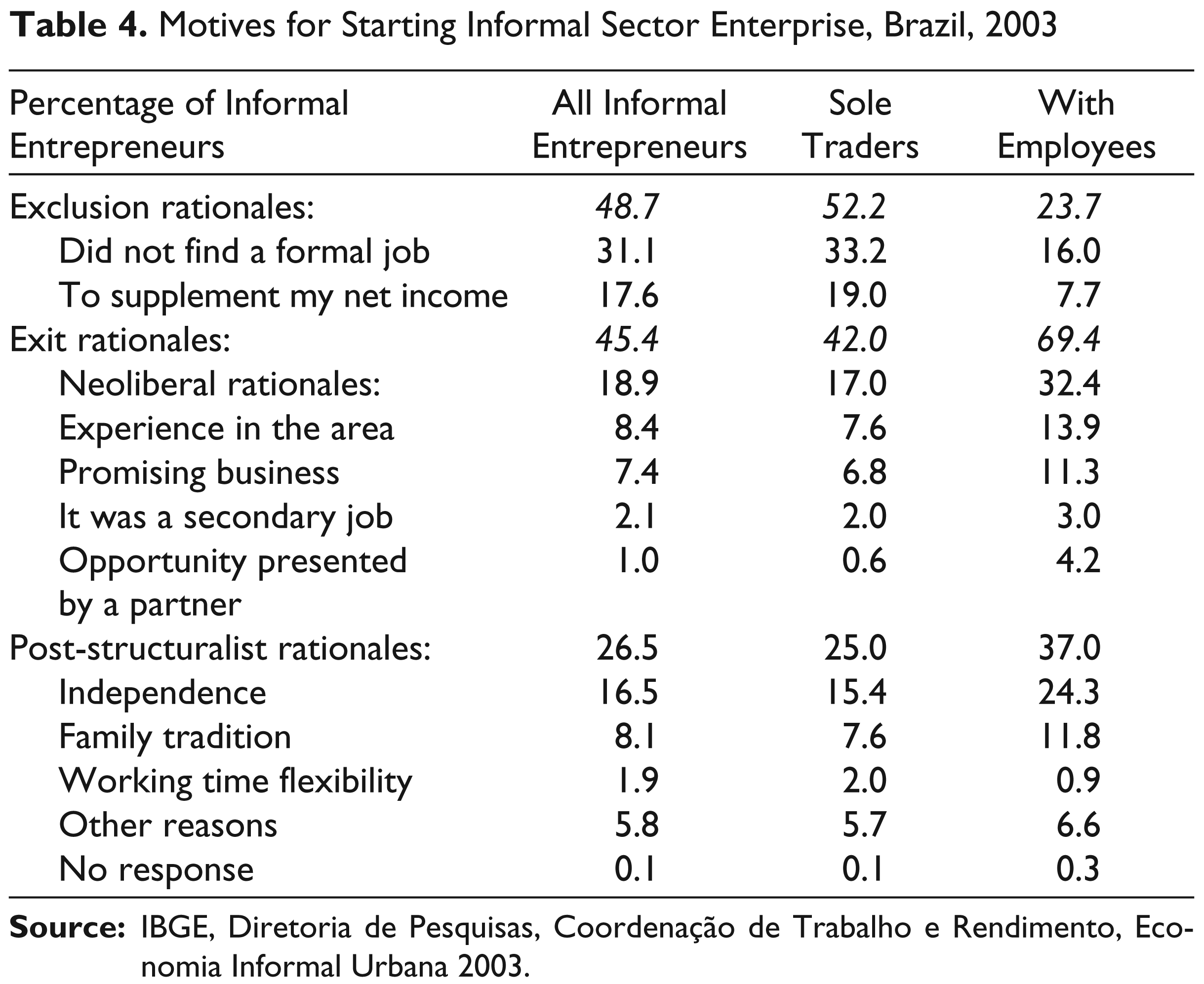
The finding is that less than half (48.7 per cent) of informal sector entrepreneurs claim that they started up their micro-enterprise due to their exclusion from the circuits of the modern economy such as due to their inability to find a formal job or due to inadequate income. Indeed, less than one-third (31.1 per cent) of informal sector entrepreneurs gave their inability to find a formal job as their reason for engaging in such entrepreneurial endeavour in the informal sector.
For 45.5 per cent of informal sector entrepreneurs, therefore, participation in this endeavour is more a matter of choice, rather than due to a lack of choice. Why, therefore, do they assert that informal entrepreneurship is a chosen activity? Some 18.9 per cent of informal sector entrepreneurs reflect the neoliberal explanation representing themselves as rational economic actors who have chosen to exit the formal economy, with 8.4 per cent stating that it was due to their experience or skills in the area, 7.4 per cent because it represented a promising business opportunity, 2.1 per cent because it was a secondary job and 1 per cent because of the opportunity presented by their partner. Some one-quarter (26.5 per cent) of informal sector entrepreneurs, meanwhile, reflect the post-structuralist explanation, viewing this endeavour as a lifestyle choice due to the independence they achieve from pursuing this type of work (16.5 per cent), the fact that they are following a family tradition in pursuing such endeavour (8.1 per cent) and the flexibility they can achieve in their working lives (1.9 per cent). These informal entrepreneurs are therefore ‘lifestyle entrepreneurs’ doing so out of family tradition and/or due to the flexibility and independence they find in such endeavour.
In broad terms, therefore, some 10 in every 20 informal entrepreneurs do so due to their exclusion from the formal economy, four out of choice and as a rational economic decision, five as a lifestyle choice and the remaining 1 in 20 either gave other reasons or did not respond. When comparing the sole traders’ motives with those who have five employees or fewer, however, some marked differences stand out. While over half (52.2 per cent) of informal sector sole traders are primarily doing so due to their exclusion from the formal economy, this is the case for less than a quarter (23.7 per cent) of informal sector entrepreneurs with five employees or fewer. For the latter, it is more due to a desire to voluntarily exit the formal economy. Indeed, neoliberal explanations account for nearly one-third (32.4 per cent) of informal sector entrepreneurs with employees and post-structuralist exit rationales for 37 per cent of these entrepreneurs. While sole traders are driven more by exclusion into informal sector entrepreneurship, therefore, entrepreneurs with five or fewer employees are driven more by exit rationales, with approximately the same number viewing it as a rational economic decision as those who view it as a lifestyle choice.
In sum, no single explanation is universally valid in relation to all informal entrepreneurs. Instead, it is only by combining and using both exclusion and exit explanations that a more comprehensive and fuller explanation can be achieved of the different rationales for informal sector entrepreneurship. Consequently, rather than view these as competing either/or explanations, they should both be viewed as required in order to more fully understand the range of reasons for informal sector entrepreneurship. It is not whether one is universally correct, in sum, but the weight which needs to be given to each explanation in any particular context that is important.
Conclusions
This article has evaluated critically the competing explanations that read engagement in informal sector entrepreneurship through either a structuralist lens as driven by ‘exclusion’ from state benefits and the circuits of the modern economy or through a neoliberal and/or post-structuralist lens as driven by the voluntary ‘exit’ of workers from formal institutions. To do this, empirical evidence from a 2003 survey of informal sector entrepreneurs in urban Brazil has been reported.
The finding in broad terms has been that some 10 in every 20 informal sector entrepreneurs engage in this endeavour due to their exclusion from the formal economy, four out of choice as rational economic actors, five as a lifestyle choice and the remaining 1 in 20 either gave other reasons or did not respond. Around one-half (48.7 per cent) of these informal sector entrepreneurs operating micro-enterprises with five employees or less, therefore, are driven into this realm due to their exclusion from the circuits of the modern formal economy. Instead, for 45.4 per cent of informal sector entrepreneurs, participation in this endeavour is a matter of choice, rather than due to a lack of choice. They voluntarily ‘exit’ the formal economy as either a rational economic decision or a lifestyle choice. The remaining 5.9 per cent either cite other reasons beyond the issues investigated or did not respond. Of those conforming to the voluntary ‘exit’ perspective, some 18.9 per cent stated neoliberal explanations associated with it being a rational economic decision and 26.5 per cent cited post-structuralist explanations associated with it being a lifestyle choice. However, although similar proportions of informal sector entrepreneurs cite exclusion and exit rationales in urban Brazil, those who are sole traders are more likely to cite exclusion rationales while those informal sector entrepreneurs with five or fewer employees are more likely to cite exit rationales.
The outcome is that these exit and exclusion perspectives can no longer be seen as mutually exclusive. Informal sector entrepreneurship is not universally due to either exclusion or exit. To fully understand such endeavour, both exit and exclusion explanations need to be used. There is therefore a need to shift from an either/or to a both/and approach when explaining informal sector entrepreneurship. It is more an issue of the weighting which applies to each explanation when seeking to understand informal sector entrepreneurship in different contexts. Hopefully, therefore, this article will encourage not only a shift from an either/or that views them as competing perspectives and towards a both/and approach which examines the weight that needs to be given to each explanation in different contexts but also further research on what weighting is valid for exit and exclusion in different contexts so as to begin to piece together a more socio-spatially contingent explanation for participation in informal sector entrepreneurship across the globe. If this article stimulates this re-theorising of informal sector entrepreneurship and encourages such further research, then it will have achieved its objectives.