







Abstract
The objective of the study was to examine the effect of entrepreneurs’ risk-taking propensity on firm performance and the moderating role of managerial network ties on this relationship in a sub-Saharan economy. This theoretically derived research model is empirically validated using survey data from 298 small and medium-sized enterprises (SMEs) in Ghana. The study’s empirical findings are that high levels of entrepreneurs’ risk-taking propensity enhance firm performance. This relationship is amplified when entrepreneurs cultivate stronger business, political and community network ties.
Entrepreneurs’ risk-taking propensity is consistently viewed by scholars as a highly influential variable in entrepreneurship (Brockhaus, 1980; Delmar, 1994; Zhao, Seibert & Lumpkin, 2010). Entrepreneurship provides a unique background to study risk-taking due to the high amount of subjectivity in entrepreneurs’ decision-making (Busenitz & Barney, 1997; Cooper, Woo & Dunkelberg, 1988; Lammers, Willebrands & Hartog, 2010). Recent theoretical work on small and medium-sized enterprises (SMEs) performance takes into account risk-taking propensity of entrepreneurs (e.g., Cressy, 2006; Zhao et al., 2010). In the psychology literature, risk-taking has often been included in the examination of firm success as one of the personality characteristics of an entrepreneur (e.g., Rauch & Frese, 2000). As such, the literature suggests that entrepreneurs’ risk-taking propensity is a critical aspect of entrepreneurship (e.g., Rauch & Frese, 2000; Zhao et al., 2010) and that how entrepreneurs perceive and manage risks in the business environment is essential for the growth of a business (Delmar, 1994). In light of this, it is crucial that deeper investigations are made to understand the role of entrepreneurs’ risk-taking behaviour in driving firm performance.
Although risk-taking propensity has been widely studied in the past (e.g., Brockhaus, 1980; Carland et al., 1984; Masters & Meier, 1988; Ray, 1986; Schwer & Yucelt, 1984; Sexton & Bowman, 1986; Zhao et al., 2010), how entrepreneurs’ risk-taking propensity drives firm performance is not well understood. Additionally, the conditions in which risk-taking propensity is more or less pronounced in firm performance are less understood. This study attempts to fill these knowledge gaps. This study, therefore, aims to examine the following research question: What influence does entrepreneurs’ risk-taking propensity have on firm performance and what are the performance implications of managerial network ties on the relationship between entrepreneurs’ risk-taking propensity and firm performance of SMEs operating in a less developed market economy?
To address this question, the present study draws on prospect theory (Kahneman & Tversky, 1979; Tversky & Kahneman, 1992) and social capital theory (Granovetter, 1985, 2005). The prospect theory suggests that entrepreneurs are rational in making their risky investment decisions but exhibit different levels of risk-aversion over time, depending on their positions relative to a given target outcome. The main tenet of prospect theory is the use of value function. The basic proposal of prospect theory is that decision-makers, such as entrepreneurs, use reference points in evaluating risky choices. The theory suggests that entrepreneurs or decision-makers are not necessarily risk-averse but rather they implement a risk-seeking behaviour when their performances are below a given target level and risk-averse when their performances are above the target level. Based on extant literature on risk-taking propensity (e.g., Masters & Meier, 1988; Ray, 1986; Sexton & Bowman, 1986; Zhao et al., 2010), this study contends that high levels of risk-taking among entrepreneurs have a positive influence on a firm’s performance.
The second major theoretical perspective that guides the integration of risk-taking propensity and managerial network ties is social capital theory. The present study contends that network ties among entrepreneurs are important informal governance mechanisms that minimise the impact of uncertainty associated with risk-taking behaviours of entrepreneurs, such that network ties become increasingly relevant to firms while risk-taking (Granovetter, 2005). Management scholars have contended that the social capital embodied in the development of social networks and ties with external entities, a micro-level construct, affects a firm’s competitive advantage and performance, a macro-level construct (e.g., Acquaah, 2007; Burt, 1997; Peng & Luo, 2000). Additionally, although it has been suggested that the value of social capital is contingent on the risk-taking (as part of entrepreneurial orientation literature)– performance relationship (Boso, Story & Cadogan, 2013), there is no comprehensive investigation into how social capital is contingent on individuals’ risk-taking propensity–firm performance linkage. Social networking and ties are important in a developing country setting because of the presence of strong collectivistic cultures (Acquaah, 2007; Acquaah & Eshun, 2010). Yet, there have been few scholarly studies testing the moderating effect of social capital developed from entrepreneurial networking and social ties on individual’s risk-taking propensity and firm performance in less developed market settings. This study argues that managerial network ties positively moderate the risk-taking propensity–performance linkage. This argument is based on the notion that because formal business-supporting institutions in emerging markets are underdeveloped (London & Hart, 2004), managerial network ties (defined as entrepreneurs’ social ties with governmental authorities, with managers in other firms and with community leaders) may be a major facilitator of the effectiveness of entrepreneurs’ risk-taking propensity (Bruton, Ahlstrom & Obloj, 2008; Li & Zhou, 2010).
In order to validate the study’s theoretical arguments empirically, the hypotheses are tested using survey responses provided by entrepreneurs of Ghanaian SMEs. This study focused on Ghana because it is, in some important respects, representative of sub-Saharan African emerging economies (Hoskisson et al., 2000; Julian & Ofori-Dankwa, 2013). The empirical findings provide support for the study’s core expectation that risktaking propensity drives firm performance and that managerial network ties boost the effect of risk-taking propensity on firm performance.
The present study contributes to the entrepreneurship literature in two important ways. First, whiles risk-taking has been studied as part of entrepreneurial orientation literature (firm level) in developing country contexts (e.g., Boso et al., 2013), this study is the first study from the perspective of sub-Saharan Africa to examine entrepreneurs’ risk-taking propensity as one of the personality characteristics of the entrepreneur. Specifically, this study examines the relationship between entrepreneurs’ risk-taking propensity and the performance of their firms. Second, the current study examines the moderating role of network ties on entrepreneurs’ risk-taking propensity–performance relationship. By so doing the current study shows the boundary conditions of the impact of entrepreneurs’ risk-taking propensity on firm performance.
In the sections that follow next, entrepreneurs’ risk-taking is examined; the theoretical background and research hypotheses are presented. This is then followed by the study’s analytical approach relating to measures and an assessment of the hypotheses. The study then presents the results and discussion of the study’s contribution. The study concludes with remarks relating to future research direction.
Theory and Hypotheses
There have been some scholar attempts in defining risk-taking in the entrepreneurship literature (Forlani & Mullins, 2000; March & Shapira, 1987; Stewart & Roth, 2001). However, the biggest challenge in understanding risk-taking rests on defining the term risk (Janney & Dess, 2006). According to Brockhaus (1980, p. 513), risk-taking propensity is
the perceived probability of receiving the rewards associated with success of a proposed situation, which is required by an individual before he will subject himself to the consequences associated with failure, the alternative situation providing less reward as well as less severe consequences than the proposed situation.
Indeed, Palmer (1971, p. 38) indicated that the psychological testing of entrepreneur ‘be directed most toward the measurement of an individual’s perception and handling of risk’. In the literature, risk is often seen as an offshoot of the variation in the distribution of possible outcomes, the related outcome likelihoods and their subjective values (March & Shapira, 1987; Stewart & Roth, 2001). Other scholars in classical decision theory, however, have noted that risk-taking decisions are not based entirely on realistic calculations but are also influenced by individual proclivity towards risk (Bromiley & Curley, 1992). Thus, a vast scholarly research suggests that risk-taking is predispositional rather than situational (Plax & Rosenfeld, 1976; Stewart & Roth, 2001; Zhao et al., 2010).
The trait approach suggests that entrepreneurs are characterised by the ability to take risk. Studies generally support the notion that risk-taking is predispositional and not simply a situational variable and there is strong evidence for a propensity for risk-taking (Jackson, Hourany & Vidmar, 1972). This suggests that entrepreneurs take risk to establish a business venture. The different types of risks an entrepreneur faces are financial risk, management risk and personal risk (Gartner, 1990). It is, therefore, reasonable to argue that entrepreneurs put their whole career on the line in their pursuit of a new and independent enterprise (Gartner, 1990). Entrepreneurs who start new ventures risk financial well-being, career opportunities, family relations and psychic well-being (Liles, 1974). The financial commitments made by entrepreneurs to a failing venture can result in major losses and could endanger the entrepreneur’s future standard of living (Brockhaus, 1980). Failure of the entrepreneur can emotionally affect the individual because the individual is likely to devote himself to the venture. According to Liles (1974), as the financial and emotional consequences of failure could be injurious, potential entrepreneurs should analyse the risks associated with a specific venture. The decision to undertake a venture, therefore, rests on the potential entrepreneurs (Zhao et al., 2010).
While risk-taking propensity is argued to influence firm performance, a major argument for the present study is that managerial network ties are organisational resources that boost the effect of risk-taking on firm performance (Granovetter, 1985; Laumann, Galaskiewicz & Marsden, 1978). Although it has been argued that the value of managerial network is contingent on the strategic organisation of firm activities (Burt, 1997; Burt et al., 1994), there is no comprehensive investigation into how managerial network ties are contingent on entrepreneurs’ risk-taking propensity. Therefore, a major theoretical argument of the present study is that entrepreneurs’ risk-taking propensity enhances firm performance more so when entrepreneurs cultivate stronger managerial network ties.
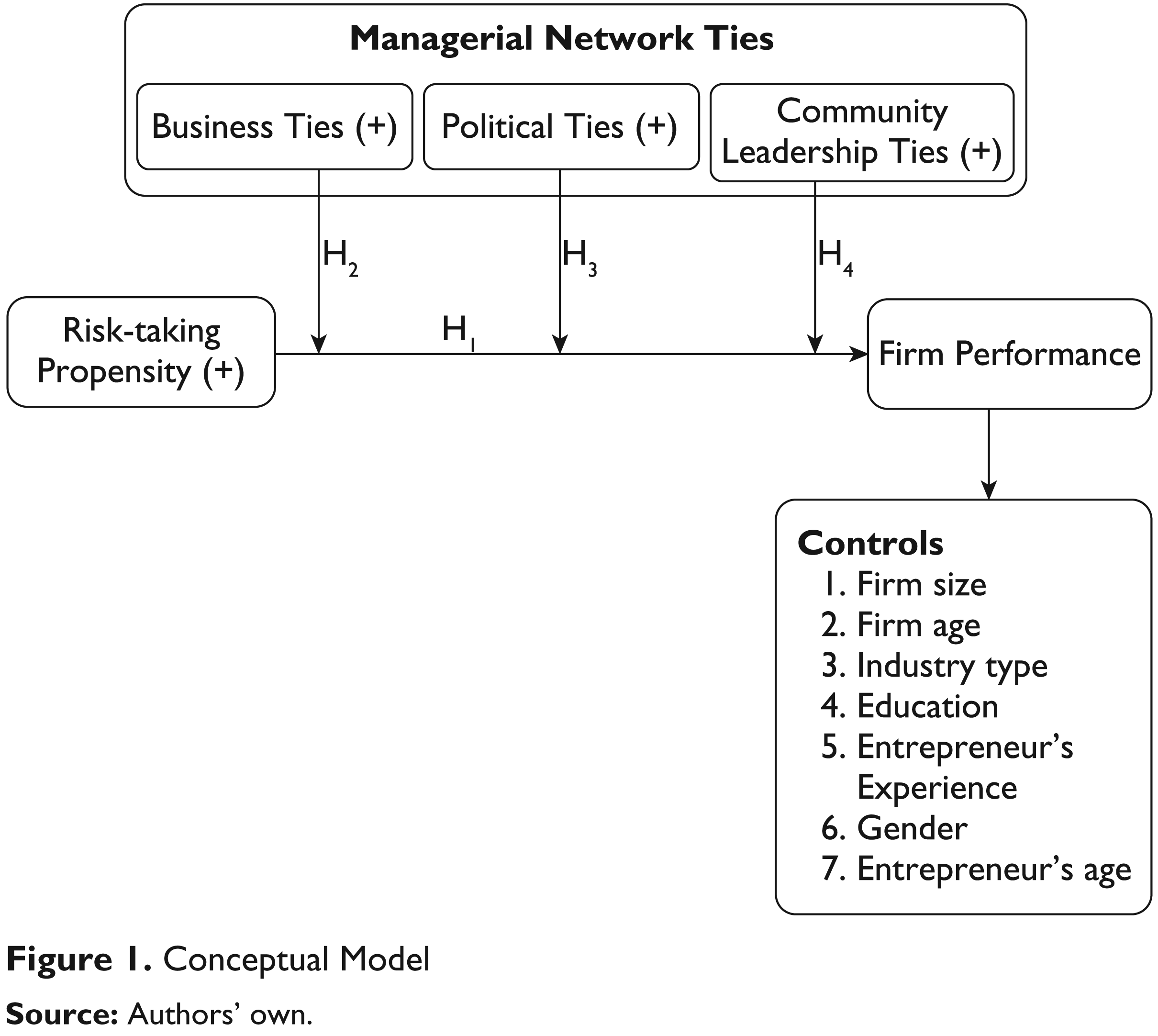
Figure 1 illustrates the study’s model of the interrelationship between risk-taking propensity, managerial network ties and firm performance. The firm performance is influenced by the entrepreneurs’ risk-taking propensity. The level of managerial network ties (business, political and community ties) influences the effect of entrepreneurs’ risk-taking propensity on performance. The section that follows next explains the development of hypotheses for each of these relationships.
Risk-taking Propensity and Firm Performance
Small and medium-sized enterprises in Africa face several challenges including uncertain demand, price and exchange rate volatility, difficulties in contract enforcement and unreliable infrastructure, notably electricity (Pattillo & Söderbom, 2000). For example, one of the difficulties faced by SMEs in enforcing contracts is that input quality and timeliness of delivery are subject to uncertainty. Economic theory suggests that risk-averse entrepreneurs might be willing to accept a lower return in exchange for less exposure to risk, while entrepreneurs highly inclined to take risk might receive compensation through higher expected profits. In the Ghanaian setting, entrepreneurs’ risk-taking may play a role in several ways. For example, entrepreneurs’ risk-taking becomes crucial in deciding the sector to operate when starting a new venture.
Entrepreneurship and risk are two concepts that are viewed as inseparable in the entrepreneurship literature. For example, entrepreneurship is often associated with bearing of or exposure to risk, separating entrepreneurs from employees and managers (Begley & Boyd, 1987). For this reason, the way an entrepreneur deals with risk is likely to influence the firm’s performance (Pattillo & Soderbom, 2000). The standard model suggests that in a market where all risks are priced and investors are generally risk-averse, a portfolio with a higher risk level will lead to a higher expected return by earning a risk premium (Pratt, 1964). As such, the level of risk-taking by the entrepreneur is expected to have a positive impact on performance (Cressy, 2006; Wang & Poutziouris, 2010; Zhao et al., 2010). Based on this, it is expected that entrepreneurs’ risk-taking propensity will be positively related to firm performance. Accordingly, it is proposed:
Moderating Influence of Business Network Ties
Scholarly developments have shown that when entrepreneurs develop networking relationships with entrepreneurs of other firms, they are able to acquire resources, valuable information and knowledge, which are used to lessen uncertainties (Acquaah, 2007). For example, the literature has underlined the significance of business network ties in facilitating the creation, acquisition and exploitation of knowledge (Yli-Renko, Autio & Sapienza, 2001). Entrepreneurs who develop with competitors may lead to the sharing of information about how to reduce operation costs (von Hippel, 1988). This enables entrepreneurs to collaborate with competitors to share resources, and implicitly collude to deal with competitive uncertainties in their environment (Acquaah, 2007; Park & Luo, 2001). This may help entrepreneurs to reduce uncertainties associated with risk-taking in the business environment. Entrepreneurs with higher levels of risk-taking propensity are likely to take reactive actions to shift their attention from low-risk activities towards responding to risky actions. Through their interaction with business ties, managers are exposed to information concerning other firms’ policies and practices, which they often emulate in their own organisations (Geletkanycz & Hambrick, 1997). Therefore, connecting business ties might help entrepreneurs to better access new information, resources and know-ledge which are used to mitigate the level of uncertainties in the business environment to improve performance. Thus, it is argued:
Moderating Effect of Political Network Ties
Political ties often portray personal links with government agencies and officials (Acquaah, 2007) and are seen as an important social resource for firms operating in a less developed market environment where formal institutional constraints remain relatively weak and business people often rely on connections with those in power to achieve their business objectives (Acquaah & Eshun, 2010). Entrepreneurs in less developed market economies benefit from preferential access to valuable market information controlled by governments which enables them to take higher risks (Child & Tse, 2001; Park & Luo, 2001). In Ghana, government officials and agencies play a significant role in regulating business activities and providing resources and opportunities for firms. Firms, therefore, depend heavily on governments for valuable resources and favourable regulations (Acquaah & Eshun, 2010). Therefore, firms whose owner–managers are able to get access to politicians and bureaucratic officials will be more able to secure the resources necessary for the strategic organisation of their activities and be successful in guiding their firms to higher performance. Accordingly, this study argues that entrepreneurs who develop extensive networking relationships with politicians and bureaucratic officials are likely to take higher risks that will boost the effect of risk-taking propensity on firm performance. A major argument is that political backing is needed to take higher risk in developing country contexts due to high level of uncertainty (Acquaah, 2007). Thus, a summary of the ensuing argument is provided as follows:
Moderating Effect of Community Leadership Ties
Culture plays a significant role in many African economies. For example, the cultures in sub-Saharan Africa are highly collectivistic, with the extended family and broader community performing a substantial role in the lives and activities of individuals and businesses (Acquaah, 2007). In Africa, community leaders, such as local chiefs and kings and religious leaders, possess influential powers in sharing resources (e.g., land) and providing access to valuable information and knowledge to businesses (Acquaah, 2007; Acquaah & Eshun, 2010). For example, Ghana has two parallel political systems and authorities: (i) the formal political system of the modern nation state (democracy) and (ii) traditional political systems that predate the modern nation state (traditional ruling) (Acquaah, 2007). The role of these traditional political leaders is to establish ownership, control and distribution of property among families in communities. They also create, maintain and enforce the social norms and values of their communities, including traditional religious rituals, thus developing a strong interpersonal bond among individuals in their communities. Thus, individuals (including government officials) who belong to a particular ethnic group or community demonstrate strong allegiance and loyalty to their traditional social and political system and its leadership (Acquaah, 2007). As such, the present study argues that entrepreneurs who develop network ties with community leaders are able to get access to resources and information as the community leaders endorse the firm and its activities and refer it to their communities. This may enable the firm to obtain financial resources, enter new market segments or gain access to new customers, and/ or acquire technological know-how. Accordingly, this study argues that entrepreneurs who develop extensive personal and social networking relationships with community leaders, such as chiefs, kings, opinion leaders, church leaders and elders, are likely to reduce the uncertainty associated with risk-taking in sub-Saharan Africa. Thus, entrepreneurs who cultivate stronger social networking relationships with community leaders will be able to utilise the benefits derived from such relationships to reduce risk in the environment. The ensuing discussion leads us to argue:
Method
Sample and Data
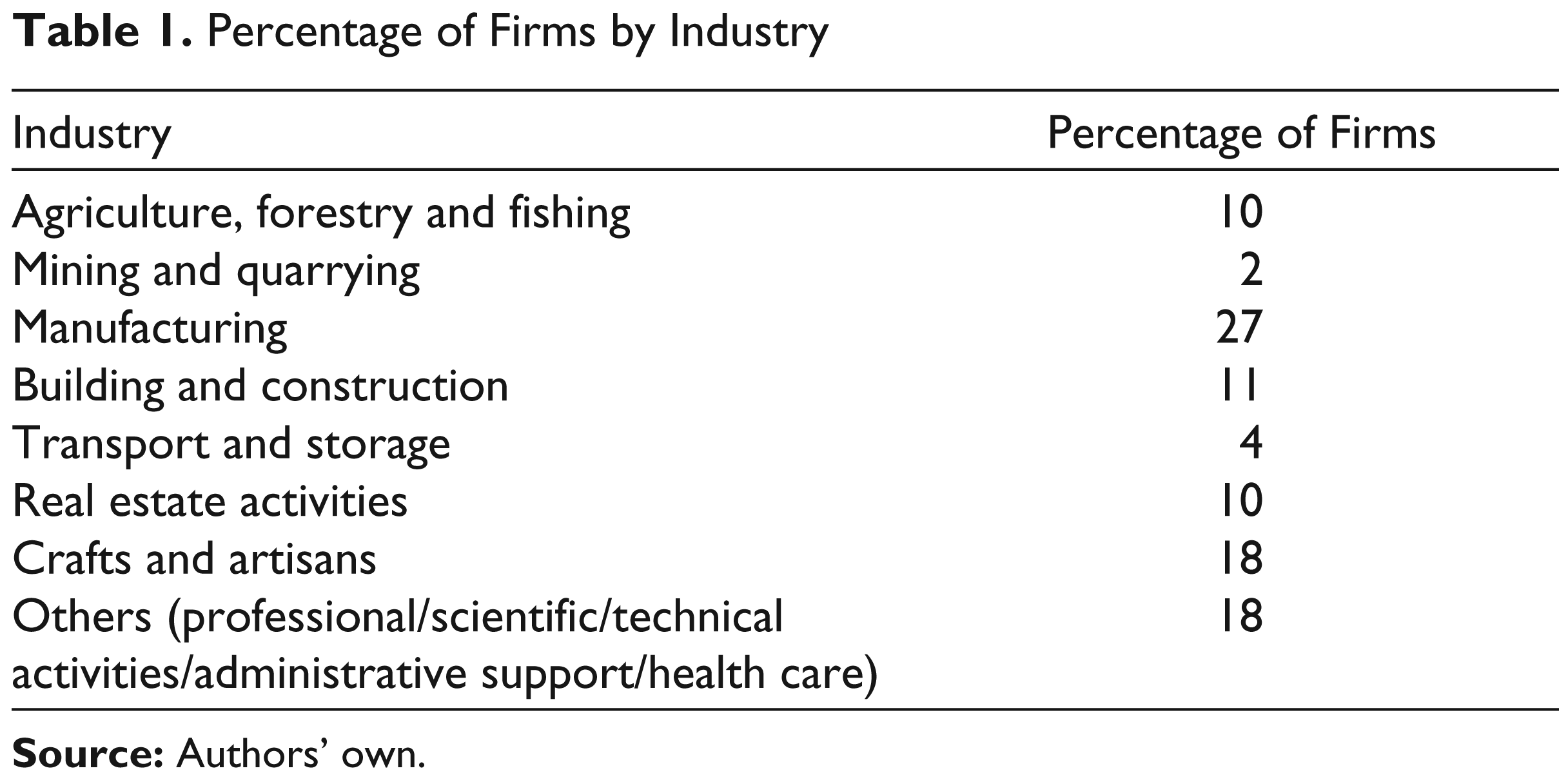
The purpose of the study is to examine the performance of SMEs in an emerging economy. As such, a survey-based approach was used to collect data from SMEs operating in Ghana, a sub-Saharan African country. This study used a non-probability sample of SMEs selected from the 2012 database of the Ghana Business Directory and the membership directory of the Association of Ghana Industries (AGI) to test the hypotheses. We contacted 736 firms via telephone and email to elicit information in this study. The sampling criteria were based on the following: (i) firms had to be independent entities with no affiliation to any company group or chain (Boso et al., 2013; Wiklund & Shepherd, 2011); (ii) firms that were owned and controlled by individual or group of entrepreneurs with at least 50 per cent ownership (Goedhuys & Sleuwaegen, 2010); (iii) firms that employed a minimum of five and a maximum of 500 full-time workers (Boso et al., 2013; Goedhuys & Sleuwaegen, 2010; Wiklund & Shepherd, 2011); (iv) firms had to be manufacturers of physical products or service providers that engaged in productive business activities (Morgan, Katsikeas & Vorhies, 2012); (v) firms with a minimum of 5 years business operation experience (Morgan et al., 2012); and (vi) firms that had a complete contact information of the founder or the chief executive officer (CEO) (Khavul et al., 2010). Of the 736 firms contacted, 514 firms agreed to participate in the study. Subsequently, the entrepreneurs were contacted with the questionnaires, administered in person. Responses were received from 298 firms yielding 57.97 per cent response rate. Table 1 presents information about the specific industries of the firms involved in this study. A test for response bias was performed to see whether non-response could be a major issue in interpreting the regression results. On the basis that late respondents are similar to early respondents (Oppenheim, 1966), the responses from the early respondents to the late respondents were compared on a number of key variables by using Wilcoxon–Mann–Whitney test to see if any significant difference exists between these two groups of respondents. The test revealed no significant difference between the responses from early and late respondents. Thus, in interpreting the outcome of this survey, non-response was not a major concern.
Percentage of Firms by Industry
Measure of Constructs
The current study relies on previous studies for items to measure key constructs examined. The internal reliability values for all scales are above 0.70 thresholds recommended by Nunnally and Bernstein (1994).
Firm performance: A nine-item, seven-point, subjective performance scale adopted from Murphy, Trailer and Hill (1996) measured firm performance: return on assets, return on equity, return on investment, employee growth, sales growth, market share growth, net profit margin, return on sales and gross profit margin. The use of a subjective performance measure, long employed in management research (e.g., Boso et al., 2013; Covin & Slevin, 1989; Lawrence & Lorsch, 1967; Tan & Peng, 2003), provided several advantages in the current study over the use of objective measures. First, the focus of this study was on entrepreneurs’ risk-taking–firm performance relationship and how network ties moderate this relationship in Ghana. In this study’s context, obtaining reliable accounting-derived measures is tiresome due to difference in accounting procedures and willingness of survey respondents to disclose confidential performance information (Dess & Robinson, 1984; Powell, 1992). Second, the use of a subjective performance measure facilitates comparison across industries, market contexts and economic conditions (Achtenhagen, Naldi & Melin, 2010). All items were measured with Likert-like scale with each item showing acceptable reliability with Cronbach’s alpha values above the recommended threshold (Huck, 2000). The combined mean of the scale measures constitutes the variable score. Cronbach’s alpha for the combined mean was α = 0.89, indicating high reliability (Hair et al., 2006).
Risk-taking propensity: A scale developed by Gomez-Mejia and Balkin (1989) was used to measure entrepreneurs’ level of risk propensity. Accordingly, the items used in this study were based on previous studies. The entrepreneurs who responded to this survey were asked to register their responses to each of the four items using a seven-point Likert-like scale ranging from 1 = strongly disagree to 7 = strongly agree. With a Cronbach’s alpha of 0.93, risk-taking propensity scale showed acceptable reliabilities (Hair et al., 2006).
Business network ties: Business network ties were measured by adapting the scales developed by Yiu, Lau and Brutton (2007) and Lau and Bruton (2011). The extent to which owner–managers interact with industry counterparts including suppliers, customers, distributors and competitors was measured. Each item was measured on a seven-point Likert-like scale ranging from 1 = not at all to 7 = to a large extent. The Cronbach’s alpha of the political ties scale was 0.92, demonstrating high reliability (Hair et al., 2006).
Political network ties: Measures of political ties were adapted from Acquaah (2007) and political ties were defined as social capital derived from the development of networking relationships with government officials such as politicians at different levels of government and with bureaucratic officials in regulatory, supporting, investment and industrial institutions. This approach to measuring political ties has been validated in other studies (e.g., Acquaah & Eshun, 2010). Political ties scale was measured on a seven-point Likert scale with anchors ‘not at all’ and ‘very high extent’. The Cronbach’s alpha of the political ties scale was 0.88, demonstrating high reliability (Hair et al., 2006).
Community leadership ties: Following Acquaah (2007), community network ties were defined as the extent to which top managers at entrepreneurial firms utilise personal ties, networks and connections with local kings, chiefs and/or their representatives, religious leaders (e.g., pastors, priests and imams) and ties with local opinion leaders (e.g., assembly men/women, local head teachers and community leaders). Thus, community leadership ties scale was adapted from Acquaah (2007) to assess managers’ ties with community members. Each item was measured on a seven-point rating scale ranging from 1 = not at all to 7 = to a large extent. An acceptable reliability value was obtained for the community leadership ties scale with Cronbach’s alpha of 0.91 (Hair et al., 2006).
Control Variables
In line with existing literature (e.g., Krishnan & Teo, 2012; Li & Zhang, 2007), seven control variables were included in the study’s model. This is because previous studies indicate that these variables have the potential to influence the performance of a firm. Therefore, as argued by Krishnan and Teo (2012) the controlled variables were adopted to account for factors other than the theoretical constructs of interest that could explain variance in the dependent variable (performance). The control variables adopted in this study include firm size, firm age and entrepreneurs’ level of education, entrepreneurs’ level of experience, gender and entrepreneurs’ age. Additionally, following scholarly works (e.g., Adomako & Danso, 2014; Boso et al., 2013), industrial type were controlled for by using industry dummy.
Validity and Reliability Assessment
Following Podsakoff and Organ (1986), Harman’s one-factor test was conducted to check for the existence of common method variance by subjecting all the key constructs of interest to a factor analysis. A factor analysis of the items on the risk-taking propensity, managerial network ties and performance variables yielded five factors with eigenvalues greater than one and the first factor accounting for about 29 per cent of the variance. Thus, common method variance is not likely to be causing the relationships between the dependent and independent variables in this study.
The internal consistency reliability of the main constructs was analysed using Cronbach’s alpha, which ranged from 0.88 to 0.93. The composite reliability (CR) of the main constructs ranged from 0.84 to 0.95, and the average variance extracted (AVE) ranged from 0.76 to 0.88. A full list of all constructs and corresponding Cronbach’s alpha, CR and AVE is provided in Table 2. To test the reliability and validity of the measures, LISREL 8.5 and the maximum likelihood estimation procedure were used to examine all scales in confirmatory factor analysis (CFA). In order to avoid the risk of violating minimum sample size to parameter ratios, conventional practices were followed (e.g., Cadogan, Cui, Morgan & Story, 2006) to analyse the scales initially in subsets; thus, scales that were conceptually related were analysed together (Baker & Sinkula, 1999). Each item was allowed to only load on one construct for which it was an indicator. Item loadings were as hypothesised and were significant at p ˂ 0.001. The results indicated that a two-factor model fitted the data moderately well (χ2 = 311.59, df = 186, p ˂ 0.001, goodness-of-fit index [GFI] = 0.97, comparative fit index [CFI] = 0.96, non-normed fit index [NNFI] = 0.95, standardised root mean square residual [SRMSR] = 0.05, root mean square error of approximation [RMSEA] = 0.04). As can be seen in Table 3, fit indices that ranged from very good to excellent were obtained. For completeness, Table 3 also displays the results of a ‘full measurement model’ in which all items were entered simultaneously in a CFA model with a predicted measurement model imposed (Cadogan et al., 2006).
Summary of Predictor Measures
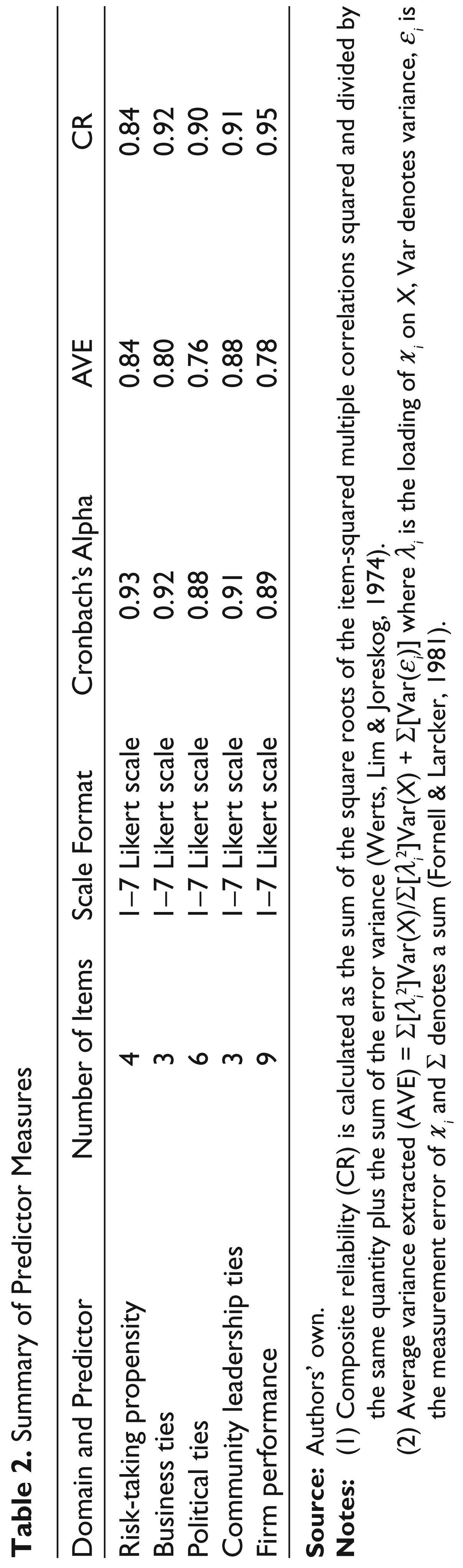
(2) Average variance extracted (AVE) = Σ[λi2]Var(X)/Σ[λi2]Var(X) + Σ[Var(εi)] where λi is the loading of ϰi on X, Var denotes variance, εi is the measurement error of ϰi and Σ denotes a sum (Fornell & Larcker, 1981).
Statistical Procedures
Moderated hierarchical regression analysis was utilised as the main statistical procedure for examining the relationship between entrepreneurs’ risk-taking propensity and firm performance as well as the proposed moderating effects of managerial network ties. To test the hypotheses, a number of multiplicative interactions were created. Existing literature was followed in the creation of the interaction terms (Hmieleski & Baron, 2009). Due to the inclusion of interaction term in the regression estimate, multicollinearity becomes apparent. As such, all the variables involved in the creation of the interaction terms were residually centred (Little, Bovaird & Widaman, 2006). After the residual centring approach, the variance inflation factor (VIF) was calculated for all regressions in the study’s model to test for multicollinearity. All VIF values were below 3.5. Thus, lower than the threshold of 10, indicating no concerns regarding multicollinearity (Aiken & West, 1991).
Results
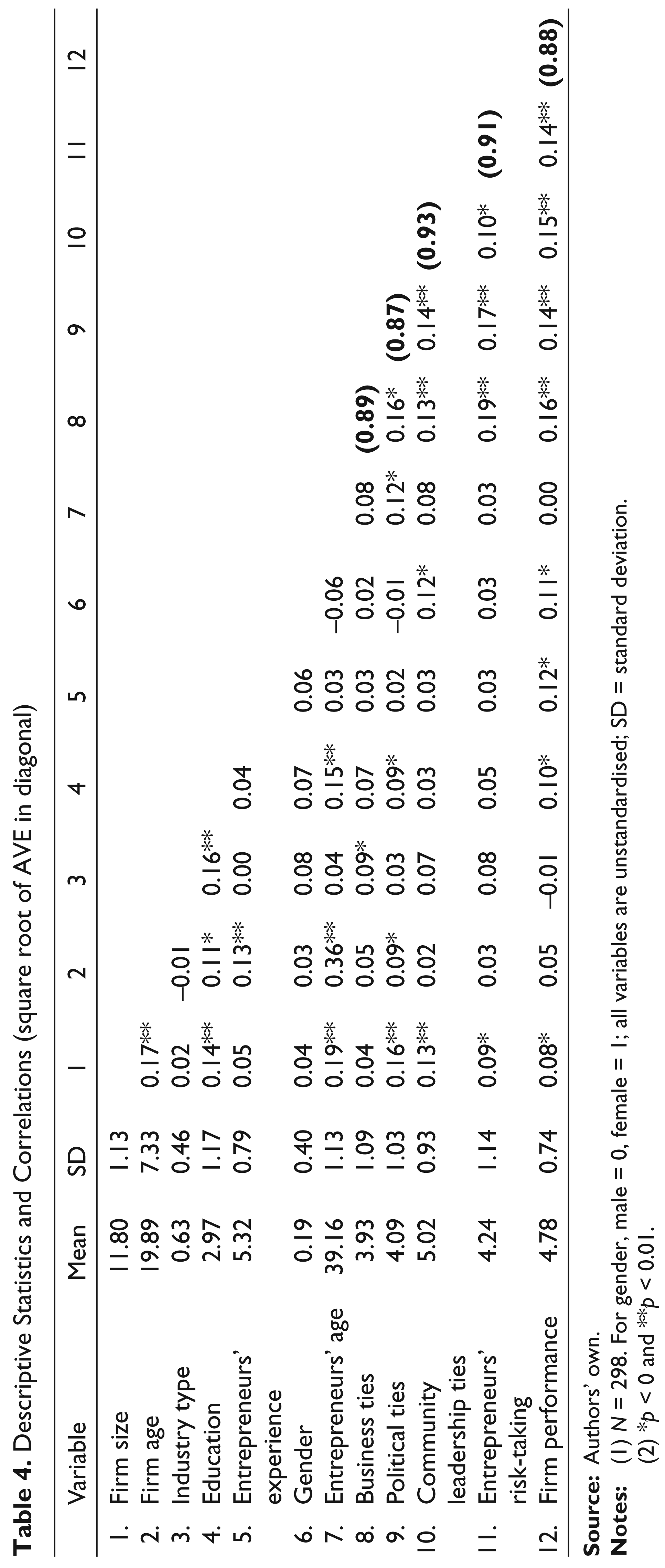
Table 4 provides means, standard deviations and bivariate correlations for the study variables. In order to test the study’s measures for discriminant validity, the square roots of AVE for all multi-item constructs were calculated (Table 4).
Fit Indices for the Measurement Models
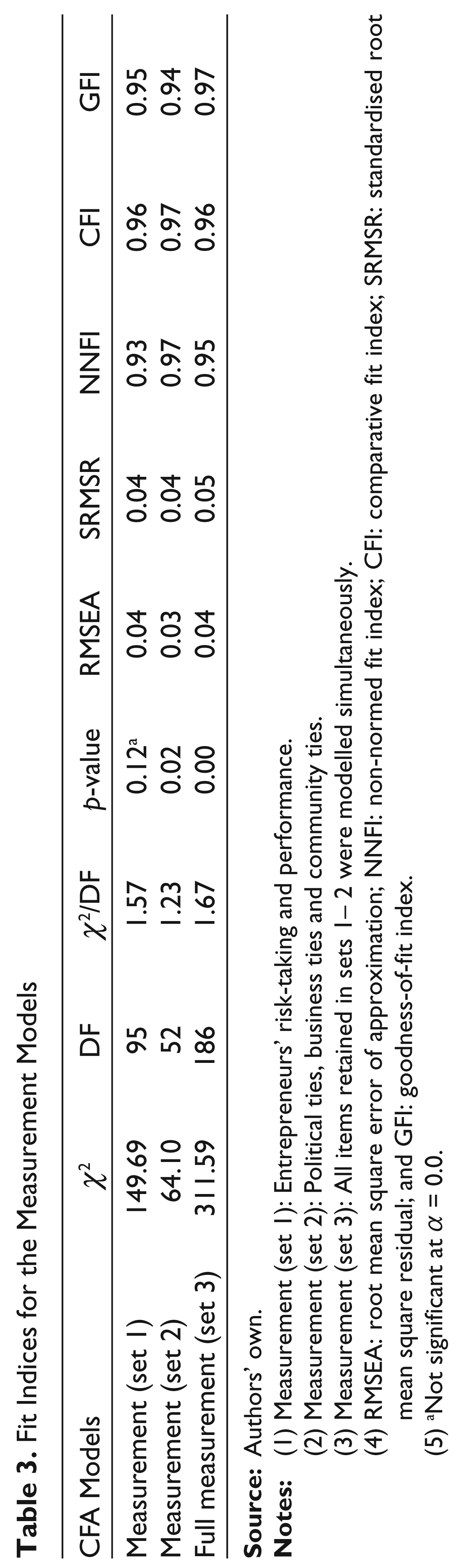
(2) Measurement (set 2): Political ties, business ties and community ties.
(3) Measurement (set 3): All items retained in sets 1– 2 were modelled simultaneously.
(4) RMSEA: root mean square error of approximation; NNFI: non-normed fit index; CFI: comparative fit index; SRMSR: standardised root mean square residual; and GFI: goodness-of-fit index.
(5) aNot significant at α = 0.0.
Descriptive Statistics and Correlations (square root of AVE in diagonal)
(2) *p < 0 and **p < 0.01.
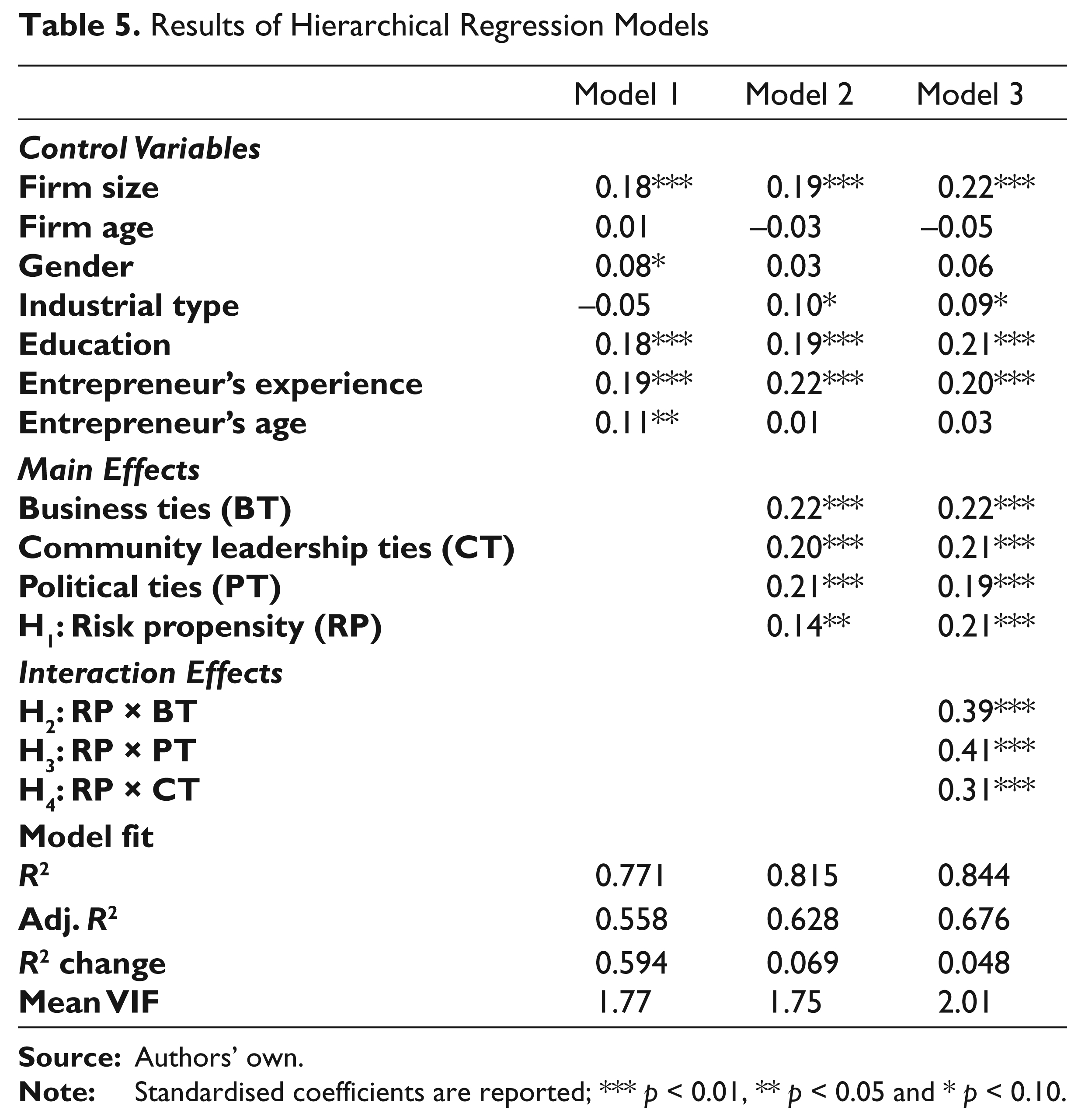
Results of Hierarchical Regression Models
The results show that, for all constructs, each correlation of one construct with another is smaller than the square roots of its AVE, indicating discriminant validity for our measures (Fornell & Larcker, 1981).
This indicates that the measured concepts differ significantly from each other (Bagozzi & Philips, 1982). Table 5 presents the results of the hierarchical regression models. The interactions are presented in the form of graphs in Figures 1–3.
Three main models were estimated. In model 1, the effects of the control variables on firm performance were estimated. In model 2, the control variables and the main effects of variables were estimated. In model 3, all variables (including the interaction variables) were estimated. Following procedures set forth by Dawson and Richter (2006), each interaction was graphed. The results are described in relation to the individual hypotheses.
Hypothesis 1 proposed that entrepreneurs’ level of risk-taking propensity is positively related to firm performance. As shown in model 2 of Table 4, the relationship between entrepreneurs’ risk-taking propensity and firm performance (β = 0.16, p ˂ 0.01) is significant and positive. Therefore, the findings offer support for hypothesis 1.
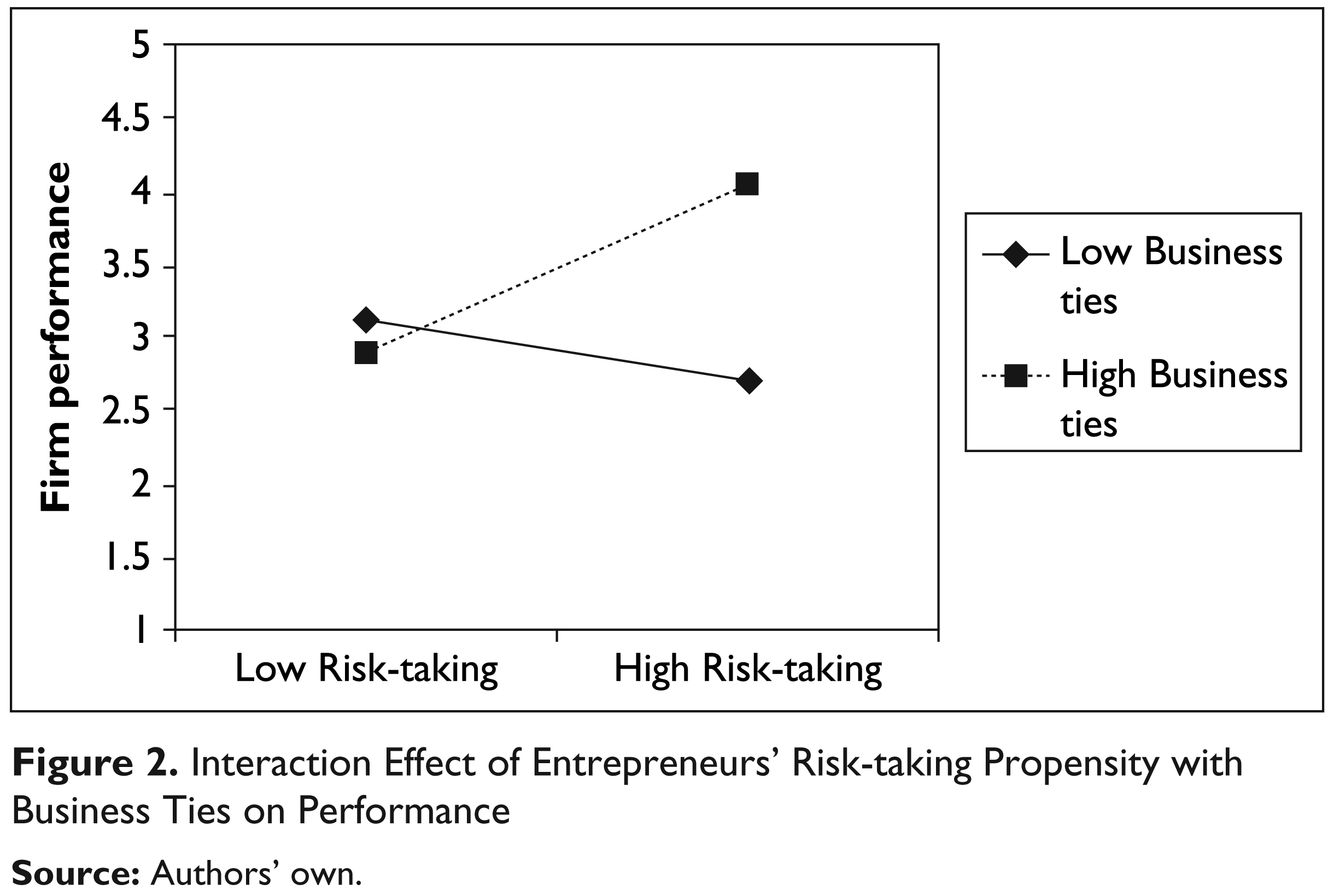
Hypothesis 2 suggested that business network ties moderate the relationship between the level of entrepreneurs’ risk-taking propensity and the performance of their firms, such that the relationship will be stronger (i.e., more positive) for those with high, as opposed to low, business network ties. As shown in model 3 of Table 4, the interaction of entrepreneurs’ business network ties with risk-taking propensity is significant and positive (β = 0.39, p ˂ 0.01). The graph of this interaction (Figure 2) indicates that the relationship between entrepreneurs’ risk-taking propensity and the performance of their firms is more positive for those with high, as opposed to low, business network ties. Therefore, results support hypothesis 2.
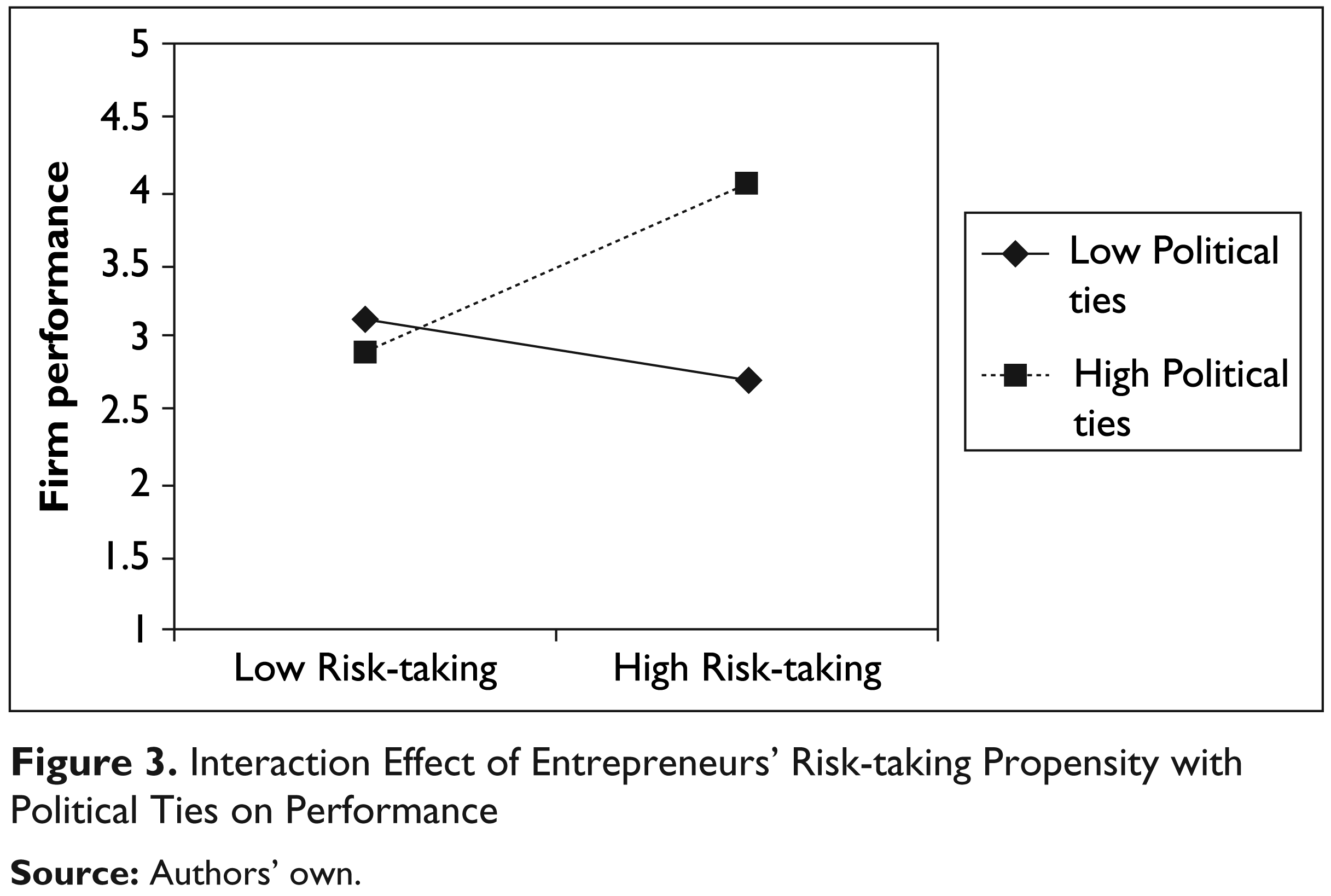
Hypothesis 3 argued that political network ties moderate the relationship between the level of entrepreneurs’ risk-taking propensity and firm performance such that the relationship will be stronger (i.e., more positive) for those with high, as opposed to low, political network ties. As shown in model 3 of Table 4, the interaction of entrepreneurs’ political network ties with risk-taking propensity is significant and positive (β = 0.41, p ˂ 0.01). The graph of this interaction (Figure 4) indicates that the relationship between entrepreneurs’ risk-taking propensity and the performance of their firms is more positive for those with high, as opposed to low, political network ties. Therefore, results support hypothesis 4.
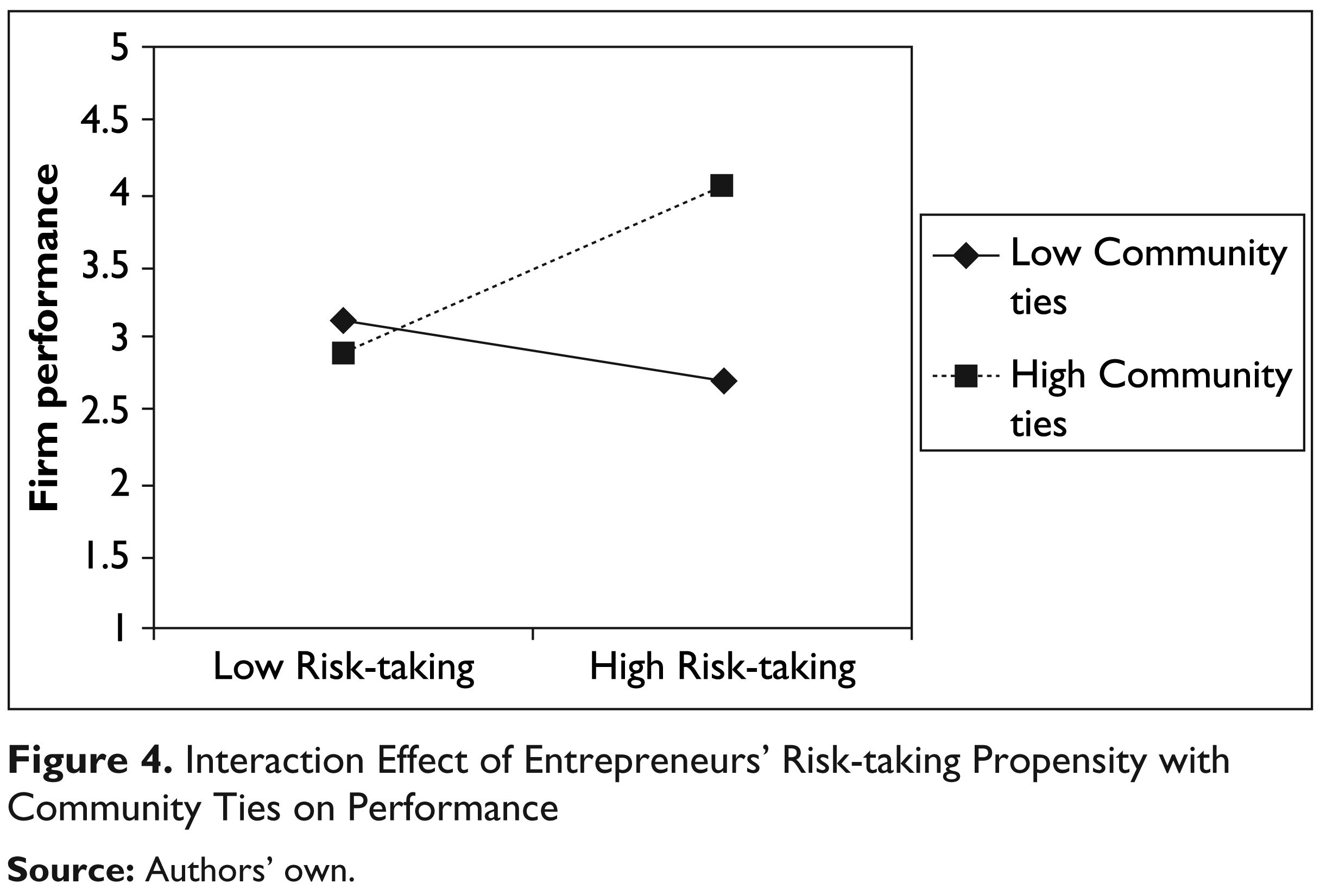
Hypothesis 4 stated that community network ties moderate the relationship between the level of entrepreneurs’ risk-taking and firm performance, with the relationship being stronger (i.e., more positive) for those with high, as opposed to low, community network ties. As shown in model 3 of Table 4, the interaction of entrepreneurs’ community network ties with risk-taking propensity is significant and positive (β = 0.31, p ˂ 0.01). The graph of this interaction (Figure 3) indicates that the relationship between entrepreneurs’ risk-taking propensity and firm performance is more positive for those with high, as opposed to low, community network ties. Therefore, results support hypothesis 3.
Discussion and Implications
Motivated by the fact that there are a limited number of studies from emerging economies that have examined the impact of managerial network ties on the relationship between entrepreneurs’ risk-taking propensity and firm performance, this study investigated the interrelationship among entrepreneurs’ risk-taking propensity, network ties and firm performance. The study’s main argument is that relational networks have a significant and positive performance implication on entrepreneurs’ risk-taking–firm performance relationship. Thus, a set of hypotheses were formulated to test the argument. The study argued that the level of entrepreneurs’ risk-taking is positively related to firm performance. This study finds support for the notion that in a less developed market economy, the level of entrepreneurs’ risk-taking is positively related to firm performance. Therefore, entrepreneurs who seek to take higher risk are more likely to succeed in an emerging economy such as Ghana.
In addition, this study proposed a positive relationship between entrepreneurs’ risk-taking propensity and firm performance when moderated by business network ties. This study finds support for the notion that in less developed market economies, the positive association between entrepreneurs’ risk-taking propensity and firm performance is more positive when moderated by business network ties. These results revealed that business network processes outside the borders of the firm further maximise the performance benefits of entrepreneurs’ risk-taking. This novel contribution to the small business and entrepreneurship literature made by the current study demonstrates that the development of business network ties makes the positive relationship between the level of entrepreneurs’ risk-taking and firm performance more positive for SMEs operating in a less developed market economy. This finding is important given that in Ghana, business-supporting system is weak with underdeveloped legal and regulatory institutions, meaning that commercial laws and regulations are not strictly enforced by government officials. As such, exclusive reliance on taking higher risk is not sufficient for SMEs’ success.
It was hypothesised that political ties moderate the relationship between the level of entrepreneurs’ risk-taking and firm performance in such a way that such relationship is more positive and significant. These findings support the key theoretical argument that in a developing country such as Ghana, where there regulatory and other institutional settings are undeveloped, political ties are an important element in the performance of SMEs. This is consistent with what Acquaah (2007) speculated, indicating that owner–managers in sub-Saharan Africa and in many emerging economies develop networking relationships with government officials such as politicians at different levels of government and with bureaucratic officials in regulatory institutions to facilitate business transactions. This novel contribution to the literature indicates that the development of political ties increases the impact of entrepreneurs’ risk-taking on firm performance among SMEs operating in a less developed market economy. This contribution is important because the enforcement capacity of the formal institutional structures is weak in sub-Saharan African economies, thus creating a high level of uncertainty about the firm’s business activities.
It was further hypothesised that in an economy such as that of Ghana, community leadership ties moderate the association between entrepreneurs’ risk-taking propensity and firm performance in such a way that such association is more positive and significant. This study finds support for the notion that the positive relationship between entrepreneurs’ risk-taking and firm performance is more positive when moderated by community leadership ties. The results suggest that social processes of network with community leaders outside the borders of the firm increase the benefits of taking higher risks in a less developed market economy such as Ghana. In Ghana, the role of community leaders, such chiefs, kings and opinion leaders, is to establish ownership, control and distribution of property among families in communities. They also create, maintain and enforce the social norms and values of their communities, including traditional religious rituals, thus developing a strong interpersonal bond among individuals in their communities. The current findings suggest that the development of community leadership ties with chiefs, kings and opinion leaders in the community in which the firm operates increases the performance benefits of entrepreneurs’ risk-taking in a less developed market economy such as Ghana. Thus, according to Acquaah (2007), community leaders serve as conduits for the transmission of information and resources for firms because they serve as local bridges between a firm and the community. The development of relationships between the firm’s founders with community leaders provides the firm with valuable access to resources and information as the community leaders endorse the firm and its activities and refer it to their communities (Acquaah, 2007; Acquaah & Eshun, 2010). This suggests that community network ties are critical in explaining variations in performance outcomes of risk-taking activities in a less developed market economy.
This study advances the literature on SMEs by providing empirical evidence from the perspective of developing economies such as those located in sub-Saharan Africa. So far, this is the first study from sub-Saharan Africa that has examined this interrelationship between entrepreneurs’ risk-taking propensity (individual-level variable), managerial network ties and firm performance.
The study’s findings are important to managers of SMEs in less developed market economies in a number of ways. First, the findings indicate that the positive relationship between entrepreneurs’ risk-taking and firm performance in a less developed market economy is made more positive when political ties are stronger. That is, when managers of SMEs develop higher ties with politicians and government officials, these ties positively moderate the positive relationship between entrepreneurs’ risk-taking and firm performance. A major ramification of this finding is that entrepreneurs should develop high levels of ties with politicians and government officials in less developed market economies when taking projects that are deemed risky. Establishing high levels of ties with government officials and regulatory authorities is relevant in lessening the risk associated with the business activities.
Second, the study shows that in a less developed market economy, business network ties maximise the benefits of lessening the high risk associated with business activities. Hence, this study encourages managers of SMEs to consider developing ties with managers of other rival firms in the operation of their businesses as such ties can increase the performance benefits of risk-taking. Third, the study shows efforts to develop community leadership ties maximise the benefits of risk-taking in a less developed market economy such as Ghana; hence, this study encourages managers of SMEs in less developed market economies to leverage community network ties to earn greater rewards for risk-taking activities. There are implications for policy too, since it may be possible for less developed market economies and training organisations to develop training programmes to assist entrepreneurs to understand how to achieve greater performance through network activities.
Limitations and Suggestions for Future Research
This study has a number of limitations that also offer directions for future research. First, the study focuses on SMEs in general. Since different SMEs may operate in multiple industries, the use of industrial dummies in the regression analysis to control for industrial effect may be insufficient to ‘partial out’ the industrial effects (Wan & Hoskisson, 2003). Hence, future studies could focus on SMEs limited to single industry to help deal with the industrial effect. Second, this study is only limited to SMEs in Ghana. A natural extension could, therefore, be to compare the results across a number of SMEs in different countries in sub-Saharan Africa. Third, the use of cross-sectional data does not allow us to examine any changes in entrepreneurs’ risk-taking and the dynamic nature of managerial network ties. Future studies can, therefore, rely on longitudinal research approach.
Conclusion
This study has examined the interrelationship between entrepreneurs’ risk-taking propensity, managerial network ties and firm performance in an emerging country setting. This article contributes to risk-taking propensity, managerial network ties and entrepreneurship literature. It outlines theoretically that entrepreneurs’ risk-taking propensity enhances firm performance in an emerging economy. Additionally, managerial network ties help entrepreneurs deploy their risk-taking behaviour in order to improve their firms’ performance, especially if the firm operates in a turbulent market. In examining entrepreneurs’ risking-taking–firm performance relationship, this study acknowledges that managerial network ties are particularly important in an emerging country such as Ghana which is characterised by relational and collective cultures, in which network plays a significant role in firm performance. The theoretically derived research model, which links risk-taking propensity, managerial network ties and firm performance, was empirically tested by means of an empirical study of 298 SMEs operating in Ghana.