






Abstract
This study aimed to investigate the effect of personality traits on social entrepreneurial intention by extending Mair and Noboa’s (2006) model. Data were collected from a sample survey of 503 individuals. The four-step method suggested by Baron and Kenny (1986) was followed to test the mediational roles of perceived desirability and perceived feasibility in the relationship between six personality traits (need for achievement, risk-taking propensity, innovativeness, proactiveness, empathy and moral obligations) and social entrepreneurial intention. The results showed that the two mediators fully mediated the effects of proactiveness on social entrepreneurial intention, whereas both the mediators were found partially mediating the impact of moral obligation on social entrepreneurial intention. In addition, only perceived feasibility fully mediated the effects of innovativeness on social entrepreneurial intention and partially mediated the effects of empathy. These research results are expected to trigger a change in social entrepreneurship education by cultivating personality traits towards sustainable development. This study’s originality lies in its exploration of potential social entrepreneurs’ personality traits as a combination of general entrepreneurial and social entrepreneurial traits.
Social entrepreneurship is growing worldwide. It is a unique entrepreneurial endeavour that combines two separate missions: social impact and financial benefits (Peredo & McLean, 2006). Although social entrepreneurship has been noted to be an essential strategy for the sustainable development of society, academics and policymakers are trying to understand how an individual wishes to become a social entrepreneur to elevate its presence (Tan et al., 2019). The answer to this question may come from understanding social entrepreneurial intention (Chipeta & Surujlal, 2017). Social entrepreneurial intention can be interpreted as a belief, desire or determination to establish a new social enterprise in the future (Tran & Von Korflesch, 2016).
Although the crucial role of personality traits and entrepreneurial intention is acknowledged in many previous studies (Zhao et al., 2010), this relationship in the context of social entrepreneurship is still receiving much attention from the academic community (Tan et al., 2019). This phenomenon can be explained by the fact that social entrepreneurs are considered to be individuals who possess particular personality traits different from commercial entrepreneurs (Baum & Locke, 2004). Personality traits directly affect an individual’s emotions, thoughts and behaviours (Nga & Shamuganathan, 2010). Further, personality traits are often used to explain the behaviour of potential commercial entrepreneurs, in general, and potential social entrepreneurs, in particular (Nga & Shamuganathan, 2010). Several meta-analyses have provided strong evidence that it is important for entrepreneurship and commercial entrepreneurs’ success, in general, and social entrepreneurs’ success, in particular (Stephan & Drencheva, 2017). As with any behaviour, entrepreneurial activity can be interpreted as a result of personal and situational factors (Davidsson, 2015). Therefore, personality traits can be a stable basis for academics and policymakers to understand more about entrepreneurial activity and social entrepreneurial activity.
The social personality traits were first recognised by Penner et al. (2005) and are widely used in research with the intention of participating in social and volunteering activities. Previous studies have considered social entrepreneurs’ personality traits similar to those of commercial entrepreneurs (Chipeta & Surujlal, 2017; Kedmenec et al., 2015). A few studies try to understand the social entrepreneurial traits that only occur in social entrepreneurs (Hockerts, 2017). Further, social entrepreneurial traits are less commonly considered with general entrepreneurial traits (Stephan & Drencheva, 2017). According to Drayton (2006), social entrepreneurs are the people with unique characteristics, which includes motivations to pursue social change. Light (2010) argues that a social entrepreneur’s personality traits will be broader than those of a commercial entrepreneur. This study considers potential social entrepreneurs’ personality traits as an amalgamation of general and social entrepreneurial traits. Commonly, general entrepreneurial traits include the need for achievement, risk-taking propensity, innovativeness and proactiveness. In contrast, social entrepreneurial traits include empathy and moral obligation.
Models that are popular in entrepreneurial intention studies include Shapero’s Entrepreneurial Event (SEE) model (Shapero & Sokol, 1982), the theory of planned behaviour (TPB) (Ajzen, 1991) and the model of entrepreneurial potential (Krueger & Brazeal, 1994). However, little is known about the social entrepreneurial intention model (Tan et al., 2019). Mair and Noboa (2006) proposed the first social entrepreneurial intention model based on TPB (Ajzen, 1991) and SEE (Shapero & Sokol, 1982). They argued that perceived feasibility and perceived desirability are two premises of social entrepreneurial intention. This study extends Mair and Noboa’s (2006) first social entrepreneurial intention model to investigate the mediating effects of perceived desirability and perceived feasibility in the relationship between personality traits and social entrepreneurial intention.
First, the model of Mair and Noboa (2006) simplified previous models by associating attitude and subjective norm with perceived desirability and replacing perceived behavioural control with perceived feasibility (Mair & Marti, 2006). Perceived feasibility and perceived desirability are two determinants frequently used in various ways of entrepreneurial intention research (Saadin & Daskin, 2015; Zampetakis, 2008). The perceived desirability of social entrepreneurship reflects the level of personal attraction to creating a social business. The attraction grows from the views on the personal consequences of entrepreneurial experience, and the level of support from the environment (society, friends and family) to reflect the affection of surrounding people towards social entrepreneurship (Mair & Noboa, 2006). Perceived feasibility of social entrepreneurship is defined as the degree to which people consider themselves personally able to creating a social business. This brings attention to certain abilities and skills to assess the ability of establishing social enterprises (Mair & Noboa, 2006).
Second, the Mair and Noboa’s (2006) proposed model recognises the relationship between perceived feasibility and perceived desirability with specific social entrepreneurial traits, such as empathy and moral obligation. Thus, the addition and testing of general entrepreneurial traits and social entrepreneurial traits in this model are reasonable and convincing.
The objectives of this study are as follows:
To test the effect of perceived desirability and perceived feasibility of social entrepreneurship on social entrepreneurial intention; To investigate the impact of general entrepreneurial traits (risk-taking propensity, need for achievement, proactiveness and innovativeness) and social entrepreneurial traits (empathy and moral obligation) on the perceived desirability and perceived feasibility of social entrepreneurship; and To investigate the mediating roles of perceived desirability and perceived feasibility in the relationship between personality traits and social entrepreneurial intention.
This article introduces the theoretical background, research model and hypotheses. The following sections present the research methods and results. Discussion, conclusions and limitations constitute the final sections of this article.
Theoretical Background, Research Model and Hypotheses
Entrepreneurial Intention Models
The two frequently used models of entrepreneurial intention are the SEE model and Azjen’s TPB. Since the first model of entrepreneurial intention proposed by Shapero and Sokol in 1982, there has been a steady rise in this field of research. Shapero and Sokol rooted their model in desirability, feasibility and a propensity to act upon opportunities, noting that there is a specific ‘entrepreneurial event’ triggering one to act towards a behaviour rather than inertia or habit. Meanwhile, the TPB model was derived from the more general TPB (Ajzen, 1991) by Krueger and Carsrud (1993). Unlike Shapero and Sokol, the TPB model was based on the premise that any behaviour requires a certain amount of planning. Intentions are shaped by three elements: the subject’s attitudes towards a behaviour, subjective norms and the perception of behavioural control (Ajzen, 1991). Some 3 years later, the Boyd and Vozikis (1994) entrepreneurial intention model, an extension of Bird’s (1988) model, argued that politics, economic climate, abilities and personality traits can affect one’s thoughts about venture creation, thus creating entrepreneurial intention. Mair and Noboa’s (2006) model proposed the original social entrepreneurial intention model based on TPB (Ajzen, 1991) and SEE (Shapero & Sokol, 1982). They argued that social entrepreneurial intention is formed by perceived feasibility and perceived desirability.
Social Entrepreneurial Intention, Perceived Desirability and Perceived Feasibility
Bird (1988) defined intention as a state of mind that motivates a person towards a specific goal. Intention can be considered a prerequisite for behaviour (Fillion & Berthelot, 2007). In this study, social entrepreneurial intention is defined as the belief and self-recognition of a person who intends to establish a new social venture (Ip et al., 2017). While extending Mair and Noboa’s (2006) first social entrepreneurial intention model, this study investigates the mediating effects of perceived desirability and perceived feasibility.
Perceived desirability in social entrepreneurship is defined as the way an individual finds attraction when becoming a social entrepreneur (Mair & Noboa, 2006). It postulates that attraction can be derived from assessing the outcome of a behaviour and the level of support from the environment (social, friends and family) to reflect the feelings of the people around towards social entrepreneurship. These attractions have a positive effect on the intention to start a business (Linan, 2008; Liñán & Chen, 2009; Luc, 2018). Perceived feasibility of social entrepreneurship is understood through the level of ease or difficulty in the experience of individuals when they become social entrepreneurs, and it also works as a motivational factor for starting a social business (Mair & Marti, 2006).
Any person who intends to set up a business is likely to have investigated obstacles and assessed his/her ability to solve them (Kedmenec et al., 2016; Kunttu et al., 2017; Politis et al., 2016; Sahut et al., 2015). Also, the intention to display behaviours is established when individuals do not recognise the obstacles or think they can solve them. Numerous studies have already confirmed that perceived feasibility and perceived desirability are the key factors that explain entrepreneurial intention (Autio et al., 2001; Dissanayake, 2013; Kedmenec et al., 2016; Kolvereid & Moen, 1997; Saeed et al., 2014; Vuorio et al., 2018). Accordingly, this study argues that perceived feasibility and perceived desirability work as determining factors in shaping the intention to display social entrepreneurial behaviours.
The authors propose the following hypotheses:
Risk-taking Propensity
Any entrepreneur must have the courage to take risks and dare to face obstacles. Such human ability is called risk-taking propensity (Meertens & Lion, 2008). In this study, the authors assume that becoming a social entrepreneur is as much risky as becoming any commercial entrepreneur, so social entrepreneurship becomes attractive to only those who are highly motivated individuals with high risk-taking propensity. In other words, risk-taking propensity has a robust positive effect on attitude towards behaviour, similar to the understanding of perceived desirability used by researchers (Antoncic, 2003; Macko & Tyszka, 2009).
Accordingly, individuals with high risk-taking propensity are attracted to risky jobs and tend to trust more in their ability to pursue them (Antoncic et al., 2018; Josef et al., 2016). Further, Hyrsky and Tuunanen (1999) suggested that entrepreneurs tend to take risks in a sector where they have enough knowledge to estimate probabilities for different outcomes. It is also understood that although they are attracted to high-risk tasks, they only intend to display risk-taking behaviour if they have the adequate knowledge and skills to evaluate the likelihood of success in that task.
Need for Achievement
The need for achievement is defined as the desire to do things to achieve an internal feeling of personal achievement (Zeffane, 2013). Collins et al. (2004) concluded that the need for achievement is an effective instrument that differentiates entrepreneurs from non-entrepreneurs. McClelland (1965) argued that individuals with a high need for achievement are always attracted to challenging and interesting jobs. We can take this view of McClelland (1965) as a linkage between the need for achievement and desirability of social entrepreneurship (Salhi, 2018). Moreover, individuals with a high need for achievement may aspire to achieve their accomplishments by becoming social entrepreneurs. They must strive to develop themselves to achieve that (Zeffane, 2013). Individuals with a strong need for achievement also tend to increase personal confidence in planning and implementing behavioural perception in decision-making control (Hansemark, 1998; Wu et al., 2007; Zeffane, 2013). Thus, the authors propose:
Proactiveness
Proactiveness refers to individuals’ positive efforts to make changes in their environment (Zampetakis, 2008). Zampetakis (2008) confirmed the mediating effect of perceived desirability in the relationship between proactiveness and entrepreneurial intentions. Some succeeding studies also found this relationship between proactiveness and perceived desirability to be effective (Chipeta & Surujlal, 2017). In addition, proactiveness also refers to the orientation towards initiating and maintaining specific actions, such as finding opportunities, overcoming barriers, predicting differences and avoiding bad habits (Kedmenec et al., 2015). Proactive people are more confident about their entrepreneurial effort (Kreiser & Davis, 2010; Kreiser et al., 2010). Individuals with high proactiveness show a sense of initiative and persistence until they achieve the desired results by developing the required abilities (Grant et al., 2011; Thompson, 2005). As a result, they are more confident in their ability, compared to other individuals, to become social entrepreneurs in the future.
Innovativeness
Innovativeness refers to producing new and marketable ideas and products (Weerawardena & Mort, 2006). In social entrepreneurship, innovativeness is quintessential and is considered a key personality trait, because it helps provide innovative solutions to social issues (Peredo & McLean, 2006). People with high innovativeness, combined with the desire to solve social problems, are highly likely to become social entrepreneurs in the future (Gur-Erdogan et al., 2014; Ip et al., 2018; Mueller & Thomas, 2001). In addition, innovativeness is considered the core competence to solve social problems, and it is closely related to social entrepreneurship (Gur-Erdogan et al., 2014; Weerakoon et al., 2020). As a change agent, social entrepreneurs exploit innovation at the system level to bring about change in a social equilibrium (Partzsch & Ziegler, 2011). Individuals with high innovativeness are always confident in dealing with complex issues, like social issues (Duvnäs et al., 2012; Shin, 2018; Weerawardena & Mort, 2006).
Empathy
Empathy is one of the social entrepreneurial traits and is defined as the ability to perceive and share the emotions of others (Mair & Noboa, 2006) or the sharing and recognition of similar emotions that others have experienced. Mair and Noboa (2006) emphasised the importance of empathy in promoting supportive behaviour and helping others. Several studies show a positive relationship between empathy and helping responses (Bacq & Alt, 2018; Graziano et al., 2007; Hockerts, 2017). Based on this evidence, the authors assume that the ability to share emotions can trigger a desire to help those around them. They also argue that social entrepreneurial traits are formed from education and experience with social issues through learning or practical experience. These experiences help potential social entrepreneurs believe that they can cope with the challenges of social enterprise (Bargsted et al., 2013; Lacap et al., 2018). Therefore, the authors expect a positive association between empathy and the perceived feasibility of social entrepreneurship. Put simply, empathy boosts self-confidence in creating a social entrepreneur.
Moral Obligations
Moral obligations are characterised by the perception that social norms imply the responsibility of helping marginalised people (Hockerts, 2017). Ip et al. (2018) argued that social entrepreneurs are individuals who demonstrate high moral obligation and that they are motivated by the need to be loyal to their principles and social responsibility. Even so, moral obligation is needed to trigger awareness of the desire to establish social enterprises (Hockerts, 2018; Lacap et al., 2018). It is not surprising that Tiwari et al. (2017b) and Ip et al. (2017) identified moral obligation as an essential social personality trait of social entrepreneurs. Similar to empathy, moral obligation directs individuals to social behaviours, rather than profits, and social norms make them feel more confident when choosing to become a social entrepreneur instead of a solely profit-driven entrepreneur (Cook et al., 2003; Lee & Oh, 2017; Tiwari et al., 2017a).
Mediating Roles of Perceived Desirability and Perceived Feasibility
This study tests the Mair and Noboa (2006) model’s relationships: the effect of perceived desirability and perceived feasibility of social entrepreneurship on social entrepreneurial intention (H1 and H2). In addition, the relationship between personality traits, perceived desirability and perceived feasibility has also been proposed to be examined (H3, H4, H5, H6, H7 and H8). Together, these hypotheses show perceived desirability and perceived feasibility as mediators in the relationships between personality traits and social entrepreneurial intention. Also, many empirical studies show that general entrepreneurial traits are related to the intention to start a social business (Chipeta & Surujlal, 2017; Kedmenec et al., 2015). These studies show that commercial personality traits have a strong positive effect on attitude, which influences the intention to become an entrepreneur. Therefore, previous studies have shown the mediation effect of perceived desirability in the relationship between entrepreneurial traits and the intention to start a social enterprise. Thus, the authors propose the following:
Method
Sampling Procedures and Participants
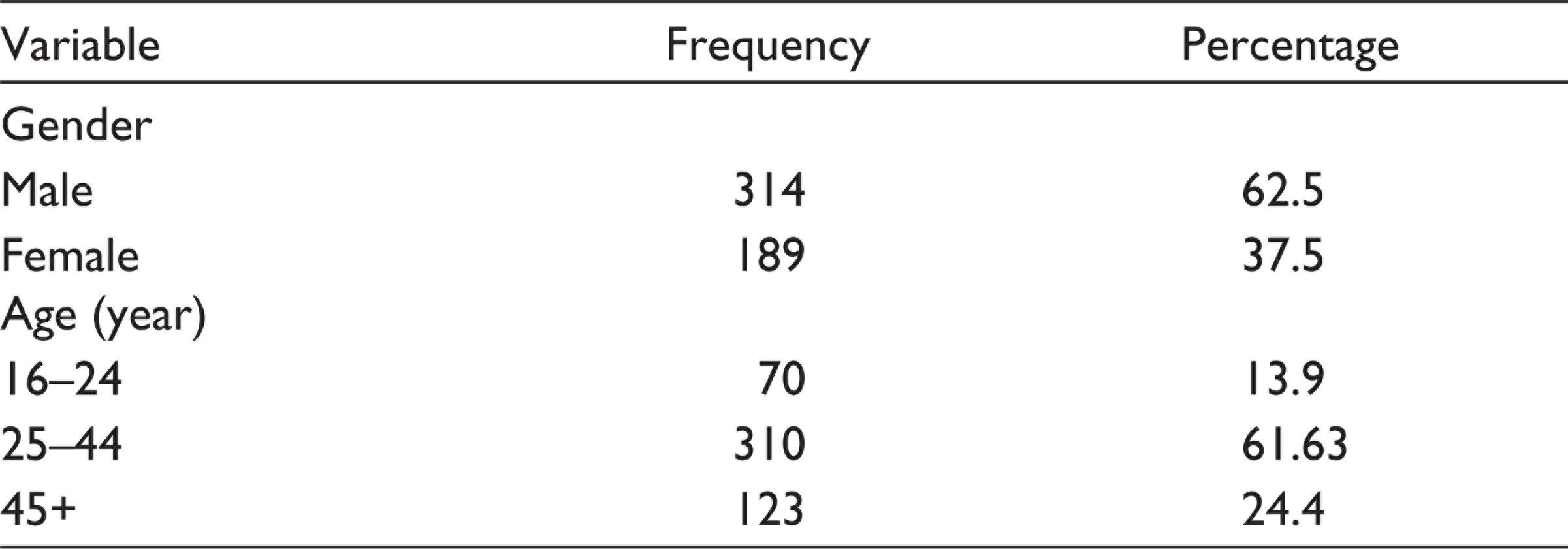
This study targeted individuals with specific knowledge about social entrepreneurship, as the development of social entrepreneurship in Vietnam is still at an early stage. This choice differs from the main study of social entrepreneurial intention, where students are chosen (Chipeta & Surujlal, 2017). Although interest in social entrepreneurship and social enterprises has increased significantly in recent years, awareness of social entrepreneurship in Vietnam remains low. Therefore, selection of individuals with specific knowledge about social entrepreneurship will ensure the survey’s quality. The survey was undertaken in collaboration with the Vietnam Social Enterprise Support Community (VSESC). Based on an email list provided by them, a Google Forms questionnaire was sent to individuals who attended social entrepreneurship courses at VSESC. Survey data were collected from October to December 2019. A total of 850 questionnaires were distributed. The authors received 503 valid responses, which represented a response rate of 59.17%. The characteristics of the sample are described in Table 1.
Sample Characteristics (n = 503)
Measurement
All items were measured on a 7-point Likert type scale, starting from 1 (strongly disagree) to 7 (strongly agree). The risk-taking propensity construct measures were adopted from the Risk Propensity Scale (Meertens & Lion, 2008) with seven items. The need-for-achievement scale consisted of five items, developed by Zeffane (2013). The measures of proactiveness and innovativeness when setting up a social enterprise were adopted from Satar and Natasha (2019). These were measured using three items and four items, respectively. To test the social entrepreneurial traits moral obligation (four items) and empathy (three items), this study used scales from Hockerts (2017). Perceived desirability and perceived feasibility scales were taken from Krueger and Brazeal (1994) and measured by three items and five items, respectively. Liñán and Chen (2009) developed a comprehensive scale to measure the intention to start a business. This scale can be adapted to measure intention to create a social enterprise (Ernst, 2011). The six items of social entrepreneurial intention were adopted from Liñán and Chen (2009).
Data Analysis
The partial least squares structural equation modeling (PLS-SEM) was used to test the research model, because this research model has multiple independent–dependent relationships, and also direct and mediational relationships, as hypothesised (Hair, et al., 2016). To assess any model using the PLS-SEM approach, two steps should be followed, including assessing the measurement model and the structural model. To test the direct effects, a t-test was performed using the bootstrapping process on 5,000 samples.
Finally, as Baron and Kenny (1986) suggested, a four-step procedure was applied to test the mediating effects. In step 1, a simple regression analysis is conducted, with an independent variable predicting the outcome variable. This step establishes an effect that could be mediated. In step 2, a simple regression analysis is conducted, with an independent variable predicting the mediator. This step essentially involves treating the mediator as if it were an outcome variable.
Step 3 shows that the mediator affects the outcome variable. A simple regression analysis is conducted, with mediator effects predicting the outcome variable. In step 4, to establish that the mediator completely mediates the independent variable–outcome variable causal relationship, the independent variable’s effect on the outcome variable controlling for the mediator should be zero. If all four of these steps are met, then the data are consistent with the hypothesis that the mediator completely mediates the independent variable–outcome variable relationship. If the first three steps are completed but step 4 is not, partial mediation is indicated.
Results
Measurement Model
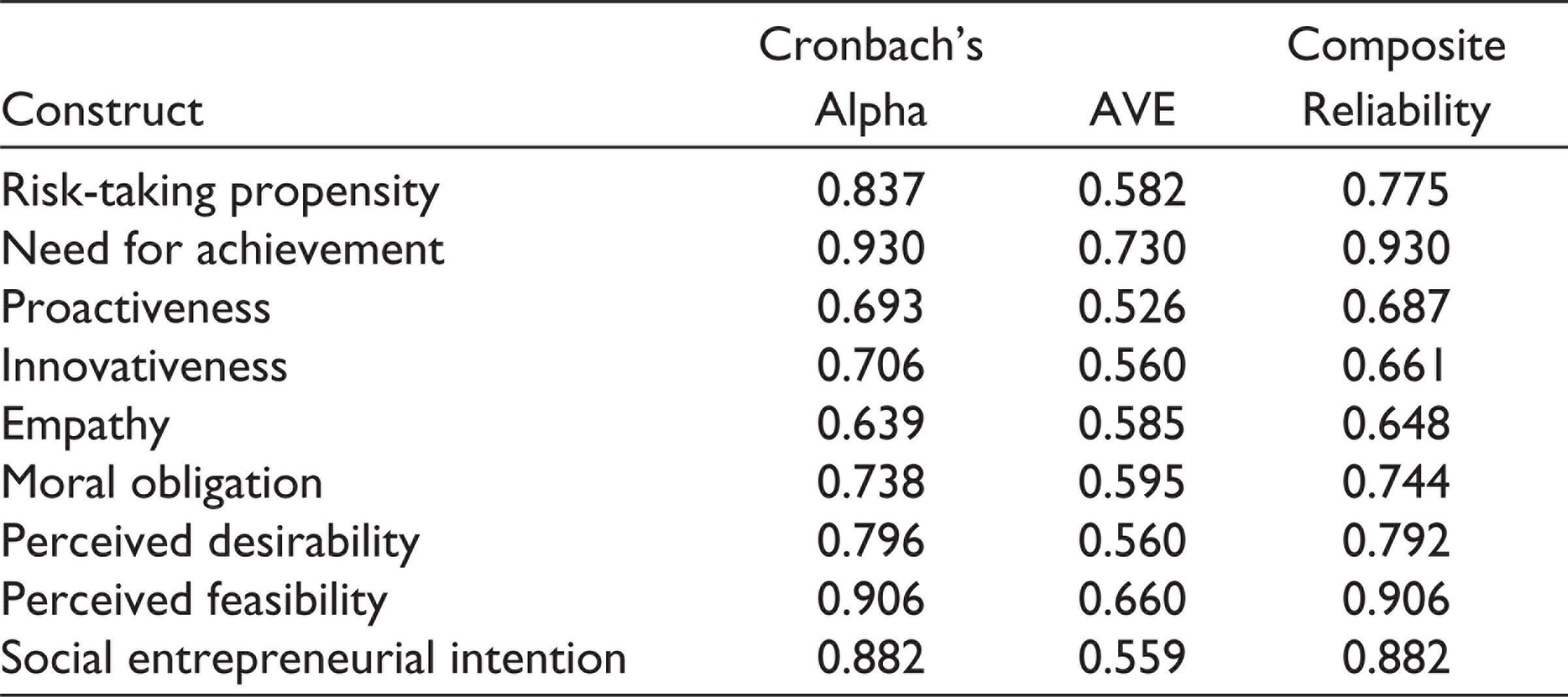
The reliability of the factors was measured using Cronbach’s alpha and composite reliability measurements. As shown in Table 2, Cronbach’s alpha values in this study ranged from 0.639 (for empathy) to 0.93 (for need for achievement). The composite reliability values ranged between 0.68 (for empathy) and 0.93 (for need for achievement). Cronbach’s alpha and composite reliability values for all the constructs were very close to or above the threshold value of 0.7 (Hair et al., 2016). The results indicated evidence of construct reliability. The average variance extracted (AVE) was calculated for each construct, shown in Table 2. The value of AVE for all constructs in this study was above 0.5, which indicated that convergent validity for each construct in the model was ascertained.
Construct Reliability and Convergent Validity
This study evaluated the discriminant validity using three criteria: Fornell and Larcker (1981), cross-loading and heterotrait-monotrait (HTMT) ratio of correlations.
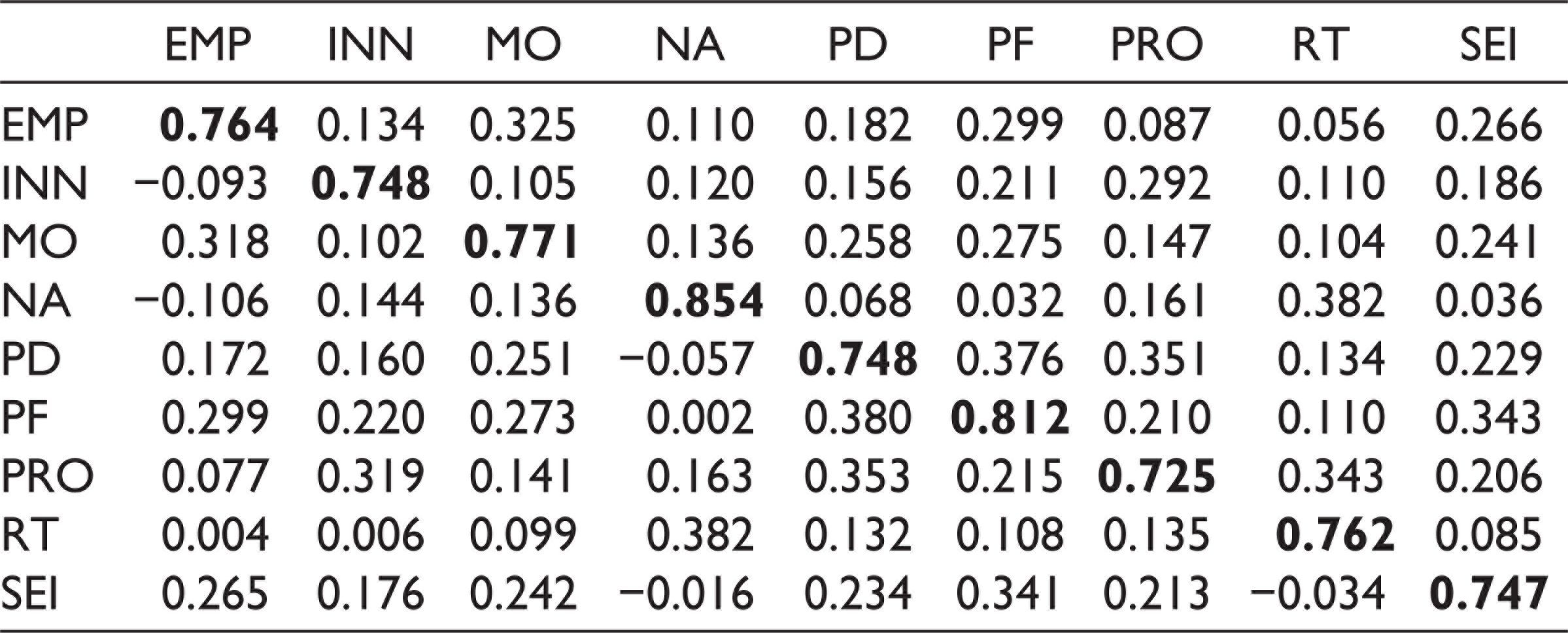
Fornell and Larcker (1981) stated that the values of variables are compared to their AVE’s square root. As shown in Table 3, the square roots of all AVEs (0.526–0.730) were more extensive than the shared variance of a latent variable with other latent variables. Regarding cross-loading, Hair et al. (2016) suggested that each indicator’s loading should be greater than all its cross-loadings. Each indicator’s outer loading was greater than 0.5 (0.502–0.980) on its construct and higher than all its cross-loadings with other constructs in this model.
Finally, as shown in Table 3, the HTMT ratio values showed that neither the lower nor the upper confidence interval (CI) included a value of 1, which showed that the model satisfied discriminant validity. To sum up, convergent validity and discriminant validity of the measurement items were ascertained.
Correlation, AVE and Heterotrait–Monotrait (HTMT) Ratio Values
Structural Model
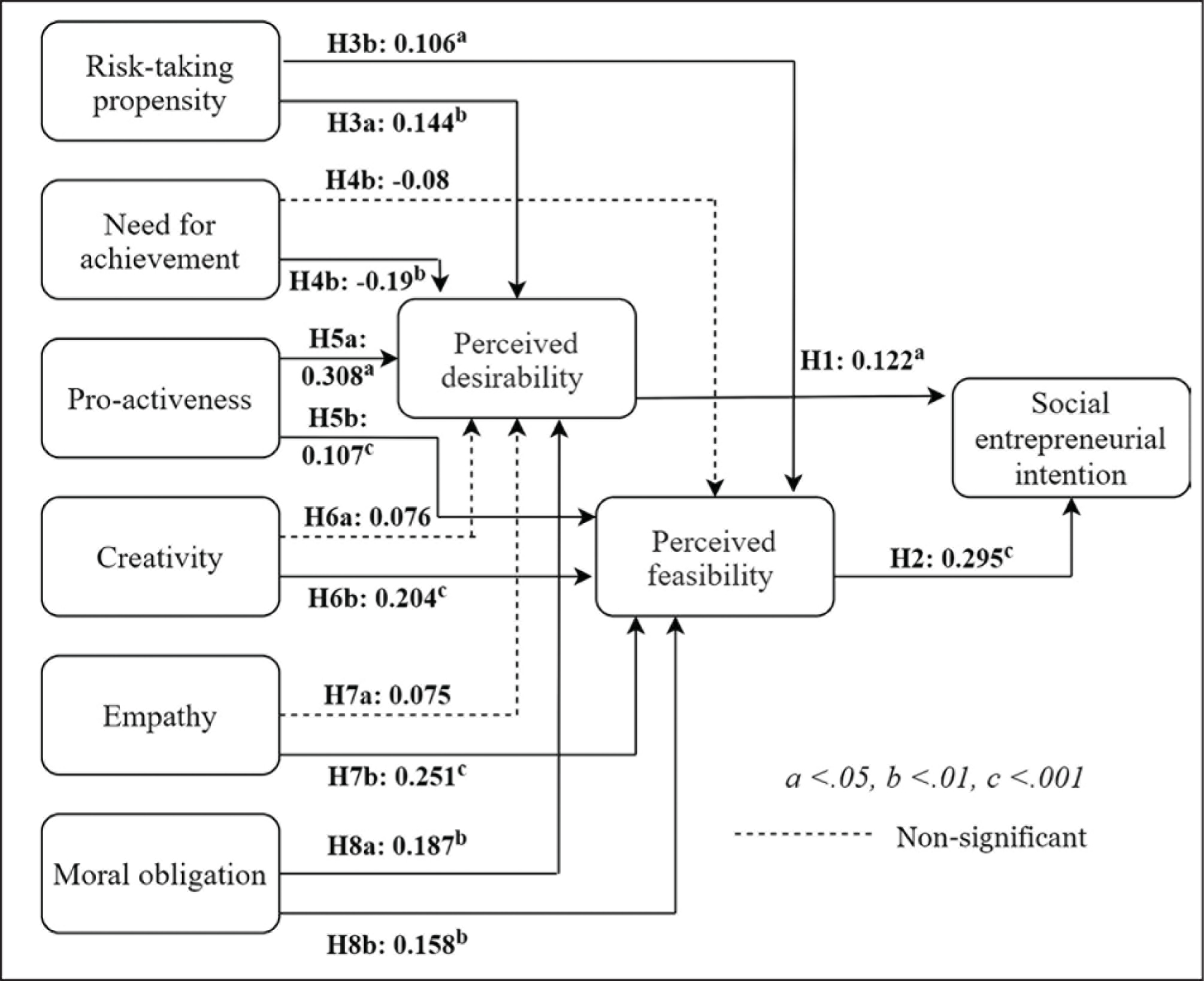
The R2 values for the endogenous variables of perceived desirability, perceived feasibility and social entrepreneurial intention were 0.201, 0.187 and 0.226, respectively—values considered acceptable (Hair et al., 2016). Also, the authors used the predictive sample reuse technique (Q2) to evaluate predictive relevance (Hair et al., 2016). Based on the blindfolding procedure, Q2 for perceived desirability, perceived feasibility and social entrepreneurial intention were 0.084, 0.092 and 0.060, respectively—all greater than zero. These results showed that the research model had significant predictive relevance (Hair et al., 2016). A t-test calculated from the bootstrapping process of 5,000 samples was applied to test the direct effects. H1 and H2 examined the direct relationships between perceived desirability and perceived feasibility of social entrepreneurship and social entrepreneurial intention. Support was found for H1 and H2. The other hypotheses in the research model, pertaining to the direct effect of personality traits on perceived desirability of social entrepreneurship and perceived feasibility of social entrepreneurship, were examined, and support was found for H3a, H3b, H4a, H5a, H5b, H6b, H7b, H8a and H8b. The remaining hypotheses, H4b, H6a and H7a, were rejected. The results are presented in Figure 1.
The four-step procedure suggested by Baron and Kenny (1986) was followed to test the mediating effects of the two mediators (perceived feasibility [PF] and perceived desirability [PD]) on the relational antecedents (six personality traits, including the need for achievement [NA], risk-taking propensity [RT], innovativeness [INN], proactiveness [PRO], empathy [EMP], moral obligation [MO] and social entrepreneurial intention [SEI]). The results are presented in Table 4.
Mediation Test
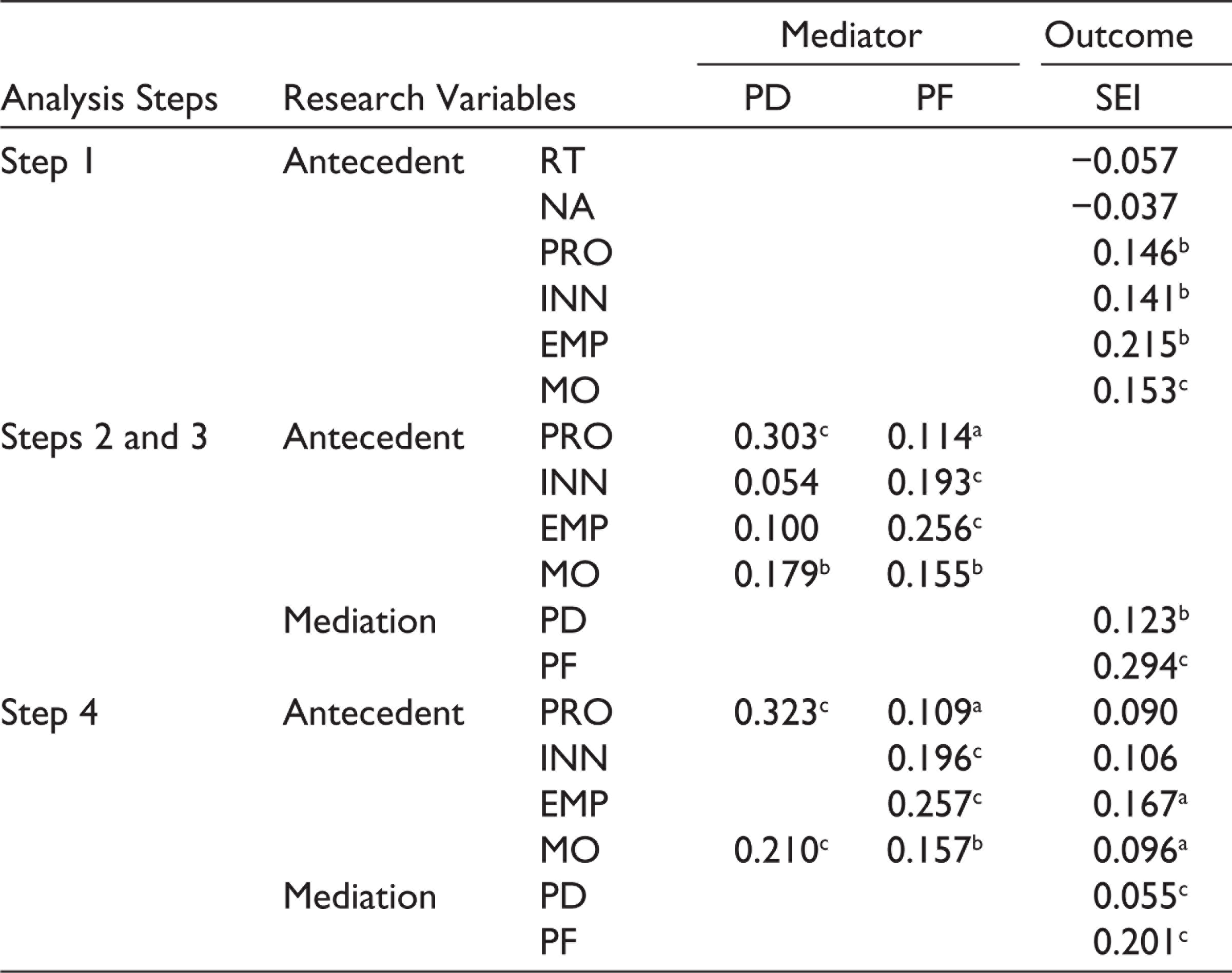
In step 1, all antecedents (six personality traits—the need for achievement, risk-taking propensity, innovativeness, proactiveness, empathy and moral obligation) were tested to ascertain any direct effect on social entrepreneurial intention. At this step, there were only four personality traits that affected social entrepreneurial intention: proactiveness, innovativeness, empathy and moral obligation. As risk-taking propensity and need for achievement failed to test the direct effect, these two personality traits were not further assessed in steps 2 and 3.
In steps 2 and 3, the four antecedents proactiveness, innovativeness, empathy and moral obligation were found to be significantly affecting the two mediators, which also considerably influence social entrepreneurial intention.
In step 4, the research results of testing the mediating effects of perceived desirability and perceived feasibility showed that all the relationships in steps 2 and 3 were supported. In contrast, considering the direct effect of the personality traits (proactiveness, innovativeness, empathy and moral obligation) in step 1, only the relationships of empathy and moral obligation were supported. The relationships of proactiveness and innovativeness were not significant. Thus, the results showed that the two mediators (perceived desirability and perceived feasibility) fully mediated the effects of proactiveness on social entrepreneurial intention, while they partially mediated the effects of moral obligation on social entrepreneurial intention. In addition, only perceived feasibility fully mediated the effects of innovativeness on social entrepreneurial intention and partially mediated the effects of empathy on social entrepreneurial intention. Thus, H9d found support, and H9a, H9b and H9c were rejected.
Discussion
The research results bring interesting insights on the effect of general entrepreneurial traits and social entrepreneurial traits on social entrepreneurial intention. To consider them, this study examined the effect of four key general entrepreneurial personality traits on potential social entrepreneurs: risk-taking propensity, need for achievement, proactiveness and innovativeness. There is evidence that two very typical personality traits of commercial entrepreneurs, risk-taking propensity and need for achievement, does not affect social entrepreneurial intention. Social entrepreneurial intention is considered unaffected by risk-taking propensity, because social entrepreneurs do not allow risk barriers to reduce their desire to pursue social values (Peredo & McLean, 2006). They see the risk of failure as part of the innovation process rather than an individual tragedy and are willing to accept it (Mair & Marti, 2006). Social entrepreneurs do not seek short-term solutions or short-term results but want to create a lasting social impact and sustainable results.
Regarding the need for achievement, this study’s results can be explained by potential social entrepreneurs who are socially oriented in their thinking, that is, oriented towards pursuing social value instead of fame, money or achievement. Perceived desirability and perceived feasibility fully mediates the relationship between proactiveness and social entrepreneurial intention. Proactive people are continually looking for opportunities to change their lives, and starting a business is also one of their priority options (Chipeta & Surujlal, 2017). Thus, they always have the desire to become entrepreneurs. In addition, they always strive to develop their capabilities to meet best the opportunities they see, so these individuals always feel confident when they find opportunities to become entrepreneurs.
This result also confirms once again the role of innovativeness in entrepreneurial intention and social entrepreneurial intention (Kedmenec et al., 2015). In social entrepreneurship, an entrepreneur is an innovator with different approaches (Dees, 2007). Many studies suggest that social entrepreneurs exhibit greater innovativeness than commercial entrepreneurs, because they face less common problems and situations in society (Kedmenec et al., 2015). The intriguing insights obtained about mediation indicate that only perceived feasibility fully mediates the relationship between innovativeness and social entrepreneurial intention. This can be explained, because innovativeness is a common trait that increases confidence in finding solutions to social problems, but this does not mean that innovativeness promotes in one the desire to become a social entrepreneur.
The two social personality traits empathy and moral obligation also affect social entrepreneurial intention. The research results show that like traditional personality traits, empathy and moral obligation also strongly affect an individual’s desire to become a social entrepreneur. Perceived desirability and perceived feasibility partially mediate the relationship between moral obligation and social entrepreneurial intention. The cognitive process of helping individuals is one of the basic personality traits which distinguishes commercial entrepreneurs and social entrepreneurs (Ip et al., 2018), and this is especially true for individuals who intend to become social entrepreneurs. Moral obligations can guide individuals to help people around them by shaping their desire to become social entrepreneurs. The findings from some previous studies suggest contradictory effects of empathy (Hockerts, 2017), but this study agrees with most previous studies that empathy has a direct and indirect effect on social entrepreneurial intention (Ip et al., 2018). In addition, moral obligation and empathy help individuals overcome barriers of knowledge and skills to believe it is feasible to become a social entrepreneur.
Regarding the mediating effects of perceived desirability and perceived feasibility, all personality traits affect social entrepreneurship’s perceived feasibility. It means that these personality traits not only influence attitudes, subjective norms or the desire in one to become an entrepreneur, as shown in previous studies (Chipeta & Surujlal, 2017), but also play an important role in promoting belief about one’s competence to become a social entrepreneur. While perceived desirability and perceived feasibility fully mediate the relationship between general entrepreneurial traits (proactiveness and innovativeness) and social entrepreneurial intention, perceived desirability and perceived feasibility partially mediate the relationship between social entrepreneurial traits (empathy and moral obligation) and social entrepreneurial intention. This divergence might result from differences in the nature of the two groups of personality traits. Social entrepreneurial traits can directly influence intention when an individual has empathy for or a moral obligation towards social issues. General entrepreneurial traits require a process of evaluation and information gathering to form perceived desirability and perceived feasibility before triggering a social entrepreneurial intention.
Future Research
This research has several inherent limitations that provide avenues for future research. First, the authors have used a sample of convenience, which limits the generalisation of the study. Future studies might want to use larger and more diverse samples to increase representation. For generalised applicability, this research model can be replicated across other cultures.
Second, this study only focuses on personality traits and does not consider contextual or institutional influences. Future studies can combine personality traits with other factors, such as education, experience, background, etc. Finally, this study has been limited to learning about the intention to start a social business and has not included the process of transformation of the intention to behaviour. Using longitudinal studies, understanding the influence of personality traits on intention formation and, subsequently, the decision to establish a social enterprise can be a potential research topic for future researchers.
Conclusion
This study confirms the possibility of applying the model of Mair and Noboa (2006) in predicting the intention to start a social business through a detailed understanding of perceived desirability and perceived feasibility of social entrepreneurship. Also, we found that the personality traits of individuals who intend to create a social enterprise are a combination of general entrepreneurial traits (proactiveness and innovativeness) and social entrepreneurial traits (empathy and moral obligation).
This study offers practical insights for policymakers and social entrepreneurship educators. Policymakers should develop an environment that fosters proactiveness, innovativeness, empathy and moral obligation. These are the personality traits that most effectively influence social entrepreneurial intention. Policymakers can organise and design programmes that help students become more aware of social entrepreneurship and get relevant advice and support for creative ideas and solutions. Further, such awareness programmes will help prospective social entrepreneurs by boosting their aspirations of becoming successful social entrepreneurs through providing significant support.
Social entrepreneurs have personality traits similar to those of business entrepreneurs. Thus, developing potential commercial entrepreneurs’ personality traits is also an appropriate development strategy to grow the number of social entrepreneurs. Current entrepreneurship courses should be expanded to foster social entrepreneurship knowledge and skills. This expansion will not only improve social entrepreneurship awareness but also equip both commercial entrepreneurs and social entrepreneurs with the necessary capabilities for the future. Social entrepreneurial educators should develop more hands-on experience through social entrepreneurship–related tasks to provoke students’ social entrepreneurial traits. Besides, extensive experience with social issues in volunteering or direct contact with social entrepreneurs can act as an incentive for any individual to become a successful social entrepreneur.
Footnotes
Acknowledgements
This research is funded by Vietnam National Foundation for Science and Technology Development (NAFOSTED) under grant number 502.02-2019.03.
Declaration of Conflicting Interests
The authors declared no potential conflicts of interest with respect to the research, authorship and/or publication of this article.
Funding
The authors received no financial support for the research, authorship and/or publication of this article.