







Abstract
This study represents the pioneering exploration of succession dynamics within family firms operating in the service industry by adopting a stewardship perspective. Surprisingly, there is a gap around research that considers the specificity of the service process in family firms. Considering the importance of both family firms and the service industry in international economies, the aim of this article is to explore the family influence in service business succession through a theoretical investigation inspired by stewardship perspective and provide a research agenda for future investigation.
The primary aim of this article is to push the boundaries of understanding of the intricate case of succession within family-led service firms. Although succession has been extensively scrutinised in the family business literature because of its profound implications for the survival and management of firms (Sharma, 2004; Ward, 2004), the distinctive nuances of succession within service businesses have been largely overlooked. According to Daspit et al. (2021), family firms exhibit unique succession intentions (e.g., Fiegener et al., 1994), nonfinancial goals (e.g., Gómez-Mejía et al., 2007), governance structures (e.g., Schulze et al., 2001) and outcomes that differ from those of nonfamily firms.
In his seminal work that inspired the study of succession in family firms, Lansberg (1988) distinguished four forces that interfere with succession planning: the founder, the family, the owners and the managers. Succession has long been considered an uncertain and challenging business process that requires exceptional capabilities and competencies for successful execution. In this context, it is widely recognised that succession represents a crucial step in enhancing the competitiveness and long-term success of family firms. For these reasons, it is evident why family business scholars continue to search for evidence and theories to support effective techniques and practices (see Cabrera-Suárez et al., 2001; Eddleston & Kellerman, 2007; Le Breton-Miller et al., 2004). The large number of contributions and studies in this field confirms the relevance of the topic.
Service firms, by their very nature, warrant a dedicated exploration distinct from that of the manufacturing sector (Brax et al., 2017; Li et al., 2020; Raddats et al., 2019; Sampson, 2012), for at least two main reasons.
First, the service sector plays a pivotal role in the global economy, contributing significantly to the GDP of many countries. For instance, in the United States, the service sector accounts for over 70% of GDP and represents about 80% of total employment. Similarly, in India, it contributes 57% of gross value added and constitutes 66% of GDP. This sector encompasses industries such as information technology, telecommunications, healthcare, education, financial services and tourism. These industries provide essential services to the population and are critical sources of employment and innovation.
Second, the service industry is characterised by transactions founded on strong interdependence between service providers and customers (Solomon et al., 1985), requiring the successful management of such exchanges (Lovelock, 1983; Sierra & McQuitty, 2005). Firms—family-owned or otherwise—operating in this sector face distinctive challenges in both operational management (Hennig-Thurau, 2004; Morris & Johnston, 1987) and market interactions (Bowen, 1986; Bowen & Ford, 2002). The creation and maintenance of competitive advantage depend on the abilities and skills of those involved in production processes and on the relationships they establish with customers (Ahn & Rho, 2016; Bove & Johnson, 2000; Karunaratna & Kumara, 2018; Mills & Morris, 1986). Moreover, customer opinions and experiences—both during service delivery and afterwards—shape the firm’s market reputation (Goldsmith et al., 2010), which becomes a strategic differentiator (Chen, 2015; Dagger & O’Brien, 2010). Because service production relies heavily on direct customer contact (Butcher et al., 2001), such relational capital is at risk of being disrupted during succession.
Surprisingly, although family firms represent a significant part of the global economy (Arregle et al., 2021; Basco et al., 2021), the link between succession in family businesses and service firms has not been comprehensively examined. A few studies have explored this relationship within specific service sub-sectors, such as tourism (Getz et al., 2004; Sharma et al., 2003; Thomas et al., 2011), but existing research remains fragmented and limited.
This article represents an initial attempt to unravel the intricacies of succession within service businesses, with a particular focus on the impact of family governance—a critical area that has been overlooked despite its profound implications for business continuity and success. Drawing on the stewardship perspective, this study develops a theoretical framework to examine the family’s influence on succession within service firms. This perspective is particularly relevant given the unique challenges associated with the intangibility of services, the reliance on personal client relationships, the transfer of specialised knowledge and expertise, the importance of the owner’s personal brand and reputation and the need to maintain high levels of customisation and personalisation. In this context, stewardship in family businesses embodies an ethos in which family members view themselves as ‘custodians of the firm’, managing the business not solely for short-term profits but also for long-term sustainability, while ensuring employee well-being and preserving the firm’s core values and culture (Craig et al., 2008; Basly & Saunier, 2020).
By examining these nuances, this article aims to fill a gap in the literature and ultimately contribute to the development of effective strategies for ensuring the longevity and competitiveness of family-owned service firms. The remainder of the article is structured as follows. First, the conceptual background that informs the theoretical model is presented. The initial section addresses whether there is a gap in the literature. To answer this question, the characteristics of family ownership and the service encounter are described. Next, building on the stewardship perspective, the article presents the theoretical framework and introduces the research agenda. Finally, conclusions and outline directions for future research are provided.
Conceptual Background
Succession and Service Management in Family Firms: A Gap in the Literature?
Generational transfer is a developmental and innovative opportunity to introduce successors to a business, give them new roles and thereby, due to their favourable age, gain an advantage over the founder’s experience (Welsch, 1993). In addition, during the succession process in service businesses, it is necessary to ensure that customers do not experience any of the inconveniences that may arise at an organisational level from a generational transfer. These issues are of strategic value in the case of service businesses, in which succession is traditionally seen as an adjustment process between two paths: that of the previous organisation and that of the new leader (Ahrens et al., 2019). Often, the solution adopted to respond to this need is a prolonged coexistence between old and new leaders (Denis et al., 2000).
Succession is natural in all firms, but in service businesses, it has an even greater impact than in goods businesses since the owner–management–worker–customer relationship is direct. Any worker dissatisfaction reaches the market directly, and this is an issue that managers must be prepared to face. In these cases, previous management should be analysed to understand their strengths in the market and how new managers must act to strengthen this relationship through innovation. In service businesses, an important issue is the switching costs linked to changes in providers. Therefore, family firms that are aware of generational changes must foresee these costs. The solution could be to create conditions that increase customer satisfaction and address relationships with targeted actions during the succession phase. In family service businesses, succession must therefore be planned regarding emotional relationships with employees (a shared aspect with goods businesses) and the market (an element specific to service businesses). During the service delivery process, in some cases, if there are constant debates or dissatisfaction within the organisation or from individual employees, these inevitably become visible to customers, with damaging results. Dynamics such as these could cause a firm to lose its competitive advantage. Moreover, the success of the succession process can be verified much more directly in service businesses than in goods businesses. In fact, in the case of goods businesses, the quality of a product might not vary in the short term because it relies on standardised production processes, whereas in the case of service businesses, the effect is almost certainly immediate because the customer is present for such processes and absorbs the effects of ongoing changes. Family-owned businesses that are able to plan such transfers over time have an advantage over nonfamily firms, where succession can happen suddenly due to choices related to the personal needs of managers who are not tied to the firm in the same way as a family member (e.g., family transfers, offers of better jobs, a need to change jobs). These issues certainly deserve further detailed study by both family business researchers and management researchers.
Moreover, the succession process is the main process that helps people identify a firm as a family firm, and it represents a key moment for social exchange in an organisation. A transfer of power also takes place, in fact, in nonfamily firms, but this often occurs due to market-related conditions or a former director terminating their contract. In the case of nonfamily firms, there is no deadline, and such a termination can sometimes be a sudden event that sends powerful shocks through the firm’s management. In the case of family firms, transfers of power are usually cyclical based on the retirement age of owners. Except in cases where a person passes away suddenly, the process of succession coincides with the death of the founder and follows their life. This long cycle of power and management triggers emotional mechanisms among the employees of such a firm that create unpleasant conditions along with a transfer of power. These are conditions that trigger habits that, on the one hand, create dependence, even if just emotional dependence and, on the other hand, generate organisational stability capable of achieving more effective management—at least in theory and when relationship dynamics are healthy. However, when this long cycle of power ends, organisational shocks inevitably arise, for both nonfamily members and family members. The longer the previous cycle of power was, the more important succession is. This is equally true for goods companies and service businesses. However, in the case of a service business, if the owner is also a service provider, there are many issues to consider related to the production process. Consider the case of a restaurant owner or business consultant. Thus, a detailed study of the family ownership in the service industry seems appropriate.
Exploring Family Ownership for Service Management Firms: A Stewardship Perspective
After more than four decades of investigation, scholars have suggested that the presence of a family in the ownership and/or management of a firm creates an exclusive intersection between the family system, the business system and the individual organisational members that generates a bundle of unique resources and capabilities (Chua et al., 1999; Olson et al., 2003). The outcome of this intersection has been called and long investigated as ‘familiness’ (Habbershon et al., 2003), a variable that can influence (and differentiate) a firm’s competitive advantage, as suggested by the resource-based view (Habbershon et al., 2003; Sirmon & Hitt, 2003).
There are two main intrinsic factors that explain and shape family firms’ behaviour: family goals and values that operate inside the firm (Dyer, 1986; Tagiuri & Davis, 1992). Fundamentally, as institutions, families operate to develop, support and take care of family members. Consequently, family business scholars have observed how family firms consider family goals and integrate key influential issues into all decisions regarding business strategy, financial strategy and organisational structures (Chrisman et al., 2013; Davis & Harveston, 1998; Kelly et al., 2000). For instance, the value of altruism has been shown to play a crucial role. Schulze et al. (2001) stated that altruism induces family members to be considerate of one another, and this in turn leads to loyalty and commitment to the family firm’s long-term prosperity. The literature has extensively delved into key factors driving family firms, highlighting their distinctive features linked to family goals and values (Camfield & Franco, 2019). In this exploration, stewardship perspective provides four dimensions that significantly shape the functioning of family ownership and their impact on the service process, with a specific focus on succession.
Leveraging Donaldson and Davis’s (1991) seminal paper, managers, acting as stewards, are motivated to act in the best interests of their firm rather than solely pursuing personal gains. Stewardship perspective emphasises the importance of trust, empowerment and alignment of interests between managers and owners (Davis et al., 1997). In family firms, stewardship theory is relevant because family members often view themselves as custodians of both the business and the family legacy. Stewardship in family firms is about balancing the desire to preserve the family legacy with the need to adapt and grow in a changing business environment. By fostering a long-term vision, strong values and a deep sense of responsibility, family firms can achieve sustainable success and make a positive impact on their employees and industries. While not all family firms have a stewardship culture (Eddleston et al., 2012), those that do can gain a competitive advantage through the collectivistic attitudes, psychological commitment and trustworthy behaviours of their organisational members (De Massis et al., 2013). Given the characteristics of services, this theoretical perspective supports the development of the model. Specifically, the study leverages Eddleston et al. (2012) to analyse the relationship of family ownership influence on succession in service business following their proposal of stewardship effect on family firms: long-term orientation and comprehensive decision-making. Further, Medina-Craven et al. (2021) added to the stewardship impact on the motivation and commitment of the workforce.
Long-term Orientation
Long-term orientation is a key component of the stewardship perspective (Davis et al., 1997). Family ownership of a business is characterised by a strong passion and dedication to trying to grow the business, with the aim of passing it down to future generations (Bressan et al., 2023; Chua et al., 1999). Family goals and values lead family firms to have a long-term perspective due to decreased level of pressure to acquire short-term returns (Dunn, 1996; Lumpkin et al., 2010). The family cares about the longevity of the firm, and this affects their strategic decisions (Le Breton-Miller & Miller, 2006; Lumpkin & Brigham, 2011). The long-term perspective may be linked to building a legacy of excellence in producing tangible goods (De Massis et al., 2016). The family may focus on product quality and building a lasting brand over time. Strategic decisions could involve investing in technology and material quality to ensure the longevity and recognisability of the brand (Craig & Moore, 2017).
Comprehensive Decision-making
To optimise the organisation’s performance, stewards are likely to be more thorough in assessing options and making strategic choices. This is especially true as stewardship fosters transparent communication and a collaborative management approach (Davis et al., 1997). Families aim to preserve family relationships, and decisions based on this goal may appear illogical to nonfamily managers (Nason et al., 2019; Newbert & Craig, 2017). The challenge is to harmonise family dynamics with professional decisions to ensure the long-term success of the business. For instance, the focus on product quality and operational efficiency may be influenced by the need to balance familial relationships. The family’s rationality of decision-making processes extends beyond the immediate family members involved in the business (Hoekx et al., 2023). It encompasses a broader perspective that includes not only the dynamics among family members serving in managerial roles but also their interactions with employees and customers (Rajan et al., 2023). This holistic approach recognises that family businesses often prioritise familial relationships not only within the family unit but also in their interactions with employees and the broader community of customers. The decision-making processes, therefore, consider a spectrum of relationships, reflecting the interconnectedness of family, employees and customers. This expanded view captures the multifaceted dynamics that contribute to the unique rationality of decision-making in family-owned firms.
Motivation and Commitment of the Workforce
According to the stewardship perspective, employees are more likely to be engaged and committed when they feel that their leaders are genuinely invested in their well-being and the organisation’s long-term success (Davis et al., 1997). Family firms have been known to pay higher wages than nonfamily firms and to care significantly more about the satisfaction of their employees (Donckels & Frolich, 1991). In addition, Dunn (1996) found that family workforces generally have motivation that is superior to that of nonfamily firm workforces, which leads them to feel a relevant sense of responsibility to the family and a high level of commitment to pursue shared goals and values, potentially creating a unique source of competitive advantage (Gottschalck et al., 2020; Miller & Le Breton-Miller, 2005; Sharma & Irving, 2005).
The elevated motivation within family workforces (Creemers et al., 2023) could contribute to increased efficiency, quality control and innovation. The shared commitment to family values may instil a sense of pride and responsibility among employees, positively impacting the overall performance of family firms compared to nonfamily firms.
Distinctive Aspects of Service Businesses: An Emotionally Laden Strategic Approach
Most service encounters require a high degree of social interaction between providers and customers. ‘A service is any act, performance or experience that a party can offer to another and that is essentially intangible and does not result in the ownership of anything, but nonetheless creates value for the recipient’ (Lovelock & Patterson, 2015). Adopting a strategic management view, a service firm’s success is mainly based on the capabilities of its human resources: management, service providers, marketing and salespeople. It is this high-contact strategy that creates value through interactions with customers that, in most cases, is based on long-term relationships. Contact with customers consists of three dimensions: communication time, wealth of information and intimacy (Soteriou & Chase, 1998). In the case of goods businesses, these issues are mitigated because the production process is carried out by machines and without the customer’s presence. This separation prevents customer perceptions of angry, unmotivated or grumpy members of staff. In service businesses, the process is different and often based on a high level of contact between providers and customers (Chase, 1981; Chase & Tansik, 1983; Mills et al., 1983). Based on this natural condition, Czepiel (1990, p. 16) states that ‘the social content of service encounters often seems to overshadow the economic’. Repeated exposure to a positive stimulus from the same service provider tends to increase customers’ affective reactions, heavily impacting their judgements and final evaluations of the quality of the service (Slovic et al., 2002). In service encounters research, these aspects, which are called familiarity (Patterson & Mattila, 2008) and are based on the psychology-supported effect that concerns how repeated exposures to a stimulus tend to increase individuals’ affective reactions (Zajonc, 1968), are considered favourable conditions that enable an individual to become a long-term affected customer (Schwarz & Clore, 1988). Familiarity, understood as a feeling with a positive emotional tone, generates warm feelings (Garcia-Marques & Mackie, 2000), enhances positive judgements and evaluations (Schwarz & Clore, 1988), and makes individuals more resistant to negative information (Patterson & Mattila, 2008). Research on service encounters suggests that prior experience with a service provider stimulates trust and commitment from the consumer side (Tax et al., 1998). Accordingly, familiarity reduces the impact of poor service on service quality perceptions, and employee performance ratings mitigate negative behavioural responses following a service failure (Patterson & Mattila, 2008).
Because a degree of social interaction between a provider and a customer is necessary for most service encounters, such jobs should be considered emotional labour (Hochschild, 1983). In her seminal study, Hochschild (1983) defined jobs involving emotional labour as those that require the following:
(a) face-to-face or voice-to-voice contact with the customer, (b) workers to induce an emotional state in another person, and (c) ‘the employer … to exercise a degree of control over the emotional activities of employees’. (Hochschild, 1983, p. 147)
Later, her work was extended in the organisational literature, most notably by Rafaeli and Sutton on the role of emotions in organisations (Rafaeli, 1989; Rafaeli & Sutton, 1989, 1990). The effects of displayed emotions on recipients (customers) have greatly captured the interest of researchers but remained untested for a long time (Pugh, 2001). This is particularly interesting for service encounters, given that the study of expressed emotion is argued to be important precisely because of its effects on other people (Rafaeli & Sutton, 1989). The empirical work of Pugh (2001) was the first to clarify how employee emotions affect customer emotions. His results opened the black box of this relationship, showing that emotions displayed by employees may be more strongly associated with service quality perceptions for customers who prefer human interactions in the delivery of services. Lechner et al.’s (2022) work, which is based on cognitive dissonance theory (Festinger, 1957), explains why customers with high choice confidence react less negatively to inauthentic displays. In line with the EASI theory, it is specifically proposed that after choosing a service provider, customers reconcile their decision with conflicting information, such as the quality of emotional displays from frontline employees. In conclusion, considering the degree of social interaction required during a service encounter (Delcourt, 2024; Pham et al., 2022), the ‘quality of emotion’ (Lechner et al., 2022) involved in service businesses is a strategic tool for competitive advantage because customers expect emotion to be a part of service. In addition, displayed emotions can alter customer moods and thus influence customer judgements and loyalty towards an organisation. The idea is that family as owner and/or manager creates different ‘quality of emotions’ and values to pursue compared to a nonfamily owner and/or manager.
Exploring service businesses within the domain of family firms holds significance, given the distinctive features characterising service encounters. These interactions, marked by high social engagement and emotional labour, distinctly differ from goods-based businesses. The emphasis on human resources and the intricacies of emotional aspects in service delivery necessitates a specialised perspective. This approach unveils the nuanced interconnection between family values, emotional labour and service quality, offering a distinctive competitive edge that influences customer perceptions and loyalty in the service sector. Further, in the context of succession, understanding how these intricate family dynamics and emotional connections evolve during leadership transitions (Cabrera-Suárez et al., 2018) becomes imperative for sustaining service quality and customer relations over successive generations.
Theoretical Framework
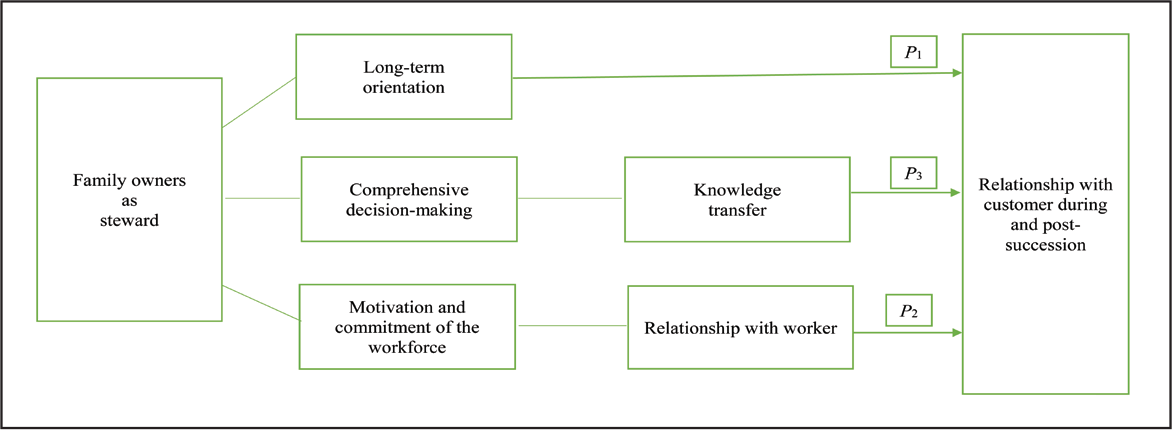
This section aims to explore how the family-led firms influence succession in service businesses. Following a stewardship perspective, the analysis will focus on the specific dynamics that arise from the intersection of the family influence on the business and the managerial and succession challenges in the service sector (see Figure 1).
Conceptual Framework on Family Owners’ Influence on Succession in Service Business.
Service encounters are first and foremost social exchanges, with interactions between service providers and customers being a crucial component of satisfaction and providing a motive to maintain relationships (Patterson & Mattila, 2008). Some authors describe succession as a singular event, akin to the notion of ‘passing the baton’. However, there is a growing consensus that succession should be viewed as a process rather than an isolated event. From this perspective, succession is seen as a multistage process, ideally involving the gradual integration and increasing involvement of the successor in the business. In the case of service business, there are two main aspects that should be considered in the analyses of the succession and in which the family owner positively impacts:
Relationships with customers (service management literature); Relationships with workers (family business literature); Knowledge transfer (service management and family business literature).
Relationships with Customers During the Succession Process in Service Businesses
Customers’ judgements of service quality are by and large based on their evaluations of their personal experiences during service encounters (Patterson & Mattila, 2008). The most important feature of a service business is its relationship with customers, considering how perceived risk in service businesses is different from that in goods businesses and how service providers are often the solution to decrease this risk. A recurring risk is that customers might be so attached to the idea of an old service provider (owner) that they are not able to see their successor as a valid alternative. In this case, a possible solution is to increase the level of service offered to give the perception of a positive change in customers’ minds. In any case, investing in understanding these issues is fundamental. Additionally, a family firm can plan such a transfer over time and even build it in a systematic way in the minds of customers. To date, there are no theoretical contributions that analyse whether and how customers react to generational transfer in the management of a firm. Therefore, it would be interesting to quantitatively analyse customers’ opinions and feedback during and after the succession phase to identify critical factors for the success of the process. The succession phase is a ‘problematic’ event that a firm inexorably faces during its life cycle. This involves both a pessimistic view supported by empirical evidence and a defensive attitude adopted by the firm/family that identifies succession as a threat to face. Little space is dedicated, however, to the aspects that can represent opportunities for innovation and growth. Succession is identified as an inevitable stage in the life of a business, and it is therefore necessary to engage in suitable marketing strategies well in advance to make this process a developmental factor, especially for market relationships. The survival of a business, in fact, is closely connected to its ability to relate to clients and be continually more effective and efficient in relation to market demands. Although successors have much to learn from their predecessors, they bring new visions and skills that enable them to sense potential sources of innovation (Dorsch et al., 2023). Specifically, it would be useful to study customers’ reactions to the succession process to identify the factors that determine their trust in the firm (Datta & Mukherjee, 2023; Larino et al., 2023); subsequently, these factors could be focused on to maintain competitive advantage and facilitate the succession phase.
Based on this aspect, family-led firms provide a sense of trust grater that nonfamily firms. The concept of intense passion and commitment in family ownership holds unique implications when applied to both service businesses and manufacturing, showcasing distinct specificities in each context (Rondi et al., 2019). In the context of service businesses, where family members often identify not only with the business but also with the personalised, experiential nature of the services provided, the influence on the relationship with customer is positive. The family name, associated with the service, carries emotional weight, influencing customer perceptions and fostering a sense of connection. This emotional attachment can impact customer loyalty and satisfaction, contributing to the intangible value of the service during and after the succession. Family firms clearly emerge as more long-term oriented firms than nonfamily firms. They tend to have a distinct business culture (Denison et al., 2004). Specifically, the service factors of success are compared with the factors differentiating between family and nonfamily firms highlighted by the relevant literature. The long-term orientation of family firms, which contrasts with the orientation of nonfamily firms, seems to play a strategic role in facilitating successful succession. If a firm has a long-term orientation, it is reasonable to expect that it will manage its succession, establishing a long-term perspective in customers and workers. In the specific context of service businesses, the long-term perspective is often associated with building lasting relationships with customers and maintaining a positive reputation over time (Rajan et al., 2023). Family goals of preserving reputation and providing quality services can lead to strategic decisions oriented towards long-term customer satisfaction rather than short-term gains. This turns into a consideration of how ‘familiness’ is associated with the service management process in the long term, leading to the following proposition:
P1: From a stewardship perspective, the long-term orientation of the family owners creates a positive association with customers during the succession process in service businesses.
Relationships with Workers as an Element of Distinctiveness of Family Firms
By creating relationships based on family affection and altruism towards both their own family members and their employees (Sirmon & Hitt, 2003), families are able to establish an organisational environment that fosters the conditions identified by the management literature as beneficial for service businesses. First, the influence that family ownership has on the training and motivation of service providers must be considered, since these factors definitely affect the success of a firm. Both the training and motivation of employees depend on ownership culture. In particular, it is believed that both goods and service businesses address the paradox of potential abandonment by imposing an unconscious limit on the delivery process of training employees due to their possible departure from the organisation. This perspective is also adopted in contract theory, insofar as it emphasises the failure of employment contracts to regulate tasks and responsibilities and delegate employee decisions to the company (Hodgson, 1998). This regulatory failure of contracts also appears in relation to the management of knowledge in the event of employee departure from an organisation, as they cannot give back what they have learnt in the same way they give back their uniforms. In family firms, this paradox is mitigated, if not eliminated, due to the spontaneity of the knowledge transfer process that is triggered within the caring and nurturing father–family relationship present within such an organisation (Garcia-Alvarez et al., 2002). This generates organisational conditions that are instrumental in the transfer of unique and inimitable knowledge and present exclusively in family-owned firms (Cabrera-Suárez et al., 2001). In general, considering that family firms are established and developed with the aim of being passed down to future generations (Hatak & Roessl, 2015), it is reasonable to assume that, by adopting stewardship lens, a father will train his son without any hesitation; therefore, the familiarity condition helps overcome this paradox. In fact, the social exchange generated inside a family encompasses how a parent, through natural inclination, wants the best for his or her child’s future and therefore will train the child without hesitation.
P2: From a stewardship perspective, family owners generate motivation and commitment of the workforce that create a positive association with customers during the succession process in service businesses.
Knowledge Transfer and the Comprehensive Decision-making
The combination of blood and professional relationships within family firms is associated with less-rational decision-making processes (Labaki & D’Allura, 2021; Yu et al., 2023). In the service industry, where customer interactions are pivotal, family relationships can significantly influence the formulation of customer-centric strategies. Decision-making processes may prioritise maintaining positive family dynamics to enhance service quality and customer satisfaction. From a stewardship perspective, to optimise the succession process in the perception of customers, family owners as stewards tend to be more meticulous in evaluating options and making strategic decisions. This is particularly evident since family owners promote transparent communication and a collaborative management approach. Moreover, the expanded dimension of rational decision-making processes within the family extends beyond internal family dynamics to encompass interactions with employees and customers. This familial approach to decision-making cultivates internal communication characterised by familiarity. Placing the needs of each stakeholder at the forefront, the emphasis on collective well-being creates an environment where communication is not only effective but also guided by a shared purpose and consideration for the needs of all involved parties (Cennamo et al., 2012; Williams et al., 2018). This reinforces the familial ethos that forms the foundation of family-owned service businesses. However, the literature shows cases in which there are conflicts that trigger different dynamics of care and mutual aid (Ainsworth & Cox, 2003). Therefore, following this logic, a family firm establishes conditions for a service culture market that tend to be better than those of nonfamily firms. The idea is that in nonfamily firms, the ‘natural’ spread of knowledge and technology could be altered by the paradox of potential abandonment. Family involvement reduces this paradox. In the long term, the pressure to transfer knowledge and skills to future generations would, at least potentially, render a family firm more competent than a nonfamily firm due to the growing stratification of increasing knowledge over generations. Therefore, the absence of the paradox of potential abandonment could make a family service business more successful than nonfamily firms. In fact, when family dynamics create difficult conditions for a generational transfer, if the transfer of knowledge has taken place in time, the corresponding individual’s best skills will be preserved (Cabrera-Suárez, 2005).
These arguments support the following proposition:
P3: From a stewardship perspective, family owners facilitate a comprehensive decision-making process that creates a positive association with customers during the succession process in service businesses.
Issues to Consider in Future Investigations
Although the propositions emphasise the role of family in succession of a service business, the conceptual framework sets the stage to extend the analysis to the broader domain of succession in the service industry, which requires further exploration within the context of family firms. To foster the development of this research area, begin by constructing a research agenda (see Table 1 for a synthesis) that paves the way for future investigation.
Research Agenda.
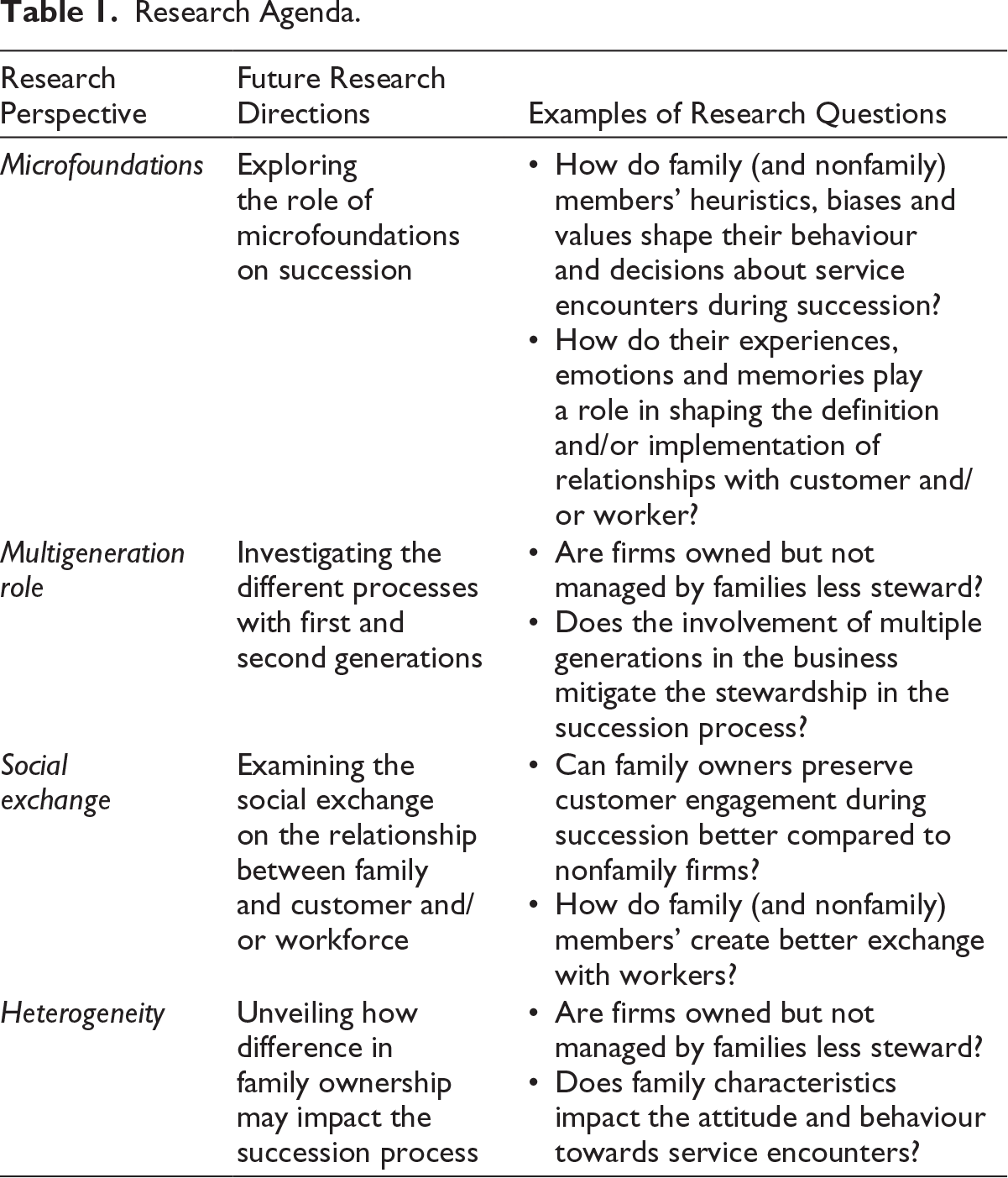
Future work, especially empirical studies, could examine the microfoundations (De Massis & Foss, 2018) and psychological foundations of management (Picone et al., 2021) in succession in the service industry within family firms. This research could reveal at the microlevel how these firms implement novel solutions and integrate innovations into traditional family business models. A more detailed look needs to be invested on two aspects, highlighted in the next two sections.
Family Governance Heterogeneity
To date, no general agreement has been reached among family business scholars on what constitutes a family firm. Recently, Daspit et al. (2021) provided a profound literature review on family firm heterogeneity. Taking into account the family role, scholars agree that family firms are those that present some degree of family involvement in their ownership and/or management (e.g., Chua et al., 1999). However, even if family business scholars agree that the impact of family involvement in a business is fundamental to family firm governance, they recognise that the type of family involvement can differ. Previously, Nordqvist et al. (2014) offered a categorisation of family firms that includes nine specific types of family involvement in ownership and management. In addition, Daspit et al. (2018) noted that family firm ownership differs along at least six possible dimensions: (a) the number of kin involved in ownership, (b) the proportion of firm ownership held by the kin, (c) the dispersion of ownership among the kin, (d) relationships among owners, (e) owner demographic characteristics and (f) the extent of owner involvement in firm governance. These kinds of ownership differences also impact family firms’ management structure (the number of family members involved in management and the characteristics of those involved). Thus, investigations of family firm succession need to include a great number of governance configurations, with each combination having potentially distinct effects on family firm succession. The topic on heterogeneity needs to be explored (Hernández-Linares et al., 2017) in addition; family members identify with their firms and the firms’ results, considering them extensions of their own well-being and abilities. These aspects characterise the essence of the family firm definition (Chua et al., 1999) and are emphasised during the succession process.
There are three possible compositions of management teams in family firms: (a) pure family management; (b) mixed constellations, that is, cooperation with nonfamily executives; and (c) total separation of ownership and management, that is, pure nonfamily management (Klein & Bell, 2007). A nonfamily executive is a person who is neither a blood relative nor related to the owning family by marriage or adoption (Klein & Bell, 2007). Rarely, such a person sits on the management board of a family firm and shapes actions according to their individual intentions, motivation, skills and scope. However, the strategic focus of such a firm is always previously and clearly defined, and knowledge transfers are rigidly consistent with the corporate strategy defined by the family. Thus, future advancements of this topic should consider if and how the presence of a family in the ownership and/or management of a firm enhances monitoring and reduces agency costs (Lohde et al., 2021) and if this is positively associated with succession management in service businesses.
Choosing the Right Theoretical Lens to Understand Succession in Service Business
The success of a service business is based upon social exchanges between service providers and customers. Customers weigh the potential benefits and risks of services delivered from service providers, and if the risks and/or costs outweigh the benefits, they will abandon the relationship. In particular, the reciprocation process involved in the social exchange theory adds an interesting point of view that advances the understanding of succession in service businesses.
In the study of succession in service businesses, there are two levels of analysis to which the social exchange theory can contribute. The first addresses the reciprocity between a service provider and a customer and focuses on the end of a social exchange between them in the case of succession. The second concerns the activities carried out within the firm to decrease the costs that the customer may experience at the moment of succession, when the service provider must necessarily change, and concerns all the research and theory about leader and member exchange. This second level of analysis presents an impressive body of research that can be classified based on the background, outcomes and development of leader and member exchange. Leader characteristics and member characteristics influence these interactions (Dienesch & Liden 1986) and may influence the development of the succession process. Among the factors that influence this relationship, Dienesch and Liden (1986) identified some contextual factors: culture, group size and organisational policies. Service businesses need to consider those elements much more thoroughly than goods businesses due to their interactions with customers. Daspit et al. (2016) argue that a more practical understanding of succession calls for a theoretical framework able to absorb the fragmented findings of existing research—including the notion that family firm succession is a process that encompasses various events over time (Handler, 1994)—and explain social structures built through recurring social interactions along with the influence those structures have on behaviour (Daspit et al., 2016). Specifically, the authors advance the general understanding of succession in family firms and propose the idea that succession is a process of transferring knowledge, transitioning roles and transferring management control.
Considering the characteristics of service businesses and extending the idea of Daspit et al. (2016), one could view succession as a social exchange process that is promising in terms of helping businesses better manage direct relationships with customers. Thus, service businesses offer a promising setting for testing the model proposed by Daspit et al. (2016), and research in this direction is needed.
Conclusion
This conceptual article aimed to explore the influence of family-led firms on succession in service businesses through the lens of a stewardship perspective. The study’s findings offer significant insights into the unique dynamics that emerge at the intersection of family influence and succession processes in the service sector. The goal is to open a research agenda with future follow-up works that are able to have a substantial impact on academic research in the field of both family business and service management.
First, the analysis revealed that family-led firms often maintain stronger, more personal relationships with their customers. These relationships become crucial during succession, as they ensure continuity on the perception of customer satisfaction. Based on a stewardship perspective, the family’s values and long-term orientation significantly contribute to sustaining customer loyalty through periods of transition.
Second, the stewardship perspective highlighted the distinctive nature of employee relationships in family-led firms, where the bonds often resemble those of an extended family. These dynamics foster a sense of loyalty and stability among employees. During succession, these strong interpersonal connections can mitigate employee turnover and maintain morale, as workers are more inclined to stay committed to the business due to their emotional ties to the family and its legacy. This is a positive turn on the relationship with customers.
Third, the study also underscored the effectiveness of knowledge transfer in family-led service businesses, which, although often informal, plays a critical role in maintaining service quality. The tacit knowledge essential for business operations is typically conveyed through close family interactions and mentoring. The stewardship perspective emphasises the importance of preserving this knowledge to ensure business continuity and service excellence.
Finally, this study paves the way for several future research directions. Comparative analyses between family-led and nonfamily-led service firms could elucidate distinct challenges and benefits inherent in succession in the service industry. Additionally, longitudinal studies could provide insights into the long-term effects of succession strategies on both business performance and employee satisfaction. By tracking these elements over time, family business scholars may better provide insights for firms that operate in the service industry.
The stewardship perspective supports the original idea that family-led firms exhibit distinctive strengths that can significantly enhance succession processes within service businesses. The adoption of the stewardship perspective highlights the critical role of long-term orientation, the maintenance of strong interpersonal relationships that impact the decision-making process, and the motivation and commitment of the workforce that facilitate the effective knowledge transfer. These factors are essential for ensuring continuity, preserving service quality and achieving sustainable success through generational transitions. The insights derived from this study promise inspiration to both theoretical discourse and practical applications, thereby supporting the ongoing resilience and growth of family-led service firms.
Practical Implications
Especially during the succession and changeover phase, a business must increase its capacity to listen to and learn from complaints, as its relationships with clients are more delicate during these developments. It is rightly believed that during this phase, the risk of losing customers and suppliers is exponential, and therefore, both of these production process players must be taken care of (Vaid et al., 2023). It might therefore be necessary to have a business plan to ensure organisational stability; this business plan would become a guide indicating when and how the new generation of entrepreneurs should take over the business, and it would contain all the necessary information to minimise internal and external risks to the company during the generational transfer. This is done with the intention to contribute to this area and pave the way for future research, promising to uncover the relevant practical implications of this process, including those for family firms. Furthermore, even in family business studies, it can be interesting and relevant to introduce the distinction between service and goods firms since this distinction can be useful in overcoming some of the problems faced by service businesses.
One of the most important decisions that a family firm has to make as it grows is the extent to which it will employ nonfamily managers (Chua et al., 2003) because this decision could fundamentally affect the relationship between the family and the firm (Fang et al., 2017). Family firms often face challenges when employing nonfamily members due to inherent family biases (Verbeke & Kano, 2012), informal organisational structures (de Kok et al., 2006) and idiosyncratic goals (Kammerlander et al., 2015). The benefits and challenges associated with nonfamily employees have been an intriguing topic of scholarly inquiry for years (Tabor et al., 2018).
In any case, both family and nonfamily workers should be present inside a family firm, and this is a premise of the discussion about the organisational environment created by family ownership that is extended to service businesses (Marín et al., 2016) supporting the succession process.
Footnotes
Declaration of Conflicting Interests
The author declared no potential conflicts of interest with respect to the research, authorship and/or publication of this article.
Funding
The author received no financial support for the research, authorship and/or publication of this article.