






Abstract
While the monstrous feminine of Hollywood is available transhistorically over much of cinema across the world, the female monster of Hindi horror cinema remains ignored and merits serious academic exploration. Much of the widely accepted modern art-horror theory as applied to the horror genre is predicated upon Julia Kristeva’s notion of the ‘abject’ and the Freudian notion of the ‘return of the repressed’. While Creed (1993, 2002) exemplifies that horror texts indeed serve to illustrate abjection, her work reduces all forms of the monstrous feminine in the horror genre to fear of the abject mother. I posit that there is no universal archetype of the abject mother, and the maternal as an abject figure does not find resonance in the Hindi horror genre. Instead, I propose that a sub-genre, which I term the ‘Monstrous “Other” Feminine’ narrative, within the Hindi horror cinema engendered in the 1980s, presents an interstitial phantasmal female monster with wanton sexual desire and gaze as the abject ‘other’. Through narrative closures, traditional gendered perspectives are reinforced, normative femininity is deified and the monstrous other feminine, commanding sovereign female desire and controlling gaze, is annihilated. Exorcism becomes the means not only of expelling the interstitial phantasmal being but also of punishing and disciplining the female body for unrestrained desire and look.
Introduction
Reversing the normative traditional mode of the female-in-crisis scene in the horror genre, Veerana/Wilderness (Ramsay and Ramsay, 1988) opens with a ‘masculinity-in-crisis’ setting. A would-be male victim pleads for mercy, to which Baba (Rajesh Vivek) mockingly retorts, ‘Nikita will slake her thirst with your warm blood today.’
A silhouette appears as the casting rolls off and a pan shot brings Nikita in focus, dressed in an ultra-feminine, black, lacy gown that partially compensates for her masculinisation, and holding a phallic-looking dagger. With her controlling gaze fixed on the male victim, signifying her superiority in the psychological relationship of power, she soon turns into a hideous monstrosity and carries out a ritual disembowelment of her victim. A disembodied voice introduces Nikita as a naapak jism (unholy body), the site for sexual perversity and moral transgression. Men ensnared into illicit sexual encounters with the centuries-old witch in her more alluring form are waylaid and killed. Her recourse to a behavioural trait that is considered typical of men and her male victims’ emasculation, represented by the phallic dagger with which she ‘penetrates’ them, mark their symbolic castration.
Nikita the seductress is doubly abject. First, she routinely transforms herself into a beautiful woman from her true, disgusting, abject, non-human self. Second, she lures men with offers of illicit sex and uninhibitedly transgresses the social boundaries of female propriety. Female desire ‘offloaded’ on to an interstitial immor(t)al female body thus stands doubly ‘abjected’.
A more extended discussion of Veerana is reserved for a later section, but here, in Barbara Creed’s terms, Nikita is the prototypical representation of female monstrosity.
If woman is the image and man the bearer of the look (Mulvey, 1975), Nikita, the monstrous female, in a clear reversal of roles, is the beholder of the scopophilic gaze and objectifies the male, her gaze becoming the erotic basis for her pleasure, sexual or otherwise.
The Return of the Monstrous Other Feminine
Coming in the wake of the second feminist wave, and having imbibed Freudian psychoanalysis, semiotics, structuralism and Althusserian Marxism, Mulvey (1975), Creed (1993, 2002) and Williams (2002) deconstructed the gaze and the popular representation of women in cinema, disseminated through theoretical writings, and had an impact beyond western film theory. While the monstrous feminine of Hollywood is available transhistorically over much of cinema across the world, the female monster of Hindi horror cinema remains ignored and merits serious academic exploration. The preoccupation with male monsters led western film theorists and critics alike to discuss ‘female monstrosity either as part of male monstrosity or as man’s castrated other… including making insinuations that “there are no great female monsters as in the tradition of Frankenstein’s monster or Dracula”’ (Creed, 1993, p. 3). Creed (1993, 2002), Williams (2002) and Clover (1992) have presented extensive elaborations on art-horror’s brush with gendered monstrosity, and much of the widely accepted art-horror 1 theory as applied to horror cinema is predicated upon Julia Kristeva’s notion of the ‘abject’ and the Freudian notion of the ‘return of the repressed’.
According to Julia Kristeva, the abject is that which threatens to break down the distinction between the subject and the object or between the self and others. Through abjection, ‘primitive societies marked out a precise area of their culture in order to remove it from the threatening world of animals and animalism, which were imagined as representatives of sex and murder’ (Kristeva, 1982, pp. 12–13). Following this, abjection was ‘a psychological process of casting off’ (Baldick, 2008, p. 1). Anything on the margins of the physical self that defied classification became abject: bodily secretions such as pus, faeces, blood and urine as well as, importantly, cadavers, the ultimate abject objects. The most primitive of these ‘in-betweens’ is the moment of birth. The primal chaos of birth, the base of our existence, always calls us back, and yet we distance ourselves from this abject moment in order to define ourselves as a subject. Julia Kristeva locates the source of horror in the pre-oedipal stage, in a child’s attempts to break away and become a separate subject. The abject confronts us from within in ‘our earliest attempt to release the hold of the maternal entity’ (Kristeva, 1982, p. 13). Abjection is a necessary precondition of narcissism, allowing the child to take its proper place in relation to the symbolic order ‘of language, law, morality, religion and all social existence’ (Baldick, 2008, p. 327). It is in the child’s attempt to free itself from the mother and her refusal to let go that the mother becomes abject. The abject thus is that which ‘does not respect borders, positions, rules: the in-between, the ambiguous, the composite’ (Kristeva, 1982, p. 4).
In her psychoanalytic study The Monstrous Feminine, published in 1993, Barbara Creed asserts that horror cinematic texts serve to illustrate the Kristevan ‘abject’ in three ways: first by presenting to us an array of bodily waste and putrefying flesh; second, through the ghost/monster metaphor as an interstitial ‘other’ that defies taxonomy and challenges boundaries between the human and the non-human and third, through the monstrous maternal figure, the archaic mother of films such as Psycho (Hitchcock, 1960), Carrie (de Palma, 1976), The brood (Cronenberg, 1979) and Aliens (Cameron, 1986). Much of the monstrous imagery constructed with regard to the female monster, Creed’s monstrous feminine, is built in conjunction with her reproductive and mothering functions (Creed, 1993, p. 7). While I agree with Creed’s views that horror texts indeed serve to illustrate abjection, the monstrous feminine as an archaic mother figure finds no resonance in Hindi cinema. I posit that a sub-genre, which I term the ‘Monstrous Other Feminine’ narrative, engendered within the Hindi horror cinema in the 1980s, presents an interstitial phantasmal female monster, with wanton sexual desires and gaze, as the abject ‘other’. What differentiates this sub-genre from other horror films is that through narrative closures, traditional gendered perspectives are reinforced, normative femininity is deified and the monstrous other feminine, commanding sovereign female desire and controlling gaze, is annihilated. Exorcism becomes the means not only of expelling the interstitial phantasmal being but also for punishing and disciplining the female body for uninhibited desire and gaze.
Since ‘narration is one of the means of reproducing subjectivities’ (Smelik, 1999, p. 358), an interrogation of narrative strategies offers key aspects of the subjectivities engendered by the sub-genre. I focus on films that depict females as villainous ghosts that threaten the extant moral and sanctified sexual order, and hope to show how these Hindi horror narratives of the interstitial female monstrosities, with their sub-text of repressed sexuality and projection of fear and longing, prime themselves for Freudian analysis.
This article will consider the role which gender plays in the articulation of monstrosity in Hindi horror cinema and trace the inaugural moment of the monstrous other female as a sub-genre within Hindi horror cinema, mapping narratives in which female sexuality is the monstrosity, and female desire, above and beyond reproductive needs, is delegitimised, both socially and conventionally.
The deep-seated anxieties relating to female sexuality as expressed in such narratives can be traced to the colonial encounter. In the popular imagination of the 19th century, the nation state was a corporeal being, or Bharat Maa (Mother India), and the maternal figure was viewed as neither monstrous nor malefic. Rather the period saw ‘an alternate tradition… in which the nation [was] cartographically presented to its subject-citizens… as mother, woman, goddess’ (Ramaswamy, 2001, p. 97). Even the Hindu ideal feminine construct of Sati–Savitri–Sita, the mythical triad of devotional wives committed to chastity and fidelity, was ‘wholly a product of the development of a dominant middle-class culture coeval with the era of nationalism’ (Chatterjee, 1989, p. 248). Women of the hearth were exalted and glorified amidst apprehensions that females in the public sphere would generate disruptive identities. Deification of Indian women as non-sexual maternal figures became necessary to facilitate their entry into the outside world.
The post-colonial Nehruvian state sought a reversal of these entrenched forms of patriarchies. The Hindu Code Bill of the 1950s empowered Hindu females by awarding them equal property rights, and the burgeoning population of the 1970s led to state-sponsored family-planning programmes that inadvertently pitted women’s reproductive rights against normative patriarchal practices. The dissolution of the traditional joint-family system furthered female empowerment by removing assertive patriarchs and ‘the 1980s saw the emergence of the vocal and visible autonomous women’s groups which placed feminist issues firmly on the public agenda’ (Menon, 2004, p. 169). Picturesque foreign locales of Bombay cinema introduced a diegetic bourgeois spatial–temporal space where romance could be conducted uninterrupted, away from the disciplining patriarchal gaze, and songs came to acquire an unmistakable erotic appeal. Films such as Sanjog/Coincidence (Balan, 1971), Julie (Sethumadhavan, 1975), Insaaf ka tarazu/Scales of Justice (Chopra, 1980), Jeevan dhara/Life Stream (Rao, 1982) and Mujhe insaaf chahiye/I Want Justice (Rao, 1983) heroically narrativised the feminine struggle against middle-class conventionalities, oftentimes undermining patriarchy and most often allowing a valorised but deviant female sexuality to escape unscathed with the audience’s sympathy.
If films are best understood in relation to the ‘periods in which they were produced and consumed’ (Hall, 2001, p. 16), then the monstrous other feminine was a patriarchal riposte to this assertive feminist discourse, emerging as a sub-genre from within Hindi horror cinema in much the same way as the ‘Bitches from hell’ 2 narrative of the 1980s was Hollywood’s backlash against feminism of the 1970s, which, as Susan Faludi notes, ‘shaped much of Hollywood’s portrayal of woman in the eighties… [wherein] the “good mother” wins and the independent woman gets punished’ (Faludi, 1992, p. 141). Reflecting a generalised cultural backlash against Indian feminism, the Hindi horror genre of the 1980s engineered the monstrous other feminine, a sadistic, neurotic and narcissistic pretatma (evil soul), who, as the possessor of gaze and desire, threatened sanctified familial relations by seeking to imbricate herself within heterosexual monogamous relationships and invited divine punishment for defying the symbolic order.
Unlike Hollywood’s monstrous feminine, this sub-genre of Hindi horror cinema sought to displace abjectness and monstrosity, not onto motherhood, but on to the cultural and social ‘other’ of motherhood, the monstrous other feminine who stands outside socially sanctioned conjugal relations and desires another woman’s man, a neat demarcation of the mother and the demimondaine. If Creed’s monstrous feminine is about the archaic mother refusing to let go of her child, the monstrous other feminine of Hindi horror cinema refuses to let go of desire and gaze.
With its competing sets of female sexualities, this monstrous-other-feminine sub-genre of Hindi horror cinema plays out Freud’s return of the repressed ‘other’. As Robin Wood writes, the other ‘represents that which the bourgeois [or any other] ideology cannot recognize or accept but must deal with… in one of two ways: either by rejecting and if possible annihilating it or by rendering it safe and assimilating it, converting it as far as possible into a replica of itself’ (Wood, 2003, p. 65). As a threatening other, seeking to subvert phallocentricity through the appropriation of desire and gaze, the monstrous other feminine is vanquished in the narrative’s closure and the status quo of normative femininity is preserved.
The inaugural moment in the female-centred horror/monster film cycle is invariably Madhumati (Roy, 1958), in which the ghost of Madhumati (Vyjanthimala) returns not only to seek vengeance on her molester Ugranarayan (Pran) but also to kill her lover Anand Babu (Dilip Kumar) so as to unite with him through reincarnation. Again in Nagin/The Female Serpent (Kohli, 1976), the shape-shifting serpent Nagin (Reena Roy) is a female seeking revenge on a group of friends responsible for her ophidian mate’s death. But I situate the monstrous other feminine as a distinct entity from other female monsters. Madhumati and Nagin are sympathetic characters, their monstrous urge driven purely by the desire to avenge the disruption of conjugal domesticity. Beneath their guileless monstrosity they are very much traditional, moral women. The monstrous other feminine is a home wrecker, a fallen woman and a disruptor of domestic conjugality.
Mangalsutra and the Monstrous Other Feminine
As an archetypal monstrous-other-feminine narrative, Mangalsutra/Nuptial Necklace (Vijay, 1981) marks the inaugural moment of this sub-genre even as it reiterates the Hindu tale of the mythical Savitri in a modernist mode and idealises devotion and self-sacrifice to domesticity and patriarchy. Vijay (Anant Nag) and Gayatri (Rekha), betrothed to each other in childhood, are the progeny of best friends Badri Prasad (Madan Puri) and Mohan (Om Shivpuri). With their fate thus sealed by an oral contract between complicit paternities, the prefatory sequences are devoted to the building up of the lovers’ courtship under the watchful gaze of patriarchy. Gayatri’s father, Badri Prasad, is privy to Vijay’s taped messages mailed to Gayatri. Mohan allows his son Vijay to stay at his prospective inlaws’ home before marriage, contrary to normative Indian practice. And though Vijay has easy access to Gayatri, their interaction is regulated. Even a brazenly worded romantic love duet between the lovers is embarrassingly interrupted by the ever-watchful fathers, signifying the omnipresent patriarchal gaze. The young couple acknowledges the untenability of desire outside conjugality and refrain from the ‘forbidden’. This placid romanticism of the couple, duly approved by the patriarchate, ends in marriage, but is unexpectedly interrupted on the wedding night by an evil spirit, whose encroachment upon the narrative had been heralded earlier by a series of inauspicious events: a buffalo 3 runs amok at Vijay’s marriage procession, the sacred nuptial cord catches fire and vermillion spills onto the ground. On the wedding night, Vijay’s advances are put on hold by Gayatri’s diffident reluctance. In the song sequence that follows, however, Gayatri amply demonstrates that she does not lack desire; rather, her ultra-femininity and demureness work as a female masquerade and a subtle sexual collusion with patriarchy. Her coyness is a ruse and her attempts at averting Vijay’s gaze serve to disguise her forays into the realms of desire and look. Through Althusserian interpolation Gayatri constitutes herself as a subject, refraining from conferring her gaze on Vijay but inviting his look, as is clear when she preens before the mirror, aware that she is being looked at. In John Berger’s terms, Gayatri becomes both the ‘surveyor’ and the ‘surveyed’ (Berger, 2008, p. 46).
Vijay is able to assert his sexuality only when Gayatri has partially renounced hers, and her pretence of a lack of desire allows Vijay to project his own. But the consummation is wrecked by Vijay’s sudden collapse. His father rushes in without as much as a knock, signalling the panoptic patriarchy that is lingering somewhere off-screen, even at this moment of intimacy. Vijay is hospitalised. The first skirmish with the supernatural manifests itself when Vijay abandons his hospital bed at midnight and attempts to violate Gayatri. The ever-vigilant patriarchy averts marital rape and preserves the sanctity of marriage. Vijay is brought home, and the possession is conveniently ignored as a ‘fit’. A seemingly recovered Vijay then makes another attempt at intimacy.
Her earlier female masquerade of sexual naivety gives way in a Freudian slip when Gayatri chides him teasingly, ‘First eat; if you do not… you will grow weak’. But all sexual expectations are dissipated in the emphasis on Gayatri’s nurturing abilities; she is rendered safe within the strictures of hegemonic gender divisions. Vijay, however, makes another bid on Gayatri and is again duly thwarted by the patriarchy. An exorcism follows, crudely picturised with the writhing body of a woman superimposed on Vijay, and Kamini (Prema Narayan) is introduced as the evil spirit with a tale to tell.
Two flashbacks follow in quick succession. In the first Kamini, speaking through Vijay, alleges that possession is punishment for her rape by Vijay. The flashback takes viewers to a dark and stormy night during which Kamini, returning from a party, is waylaid by a band of hoodlums. Vijay rescues her from them, but takes her to his home and then rapes her, promising marriage as consolation. The crime, perpetrated off-screen, is merely inferred by the audience from Kamini’s desperate calls to Vijay for restraint. Later, two disembodied hands exchange rings, with the promise of marriage. Kamini says it was Vijay’s betrayal that forced her to suicide. This flashback is a moment of crucial significance as it ruptures the narration, unhinges the audience’s expectations and introduces a notion of suspense. Vijay’s fidelity, established so meticulously before, now appears suspect. Having apparently violated a prohibition, punishment for him appears legitimate.
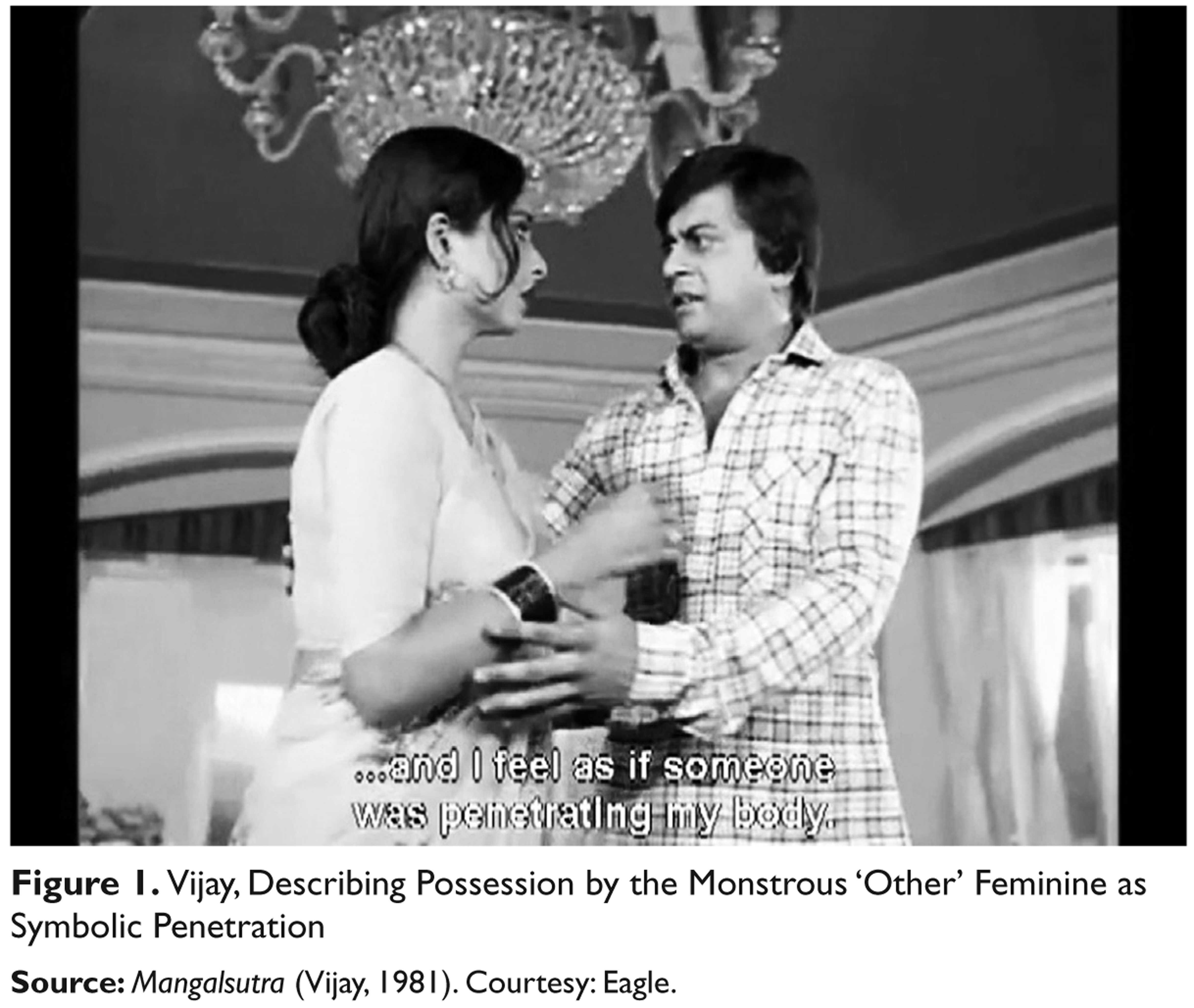
With her vengeance ‘legitimised’, Kamini emerges as the all-powerful non-phallic symbol of sexuality and a castrating nemesis of the male hero. Possession reduces Vijay to a state of powerlessness and enacts his symbolic castration; he is unable to consummate his marriage. Vijay’s feminisation and subjection to pain by the sadist Kamini become all the more obvious when he describes the onset of possession as ‘penetration’ (Figure 1).
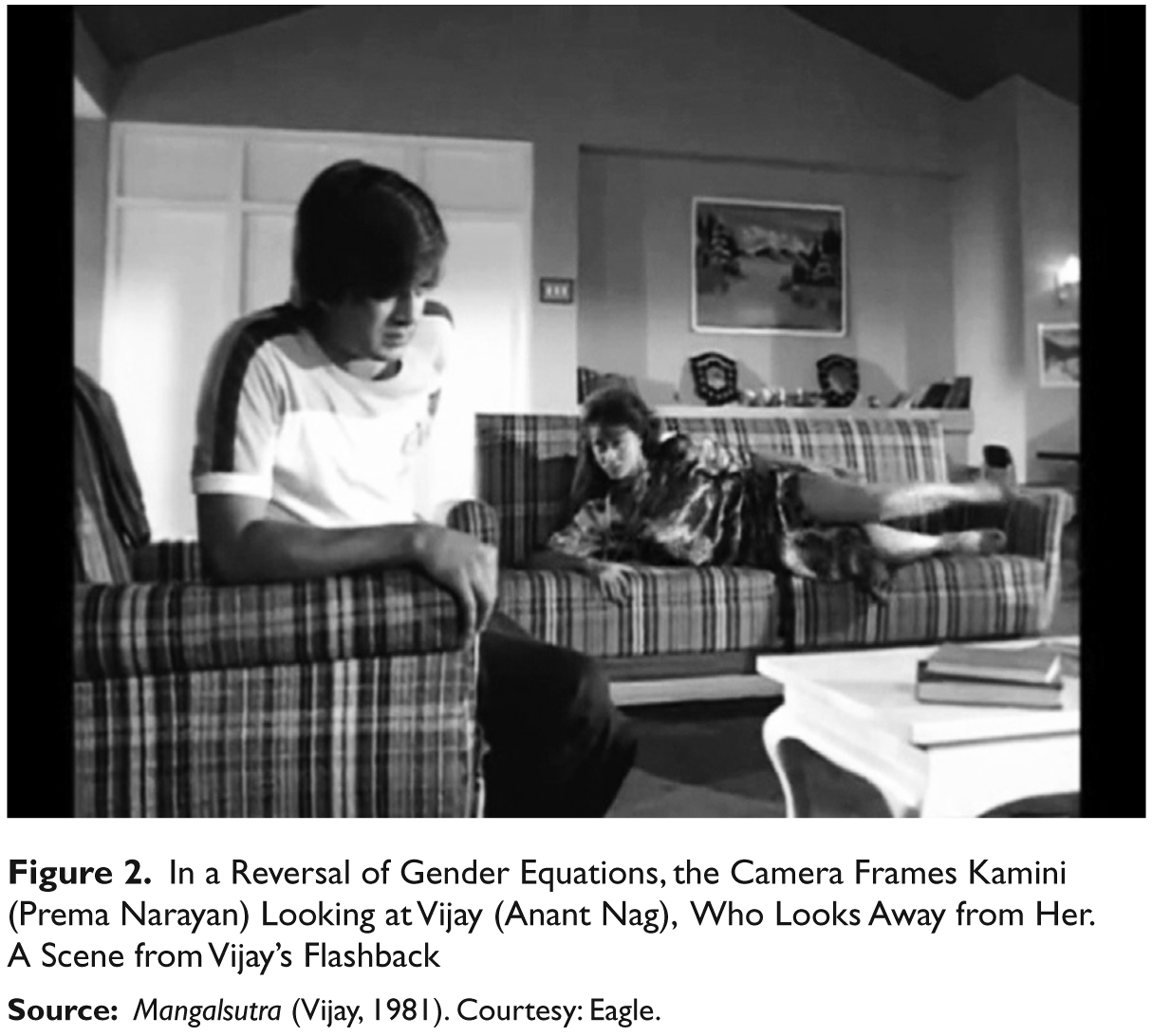
An exorcism expels Kamini, albeit temporarily. Vijay recovers and his redemptive flashback follows, which presents Kamini as the sexual aggressor while he is the victim of Kamini’s threatening gaze and desire. A series of events from this flashback unfold on-screen: Kamini stalking Vijay in college; Kamini spreading rumours about their engagement, much to Vijay’s chagrin and, finally, Vijay returning home one day to find Kamini in his bedroom. As he spurns her advances an impromptu striptease song is played. A subjective panning camera shot appropriating Vijay’s gaze first brings Kamini’s floral-patterned and colourful undergarments into the frame and then Kamini herself sprawled invitingly on his bed, wrapped in a towel. Throughout the song sequence that follows, Vijay struggles to gain a visual foothold in Kamini’s presence while she gazes on unabashedly. Significantly enough, when Vijay looks at Kamini, his gaze is appropriated by subjective camera shots, fetishising Kamini. When Kamini ‘appropriates the look’, we see her looking at Vijay through objective shots that spare male heterosexual spectators the trauma of experiencing the objectification of the male body through the female gaze (Figure 2).
Minor details also substantiate the differences between the repressed sexuality of the domesticised wife Gayatri, whose femininity is singled out through visual markers such as her sari and sindoor, while the casual and unrestrained facets of Kamini’s sexuality, are expressed through items of her apparel. She wears a split-to-the-thigh gown that reflects her sexual openness. Through disavowal and repulsion, Vijay thwarts her feelers, and hits out at her in an act of final rejection. Kamini storms out in a rage and dies in a road accident thereafter.
Vijay’s narrative is authenticated over Kamini’s through the presence of an alibi. Vijay’s friend (Shashi Puri) attests to Kamini’s uninhibited desire and assures the audience of Vijay’s fidelity. With this substantiation, Kamini’s narrative is falsified and the raison d’être of revenge is delegitimised. ‘The projection onto others of one’s own repressed desires constitutes the classic mechanism of paranoia’ (Williams, 1981). Kamini’s self-identification as the victim becomes a paranoid projection, her misplaced sense of victimhood merely an outward projection of her own corrupt, debased passion.
As Vijay is repossessed and condemned to die, Gayatri rushes to pray to Lord Shiva, symbol of male creative energy. Though Hindu iconography often depicts Shiva as Ardhanārīśvara—one half of the body male and the other female—‘the most basic and most common object of worship in Shiv shrines is the phallus or lingam’ (Zimmer, 1992, p. 126). The climax conflates divinity and masculinity. Invoked through her prayers, the deity manifests his third eye and destroys the usurper of the gaze. Towards the denouement, the mythical Savitri is refigured through Gayatri, who saves her husband from death and restores the patriarchy. The film upholds the untenability of autonomous female desire outside conjugality and asserts the primacy of patriarchal law.
An examination of the competing femininities of Gayatri and Kamini has much to offer. Gayatri and Kamini are alike in that they are both committed to go to any length to possess the man they desire. But while Gayatri’s sexuality, hedged within the sanctity of marriage, is deified as exemplary, Kamini’s invites censure and divine retribution. As a subject sutured into patriarchy, Gayatri gains social acceptability and the audience’s sympathy. Within the patriarchal structure, the appropriating gaze must remain the prerogative of the male subject, but Kamini not only possesses the gaze, she aggressively courts it, and as the threatening sexual ‘other’ can be rejected only through denunciation and disavowal. Gayatri looking away from Vijay on her wedding night is accordingly an acute internalisation of the patriarchal order.
The ‘aversion of gaze’ and ‘disavowal of desire’ are skills that enable Gayatri’s entrée into the patriarchal order, in the way that projecting women as ‘non-sexual’ entities facilitated their entry into the outside world in colonial times. Gayatri’s love does not appear spontaneous. With her match fixed at birth, Gayatri’s desire for Vijay is but a ‘patriarchal obligation’. Kamini’s sexuality, on the other hand, is a matter of choice. Again, while Gayatri is introduced in the film through a photograph which Vijay carries on his person to be able to bestow his ‘gaze’ on her, Gayatri has ‘surrendered’ her gaze and prefers to listen to Vijay on audio tapes. Gayatri’s heterosexuality also stands in contrast to Kamini’s excursions into suspected lesbianism: if Kamini experiences pain through Vijay’s body during an exorcism, we are to assume that she receives pleasure when Vijay attempts to violate Gayatri.
With star image as the reference point, the casting of Prema Narayan as Kamini and Rekha as the pious wife Gayatri reaffirms spectatorial conventions. Exorcism through divine intercessions not only expels the monstrous other feminine but also punishes the female body for unrestrained desire and gaze. Kamini is disavowed and annihilated symbolically through a phallic trishul (trident) that penetrates her ethereal body, and this moment marks her de-phallicisation. The conscious/cultural prevails over the biological/instinctual. Gendered order is restored, the status quo maintained.
Kamini’s desire and threatening gaze in Mangalsutra (1981) is displaced onto the witch Nikita in Veerana/Wilderness (Ramsay and Ramsay, 1988), a film that explicitly identifies female desire as socially corrupting and mortally threatening. Nikita preys upon men, both sexually and otherwise. Sameer Pratap (Vijayendra Ghatge) entraps the witch and strings her up, but he is abducted by Nikita’s avenging worshippers and her soul is made to enter his teenaged niece Jasmine (Jasmin). In his absence Sameer Pratap is presumed dead by his family. Years go by and an adult Jasmine grows up to prey upon men in a licentious fashion similar to Nikita’s. The framing of Jasmine’s body offers an abundant display of fetishism, signifying the fear of female sexuality, but through objectification Veerana recuperates wounded masculinity. Jasmine is introduced through a double structure of ‘look’, a striptease song plays as she is framed in a woman-at-the-keyhole moment, which demystifies her and presents her as hyper-sexualised. The subjective camera frames her in a bathing sequence through a double voyeuristic gaze.
We appropriate the ‘look’ of the servant spying on her through a keyhole. The camera then abandons the pretence of the surreptitious gaze and transplants the viewer directly into Jasmine’s bathing chamber. Her seductive dancing becomes a privatised striptease for the male viewer and, at one point, Jasmine breaks the fourth wall to look directly at the spectator. Her threatening sexuality is overpowered through voyeurism as the camera fetishises her body, lingers on her legs, exposed midriff, cleavage, bare back. Throughout the song, close-up shots ignore the illusion of screen depth and symbolically mutilate and dismember her body. The narrative crisis is precipitated by Jasmine’s attempts to steal another woman’s man, Hemant (Hemant Birje), the boyfriend of her cousin Sahila (Sahila Chaddha), but the long-missing patriarch Sameer Pratap returns in the nick of time to save the hetero-normative relationship. An entrapped Nikita released within the hallowed precincts of a Shiva temple disintegrates under the divine gaze. This Foucauldian ‘disciplining’ of female desire in Mangalsutra, Veerana and later monstrous-other-feminine discourses does not appear arbitrary because it operates through the mechanism of divine justice and is free of guilt.
In the true Bakhtinian fashion of dialogism, of constructing utterances, where ‘we usually take them from other utterances and mainly from utterances that are kindred to ours in genre, that is in theme, composition and style’ (Bakhtin, 1986, p. 86), Hindi horror cinema turns Hollywood’s monstrous feminine into the monstrous ‘other’ feminine, the non-mother, monstrous sexual other, a castrating nemesis and mortal threat to patriarchal authority.
With their narrative codes of wayward female sexuality and divine punishment through exorcism in the denouement, Mangalsutra and Veerana distinctly delineate the general thematic structures of similarly organised pre-liberalisation monstrous-other-feminine narratives, such as Bees saal baad/Twenty Years Later (Kohli, 1988), Woh phir aayegi/She Will Return (Ishaara, 1988), Suryavanshi (R. Kumar, 1992) and Zakhmi rooh/Wounded Soul (P. Kumar, 1993). But since hegemony is never stable, this patriarchal hegemonic discourse, facing the onslaught of counter narratives, must recuperate, accommodate and renegotiate more novel terms of submission. Thus, post-liberalisation monstrous-other-feminine narratives such as Raaz/The Secret (Bhatt, 2002), Krishna Cottage (S. Varma, 2004), Eight: The Power of Shani (Razdan, 2006) and Darling (R.G. Varma, 2007) reiterate the same destructiveness of uninhibited female desire, but appear conciliatory, as I shall demonstrate later.
Modernisation of Patriarchy and Post-liberalisation Female Monstrosity
Bakhtin writes, ‘Utterance is constructed while taking into account possible responsive reactions, for whose sake in essence it is actually created’ (Bakhtin, 1986, p. 94). With liberalisation in the 1990s, India embarked upon a knowledge-based economy and workplaces began to exhibit gender diversity. The Indian public sphere witnessed a proliferation of erotic visuals, heralded by a series of print advertisements for Kamasutra condoms, which focused ‘unequivocally if not solely on erotic pleasure… and foreground[ed] the erotic desires and pleasures of the woman’ (Mankekar, 2004, p. 415). This sexualisation of Indian television took place in the context of ‘feverish commodity consumption precipitated by the expansion of mass culture, the liberalisation of the Indian economy and the introduction of global capital’(Mankekar, 2004, p. 408). Television re-fashioned social habits and consumption patterns. With the feminisation of the workplace, cinema stretched its demographics to the new constituency of a recent upwardly mobile female spectatorship, lately empowered through economic reforms. To conciliate dominant cultural anxieties engineered by the media industry’s somewhat blatant explications of female desire, patriarchal surveillance was remoulded in the sub-genre to accommodate the female gaze.
Marking genre anxiety, a moment of conflict between ‘conservative continuity reinforced by the persistence of generic forms and the ceaseless pattern of social change’ (Lipsitz, 1998, p. 209), the monstrous-other-feminine sub-genre moved away from the essentialist position of compulsory repression of female sexual autonomy to a more revisionist discourse that sought to reappraise female sexuality/desire in more considerate terms and offered the male body for uninhibited female scopophilic gaze. The post-liberalisation narratives impart to these monstrous other females a quasi-legitimacy that softens their evilness, invests them with a cause that invites the audience’s sympathy and offers a narrative closure that does away with the need to exorcise them in the dénouement, as in Krishna Cottage (S. Varma, 2004), Eight: The Power of Shani (Razdan, 2006), Darling (R.G. Varma, 2007) and Click (Sivan, 2010).
As a revisionist horror narrative, Raaz/The Secret (Bhatt, 2002) tenders several opportunities for male objectification and marks the introduction of the female gaze, offering the quintessential metrosexual male lead Aditya (Dino Morea) for female scopophilic consumption (Figure 3). A newly married Aditya, alone on a business trip to Ooty, is accosted by the mysterious, footloose Malini (Malini Sharma) and is seduced by her. When the affair subsides, Aditya’s refusal to divorce his wife and acknowledge Malini’s presence beyond the bedroom leads her to commit suicide. Fearing the law, Malini’s body is secretly buried and Aditya returns home, but the traumatic event leaves him ‘limp’ and ‘unmanned’, marking the loss of libido and his symbolic emasculation, precipitating the narrative crisis with which the film’s plot opens. Aditya’s wife Sanjana (Bipasha Basu), unable to take Aditya’s workaholism and concurrent sexual neglect, storms out of a party and has a car crash. In hospital, Sanjana implies that he is ‘not the same Aditya’. On another occasion she says, ‘You would run away from me, when you should have been much closer… I would remain awake, while you would go to sleep.’
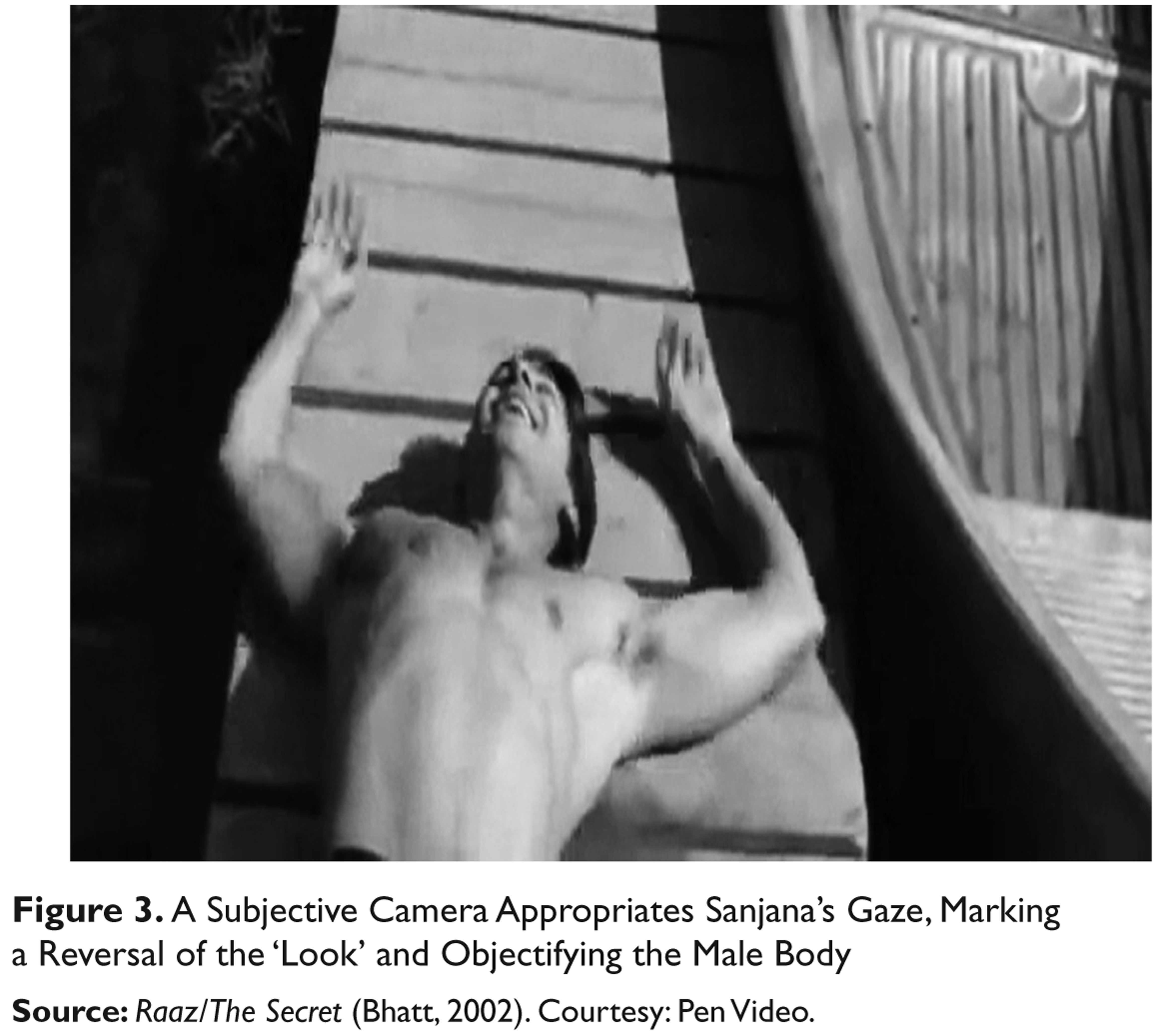
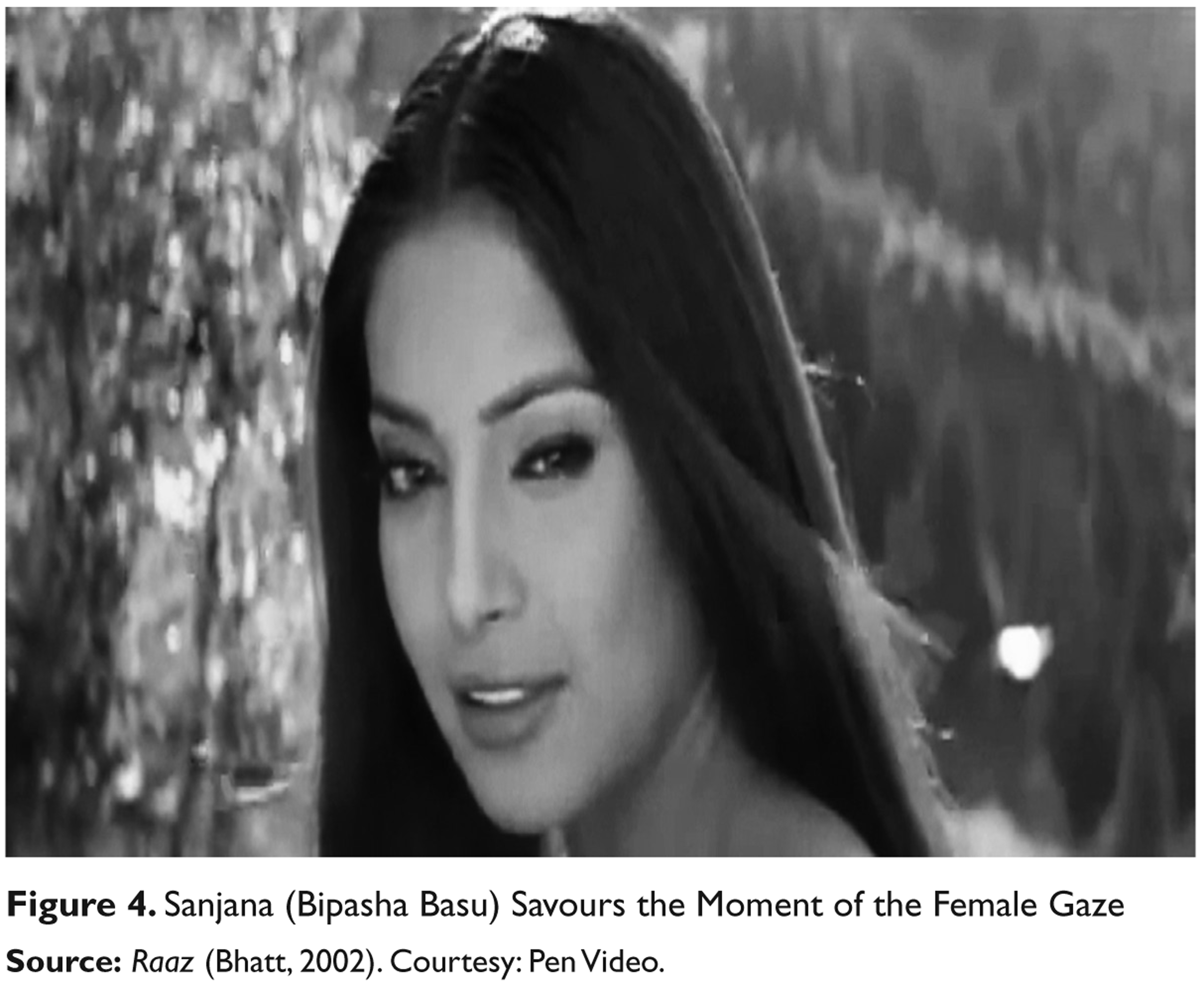
In an attempt at reconciliation, the couple heads for Ooty, which necessitates a cinematic digression through a song that intercuts between the happier past and the disconsolate present. Surprisingly, if the ‘present’ provides no opportunity for the buttoned-up Aditya to dispense with his clothes, the accommodating flashback marks a reversal of gaze. Marking a transitional society in which objectifying the male body is no longer taboo, a song sequence puts Aditya’s muscular bare body on display and invites voyeurism. Sanjana’s expressions at this male objectification are unambiguous; she appears to enjoy this male spectacle (Figure 4).
Back in the present, Malini’s voyeuristic presence, implied through point-of-view shots, intrudes upon and disrupts the couple’s intimacy, just as Kamini’s presence dampened passions in Mangalsutra (Vijay, 1981). Kept in abeyance, Malini’s spectral presence is ushered into the narrative, and the transiently possessed Sanjana extracts a confession. Aditya admits to his ‘reluctant’ sexual transgression. A transition to an earlier event through a flashback interrupts the chronological development of the story and a picturised song shows the two transgressors, with Malini as a dominatrix and wielder of the phallus. An unclothed Aditya is propped against a tree while Malini is all over him. In the climax, however, the monstrous phallus-appropriating femininity is banished once again, and Sanjana battles to save her husband’s life and the marriage.
As another revisionist attempt, Eight: The Power of Shani (Razdan, 2006) seeks to assuage feminist anxieties and concerns, even if the narrative’s closure is conventional. The family of patriarch Suraj Rai (Gulshan Grover) experiences mysterious malefic paranormal activity in their home on Saturdays and on dates that total eight, the number attributed to the Hindu deity Shani. 4 A terrified Suraj Rai flees with his family and, in a cathartic moment, owns up to a fling with Kamini (Vastavikta), an ardent worshipper of Shani. A generic flashback establishes Kamini’s wayward sexuality and Suraj’s trepid complicity. When the promised marriage does not materialise, a traumatised Kamini, unable to transubstantiate her pleasure principle into reality pleasure, drives off a cliff and dies. In Freudian interpretation, the erotic instinct and the desire for death are fused together. From desire to death, Kamini moves from Eros to Thanatos and returns to haunt the family. The narrative’s closure reaffirms the inviolability of the socially sanctified monogamous relationship. The law of marriage overwhelms desire, and Eros submits to cultural constraints. However, Kamini is able to elicit divine retribution to her advantage: the Shani deva allows her to exact vengeance on Suraj (even if short-lived). This marks an overt change in divine posture. The Kamini of Mangalsutra, in comparable circumstances, had been penalised by the gods.
Darling (R.G. Varma, 2007) re-scripts the monstrous narrative and showcases the active sexuality of the vengeful spirit Geeta (Esha Deol), who is allowed to conquer the passivity of the wife Ashwini (Isha Koppikar). Aditya (Fardeen Khan) has an extramarital relationship with his secretary Geeta, but it flounders on the broken promise of marriage. They fight during an amorous rendezvous and Geeta is accidentally killed. She returns from the dead as the monstrous other feminine, her gaze perpetually fixed on Aditya. As a post-liberalisation femme castratrice, her surveillance is limited to embarrassing Aditya and dampening things in the bedroom, which again can be read as symbolic castration. But Geeta’s monstrosity is also a dilution of evilness: she can visit the temple and seek divine intervention. The patriarchal gaze, so panoptic in Mangalsutra (1981), becomes invisible in Darling (2007) and despite the absence of a patriarchate in the nuclear household, the restrained eroticism and modesty of Aditya’s domesticised wife (Isha Koppikar) is but the internalisation of patriarchal surveillance. She takes to policing herself, as when she looks visibly embarrassed when Aditya offers her a foot massage. Meanwhile, Geeta’s body is subjected to a fetishised representation, with the camera appropriating the male gaze, lingering on Geeta’s derrière in one scene. But as a genre-revisionist narrative, Darling not only offers benignity to Geeta’s ghost, the camera also identifies with Geeta’s gaze, objectifying the male body by offering the audience a glimpse of Aditya’s crotch. The controversial climax reintegrates Geeta with domesticity as Ashwini dies in an accident. Her body is taken over by Geeta, her amorous desire now legitimised and accommodated within marriage.
If the ‘final girl’ 5 who survives and/or defeats the killer/monster is phallicised and given masculine traits in Hollywood’s monstrousfeminine narratives, Gayatri in Mangalsutra and Sanjana in Raaz as the final girls of Hindi horror cinema are artificialities, camouflages and masquerades, designed to cover desire and discount the reprisals that possessing desire would invite. Normative femininity enables them to assume subordinate positions within patriarchal narratives, saving them from the certain annihilation to which Kamini in Mangalsutra (1981), Nikita in Veerana (1988) and Malini in Raaz (2002) are subjected. With their destruction/expulsion from the narrative, the final girl is the woman who has surrendered her claim to desire and gaze and acquiesces in passive sexuality.
The monstrous-other-feminine sub-genre of Hindi horror cinema offers us an image of feminine autonomy, but one which is negated and condemned either to discipline or annihilation. The monstrous other feminine is a phallic woman at one moment and a fetishised woman the next. As part of a dynamic patriarchal discourse, the monstrous-other-feminine narrative of Hindi horror cinema anticipates and accommodates the counter-hegemonic dialogue. The appropriation of gaze and desire by the monstrous other feminine opens up a space of resistance but within the limits set by patriarchy. Thus, an exploration of the cinematic subjectivities reveals that ‘specific historical moment[s] ha[ve] affected the Hindi horror genre’ (Mubarki, 2013, p. 60) and the monstrous narratives enmesh the fear of the interstitial phantasmal female within the larger framework of cultural misogyny and patriarchal fear of the all-powerful feminine. Therefore, these narratives act as moments of catharsis and allow for the manifestation of social prejudices that can be safely dismissed as coming from outside, not from within us. We stand distant from these narratives as spectators and onlookers.