







Abstract
Menstruating women in remote villages of the Himalayas still practise segregation due to the belief that menstrual blood is impure. They are confined to the cowshed (goth) and are not allowed to interact with others. Although Bageshwar district has been declared as open defecation free and every household has a toilet, menstruating women continue to defecate in the open because they are not allowed to use sanitation facilities used by others. Menstrual taboos have an impact on the mobility, health, education and self-esteem of women and adolescent girls. This article looks at the taboos that exist in the Pindar Valley and how women and adolescent girls cope when they have their period. What is the impact of these taboos on the women and girls? How do men and women perceive these taboos? What are the key barriers to changing these practices? How have women negotiated this change given the rigid traditions that have been handed down the centuries?
Background to Pindar Valley
The study is undertaken in Pindar Valley, located in the remote north-east of Uttarakhand state. The 10 gram panchayats in this valley fall under the administration of Kapkot block of Bageshwar district. The valley is situated at the mouth of the Pindari Glacier with the Pindar River originating here. While the average elevation of the villages is 6,500 ft (2,000 m), it is surrounded by peaks well over 16,000 ft (5,000 m) on all sides. The villages are the last inhabited settlements in the north of Bageshwar beyond which lies the highly protected Nanda Devi Biosphere Reserve. The remoteness of the Pindar Valley combined with the harsh terrain and climate defines the resident’s way of life.
The valley is for the most part bereft of essential public services such as roads and electricity. Until 2005, before the roads were laid, the residents had to hike 50 km to reach the block headquarters. Recently, due to the construction of an unpaved road, this travel time has been cut short to 3–4 hours. However, this unpaved (kuchha) road is often shut due to torrential monsoon rains or heavy snowfall in the winters, cutting off the valley from the rest of the region. Moreover, the road connects only the mouth of the valley to outer regions with most habitations still relying on British era footpaths for interconnectivity. Porters and mules remain vital means of transportation. Access to regular supply of electricity remains elusive. Internet and telecom connectivity, almost an essential aspect of modern day life, is acutely missing in the valley.
Apart from poor physical infrastructure, Pindar Valley also lags behind on access to healthcare and education. The literacy rate is significantly lower than the district average. While schools were built in every major habitation under the Sarva Shiksha Abhiyaan in the 2000s, teaching staff is often not allocated or if allocated remain absent. This leads to poor performance of the students in the critical exams. However, the valley has a high school enrolment rate. Beyond grade 12, students have to migrate out of the valley permanently to access higher education. Those who can afford to do so take up studies in Bageshwar or Haldwani bearing the higher living expenses. The rest stay back and explore other often less attractive opportunities. In terms of access to healthcare, the valley performs poorly with the nearest available doctor 50 km away at Kapkot, the block headquarters. With the exception of the vaccination program that runs smoothly, ANM nurses and ASHA workers are often unavailable/absent. For any major health procedure, the residents travel to Haldwani, 180 km away.
In spite of the harsh terrain and the underdeveloped infrastructure and facilities, there is relatively little migration out of the region. This is in contrast to the adjacent valleys of the district. One major reason could be the economic situation of the region. Agriculture is mostly subsistence in nature with livestock reared for household consumption of meat and milk. Tourist footfalls are restricted mostly to Khati and parts of Wachham and are highly seasonal in nature. What drives the economy of the valley are two products—hashish (charas) and yartsa gunbu (keeda jhadi). The cultivation of the cannabis plant provides the residents income of up to fifty thousand rupees a year from the sale of its illegal by-products. On the other hand, the collection and sale of yartsa gunbu, a fungal infected insect found burrowed only in the snow laden higher regions, provides income upwards of one lakh rupees every year. Hence, the economic needs of the households are satisfied by local phenomenon that renders migration unprofitable in comparison.
This economic security masks the more serious concerns of more legitimate forms of unemployment of young people and overall lack of local opportunities. While the men increasingly turn away from agriculture and move towards more ‘respectable’ jobs, the women are expected to fulfil the traditional roles in the household and also perform activities such as collection of firewood, fodder and leaves. Due to lack of cylinders and pastures, both fodder and firewood are essential in the day-to-day lives of the family. Compared to the men, they work longer hours and have less time for leisure and rest. As one of them said, ‘once upon a time we were enslaved by the British. Today we are enslaved by our sheep and cattle’.
Methodology
Data collection took place between October 2017 and May 2018. Qualitative and quantitative methods were used to understand menstrual practices in the valley.
A short survey was administered with 48 women from 5 gram panchayats: Khati (10), Wachham (12), Sorag (11), Badiyakot (10) and Kalone (5). See Figure 1 and Table 1 for additional information about the selected gram panchayats. The women were within the age range of 13–53 years. They comprised both upper-caste members (30) as well as members from the Scheduled Caste (18). In total, 21 women lived in nuclear families, whereas the rest lived in joint families. The sample comprised women who were not literate but also educated women, including graduates.
Gram Panchayat details
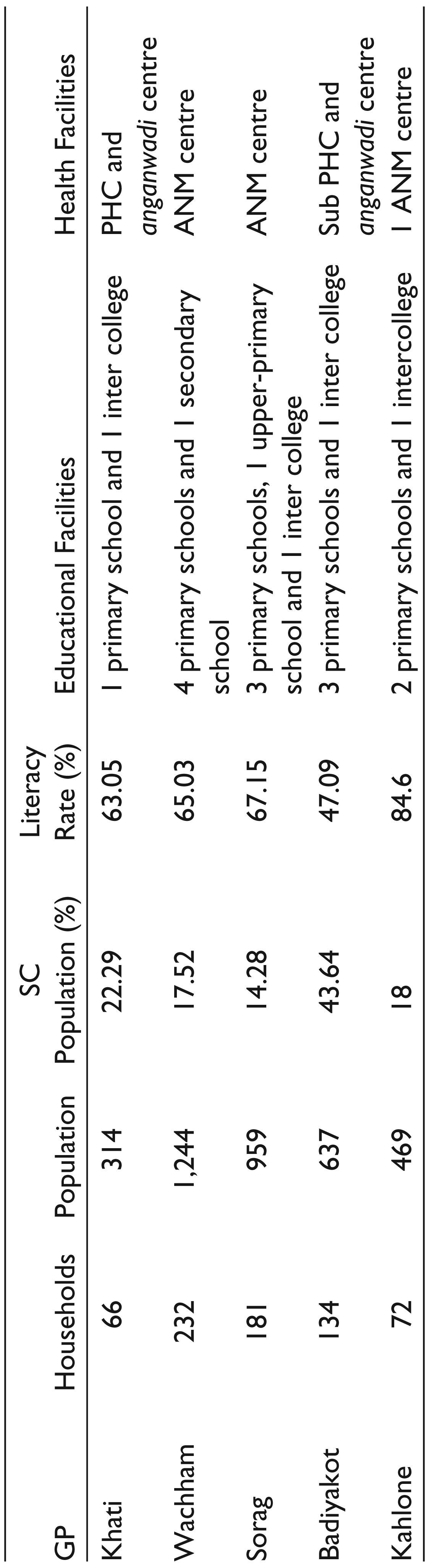
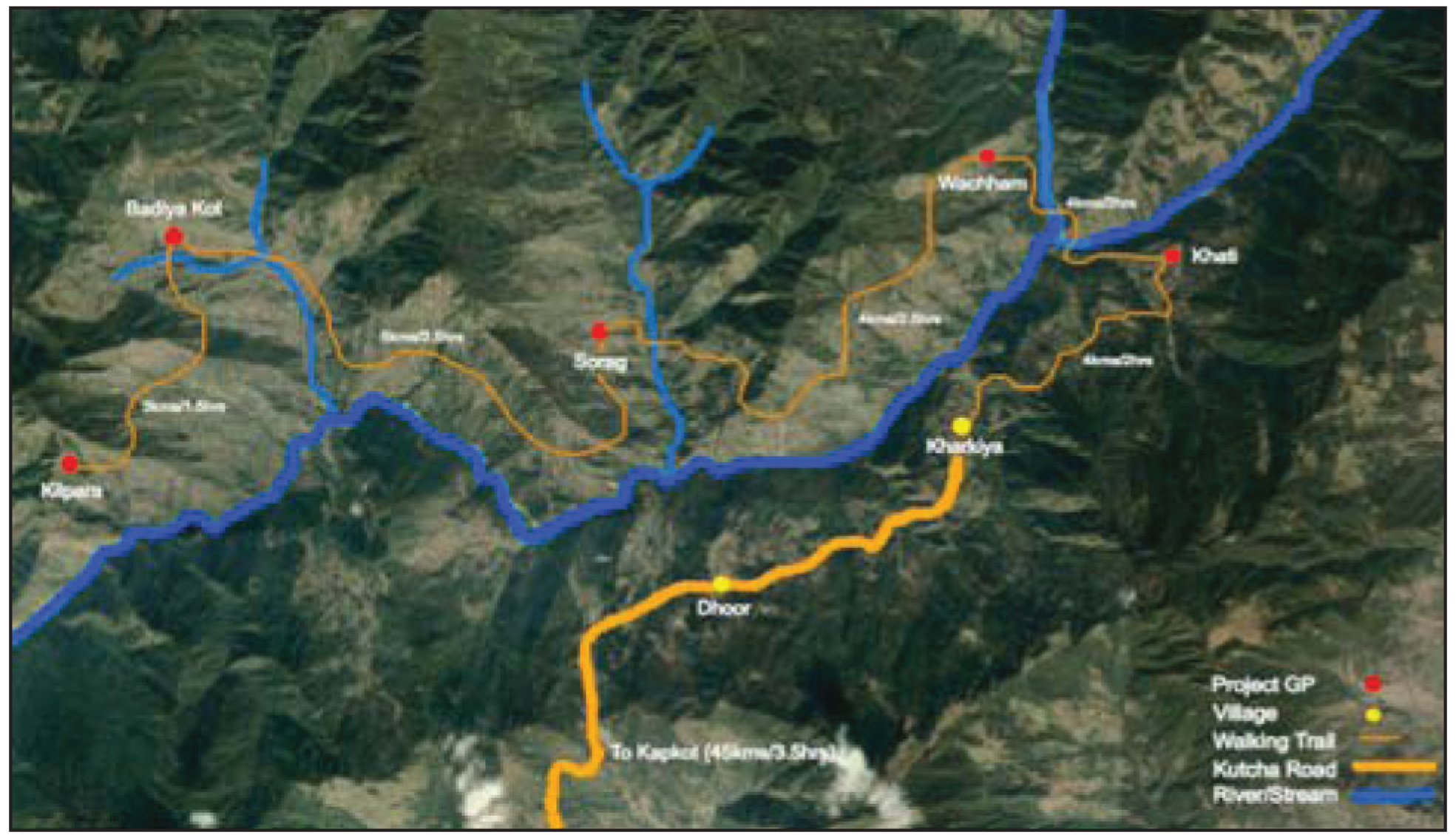
For qualitative data, a focus group discussion was conducted with 15 adolescent girls enrolled in a government school in Khati village. A participatory workshop was also held with 11 men and 23 women during which female participants shared their first menstrual experience and the taboos and menstrual practices they observe while the men shared the first time they learnt that women menstruate and how they feel about the taboos women observe. A total of 20 interviews were also held with different stakeholders, including school girls, young women, men, teachers, anganwadi workers, a woman pradhan and elderly women.
The data collection methods focused on the following areas of inquiry:
Social taboos and practices observed during menstruation Level of awareness about menstruation Access to and usage of menstrual absorbents Hygiene practices and related health issues Menstrual waste disposal Women’s perceptions about their situation
The Practice of Seclusion During Menstruation
I was just 12 years old when it happened for the first time. I was in the forest collecting wood and started crying. My family took me to a gadhera (stream) so that I could clean myself and brought me some food. Then they made a temporary hut in the forest with leaves and bamboo for me to sleep. I stayed there for 10 days. The following month, I was asked to stay in the cattle shed.
Uttarakhand, the state where the Pindar Valley is located, is also known dev bhumi (the Land of the Gods) because of the presence of many temples and Hindu pilgrimage sites. As a result, religion has a deep influence on the social customs of the population, including the adherence to strict rules of purity and pollution. Like in other parts of India, menstruation is not seen as a normal biological process that enables women to give birth to the next generation. Instead, menstrual blood is considered impure and menstruating women and girls are treated as untouchable. In the valley, even the words used for menstruation in the local language, such as alag hona (stay separate), achoot (untouchable) and bahar hona (stay outside), signify impurity and segregation.
Women practise menstrual seclusion. Over 90 per cent of women and girls live separately in the cattle shed (goth) along with the cows and buffaloes when they get their periods. Only 6.25 per cent had access to a separate room within the house. The first time a girl starts her periods, she has to spend 10 days in the cattle shed. Thereafter, whenever she gets her monthly period, she has to spend three days in the shed followed by another two days segregated in the home before she can return to a normal life. Cow dung and urine are considered purifying and every month when a menstruating woman enters the cattle shed, she is purified with a sprinkling of cow urine.
Menstruating women are also forbidden to use the toilets and have to go to the stream to defecate, wash and bathe. Clothes are handed to them separately as they cannot enter the house. Food is served to them in separate dishes reserved for menstruating women. They are not allowed to drink milk. Since they are seen as ritually impure, they are not allowed to show their face to men in the family. As one of the girls said, Nau din tak mere papa ne mujhe dekha bhi nahi (For nine days my father didn’t even see me). Mahipal Singh explains why ‘People say that men will get ill if they stay with a bleeding women’. This causes great stress to an adolescent girl not only because she has to stay away from her parents but also because she is terrified of causing harm to ones she loves.
Girls are forbidden from going to school, the temple or any other institution. Chandni, a student enrolled in class XII in the government school in Khati, describes her daily routine on the days she has her period. She wakes up at 5.00 AM, collects cow dung, goes out to cut grass and fetch wood. Then she goes to the stream to bathe and wash her clothes. Normally she would go to school after having her breakfast, but when she has her periods, she is not allowed to mix with other children. She has to stay back in the cattle shed and do domestic chores, or spend time reading a book, doing her homework or seeing movies on her mobile.
Not unexpectedly, absence from schools affects girls’ educational performance. Menstruating girls are unable to attend class or write their exams because of these social taboos. Female staff, such as teachers and anganwadi workers also stay away from school during their period which impacts all students unless there are substitute staff.
These rituals are also to be practised by women who have recently delivered and have post-partum bleeding. They are secluded for 11 days in small, ill-ventilated cow sheds with their newborn infants. Cowsheds are very unhygienic and usually filled with flies and reek of cow dung. Hansa Devi of Khati village recounted her experience:
Sleeping in the cattle shed is terrible. It stinks and is very dark inside. There are many flies and we often catch a cold and fever in the winter. During the rainy season, the cattle shed attracts many insects and even snakes. I block my ears with cotton to prevent insects from crawling in.
Similar practices are followed by menstruating women in other parts of India and in Nepal. Literature on the chhaupadi 2 practice in Nepal illustrates the harmful consequences of staying in menstrual huts (chhaupadis) on women’s health—consequences that can sometimes even be fatal (Alejos, 2015; Joshi, 2015; Kadariya and Aro, 2015; Upadhyay, 2017). Sleeping in the goth/chhaupadi in sub-zero temperatures in the long winter months can lead menstruating women and girls to contracting cold, fever, pneumonia and other respiratory disorders. The goth/chhaupadi also exposes them to dangerous insects, bacteria and viruses.
Kadariya and Aro (2015) also highlight the health consequences for post-partum mothers who have to stay in the goth with their infant. Mothers who have recently given birth are weak and have to look after their infants themselves. Poor nutrition and the harsh living conditions lead to higher neonatal and maternal mortality in regions where menstrual seclusion is practiced.
Women and adolescent girls in the Pindar Valley did not report any instances of sexual violence. However, in Western Nepal and in other parts of India, especially among the Gond and Madiya ethnic groups in Odisha, Chhattisgarh, Maharashtra and Andhra Pradesh where this practice is also prevalent, sexual violence is more common (Kaur, 2015). This may also have to do with the location of the goth. In the Pindar Valley, the goth is a room for livestock at the bottom of the house, whereas among the Gond, the menstrual hut is outside or on the periphery of the village.
The practice of seclusion also takes a toll on women and girls’ mental health. As Kadariya and Aro (2015, pp. 54–55) point out, ‘Isolation from family and social exclusion results in depression, low self-esteem and disempowerment among girls’. The narratives of the women in the Pindar Valley do illustrate the mental anguish and stress that adolescent girls go through when they have to sleep in the goth away from their loved ones. As we shall see below, some of the women interviewed mention seclusion in a cave in the forest or a hut in the fields. In such cases, there is bound to be fear of attacks by wild animals, snake bites, sexual abuse and assault at night. Cases of rape may not be reported at all due to the silence around rape and fear for one’s future, especially in the case of unmarried daughters.
Knowledge and Perceptions About Menstruation in the Valley
Women and girls in Khati have little knowledge about why menstruation takes place and the biology behind it. Although menstruation is public knowledge and everyone knows when a woman or girl has her periods (since menstruating women and girls have to live separately), very few respondents knew why it happens, the scientific reasons behind this physiological process and its link with reproduction.
Out of 48 women surveyed in Khati, only 41.6 per cent knew about menstruation before they started their period. A total of 95 per cent learnt about it from their peers and only 5 per cent got this information from their mothers. For many of them, it was a traumatic experience as they had no idea why they were bleeding and where the blood was coming from. One of them thought she had picked up a leech. Others recalled being scared and abandoned because they had to spend several nights alone in the forest. This is how Kamla Devi described the trauma of menarche:
I ran from school towards the jungle and hid myself in a cave. When I didn’t return home, my parents got worried and started searching for me. I was scared and started crying. When my parents found me, they told me to remain there. They sent me pooris and sweet rice but I had to stay far away from home in a hut in the jungle for 11 days.
A 60-year-old lady Rukmani Devi said:
I was at my home when it happened for the first time. I was just 14 years old. I told my aunt I don’t know why but blood is coming out. She said me ‘tum alag hogaye ho’ (you have started your periods) and then she took me to the gadhera to take a bath after which I stayed in the forest for 10 days.
The men knew even less about menstruation compared to the women. Most of them learnt about menstruation from their friends or the internet. However, they all knew that women bleed every month for a few days as they had noticed that their mothers and other female relatives were segregated every month. As one of the male respondents explained, ‘I learnt about the process only in school from a teacher. But I had observed things at home that gave me some clues about menstruation but the science behind it always escaped from me.’ The teacher at the government school at Khati village said although menstruation is included in the school curriculum, this topic is often skipped as parents may object. School girls confirmed that this topic is not included in their science class.
Menstrual Hygiene Practices in the Valley
Toilet Usage
In Bageshwar district and the Pindar Valley, almost every household has a toilet. There are also community toilets in some villages that people can use. Yet 95.8 per cent of the women surveyed said they defecate in the open when they have their period. Only 4.1 per cent or 2 said they use toilets in their homes. This is not surprising since social taboos do not allow menstruating women to use the same toilets as others and as a result, they are forced to go out to defecate.
This scenario is especially interesting in the context of the Swachh Bharat Mission which aims to eliminate open defecation by October 2019. Though Uttarakhand is one of the first states to become open defecation free (ODF), the fact that menstruating women cannot use their own toilets every day of the month suggests that the definition is open to question. To verify that a habitation is truly ODF, it is necessary to ensure that all members of the household are using the toilet every day of the month. Otherwise there is a risk that vulnerable members within the household can get left behind. Unless the different sanitation needs and priorities of individual household members are recognised and inequitable gender norms are addressed, India will not be able to eliminate open defecation.
Access to and Usage of Menstrual Absorbents
Access to commercial sanitary pads is a challenge in the valley due to the lack of roads and the distance of villages from the markets in Kapkot and Bageshwar. Khati village is a two-hour walk to Kapkot and because it is on the trekking route to the Pindari Glacier, there is better access to shops and sanitary pads. Nor do many village shops stock these pads because of low demand. Moreover, because the valley is cut off from the closest town for the long winter and during the rains, even these limited stocks tend to get depleted, making access to sanitary pads a challenge. Respondents who used pads said they either make them at home or buy them from a shop in Bageshwar.
Older women are more comfortable using cloth or nothing at all. The younger generation, however, tends to prefer well-known brands of sanitary pads. Many women and girls also use a combination of absorbents based on availability, affordability and whether they are going out or staying at home. According to the survey, 20.8 per cent of the respondents said they use only cloth, only 4.16 per cent use sanitary pads, 30 per cent use a combination of cloth and pads, while as many as 25 per cent do not use anything at all during their period.
Kumari Tara, an anganwadi sahayika (crèche assistant), said she mostly uses cloth. However, often when she is at home, she does not use an absorbent as ‘stopping the menstrual flow can cause illnesses’. According to her, women in the valley bleed very little and so the need for an absorbent is not so critical. Of the 25 per cent survey respondents who do not use an absorbent, 91.6 per cent said the reason was because they have very light flow, 25 per cent said they do not have access to shops and 16 per cent said they do not like disposing off used pads in the open. Supporting Kumari Tara’s claim, many women reported that they do not bleed heavily and that the bleeding lasts only three days. This may be due to anaemia which is widespread among Indian women due to poor diets. It may also be due to the cold, high altitude or extreme physical exercise—though there is no research to back these hypotheses.
Menstrual Hygiene
It is a normal practice for menstruating women to wash everyday—even in the absence of a bathroom. Unlike other parts of India, bathing or washing hair during menstruation is not a taboo. However, although all women have access to a toilet and bathing spaces, during their periods, they are not allowed to use them. They have to walk down to the stream and find a private space—even in sub-zero temperatures—to change their menstrual material, wash themselves and their clothes. They either take hot water with them or heat it at the stream. Some families, who can afford it, have constructed separate bathing spaces and toilets for their women so that they do not have to trek down to the stream and wash in public. The majority, however, still have to get water from a distance of between 1 and 5 km away. Only 4.16 per cent of the respondents said they have access to a toilet with piped water, a shelf and a lock.
Due to limited access to sanitary materials and a light menstrual flow, women and girls tend to change their absorbents infrequently. According to the survey, 63.8 per cent respondents change their sanitary material only after 12 hours, 27.7 per cent change it once in 8 hours and only 8.33 per cent change it every 4–6 hours. As a pad usually needs to be changed at least three times a day, infrequent changing of pads can result in urinary and reproductive tract infections. Women and girls did mention itching in the genital area but as there are no gynaecologists they can consult, they did not know if they had infections.
Menstrual Waste Disposal
There are no disposal facilities for menstrual waste in the valley. School students reported throwing their used sanitary pads in dust bins whose waste is then incinerated. Most women said they threw away their pads or stained cloth in or around the stream where they went to change and wash up. According to the survey, 75 per cent of the respondents said they throw their menstrual waste in or near a water source and 6.25 per cent said they bury it in a pit. Since commercial pads have plastic and super absorbent polymers, it would take 500 years or more to decompose fully. Less than 5 per cent of respondents said they wash and reuse their menstrual absorbent. With an increasing number of young girls using sanitary pads, there is a danger that menstrual waste will accumulate and become a health hazard unless a proper disposal system is provided.
Perceptions About Women’s Situation and Barriers to Change
The most common explanation for taboos regarding menstruation given by both women and men was that the valley is dev bhumi or the land of the Gods and these customs form part of local tradition. Not observing these social taboos would invite the wrath of the Gods. As 50-year-old Rukmani Devi said, ‘We are punished by the gods if we don’t follow this system here.’ However, some of the women did question the need for such outdated and discriminatory customs. Chandni, a 16 year-old student, feels this custom is simply wrong and needs to be changed. She expressed her indignation at having to sleep in the cattle shed every month during her period, ‘Why do girls have to leave the house and live separately when they menstruate? Why not the boys?’ She asks. ‘If we did not have these customs, we would not face any difficulties when we have our periods’. Similarly, Savita Devi—55 years, also traced the custom back to patriarchal structures in society: ‘We have to go through such social taboos because in mountains these rules are made by men which have continued since ages.’ However, most women seemed to have accepted their plight (humari mazboori hain [we have no option]) and even the female pradhan was confined to the cowshed when she had her periods.
Although younger women and adolescent girls disliked the practice of staying separately during their periods and believed that it must be stopped, they did not think that change was possible as long as the older generation—the custodians of tradition—was still alive. The resistance to change was not from the men per se, but rather from the village elders, particularly, the mother-in-laws who felt that since they had shouldered this burden in their youth, why should the younger generation not make the same sacrifices for the good of the community and the village? Interestingly, younger educated men feel that seclusion of menstruating women in the goth is a regressive custom but they cannot initiate a change on their own. Going against social norms is risky in a small village where people are interdependent on each other and fear being socially boycotted or ostracised. Men like 35-year-old Nandan Ram also fear that if these social taboos are violated, it could affect the entire community as ‘God becomes angry and will curse the men.’ He feels these customs should change, provided it doesn’t harm anyone.
According to a study done by Restless Development in Western Nepal, where the practice of menstrual segregation or chhaupadi is also very common, 57.7 per cent of women surveyed believe that if chhaupadi were not observed, there would be negative consequences for the family or community; 56.7 per cent think that if a menstruating woman touches green vegetables, crops will die; 50.5 per cent believe that during their periods, women should wash themselves and their clothes only at a chhaupadi dhara, an exclusive well to avoid polluting others (Alejos, 2015).
Women thus have to sacrifice their wellbeing, dignity and freedom, by going into exile every month during their periods for the welfare of the village. Whenever women have asserted themselves and chosen to sleep in the comfort and safety of their own homes, instead of the cattle shed, there has been a backlash with the elderly blaming them for any bad luck or natural calamity, such as a landslide or the lack of rain. In the 2018 Kerala floods as well, the Hindu Makkal Katchi linked the occurrence of floods with the entry of women in the Sabarimala temple (New Indian Express, 2018).
Negotiating Change in the Valley
Even in a society as remote and secluded as the Pindar Valley with its deeply entrenched beliefs and practices, there are traces of change. For example, with growing urbanisation, better communication and exposure to towns, women and girls get an opportunity to leave their villages and experience a different life style. When girls move to Kapkot or Bageshwar for college and their mothers visit them, they do not practice seclusion during their periods. They live together with their family and it is only when they return to their village that they have to conform to social taboos.
It is also not certain whether they do in fact go back to sleeping in the goth. Since menstruation is a private matter, it may be possible for them to hide the fact that they have their period and continue to sleep at home and use the toilet. Family members—especially in the case of a nuclear family—may also turn a blind eye and pretend they do not know their female relatives are menstruating. In the eyes of the community, they continue to observe social taboos, but in reality, who is to know any better? Although none of the women admitted to violating the taboos, there were rumours that one of the women we met had in fact stopped sleeping in the goth during her period—and no one was any wiser about it. Some women who had just given birth to babies confided that they had chosen to go to Bageshwar for their delivery so that they could avoid staying in the goth during the period of post-partum bleeding. However, this luxury is only available to those families that have relatives in Bageshwar and can afford to go there.
In the valley too, practices have gradually started changing and becoming more flexible to accommodate modern lifestyles or other imperatives. Earlier women were banished to the forest and had to spend their first period on their own. According to 60-year-old Uma Devi, ‘life has become very easy for [menstruating] girls now’ as now they are ‘provided food, clothes and soap to wash’. This was not the case when she was a young girl. A 50-year-old lady Vasanti Devi agrees: ‘Yes things have changed a lot. Now girls are not asked to stay in the forest when [their period] happens for the first time. They don’t have to suffer and go through what we have gone through in our time.’ In addition, a few families that can afford it have built a separate room, toilets and a washroom for their menstruating daughters and other female members so they do not have to suffer the hardships of staying in the goth and bathing or defecating in the open. Although they continue to practice seclusion, it is in the comfort of their own homes.
The number of days that a menstruating woman is isolated has also reduced. According to anganwadi worker Kumari Tara, earlier they had to stay in the chhaupadi (menstrual hut) for 11 days. Now they have to stay in the cattle shed for only three days followed by another two days of segregation at home. However, she feels these changes are not motivated by a concern for women’s wellbeing. Instead, she attributes these to the fact that women cannot be absent for so long—especially in the case of a nuclear family—as they have to look after the children and their family.
There is also an attitudinal change among some young people, like Chandni, who have started questioning these traditions. All respondents, both men and women, felt segregation of menstruating women was a regressive practice that needs to change but they were not willing to take the first step and stop the practice in their own homes because they were afraid of social ostracism if they stopped observing this practice.
For sustainable change, leadership has to emerge from within the community—though this is not always easy. Following a workshop on menstrual hygiene in December 2017, 3 grassroots workers, such as Radha Danu and Chanda Danu started initiating discussions on menstruation in their homes and communities. When the news of their initiative spread in the village, they both met with resistance from sections of the community. People started saying, Radha aur Chanda kaun hain parampara todne waali? (who are Radha and Chanda to challenge the customs?) But this didn’t deter them. Instead, they invited the villagers, including their fiercest critics, for a meeting and explained to them what menstruation is and how important it is to maintain menstrual hygiene. They argued that if women do not have access to sanitation facilities and are unable to maintain proper hygiene, they would fall ill and the family would have to bear the medical expenses. Strategically, toilet usage during menstruation was linked with women’s health and safety and this convinced the villagers to recognise that women needed these facilities especially when they had their periods. Today, all 23 female participants who attended this workshop have stopped sleeping in the goth and are now influencing other women in their village to do the same. They have also been supported by male participants who have ensured that their female relatives will no longer sleep in the goth.
Conclusion
All these steps are encouraging but there is still a long way to go. While the women have stopped staying in the goth during their periods, they still continue the practice of seclusion, in that they sleep in a separate corner or room within their home. Even though they are safe and are not exposed to the health hazards present of the goth, they are still seen as impure and untouchable during their period. As Nepali activist Radha Paudel says, ‘[i]t’s not about how clean the exiled space is or the availability of sanitary napkins. … If [a menstruating woman] is not allowed to go out or interact with others or eat or drink whenever she feels hungry or thirsty … she will still feel humiliated and unequal’ (cited in Arora, 2018).
The experience of Kullu district is instructive and could offer valuable lessons for other parts of India that follow the seclusion of menstruating women. Located in the Himalayan state of Himachal Pradesh, women in Kullu district also sleep in the cowshed and are prohibited from using the toilet during their period. The drive to make India ODF threw up a problem when it came to menstruating women who continued to go out to defecate. The deputy commissioner of the district—Mr Yunus Khan said that he recognised the problem only when the head of households approached him asking for a second toilet for the menstruating members of their families. While providing additional infrastructure would have addressed a practical need of women and ensured they had access to a safe space to defecate, clean themselves and change their sanitary materials, it would not have addressed the discriminatory practice of seclusion during menstruation and may even have deepened gender inequalities in society in the long run. As he commented: ‘This age-old notion goes against the fundamental right conferred by Article 21 of the Constitution of India on its citizens—the right to life with dignity.’ The only long-term solution was to raise awareness about menstruation and bring about an attitudinal change so that people would stop seeing menstruation as something impure but as a natural biological process. To this end, he launched the Nari Garima (dignity of women) campaign and motivated religious leaders to support the efforts to end the regressive practice of seclusion during menstruation (Thakur, 2018).
In Nepal, the practice of chhaupadi or exiling menstruating girls and women in menstrual huts was outlawed in 2017. Under the law, anyone who forces a menstruating woman to sleep in a menstrual hut can be arrested and go to jail (Zigor, 2018). However, the practice continues as it is deeply embedded in the traditional way of life. In India, there is no such law, even though the practice is widespread in the Himalayas as well as among tribal pockets across the central states of India. In 2015, the National Human Rights Commission described the practice of confining menstruating women in a menstrual hut (known as gaokar in the tribal region of Gadchiroli, Maharashtra)—as a serious violation of the human rights of women and instructed the government of Maharashtra to take steps to end this practice (Kaur, 2015; NDTV, 2015). While there have been efforts by the district administration to improve the conditions in the menstrual huts (goakars) and make them safer for women, the fundamental question is why should women have to be secluded during their periods?
It is only sustained awareness campaigns and education on gender, menstruation and menstrual hygiene that will finally change people’s beliefs and practices. It is critical to engage with boys, men, religious leaders and parents to ensure they break the silence on menstruation and support women to overcome the shame and stigma associated with it. The Swachh Bharat Mission offers an excellent opportunity to address what can be termed ‘the menstrual crisis’. With the mission drawing to an end in 2019, there is immense pressure to ensure that every household has a toilet and that these toilets are being used. But it is equally important to ensure that no one is being left out and that these toilets are available for use by ‘all’ household members including menstruating women. For without addressing inequitable gender norms and social taboos, it would be difficult to achieve and sustain an ODF India.
Declaration of Conflicting Interests
The authors declared no potential conflicts of interest with respect to the research, authorship and/or publication of this article.
Funding
The research was supported by the Hans Foundation.
Footnotes
Acknowledgements
We would like to acknowledge the support provided by Dinesh Meneria, Programme Manager of the Hans Foundation and Rabina Jaiswal, Swaniti Initiative.