






Abstract
The article is based on a qualitative study of 60 women entrepreneurs belonging to the urban middle class in Kolkata, undertaken to explore how their demographic characteristics, social values and agency shape their entrepreneurship initiatives. It examines the relative importance of different factors behind the motivations and challenges of middle-class women engaged in business. The findings suggest that the educated middle-class women entrepreneurs are motivated predominantly by aspirations for self-actualisation, but their initiatives are impeded by institutional inadequacies. Although explicit gendered social barriers are relatively less in their case, there exists an undercurrent of gender stereotyping that exaggerates the institutional barriers. It is suggested that policy measures for entrepreneurial development of educated middle-class women should be distinctly different from those designed for low-skilled, poor women with lower levels of education.
Introduction
Women entrepreneurs make substantial contributions to household income, economic development and poverty reduction. But they are subjected to social, cultural, infrastructural, educational and role-related impediments, particularly in developing countries (Jennings & Brush, 2013). The progress of women in business in India has not been impressive. The Mastercard Index of Women Entrepreneurship, 2021, places India at the 57th rank out of 65 countries studied. The existing literature on women entrepreneurs concentrates mostly on self-employment of rural poor women, largely engaged in informal activities that have low productivity and low returns (Mashapure et al., 2023). Their business involves low investment at minimum risk and does not require any special skills. These are usually in the nature of ‘survival entrepreneurship’, with their incentive established out of necessity and livelihood generation (Food and Agriculture Organisation, 2010). The fastest growing segment representing 31% of the population and expected to reach 60% in 2047 in India is the middle class (Economic Times, 2023). Hence, the participation of women belonging to the burgeoning middle class in business is an important development.
This study aims to explore the factors that shape the motivations of middle-class women entrepreneurs in Kolkata and the obstacles to their efforts. It contributes to the existing literature in three ways: first, it focuses on middle-class women engaged in business, who have not been adequately studied earlier; second, it examines the relative importance of different factors behind their motivations and challenges, and third, it suggests policy strategies that focus on equipping educated urban middle-class women for entrepreneurship.
Data and Methodology
The study uses qualitative research methodology to analyse the motivations and challenges faced by women entrepreneurs. Using the snowball sampling technique, semi-structured questionnaires were administered to 60 middle-class women residing in Kolkata and engaged in their own business. The questionnaire consisted of 20 questions that were designed to reflect their demographic attributes, entrepreneurship- related information and perceptions regarding entrepreneurship. The survey was followed by in-depth personal interviews. The responses were transcribed and thematically analysed following Braun and Clarke (2006) through coding, and these themes and subthemes were examined to identify motivations and constraints experienced as entrepreneurs.
Identifying the middle-class women entrepreneurs was challenging since there is no consensus on the definition of ‘middle-class’. Ravallion (2010) defines the middle class as those who have an income secure enough to withstand any sudden economic crisis. PEW Research Center (2021) claims that middle-income earners earned between ₹856.26 and ₹1,714.80 daily. Ahalya and Paul (2017) find that a large part of the middle class in India is self-employed in small and micro enterprises or has regular wage employment. In this study, women from households in which other family members were engaged in service or small to medium sized business were considered as middle class.
Results
Characteristics of Female Entrepreneurs
The demography of the participants indicates that about 41.7% were in the age cohort of 45 to 54, and 31.7% were aged between 35 and 44 years, reflecting that most of the women entrepreneurs were middle-aged. A total of 93.3% were graduates or post-graduates, and 85% were married. While 16.6% were childless, the age of the youngest child of 41.6% of the women was above 16 years. No male family member of 78.3% women was engaged in business.
Table 1 shows that the largest segment of women (46.7%) had started their business in the last 1 to 5 years. According to the report of NITI Aayog’s Women Entrepreneurship Platform (2022), 95.6% of women-owned enterprises in India are unregistered or informal. But our study finds such informality comparatively lower among the urban women entrepreneurs surveyed (58.3%). Business was a full-time job for 78% of the women, and 53.3% have not been employed previously. The women were engaged mainly in services and small production units, with the predominant products being clothing (45%), bags and accessories (11.7%) and food (10%). Gender-based occupational segregation is clearly visible and persistent in entrepreneurship despite women being urban and educated.
Entrepreneurship Profile.
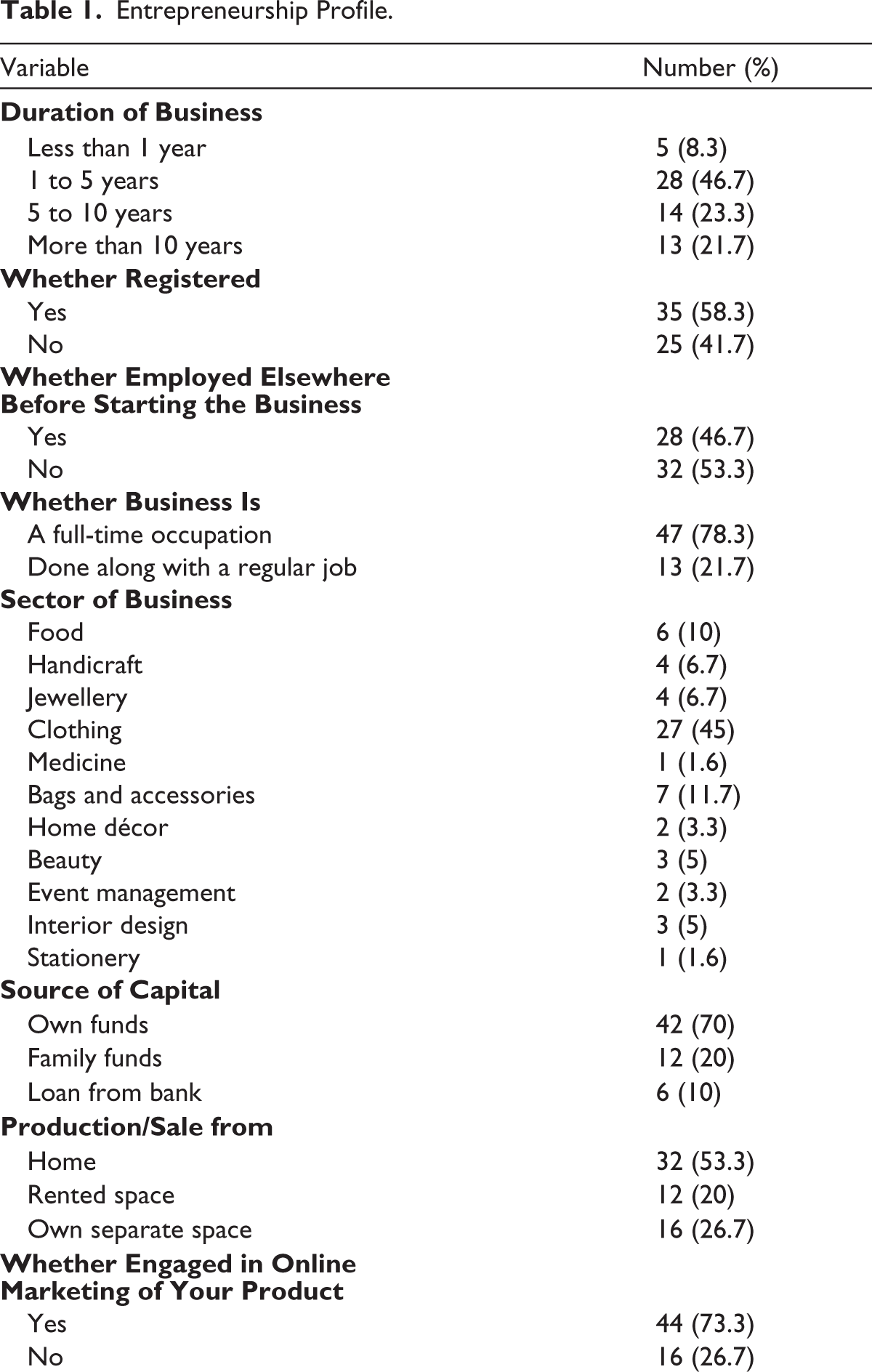
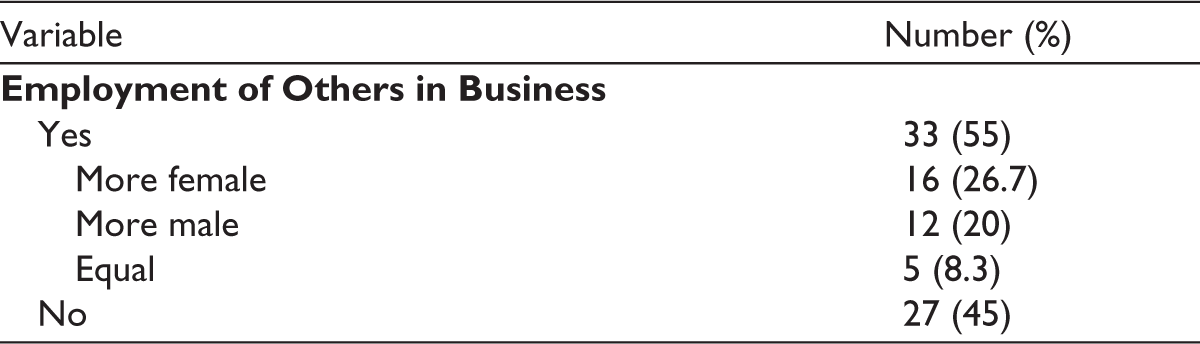
About 71.2% of women relied on their own savings to establish their business, while only 10.2% received credit from banks. Most women were unable to receive bank loans due to prevalent discriminatory practices against women, such as more demanding terms of credit than for men in terms of interest, duration of loan, and collateral.
A total of 53.3% of the women were home-based, and 73.3% of the women used digital modes for their business. Use of technology and participation on social media have effectively transformed traditional entrepreneurs into digital entrepreneurs. However, limitations also exist with regard to online services in some sectors such as beauty care, food delivery and event management. A total of 55% of the women entrepreneurs employed workers, in contrast to the findings of the Ministry of Statistics and Programme Implementation (2013) that only 16.81% of women entrepreneurs hired workers in their establishments in India. A gender bias towards women employees is evident from the composition of their employees, with 48.4% of them having more female employees than male employees.
A total of 93.3% of them started their business voluntarily. Only four women (6.7%), driven by a sudden financial emergency and inability to secure a job, were compelled to start a business. A total of 86.7% women considered entrepreneurship to be better than employment, the prime reasons being autonomy (50%) and flexibility (46.2%).
Motivations for Women Entrepreneurs
Three key factors were found to drive women’s entrepreneurship: financial, social and aspirational. The major factors/themes and subthemes obtained from classifying the responses of participants are presented in Table 2.
Codes and Themes Generated from Interviews Regarding Motivations.
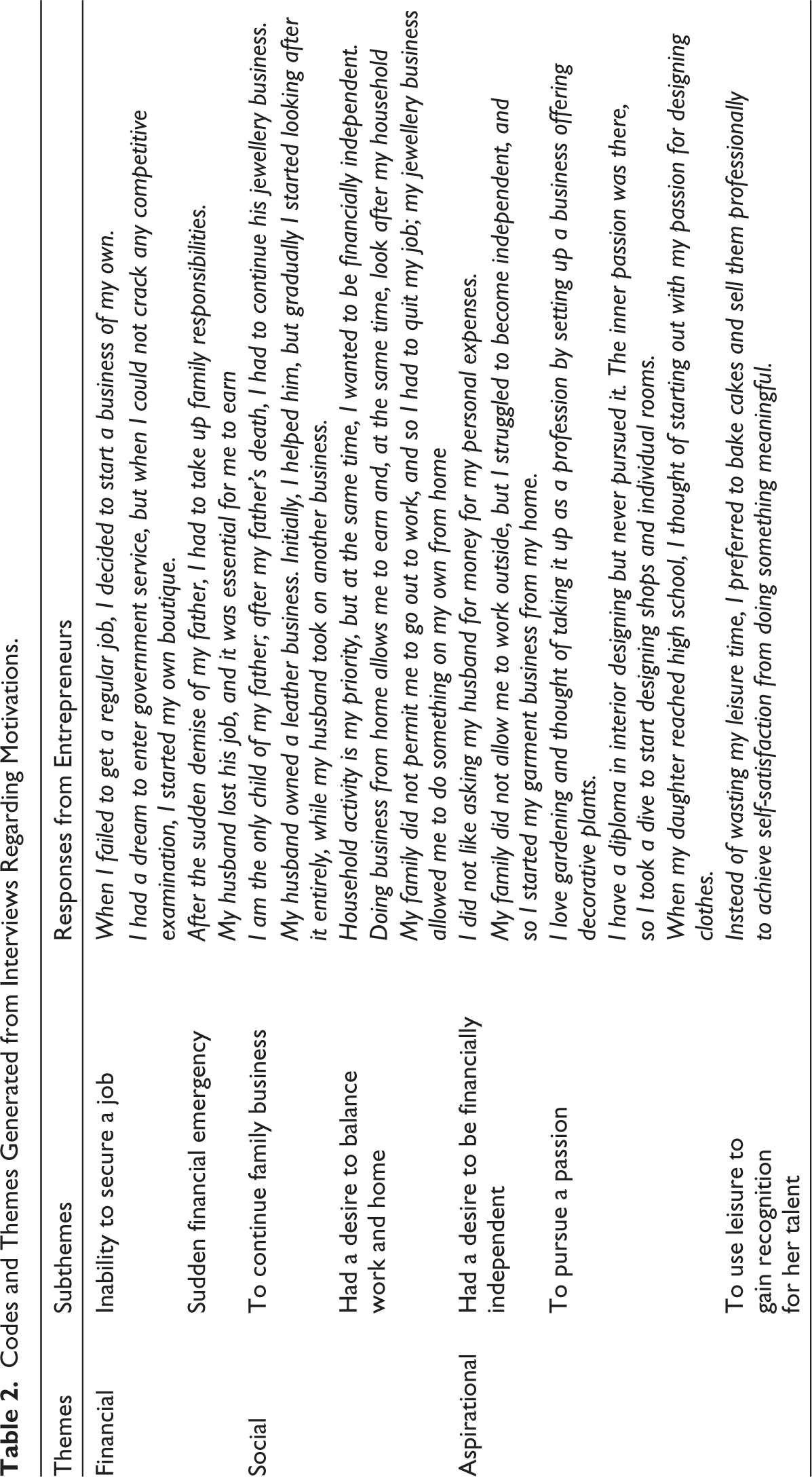
The predominant motivation was found to be aspirational (61.7%), followed by social (28.4%) and financial (6.7%). A total of 51.7% of the women yearned to be independent and engage in activities that unleash their self-esteem and sense of freedom; 5% wanted to pursue a passion and productively use the competencies/skills they possess or have acquired through training and experience, while 5% (mainly homemakers) desired to be usefully engaged during their leisure hours and to obtain acknowledgement from their family or society by demonstrating their capabilities. Entrepreneurship provides an effective means to express and use their talents and special abilities since their traditional roles, however proficiently performed, often go unnoticed (Singh et al., 2011).
About 25% of the women embarked on business ventures to achieve a work–life balance. By starting their own business, they could gain more flexibility and control over their work while catering to their familial and household obligations. Personal interviews indicated that, beyond childcare and caregiving for the elderly, the undercurrent of patriarchy prioritises household chores, which ought not to be compromised by the woman’s economic activity and engagement. Only 3.3% of women joined a family business to continue the family legacy, as sons are usually preferred over daughters to carry on family businesses.
The financial factors for starting an entrepreneurial activity include women’s inability to secure paid employment or a sudden financial emergency. A total of 5% lost their only source of income due to the death of the earning member of the household or an existing job, and entrepreneurship provided a way out of the economic crisis.
Barriers to Women’s Entrepreneurship
The study identifies two major barriers faced by women in starting an enterprise: institutional barriers (90%) and gendered perceptions of women’s entrepreneurial competence (10%) (Table 3). Institutional factors comprise the more pressing barriers and include limitations in access to capital, entrepreneurial skill and marketing. A total of 50% of the women consider access to capital as a major challenge in initiating a business. Women are disadvantaged in accessing bank credit due to high loan denials, high interest rates, and additional collateral requirements. A total of 13.3% stated that they consider themselves inferior in entrepreneurial skills, which poses a challenge in crucial decision-making. A total of 26.7% opined that the lack of knowledge about the mode and mechanism of marketing was a major hurdle. The scope for advertisement is limited too due to the small size of their business. For those engaged in virtual sales, gaining the trust and confidence of customers, adapting to social media boosting, online payment and managing shipments are vital determinants of success in online marketing. Moreover, transitioning to online sales involves sharing platforms for accessing raw materials, services, and finance, unfamiliar to most women.
Codes and Themes Generated from Interviews Regarding Constraints.
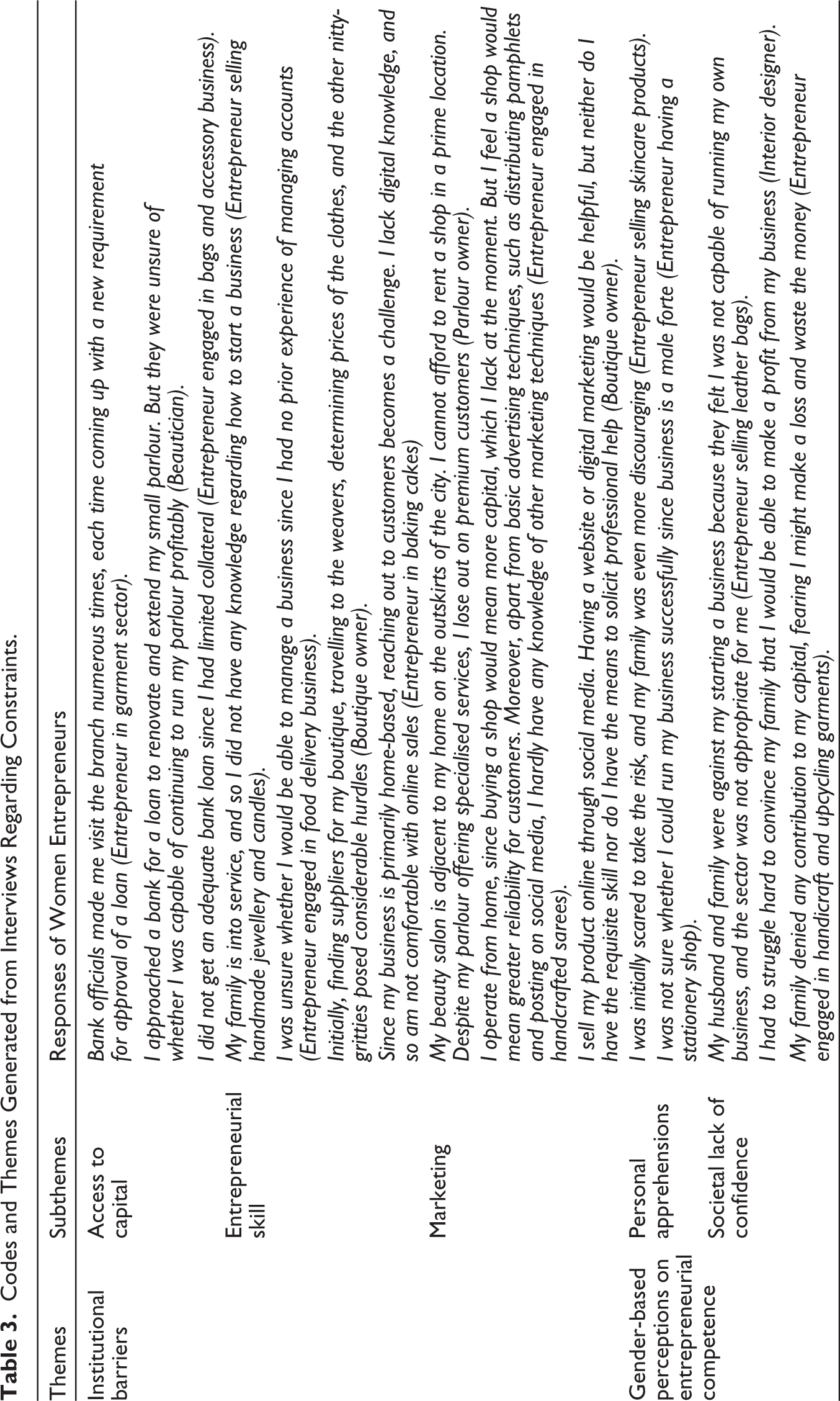
Both external (societal) and internal (personal) perceptions affect the entrepreneurial confidence of the women. A total of 3.3% of the women cited their apprehensive mindset as a hindrance to their aspirations. Studies show that fear of failure and self-efficacy are important deterrents for women to undertake a business venture (Wieland et al., 2019). On the other hand, 6.7% identify societal, particularly familial, lack of confidence in their entrepreneurial ability as a hurdle. In addition, biases in society based on traditional gender norms continue to exist, by which women are dissociated from leadership attributes such as assertiveness and competitiveness in business.
Social Gender Stereotyping
An important dimension that unfolded from the study is that while the participants rarely faced blatant resistance from their family, there was no direct encouragement either. Interviews revealed that women were bound by their obligation to complete their household and care activities before attending to their business, this inflexible expectation restricting the nature and mode of operation of their business and the time devoted to it. Most women lived in a nuclear family set-up, with limited support structures. Their domestic and care responsibilities were prioritised, indicating an undercurrent of gender stereotyping and skewed division of labour in households. In joint families, female members were instrumental in upholding gendered roles. Interestingly, most women themselves believed that household activities constitute their primary work, which cannot be neglected even if domestic workers were present and available, so that their entrepreneurial activities became secondary.
One participant stated,
My children are my prime responsibility. Since my husband has to remain in the office for long hours, who else will take care of my children? I prefer to work from home at my pace so that I can maintain a balance between my family and work.
Another participant stated,
My mother-in-law, though not opposed to my business venture, ensures that I complete all domestic chores before concentrating on it.
Gender stereotyping reinforces the institutional barriers as well. Women entrepreneurs are disadvantaged in accessing bank credit due to social biases of banks regarding the creditworthiness of women-led enterprises, arising from a lack of collateral, limited access to assets and property, low financial literacy, poor credit histories and restrictions on physical mobility. Chavan (2020) confirms a gender gap in access to capital in India, with urban women receiving only 24% of the credit provided to urban men. Ejaz et al. (2023) attribute this gender bias to the unfavourable evaluation of women-led businesses and the stereotyping of women as less ambitious and capable of achieving success in entrepreneurial ventures.
Discussion
The pertinent aspects of women’s entrepreneurship are obvious. First, while the evidence shows that rural women-owned businesses are concentrated in agro-based businesses, urban middle-class women operate in manufacturing (food processing, garments) and service (beauty and interior design) sectors. However, their presence is more clearly visible in personal care and ‘feminine’ sectors. Second, most businesses are home-based since it enables women to satisfy competing demands for their time and to perform their disproportionate share of housework without difficulty. Third, the level of informality of their economic activity is surprisingly lower than expected, since most of them are registered with the government and hold trade licences. Fourth, women extensively use digital technology, particularly for marketing and financial transactions. Fifth, a large proportion of women tend to hire workers who are female, thus generating potentially transformational employment for other women. Sixth, work–family conflict has been both a trigger and a limitation for women’s entrepreneurship. On the one hand, managing both family and work poses a fundamental obstacle for them. On the other hand, business allows women considerable flexibility in terms of work hours, enabling them to find a balance between work and family commitments.
It may be safe to conclude that women entrepreneurs of the urban middle-class, particularly married women, are primarily motivated by their aspirations. Their yearning to be financially independent is frequently manifested through business initiatives. They are driven by the ‘self-actualisation’ motive (Maslow, 1943), which is related to opportunistic entrepreneurship, with ‘achievement’ being the dominant stimulus (McClelland, 1961). This is in stark contrast to the motivations of low-skilled rural women for whom survival and livelihood generation are the main incentives (Orhan & Scott, 2001).
But middle-class women entrepreneurs are subjected to institutional barriers to a greater extent than social barriers that act as the initial, crucial encumbrances. These institutional constraints are rooted in male-centred norms of society, reinforcing gender stereotypes. On the one hand, access to capital through bank credit is severely hindered by the tendency of banks to exaggerate the likelihood of default by women entrepreneurs, resulting in discriminatory conditions for credit. On the other hand, there exists a gender gap in entrepreneurial education and training, and access to markets, which impede women’s progress in entrepreneurial activities. The major bottlenecks are a lack of professional skills, advertising and promotion techniques, and managerial and administrative expertise, worsened by the misogynistic anticipation and assumption of female entrepreneurial incompetence. Unequal household responsibilities, particularly for married women, coupled with social norms and attitudes discouraging women’s participation in business, act as catalysts for asymmetric access to entrepreneurial opportunities for women. Barriers emanating from gendered social constructs lead to other barriers, perpetuating the gender disparities. Thus, gendered barriers are embedded in cultural values, norms, and customs. The attitudes toward women entrepreneurs reflect biased subjective perceptions based on traditionally defined gender roles.
Conclusion
The participation of women in entrepreneurship is influenced by myriad factors that shape the ‘entrepreneurial ecosystem’. Urban middle-class women are driven by aspirations of self-esteem and independence, but are severely impeded by a complex interaction of social stereotypes, discrimination and gender inequalities owing to gender-biased power relations that in turn, reinforce institutional bottlenecks. Women entrepreneurs, though educated, cannot escape gender stereotyping due to patriarchal social constructs and the asymmetric division of labour in the household.
Three areas of government intervention to tackle ‘gendered’ institutional barriers can be identified. First, initiatives towards training programmes for not only entrepreneurship development, marketing and managerial skills, but also for learning new technology to explore business opportunities, business innovation and improving social media skills can be effective in boosting women’s entrepreneurial intentions and performance. In view of women’s marginalisation in entrepreneurship education and training, gender mainstreaming by bringing female perspectives into the strategies and implementation of entrepreneurship training from high school or college level can play a catalytic role. Second, governmental measures for financial inclusion focus more on deposit mobilisation than credit provision. The rampant gender discrimination in financial institutions should be eliminated, making way for more policies that encourage women entrepreneurs. Third, the government schemes in India for boosting entrepreneurship among women, such as Mahila Sammridhhi Yojana, Mahila Shakti Kendra and Nai Roshni, are mainly designed for rural women and hardly reach or benefit educated middle-class women. Further, women are either unaware of the broader schemes or fail to take advantage of them. Relevant information ought to be well disseminated. There is a need to formulate specific schemes for the development of educated women entrepreneurs, which could encourage more women to take advantage of them to establish businesses. Sustained policies and coordinated efforts across state institutions, banks and educational as well as social institutions are essential to remove barriers and ensure capacity building and institutional support to the entrepreneurial endeavours of women.
Footnotes
Declaration of Conflicting Interests
The author declared no potential conflicts of interest with respect to the research, authorship and/or publication of this article.
Funding
The author received no financial support for the research, authorship and/or publication of this article.