






Abstract
Although women with disabilities constitute a significant proportion of India’s population, their experiences remain marginalised. Notions of women with disabilities are riddled with gendered, ableist stereotypes. As Hindi films are an important reflection of popular perceptions of disability, we analysed six successful films that revolve around women with varied disabilities, which are relatively poorly understood in the country, to assess their portrayals of womanhood and disability. Our main interest was in the points in the films where the women are able to act as agentic selves. We wanted to know the ways in which women express agency as well as the enabling factors and opportunities that they utilise to pursue their objectives. A critical-feminist thematic analysis was used on portrayals to assess their potential to undermine or reinforce prevalent social notions. A comparison of the films showed diverse depictions of the women’s agentic selves, ranging from being fairly self-determined to having little control or choice.
In many cultures across the world, womanhood is still defined in very specific ways. The biological function of producing children (preferably male) and the social role of nurturing the family are the primary aspects of these definitions (Marchbank, 2004). Social norms prescribe whom a woman can marry and which women may be regarded as unfit for marriage. Marriage-based prescriptions stem from various social hierarchies based on religion, caste, class and ableism (see, e.g., Addlakha, 2007; Jauregui & McGuinness, 2003; Srinivasan, 2005). In patriarchal societies, a woman’s value is often estimated in terms of her youth, beauty and skin tone. Strict policing of women’s marriages by family members or rural caste councils is not uncommon, with brutal reprisals for those who defy the rules (Ahuja & Ostermann, 2016).
Women’s experiences are mediated by the constructions of gender prevalent in a given society. To be a woman with disability means being scrutinised not only through the patriarchal lens but also the ableist lens. The bodies of women with disabilities are viewed as inferior in at least two senses: as inferior to male embodiments (Bordo, 1993) and as inferior to the able-bodied. This ‘double burden’ (Lloyd, 1992; Rajni, 2020) is deemed a major disqualifier for competence and success. Garland-Thomson (2005) explores the network of exclusion, stigma, power and politics of appearance. Since women embody family honour in India, girls with disabilities are often kept hidden at home and denied basic rights to mobility, education and employment (Addlakha, 2007). Their bodies are associated with evil and deviance, for instance, thus becoming targets for children’s pranks and adults’ derision (Vanashree, 2019). Many are excluded from family functions, festivals and extracurricular activities (Daruwalla et al., 2013). Parents become even more restrictive once the girls reach puberty. Families of women with disabilities seek husbands for them, but may hide the fact of the disability from prospective in-laws, which is bound to create problems for the women down the line. Many women with disabilities never marry because motherhood is considered out of bounds for them. Agency and reproduction are thus made inaccessible in several ways.
In the public sphere, women with disabilities are made self-conscious of their ‘failure’ to match the expectations of female bodies. Women who enter public arenas tend to engage in practices that show their bodies to be in accordance with the dictates of idealised constructions of femininity (e.g., by hiding their disability with clothing, if possible). Because they realise that their bodies are different from the norm, disabled women try to draw as little attention as possible to themselves, yet in public encounters cannot avoid being the focus of attention, not as women but as disabled (Ghosh, 2019). Violence in public spaces, prejudice and accessibility issues impede the social participation of women with disabilities (Daruwalla et al., 2013). Unsurprisingly, such women are missing from educational institutions, workspaces, politics, policy-making roles and governance.
There is a relative dearth of statistics on women with disabilities. Most macro-level data-gathering efforts by the government, apart from the national census, do not incorporate disability (Addlakha, 2022). If they do, the data are not disaggregated by gender. Currently, data on Indian women with disabilities date back to the 2011 Census, according to which there are 11.8 million such women in the country, but in all probability, this is a gross under-representation. As an added problem, the census recognised only a limited number of disabilities. Nevertheless, gender disparities are clear from the data: more men (62%) than women (54%) with disabilities are married, more women (13%) with disabilities fall within the divorced/separated and widowed categories than men (6%), and literacy rates for women are lower (45%) than for men (62%). In comparison to men with disabilities, women with disabilities face greater mobility challenges with regard to public spaces because, first, they are less likely to gain permission to move about outside of their homes due to parental fears regarding their safety, and second, as no gender perspective is incorporated into infrastructure design, there are no mobility aids manufactured with specifications suited to women’s needs (Addlakha, 2022).
Although women with disabilities are at great risk of violence, this issue remains unaddressed. The National Crime Records Bureau of India does not provide disaggregated data on women with disabilities. In a survey of informal settlements in Mumbai, there were 50% greater odds of women with disabilities reporting interpersonal violence than women without any disability. In violent situations, women with disabilities face problems that range from difficulties in escaping due to mobility issues to communication hurdles due to hearing or speech impairment. Police personnel most likely lack sensitisation training with regard to disabilities, while the necessary documentation when seeking justice could prove to be an impossible hurdle if, for instance, it does not offer a Braille or voice-mode option. Moreover, even transport and police stations are often inaccessible to the disabled (Human Rights Watch, 2018).
Media Portrayals
Media portrayals have a significant impact on the collective awareness of disabilities. For people who have no direct knowledge or experience of disability, popular films become an important source of information/misinformation (Schwartz et al., 2013). Several films perpetuate stereotypical notions, such as persons with disabilities being asexual, incapable of work, and prone to self-destructive behaviours due to their inability to cope (Black & Pretes, 2007). Barnes and Mercer (2001) found them commonly stereotyped as ‘super-cripples’, pitiable, sinister, objects of ridicule, their own worst enemies and a burden. The character of Dopey created for the film Snow White is a glaring example: It represents a combination of several devalued roles, including sub-human animal, object of ridicule and eternal child (Schwartz et al., 2013). Another example of stereotypical representation is the formulaic plot device that focuses on the spectacular abilities of autistic characters. Such portrayals create the impression that autistic people who are not savants are undesirable, since they lack the redeeming feature of cinematic autism (Baker, 2008).
Mitchell and Snyder’s phrase ‘narrative prosthesis’ (2000) explains disability as a crutch used by literary narratives for representational power, disruptive potentiality and analytical insight. While disability has been overplayed as a metaphorical signifier of social issues, a closer look reveals only rare instances of these characterisations taking up disability as an ‘experience of social or political dimensions’. The disabled body becomes a paradigm through which normality is validated and reinforced as superior. For instance, Cheu (2009) suggests that cinematic representations of blindness perpetuate ableist notions of the primacy of the act of seeing. The normative gaze of able-bodied characters or the gaze of the camera itself constructs the gaze of the blind female character so as to convey helplessness and dependency. Further, many films tend to represent disability as impairment without recognising the social barriers that influence lives (Darke, 2004). Here, the medical model seems to enjoy hegemony, placing disability within the individual body and implying that the ‘good cripple’ does his best to overcome his ‘flaws’.
In contrast to the above, progressive representations have linked disability to social factors and ableist policies or attitudes. Clogston (1994) identifies two progressive frames used by the media: the minority/civil rights model and the cultural-pluralism model. In the minority/civil rights model, persons with disabilities are seen as having rights and legitimate political grievances that they can fight for as members of a community. According to the cultural-pluralism model, persons with disabilities are multifaceted and portrayed as non-disabled persons would be. Their disabilities do not receive undue attention. Although steps towards more nuanced representations of disability are evident, they still co-exist with films that perpetuate hegemonic discourses and caricaturise disability. Moreover, empowering images of disability on the one hand and stereotypes on the other can co-exist within a given media representation (Ljuslinder, 2014). In an analysis of Arab films, O’Dell (2023) found the productions to have broadened marginalised subjectivities on screen. Yet, the portrayals came loaded with representational mechanisms of exploitation. The films used disability as an ‘artistic prosthesis’ to explore broader social themes while depoliticising the struggles of disabled people and focusing on disability as a personal misfortune (Shakespeare & Watson, 1997). Although these characterisations represent an ‘improvement’, they still operate as passive vehicles lacking agency. Thus, with films remaining prone to questionable cinematic representations, a continued critical engagement by film scholars is imperative.
Hindi Cinema, Disability and Gender
This study focuses on the portrayals of women with disabilities in Hindi cinema. Traditionally, Hindi films have revolved around male characters, with the battle between an able-bodied hero and a villain being central to the plot. However, the number of women-led movies has been increasing, with women playing assertive characters that stand up for their rights. Such films show women resisting patriarchal notions of women’s sexuality (Pink, 2016), fighting male villains (Mardaani, 2014), exiting unhappy marriages (Thappad, 2020) and serving national intelligence agencies (Raazi, 2018). Interestingly, such portrayals exist alongside the massive popularity of item numbers, songs that feature women as ‘items’ dancing for the purpose of titillating men.
Over the years, several Hindi films have involved characters with disabilities. Well-known movies include Dosti (1964), Koshish (1972), Sparsh (1980) and 15 Park Avenue (2005). To varying degrees, the depictions of disability in these films have been regarded as progressive when compared to other representations in Hindi cinema. However, there are concerning aspects within these films as well. Koshish, for instance, is the story of a young deaf-mute couple. Although they live independently, they experience several hardships, including the loss of their child and constant harassment by a greedy brother-in-law. Pal (2013) identifies two sequences in the film that must be problematised. In the first, the couple anxiously observe their infant for signs of deafness and are delighted once they establish that he is not in fact deaf, a scene that reinforces the understanding of deafness as a misfortune rather than another way of being. In another, the brother-in-law loses a leg and becomes disabled, implying karmic punishment.
In depictions of disability in Hindi cinema, one of the problematic aspects is that disabled maternal characters are included in the plot to provide opportunities for the male leads to demonstrate their masculinity. Dey and Tripathi (2022) discuss the distinct invisibility in the agentic representation of widowed mothers, whose presence is denoted only through their disabled bodies, lack of voice and disembodied identities. These elderly women receive protection from their male kin against the male villain. There are several other instances where women with disabilities are shown to be in need of rescue by men. In Satte Pe Satta (1982), an assassin is unable to bring himself to kill a beautiful woman in a wheelchair, which eventually leads him to become a good man. Sadma (1983) is the story of a woman who regresses into childhood due to retrograde amnesia after suffering a head injury. She gets lost, ends up in a brothel, and is rescued by a schoolteacher who falls in love with her and then continues to protect her from all harm. In Lafange Parindey (2010), a dancer who becomes blind before a major competition briefly loses her confidence and then is mentored back to excellence on the dance floor by the male lead. It is through the training he provides that she finds the determination to ‘rectify’ her disability by honing her listening skills. Kaabil (2017) is a story of a young married couple where both are blind. Soon after their wedding, the wife is sexually assaulted, which shatters the idealistic life they were creating together. Later, she commits suicide, and the husband sets out on a revenge saga, eventually killing the sighted men who assaulted her. There are several other Hindi films in which women with disabilities have been aggressively pursued when lacking male protection (Pal, 2013).
With these films as the backdrop, we sought to explore disability portrayals in six Hindi films, which we felt provided potent platforms to explore the tensions created by gender, disability, modernity and empowerment. Some of these films were appreciated at the time of their release for being ‘sensitive’ portrayals. The six films we chose all place women with disabilities at the centre of the plot, though their disabilities were approached by the film-makers in distinct ways. Of main interest to us were the points in the films where the women with disabilities could act as agentic selves, influencing their own functioning and the course of events. We wanted to know not only the ways in which the women protagonists expressed agency, but also the enabling factors and opportunities that they utilised to pursue their objectives. In neglecting issues of agency, movies can contribute to normalising passive stereotypes of women with disabilities, thereby minimising the possibilities of political engagement and our understanding of how women negotiate their need for self-determination. Our analysis of the films highlights the need to widen the discussion on how women relate to their minds, bodies and lives within landscapes that seek to invisibilise them.
Method
Sample
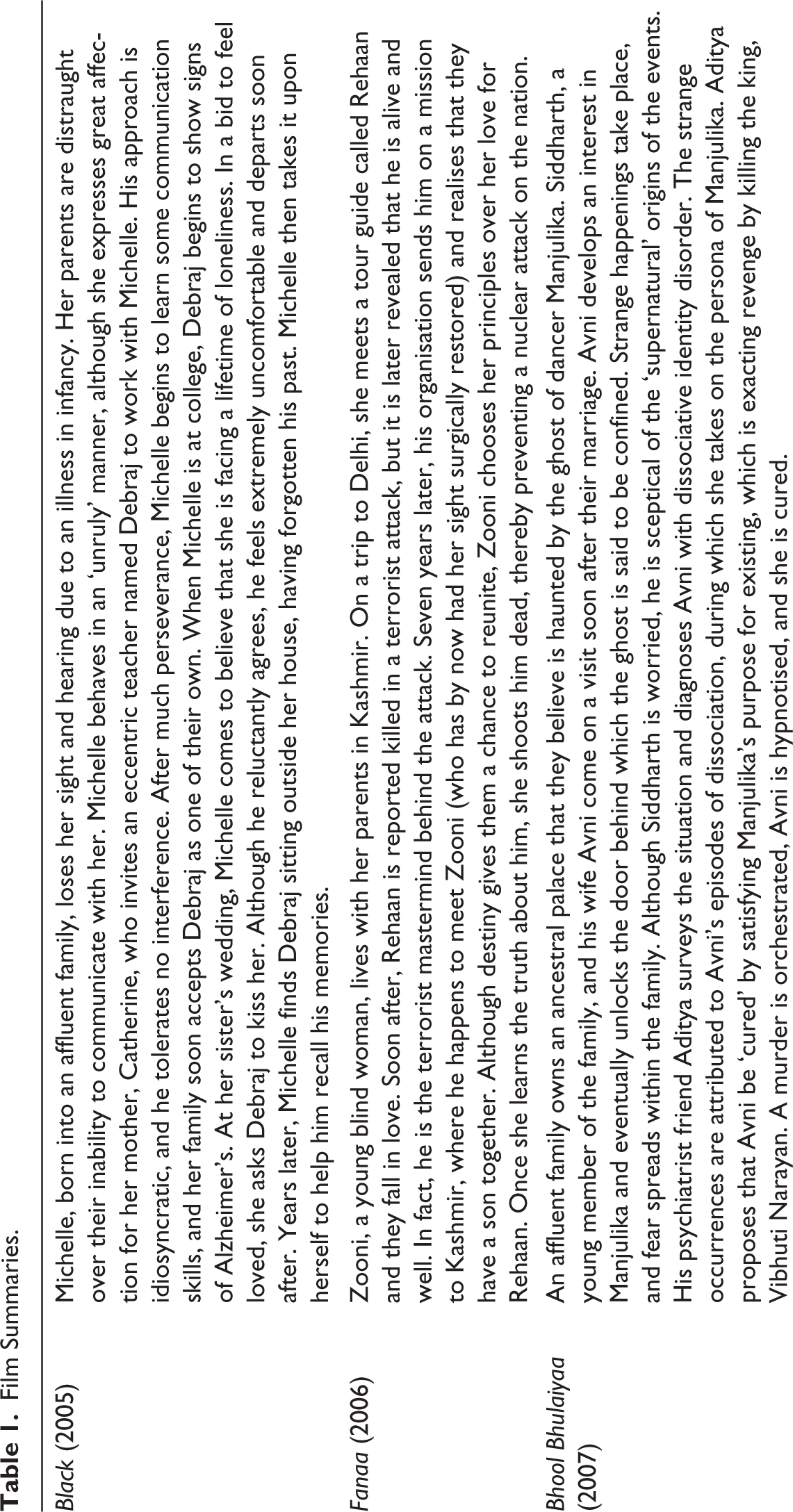
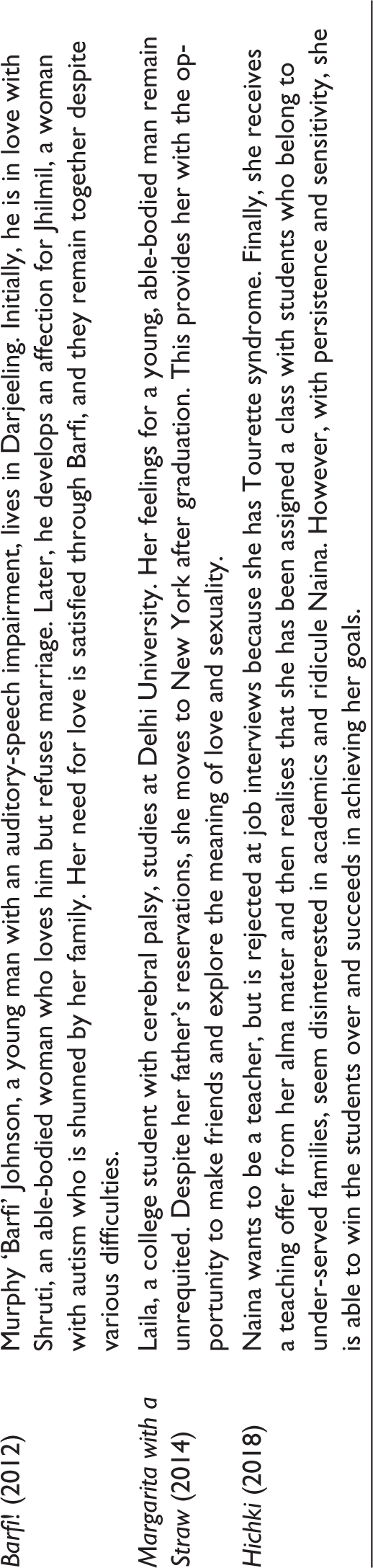
We chose six films that revolve around women protagonists with varied disabilities, including Tourette syndrome, dissociative identity disorder (DID) and autism (Table 1). The films were selected from a larger pool based on three inclusion criteria: language (Hindi), the year of release (post 1990), and box-office performance (‘hit’). These six films were then studied as a separate cluster due to the significant roles played by women in them. Among the films we chose, Bhool Bhulaiyaa stands apart: although touted as progressive at the time of its release for favouring scientific treatments for mental disorders, the movie ultimately resorted to the religious model for the character’s ‘healing’ (Natu, 2024). We feel that Fanaa also presents various problems, which we discuss later. However, both movies were massive successes, making it important to decipher the messages they contain. Our analysis includes these films as negative cases, which provide an understanding of the range of possibilities that exist with respect to disability and womanhood.
Film Summaries.
Analysis
The films were analysed using the critical-feminist thematic analysis approach. A critical perspective recognises the play of power and aims to understand how oppressive social conditions come to be accepted as historical givens (Cannella & Lincoln, 2016). Lawless and Chen (2019) suggest that the framework provided by Braun and Clarke (2006) is limited in its capacity to connect everyday discourses with larger socio-cultural practices that are nested in power relations. Critical thematic analysis requires not only that researchers articulate coherent themes, but also link them to larger systems of power within a society. They adopt three criteria developed by Owen (1984) for analysing discourse: recurrence, repetition and forcefulness. Recurrence refers to when meaning is repeated, not necessarily using the same words. Repetition is the specific reappearance of key words or phrases. We found these criteria to be useful for our own analytic process.
The first step was to see each film in its entirety, followed by a step akin to open coding, which requires researchers to remain close to their data. It meant watching, re-watching and discussing each relevant scene to understand what the characters reveal about their inner and outer worlds. We looked at depictions of the women’s personalities, their relationships with significant others, their experiences and responses to their social worlds (with particular attention to the exercise of agency) and the power dynamics that shaped their lives.
The next step, which was akin to closed coding, involved the task of developing critically informed themes by linking the discourses we had witnessed to larger societal ideologies. Alongside identifying what was revealed, there was also an emphasis on discourses that might be concealed. During the analytical process, we used an iterative strategy which allowed for the identification of similarities and contrasts in the films.
Feminist researchers are concerned with the implications of the exclusion of women’s knowledge and experiences from traditional male constructions of knowledge. Feminist epistemology asks how conceptual frameworks of particular sciences could be reconfigured to reflect women’s interests (Landman, 2006). Adopting a feminist lens in making connections within our data underpinned our commitment to exploring relations between knowledge production and the social realities of women’s lives, as well as an acknowledgement of the diversity in women’s experiences. The main outcomes of the analysis are presented below as three themes.
Aspirations
Disability and aspiration can have a tenuous relationship, given the stereotypes of incompetence that weigh down women with disabilities. Three films—Hichki, Black and Margarita with a Straw—make the professional and educational aspirations of the protagonists a key component of their plots. In doing so, they explore the aspirations of the characters and the obstacles they confront as they pursue their aspirations.
In Black, the young Michelle is viewed by her father as uncontrollable and best sent away to an institution that can ‘manage’ her. Given that his objective is to remove her from the family home, the possibility that Michelle could be creative, agentic and aspirational is completely lost on him. Her mother, hard-pressed to protect Michelle from being sent away, is left feeling helpless and, therefore, not in a position to encourage any form of aspiration in her little girl. The idea that Michelle may want to make something of her life only emerges once Debraj comes to the family home. As he discovers different ways of connecting with her, Michelle’s aspirations to learn and experience the world begin to be recognised. This is a crucial point in the film, defining everything else that follows. Throughout the film, Debraj supports Michelle in actualising her aspirations, even encouraging her to pursue a college education, an aspiration that had been deemed unattainable for a woman who could neither see nor hear.
Aspirations are also central to the characters of Laila and Naina. Laila studies at a well-known college, where she encounters infrastructural and attitudinal barriers. In one scene, she is carried up the stairs in her wheelchair by college staff because the elevator is malfunctioning. The men assigned to the task complain to each other about the weight of the wheelchair and the ‘corrupt’ college principal while carrying Laila, paying no heed to the fact that their conversation is clearly making her uncomfortable. In this particular scene, Laila does not protest, enduring her discomfort silently. In another scene, however, when she faces benevolent ableism—her college band is awarded a prize because she is disabled—she asserts herself by refusing to accept the prize. Her responses to the two situations—one that makes her feel dependent and the other that patronises her—are immensely different. Perhaps in the first scene, it was harder for her to respond because the men’s comments were not directed at her. Such instances have the potential to dampen her ambition, but Laila remains focused on her larger goals. Her aspirations lie in the field of music, and she secures a scholarship to study at New York University. The move opens up several new avenues in her life, with New York enabling increased autonomy as she begins to live and travel independently, without her parents. The professors here are mindful of her accessibility needs, and she is offered peer assistance. An environment with fewer barriers and greater accommodations emerges as a powerful space for Laila’s growth.
Naina is a highly driven young woman, focused on her goals, but her aspirations to be a successful teacher are repeatedly thwarted. Rejected at job interviews, she attributes the challenges she faces to people’s lack of knowledge about disability rather than to shortcomings in herself. Even when she finally obtains a teaching job, her students and colleagues remain sceptical. The remaining film portrays her efforts to succeed despite these obstacles. Not one to accept defeat easily, she visits her students’ homes, speaks to their parents and alters her teaching strategies. The students eventually begin to respect Naina and take academics seriously. They do extremely well, and Naina herself retires as the principal of the school. The message appears to be that fortitude, persistence and creativity produce success, no matter how difficult things may be.
While the protagonists in Bhool Bhulaiyaa and Fanaa are shown to be well-educated, their aspirations are not addressed in the films. Avni, for instance, is an archaeologist, but this seems to have no bearing on the actual plot. In Barfi!, no educational or professional aspirations are associated with Jhilmil. Her aspirations appear to be confined to her personal life, a point we shall come to later.
Family
Parents are shown to play a critical role in the lives of most protagonists. In Fanaa and Margarita with a Straw, all members of the family are depicted as sources of love. Although worried about her safety (and her marriage in the future), Zooni’s parents encourage her to travel to Delhi with her friends. They express pride in her accomplishments and support her choice of partner. Laila’s parents provide a nurturing space for her at home, express faith in her abilities and try to help her in whatever way they can. Her mother Shubhangi supports her through her first heartbreak and accompanies her to New York so that she can pursue tertiary education. These films avoid stereotypical notions of parents burdened by their daughter’s disability or daughters feeling guilty for inconveniencing their families. Although Laila is close to her mother, some tensions enter their relationship because of Shubhangi’s inability to accept her daughter’s sexual agency. However, these tensions do not diminish the affection between them. These parent–child relationships are characterised by mutuality and reciprocity, with both Zooni and Laila deeply caring for their parents. They are a source of joy to their families, as when Laila brings members of her family to dance together before she departs for New York.
Hichki and Black portray fathers as distant and unable to understand their daughters. The mother expresses unconditional love for her child, Michelle, who also seeks solace in her mother’s arms. However, as mentioned earlier, the father is frustrated by her behaviour and insists on institutionalising Michelle, his attitude changing only when his daughter begins to respond to Debraj. A similar schism exists in Naina’s family. While her mother provides her unstinting support, the father remains sceptical of Naina’s abilities, urging her to relinquish the idea of teaching and seek a job he believes she can do. Unlike Michelle, who is a child, Naina asserts herself and dismisses his suggestions. She keeps her aspirations alive with the support of her mother and brother.
Barfi! and Bhool Bhulaiyaa, two films that focus on non-physical disabilities, depict fractured relationships between the protagonists and their parents. In Bhool Bhulaiyaa, Avni’s parents are blamed for abandoning her in childhood and causing the trauma that predisposes her to mental illness. Jhilmil’s parents are shown to be embarrassed by her, sending her away to a residential facility. Once there, Jhilmil creates a close circle for herself and only agrees to return when her beloved grandfather falls ill. She makes her discomfort around her parents apparent and looks to Barfi to address her need for love.
Romance
Romantic love was part of the plot in all the films except Hichki. By focusing on love, these films brought to the fore the possibility of women with disabilities falling in love and desiring intimacy. The movies contain several moments during which women make choices about what they want from their relationships. Fanaa explores the intense passion between Zooni and Rehaan. Initially, the film focuses on their immediate mutual attraction. Although Rehaan soon realises that Zooni has a visual impairment, it is shown to have no adverse impact on the way he feels, and he continues to flirt with her. He does, however, take her to a shrine and prays that she is granted her sight. She is not shown to question or problematise this in any way. Although a friend warns her to keep her distance from him, Zooni and Rehaan rapidly develop genuine feelings for one another, and, with the hope of marrying him, she tells her parents about him. But he disappears, and Zooni decides to keep the child she has conceived with him: A risky choice for an unwed Indian woman. Interestingly, her story takes a different turn once her disability is ‘cured’. By the end of the film, Zooni transitions from a young, disabled girl into a sighted, determined patriot, who kills Rehaan because he is a threat to the nation.
In Barfi!, Jhilmil is shown to be fond of Barfi, although she does not reveal her feelings to him. Barfi himself is in love with an able-bodied woman named Shruti. He is, however, considered an unsuitable match by Shruti’s mother and the affair soon ends. A series of events brings Jhilmil and Barfi together, and Jhilmil makes her intention to be with Barfi extremely clear. Although he attempts to get away, she finds her way back to him. They eventually grow close, and their relationship becomes one of deep trust, untouched by materialism and social mores. They both care for each other and live together before getting married. However, no physical intimacy is ever shown between Jhilmil and Barfi, although Barfi is shown to kiss Shruti during their relationship. The reason for this difference is not clear, but it could indicate an infantilisation of Jhilmil and Barfi’s relationship. Shruti’s return makes Jhilmil insecure, and she is afraid of losing Barfi. She dresses like Shruti to win back Barfi’s attention, but is unsuccessful. She decides to walk away, but he eventually finds her. Jhilmil and Barfi re-unite and they end up living together at a residential facility. Jhilmil’s will to live is shown as derived from Barfi; once he takes his last breath, she decides to join him in death.
Margarita with a Straw portrays the complexities of trying to find love in an ableist world. Laila expresses her liking for a young man in her college band, but he does not reciprocate. Later, and somewhat to her surprise, she is attracted to a blind Muslim girl and begins a relationship with her. By entering this relationship, Laila makes choices usually denied to someone in her position. Not only does she begin an intimate relationship with a woman, but also one who is blind and Muslim, thereby transgressing several boundaries. Laila is only able to engage in a same-sex relationship once she lives independently. She finds happiness in the process although the relationship is not without its difficulties.
Black explores Michelle’s desires through the feelings she develops for her teacher. It is implied that these feelings are directed toward him because he is the only man in her life. At her sister’s wedding, Michelle insists that Debraj kiss her, and he gives in eventually. This is a moment in the film when Michelle, like Laila, wants to experience intimacy with someone she should ideally not pursue with. Michelle’s feelings make Debraj so uncomfortable that they drive him away, not because of her disability, but because he sees himself as her elderly teacher, one who has known her as a young child. In both these films, women with disabilities step out of the usual, extremely restrictive boundaries of desire defined for them.
Discussion
McNay (2000) defines agency as the capacity for autonomous action in the face of often overwhelming cultural sanctions and structural inequalities. People exhibit agency when they act in unexpected ways, despite the influence of social institutions, internalised customs, and traditions (Bourdieu, 1990; Giddens, 1979). We believe that women’s agency is often practised within the structural and cultural limitations of their lives, not outside them. Neither do acts of agency always look like what one would expect. In fact, there are no fixed forms of agency expression. Agency is the universal capacity to act, but it is socio-culturally mediated. For example, scholars have spoken of how Indian women’s expressive traditions are one form of resistance to patriarchy. The ideology that silences a woman applies only to specific contexts in her husband’s village. In other spaces—courtyards, kitchens, weddings—women speak. Through their stories and songs, women imagine different lives and celebrate themselves (Raheja & Gold, 1994). The need to understand agency as the capacity to act according to the demands of the specific socio-cultural context is crucial. It has been suggested that by expanding typical definitions of agency, scholars can better reveal the complexities of women’s lives.
Hichki, Barfi!, Margarita with a Straw and Black explore questions of agency by focusing on the choices the women make in the face of various barriers. These barriers represent challenges to the women’s sense of agency by curtailing their choices and pre-defining who the women could be. For example, in Barfi, the attitude of Jhilmil’s family boxes her into the category of ‘problem child’. These films then become stories of how women fight back to be what they want to be. Several times in these films, the women make decisions that entail risk but are authentic for them, such as Jhilmil leaving her parents, Laila refusing to receive an award that has been given out of pity, and Michelle seeking admission to university. The main factor facilitating the women’s choices is social support from their loved ones. Interestingly, the films show the women to also be providers of social support and not just its recipients. For example, in Margarita with a Straw, after Shubhangi’s health deteriorates, the mother-daughter relationship witnesses a role-reversal with Laila taking care of her mother. In Black, the role-reversal occurs when Michelle begins to help Debraj re-learn everything he has forgotten.
Romance and desire are integral to the films, with Hichki being the only exception. When femininity and disability meet, the interaction of identities is complex. Here, disability tends to impact not only society’s view of women with physical disabilities as ‘adequately feminine’, but also the women’s sense of themselves as feminine. Thus, women with disabilities must work hard to prove that they are capable of femininity (Dotson et al., 2003). This can include compensation strategies undertaken to hide visible signs of disability (Batty et al., 2014; Li & Yau, 2006). Due to internalised doubts regarding their femininity, women with disabilities may feel that success in relationships bolsters their ‘normalness’, whilst failed relationships reinforce perceptions of them as asexual (Galvin, 2005). Films such as Margarita with a Straw portray this interaction of disability and femininity. Laila crops her wheelchair out of a photo before uploading it on social media, where the able-bodied man she is attracted to will be able to see her. In another scene, she seems distraught, but then looks into the mirror, applies lip gloss and smiles as if preparing herself for a performance. She then proceeds to kiss her disabled male friend. These seem to be some of the ways in which she claims her femininity and addresses her desire to fit in. In Barfi!, short-haired Jhilmil, who usually dresses in a frock, compares herself to Shruti, who wears a saree and bindi and has long flowing hair. Jhilmil then tries to wear a saree herself in a bid to look more adult and feminine like Shruti, hoping that she will not be marginalised for not looking beautiful enough.
Bhool Bhulaiyaa and Fanaa are very different in the way they handle ‘compensation’. As opposed to exploring the intersections between femininity and disability, we feel that these films use the protagonists’ physical beauty to compensate for their disability. In Fanaa, the film-maker compensates for Zooni’s visual disability by giving her an ultra-feminine and beautiful physical appearance through her striking outfits, jewellery and hair. She also demonstrates femininity by dancing on stage in long flowing garments while celebrating her love for her country. Bhool Bhulaiyaa follows a similar formula for embodying womanhood.
The medical model has hegemony in Bhool Bhulaiyaa and Fanaa, which focus on ‘fixing’ people with disabilities. The women are completely ‘cured’ in these films, although the process of adjustment to their new lives and identities after swiftly being ‘fixed’ remains unexplored. Zooni, who undergoes retinal replacement surgery, wakes up to perfect vision. There is no focus on the complexities of the surgery, its potential scars and Zooni adapting to the world as a sighted person. Her cure appears necessary to achieve the ultimate goal of the plot, which is to show terrorists meeting their just fate. Once sighted, Zooni is equipped to kill Rehaan and emerge as the strong female hero. This would perhaps have been impossible had she continued to be disabled.
There is also inadequate focus on the complicated treatment of DID, which requires long-term therapy and possibly much time spent exploring different alternate personalities, identifying the role that each plays in the disorder (Gentile et al., 2013). However, in Bhool Bhulaiyaa, the complicated treatment system is represented as a one-time event, with the psychiatrist guaranteeing that Avni will never experience symptoms of DID again. Given the poor awareness of mental illnesses and their treatment, such portrayals do little to alleviate the current state of misinformation. The film also reinforces the fallacy linking mental illness with violence and danger. Webermann and Brand (2017) assessed individuals undergoing treatment for dissociative disorders (DDs) and found compelling evidence that contradicted the misconception that those with DDs are highly prone to criminality and violence. They suggest that awareness about such disorders needs to improve through thoughtful portrayals. Until the end of the film, Avni remains unaware of her mental health condition, and her eventual acceptance of the diagnosis or its later impact is also not addressed. The film is clearly not about Avni’s relationship with her condition, but rather about the havoc it creates. Fanaa and Bhool Bhulaiyaa attempt to abruptly ‘rid’ the protagonists of their disabilities in a manner so simplistic that it appears absurd.
Conclusion
De Beco (2021) argues that a person’s agency is contextually dependent and varies depending on the circumstances. We can all be more agentic in certain situations and less in others. Following from this, the difference between being disabled and able, or vulnerable and invulnerable, is not so much a matter of either/or, but a matter of degree. We wanted to assess whether and in what ways the commercially successful films we analysed subvert or reinforce these assumed binaries, especially for women. Although we feel all the films are important for their explicit representation of disability, not all of them contribute to the efforts needed to mitigate existing social stigmas. For example, in Fanaa, Zooni’s disability is conveniently ‘fixed’ by surgeons just in time for her to be a good mother, caregiver and patriot. Further, we found the representations of cognitive and psychiatric disabilities highly problematic. Avni as Manjulika in Bhool Bhulaiyaa is malicious, and Jhilmil is infantilised in Barfi! in several senses. In fact, Avni’s voice is conspicuous by its absence throughout the film, although on the surface her character is central to the plot. Her story is narrated to the audience by Aditya, the psychiatrist who had barely known her for a few days. The film’s vacillation between medical and religious models of mental illness leaves little space for Avni to act as an agent in her own right. On the other hand, films such as Hichki, Margarita with a Straw and Black are focused on ideas such as strength, determination and personal growth without succumbing to the supercrip stereotype. In these films, the protagonists are complex, layered individuals, seeking to create meaning and purpose in their lives. They are willing to take risks, are curious to explore new opportunities and find the ability to be resilient despite facing difficulties. However, such representations are rare in Hindi cinema.
Footnotes
Acknowledgements
We thank the Governing Board and Principal Prof. Suman Sharma of Lady Shri Ram College for their support. We also appreciate the contributions of Agrima, Ananya, Upasana and Vandya from the Department of Psychology, Lady Shri Ram College.
Declaration of Conflicting Interests
The authors declared no potential conflicts of interest with respect to the research, authorship and/or publication of this article.
Funding
The authors disclosed receipt of the following financial support for the research, authorship and/or publication of this article: This work was supported by the Bharat Ram Research Grant.