






Abstract
The interaction of gender, poverty and disability has affected the experiences of women with disabilities living in rural municipalities of Nepal. This study examined how the intersecting effect of gender, disability and disaster impacted the basic healthcare needs of disabled women. We conducted seven key informant interviews, three focus group discussions, two workshop meetings with local stakeholders and nine in-depth interviews with women with disabilities in Palungtar Municipality and Marsyangdi Rural Municipality of Nepal, affected by natural calamities (floods, landslides and earthquakes), along with the COVID-19 pandemic. The study found that women with disabilities experienced double discrimination due to gender and disability, which contributed to increased vulnerability and reduced well-being, and that disasters exacerbated the situation. They experienced increased sexual and gender-based violence due to unsafe shelters where they lived during disasters. Providing disability-friendly services, reducing barriers to accessing services and developing competencies among vulnerable groups to empower them are recommended for resilience.
Introduction
In 2021, 101.8 million people were affected by 432 disasters globally, contributing approximately to $252.1 billion of economic losses and 10,492 reported fatalities (Centre for Research on the Epidemiology of Disasters, 2022). People with disabilities face challenges in performing their daily activities in a normal social context. In situations of disaster, they are more likely to lose jobs and experience higher levels of financial crisis (Emerson et al., 2021), a higher risk of depression, lower life satisfaction and increased loneliness (Brunes et al., 2019).
Women and girls are particularly exposed to disaster risks and suffer higher rates of mortality, morbidity and economic damage to their livelihoods (Gartrell et al., 2020). They have limited access to education, health and nutrition and are adversely and disproportionately impacted by disasters and during the COVID-19 pandemic (Lebrasseur et al., 2021). Women’s and men’s differential access to social and physical resources is one of the key dimensions of gender inequality (Drolet et al., 2015). Typically, women in poor, rural locations are expected to assume primary responsibility for their family’s subsistence, and their wage-earning capacity is often less than men’s, leaving them more vulnerable to changes in their working environment caused by disasters (Brody et al., 2008).
People with disabilities, representing 15% of the global population (World Health Organisation, 2011), are already highly marginalised and have reduced access to healthcare and community support services. Among other restrictions due to the COVID-19 pandemic, which amplify their daily difficulties, three factors—poor health outcomes from disabling conditions, compromised access to basic healthcare and rehabilitation services, and adverse social impacts of efforts to mitigate the pandemic—play a role in affecting people with disabilities during disaster situations (Shakespeare et al., 2021). With their dependency on services and others to meet specific needs and their increased susceptibility to COVID-19, people with disabilities have experienced heightened vulnerability in crisis situations.
The official census data of Nepal (2021) reports a 2.25% disability rate. Nepal ratified the United Nations Convention on the Rights of Persons with Disabilities (UNCRPD) in 2010, and the Constitution of Nepal 2015 ensures the rights of people with disabilities to receive quality healthcare services as well as life-saving support services during disasters and pandemics. However, people with disabilities are still denied the basic rights of schooling and inclusive education. They face difficulties in accessing healthcare facilities of their choice and are restricted from their rights to employment opportunities or means of livelihood (Adhikari, 2019). People with disabilities often experience stigma, prejudice and marginalisation, which excludes them from necessary services, especially in rural areas (Banks et al., 2018). Moreover, they face a greater risk of violence and abuse. The intersection between gender and disability compounds further the marginalisation and oppression faced by women with disabilities (Kabia et al., 2018). While a previous study mentioned that caste and gender do not compound the effects on people with disabilities accessing maternal healthcare services (Devkota et al., 2021), another study has shown that women with disabilities do face difficulties in accessing healthcare and life-saving procedures, putting them at greater risk of death, injury and long-term negative impact on their health and well-being, particularly in times of disasters when their systematic disadvantages are further highlighted (Birchall, 2021). Women with disabilities are affected more by such adversities compared to their disabled male counterparts (United Nations Population Fund, 2021).
The interactions that occur between and within multiple dimensions of society, such as social systems and practices related to gender and disability, and power structures, contribute to discrimination and various forms of oppression faced by people with disabilities. Therefore, this study explored the intersection between gender and disability identity in influencing women’s lives and social practices that ultimately impact the services utilised by these individuals.
Nepal is currently in the midst of implementing a federal structure as defined by the new constitution of 2015, which entails significant policy changes and reforms in the service delivery system, devolving power and responsibilities to municipalities (Chaudhary, 2019). There is still fear among the public regarding the capacity of these newly formed local governments to successfully take on their new roles, as well as doubts about the readiness of the service delivery system, including the health system, to adapt to the changes (Acharya, 2018). In this period of transition, the country has been confronted with challenges posed by the COVID-19 pandemic, as well as the devastating floods in many parts of the country, which have a profound impact on people’s daily lives (Okura et al., 2020).
In this given context, the impact of those adversities on disadvantaged and vulnerable populations, such as people with disabilities, has not received much attention. The question arises: How did the COVID-19 pandemic, together with other disasters, affect these groups? How did the most vulnerable people cope with the hardships created by the pandemic/disaster? What was the experience of at-risk populations in receiving healthcare and other basic/emergency services? Previous studies in this setting have not addressed these questions. Furthermore, there is limited knowledge about the combined effects of disaster, gender and disability in the context of healthcare and resilience of affected populations in Nepal. Therefore, this study intended to explore the impact of the COVID-19 pandemic and environmental disasters on the health and well-being of women with disabilities.
Methods
Setting
This case study was conducted in Palungtar Municipality of Gorkha district and Marsyangdi Rural Municipality of Lamjung district of Nepal. These two municipalities have been affected in recent years by natural calamities (floods and landslides), and Gorkha was the epicentre of the devastating earthquake of 2015. These two municipalities are located in hilly regions of Nepal, where agriculture and livestock are the main sources of livelihood for the local population, which comprises a diverse mix of ethnic groups.
Due to their remote location from the district capitals and the challenging topography of the hilly region, physical infrastructure and other services in these municipalities are relatively underdeveloped. Facilities in Marsyangdi Rural Municipality, in particular, are poor, with roads often becoming impassable during the rainy season due to frequent landslides and floods, which significantly impact people’s livelihoods and lives. Access to healthcare facilities is challenging as these are scattered and the travel distances to them are significant. Many people have to travel to the district or even the capital city for advanced healthcare services, but transportation options are limited. Additionally, the Marsyangdi Hydropower station was also damaged by the flood during our study period.
Study Population and Sampling
As the study intended to explore the lived experiences of women with disabilities during the COVID-19 pandemic and/or disaster, the inclusion criteria were unmarried or married women with a disability, living in the study municipalities. Since people with different types of disabilities have unique life experiences, we included only women with visual and physical disabilities, excluding those with intellectual, psychosocial and hearing disabilities due to the study’s requirement for women to be able to verbally communicate their experiences.
To gain a comprehensive understanding of the issue from various perspectives, we included local authorities, health service providers, members of non-government organizations (NGOs), municipalities, disaster risk reduction (DRR) coordinators and local stakeholders in workshops and meetings. Focus group discussions (FGDs) were conducted with three groups of healthcare workers, disabled people’s organisations, and women’s groups. Similarly, seven participants, family members (care providers such as mothers and sisters) of disabled people, female health volunteers, executive members of the Nepal Disabled Women’s Association, and local-level government officers were participants in the key informant interview (KII). In-depth interviews (IDIs) were conducted with nine women having different types of disabilities as mentioned above.
A total of 54 participants were involved in the study. The participants were identified and recruited for interviews using purposive snowball techniques. It is important to note that all the women with disabilities in this study were dependent on their families for their subsistence needs.
Data Collection Procedure
To facilitate data collection, we developed an IDI guideline, a KII guideline, an FGD guideline, and a schedule of workshop meetings. The research team (the authors of this report), comprising experts from different areas like nursing with experience in DRR, experts in mental health, and public health researchers with expertise in gender and disability conducted three FGDs with members of the disabled welfare organisation, and local-level health workers who were directly involved in providing health services to the community generally or in disaster and pandemic situations, and members of disabled people’s organisations.
To understand the key issues regarding the implications of policy at the local level, we organised participatory policy review workshops cum meetings with relevant stakeholders at the local level in the two rural municipalities of the study setting. We conducted interviews in the local language and recorded them using a digital voice recorder with the participants’ permission. Each interview and FGD took between 45 and 60 minutes, and the data were collected from 26th January to 15th February 2022.
Ethical Consideration
The study obtained ethical approval from the Nepal Health Research Council (Protocol Approval No. 5392021P) and the Institutional Review Committee (IRC) of the Institute of Medicine, Tribhuvan University. Before enrolment of the participants in the study, detailed information about the study and their role as participants was explained to them. After ensuring their voluntary participation, written informed consent was obtained from the participants.
In order to ensure COVID-19-related safety, the research team adhered to national public health measures. Ethical protocols were strictly adhered to, including rules and guidance on data protection. All researchers were trained in informed consent processes ahead of entering the field, as well as local safeguarding regulations, based on Nepal’s national policies.
Data Analysis
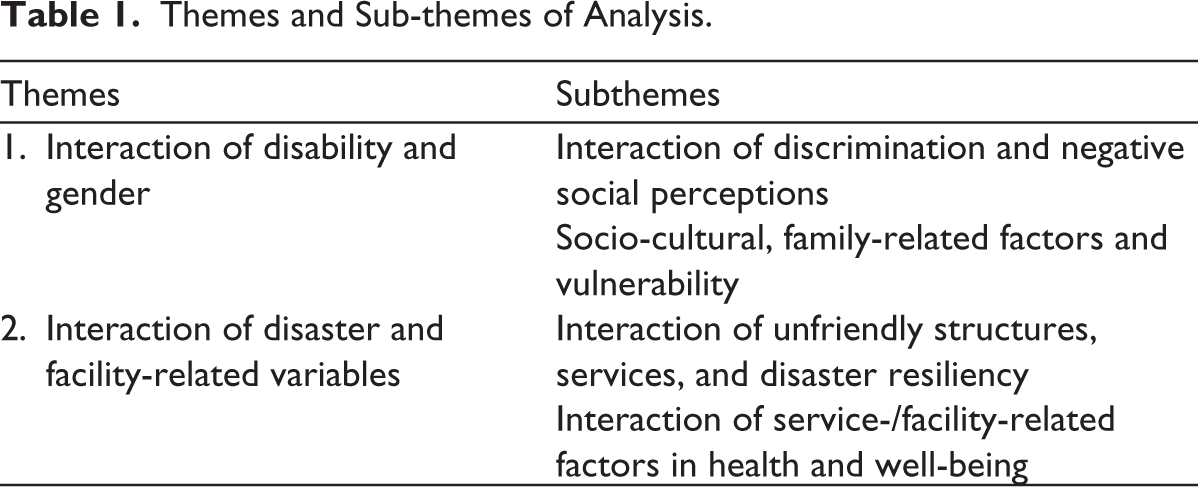
The audio records were transcribed verbatim in MS Word and translated into English. The transcripts were verified by the authors independently and imported into the RQDA software for coding. After the development of the initial coding, sub-themes and themes were generated. These identified concepts in the text were grouped (Table 1). An inductive approach, establishing clear links between the research objectives and the summary findings, was derived from the data.
Themes and Sub-themes of Analysis.
Results
What and how the disability, gender, and disaster-specific barriers and vulnerabilities experienced by the women with disabilities are elaborated under the themes of:
Interaction of disability and gender and Interaction of disaster and facility-related variables.
Interaction of Disability and Gender
Discrimination and Negative Social Perception
Not surprisingly, disability intersects with participants’ identities and how society perceives them. Participants perceived that their disability dominates how they are viewed and see this as inappropriate. This is illustrated by a verbatim remark by one participant (P3) whose pain while sharing this was clear:
People call me dundi (having no hand). Why do they blame me for my disability, even though I can still work and earn for myself, despite not having hands?
The shared experiences of the participants demonstrated that disability per se increases the risk of vulnerability, and if it comes to the female sex (gender identity), the risk of marginalisation further increases. Another experience shared by a participant with a disability (P6) speaks to the ways disability and gender intersect in shaping women’s health and well-being.
I met a young lady who had been married for 5–6 months. She fell from a tree and was treated alongside me. After the accident, she became disabled, and the doctors told her she could never get pregnant. Her husband left her and married another woman.
Participants spoke of how societal discrimination against women increases with disability and how this is manifested in the different rules governing marriage for women with disabilities compared to men with disabilities. Disability intersects with the female gender to disqualify them for marriage, thereby negating the fulfilment of sexual needs. One of the women (P8), whose husband had left her after she became disabled, expressed her annoyance:
It’s not a problem for a disabled man to get married, but it becomes a problem for a woman.… People hesitate.… If it were him, he would have married someone else.… But I’m suffering because I’m a woman. If I were a man, I wouldn’t have to endure this kind of suffering.
The study also revealed that sometimes conditions/diseases that cause disability for a person compound his/her vulnerability. A twenty-year-old woman participant suffering from epilepsy (P6) was miserable while sharing her experience:
They say she (referring to herself) has a disease that could be transmitted. Why is she still alive? Hearing such things made me feel that survival is meaningless, and I feel like dying.… They hated me there, throwing away the dishes I had washed and re-washing the clothes even though I had just washed them.
A government-employed woman working in the education sector (P10), participant of KII, added further:
Whenever we talk about disability, there is always a negative perception. People believe that a disabled person shouldn’t wear nice clothes or eat well.… They think they won’t get married, and even if they do, their children will also be born with disabilities.… According to society, they are seen as incapable of doing anything.
It has also been shared that the vulnerability of being poor and female is heightened due to unfair wages for labour. Although the Labour Act of Nepal talks about fair payment regardless of caste, creed or gender, females are paid less for the same job compared to males. The following was shared by one of the KII participants with a disability (P13):
When we go for any job, men always tell us that we can’t work as much as they can. They claim that we always lag behind them. For instance, if men are given 1,000 rupees per day, they only give us 500 or 600 rupees. I always tell them that we work just as hard as men do, but they despise us and pay us less just because we are women. These things keep happening here.
People of rural communities have been involved in labour work (daily wage earners) mainly for agricultural and/or building construction works. This study also found that women with disabilities have been facing disproportionate barriers to exercising their rights; they are not trusted due to their gender and disability identity. A woman with a disability also shared that after the earthquake, she was looking for a house to rent, but she could not get anything due to the perception that she would not be able to pay the rent. As one woman (P2) remarked:
When we ask people for a room or house to rent, they don’t give it to us. They outright reject us, saying, ‘You can’t earn, so you won’t be able to pay the rent’. There are many instances like this.
Socio-cultural, Family-related Factors and Vulnerability
Nepal is a patriarchal society where women have been given secondary status in decision-making, which diminishes their value in society. This study revealed that the families of women with intellectual disabilities view the responsibility for a disabled child as a burden. When the family perceives a girl with a disability as a heavy load to bear, she becomes more prone to physical, psychological, and sexual abuse. One participant (health worker) of FGD shared her experience with a heavy heart (P26):
One girl with an intellectual disability was brought to my office for an abortion. After the procedure, I offered Norplant (family planning) for her, but her family refused. I felt they wanted the girl to become pregnant again so that they could hand over their responsibility to the abuser.
Women’s vulnerability to sexual abuse, which intersects with other social conditions, such as being single or not having anyone to support them, is also heightened due to being unable to fight back and protect themselves. One of the participants (P8) expressed her frustration and helplessness:
I feel unsafe because people think they can do anything to a single woman when there is no support for her. They try to dominate me and want to do this and that (referring to unwanted sexual contact). I have experienced a lot. I used to live down there. There was a tenant brother in another room. At night, when men came, I used to open the back door, call that brother and escape. I was also strong at that time. Now I have come here … here also, men come; they hit and bang on my door.… If I were a man, I wouldn’t have suffered. I suffered because I am a woman. Why would men suffer like me? They are bigger people.
In the above narration, we can see the extent to which patriarchy and power relationships are situated within a society where males are ranked as superior. Participants shared that females have been ranked inferior, and if they are disabled, the societal rank decreases even more. Due to the intersection of gender and disability, disabled women experience increased vulnerability to unmet basic needs of health and survival. A participant of the FGDs shared the following (P28):
Yes, it is different. If a woman is disabled, she is not sent to school. The services that have to be given by the family are lacking: They are not given proper clothes; they are not given a bath; their clothes are not changed. If there is a disabled woman … she is despised … she is not treated well by her family.… If there were a man in her place, he wouldn’t be suppressed. But…
We also found that when disability and gender come together, it impacts health and well-being, as expressed by a FGD participant (P17):
There is a disabled man who had an injury who is receiving very good care because he is a man. His wife, family members, and father have been providing him with good support.
Interaction of Disaster and Facility-related variables
Interaction of Unfriendly Structures, Services, and Disaster Resiliency
This study found that women and men were affected differently by natural disasters and pandemics, highlighting how gendered disaster vulnerabilities can be. Participants shared that the workload of women increased during COVID-19. Moreover, as they had to take care of their families irrespective of their health conditions, they were also more vulnerable to experiencing severe illness. One experience was shared by one of the IDI participants (P1):
Even if women are infected with COVID-19, they have to take care of the household work and have to work inside the kitchen. Even if there are no symptoms, the body becomes weak, and there is a feeling of fatigue. Every symptom faced by a man is faced by a woman as well, but women are not allowed to rest because of their gendered roles. They are expected to carry on with their responsibilities.
It has also been shared that gender intersects with familial responsibility, which further increases the risk of negative health consequences for the female gender. It is believed that grown-up daughters should go to work and fulfil their responsibilities. The disparity in treatment and societal expectations between sons and daughters becomes evident in these situations. One of our IDI participants (P7) shared the following:
If a son gets an infection, he receives proper care and is provided with nutritious food. But if a daughter falls ill, she is expected to resume her work as soon as the fever subsides. Daughters who have grown up must go to work. Even when parents are supportive, society often labels them as over-pampering their daughter.
Participants in this study also shared that people with disabilities require specific facilities, including accessible toilets, but unfortunately, there is no provision for them. This lack of consideration for their needs further exacerbates the difficulties they face in accessing proper healthcare services. This is so even though there is a policy of the Nepal government for disabled-friendly health and other services. One participant in a workshop meeting (P48) shared:
I feel that health centres are not disabled-friendly. New buildings have been built, but even so are a bit congested. It is difficult to accommodate the normal service-seekers also. Disabled people need a different kind of toilet but there is no such provision.
In addition, people with disabilities shared an unfriendly and disrespectful environment at public schools and health centres/hospitals. An IDI participant (P12) said,
After hearing such things, my son (a disabled child) doesn’t enjoy going to school. He told me that he is despised by teachers and friends because of his disability. Yesterday, one of his friends also teased him saying that he is disabled. So, he refused to go to school today.
Interaction of Service/Facility-related Factors in Health and Well-being
It has also been found that in the context of COVID-19 and other disasters such as earthquakes and floods, disabled women are left behind. Disabled women shared that they have less support from family, and in particular, from male members (husbands), which makes them feel helpless and hopeless, and this has led to a spiralling sense of despair. Hence, disability and gender intersect to increase women’s vulnerability, leading to their health consequences. This was the experience of a woman with a disability who had just given birth to a baby (P9):
My husband also doesn’t care about me, and I used to feel like dying by hanging myself. I don’t know why. Now, he has not cared about me since I delivered a baby. I have been staying with my parents since then.
In this study, increased fear, anxiety, and mental distress due to repeated lockdowns were experienced by all IDI participants. Disasters such as COVID-19 pandemic, floods, landslides and earthquakes made them live with uncertainty. Their fear and stress were more over securing food for the family, and the daily basic requirements of living. The mental pressure even increased for women with disabilities, as they have less outside support (from the government and social organisations). In this way, disaster, gender and disability are interconnected, which increased vulnerability of the individual. An experience shared by one of the IDI participants (P7):
No, I didn’t get anything from the municipality. However, the ward did provide food once. There are many problems for disabled women like me. We can’t work and earn whenever it is needed. During floods and landslides, where is one to go and where to stay?
In line with the above narration, another IDI participant (P9) shared her experience:
The earthquake hit. Floods and landslides occurred. That’s why our hearts panicked. Our home is completely made up of soil. The soil used to fall during the earthquake. This is actually my mother’s house. She gave me, and I’m staying here. On the first day of the earthquake, we stayed in a house down there.
In response to the COVID-19 public health crisis, Nepal implemented various measures to curb the spread of the virus and ensure healthcare facility capacity. However, individuals involved in this study expressed that these preventive measures, including mobility restrictions and localised responses, created additional difficulties for women with disabilities by limiting their access to support services and disrupting their daily lives. Furthermore, the healthcare facilities provided during the crisis were found to be unfriendly towards women with disabilities, exacerbating their health and well-being challenges. One such experience was shared by one of our IDI participants (P1):
Yes, isolation. Isolation wards were not disabled-friendly. The bulbs also did not provide good vision. The road was not disabled-friendly. In that condition, it is already difficult for disabled people to work by themselves. On top of it, when the environment is not disabled-friendly, not only females but all disabled people are highly vulnerable.
It was found that disabled women were prone to sexual violence and abuse during disasters. Therefore, fear and stress are experienced more by women than men. An unmarried woman with a disability and studying for a bachelor’s degree had this to say:
It is unsafe for a female. We have to stay in the cottage. People take advantage of the situation. Snakes could come. There is a fear of males. There is fear of males even inside the home. In the situation where we have to stay in an open cottage with everyone, the fear increases much more.
Participants in FGDs shared that people with disabilities are slipping lower and lower in the social hierarchy; they are most of the time perceived as unwanted and unproductive human resources and are silenced. They have no social security and thus are living with unmet health needs. In situations of disaster, disability often adds to and worsens their vulnerability, even when available basic health services are not accessible to them. FGD participants shared one instance of a woman working in the local health centre:
I met two elderly people who were 86 years old. I asked them why they had not received the COVID-19 vaccine. They answered, ‘We cannot go by ourselves to get the vaccine, and there is no one to take us’. They are not taken to the hospital even when they fall sick.
There has been a growing trend of youth migration from Nepal to other countries. This migration has resulted in a confluence of challenges for parents, particularly those with disabilities, who experience helplessness and loneliness. In cases where individuals with disabilities lack family members to provide care, they are also deprived of access to essential health services. This experience was shared by a participant of FGD, another healthcare worker:
While on a home visit, I have seen an elderly adult with a mental disability living without medicine because his sons and daughters-in-law are abroad, and he is living alone.
Participants in this study also shared that in the situation of the pandemic, disabled persons with comorbid health conditions were left behind. Therefore, disasters have increased health consequences, such as increased stress and anxiety for persons with a disability because, due to their physical condition, they could not visit health facilities, hence they had unmet healthcare needs during the COVID-19 pandemic. Narration of a KII participant (a secretary of the local ward office):
[T]here was a problem with medications. There is a person with a disability who has Haemophilia. If he does not take medication, it becomes really difficult and that medication is not easily available here in the local areas, and there is no transportation.… Where to go? For women, sanitary pads should be made available.
Another woman’s (P9) words speak even more starkly to the problems faced by the very vulnerable:
I am afraid of dying. What to do? Nothing is greater than being able to breathe. If there is life, it is enough even if we get to eat little.
The study revealed that while Nepali society at large is fighting to meet a higher level of needs for its population, people living with disabilities are struggling to meet the most basic needs of survival, especially during times of disaster. The problem is compounded, as shared by policymakers and policy implementers at the local level, that municipalities lack adequate resources and lack the capacity to address the needs of disabled people during disaster situations. Still, the local government did manage to rescue and provide support and relief materials for disabled people to the extent of its capacity, as one policy-level worker revealed at a workshop:
[A]mong them, six houses were swept away. The house of a disabled person has also been swept away. In addition, there was a post-partum mother. The husband was disabled, and the wife was six months post-partum. The condition of the home was very critical. The municipality provided support as per its capacity. Ward also provided support. Reports and data on the damaged property are requested, and we send the data to the provincial government and the federal government, but it is meaningless. Nothing has been done until now since the flood took place.
This study found that during the disasters, although disabled people were not discriminated against, they had to compete with able-bodied people to receive support through relief programmes. It is said that there should not be one blanket approach for two different groups (disabled and able-bodied), but in the field, it was not incorporated; hence, there was no equity in disaster support services. Therefore, disasters increased the vulnerability of disabled people more than that of able-bodied people. A local functionary narrated the following:
There were no such specific plans for people with disabilities only. Those who could do it by themselves fulfilled their requirements just like how abled people do, and those who could not do anything or were bedridden remained just like that.
This study was carried out during the second wave of COVID-19, where participants shared that if health services for people were also compromised, the condition of disabled persons, infected with COVID-19, was further compromised. The following verbatim of the participants clearly indicated that there was an intersection of disability and disaster that affected the health and well-being of disabled people.
P2: I had a headache and a fever. At the hospital, I was also not examined; it was very difficult. They threw the medicines also. They say that COVID-19 infected must not be touched.
P5: I tested positive.… While measuring the temperature, it was difficult, especially for the blind like me. Who would see? People were afraid to come closer to the COVID-19 patients.
On the other hand, local players during FGD shared that unfriendly public organisations provide fewer opportunities to disabled people, thus they are left behind. One of the discussants said:
One thing is that the organisations are not disabled-friendly. Similarly, there is no policy to identify disabled people. We don’t have accurate data on disabled people. There are no focal persons to go to and enquire about their problems.
On this ground reality, we can say that although there were disaster approaches in the community, they were not easily accessible for persons with disabilities.
Discussion
These findings illustrate how environmental disasters and the COVID-19 pandemic have exacerbated the challenges faced by women with disabilities in Nepal. In general, women have different identities due to their gender roles, and when they have disabilities, these intersect even more with their role, status and power, and hence were left behind. Although women with disabilities can reject their label of ‘different’ so as not to feel social exclusion (Sumskiene et al., 2016), in reality, they are a neglected section of society facing discrimination and stigma; they were perceived as dependent and useless beings of society. Sumskiene et al. (2016) further added that a person’s dignity is severely affected by humiliation and devaluation, and in this study, some women with disabilities wanted to end their lives by hanging or drowning in a river due to the discrimination they faced. In this study, epilepsy, a disabling medical condition, has been perceived as communicable, thereby labelling the woman ‘untouchable’ and even advising her to end her life. Our findings corroborate the literature that has reported that disabled women’s heightened experience of discrimination, violence, and assault puts them at greater risk of prematurely ending their lives (Dean et al., 2017). This shows that there is a social stigma regarding some medical conditions that can cause disabling conditions. In this regard, social awareness programmes might be effective to reduce misconceptions/stigma, consequently would minimise social discrimination and enhance resilience.
According to the study participants, a patriarchal society enforces different rules for females and males, leading to double discrimination for those who belong to both the female and disabled minority groups. As a result, they face heightened insecurity, including physical, psychological, and sexual harassment and abuse. This finding aligns with existing literature that highlights a higher prevalence of intimate partner violence and homicide in patriarchal societies compared to non-patriarchal contexts (Brown et al., 2022). The challenges faced by women with disabilities are further exacerbated during and after natural disasters such as floods, landslides and earthquakes, as they are at a greater risk of sexual abuse and face mobility limitations that make it difficult to escape. This finding also supports previous research in the field of disaster studies, which emphasises the increased threat of gender-based violence following such calamities (Gartrell et al., 2020).
On the other hand, women with disabilities are often easy targets for sexual attacks and are denied the recognition of their own desires and needs. If a married woman becomes disabled, it is not uncommon for her husband to abandon her. Similar to our findings, a study conducted in India also reported that society permits disabled men to marry an ‘able-bodied’ woman, but holds a bias against the reverse scenario (Dean et al., 2017). This evident discrimination against women with disabilities may stem from the societal belief that a woman with a disability cannot be considered beautiful or sexually attractive.
Our study clearly indicates the compound effect of gender and vulnerability as disabled women shared experiences of discrimination and receiving lower wages compared to their male counterparts, despite having equal or even higher workloads. Consistent with our findings, Jetha et al. (2021) reported that women face fewer workplace supports compared to men, and the intersection of gender and different types of disabilities increases the unmet need for workplace support. In Nepalese culture, men are traditionally seen as the breadwinners, independent, assertive and strong, therefore economic contributors to the household, while women are expected to be weak, passive, dependent, and inferior. As a result, women with disabilities encounter disproportionate barriers to exercising their rights and are often distrusted due to their gender and disability, even in normal circumstances, leading to their exclusion.
This study found that in disasters like the COVID-19 pandemic, women’s workloads were increased, and they had to keep their health as their last priority, and their first priority was to care for their family members, even though they were infected and symptomatic. Drolet et al. (2015) have reported that despite cultural and social restrictions on women, they have to take on additional roles after a disaster. This suggests that women and men were affected differently by natural disasters, and there were gendered and disaster vulnerabilities. Additionally, the COVID-19 pandemic has exacerbated gender disparities and health inequities (Devkota, et. al., 2021; Ryan & Ayadi, 2020) that further marginalise them and render them vulnerable to health consequences. This highlights the importance of a gender-responsive, intersectional approach that would be better situated to address the adversities of disasters and pandemics. Although the policy of the Nepal government has indicated that a health facility must be disabled-friendly, the reality is very different, with participants reporting that health offices, public schools and health centres were not responsive to people’s needs. Women with disabilities in India preferred private over government facilities due to a fear of poor treatment in government-run facilities, such as the use of impolite tones and very insulting language (Dean et al., 2017). In line with Indian women perception, women living with disabilities in Nepal claimed that health facilities were not disabled-friendly but they had no options for treatment because in the remote community, there were no private health facilities or advanced health services provided by the Nepal government. For this reason, they had to go far away for better health services, which they could not afford.
Additionally, the preventive measures taken during COVID-19 contributed to compounding challenges, such as limited access to support services that disturbed the daily lives of women with disabilities. The study has shown that the isolation wards were not well-lit, so it was difficult for disabled people to take self-care, there was no one to check the temperature of visually impaired persons. Literature has shown that the barriers to meeting health needs were cessation of home-based health services, insufficient ambulances, and public transportation resources to go to the hospital, difficulty finding medications, and changes in usual care (Lebrasseur et al., 2021). Although measures were taken to mitigate the adversities of disaster, disabled people were living with unmet health needs. Those who could not visit the health centre due to the unaffordability of transportation costs or no person to accompany them were not vaccinated against COVID-19 despite government targets, and could not access other free health services. This suggests that there was no equity and access to health services for vulnerable people, and the service was left unreached by them. Thus, rehabilitation, community support, and home-based services during the pandemic and disasters to individuals with disabilities in the future are important to enhance resiliency and promote health and well-being.
Conclusion
Women with disabilities experienced various challenges during the periods of pandemics and disasters. When gender and disability intersect, it results in multiple layers of discrimination against women with disabilities living in rural communities. Women with disabilities, single women and women who are left behind by their husbands face increased levels of sexual and gender-based violence, especially those with intellectual and mental disabilities. They find it harder to flee or are left behind, making them more vulnerable to violence and sexual attacks. The absence of someone to accompany them and the unaffordability of the high transport costs lead them to forgo seeking healthcare services despite the availability of a free programme. On the other hand, the layout and equipment of health facilities offering care were not disability-unfriendly. The breakdown of housing, transportation and other infrastructure due to disasters such as earthquakes and floods compounds the vulnerability of women with disabilities, affecting their health and well-being. Therefore, in an effort to achieve equitable services and healthcare for all, the service systems need to address the unique barriers that people with disabilities face when accessing services.
Footnotes
Acknowledgements
The authors would like to acknowledge GRRIPP South Asia, UK Research and Innovation, and University College London for support through the South Asian micro project award. We would like to extend our special thanks to Professor Mahbuba Nasreen and Raisa Imran Chowdhury for their continuous support for the project. Our immense gratitude goes to the participants of the study.
Declaration of Conflicting Interests
The authors declared no potential conflicts of interest with respect to the research, authorship and/or publication of this article.
Funding
The authors disclosed receipt of the following financial support for the research, authorship, and/or publication of this article: Gender Responsive Resilience & Intersectionality in Policy & Practice (GRRIPP), South Asia had supported this study for proposal, data collection and report writing by Asian Micro Project Award.