







Abstract
This study delves into the role of social media in the realm of Islamist militancy, with a particular emphasis on Bangladesh, a country with the third-largest Muslim population. Employing a content analysis approach, this study finds that while explicit calls to join Islamist militancy are rare, social media platforms contribute to the creation of a moral foundation for militant ideology and provide justification for violent acts. Additionally, the study highlights the influence of social media in motivating young individuals to participate in Islamist militancy, although the direct impact of online radicalisation on real-life actions remains uncertain. The findings underscore the need for further research on the dynamics between social media and Islamist militancy and their implications for countering militant ideologies.
Introduction
Although Islamist militancy has been a global phenomenon since the 1970s (Beinin, 2005), it has taken a new form with the widespread use of information and communication technologies (ICTs). While ICTs have brought numerous positive advancements to society, they have also provided militants with an unprecedented ability to carry out acts of violence without limitations of time or space (Castells, 2010). These technologies have been utilised by militants for recruitment, propagating their objectives, fundraising and even training their members for operations (Hale, 2012; Hoskins et al., 2011). Bangladesh, the world’s third-largest Muslim-populated country with over 165 million people, has not been immune to this emerging trend of Islamist militancy. While Islamist militants have been involved in various activities in the South Asian country since the 1980s, there has been a recent surge in violent extremism in the past few years (Mostofa, 2021). According to a study, between 2001 and 2016, Islamist militants carried out 147 violent attacks in Bangladesh (Fair & Abdallah, 2017). Transnational Islamist militant organisations like the Islamic State of Iraq and Syria (ISIS) and Al-Qaeda in the Indian Subcontinent (AQIS) have claimed responsibility for these attacks. During the period from January 2015 to June 2016, at least 44 people, including bloggers, online activists, publishers, professors, religious and ethnic minorities, journalists, LGBTQ+ activists and foreigners, were killed or injured in such attacks (Riaz, 2017). Additionally, between 2013 and 2018, at least 12 writers were killed, and many others fled the country due to life-threatening situations posed by Islamist militants (Bhatt, 2021; Crisis Group, 2018).
On 1 July 2016, Bangladesh experienced a horrific militant attack at the Holey Artisan Bakery in Dhaka, resulting in the loss of 29 lives, including 20 hostages (18 foreigners and 2 locals). The attack was carried out by a group of five youths who were allegedly affiliated with the ISIS. This attack garnered significant international attention, primarily due to three notable factors. First, all the attackers were young, in their late teens or early 20s, and hailed from affluent backgrounds. They had received their education from prestigious local and foreign private schools and universities (Manik & Anand, 2016). This contrasted with the prevailing belief at the time that poverty, unemployment and madrassah education were the primary factors contributing to militancy in Bangladesh (Riaz, 2017). Second, this incident marked the country’s first hostage experience. The attackers held foreigners captive, and 18 of them were shot or hacked to death. Lastly, the attackers actively used the Internet during the attack, including claiming responsibility for the heinous act through social media and sharing video messages supporting their actions. It was found that the attackers had utilised social media platforms for motivation and organisation of the attack (Corraya, 2017).
The tech-savvy nature of Islamist militant groups in Bangladesh has become increasingly prominent in recent years (Sharma, 2023). The country has witnessed a significant rise in Internet and social media usage. As of March 2023, there were over 183.89 million mobile phone subscribers in Bangladesh (BTRC, 2023). A government report published in July 2022 says that 37.01% of the adult population (18 years and above) of the country are Internet users (The Business Standard, 2022). Additionally, as of early 2022, there were 49.55 million social media users, accounting for 29.7% of the total population. The number of Facebook users in September 2022 reached 53.61 million, representing 30.7% of the entire population (DataReportal, 2022). Among these users, the majority (21.2 million) are young individuals aged between 18 and 24 years (Rahman, 2022). Studies have shown that Bangladeshi youths utilise these new media platforms not only for communication but also for community-building, voicing their opinions, mobilising people, organising movements and engaging in citizen journalism (Sharma, 2014, 2015, 2020; Sharma & Rahaman, 2018). Islamist militants have also capitalised on the opportunities provided by these advancements in ICTs. It has been observed that the believer–atheist debate is one of the most discussed topics in the Bengali online community (Haq, 2011). Various online groups tend to promote Islam while disparaging other religions and nations. Furthermore, social media has been utilised to incite and motivate youths towards militancy in the country (Rashid, 2016).
Following the Holey Artisan attack, law enforcement and security agencies in Bangladesh took various actions and initiated extensive anti-terror operations throughout the country (Sharma, 2021b). These efforts resulted in the death or suicide of at least 80 alleged Islamist militants, who sought to evade arrest, while 300 others were apprehended by authorities until 2019 (BBC, 2019). Subsequently, as a result of these anti-terror operations and the decline of the ISIS in Syria and Iraq, the number of militant attacks has decreased. This shift is also reflected in the Global Terrorism Index (GTI) scores, which illustrate the evolving pattern of militancy. The country’s GTI score reached its peak at 6.48 in 2015, following a historic low of 4.1 in 2012. Since 2016, there has been a steady decline in the score, with values of 6.18 in 2016, 5.7 in 2017, 5.21 in 2018, 4.91 in 2019 and 4.9 in 2020 (GTI, 2020). Nevertheless, scholars argue that Bangladeshi Islamist militants remain active in the changing landscape and have adjusted their strategies accordingly (Alam, 2020; Bashar, 2019; Sharma, 2023).
Despite the absence of a strong support base or sympathisers for militant organisations in Bangladesh, evidence suggests that the country is conducive to radical ideologies and extremist violence (Fair & Abdallah, 2017). Scholars argue that Bangladesh, which remains relatively understudied, requires serious examination regarding Islamist militancy (Fair & Oldmixon, 2015). The Holey Artisan attack not only motivated law enforcement personnel to conduct operations but also piqued the interest of security and terrorism scholars in studying Islamist militancy in Bangladesh. Some researchers are particularly interested in exploring the intersection between ICTs and Islamist militancy (Parvez, 2017, 2019b). However, there is a dearth of empirical evidence concerning the role of social media in this context. As a result, government and law enforcement agencies often make decisions based on assumptions. This study aims to fill this research gap by providing insights and findings that can assist policymakers in formulating effective de-radicalisation strategies grounded in facts and evidence.
Islamist Militancy, Internet and Social Media
The role of the Internet and social media has emerged as a significant topic of discussion regarding Islamist militancy in the era of new communication technologies (Blaker, 2016; Rudner, 2017). Numerous studies highlight that the Internet is increasingly acting as a catalyst for violent radicalisation and the dissemination of extremist ideologies through fast, cost-effective, decentralised and globally interconnected networks (Alava et al., 2017; Hale, 2012; Neumann, 2013). The Internet is often described as a powerful tool that helps aspiring militants transcend traditional boundaries (Pantucci, 2011). In an empirical study of 242 European militants, Precht (2008) discovered a correlation between militant websites, online propaganda and rapid radicalisation. Additionally, several studies (i.e., Chatfield et al., 2015; Weimann, 2016) demonstrate how Islamist militants utilise social media platforms such as Facebook, Twitter and YouTube for propaganda, recruitment and fundraising purposes. It has also been observed that the ISIS effectively mobilised a significant number of individuals to travel to Syria or engage in jihad within their home countries through the creation of diverse content in multiple languages on social media (West, 2016).
According to some studies, the Internet has the ability to reach individuals who may be otherwise difficult to access (Neumann, 2013). Anonymity is one of the key factors that contribute to this phenomenon (Schmidle, 2009). Blaker (2016) identifies parallels between the grooming techniques employed by Islamist militants and online predators in recruiting teenage girls. In both cases, the recruiters establish trust with potential recruits and encourage them to keep their relationship secret from others. Over time, they may persuade the girls to join them by severing ties with their families. Bjelopera (2011) highlights how the Internet normalises attitudes and behaviours that might otherwise be deemed inappropriate or objectionable in the offline world.
Definitive characterisations of the drivers of Islamist militancy in Bangladesh are challenging due to the limited empirical evidence available on individual militants, their paths to militancy, and their diverse perspectives and goals. However, scholars have identified a range of factors that are believed to play a significant role in driving the phenomenon (Hasan & Macdonald, 2022; Mia, 2017; Parvez, 2017; Hussain, 2007). These factors include:
Perception of Islam being under attack: There is a sense among some individuals that Islam is under threat both globally and within Bangladesh. Increasing religiosity and debates over the role of Islam: There is a growing emphasis on religious observance and ongoing debates about the proper place of Islam in Bangladeshi society. Political dynamics and governance issues: Malignant politics, governance challenges and an absence of the rule of law contribute to the environment conducive to militancy. Repression of political rights and civil liberties: Restrictions on political rights and civil liberties create frustrations and grievances that may contribute to radicalisation. Socio-economic conditions and corruption: Frustration arising from socio-economic conditions, including poverty, unemployment and corruption, can fuel discontent and provide fertile ground for radicalisation. Growing inequality: Increasing social and economic inequality exacerbates feelings of marginalisation and injustice, potentially contributing to radicalisation.
Moreover, evidence suggests that radicalisation tendencies have emerged among a small fraction of Bangladeshi individuals residing abroad, which has implications for domestic dynamics (Hasan & Macdonald, 2022). Riaz (2008) argues that the emergence of Islamist militancy in Bangladesh is the result of a complex interplay between domestic and international factors. He describes:
There are several reasons why the militant organizations have thrived. First, domestic politics have created an environment for their proliferation. Second, Bangladeshi state institutions are weak in certain geographical areas. Third, a new popular culture glorifies militancy, and fourth they have received support from beyond the borders of Bangladesh. (p. 2)
Consistent with trends observed in other parts of the world, studies indicate that the Internet and social media play a significant role in the radicalisation of Bangladeshi youths (Amit et al., 2020; BIPSS, 2017). A study conducted by the Bangladesh Police reveals that 82% of Islamist militants in the country were radicalised through social media platforms. The study further highlights that 56% of militants have a general school background, while 22% come from madrasas, Islamic religious schools (Hassan, 2017). Another study suggests that Bangladesh’s Islamist militancy is predominantly male and young, with an increasing number of militants hailing from affluent and educated families. The research also underscores the importance of social networks, including friends, teachers, family members and influential individuals, in the radicalisation process (Riaz & Parvez, 2018). Additionally, Bangladeshi militants heavily rely on the Internet for various activities such as funding, mobilisation, recruitment, propaganda and communication. Mostofa (2021) also finds that cyberspace is progressively radicalising middle-class teenagers from urban and secular backgrounds, and individuals with perceived ideological differences are targeted for assassinations. The motivations behind Islamist militancy in Bangladesh, according to Mostofa, encompass the idea of an apocalyptic Caliphate, a sense of victimhood, disillusionment with the government and society and personal distress. Parvez’s (2019a) study identifies three main themes in the Bangladeshi jihadist narrative:
First, the Jihadists construct a perceived crisis, a situation where jihadists project that Muslims are oppressed solely for being Muslims; Islamic culture and lifestyle are under threat; states with Muslim-majority populations are puppets of Western ‘crusaders’ and Hindu ‘invaders’; and individuals are immersed in an anti-Islamic, depraved and corrupt system. After depicting a grim picture of the crisis, the jihadists offer solutions to these crises: only an Islamic State based on sharia law can be the panacea of all these crises, and Muslims should take every step possible to establish it. Using this rationale, jihadists justify that armed jihad is necessary and the ‘only way’ to reach the solution from the existing crisis, even if it needs killings of civilians. (p. 33)
Studies also find that Islamist extremists utilise social media platforms to depict the illustrious history of Islam, aiming to persuade individuals that everything was flawless during the early age of Islam, and consequently, every Muslim should strive to establish a similar Islamic system (Maowa, 2020). Another study, analysing the published content of a Bangladeshi militant organisation, indicates that 30% of the content is directed against Western democracy. Comparatively, 25% of the content focuses on opposition to the government, while another 25% addresses issues such as corruption, injustice or the misuse of laws. Approximately 20% of the content in the dataset revolves around topics such as jihad, the suffering of Muslims and religious discussions. Extremists deliberately select these topics, which are relevant to public interest. By labelling democracy as kufri (blasphemous) and portraying the negative aspects of the government, they seek to incite public anger towards the existing system (Alam, 2020).
Scholars argue that the possibility of Islamist militant attacks has significantly increased in recent years, and social media has played a role in exacerbating these circumstances. This is attributed to the growing number of local militants who are inspired by transnational organisations (Hossain, 2015). The utilisation of social media platforms has contributed to increased organisation among militants and has been associated with a rise in the frequency of terrorist attacks in Bangladesh. Small local militant groups have formed alliances with transnational organisations and have been involved in various acts of militancy.
However, promoting violent extremism is in violation of social media community policies. Extremists employ strategies to create groups that are difficult to identify quickly, ensuring their activities remain undetected. When a platform like Facebook shuts down a group or page, they promptly create a new one with a different name and inform other members to join. Facebook is often used as a means to search for supporters, and reliable supporters are then invited to join other secretive online platforms (Swapan, 2018). Research has also highlighted the significance of Bangladeshi Islamic Facebook groups and pages, which primarily share religious content without explicitly endorsing violent extremism, in promoting online radicalisation, particularly during the involvement phase when targeting and influencing potential militants (Amit et al., 2020; Parvez, 2019b). Facebook pages and groups are exploited for the dissemination of religious extremism, with extremists distorting religious interpretations to attract susceptible youth to Islamist militancy (Ghatack, 2018). However, only limited efforts have been made thus far to comprehensively analyse the content of these platforms. Against this backdrop, this study aims to address these gaps and shed light on the dynamics and mechanisms of online radicalisation in Bangladesh.
RQ1: What are the themes and narratives portrayed in the content shared on Bangladeshi Islamic social media platforms?
RQ2: How does the content shared on these platforms contribute to constructing a narrative that justifies violent extremism?
RQ3: Is there evidence to suggest that online radicalisation translates into real-life attacks in Bangladesh?
Methods
A purposive sampling method was employed to select 10 public Facebook groups for data collection. These active groups were chosen based on their membership number and their focus on sharing Islamic religious content. Since the collected posts were publicly available, no requests for access or consent were necessary (Stubbs-Richardson et al., 2018). Facebook groups were specifically chosen over other social media platforms due to the widespread popularity of Facebook among the younger population in the country.
Table 1 provides information about the selected groups. Subhanallah, which was created approximately six years ago, boasts a membership of over 350,000. The largest group, Islamic World, was established over five years ago and has an impressive membership of more than 4.2 million. The Islamic World group witnesses the daily sharing of over 100 posts. In contrast, the four remaining groups share an average of 2–5 posts per day, while the remaining five groups share 15–50 posts daily.
Ten Islamic Facebook Groups (Until 31 July 2021).
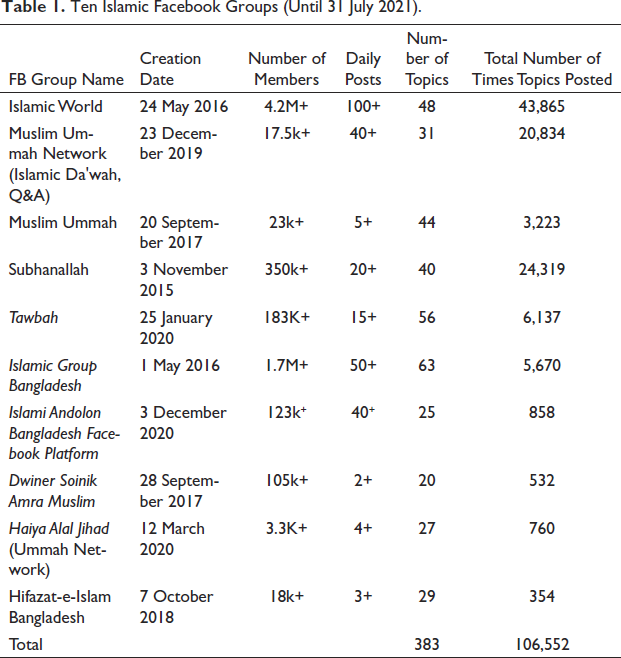
Posts in these groups utilise hashtags, which transform topics and phrases into clickable links within the posts. This functionality allows individuals to easily locate posts pertaining to their specific interests. Additionally, Facebook’s feature enables group members and administrators to categorise group posts effectively 1 (Hutchinson, 2023). Each group’s topics are documented as ‘Group Topics’, revealing the frequency of each topic’s appearance. Table 1 highlights that Islamic World Bangladesh encompassed the highest number of topics, with a total of 63, whereas Dwiner Soinik Amra Muslim had the lowest number of topics, with only 20, throughout the duration of the study. All the group topics and the number of times they were shared in the selected groups until 31 July 2021 were collected and included in the analysis (Zaleski et al., 2016). Additionally, a few related posts that best describe each topic were collected to gain a better understanding of the topics.
The data were analysed using the content analysis method. Content analysis is a commonly used approach in social media research, particularly for analysing Facebook and Twitter posts, YouTube videos and other social media content (Snelson, 2016). It involves systematically analysing written, verbal or visual communication to quantify content based on predetermined categories (Cole, 1988; Neuendorf, 2002).
Two coders immersed themselves in the collected data by extensively reading and re-reading it. This process allowed the researchers to become familiar with the context and gain a deeper understanding of the content. Qualitative analysis and basic intercoder reliability were employed to analyse the data, examining both manifest and latent qualities within the content. For the assessment of basic intercoder reliability, the coders independently examined the data and categorised the content based on their judgement of both manifest and latent characteristics. Initial placement of content into categories showed a 94% agreement, and any remaining discrepancies were resolved through a second review that focused on identifying themes and narratives. Manifest qualities pertain to observable themes and narratives present in the content, while latent qualities involve underlying meanings that require interpretation. Although certain items could potentially be grouped together under a religious framework, the researchers took care to analyse both the manifest and latent qualities of each post, taking note of subtle differences in semantics, attributions and meanings.
Both inductive and deductive qualitative content analysis methods were used to identify and interpret both explicit and underlying features in the content. An unconstrained categorisation matrix was developed for the analysis, drawing on relevant studies that specifically focused on the narrative of Islamist militancy content (Orth et al., 2020). The initial categories included conspiracy, divine punishment, religious support and resources, anti-Western, anti-government, call for jihad, Muslims’ sufferings, Islamic culture and lifestyle under threat, and COVID-19 (Alam, 2020; Daymon & Criezis, 2020; Maowa, 2020; Parvez, 2019a). The use of an unconstrained categorisation matrix allowed for inductive principles to guide the analysis process. Instead of considering the categories as fixed, they were viewed as fluid, allowing for interpretation to evolve based on the information obtained from the group topics (Cole, 1988; Elo & Kyngäs, 2008). While a predetermined set of categories was used to code the data, they were open to interpretation and subject to change based on emerging insights. Finally, the data were analysed quantitatively, taking into consideration the key narratives and themes that emerged from the qualitative breakdown (Daymon & Criezis, 2020).
To examine the relationship between online radicalisation and real-life attacks, news reports concerning Islamist militancy were gathered from prominent newspapers in Bangladesh (Riaz & Parvez, 2018; Sharma, 2023). The data collection spanned from 1 July 2016 to 31 July 2021. The focus was on reports that featured interviews and published confessions of alleged militants. 1 July 2016 was selected as the starting point due to the significant impact of the gruesome attack that occurred on that day. Following the attack, security agencies in the country initiated various actions, resulting in the arrest or killing of numerous militants.
Themes and Narratives of Islamic Facebook Groups
Table 1 displays a comprehensive overview of the content analysis conducted on the 10 Facebook groups during the study period, revealing a total of 383 topics that were utilised a combined 106,552 times. 2 The content encompassed various forms such as text, photos, videos, and links, as well as text accompanied by links, photos or videos. Through the analysis, 12 distinct themes and narratives 3 were identified and examined. However, it should be noted that certain content exhibited broad narratives and themes that did not neatly fit into any of the existing 12 categories. As a result, a 13th category labelled ‘other’ was created to accommodate such instances.
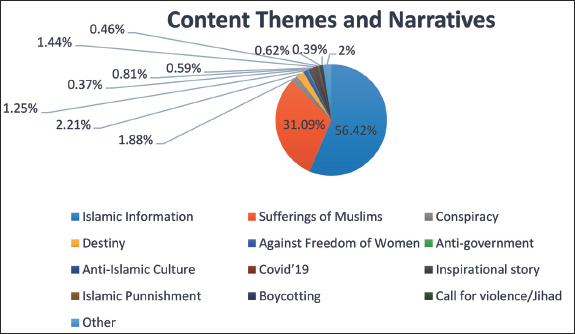
Figure 1 illustrates the breakdown of the main themes and narratives within the content. The analysis indicates that two themes, namely Islamic information and the sufferings of Muslims, constituted the majority of the content, amounting to 87%. The identified themes and narratives encompassed the following:
Content Themes and Narratives.
Islamic Information
The ‘Islamic Information’ theme accounted for the largest portion of the dataset, comprising 56.42% (or 60,127 items) of the content. This category included posts containing excerpts from Islamic texts, explanations of Islamic teachings, discussions on the glorious history of Islam, as well as information about the duties of Muslims and the rewards associated with adhering to Islamic principles. The posts under the ‘Islamic Information’ theme aimed to educate group members about various aspects of Islam, providing them with valuable insights into religious texts and teachings and fostering a deeper understanding of the faith and its significance in the lives of Muslims.
Sufferings of Muslims
The ‘Sufferings of Muslims’ theme constituted the second-largest portion of the dataset, representing 31.09% (or 33,127 items) of the content. This category included posts that shed light on the sufferings faced by Muslims globally. It was observed that group members not only highlighted the injustices and sufferings endured by Muslims in various regions such as Palestine, India, Syria, France, China, Myanmar and Kashmir, but also called upon Muslims to unite and resist against oppressors. By sharing stories of oppression and advocating for resistance, these posts sought to mobilise support and action in addressing the injustices faced by the Muslim community around the world.
Conspiracy
The ‘Conspiracy’ theme and narrative encompassed content that discussed various conspiracies against Muslims worldwide. Approximately 1.88% (or 2,008 items) of the dataset focused on topics such as conspiracy against Muslims, inter-faith conspiracies and allegations of conspiracy by the governments of Bangladesh and India against Islam and Islamic leaders. These posts aimed to highlight perceived threats and raise awareness about potential plots targeting the Muslim community.
Destiny
The theme of ‘Destiny’ constituted 2.21% (or 2,358 items) of the content in the dataset. It included Islamic discussions on topics such as signs of resurrection, death, rewards and punishments after death, concepts of heaven and hell, the final judgment day, and figures like Imam Mahdi 4 and Dajjal. 5 These posts delved into eschatological aspects of Islamic beliefs, providing insights into the afterlife and the ultimate destiny of individuals.
Against Freedom of Women
The ‘Against Freedom of Women’ theme focuses on discussions surrounding the perceived negative consequences of women’s freedom, such as extramarital affairs, pornography, rape and eve-teasing. A significant portion of the content (1.25% or 1,334 items) centres around women’s attire and their interactions with men, highlighting concerns related to modesty and moral values within the context of Islamic teachings.
Anti-Islamic Culture
The ‘Anti-Islamic Culture’ theme involves regular posts that label certain days as part of an alleged anti-Islamic culture, including Valentine’s Day, Friendship Day, 31st Night, Kiss Day, Mother’s Day, Father’s Day, Chocolate Day and the first day of the Bengali new year. These posts call upon Muslims to refrain from participating in these celebrations. Analysis shows that 0.81% (or 863 items) of the posts in the dataset revolve around discussions related to ‘anti-Islamic culture’, emphasising the need to resist and avoid practices deemed contrary to Islamic teachings.
Anti-government
The ‘Anti-government’ theme encompasses groups that criticise the activities of the Bangladesh government, particularly referring to the Awami League-led government as anti-Islamic and illegal. These posts often condemn the activities of the government’s student wing, Chatra League, highlight oppression against Islamic leaders and scholars and criticise the government’s relationship with perceived enemies of Islam, particularly the Indian government. Approximately 0.37% (or 393 items) of the posts in the dataset were classified as ‘anti-government’.
COVID-19
The ‘COVID-19’ theme includes posts discussing the coronavirus, the COVID-19 pandemic, lockdown measures and vaccines. This theme accounted for 0.59% (or 627 items) of the content in the dataset. These posts may provide information, opinions or discussions related to the virus and its impact on society.
Inspirational Story
The ‘Inspirational Story’ theme constituted 1.44% (or 1,535 items) of the content in the dataset. This category featured posts that shared inspiring narratives of individuals who adhere to Islamic rules and duties and are rewarded in their lives. These stories aim to motivate and uplift the group members.
Islamic Punishment
The ‘Islamic Punishment’ theme accounted for 0.46% (or 487 items) of the content in the dataset. This category included discussions on sins and the corresponding punishments in Islam for various crimes, such as extramarital affairs, rape, homosexuality, murder, bribery and smuggling. These posts aim to educate group members about the consequences of engaging in prohibited actions according to Islamic teachings.
Boycotting
Regular posts are found in these groups urging members to boycott various products, media houses, social media platforms, movies, celebrities and video games due to perceived anti-Islamic activities associated with them. Some of the mentioned boycott targets include Arong, Close-up, Transcom Hair Styler, Daily Prothom Alo, 71 TV, DBC TV, Tiktok, Likee, Imo, 10 Minutes School, Commando, Shakib Al Hasan, Anonto Jalil, Dev, PUBG and Free Fire. This study identifies that 0.62% (or 664 items) of the content in the dataset revolves around such calls for boycotts.
Call for Violence/Jihad
A total of 414 posts, accounting for 0.39% of the dataset, were found to be urging all Muslims to engage in jihad or violence as a means to protect Islam and its prophet. These posts reflect a call for action to defend the faith and employ forceful measures in pursuit of that goal.
Other
In addition to the aforementioned themes and narratives, a significant portion of the content, comprising 2.47% (or 2,627 items), encompasses a diverse range of topics. This category includes posts related to news, help requests, press releases, programme information, tips and articles featuring Islamic personalities. These miscellaneous topics contribute to the overall content diversity within the dataset.
Online Radicalisation and Real-life Attack
On 4 May 2020, Bangladesh police arrested 17 individuals who were planning to travel to Saudi Arabia to meet ‘Imam Mahdi’. According to media reports, a Bangladeshi engineer residing in Saudi Arabia had been using audio and video speeches on behalf of ‘Imam Mahdi’ to call for Muslims to join jihad (Rabbi, 2020). The arrested individuals were motivated by these speeches and intended to meet him in order to participate in jihad under his guidance. This incident highlights the potential impact of online radicalisation on real-life actions.
The Holey Artisan attackers, who were killed in a confrontation with law enforcement, were found to have become involved in violent extremism through their engagement with social media platforms (Majumder, 2016; The Daily Star, 2016). Nibras Islam, one of the key perpetrators of the attack, exhibited his pre-extremism life through his Twitter activities, which included participation in social activities and admiration for Bollywood actresses (Bhuiyan, 2016). However, his online behaviour took a significant shift as he began following two conservative Islamist preachers, subsequently ceasing his social media activity and reducing communication with friends and family. Similarly, the father of another Holey Artisan attacker, Rohan Imtiaz, stated that his son’s radicalisation was influenced by online content. Rohan’s Facebook profile contained posts that could be interpreted as having radical undertones. These instances demonstrate the potential role of online content in shaping individuals’ radicalisation processes.
This pattern is also evident in the cases of two other militants, Gazi Kamrus Salam Sohan and Suman Hossain Patwary, where the influence of social media played a significant role in their radicalisation process. Sohan, an engineer, travelled to Syria in December 2014 to join the ISIS. Upon his return to Bangladesh on 16 May 2015, he shared his experiences with the police, including how social media played a part in his journey (Ahsan, 2017). Initially, Sohan joined a Facebook group to enhance his understanding of Islamic laws, where he encountered Aminul, a prominent member. Through their interactions, Aminul introduced Sohan to Ozaki, a Japanese-Bangladeshi militant, and they connected on Facebook. Sohan admitted in his confession statement that both Ozaki and Aminul played a pivotal role in reinforcing his radical beliefs through their communication on social media. Similarly, Suman Hossain Patwary, who carried out an attack on a publisher and two others in Dhaka on 31 October 2015, utilised social media to connect with like-minded individuals who shared radical views, creating an echo chamber that contributed to his process of radicalisation (Ahsan, 2016).
The cases discussed above highlight the role of social media, particularly Facebook, in facilitating communication between recruiters and individuals aspiring to become Islamist militants. According to news reports, a significant portion of virtual communication among Bangladeshi militants is controlled from abroad. In addition to platforms such as Telegram, they are now utilising Hoop and TamTam. These militants upload content, including translated materials, on social media platforms and closely monitor the reactions and comments of young individuals regarding government activities or other religions. They then engage in communication with these individuals and recruit those whom they deem reliable (Alam, 2020; Mamtazi, 2019). Furthermore, militants are not only focused on recruitment but also attempting to train every member in bomb-making through online resources, as stated in a media report (Labu, 2021). They have developed an online manual on bomb production, which they share with their members for training purposes.
However, Monirul Islam, chief of the counterterrorism and transnational crime unit of Bangladesh Police, claims most extremists are active merely online:
The law enforcement authorities had observed extremists posting provocative content on the Internet. However, most of those who spread such content is not connected to any terrorist organisation or network. Sharing extremist content does not necessarily mean that they will join terrorist organisations. Even though these groups are active in the virtual world, many do not have any strength and structure in the real world. (Mithu & Kamal, 2020)
Discussion
Since social media, particularly Facebook, is highly popular in Bangladesh, various groups and organisations utilise this platform to pursue their social and political objectives. Islamist militants are no exception, as they leverage different social media platforms, including Facebook groups and pages, to propagate their ideology and recruit new members. However, identifying militant Facebook groups and pages can be challenging due to Facebook’s community policy against extremism. Nonetheless, this study reveals that their narrative closely resembles that of Islamist militants.
Studies indicate that one strategy employed by extremists is to portray the early days of Islam as a time of glory, aiming to convince ordinary Muslims that everything, including the punishment system during that era, was flawless (Maowa, 2020). Rather than employing an ethical approach to history, propagandists of extremism manipulate people’s beliefs. They refuse to acknowledge that the current situation, realities, problems and solutions faced by Muslims worldwide are fundamentally different from those of the early days of Islam. This study also uncovers the similarity of the extremist narrative, with over half of the content in the dataset focusing on the glorious history of Islam and Islamic texts.
Previous studies have revealed that Islamist militants attempt to portray Muslims as victims worldwide (Parvez, 2019a). In this context, they often highlight examples of countries where Muslims are a minority, aiming to convince the majority-Muslim population of Bangladesh that Muslims face persecution and oppression universally. However, these narratives tend to ignore the ongoing conflicts and internal disputes among Muslim-majority countries. The present study also finds that the second-largest portion of the dataset (31.09%) is dedicated to discussions on the sufferings of Muslims globally, accompanied by calls for action to alleviate their plight. Such content has the potential to evoke anger among ordinary Muslims, potentially leading to their involvement in violent extremism. Extremists also monitor people’s reactions to these posts and establish contact with those deemed reliable (Ghatack, 2018). Another strategy employed by extremists in Bangladesh is to claim that only their chosen interpretation of Islam represents the true Islam. They often label the peaceful and diverse Muslim population outside their ideological framework as ‘Western-influenced’ Muslims. However, they conveniently overlook the rich history of Muslim diversity that predates the Western colonial era and the numerous esteemed Muslim scholars who offered brilliant interpretations of Islam during periods of Muslim rule. Moreover, they assert that Islamic culture and lifestyle are under threat. This narrative aligns with the findings of the study, where different days and celebrations are frequently labelled as anti-Islamic, including cultural events such as Pohela Boishakh, the first day of the Bengali New Year. Additionally, they propagate the notion that unrestricted interaction between men and women is part of Western and Hindu culture, urging Muslims to refrain from such practices. This narrative closely resembles that of Islamist militants.
Other themes and narratives identified in this study, such as conspiracy theories against Muslims and anti-government sentiments, bear resemblance to militant narratives. Previous studies, including Parvez (2019a), have also noted that violent extremist groups propagate the idea that Muslims are victims of a Western conspiracy, with complicit governments playing a role. This study corroborates these findings, as similar narratives were observed. Additionally, militants employ the tactic of invoking death and resurrection to motivate individuals in fulfilling their religious duties. They share inspirational stories and emphasise the duty of every Muslim to protect Islam and its prophet. This study also identifies similar narratives, with 0.39% of the content directly urging Muslims to engage in jihad or violence, and 0.62% calling for boycotts. It is worth noting that boycotts, defined as acts of war, represent an extreme behaviour of attacking the perceived ‘enemy’ without first exploring peaceful alternatives (CTB, n.d.).
We have witnessed examples in India where the politics of victimhood has been successfully employed to gain power. Hindutva leaders in India have effectively utilised this strategy, and at times, even US President Donald Trump has employed similar tactics. Furthermore, the arrival of the COVID-19 pandemic has contributed to instilling panic among ordinary Muslims by alluding to signs of the Hour, which signifies the pre-resurrection period (Sharma, 2021a). Extremist groups in Bangladesh have consistently utilised social media to strengthen their ideological positions. Thus, it can be argued that while most social media content may not explicitly call for participation in jihad or violence, Islamic Facebook groups, to some extent, play a role in creating a moral foundation for militant Islamist ideology and justifying violent extremism. Extremists exploit Islam to gain the initial acceptance of Muslims and conceal their extremist activities on social media. Although they often share innocuous Islamic information, they rarely share extreme content for the purpose of recruiting new members.
While the direct impact of online radicalisation on real-life actions is not yet definitively established, there is a clear indication that young individuals are being motivated to engage in violent extremism through social media platforms. Instances such as the Holey Artisan attack demonstrate that some of these individuals have carried out or attempted violent attacks. The availability of online training manuals further facilitates their radicalisation process.
Conclusion
Online radicalisation can have far-reaching consequences beyond individual acts of violence, as it contributes to the spread and normalisation of extremist ideologies within society. It creates a breeding ground for like-minded individuals to connect, reinforce their beliefs and potentially form networks that can pose a significant threat to public safety. The impact of online radicalisation extends beyond immediate acts of violence, as it can also fuel societal divisions and undermine social cohesion.
Considering the evident continuation of this trend and the likelihood of individuals partially becoming extremists through social media, it is crucial that this issue receives increased attention. There is no room for complacency when it comes to addressing the activities of militants. Moreover, it is essential for scholars to actively confront militancy from an ideological perspective. They should acknowledge and address the underlying social, economic and political factors that contribute to the rise of Islamist militancy. By addressing these root causes, scholars, civic-social organisations and writers can help create an environment less conducive to extremist ideologies. Additionally, civic-social organisations and prominent writers should actively participate in social media to create counter-extremism narratives and raise public awareness. Civic-social organisations can also establish community-based educational programmes that focus on promoting a tolerant, inclusive and pluralistic society. Encouraging open discussions and inter-faith initiatives can help bridge divides and reduce the appeal of militant ideologies.
Efforts to address online radicalisation should focus not only on the removal of extremist content but also on promoting digital literacy and critical thinking skills among social media users, particularly young individuals. Education and awareness programmes should be developed to empower individuals to recognise and resist the influence of extremist narratives online. Additionally, collaboration between technology companies, law enforcement agencies and civil society organisations is crucial to develop effective strategies for early detection, intervention and rehabilitation of individuals at risk of radicalisation.
To gain a more comprehensive understanding of the dynamics of online radicalisation, future research should explore the underlying factors that make individuals susceptible to extremist ideologies, such as social, psychological and economic factors. Furthermore, studying the role of algorithms, echo chambers and online recruitment tactics employed by extremist groups can provide valuable insights into the mechanisms of radicalisation. By combining these approaches, policymakers and stakeholders can develop evidence-based strategies to effectively counter online radicalisation and mitigate its impact on society.
Footnotes
Acknowledgements
I am grateful to my students, Kamrul Islam and Minhaz Habib, for their valuable assistance in data collection and coding. Additionally, I would like to express my gratitude to the editor and reviewers for their insightful comments and suggestions, which have greatly contributed to the development of the paper. Their input has been invaluable, and I appreciate their contributions to the manuscript.
Declaration of Conflicting Interests
The author declared no potential conflicts of interest with respect to the research, authorship and/or publication of this article.
Funding
The author disclosed receipt of the following financial support for the research, authorship, and/or publication of this article: This project was funded by the Research and Publication Cell, University of Chittagong.
