






Abstract
This article discusses (i) teaching as a profession, (ii) norms of teaching and (iii) ethics in teaching, particularly in Indian higher education. Like other professions, teachers possess specialized skills, knowledge and attitudes in area of their expertise, work in lieu of rewards and recognition and are guided by formal rules and informal conventions. The norms governing the teaching profession include higher-order values like integrity, empathy, respect and justice. The ethics in the teaching are conceptualized in the context of teachers, students, parents and communities surrounding the college/university. The first two are more important in higher education than the last two. Accordingly, ethics in teaching of higher education cover: content and pedagogical competency, fair assessment, respect to stakeholders, professional conduct, student development, reasonable pay, perks and leaves, avoidance of dual relationships, counselling to students and parents and involvement in community development.
Keywords
In ancient times in India, gurus were informally imparting skills, knowledge and attitudes to chelas (disciples) in the gurukul ashrams. There was no fixed duration of learning, education was value- and skill-based, acquired through experience, realization and knowledge application and gurus were reputed persons of knowledge, principles and role models for their disciples. In sixteen and seventeen century, Buddhism, Jainism and ruling of Islamic kings and their ideology influenced the Indian education. In late eighteenth and early nineteenth centuries, India was the largest British colony. The colonizers aped their higher education in India, medium of instructions, contents, research and authority structure. The colonizer did not export its best academic model. Bombay University was established in the model of London University, the less expensive and the less elite model rather than the more elite model of Oxford and Cambridge at that time (Altbach, 1989). After independence of India, American- and European-educated scholars occupied important positions in Indian universities and they influenced the university education in pattern of their alma mater. The Indian higher education has evolved as an asymmetric blend of Western and Indian education.
Higher education can transmit the teachers’ skills, knowledge and attitudes to students. The education can make students functional, competent, adjusted and creative citizens and add value for their living. Hence, the quality of higher education in a country can ensure the social, economic, cultural and scientific development of its citizens.
With about 12.4 per cent of students going currently to higher education in India, there are about 480 universities and 22,000 colleges. With a mission to improve the human resources in the coming decade, the earlier Human Resource Development Minister of India intended to increase this intake from 12.4 to 30 per cent students in higher education and correspondingly an additional 800 to 1,000 universities and 35,000 colleges (Times of India, 2010). Already there is shortage of teachers. The better lot in higher education chooses corporate jobs with attractive pay and perks. If the better lot is not mobilized to be teachers, the future generation will remain deprived of quality teachers and education.
Some teachers in higher education today are no more the role-models to students, lack higher-order virtues and have become more ritualistic in teaching–learning environment without concern for quality. Hence, there is a scope to delineate ethics in teaching. Ethics covers what are just, fair and right as well as beneficial to the society and its constituents. Applying such elements in context of teaching becomes ‘ethics in teaching’. With this backdrop, this study discusses (i) teaching as a profession, (ii) the norms of teaching and (iii) the ethics in teaching, particularly in higher education, that is, colleges/universities in India.
Is Teaching a Profession?
An analysis of a teacher’s job in higher education unfolds four inter-related activities: (i) teaching, (ii) research and consultancy, (iii) extension education and training and (iv) administration in the context of students and colleagues. In an era of rapid transformation of university education, besides teaching, teachers are expected to do research, carry out consultancy assignments, interact with organizations for training and placement of students, develop communities surrounding the college, show extra-role behaviour and run the educational institution. Though teaching profession looks simple, it is a complex web of activities with defined deliverables in the context of stakeholders.
Some of the well-known professionals are engineers, doctors, lawyers, designers and managers. First, professionals possess skills, knowledge and attitudes in a specialized area. Teachers have certification of such competencies in the form of degrees from universities. They possess specialized skills, knowledge and attitudes, be it science, liberal arts, commerce, medicine, engineering or management and pass on the same to students. Second, professionals serve the society using their expertise in lieu of rewards and recognition. Teachers for their service to students, parents and communities surrounding the college, get financial rewards and few for their exceptional contribution receive non-financial recognition from the State, the professional bodies or from the institution they serve. Third, the professionals follow a code of ethics to guide their behaviour. There are explicit codes for professionals such as doctors. The universal codes for teachers are not explicitly available, though some universities have developed their codes. In absence of explicit ethical codes, teachers obey the informal norms/conventions developed over the years and the formal ‘personnel rules’ handed over to them at the time of joining. On all counts, teachers can be considered as professionals in the service sector of education.
Teaching profession is different from other professions. First, teachers meet a large number of students at a time, unlike a single client at a time in case of doctors, lawyers and designers. Second, while teachers offer knowledge to students to reduce gaps; doctors, lawyers and designers try to meet the needs of their clients without sharing their expertise. Third, while the clients’ relations with doctors, lawyers and designers are characterized by professional dependency and inequality, teacher–student relationships in higher education are characterized by mutual understanding and equality. Teachers come closer to students for understanding the circumstances in which students live, study, do research, construct the reality and face it. In teaching profession, there is reciprocity of efforts where the teachers and students make efforts to achieve the objectives of courses taught or the research undertaken. Lastly, teachers evaluate students through examinations, assignments, case studies, quizzes, etc., to know whether the students have learnt the materials taught to them. Other professionals do not make such assessments of their clients and provide grades, although doctors evaluate patients periodically and lawyers often check the preparedness of clients to face legal trails in the court. Teachers have an additional duty to develop students and make them competent citizens.
Norms Governing Teaching Profession
Norms in a profession are desirable standards evolved over time to govern the behaviour of members in that profession. Let us cite one case each in the school and the college to delineate and understand the norms in teaching.
In Tasmania of Australia, five norms govern the teaching profession in schools. They are the principles of dignity, respect, integrity, empathy and justice. Dignity is recognizing the intrinsic worth of all persons including teachers, students, colleagues and parents. Respect is the regard for the feelings, rituals and traditions of all persons and developing relations that are based on mutual trust. Integrity entails honesty and accountability to the profession. Empathy is the understanding of feelings and perspectives of others and responding to them compassionately. Justice is the fairness, as the basis for rationality and commitment to the well-being of individuals and communities (Teachers Registration Board, Tasmania, 2006).
The graduate school at Pennsylvania State University in US mentions four norms that govern teaching: honesty, promise-keeping, respect to persons and fairness (Teaching Ethics, 2009). Honesty covers integrity. Promise-keeping covers integrity to fulfil the promises made in the beginning of semester with respect to syllabi, assignments, grading principles, class timings and off-hour schedules of teachers. Respect to persons is parallel with dignity of students, parents and community members. Fairness is similar to justice. To overcome the inherent subjectivity in grading, the teacher can evolve and practise the objective and unambiguous criteria for grading. These norms overlap with norms of Tasmania suggesting that the norms of teaching are similar across regions and in higher and lower education.
While the norms for teachers of Pennsylvania State University emphasize the concern for teachers and students, Tasmania norms for school teachers extend to serve parents and surrounding communities. In the college/university education, ethics in the context of teachers and students are more important than ethics in the context of parents and communities. While schools have smaller feeder area and teachers remain more close to parents of children and communities at grass roots, colleges/universities have greater feeder area and teachers remain less close to parents of adult learners and communities at grassroots. Such observations extend across international boundaries. In India’s village schools, teachers play an important role in context of parents and communities which is not so in university/college education. Communities surrounding the school seek the suggestions of the teacher for their well-being and development. Parents seek suggestions from school teachers for the educational achievement and future careers of their children. Essentially, the two cases suggest that ethics in teaching can be conceptualized in the context of (i) teachers, (ii) students, (iii) parents and (iv) communities.
Ethics in the Context of the Teacher
A teacher in an institute of higher learning needs to have minimum educational qualifications, an approved post-graduate degree along with a degree by research or doctor of philosophy. These qualifications ensure the minimum to teach, train and do research and are not sufficient to be effective teachers. An effective teacher possesses other abilities and attributes beyond the minimum.
Content Competency
The teachers in college education should have the right mix of skills, knowledge and attitudes in the discipline and need to know the recent developments in the discipline. The concern of teaching is not only to pass the skills, knowledge and attitudes to young adults but also to stimulate their thinking and imagination so that they can use those, solve real-world problems and create new skills, knowledge and attitudes.
The adult learners feel motivated when they are able to grasp, realize and observe what are taught and participate to expand the taught skills and knowledge. The teacher, therefore, needs to know the level of adult learners and moves from known to unknown, simple to complex contents and from theory to practice. Difficult materials can be easily learnt in less time by bright students that can pass over the heads of dull ones. Acknowledging the level of students, the teacher can disseminate the knowledge and skills accordingly. Goes with this are the verbal fluency, fundamental clarity, awareness of the teacher on recent developments in the discipline and applicability of taught skills and knowledge. Otherwise, it becomes difficult to keep the interest of adult learners.
Freshmen entering the college experience the difference in the new academic culture, language, food and interpersonal relations with the pressure to excel in education. They experience insecurity, stress, anxiety and lean towards compassionate teachers. Beyond the academic knowledge and skills, teachers can cultivate empathy, social skills and be counsellors/helpers to their students. Therefore, freshmen like a teacher who is empathetic, caring and concerned about their issues. As the years pass by, seniors adapt to the culture, learn self-management skills and seek a teacher who can intellectually stimulate them. So, an effective teacher needs to be a counsellor, mentor, academic leader and a research queen bee who can tailor her/his behaviour depending on the needs of students and attract students towards him/her.
As per the norm of the All India Council of Technical Education (AICTE) and University Grants Commission (UGC), a teacher needs to spend about 40 hours in a five-day week in preparation, teaching, assignments, tutorials/practical, research supervision, evaluations, administration and outreach extension work. Of the 40 hours, say in a town and city planning post-graduate programme, the average teaching load per week for a lecturer is 16 hours, an assistant professor/senior lecturer 14 hours and a professor 12 hours. Such load will be 10 hours for the Head of the Department. The student–teacher ratio for theory/lecture class is 30:1, tutorials 15:1 and laboratory practical 10:1. Two contact hours in a practical class is equated with one hour lecture class (All India Council of Technical Education, 2010). While the contact hours for an assistant professor, associate professor and professor are about 10, 8 and 8 hours per week respectively in elite public institutions of higher education like Indian Institute of Technologies and Indian Institute of Managements. The contact hours increase sharply in private institutions. In addition to teaching, services of research, consultancy, training and extension activities are extensively carried out in the former categories of institutions compared to the latter categories.
Contact hours can be rationalized on the basis of class strength. With increased number of students in a class, contact hours for a teacher can decrease. The teacher is often forced to compromise on methods of teaching, spends more time on evaluation of answer scripts, assignments and quizzes and constrained to spend time for research. Moreover, in teaching a novel subject, the teacher spends more time in preparation than teaching an old subject. Less experienced teachers spend more time in preparation to teach a course than more experienced teachers.
Physical infrastructure, library, laboratory, hostels and access to other facilities remain in superior condition in elite public institutions compared to their private counterparts. Therefore, the placement of students, research outputs and consultancy remain in high order in elite public institutions than in private institutions. If the private institutions do not continuously improve their physical infrastructure, intellectual resources and do not perform, the Government of India is authorized to take action against them and can revoke their status. However, many private institutions with their inadequate infrastructure, unqualified faculty and craze to earn money transfer their colleges to degree shops. Higher education is a roaring business for them rather than a responsibility to build the enlightened future citizens.
In India, there is unequal distribution of educational resources for teachers and accordingly teachers are being provided opportunity to participate in seminars, conferences, workshops and training courses to update their skills, knowledge and attitudes. The governmental agencies in India like UGC, Department of Science and Technology, All India Council of Technical Education, Indian Council of Social Science Research and other agencies provide financial support to teachers to avail such opportunities in native and foreign countries for updating their abilities, acquiring new knowledge and pedagogical competency in areas of expertise.
Teachers in higher education need to engage in research and publish the research output to maintain the edge in expertise. Publications in scholarly journals are defined by the generation of new knowledge that is sufficiently evidenced and argued for. Developing, documenting, disseminating and applying such knowledge improves teaching contents, brings peer recognition, honours the college/university and contributes to the welfare of the society. Quality in publications can be gauged if the research articles and books published by teachers are widely read, circulated and cited by foremost researchers. The teachers can publish the new innovations or Ph.D. work of scholars in popular press that are widely circulated and read. Teachers can also provide scope to students to work in laboratories or to work with them in projects to stimulate their imagination and thinking that would foster interest in innovation and help transferring students to scientists.
Pedagogical Competency
In the beginning of a semester, a pedagogically competent teacher communicates to students the objectives, the contents, the coverage in different classes, the text books and journal articles, the instructional methods and the assessment of students’ performance. The objective is to make the students aware in the beginning about the subject and what will subsequently follow. If new editions of the text books and recent journal articles are available in the discipline, those can be communicated to students to go through for updating their knowledge. If teachers know the recent developments in the subject, they can mention the same, arouse curiosity and enthuse the students to explore the new vista of knowledge. Unfortunately, some teachers teach what they know and design the course contents accordingly. They do not consider the evolved novel skills and knowledge, and the requirements of the professional world. Hence, the administrators of the college with the teachers of the course can change its contents and pedagogy getting the feedback from students, renowned educators/experts, potential employers and own alumni in every two years because the professional world is changing very fast. It is the teacher’s responsibility to cover the course contents in a specified number of contact hours, clarify the fundamentals, provide in-depth knowledge and involve students. Because of certain holidays, if the contents are not fully covered, the teacher can arrange for extra classes to compensate the shortfalls.
The instructor’s awareness about variety of methods and their use in teaching a subject can make the learning interesting, useful and creative. The instructional methods include lecture, video technology, demonstration and practice, sensitivity training, structured exercise, role play, experience sharing, case study, group discussion, simulations, brain storming, action planning, controversial debates and many more. There is no learning method that is right for all situations. The teacher has to make trade-offs in putting the different topics and appropriate methods for them together. An experienced teacher uses a combination of methods to teach a course reflecting on his/her profile, specific topic, time availability, infrastructural support, past success of the method, the extent it involves the learners, helps internalizing learning, provides immediate feedback to learners on their performance, transfers the class room learning to real-life applications and ensures low cost per learner. Here follows a number of methods for different forms of learning. The list is indicative but not exhaustive (see Table 1).
Forms of Learning and Choice of Methods
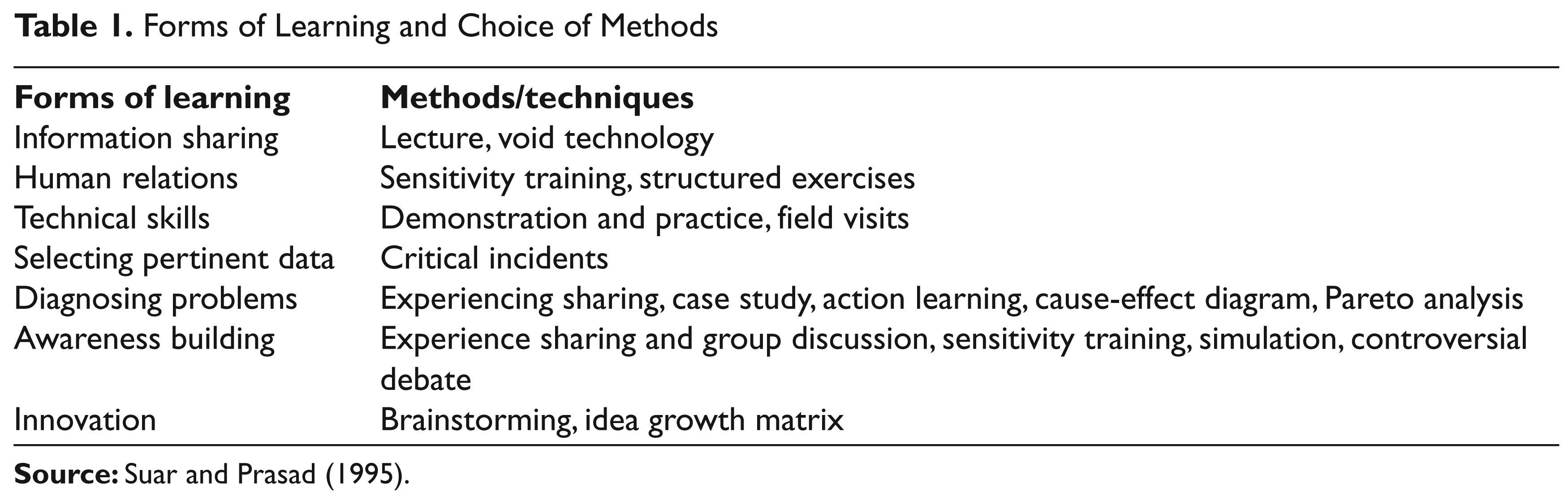
The teacher may adopt the method of lecture and video technology to disseminate information. If the topic deals with numerical problems, the teacher may use the more conventional method of teaching with the chalk and the blackboard because the mind of the learners will be stimulated to think as the teacher moves the chalk on the blackboard. To learn technical skills, demonstration and practice in the lab is necessary. The skill training can be mastered beyond the perfect performance to counter forgetting. Moreover, skill training provided needs to match with the skills currently used in industries. For example, if the machine maintenance of a particular variety or the democratic leadership is taught that is not currently practised in industries, the learner tends to forget it. If we do not use what we have learnt, we tend to forget that.
To meet the needs of growing number of students in higher education, competent teachers through videoconferencing mode can reach a large number of learners at a low cost. In such virtual reality, students can see and learn from reputed experts from their discipline. Such experts can address many students simultaneously in different physical locations where such facilities are available and students can learn in real time or in other time at their own pace. The course materials once taught can be recorded, uploaded in the net and updated depending on varied perspectives of learners and experts. Teachers can spend their time in developing contents and methods of teaching depending on the feedback of students, experts and their own experience. It is a learner-centred approach than an instructor-centred approach. Government of India has taken this initiative and courses are being developed to reach the students in different parts of the country.
Teachers in the beginning may be concerned about their ability to prepare and present bulky materials and give more workload. This leads to surface learning—memorizing, reproducing and keeping the learner within presented contents without acquiring new knowledge. As teachers grow in the profession, they want their kids like parents to be more and more independent of them. If they teach all of the discipline, students may soon forget most of it. Even if students remember, the discipline may change over time and what they remembered would no longer be useful. Even if the students remembered everything and the discipline did not change, students might end up reselling the known knowledge only (Kugel, 1993). If the students can learn independently without the teacher, they can visit corners of the discipline that their teacher had never visited, be challenged to create new knowledge. This depth learning occurs when the context is motivating, teacher is enthusiastic and the learner actively participates in assignments, projects and solves problems. The learner tries to see the pattern beyond what only she hears, reads and observes. R.L. Moore produced better research mathematicians than those from most prestigious institutions (Jones, 1977) but lectured less than two hours during three and half years. Students learnt from the teacher how to solve important problems. Higher education should make students independent learners and inspire them to put efforts purposefully to create new knowledge.
Assessment of Students and Teachers
Teachers need to ensure that the requisite number of examinations/tests (mid-term, end-term, quizzes and home assignments) are taken and the assessment of students is valid, fair, open and congruent with course objectives. The evaluations should be as objective as possible. It also depends on the type of questions. For example, in intellective type of questions used in thermodynamics or mechanics of engineering students, the questions can be posed in computers and the defined logical steps and answers can be evaluated using the software instantly because every question has a right answer and it follows defined steps to reach the solution. In judgmental type of questions in management or social sciences, similar software cannot be used because a question can have multiple answers depending on reflection and perspectives of learners. In such cases, the teacher may fix the parameters to evaluate the judgmental type of questions which are often difficult. Irrespective of the type of questions, the teacher may practice transparency showing the exam results to students and explaining the basis for marking to questions based on model answers. It convinces to students that the teacher is unbiased, authentic and trustworthy. The better it is if the examination results are known after a short time. The high academic achievers require immediate feedback on their examination performance compared to low academic achievers. Also, the feedback provides the scope to know where the student stands and accordingly she/he can make attempts to improve upon.
Like students, teachers too require candid feedback on their competency and responsibility for their continuous improvement. A questionnaire can be developed so that students can assess the teacher on a scale (Below average = 1, Average = 2, Above average = 3, Truly outstanding = 4) on subject competency (course structure and goals, knowledge in the subject area, stimulation of students’ interest, promotion of logical/reflective thinking, inclusion of recent developments with real life examples, etc.), pedagogy (clarity of presentation, use of teaching aids, pace of teaching, encouraging questions, etc.), assessment (quality of evaluation, quality and quantity of assignments and tutorials, prompt and detailed feedback, etc.) and behaviour (helping in the course work, availability outside the class, seeking students’ participation in learning, friendly, enthusiastic towards the subject, etc).
Respect to Students, Parents, Colleagues and the Surrounding Community
Respect to students, parents, colleagues and members of communities bring respect to teachers. Respect can be extrinsic, symbolic and intrinsic. The inner respect transfers to external etiquettes.
A teacher can be a patient listener as well as an exciting speaker. However, some teachers talk about the negative aspects of their colleagues. Most of their time is spent on such gossips which can be otherwise spent in reading, writing and carrying out research. This happens because of the personal insecurity and the desire to show superiority over colleagues. Teachers can refrain from such saying if respect is to be earned from others.
Treating the colleagues as equal, capitalizing on their strength, respecting the different approaches to teaching, providing support to each other, particularly those who are new to the profession and working cooperatively with them are the steps towards the development of a healthy academic culture. Respect to junior teachers in words and deeds, sharing knowledge and expertise with them in collaborative context, using appropriate forums for constructive debate on professional matters and supporting them will promote a conducive ‘developmental academic culture’.
When new teachers join the profession, they experience anxiety and insecurity in a new environment and in the new roles and responsibilities. They feel attracted to other colleagues who provide support, suggestion and protection to them. They establish interpersonal relations with such colleagues. Sometimes, such colleagues may turn out to be either incompetent, against the administration or powerful politicians. They may influence the new teachers accordingly, turn the new teachers’ vision, optimism and vigour to pessimism, lethargy and make them instruments against the administration. Ultimately, the professional merits of new teachers are drained out and they suffer academically, interpersonally, and finally become the dead load on the college. Hence, new teachers can establish social bonds knowing other teachers fully for their personal and professional progress.
Right to Leave, Remuneration and Facilities
With five-day working week, long summer holidays of about two months and with about 20 days of national holidays in a year, a faculty member can avail earned leave and medical leave depending on accumulation of previous leaves and long leaves (six months or more) for professional development after five years of continuous service. In addition, a faculty member can avail casual leave of eight days in a calendar year, special casual leave of 15 days for outside work and duty leave of 15 days in an academic year for attending seminars, conferences and workshops in India or abroad. The teacher can even avail leave of four days per month for the project(s) undertaken. The special casual, duty and project leaves should not exceed 15 days in a semester (IIT Kharagpur, 2010). Taking excessive leave during the semester hampers the regular schedule of the classes and the teacher may not cover the course contents. Teachers need not take advantage of leave rules as long as leave rules conform to their rights and do not deter their duties.
Teaching profession provides enough scope for freedom, flexibility, innovation and service. A teacher should avoid over-pricing of his/her services in terms of pay and perks that the state or the college cannot afford.
Professional Conduct
Integrity, optimism, inspiring, humility, caring, patience and forward looking are virtues of teachers. Integrity goes with honesty, trustworthiness, sincerity, responsibility, character, morality and obedience to laws. Teachers having integrity demonstrate consistency between saying and doing in course coverage, timing and grading system. They have respect for themselves and others. They make themselves accountable for their actions and decisions, do not manipulate neither students and college authorities nor parents and surrounding communities for personal or financial gains and refrain from unethical behaviour. They obey the guidelines and norms of the profession.
Wasting office hour indulging in non-professional activities is not a good option. Teachers should not go for smoking, drinking, merry-making and similar such activities within the working hours. They should not involve in sexual harassment, financial corruption, cultism and examination malpractices; should not give corporal punishment to students, influence students ideologically and maintain confidentiality when discussing work place issues. Teachers know the ins and outs of the college where they serve, therefore, should project the college accurately without undue boosting. Beyond the academic activities, teachers can organize students and guide for games, sports, dance, drama and other extra-curricular activities.
Teachers also face professional dilemmas. Teachers are supposed to describe parents about the students’ bad results and behaviour. They hesitate to tell the full truth because they think the parents will be disappointed and become aggressive against their wards. Similarly, teachers cut corners in telling the students about their shortcomings. Consequently, teachers are haunted by a bad conscience for not telling the truth.
Some teachers when distribute their time, efforts and attention to students, they seem to apply the principle of differential allocation. They give most help to those who need it. They become liberal in their judgments on issues of selection, guidance and remedial action to students from disadvantaged groups—lower castes, tribe status, women, poor, physically challenged—that do not apply to advantaged groups. Contrarily, in situations where students are punished for disciplinary action, teachers apply the principle of equal treatment. In such situations, teachers do not know whether all students who break the rule are equally responsible.
Ethics in the Context of the Student
Students’ Development
Knowing the individual differences, teachers should not discriminate learners on the basis of caste, economic status and gender, college grades and cater to needs of all so that each student develops. Jackson, Boostrom and Hansen (1993, p. 233) mention:
Teachers are expected to be kind and considerate, yet demanding and stern as the situation requires. They must be responsive to the needs of the individual pupil, without neglecting the class as a whole. They are expected to maintain discipline and order, while allowing for spontaneity and caprice.
Avoidance of Dual Relationships
Helping the students outside the classrooms, mentoring and monitoring their academic and non-academic progress and counselling them in stress and anxiety are the professional roles of a teacher. If the teacher establishes the relations with students as a husband/wife, son/daughter, brother/sister, etc., it may detract their development and may lead to the teacher’s real/perceived favouritism to students.
Dealing with Sensitive Topics
Students find them in an awkward position when topics like AIDS, pre-marital sex, addiction to TV, computer games and net-surfing, smoking and alcoholism are discussed. The teacher can deal with such topics in an open, honest and impartial way.
Ethics in the Context of the Parents
Parents passing the buck of their wards to teachers may come up with numerous problems. The teachers using their wisdom can convince the parents, give the honest appraisal of students to the extent possible and their activities so that the parents can be change agents in life of their wards, if the situation so demands. Some students involve in smoking frequently, abusing substance regularly, watching TV excessively, surfing the internet excessively, loitering with girlfriends and creating mischief in hostels. They become frustrated and aggressive and show superiority on others to hide their inferiority complex. The students, teachers and parents can discuss such deviant behaviour and find out the root causes of problems and means to regulate the behaviour before it is too late. Severe deviant cases of the students that cannot be sorted out through counselling of teachers and guidance of parents and friends can be referred to experts.
Ethics in the Context of the Community
Participating in social and public life of communities surrounding the educational institutions, teachers can understand the reality, educate the people and look to their welfare. Teachers as well as students can participate in National Service Scheme (NSS) to develop surrounding communities. They can create awareness about social evils, natural environment, facilitate the education of children, demonstrate improved agricultural practices, initiate income-generating activities, etc. This would provide scope to display students’ natural talents, improve leadership qualities, develop their personality and sensitize them to the grass-roots realities. If the teachers and students do not involve in development of the community, people around may show apathy towards the college. The college has taken the land, students, faculty and other resources from the local area. It is the duty of the college to repay some of its debts made from the local area and the community.
Here we have derived the information on ethics in teaching based on personal experiences and reflection. The author has consulted a few teachers who feel the same way. The discussions made here are experiential voices. Wherever empirical evidence is provided, a specific context, course or institute is considered. Therefore, caution must be exercised in generalizing the evidence. Though the ethics in teaching are dealt in four contexts—teachers, students, parents and community—they are not mutually exclusive rather overlapping. For example, ethics in the contexts of teachers and students overlap to a great extent. We have used both descriptive and prescriptive approach. The latter approach incorporates what to do so that the teachers in higher education can follow the norms and serve the students, parents and the community.