






Abstract
In the process of transitioning from closed to open innovation, regions in developing countries need to understand how to choose the most effective path within the complex innovation system while considering their own innovation factors. Based on provincial panel data from China’s high-tech industry and the improved dynamic threshold model, we introduce the threshold of knowledge accumulation (KLA) into the non-linear mechanism between innovation paths and innovation performance to compare the dynamic threshold effect and its heterogeneity. This research provides interesting insights into innovation paths, showing that the relationship between the innovation path and innovation performance is significantly influenced by the threshold effect of KLA. As the level of KLA strengthens, its effects on each innovation path change. Overall, this article shows how KLA affects the relationship between the innovation path and innovation performance. The article concludes with a discussion of the implications of these insights for innovation management and policy.
Introduction
Innovation is a complex, changeable process, and the sources of regional innovation are diverse. Thus, we should clarify that extensive innovative resources and capacity are required for the innovation process, along with the development and integration of knowledge (Nerkar & Paruchuri, 2005). Innovation not only involves selecting an innovation path but also includes complex changes in relationships, such as the effects of changes in technical route on regional innovation resources. Different technology acquisition modes affect innovation performance in different ways (Cassiman & Veugelers, 2006), and the use of existing knowledge sources is essential to innovation (Murovec & Prodan, 2009).
Because most regions in developing countries lack the necessary innovation resources, technology transfer and introduction as well as technology spillover are considered to be their primary sources of technological innovation (Sun & Du, 2010). However, such regions also seek to rely on endogenous R&D to generate independent technological innovation activities (Sun, 2002). For a long period of time, the traditional closed innovation model played an important role in innovation activities, which are primarily attributed to the ‘virtuous cycle’ of internal R&D (IRD). However, in China, given the knowledge diffusion and the speed of technology spillover among regions, the technology life cycle is shortening, and the risk of relying solely on R&D has increased. Profound changes have occurred in the allocation of regional innovation resources, and the virtuous cycle has gradually broken. Particularly in central and western China, technological innovation has begun to actively seek and mobilise external resources to supplement the lack of IRD and to explore a new innovation paradigm: open innovation. Accordingly, ‘External Knowledge Sourcing’ refers to a region creating and acquiring knowledge through external cooperation to produce a new knowledge flow to accumulate and update its knowledge stock (Lin & Wu, 2010). In addition, cooperating with enterprises, universities and research institutes with technical advantages among regions, including cooperative R&D, R&D outsourcing and commissioned technology development, can achieve innovation transformation (Minin, Frattini, & Piccaluga, 2010). Moreover, traditional innovation regards R&D as the main (or only) form of innovation, largely ignoring a number of diverse non-R&D (NRD) innovation activities (Arundel, Bordoy, & Kanerva, 2008). In fact, in China, there are a variety of NRD inputs in most of the leading and strategic areas in technological innovation, including technical renovation, acquisition of foreign technology, assimilation and the purchase of domestic technology among regions (Xie & Huang, 2015). According to the National Bureau of Statistics of China, the proportion of NRD investment and R&D expenditure was 22.25 per cent (2014), lower by 15.17 per cent, and NRD innovation has long been ignored. However, NRD innovation plays an important role in innovation development. Under certain conditions, it is even favourable to R&D. Thus, such innovation has a significant impact on Chinese regional innovation. As the most active field for China’s technological innovation activities, the high-tech industry plays a significant role in regional innovation transformation, economic growth and sustainable development, and has many characteristics, such as rapid technological change, large investment in R&D, and greater technology spillover which is defined as a knowledge-and-technology intensive economic entity, including sectors of medicines, aircrafts and space crafts, electronic and communication equipment, computers and office equipment, and medical and measuring instrument. Therefore, our analysis is based on panel data for China’s high-tech industry of thirty provinces over the decade 2005–2014, aims to systematically describe the structure of this neglected innovation path, to analyse whether IRD, external R&D (ERD) or NRD is more conducive to promoting innovation performance and give a better understanding of how the condition and characteristics of industrial innovation resources will affect the effective path choice for regional innovation.
This study attempts to fill several research gaps. First, prior studies essentially ignore the study of the NRD innovation path in developing countries, especially in regional heterogeneity. In contrast, we explicitly analyse whether NRD innovation in China is effective, and using a data set at the regional level thus our insights is more related to regional policy rather than at the firm level, which lead to a better understanding of the driving force, realising path and policy design for regional innovation. Second, most studies fail to provide a clear framework and structure for the diversified innovation path, which causes confusion in subsequent research. Therefore, we clearly describe the structure of the possible regional innovation paths in China. Third, ignoring the dynamic continuity of innovation and the important threshold factors of KLA results in biased estimations in assessing the link between innovation paths and innovation performance. We improve the traditional static non-linear model by constructing a non-linear dynamic threshold model. Then, we introduce the threshold factor of KLA into the complex mechanism that links the innovation path and innovation performance to compare the dynamic threshold effect and the temporal and spatial heterogeneity of KLA for each innovation path. This research provides new evidence for the implications of the innovation path and facilitates a better understanding of the innovation-driven effect and its regional differences.
Literature Review
Traditional R&D is a major innovation path representing closed innovation. Scholars generally believe that traditional R&D is one of the most important factors in technological innovation. R&D activity plays a key role in the process of innovation (Hall, Lotti, & Mairesse, 2013). IRD represents the internal source of knowledge (Lin & Wu, 2010); most scholars have highlighted the necessity and significance of IRD innovation from different angles and believe that the technological capability mainly comes from their IRD activities. Because these can effectively promote national technology development and enhance a country’s technological strength, there is thus a positive correlation between IRD and innovation performance (Vega-Jurado, Gutiérrez-Gracia, & Fernández-de-Lucio, 2009; Yam, Lo, Tang, & Lau, 2011). Although most studies had originally shown that R&D improves innovation performance, with the deepening of the research, it was found that the impact of R&D on innovation performance is uncertain; in some cases, there may be an insignificant or even a negative correlation. It was found that R&D investment is not more conducive to improving enterprise performance than other forms of investment expenditure (Bottazzi, Dosi, Lippi, Pammolli, & Riccaboni, 2001). In addition, consistent with the law of diminishing marginal returns, it is not a case of the more the better (Braunerhjelm, Acs, Audretsch, & Carlsson, 2010; Dosi, Llerena, & Labini, 2006; Ejermo, Kander, & Svensson Henning, 2011).
Due to a series of rapid changes in the configuration of innovative resources and the environment of technological activities, scholars have begun to focus attention on external sourcing and NRD innovation. Most scholars believe that external knowledge sourcing under open innovation is one of the main paths by which regional industry pursues innovation growth (Wu, 2012). Open innovation is a new approach of innovation management that has modified IRD suppositions to ERD cooperation (Khosropour, Feizi, Tabaeean, & Taheri, 2015). Particularly in China, foreign technical cooperation has had positive impacts on energy industry performance, which are more obvious in the country’s developed eastern regions (Liu, Xu, Yang, Zhao, & Xing, 2016). Based on provincial panel data for China, Li and Zhou (2015) show that ERD can improve regional innovation. However, unlike most studies, De Man and Duysters (2005) find that there are positive, negative and neutral effects of the enterprise’s external cooperation on innovation performance. Specifically, the failure rate of cooperative R&D is higher (Nieto & Santamaría, 2007). Indeed, external cooperation with competitors or institutions has a negative impact on innovation performance (Caloghirou, Kastelli, & Tsakanikas, 2004). Another study suggests that there is an inverted U-shaped relationship between external knowledge resources and innovation performance, meaning that a threshold is created by a critical point (Berchicci, 2013; Laursen & Salter, 2006). Based on the innovation ability of different regions in China, the effect of internal and ERD on regional innovation may be complementary to varying degrees but may also substitute for each other (Liu, Xuan, & Chi, 2015).
In fact, beyond external or IRD, the traditional innovation path often ignores a variety of NRD innovations. Most studies consider the concept of NRD innovation to primarily include innovative investment, design, patents and licensing, marketing, human resources and external resources (Santamaría, Nieto, & Barge-Gil, 2009). Subsequently, the OECD (2002) established basic principles to distinguish between R&D activities and NRD activities: When there is novelty or uncertainty in science or technology, R&D activity is involved, or NRD activities. Specifically, ‘NRD innovation activities’ refers to innovative or innovation-related activities that do not involve R&D or R&D-related activities (Zheng, Liu, Xu, & Peng, 2014). Therefore, from the perspective of innovation input, NRD innovation refers to a variety of innovation types in addition to R&D, whereby the innovation source is primarily existing knowledge or an external resource as opposed to systematic R&D. Considering the impact of NRD, Santamaría et al. (2009) demonstrate that it has a significant effect on innovation. Other scholars such as Barge-Gil, Jesús Nieto and Santamaría (2011), and Hervas-Oliver, Albors Garrigos and Gil-Pechuan (2011) also reach a similar conclusion. In China, J. Chen and Y. F. Chen (2009) first proposed that Chinese regional innovation investment included technology introduction, digestion, absorption and transformation as well as other NRD expenditures and revealed the significant role these factors play in the development of the regional innovation system. A cross-region empirical study on Chinese high-tech innovation showed that it is the intertwined efforts of the R&D and NRD technological innovation inputs that eventually result in the final technological innovation outcomes (Guan & Chen, 2010). Technology import in open innovation overall has no significant influence on fostering innovations, but it is significantly positive for coastal regions (Yang & Lin, 2012). Considering technology diversification, Du, Lu and Guo (2015) also find that identification and acquisition, assimilation and absorption, and transformation and exploitation have significant positive effect on technological innovation performance. Xie and Huang (2015) show that the impact of NRD innovation on the innovation performance of the high-tech industry in China’s provinces has both a ‘promotion effect’ and a ‘substitution effect’.
Different types of innovation paths affect innovation performance in different ways, and there is still no exact answer as to what type of path should be taken. The concept of a development threshold as proposed by Blomström and Sjöholm (1999) provides a relatively practical idea. A threshold means that the choice of innovation path must be consistent with the technical ability: the knowledge stock determines innovation ability (Glass & Saggi, 2002; Putranto, Stewart, & Moore, 2003). In turn, a strong knowledge base allows the extension of technological capabilities and increases the odds of developing and realising new products (Becker & Dietz, 2004). In China, although the basic innovation funding is increasing, over the past 20 years, the country’s innovation intensity has been maintained at a low level of equilibrium. This phenomenon indicates that low KLA in China is closely related to the low intensity of investment in science and technology (Xu & Zhou, 2008). Improving the level of KLA will promote the development of China’s endogenous innovation (Chen & Hou, 2016). However, KLA is not always beneficial. The core rigidity caused by KLA may result in path dependence with respect to regional development, which is not conducive to innovation (Leonard-Barton, 1992). In addition, Haas and Hansen (2005) believe that the accumulation of coding knowledge is harmful to a team with high task experience.
Methodology and Model
Based on the theoretical framework of the mechanism of the innovation path and the development threshold of KLA, we note that any selected innovation path must correspond to the technical development level. Only on a foundation of certain KLA can an industry effectively meet the needs of the innovation path. Thus, there may be a threshold effect of the innovation path. That is, when an economic parameter reaches a certain value, it causes another economic parameter to suddenly turn to other forms of development. The critical value at the root of this phenomenon is termed the threshold value, which is also known as the problem of non-linear structural change. From a methodological perspective, it is necessary to test samples on both sides of the critical value of KLA. However, the traditional grouping method simply uses average samples based on a certain standard. The results obtained by this test can only reflect the impact of various factors with difficulty. Consequently, the threshold regression model is used to expand the grouping test method. To examine if this significant non-linear relationship exists, Hansen (2000) first proposed the idea of a static panel threshold regression model, which endogenously searches for the ‘critical value’, tests significance and authenticity according to the characteristics of the sample data, and avoids the deviation of subjective grouping and cross-term estimations. Most previous studies use this mathematical model. However, this threshold method is only applicable to the non-dynamic panel model; it cannot reflect dynamic change or the lag effect of the sample object, and it also ignores the processing of endogenous variables. Thus, its application field cannot be extended.
To resolve the aforementioned issues, this article adds the lag variable to control the lag effect and includes dynamic factors based on the dynamic panel estimation method (Ho, 2006). Then, according to the development of the dynamic panel estimation method, we first estimate the dynamic panel threshold using the Hansen method and further use the ‘first-order difference GMM’ (Arellano & Bond, 1991) to explore the effect coefficients and the difference between different threshold intervals.
Next, we clearly summarise the structure of the innovation path in China and construct the research framework in Figure 1.
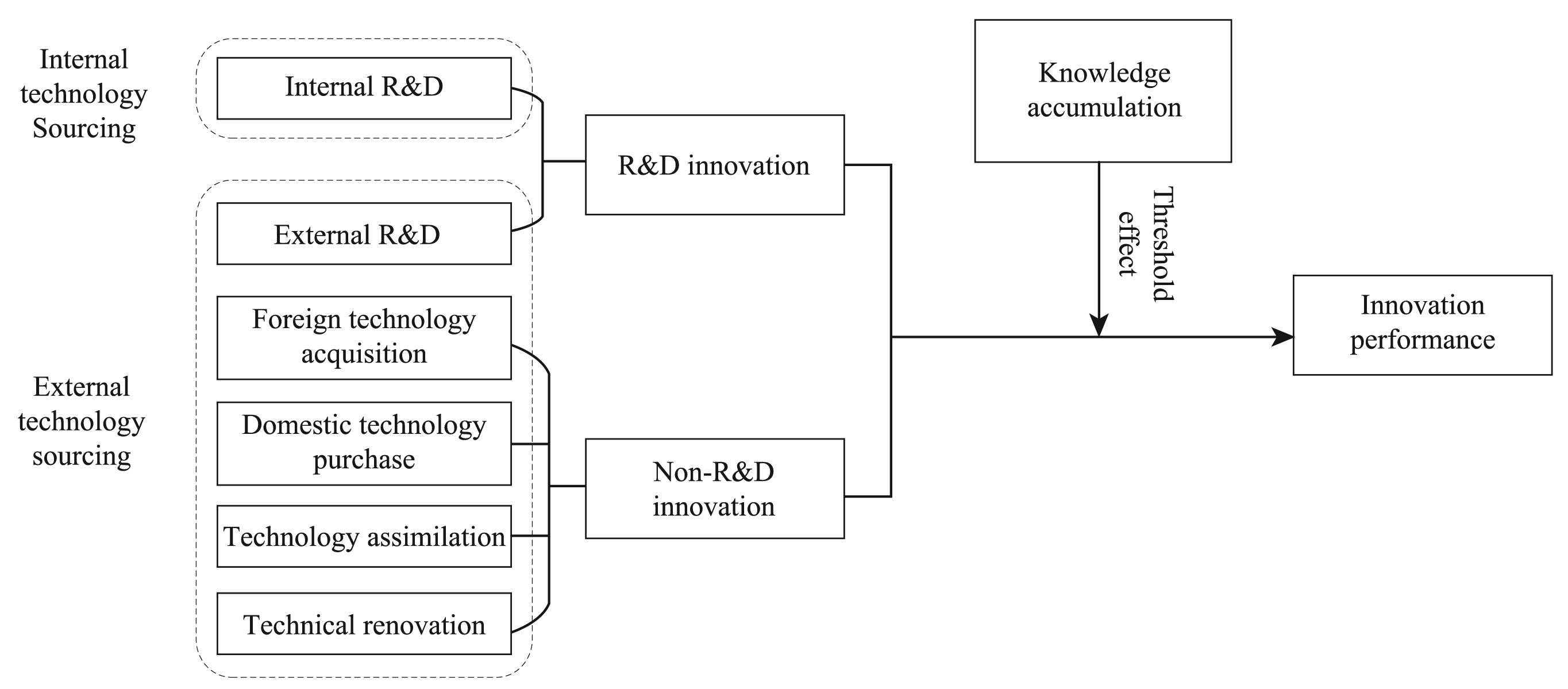
To a certain degree, the entire driving system and the role of KLA are specific to regional innovation, not only in developed countries but also in China. The structure (Figure 1) created by modelling the actual innovation produced in most regions of China and consistent with reports and limited data published by the Chinese government.
In the process of regional innovation development, local governments in China have played a major role in innovation activities and policy arrangements. To solve a series of problems and contradictions in China’s economic growth and speed up China’s establishment as an innovative country (under the guidance of national strategic policies, such as the Innovation-Driven Development Strategy, Made in China 2025 and the Five-Year Plan), regional governments directly support a large number of IRD projects. Thus, regions conduct substantial internal technology sourcing for endogenous innovation. However, prior to the promotion of these various strategies, because of the underdevelopment of the regional technology base, most areas, particularly in the eastern region, have narrowed the technical gap with developed countries in the short term by unprecedented technological introduction and external cooperation. This practice has resulted in an awkward situation in China, which stems from a lack of core technologies with independent property rights. Subsequently, as previously mentioned, with the profound changes in the innovation pattern, the technology and resources required for innovation are becoming more dispersed. It is becoming increasingly difficult to perform IRD. Therefore, regional innovation still conducts a considerable proportion of external technology sourcing.
Therefore, first, from the perspective of technology sourcing, we divide the innovation path into R&D and NRD based on the degree of participation in R&D and the characteristics of innovation activities in China. R&D comprises IRD and ERD (Cho & Yu, 2000; Liu et al., 2015). The former is the main source of internal technology. The latter is primarily cooperative R&D and expressed as ERD expenditure. NRD in China includes the acquisition of foreign technology, the assimilation of technology, the purchase of domestic technology and technical renovation, all of which belong to external technology sourcing (Xie & Huang, 2015). Accordingly, we take IRD, ERD and NRD as the innovation paths of this article.
Second, we improve the Griliches-Jaffe knowledge function and express it in the Cobb–Douglas form:

where Y is innovative performance, IRD is internal R&D, ERD is external R&D, NRD is non-R&D, α, β and γ are output elastic coefficients, and ε is random error.
As indicated by the research on the factors of innovation in developing countries (Horta, Camanho, & Moreira da Costa, 2012; Wang & Kafouros, 2009), innovation is a complex process. Considering the factors affecting innovation performance in addition to IRD, ERD and NRD, R&D personnel also provide the foundation and make it possible for industry to conduct technological innovation, which will directly affect its innovation ability. When moving from closed to open innovation, China’s high-tech industry has been more focused on foreign trade; thus, the industry’s export ratio has a great impact on innovation performance (Rasiah, Shahrivar, & Yap, 2016). The regional enterprise scale and the degree of market competition are also important factors that must be controlled. In addition, it is clear that knowledge flow and the current and future R&D activities seriously depend on the stock of KLA. As an important input factor in the process of innovation, KLA reflects the development potential of technological innovation, and it is also the basis for measuring innovation performance. Thus, we build the innovation performance model:

where i is the number of China’s province, i = 1, 2, … 30. t is the number of year, t = 1, 2 … 10. RDH is R&D personnel input, EXR is regional export ratio, SIZE is regional enterprise scale and KLA is knowledge accumulation.
On the basis of formula (2), we further introduce the Yit–1 variable to control the dynamic process of innovation and its inertia. Meanwhile, considering that there is a certain time lag for the relevant input variables, we introduce the corresponding lag data calculation.
Finally, taking into account the threshold of KLA in developing countries, we build a dynamic threshold panel model with the three innovation paths of IRD, ERD and NRD as follows:



In the aforementioned formulas, I(•) is the indicator function; KLAit is the threshold variable; γ is the threshold variable value; μi is a specific effect of the individual; υt is a specific effect of time; and εit is a random disturbance.
Then, if there is more than one threshold in the test, we construct a dynamic multi-threshold panel model with three innovation paths (double threshold as an example) as follows:



where γ1 and γ2 are the double threshold values, and the other signs are the same as in Equations (3)–(5).
Variables and Data
Dependent Variable
Innovation performance (Y)
The measurement of innovation performance primarily comprises patent applications and new product output (Bronzini & Piselli, 2016). Considering that this article primarily reflects the final commercial value of innovation, regional new product sales revenue directly indicates the gains from innovation activities, which is the dominant indicator used to measure innovation performance and represent the level of commercialisation of innovation results. Therefore, we choose the new product sales revenue of the regional high-tech industry in China as a proxy for innovation performance (Wang & Kafouros, 2009).
Independent Variables: Innovation Paths
Internal R&D (IRD)
IRD is one of the most important and basic paths for innovation, and its size and strength are the main indexes for measuring innovation ability. We consider the actual situation of China’s high-tech industry: first, there is a certain lag between R&D input and final innovation output, and second, early investment in R&D will affect the current input. Therefore, we take a one-period lag, and further estimate the regional IRD capital stock using the perpetual inventory method (Cruz-Cázares, Bayona-Sáez, & García-Marco, 2013; Hong, Feng, Wu, & Wang, 2016).
External R&D (ERD)
Based on the concept of a knowledge source (Lin & Wu, 2010), an external knowledge sourcing strategy is one way for industries to acquire knowledge and develop new technologies through cooperation with external organisations (Cassiman & Veugelers, 2002). External knowledge sourcing primarily measures R&D costs, including cooperation expenses paid by the industry to external organisations such as enterprises, universities and research institutes (Carayannopoulos & Auster, 2010; Vega-Jurado et al., 2009). Thus, we use regional ERD stock (one-period lag) to represent the degree of external knowledge sourcing.
Non-R&D (NRD)
Open innovation is a complex and changeable process. In addition to IRD and ERD, there are also many NRD activities that have great influence on innovation (Hervas-Oliver et al., 2011). According to the actual characteristics of China’s high-tech industry, we use various ‘regional expenditures on NRD’ (Xie & Huang, 2015), including ‘expenditure for the acquisition of foreign technology’, ‘expenditure for the assimilation of technology’, ‘expenditure for the purchase of domestic technology’ and ‘expenditure for technical renovation’. All of these are used to estimate NRD stock (one-period lag).
Threshold Variable
Knowledge accumulation (KLA)
The innovation path depends on the threshold level of KLA (Glass & Saggi, 2002; Putranto et al., 2003). In the process of knowledge production, knowledge is accumulated based on the total amount of knowledge resources in the industrial system or in the early stage R&D. A patent on behalf of intellectual property rights is the main source of technical information. Patent application data are relatively easy to obtain and are rarely subject to the interference of authorised agencies and, thus, can objectively reflect the flow of technology accumulation. Referencing Ang’s (2011) approach, we use the t-period stock of the number of patent applications in the region as a proxy indicator.
Control Variables
R&D human capital (RDH)
Human resources are one of the basic elements of the knowledge production function. In particular, R&D human capital (RDH) provides fundamental support for industry innovation, including applied innovation, product innovation and process innovation. In this article, RDH is measured by ‘regional full-time R&D personnel’ (one-period lag).
Regional export ratio (EXP)
International trade is one of the main channels of knowledge flow. At present, many innovation studies treat exports as an important indicator, as it is generally believed that the export trade can promote knowledge transfer at home and abroad. Exports are beneficial to improving innovation performance, especially in the high-tech industry. We use the ratio of the export delivery value to the total output value in the region as a proxy indicator.
Regional enterprise scale (SIZE)
Enterprise scale is one of the most common innovation factors used by scholars. A larger scale enterprise is more likely to have sufficient funds and infrastructure to support innovation. In contrast, a smaller enterprise scale may accompany a stronger innovation sense, a faster reaction, and increased investment in innovation (Horta et al., 2012). In this article, we measure the average size of the companies in the region by the ratio of its total output value to the number of enterprises.
Data Sources and Processing
The database of this article is province-level panel data for 2005–2014. Due to a lack of data, we exclude the Special Administrative Region of Tibet, Hong Kong and Macao, select thirty provinces for the sample. All of the data used in this study are obtained from the China Statistical Yearbook on High Technology Industry and China Statistical Yearbook 2006–2015. 1 Specifically, new product sales revenue, internal and external expenditure on R&D, expenditures on NRD, patent applications, R&D personnel full-time equivalents, export delivery value, total output value and the number of high-tech enterprises are collected from the China Statistical Yearbook on High Technology Industry. The producer price index (PPI), consumer price index (CPI), GDP index and price indices of investment in fixed assets are drawn from the China Statistical Yearbook. We perform log processing for all variables except for EXP and SIZE. 2 Database processing and analysis were performed using Stata 12.0. Table 1 presents the descriptive statistics of the variables in the model.
Given the influence of price factors on IRD and ERD expenditures, we convert the nominal value of R&D expenditures to the actual value using a ‘price index for R&D’, that is, the weighted average of the CPI and the fixed-asset investment price index, with the weights estimated to be 0.55 and 0.45, respectively, based on data from the China Statistical Yearbook on High Technology Industry. The various NRD expenditures are weighted with the same period GDP index, and the new product sales revenue and the total output value are weighted with the corresponding PPI; the base period is 2005.
For KLA estimates, we use the period t stock of the number of patent applications by the perpetual inventory method. The calculation formula is adopted here:

Descriptive Statistics of Variables
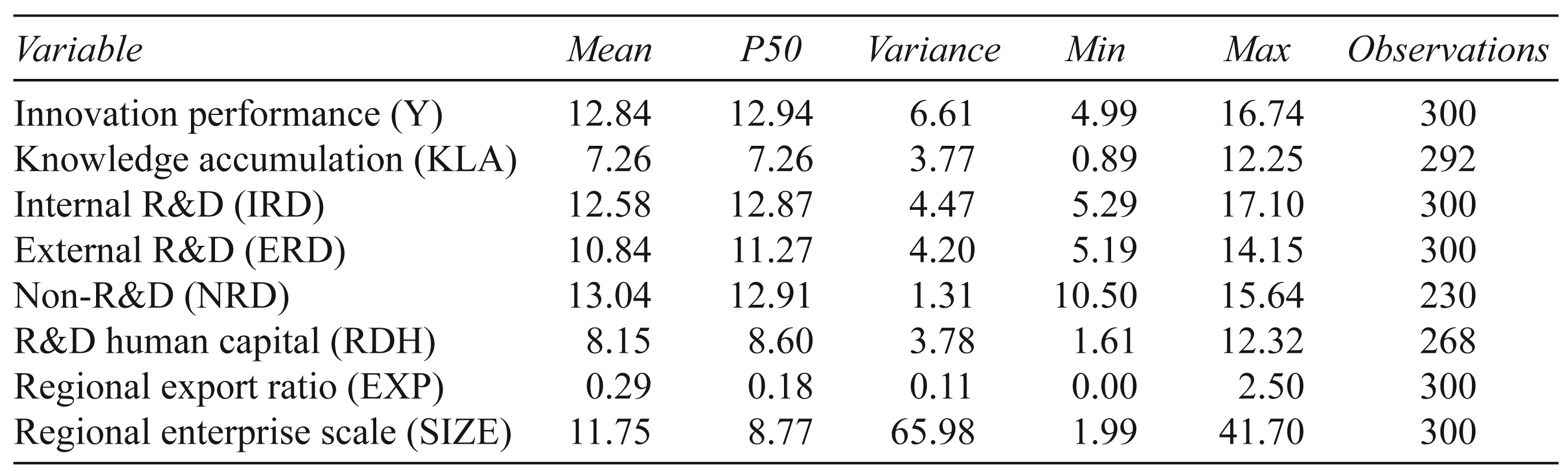
where KLAit is the knowledge accumulation of period t in area i, and ΔKLAit is the patent applications of period t in area i, Following the existing research experience, it is assumed that δ = 15 per cent.
Next, the base period KLA stock can be estimated by the following formula:

where KLAi0 is the knowledge accumulation in area i in 2005, and ΔKLAi0 is the patent applications in area i in 2005. gi is the annual growth rate of patent applications in area i 2005–2014.
As mentioned previously, it is necessary to calculate the stock of expenditures on R&D and NRD. The estimates approach is consistent with KLA.
Results and Discussion
Empirical Results
In this article, we take the threshold of KLA in China as the critical point and construct three types of innovation paths: IRD, ERD and NRD. We then use dynamic panel threshold estimation, which includes a lag variable, to conduct empirical tests and a comparative analysis.
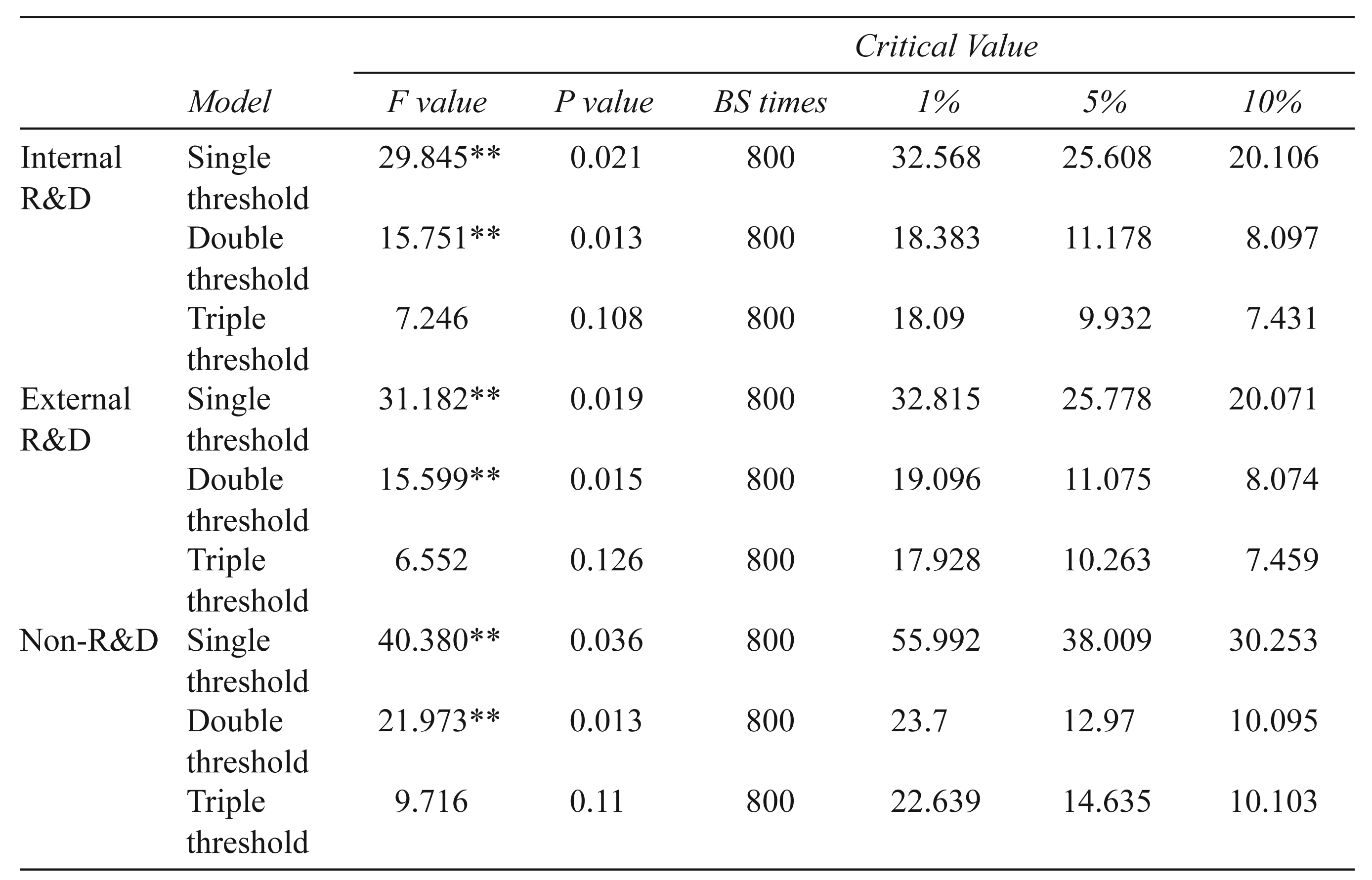
First, we need to estimate the number of thresholds to determine the form of the model. We test models (3), (4) and (5) in turn under the conditions of zero thresholds, one threshold and more. Then, the F statistic and P value are obtained by the ‘self-sampling method’ and are shown in Tables 2 and 3. For the IRD path, the F value of the double threshold is 15.751, and the P value is significant at the 5 per cent level. For ERD, the F value of the double threshold is 15.599, and the P value is significant at the 5 per cent level. The F value of the double threshold is 21.973 in NRD, and its P value is also significant at the 5 per cent level.
Threshold Significance Test
***p < 0.01; **p < 0.05; *p < 0.1.
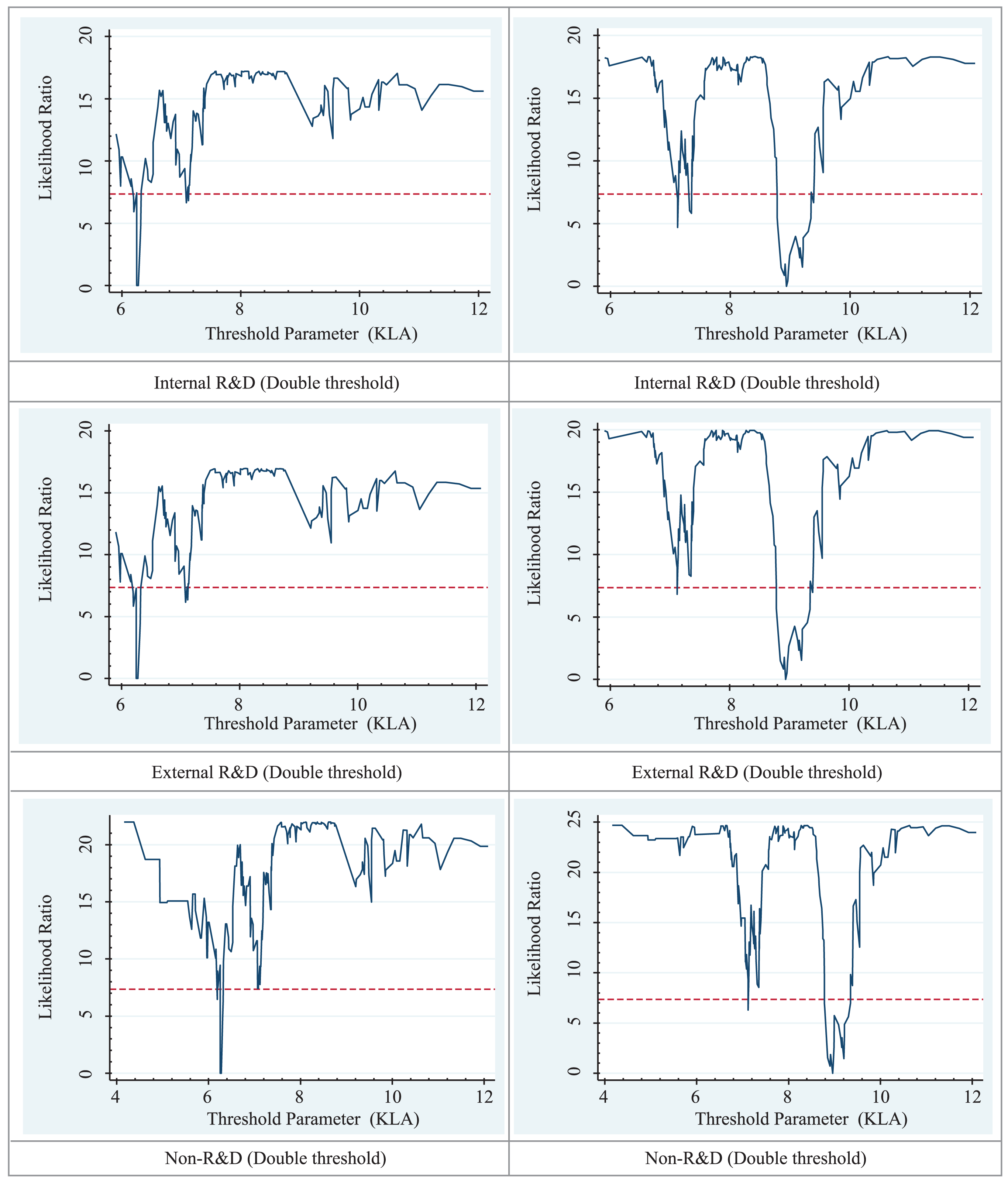
According to the improved dynamic threshold theory, the effects of IRD, ERD and NRD on innovation performance include a significant double threshold for KLA, and their confidence intervals are shown in Table 3. Take the IRD for example: the threshold values are 6.264 and 8.939, which are in the 95 per cent confidence intervals [6.196, 7.122] and [7.112, 9.393], respectively. Therefore, the sample can be divided into a low level of KLA (KLA ≤ 6.264), a medium level of KLA (6.264 < KLA ≤ 8.939) and a high level of KLA (KLA > 8.939).
The test results clearly show that the effect of KLA on the relationship between the innovation path and innovation performance is appropriate for estimating the threshold effect. Specifically, IRD, ERD and NRD are suitable for the double threshold test. The function trend chart of the threshold variable ‘likelihood ratio’ sequence with the well-defined change of threshold value shows the structure of the estimate and the confidence interval (Figure 2).
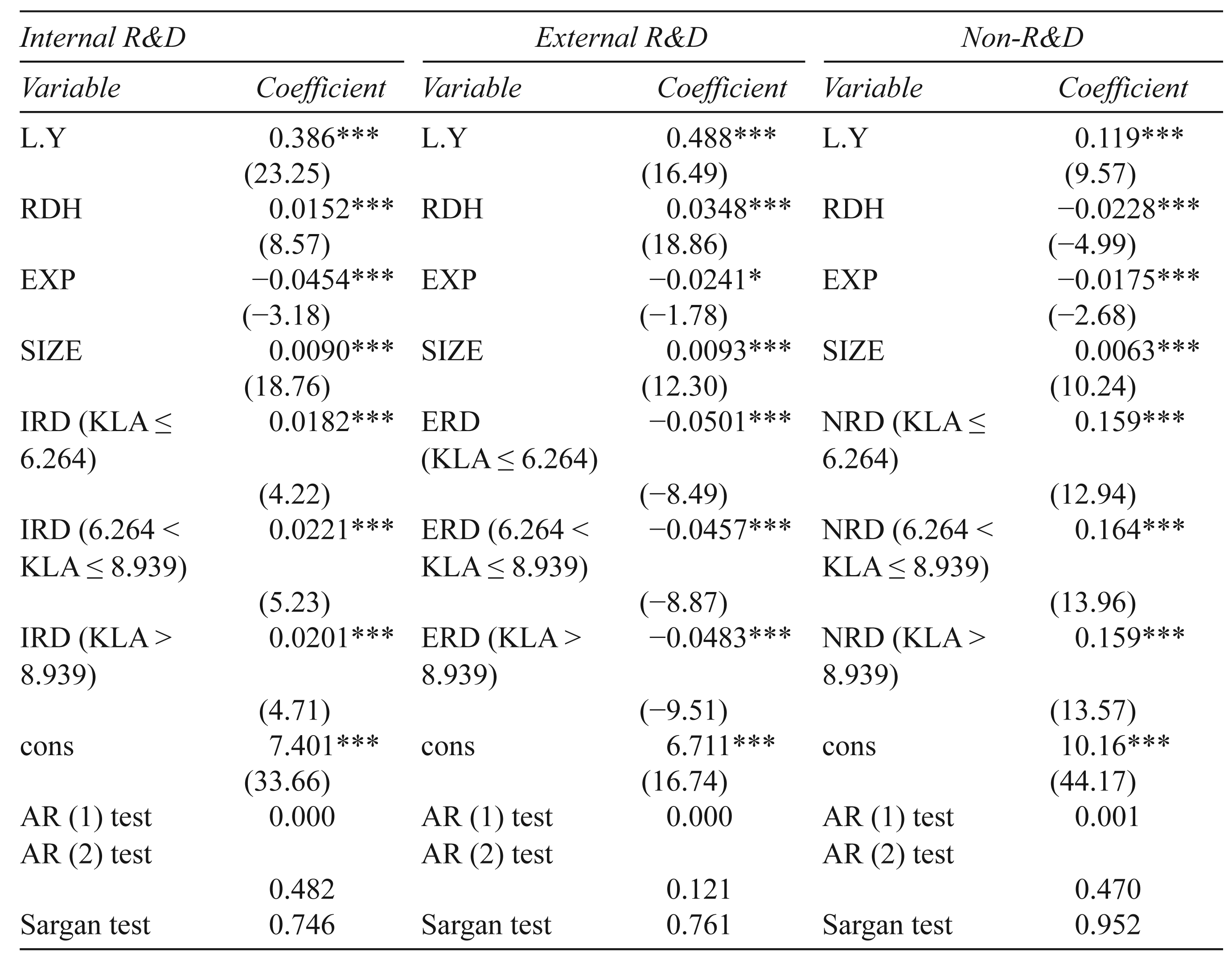
Second, we make a concrete analysis of these threshold effects. After estimating the threshold value, all samples are divided into different intervals; then, we further use the first-order difference GMM to estimate the partition coefficient and compare different paths with different interval coefficients. Table 4 shows the estimation results.
As shown in Table 4, when the threshold of KLA is lower than 6.264, IRD and NRD play a significant role in promoting innovation performance. When the threshold is between 6.264 and 8.939, the positive effects of IRD and NRD on innovation performance are enhanced, and the significance level also at the 1 per cent level, indicating that strengthening IRD and NRD at this threshold level provides the greatest improvement to innovation performance. Interestingly, when the threshold value is higher than 8.939, the positive impacts of IRD and NRD on innovation performance appear to be lower, returning to their earlier level before the threshold. Statistically speaking, this result presents a significant threshold effect. For ERD, when the threshold level of KLA is lower than 6.264, the negative effect of ERD is larger. As the threshold level of KLA rises, the negative effect of ERD on innovation performance grows increasingly smaller, but when the threshold value is higher than 8.939, the effect grows increasingly negative.
Threshold Estimate and Confidence Interval
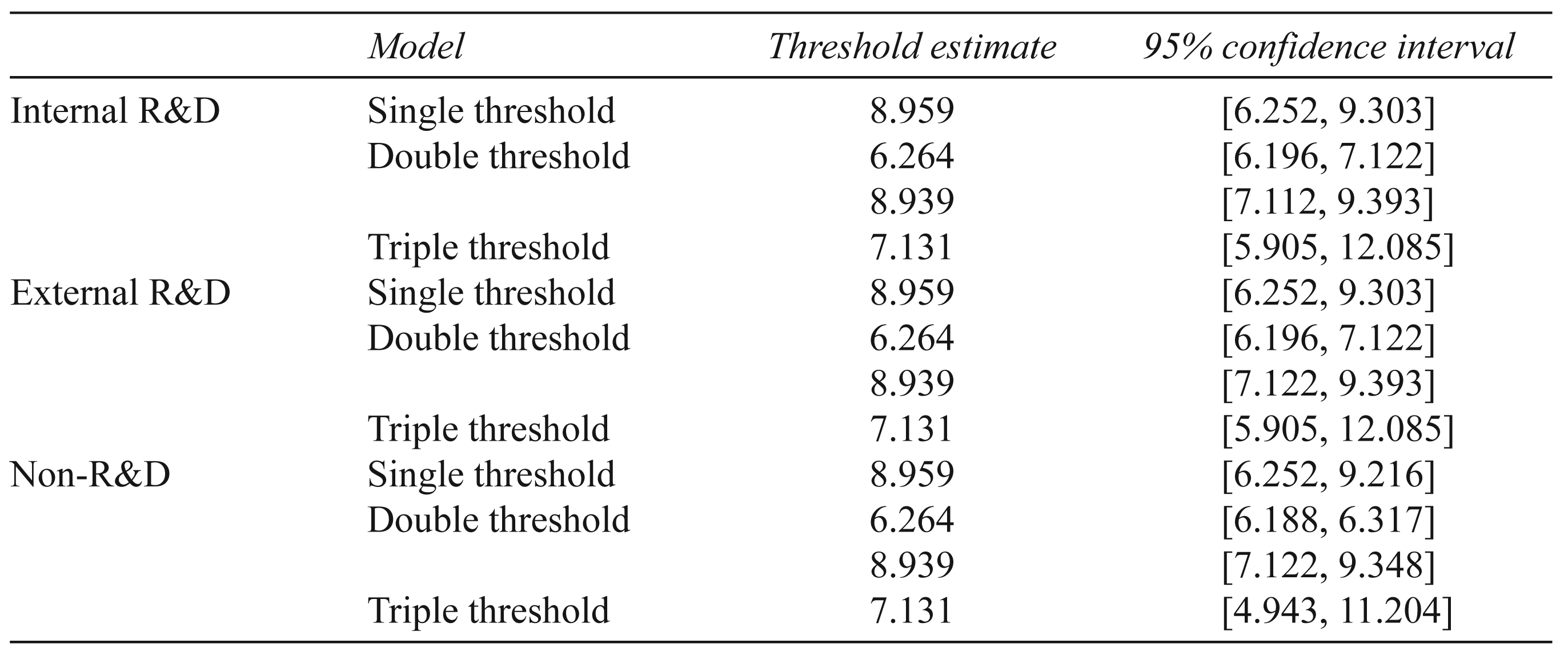
Finally, the lag variable is significant at the 1 per cent level, which indicates that the dynamic panel threshold model constructed in this article is reasonable. All of the Sargan tests and AR (1), AR (2) tests are adopted and do not reject the original hypothesis of instrumental variables. Thus, the models in Table 4 are appropriate, and the use of the first-order difference GMM is also reasonable.
Discussion
In general, we find that IRD and NRD have a significant positive effect on innovation performance, while ERD has some negative impact. Unlike previous studies, we find that as the level of KLA increases, the mechanism driving the three innovation paths offers interesting results.
The role of IRD on innovation performance is constrained by KLA. A lower level of KLA does not provide good conditions for IRD to give full play to the promotion effect, but a higher level of KLA will also inhibit the positive effect of IRD on innovation performance. This problem reflects the existence of a ‘critical size’ in KLA. The greater the KLA is, the more conducive it is to IRD and to enhancing innovation performance; however, once it passes the critical threshold, this promotion effect decreases. Considering the ‘two sides’ of R&D, one side is the endogenous support that KLA provides IRD. Industrial KLA is a founding and necessary condition of the innovation process, including R&D, organisation, design and manufacturing, sales and other aspects of innovation. Industrial knowledge helps IRD identify the most worthwhile market issues and then optimise innovation performance (Cassidy, Görg, & Strobl, 2005). Meanwhile, knowledge stock has absolutely independent property rights and can be applied in IRD at a lower cost, thereby promoting the commercialisation of IRD and innovation output. The other side is that IRD investment conforms to the law of diminishing marginal returns, and thus the relationship between costs and benefits must be considered. For China, IRD inputs are seeing a high growth rate and are among the highest worldwide, so it is clear that it is not a case of the more the better. This relationship has been confirmed in industrialised countries such as Sweden, Japan and the USA (Braunerhjelm et al., 2010; Dosi et al., 2006). That is, increasing R&D investment has not translated into output growth, especially in terms of the high-tech industry’s internal innovation activities. Moreover, in the process of R&D investment, there may be a failure of the national innovation system. China’s innovation system is still at the construction and development stage, and there is a large loss in efficiency during the conversion from IRD to output. At present, most of the innovation activities in developing countries still emphasise traditional IRD investment. However, these findings indicate that most regions of China should maintain IRD investment within a reasonable range and strive to ensure that it has room to increase.
Results of the Model Parameter Estimation
Normally, with the improvement of KLA, appropriate ERD is necessary. ERD is an external technological cooperation activity that breaks through the system boundary of the industry, and a perfect cooperation scheme. When the industry has accumulated a higher knowledge base, it will help external sourcing identify the most worthwhile market issues and then optimise innovation performance, making up for the diminishing marginal returns of IRD investment[58]. However, when KLA higher than ‘critical size’, we found that this is clearly not suitable for developing countries; there is a large ‘gap’. This finding demonstrates that there may be a substitutional relationship between IRD and ERD under the influence of KLA in China. When most regions accumulate more knowledge, IRD becomes more efficient, and the region can choose more IRD to replace ERD. At a certain degree of KLA, with an increase of ERD investment, R&D begins to see diminishing marginal returns; at this point, internal and ERD still essentially hold a simple substitutional relationship.
Finally, considering the other major innovation gap between most regions of China and the developed countries at present, KLA is not sufficient to create a national innovation system. Facing the trend in open innovation, NRD within a reasonable range of KLA can provide effective innovation factors and strategies, which in turn increase industry’s knowledge stock and reduce the costs and risk of IRD in China.
As shown in Table 5, the KLA of the high-tech industry in most areas of China is at a low threshold level. The majority of the samples for IRD and NRD are between 6.26 and 8.94, which provides an optimal and effective environment for China’s IRD. Most of the sample is less than 8.94 for ERD, which shows that current ERD investment is very limited, but there will be less negative mechanism induced by the threshold effect, only the lack of a favourable room for an increase.
Considering the characteristics of spatial variation (Figure 3), most provinces are at the low (KLA ≤ 6.26) and medium (6.26 < KLA ≤ 8.94) levels of KLA in 2005. After that, the area (6.26 < KLA ≤ 8.94) significantly increased. In 2014, there were a high number of high KLA areas (KLA > 8.94), but most were distributed in the developed eastern areas in China, such as Beijing, Tianjin, Shanghai and Guangdong. These eastern regions have formed a good internal mechanism in a regional innovation system and can fully exchange and communicate knowledge and information in the process of regional innovation development. In addition, the high level of industrial agglomeration produces a large number of inputs and outputs, accompanied by higher KLA and internal cooperation as well as a well-developed innovation environment, well-developed facilities and a plentiful talent pool (Jiao, Zhou, Gao, & Liu, 2016). In contrast, in the Western provinces, the lack of openness and dynamism as well as lagging funding and cooperation cause the continuing accumulation of innovation risks. In addition, the development model and direction encounter the bottleneck of path dependence.
Distribution of Samples in Different Threshold Intervals Each Year

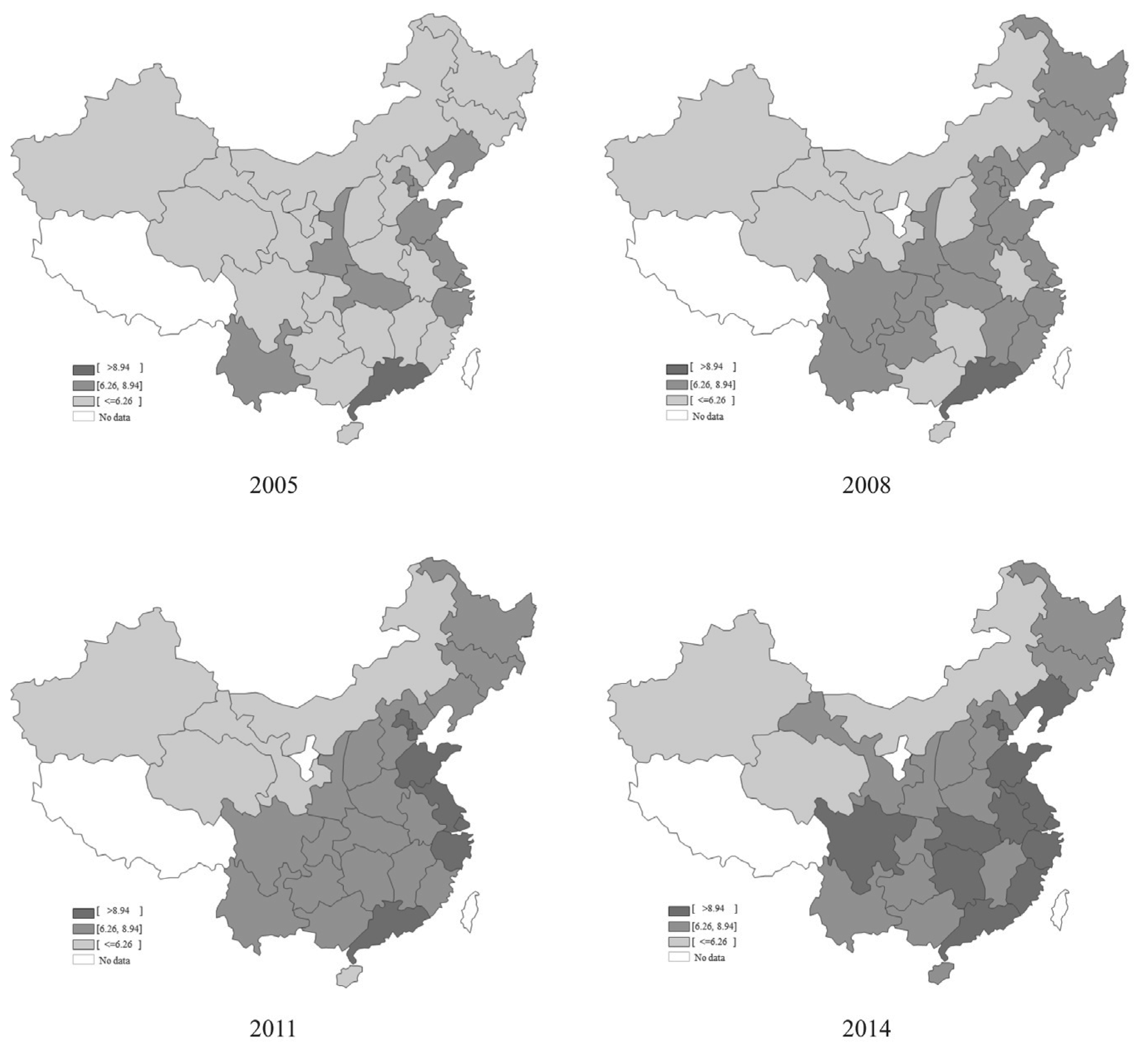
As most regions of China becomes increasingly attentive to KLA, it is interesting to note that the number of high KLA areas (KLA > 8.94) reached 40 per cent and above in the last 2 years; these areas will need to pay sufficient attention to the negative effects caused by the threshold effect.
Conclusion
We use an improved dynamic panel threshold model to empirically test the non-linear relationship between the three innovation paths and innovation performance under KLA. Taking the unique perspective of KLA in China, we provide interesting insights into the choice of innovation path for developing countries. Our findings differ from those of previous findings, which allows a better understanding of the innovation-driven effect and its differences.
Unlike previous studies, we find that the relationship between the innovation path and innovation performance is significantly influenced by KLA, that is, there is a threshold effect. As the level of KLA increases, there are interesting results for the driving mechanism of the three innovation paths. Specifically, greater KLA is more conducive to IRD and NRD, and further enhances innovation performance; however, once it breaks through the threshold, this type of promoting effect decreases. Furthermore, for ERD, when the threshold level of KLA is lower, the negative effect of ERD is larger. As the threshold level of KLA rises, the negative impact of NRD on innovation performance grows increasingly smaller, but when the threshold value is higher than 8.939, the effect grows increasingly negative.
The analytical results suggest that IRD and NRD are the dominant driving forces for high-tech industries in most regions of China and offer a favourable path for improving innovation performance. However, we must properly control the scale of ERD and reduce the cost of cooperation in regional R&D. Reaching these goals requires the establishment of a bridge between ‘gaps’ in regional KLA and ERD. It is necessary to provide more tax, financial and other preferential policies to promote technical cooperation between different regions and improve the innovation environment for the high-tech industry innovation system using government guidance mechanisms, such as increasing technical communication channels and enhancing the degree of cooperation between industry, academia and research among regions.
Because KLA is not directly related to performance, the industry often ignores KLA activities or engages in excessive accumulation. In China, it is necessary to consider the threshold effect of KLA at different stages and regions when selecting an innovative path. Areas that currently possess an abundant knowledge stock, such as Shanghai and Beijing, can strengthen IRD. However, areas with a low level of KLA require more encouragement to develop NRD innovation and to maximise the effect of open innovation to optimise the diversified innovation path.
Finally, we should be aware of the adverse effects of excessive KLA and clearly understand and evaluate the trend of KLA and transformation in most regions of China: First, these regions must control increasing KLA. Second, they must adjust by shifting to the appropriate innovation path.
This study thoroughly examines the threshold effect of KLA, yet it confronts some limitations. First, considering China’s actual situation and official reports and statistics, it is assumed that there are three innovation paths. There may also be more subdivision within these innovation paths and relationships between them. Second, the influence of the innovation path on innovation performance may have other threshold effects beyond KLA in the complex innovation system. Finally, considering the cross-sectional dependence, there might be some provinces within high-tech industry, where the innovation performance or innovation path of one province might be dependent or influenced by other province’s innovation performance. Due to the limitations of the methods and data, we do not offer further analysis, which provides the direction and space for further research.
Footnotes
Acknowledgements
Acknowledgements: We gratefully acknowledge the support by grants from the National Soft Science Foundation of China (2013GXS5B190) and the PhD Student Research and Innovation Fund of the Fundamental Research Funds for the Central Universities (HEUGIP201718).